
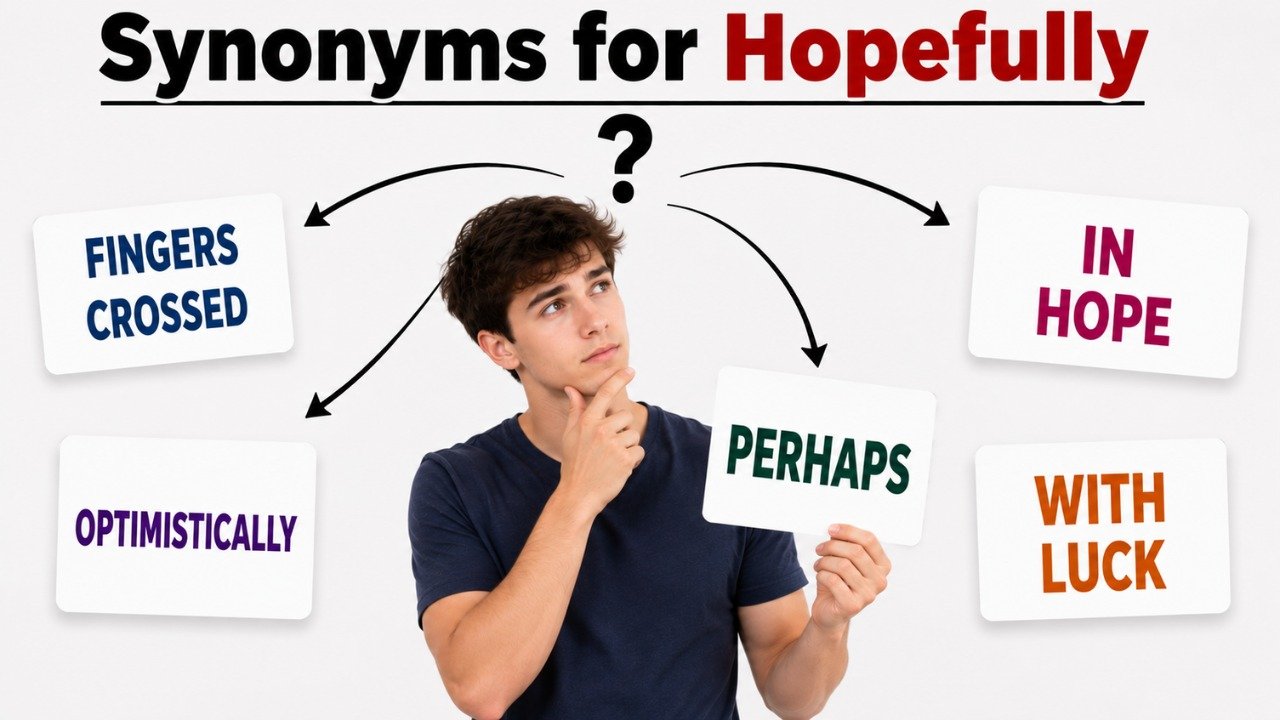
Quick Answer: Synonyms for hopefully include ideally, optimistically, expectantly, positively, confidently, with hope, with luck, if all goes well, it is hoped, and with optimism. Use ideally when describing the best possible result, with luck in casual conversation, and it is hoped in formal writing. Optimistically describes a positive attitude, while expectantly suggests that someone is waiting for a desired result.
Pronunciation and Word Details
Word: Hopefully.
Pronunciation: /ˈhoʊp.fəl.i/
Part of Speech: Adverb.
Meaning: In a hopeful manner or with the expectation that something desirable will happen.
US Pronunciation:
UK Pronunciation:
What Does “Hopefully” Mean?
Hopefully means with hope, optimism, or a desire for a positive result. It is an adverb that can describe how someone behaves or express a speaker’s wish about what may happen.
When hopefully describes a person’s manner, it means that the person acts with hope.
Example: She looked hopefully toward the entrance.
The word can also introduce a hoped for outcome.
Example: Hopefully, the weather will remain pleasant.
In the first sentence, hopefully describes the way she looked. In the second sentence, it expresses the speaker’s hope about the weather.
Hopefully is commonly used when discussing plans, results, recovery, opportunities, travel, work, relationships, and future events.
Meaning, Tone, and Context of “Hopefully”
Hopefully usually has a positive, neutral, and conversational tone. It communicates a wish without guaranteeing that the desired event will happen.
In everyday conversation, hopefully is a natural way to express what someone wants or expects.
Example: Hopefully, we will finish the project today.
In formal writing, phrases such as it is hoped, ideally, or if circumstances permit may sound more precise.
Example: It is hoped that the changes will improve the process.
Hopefully can also sound emotional when a person strongly desires a positive result.
Example: He waited hopefully for encouraging news.
The word is polite because it expresses a preference rather than a demand. However, it may sound uncertain when the situation requires a definite commitment.
When and How to Use “Hopefully”
For Expressing a Wish
Use hopefully when you want something desirable to happen but cannot guarantee the result.
Example: Hopefully, the repairs will be completed tomorrow.
For Positive Expectations
Use hopefully when evidence or circumstances give you a reason to expect a favorable outcome.
Example: Hopefully, the new schedule will reduce delays.
For an Optimistic Manner
Use hopefully to describe how someone looks, speaks, waits, or acts.
Example: The applicant smiled hopefully at the interviewer.
For Future Plans
Hopefully is useful when discussing arrangements that depend on time, weather, approval, or other conditions.
Example: Hopefully, we can visit our family next month.
For Casual Conversation
In ordinary speech, hopefully provides a simple and friendly way to express a desired outcome.
Example: Hopefully, everything goes smoothly.
For Formal Statements
In professional or academic writing, replace hopefully with it is hoped when a more formal tone is needed.
Example: It is hoped that the findings will support further research.
Best Synonyms for Hopefully
Ideally: In the best or most desirable situation.
Example: Ideally, the work will be completed before Friday.
Optimistically: With a positive belief about the future.
Example: She spoke optimistically about the company’s progress.
Expectantly: While waiting for something desired or anticipated.
Example: The children looked expectantly toward the door.
With Hope: While feeling or expressing a desire for a good result.
Example: He submitted the application with hope.
With Luck: Used to say that a positive result may happen if circumstances are favorable.
Example: With luck, we will arrive before sunset.
It Is Hoped: A formal way to express a desired result.
Example: It is hoped that the new policy will benefit everyone.
If All Goes Well: Provided that no serious problems occur.
Example: If all goes well, the building will open next month.
Positively: With confidence, approval, or an encouraging attitude.
Example: She responded positively to the proposed changes.
Confidently: With strong belief that something will succeed.
Example: He confidently predicted a favorable result.
Promisingly: In a way that suggests future success.
Example: The discussions began promisingly.
50 Synonyms for Hopefully with Short Meanings
- Ideally: In the most desirable situation.
- Optimistically: With positive expectations about the future.
- Expectantly: While waiting for something anticipated.
- Positively: With an encouraging or favorable attitude.
- Confidently: With strong belief in a successful result.
- Promisingly: In a way that suggests future success.
- Encouragingly: In a way that creates confidence or hope.
- Cheerfully: With happiness and positive feeling.
- Buoyantly: With a lively and hopeful attitude.
- Eagerly: With strong interest and anticipation.
- Wishfully: According to desire rather than certainty.
- Trustfully: With confidence in someone or something.
- Assuredly: With confidence or certainty.
- Sanguinely: With a strongly optimistic outlook.
- With Hope: While desiring a positive outcome.
- In Hope: With the expectation of something favorable.
- With Optimism: With a positive view of the future.
- With Confidence: With belief in likely success.
- With Trust: While relying on someone or something.
- With Faith: With belief that events will turn out well.
- With Luck: Provided that circumstances are favorable.
- With Any Luck: Used to express a desired possibility.
- If All Goes Well: Provided that no problems occur.
- It Is Hoped: A formal expression of a desired result.
- We Hope: A direct expression of shared hope.
- I Hope: A personal expression of desire.
- One Hopes: A neutral or slightly formal expression of hope.
- Let Us Hope: Used to encourage shared optimism.
- Perhaps: Used when something may possibly happen.
- Possibly: In a way that may happen or be true.
- Maybe: A casual word for a possible outcome.
- Conceivably: In a way that can reasonably be imagined.
- Probably: Used when something is expected to happen.
- Presumably: Based on a reasonable expectation.
- Likely: Expected to happen or be true.
- Ideally Speaking: Considering the best possible result.
- In the Best Case: Under the most favorable conditions.
- Fingers Crossed: A casual expression of hope for good luck.
- Looking Ahead: Thinking positively about the future.
- In Anticipation: While expecting something to happen.
- In Expectation: With a belief that something is coming.
- With Eager Anticipation: With excitement about a future event.
- With Positive Expectations: While expecting a favorable result.
- In Good Spirits: With a cheerful and confident attitude.
- On a Positive Note: From an encouraging point of view.
- With a Hopeful Outlook: With a positive view of future events.
- With Cheerful Expectation: With happiness about what may happen.
- In an Encouraging Way: In a manner that creates hope.
- In a Promising Way: In a manner suggesting future success.
- With Good Expectations: While anticipating a desirable result.
Read Also:
Synonyms for Imagine

Synonyms for Hopefully by Context
When Hopefully Expresses a Desired Result
Use these alternatives when expressing what you want to happen.
It Is Hoped: Suitable for formal reports and announcements.
Example: It is hoped that construction will finish on schedule.
We Hope: Suitable when a group shares the wish.
Example: We hope the event will be successful.
Ideally: Suitable when describing the best possible outcome.
Example: Ideally, everyone will arrive before the meeting begins.
With Luck: Suitable for casual situations involving uncertainty.
Example: With luck, the traffic will remain light.
When Hopefully Describes Optimism
Use these words when someone has a positive attitude toward the future.
Optimistically: Shows general confidence about future events.
Example: She spoke optimistically about her recovery.
Positively: Emphasizes an encouraging attitude.
Example: The team viewed the challenge positively.
Sanguinely: Expresses strong optimism, often in formal writing.
Example: He remained sanguinely confident about the outcome.
Buoyantly: Suggests cheerful and lively optimism.
Example: She talked buoyantly about her future plans.
When Hopefully Describes Expectation
These alternatives work when someone is waiting for a desired response or event.
Expectantly: Shows active waiting and anticipation.
Example: The audience looked expectantly toward the stage.
Eagerly: Emphasizes strong interest or excitement.
Example: She eagerly awaited the final decision.
In Anticipation: Describes preparation or waiting for something expected.
Example: They gathered in anticipation of the announcement.
With Eager Anticipation: Combines hope with excitement.
Example: He opened the letter with eager anticipation.
When Hopefully Depends on Conditions
These phrases are useful when success depends on circumstances.
If All Goes Well: Means that success is expected unless a problem occurs.
Example: If all goes well, the work will finish tomorrow.
With Any Luck: Suggests that good fortune may influence the result.
Example: With any luck, the package will arrive today.
In the Best Case: Refers to the most favorable possible result.
Example: In the best case, the repairs will take two days.
Possibly: Expresses possibility without strong optimism.
Example: We could possibly complete the task this evening.
Another Word for Hopefully
Ideally is often the best single replacement for hopefully when discussing a preferred result. However, the best alternative depends on the intended meaning. Use optimistically for a positive attitude, expectantly for hopeful waiting, and it is hoped for formal expression.
Original: Hopefully, the report will be ready tomorrow.
Better Option: Ideally, the report will be ready tomorrow.
Original: She waited hopefully for an answer.
Better Option: She waited expectantly for an answer.
Original: Hopefully, the program will improve access.
Better Option: It is hoped that the program will improve access.
Original: He spoke hopefully about the future.
Better Option: He spoke optimistically about the future.
When Not to Use “Hopefully”
Do not use hopefully when you need to promise a definite action. The word expresses desire or expectation, not certainty.
Weak: Hopefully, I will send the completed file today.
Better: I will send the completed file today.
Avoid hopefully when responsibility and commitment are required.
Weak: Hopefully, we will correct the mistake soon.
Better: We will correct the mistake by tomorrow.
Do not use hopefully repeatedly in the same paragraph because it can make the writing sound uncertain.
Weak: Hopefully, the plan will work, and hopefully, everyone will support it.
Better: We expect the plan to work and believe everyone will support it.
In very formal writing, hopefully may sound conversational.
Weak: Hopefully, the results will confirm the hypothesis.
Better: It is hoped that the results will confirm the hypothesis.
Do not use optimistically when you simply mean that something is possible. Optimism involves a positive attitude, while possibility does not.
Weak: Optimistically, the package may arrive tomorrow.
Better: Possibly, the package will arrive tomorrow.
Words Commonly Confused With Hopefully
Hopefully vs Ideally: Hopefully expresses a wish, while ideally describes the best possible condition or result.
Hopefully vs Optimistically: Hopefully can introduce a desired outcome, while optimistically describes a positive attitude or manner.
Hopefully vs Expectantly: Hopefully expresses hope in general, while expectantly suggests actively waiting for something.
Hopefully vs Probably: Hopefully describes what someone wants to happen, while probably describes what is likely to happen.
Hopefully vs Possibly: Hopefully includes desire, while possibly only indicates that something may happen.
Hopefully vs Wishfully: Hopefully may be based on reasonable expectation, while wishfully can suggest that desire is stronger than the available evidence.
Hopefully vs Confidently: Hopefully includes uncertainty, while confidently suggests stronger belief in success.
Hopefully vs Promisingly: Hopefully reflects a person’s desire or attitude, while promisingly describes a situation that shows signs of future success.
Which Synonym Should You Choose?
Choose ideally when describing the best possible result or arrangement.
Choose optimistically when describing a positive attitude toward the future.
Choose expectantly when someone is waiting for news, a person, or an event.
Choose it is hoped in formal reports, essays, notices, and professional statements.
Choose with luck or with any luck in casual conversation when success depends partly on chance.
Choose if all goes well when the desired outcome depends on avoiding problems.
Choose confidently when there is strong evidence or belief that success will occur.
Choose possibly when you want to mention a possibility without expressing hope.
Choose probably when available information makes an outcome likely.
Choose promisingly when an event or process has begun in an encouraging way.
Real Life Examples of “Hopefully” in Sentences
Original: Hopefully, the weather will improve this afternoon.
Better Option: With luck, the weather will improve this afternoon.
Original: She smiled hopefully at the doctor.
Better Option: She smiled expectantly at the doctor.
Original: Hopefully, the new system will reduce waiting times.
Better Option: It is hoped that the new system will reduce waiting times.
Original: He spoke hopefully about his job search.
Better Option: He spoke optimistically about his job search.
Original: Hopefully, we can complete the journey before dark.
Better Option: If all goes well, we can complete the journey before dark.
Original: The students waited hopefully for their results.
Better Option: The students waited with eager anticipation for their results.
Original: Hopefully, the meeting will end early.
Better Option: Ideally, the meeting will end early.
Original: She looked hopefully toward the road.
Better Option: She looked expectantly toward the road.
Original: Hopefully, the treatment will produce better results.
Better Option: We hope the treatment will produce better results.
Original: The project started hopefully.
Better Option: The project started promisingly.
Synonym Groups and Usage Differences
Hope and Desire Group
This group includes with hope, in hope, we hope, I hope, and it is hoped. These alternatives directly communicate a desire for a favorable result.
Example: It is hoped that the agreement will create lasting improvements.
Optimism Group
Optimistically, positively, sanguinely, and buoyantly describe a confident or cheerful view of the future.
Example: She spoke optimistically about the opportunities ahead.
Expectation Group
Expectantly, eagerly, in anticipation, and with eager anticipation describe waiting for an expected event or response.
Example: The family waited expectantly for the visitor to arrive.
Ideal Outcome Group
Ideally, ideally speaking, and in the best case describe the most desirable result rather than a personal feeling.
Example: Ideally, the entire process will take less than one week.
Luck and Conditions Group
With luck, with any luck, and if all goes well show that the result depends on favorable circumstances.
Example: With any luck, we will reach the station on time.
Possibility Group
Perhaps, possibly, maybe, and conceivably express uncertainty. Unlike hopefully, they do not necessarily communicate a desired result.
Example: Perhaps the missing document is still in the office.
Antonyms of Hopefully
The opposite of hopefully depends on whether the word describes an attitude, expectation, or manner.
Hopelessly: Without hope or expectation of success.
Pessimistically: With the belief that something negative will happen.
Despairingly: With a complete loss of hope.
Doubtfully: With uncertainty or lack of confidence.
Gloomily: With sadness and negative expectations.
Fearfully: With fear or anxiety about what may happen.
Discouragingly: In a way that reduces confidence or hope.
Unpromisingly: In a way that does not suggest future success.
Reluctantly: Without willingness or positive expectation.
Negatively: With an unfavorable attitude or judgment.
Comparison: Hopefully vs Related Words
Hopefully vs Ideally
Hopefully expresses a wish or positive expectation. Ideally describes the best possible situation.
Example With Hopefully: Hopefully, everyone will attend the event.
Example With Ideally: Ideally, everyone should arrive by nine.
Hopefully vs Optimistically
Hopefully can refer to a desired result or a hopeful manner. Optimistically mainly describes a positive attitude.
Example With Hopefully: Hopefully, the business will recover soon.
Example With Optimistically: The owner spoke optimistically about the recovery.
Hopefully vs Expectantly
Hopefully suggests hope, while expectantly emphasizes waiting for something that is expected.
Example With Hopefully: She looked hopefully at the manager.
Example With Expectantly: She looked expectantly at the manager, waiting for an answer.
Hopefully vs Probably
Hopefully expresses desire. Probably expresses likelihood based on evidence or judgment.
Example With Hopefully: Hopefully, the train will arrive soon.
Example With Probably: The train will probably arrive within ten minutes.
Hopefully vs Possibly
Hopefully communicates a preferred result, while possibly communicates only uncertainty.
Example With Hopefully: Hopefully, we can meet tomorrow.
Example With Possibly: We can possibly meet tomorrow.
Hopefully vs Wishfully
Hopefully can reflect reasonable optimism. Wishfully often suggests that a belief is based mainly on desire.
Example With Hopefully: He waited hopefully for a positive response.
Example With Wishfully: She assumed wishfully that every problem would disappear.
Common Phrases and Expressions With “Hopefully”
Hopefully Soon: Expresses a wish that something will happen in the near future.
Hopefully Tomorrow: Shows a desire for an event to occur the following day.
Hopefully Everything Goes Well: Expresses a wish for a successful outcome.
Hopefully It Works: Communicates a desire for something to function or succeed.
Hopefully We Can: Introduces a desired plan that is not yet certain.
Hopefully There Will Be: Expresses a wish that something will become available or occur.
Hopefully This Helps: Expresses a desire that information or assistance will be useful.
Hopefully Things Improve: Communicates a wish for a situation to become better.
Hopefully the Weather Holds: Expresses a wish that weather conditions remain suitable.
Hopefully Next Time: Expresses a desire for a better opportunity or result in the future.
Common Mistakes to Avoid
A common mistake is using hopefully when a firm promise is required. Saying hopefully may make a commitment sound uncertain. Use a direct future statement when you control the action.
Another mistake is treating every alternative as interchangeable. Ideally refers to the best situation, probably indicates likelihood, and optimistically describes attitude. Choose the word that matches your intended meaning.
Avoid placing hopefully in every sentence about the future. Repetition weakens the writing and makes the speaker sound unsure.
Do not confuse hopeful expectation with factual probability. Something can be hoped for without being likely.
Be careful with wishfully. It can suggest unrealistic thinking, so it may create a more critical tone than hopefully.
In formal writing, consider replacing hopefully with it is hoped, the aim is, or the expected result is when greater precision is needed.
Conclusion
Synonyms for hopefully help express wishes, optimism, expectation, and favorable possibilities with greater precision. Use ideally for the best possible result, optimistically for a positive attitude, expectantly for hopeful waiting, and it is hoped for formal writing. With luck and if all goes well suit uncertain plans, while probably and possibly focus on likelihood rather than desire. Choosing the right alternative makes your meaning clearer and prevents your writing from sounding repetitive, vague, or unnecessarily uncertain.
FAQs About Synonyms for Hopefully
What Is the Best Synonym for Hopefully?
Ideally is a strong general alternative when discussing a desired outcome. Optimistically is better when hopefully describes a positive attitude.
What Is a Formal Synonym for Hopefully?
It is hoped is the most suitable formal alternative. It works well in reports, essays, notices, and professional communication.
Can I Use Optimistically Instead of Hopefully?
Yes, when describing a positive attitude or manner. It may not fit when hopefully simply introduces a desired result.
Is Hopefully the Same as Probably?
No. Hopefully expresses what someone wants to happen, while probably expresses what is likely to happen.
What Is a Casual Alternative to Hopefully?
With luck, with any luck, and fingers crossed are natural casual alternatives.
What Can Replace Hopefully at the Beginning of a Sentence?
Depending on the meaning, you can use ideally, with luck, if all goes well, perhaps, or it is hoped that.
Does Hopefully Show Certainty?
No. Hopefully communicates desire or positive expectation, but it does not promise or guarantee that something will happen.
