
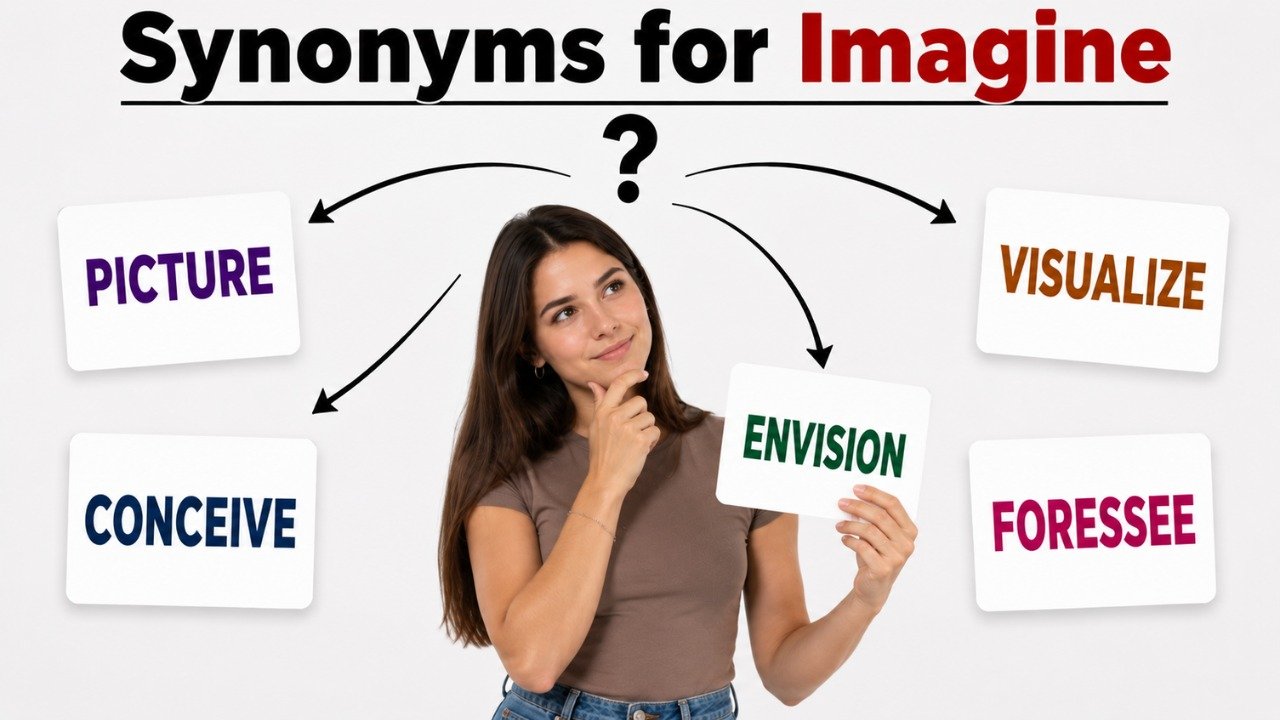
Quick Answer: The best synonyms for imagine include envision, visualize, picture, conceive, suppose, assume, envisage, dream, speculate, and anticipate. Use envision for a possible future, visualize for forming a clear mental image, and picture in casual speech. Conceive works well for ideas and possibilities, while suppose and assume express beliefs without complete proof. Dream suits hopes and ambitions, speculate fits uncertain explanations, and anticipate is useful when thinking about future events.
Pronunciation and Word Details
Word: Imagine.
Pronunciation: /ɪˈmædʒɪn/.
Part of Speech: Verb.
Meaning: To form a picture, idea, possibility, or belief in the mind.
US Pronunciation:
UK Pronunciation:
What Does “Imagine” Mean?
Imagine means to form a picture, idea, situation, or possibility in your mind.
It is a verb commonly used when someone mentally sees something that is not physically present. It can describe creative thinking, uncertain belief, future planning, personal hopes, or invented situations.
Mental Image: Imagine a quiet lake surrounded by tall trees.
Possibility: I cannot imagine the plan failing.
Belief: She imagined that someone was calling her name.
Creativity: The writer imagined an entirely new world.
Future Vision: Imagine what the town could look like in ten years.
Imagine can be followed by a noun, a clause, a question word, or a verb ending in ing.
With a Noun: Imagine the possibilities.
With a Clause: Imagine that you have already reached your goal.
With an Ing Form: Imagine living beside the sea.
The meaning changes slightly according to context. It may mean visualize, suppose, invent, believe, or consider.
Meaning, Tone, and Context of “Imagine”
Imagine usually has a neutral and conversational tone. It is common in everyday speech, creative writing, educational content, reflective discussions, and persuasive communication.
Conversational Use: Imagine sounds natural when asking someone to consider a situation.
Example: Imagine spending an entire day without electricity.
Creative Use: Writers and artists use imagine when developing fictional people, places, events, and ideas.
Example: She imagined a kingdom hidden beneath the ocean.
Emotional Use: Imagine can encourage empathy by asking someone to mentally experience another person’s situation.
Example: Imagine how frightened the child must have felt.
Persuasive Use: Speakers use imagine to help an audience picture a desirable result.
Example: Imagine a community where every child has access to education.
Academic Use: In formal writing, imagine may be replaced by suppose, consider, envision, conceptualize, or hypothesize.
Future Focused Use: Imagine can introduce hopes, predictions, ambitions, and possible outcomes.
Example: He imagined himself leading the organization one day.
The word may express confidence, uncertainty, creativity, or fantasy. The surrounding sentence determines its exact tone.
When and How to Use “Imagine”
For Mental Pictures: Use imagine when asking someone to create a picture in the mind.
Example: Imagine a bright garden filled with colorful flowers.
For Possible Situations: Use imagine to introduce a real or hypothetical possibility.
Example: Imagine what would happen if the bridge suddenly closed.
For Future Goals: Use imagine when thinking about a desired future.
Example: She imagined herself running a successful business.
For Creative Ideas: Use imagine when inventing characters, settings, stories, or solutions.
Example: The students imagined a city powered entirely by sunlight.
For Empathy: Use imagine when encouraging someone to understand another person’s feelings.
Example: Imagine how disappointed he felt after losing the opportunity.
For Uncertain Beliefs: Use imagine when something appears possible but has not been proven.
Example: I imagine they have already received the message.
For Surprising Thoughts: Use imagine when emphasizing that an idea is difficult, unusual, or impressive.
Example: Can you imagine living without modern transportation?
For Planning: Use imagine to explore possible results before making a decision.
Example: Imagine each outcome before choosing your final approach.
Best Synonyms for Imagine
Envision: To form a mental picture of a future possibility.
Example: She envisioned a peaceful and successful future.
Visualize: To create a clear image in the mind.
Example: Visualize yourself completing the task with confidence.
Picture: To see a person, object, or situation mentally.
Example: I can picture the cottage surrounded by wildflowers.
Conceive: To form or understand an idea in the mind.
Example: Few people could conceive such an ambitious solution.
Suppose: To consider something as possible or true for discussion.
Example: Suppose the train arrives earlier than expected.
Assume: To accept something as true without complete proof.
Example: We should not assume that everyone agrees with the proposal.
Envisage: To imagine a future situation or outcome.
Example: The planners envisaged a cleaner and safer city.
Dream: To imagine something desirable or unlikely.
Example: She dreamed of becoming a respected author.
Speculate: To form ideas about something without enough evidence.
Example: Experts continued to speculate about the cause of the failure.
Anticipate: To imagine or expect something that may happen in the future.
Example: The team anticipated several possible challenges.
50 Synonyms for Imagine with Short Meanings
- Envision: To form a mental image of a future possibility.
- Visualize: To see something clearly in the mind.
- Picture: To create a mental image of someone or something.
- Conceive: To form an idea, possibility, or plan mentally.
- Suppose: To consider something possible or true.
- Assume: To accept an idea without complete evidence.
- Presume: To believe something is likely based on available information.
- Think: To form an idea or opinion in the mind.
- Believe: To accept something as true or possible.
- Fancy: To imagine something unusual, pleasant, or unlikely.
- Envisage: To form a picture of a possible future situation.
- Dream: To imagine a desired experience or achievement.
- Fantasize: To imagine exciting or unlikely situations.
- Daydream: To enjoy pleasant thoughts while awake.
- Speculate: To consider possible explanations without firm evidence.
- Guess: To form an opinion without enough information.
- Surmise: To reach a possible conclusion from limited evidence.
- Conjecture: To form an uncertain opinion or explanation.
- Hypothesize: To suggest a possible explanation for examination.
- Theorize: To develop ideas that may explain something.
- Anticipate: To expect or mentally prepare for a future event.
- Expect: To believe that something will probably happen.
- Foresee: To imagine or predict a future event.
- Predict: To state what may happen in the future.
- Consider: To think carefully about an idea or possibility.
- Contemplate: To think deeply about something for a period.
- Ponder: To examine an idea carefully in the mind.
- Entertain: To consider an idea without necessarily accepting it.
- Conceptualize: To form a clear mental concept or structure.
- Ideate: To develop and explore new ideas.
- Invent: To create something new through imagination.
- Create: To bring a new idea, object, or situation into existence.
- Devise: To develop a plan, method, or solution.
- Formulate: To create an idea or plan carefully.
- Originate: To produce a new idea or concept.
- Design: To plan the form, purpose, or structure of something.
- Plan: To think about actions before carrying them out.
- Contrive: To create or arrange something through careful thought.
- Conjure: To bring a vivid image or idea into the mind.
- Project: To imagine a situation extending into the future.
- Reckon: To think or suppose that something is likely.
- Infer: To form an idea from available evidence.
- Picture in Your Mind: To mentally see a person, place, or event.
- Form an Image: To create a visual representation mentally.
- Form an Idea: To develop a thought or understanding.
- Make Up: To invent a story, explanation, or situation.
- Dream Up: To create an unusual or imaginative idea.
- Call to Mind: To bring an image, memory, or idea into thought.
- Think Of: To direct the mind toward an idea or possibility.
- Conceive Of: To understand or imagine that something is possible.
Read Also:
Synonyms for Ignore

Synonyms for Imagine by Context
When Imagine Means Forming a Mental Picture
Use these alternatives when describing a clear image created in the mind.
Visualize: To create a detailed mental image.
Example: Visualize the finished room before selecting the furniture.
Picture: To see someone or something mentally.
Example: I can picture him standing beside the old wooden gate.
Envision: To form a mental picture, often of the future.
Example: She envisioned a home filled with warmth and laughter.
Conjure: To create a strong or vivid mental image.
Example: The description conjured images of a peaceful countryside.
Form an Image: To mentally represent something that is not present.
Example: Form an image of the completed design before you begin.
When Imagine Means Considering a Possibility
These alternatives work when introducing a possible, hypothetical, or uncertain situation.
Suppose: To consider a situation for discussion.
Example: Suppose the meeting is delayed until tomorrow.
Consider: To think about a possibility carefully.
Example: Consider how the decision could affect future employees.
Entertain: To allow an idea to be considered.
Example: The manager refused to entertain the possibility of failure.
Conceive: To recognize that something could exist or happen.
Example: It is difficult to conceive how the mistake went unnoticed.
Think Of: To direct attention toward a possible idea.
Example: Think of what the team could accomplish with better resources.
When Imagine Means Believing Without Proof
These words are useful when someone thinks something is true but lacks complete evidence.
Assume: To accept something as true without confirmation.
Example: Do not assume that silence means agreement.
Presume: To believe something is probably true based on available facts.
Example: We presume the documents were delivered yesterday.
Suppose: To believe that something is probably the case.
Example: I suppose she has already left the office.
Guess: To form an opinion with limited information.
Example: I guess the event will finish before sunset.
Surmise: To reach a likely conclusion from incomplete evidence.
Example: The detective surmised that the window had been left open.
When Imagine Means Creating Something New
Use these synonyms when imagination leads to a new story, object, method, or solution.
Invent: To create something that did not previously exist.
Example: The engineer invented a simpler way to store energy.
Create: To produce something new through thought or skill.
Example: The writer created a memorable fictional character.
Devise: To develop a method, plan, or solution.
Example: The team devised a strategy for reducing waste.
Dream Up: To invent an imaginative or unusual idea.
Example: The children dreamed up a story about a flying library.
Make Up: To invent a story or explanation.
Example: He made up a tale about discovering hidden treasure.
When Imagine Means Thinking About the Future
These alternatives are suitable for goals, plans, predictions, and possible outcomes.
Envision: To imagine a desired or possible future.
Example: The director envisioned the organization becoming a national leader.
Envisage: To imagine how something may develop.
Example: The designers envisaged a building filled with natural light.
Anticipate: To expect and mentally prepare for something.
Example: We anticipate increased demand during the holiday period.
Foresee: To recognize that a future event may happen.
Example: Analysts foresee significant changes in the industry.
Project: To estimate or imagine future developments.
Example: The report projects steady growth over the next five years.
When Imagine Means Thinking Creatively
These words emphasize unrestricted, inventive, or playful thought.
Dream: To imagine a desirable achievement or experience.
Example: She dreamed of exploring distant countries.
Fantasize: To imagine exciting situations that may be unrealistic.
Example: He fantasized about living in a grand castle.
Daydream: To think pleasantly about imagined experiences.
Example: She daydreamed about spending the summer near the ocean.
Ideate: To generate and develop creative ideas.
Example: The team met to ideate new services for customers.
Conceptualize: To develop a clear mental framework for an idea.
Example: The architect conceptualized a space that combined beauty with function.
Another Word for Imagine
Envision is one of the best single replacements for imagine when discussing a future situation, possibility, or desired result. However, the best alternative depends on the sentence.
Use visualize for a clear mental picture, suppose for a hypothetical situation, assume for an unsupported belief, and invent for something creatively created.
Original: Imagine yourself achieving your main goal.
Better Option: Envision yourself achieving your main goal.
Original: Imagine the room after the renovation.
Better Option: Visualize the room after the renovation.
Original: Imagine that the information is incorrect.
Better Option: Suppose that the information is incorrect.
Original: The author imagined a creature with silver wings.
Better Option: The author invented a creature with silver wings.
When Not to Use “Imagine”
Do not use imagine repeatedly when a more precise verb can communicate whether someone is visualizing, assuming, inventing, or predicting.
Weak: Imagine the building, imagine its rooms, and imagine how people will use it.
Better: Visualize the building, picture its rooms, and consider how people will use it.
Avoid imagine when presenting a fact that can be observed or verified.
Weak: I imagine the report contains twenty pages.
Better: The report contains twenty pages.
Do not use imagine when assume is needed to describe an unsupported belief.
Weak: We imagined that every participant understood the instructions.
Better: We assumed that every participant understood the instructions.
Avoid imagine when predict or forecast gives a more accurate meaning in factual writing.
Weak: Researchers imagine that temperatures will rise next month.
Better: Researchers predict that temperatures will rise next month.
Do not use imagine when remember is the intended meaning. Remember refers to something previously experienced, while imagine creates or considers something mentally.
Weak: I imagine our first day at school.
Better: I remember our first day at school.
Avoid imagine for detailed professional planning when envision, conceptualize, project, or devise would sound more precise.
Weak: The architects imagined a new transportation center.
Better: The architects conceptualized a new transportation center.
Words Commonly Confused With Imagine
Imagine vs Envision: Imagine has a broad meaning and can involve pictures, possibilities, beliefs, or invented situations. Envision usually describes a clear picture of a possible future.
Imagine vs Visualize: Imagine may involve any idea or possibility. Visualize specifically emphasizes creating a clear visual image in the mind.
Imagine vs Suppose: Imagine can be creative or visual. Suppose introduces a possible situation, belief, or condition for consideration.
Imagine vs Assume: Imagine forms a mental idea. Assume accepts something as true without sufficient proof.
Imagine vs Dream: Imagine is neutral and may describe realistic or unrealistic ideas. Dream often refers to hopes, ambitions, or pleasant fantasies.
Imagine vs Invent: Imagine means forming something mentally. Invent means creating a new object, method, story, or explanation.
Imagine vs Remember: Imagine concerns something absent, possible, or invented. Remember brings a past experience or fact back into the mind.
Imagine vs Predict: Imagine considers what could happen. Predict states what someone believes is likely to happen.
Which Synonym Should You Choose?
Choose envision when describing a future goal, result, lifestyle, organization, or community.
Choose visualize when forming a clear mental picture of an object, place, action, or completed result.
Choose picture in casual speech when asking someone to see a situation mentally.
Choose conceive when discussing complex ideas, possibilities, systems, or original concepts.
Choose suppose when introducing a hypothetical situation or possibility.
Choose assume when someone accepts information without checking whether it is true.
Choose presume when a belief is based on probability or available evidence.
Choose envisage in formal writing when discussing a future development or intended outcome.
Choose dream when describing hopes, ambitions, wishes, or ideal situations.
Choose fantasize when the imagined situation is exciting but unlikely to happen.
Choose speculate when discussing uncertain causes, explanations, or outcomes.
Choose hypothesize in academic or scientific writing when proposing an explanation for examination.
Choose anticipate when expecting a future event and preparing for it.
Choose invent when imagination produces a new device, story, method, or explanation.
Choose conceptualize when developing a structured or detailed idea.
Choose devise when creating a practical plan, system, or solution.
Real Life Examples of “Imagine” in Sentences
Original: Imagine how beautiful the garden will look in spring.
Better Option: Visualize how beautiful the garden will look in spring.
Original: She imagined herself becoming a successful physician.
Better Option: She envisioned herself becoming a successful physician.
Original: Imagine that the first plan does not work.
Better Option: Suppose that the first plan does not work.
Original: We imagined that the store would be open.
Better Option: We assumed that the store would be open.
Original: The author imagined a mysterious island.
Better Option: The author created a mysterious island.
Original: I imagine the journey will take several hours.
Better Option: I expect the journey will take several hours.
Original: He imagined different reasons for the sudden delay.
Better Option: He speculated about different reasons for the sudden delay.
Original: The scientists imagined a possible explanation.
Better Option: The scientists hypothesized a possible explanation.
Original: The manager imagined several solutions to the problem.
Better Option: The manager devised several solutions to the problem.
Original: It is difficult to imagine such a major change.
Better Option: It is difficult to conceive of such a major change.
Synonym Groups and Usage Differences
Mental Image Group
Visualize, picture, envision, conjure, and form an image describe the creation of a picture in the mind.
Visualize emphasizes clarity and detail. Picture is common in everyday speech. Envision often relates to future situations, while conjure suggests a vivid or powerful image.
Example: The description conjured a vivid image of the ancient village.
Possibility Group
Suppose, consider, conceive, entertain, and think of introduce situations that may be possible.
Suppose is useful for hypothetical examples. Consider encourages careful thought. Conceive often expresses whether something can be understood or regarded as possible.
Example: Consider what might happen if demand continues to increase.
Belief Group
Assume, presume, believe, guess, reckon, and surmise describe ideas accepted with different levels of certainty.
Assume often lacks evidence. Presume usually involves some reasonable basis. Guess suggests limited information, while surmise sounds more formal.
Example: Investigators surmised that the fire had started in the kitchen.
Creative Thinking Group
Invent, create, devise, dream up, make up, ideate, and originate involve producing something new.
Invent often applies to objects or methods. Devise suits plans and solutions. Make up may describe fictional stories or false explanations.
Example: The students devised a practical method for collecting rainwater.
Future Thinking Group
Envision, envisage, anticipate, foresee, expect, predict, and project concern events or developments that have not happened yet.
Envision and envisage form possible future pictures. Anticipate combines expectation with preparation. Predict and project are more suitable for reports and forecasts.
Example: The organization projects continued growth during the coming year.
Reflective Thinking Group
Consider, contemplate, ponder, theorize, and conceptualize involve careful or extended thought.
Contemplate and ponder suggest deep reflection. Theorize develops explanations, while conceptualize organizes an idea into a clear mental structure.
Example: The committee contemplated several approaches before reaching a decision.
Fantasy Group
Dream, fantasize, daydream, and fancy describe pleasant, unusual, or unrealistic imagined experiences.
Dream may describe an achievable ambition. Fantasize often suggests an unlikely situation, while daydream describes relaxed thoughts that distract attention from the present.
Example: He daydreamed about owning a peaceful cottage near the mountains.
Antonyms of Imagine
The opposite of imagine depends on whether the word refers to mental pictures, uncertain beliefs, creative invention, or possible situations.
Know: To possess reliable information or understanding.
Observe: To notice something through direct attention.
See: To experience something through sight rather than mentally.
Witness: To see an event happen directly.
Experience: To personally encounter a real event or feeling.
Verify: To confirm that something is true or accurate.
Confirm: To establish that information is correct.
Prove: To demonstrate that something is true.
Remember: To bring a real past experience back into the mind.
Recall: To retrieve a fact, image, or event from memory.
Recognize: To identify someone or something previously known.
Discover: To find something that already exists.
Establish: To show something clearly through evidence.
Demonstrate: To provide visible or practical proof.
Realize: To become fully aware of a fact or situation.
Comparison Imagine vs Related Words
Imagine vs Envision
Imagine is a broad word for forming mental ideas, images, beliefs, or situations. Envision usually describes a clear picture of a possible future.
Example With Imagine: Imagine living in a quieter neighborhood.
Example With Envision: She envisioned herself leading the project successfully.
Imagine vs Visualize
Imagine may involve thoughts, sounds, emotions, beliefs, or possibilities. Visualize focuses mainly on creating a visual picture.
Example With Imagine: Imagine how proud your family will feel.
Example With Visualize: Visualize the shape and position of each object.
Imagine vs Suppose
Imagine often encourages creative or emotional thought. Suppose introduces a hypothetical condition or possible explanation.
Example With Imagine: Imagine a world without written language.
Example With Suppose: Suppose the information has been recorded incorrectly.
Imagine vs Assume
Imagine means to form an idea or image mentally. Assume means to accept something as true without confirmation.
Example With Imagine: Imagine what the city looked like centuries ago.
Example With Assume: Do not assume that every customer has the same needs.
Imagine vs Dream
Imagine is neutral and flexible. Dream commonly refers to hopes, ambitions, wishes, or pleasant fantasies.
Example With Imagine: Imagine a different solution to the problem.
Example With Dream: She dreamed of opening her own bookstore.
Imagine vs Invent
Imagine happens in the mind. Invent involves creating a new object, method, process, story, or explanation.
Example With Imagine: Imagine a machine that cleans the air.
Example With Invent: The researcher invented a machine that cleans the air.
Imagine vs Speculate
Imagine can describe any mental possibility. Speculate means considering uncertain causes or outcomes without enough evidence.
Example With Imagine: Imagine how the event could change the community.
Example With Speculate: Reporters speculated about why the meeting had been canceled.
Common Phrases and Expressions With Imagine
Can You Imagine: Used to express surprise or invite someone to consider a situation.
Just Imagine: Used to emphasize an exciting, surprising, or unusual possibility.
Imagine That: Used to introduce a hypothetical or surprising situation.
Imagine Yourself: Used to encourage someone to picture a personal experience or future role.
Imagine a World: Used to introduce a broad vision or ideal situation.
Imagine the Possibilities: Used to encourage creative or optimistic thinking.
Hard to Imagine: Used when something is difficult to believe or picture mentally.
Difficult to Imagine: Used when a situation seems unfamiliar, unlikely, or extreme.
Easy to Imagine: Used when a situation can be understood or pictured without difficulty.
Imagine What Could Happen: Used to encourage thought about possible future results.
Common Mistakes to Avoid
Using Imagine to Mean Assume
Imagine and assume are not always interchangeable. Assume means accepting something as true without proof.
Incorrect: We imagined that the payment had already been sent.
Better: We assumed that the payment had already been sent.
Using Imagine With the Wrong Verb Form
Imagine is commonly followed by a verb ending in ing, not an infinitive with to.
Incorrect: Imagine to live beside the sea.
Correct: Imagine living beside the sea.
Adding About Unnecessarily
Imagine usually takes a direct object, a clause, or an ing form. About is often unnecessary.
Unnatural: Imagine about your future career.
Natural: Imagine your future career.
Natural: Think about your future career.
Confusing Imagine With Remember
Imagine creates or considers an image. Remember recalls something that actually happened or was previously known.
Incorrect: I imagine meeting her five years ago.
Correct: I remember meeting her five years ago.
Using a Vague Synonym
Select a word that matches the specific meaning. Visualize is best for mental images, while suppose is better for hypothetical reasoning.
Vague: Imagine the figures in your head.
Clearer: Visualize the figures in your mind.
Repeating Imagine Too Often
Repeated use can make a paragraph sound monotonous.
Weak: Imagine the house. Imagine its rooms. Imagine the view.
Better: Picture the house, visualize its rooms, and envision the surrounding view.
Using Informal Alternatives in Formal Writing
Fancy, dream up, and make up may sound too casual in reports or academic work.
Casual: The researchers dreamed up a new explanation.
Formal: The researchers formulated a new hypothesis.
Treating Speculation as Fact
Words such as imagine, guess, speculate, and presume communicate uncertainty. Do not present their conclusions as proven facts.
Unclear: Experts imagine that the system failed because of heat.
Better: Experts speculate that excessive heat may have caused the system to fail.
Conclusion
The most useful synonyms for imagine include envision, visualize, picture, conceive, suppose, assume, dream, speculate, and anticipate. The best choice depends on the intended meaning. Use visualize for a clear mental image, envision for future goals, suppose for hypothetical situations, and assume for beliefs without proof. Dream fits hopes and ambitions, while invent and devise suit creative ideas or solutions. Learning these synonyms for imagine makes your writing more accurate, expressive, and appropriate for both formal and casual contexts.
FAQs About Synonyms for Imagine
What Is the Best Synonym for Imagine?
Envision is a strong general alternative when discussing future possibilities. Visualize, picture, suppose, and conceive may be better in other contexts.
Is Visualize the Same as Imagine?
Visualize specifically means forming a clear visual image. Imagine has a broader meaning that includes ideas, feelings, beliefs, sounds, and possibilities.
What Is a Formal Synonym for Imagine?
Envisage, conceive, conceptualize, hypothesize, and contemplate are useful formal alternatives, depending on the sentence.
Can Suppose Replace Imagine?
Suppose can replace imagine when introducing a hypothetical situation. It is less suitable when describing a vivid mental picture or creative invention.
What Is Another Word for Imagine the Future?
Envision, envisage, anticipate, foresee, project, and predict can describe thinking about future events or outcomes.
What Is the Difference Between Imagine and Assume?
Imagine means forming an idea or picture mentally. Assume means accepting something as true without enough evidence.
What Is the Opposite of Imagine?
Possible opposites include know, observe, verify, confirm, experience, remember, and prove. The best antonym depends on the context.
