
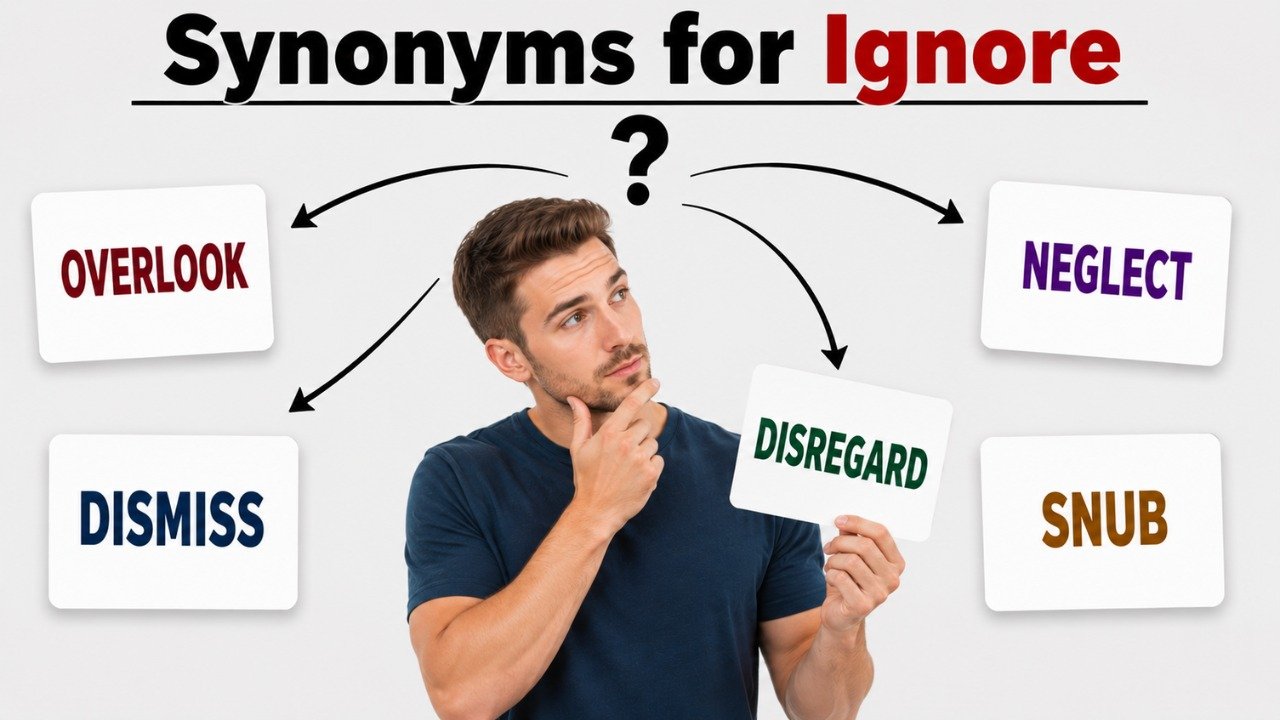
Quick Answer: Common synonyms for ignore include disregard, overlook, neglect, dismiss, avoid, shun, omit, bypass, snub, and tune out. Use disregard in formal writing when someone deliberately pays no attention. Choose overlook for something missed accidentally, neglect for duties or needs left unattended, dismiss for ideas treated as unimportant, and avoid for deliberate distance. Shun and snub describe social rejection, while omit and bypass work best when information, steps, or details are left out.
Pronunciation and Word Details
Word: Ignore.
Pronunciation: /ɪɡˈnɔːr/
Part of Speech: Verb.
Meaning: To give no attention to someone or something, whether deliberately or through carelessness.
US Pronunciation:
UK Pronunciation:
What Does “Ignore” Mean?
Ignore means to give no attention, recognition, or consideration to a person, fact, warning, need, or situation. It is a verb that can describe both deliberate and accidental inattention.
A person may ignore advice because they disagree with it. Someone may also ignore a small detail because they fail to notice it. In social situations, ignore can mean refusing to speak to or acknowledge another person.
The word also applies to duties, rules, evidence, feelings, and physical signs. For example, a person can ignore a deadline, ignore warning signs, ignore another person’s needs, or ignore an uncomfortable noise.
The exact meaning depends on the object receiving no attention. In some sentences, ignore suggests carelessness. In others, it suggests a deliberate decision to reject, avoid, or dismiss something.
Meaning, Tone, and Context of “Ignore”
Ignore usually has a neutral to negative tone. It often suggests that someone has failed or refused to give proper attention to something important.
In formal writing, ignore may describe the rejection of evidence, advice, regulations, risks, or responsibilities. More precise alternatives such as disregard, neglect, dismiss, or omit may communicate the intended meaning more clearly.
In casual conversation, ignore commonly refers to unanswered messages, unwanted noise, rude behavior, criticism, or distractions. For example, someone might say, “Ignore the noise and keep working.”
The word can also carry an emotional tone when it involves relationships. Saying that someone ignored a friend may suggest rejection, coldness, or disrespect. In such contexts, snub, shun, avoid, or give the cold shoulder may express the social meaning more accurately.
When and How to Use “Ignore”
For Warnings: Use ignore when someone does not respond to advice, danger signs, or cautions.
Example: He ignored the warning and continued along the unsafe path.
For Distractions: Use ignore when someone deliberately avoids giving attention to noise, criticism, or interruptions.
Example: She ignored the conversation and focused on her assignment.
For Responsibilities: Use ignore when a person fails to deal with an obligation, problem, or need.
Example: The owner ignored several necessary repairs.
For Social Rejection: Use ignore when someone refuses to acknowledge or communicate with another person.
Example: He ignored his colleague throughout the meeting.
For Evidence: Use ignore when facts, research, or important details receive no consideration.
Example: The argument ignores several important facts.
For Rules: Use ignore when a person deliberately acts without respecting instructions or requirements.
Example: Drivers should not ignore road safety rules.
For Physical Signs: Use ignore when someone pays no attention to pain, fatigue, or other bodily signals.
Example: She ignored the discomfort until it became more serious.
For Unwanted Comments: Use ignore when responding would give unnecessary attention to an unhelpful statement.
Example: It was better to ignore the rude comment and continue working.
Best Synonyms for Ignore
Disregard: To deliberately give no attention or importance to something.
Example: The manager disregarded the repeated safety concerns.
Overlook: To fail to notice or consider something, often accidentally.
Example: I overlooked a spelling mistake in the final paragraph.
Neglect: To fail to provide proper attention, care, or action.
Example: They neglected the garden during the winter.
Dismiss: To reject an idea, concern, or statement as unimportant.
Example: She dismissed the complaint without examining the evidence.
Avoid: To stay away from someone or something deliberately.
Example: He avoided discussing the difficult subject.
Shun: To deliberately keep away from a person or group.
Example: The community shunned him after the disagreement.
Omit: To leave out a word, detail, person, or step.
Example: The writer omitted an important date from the report.
Bypass: To go around a person, process, rule, or problem.
Example: The team bypassed the usual approval process.
Snub: To deliberately refuse to acknowledge someone as a sign of disrespect.
Example: She felt that the other guests had snubbed her.
Tune Out: To stop listening or paying attention.
Example: He tuned out the background conversation and continued reading.
50 Synonyms for Ignore with Short Meanings
- Disregard: To deliberately pay no attention.
- Overlook: To fail to notice or consider.
- Neglect: To leave without proper care or attention.
- Dismiss: To treat something as unimportant.
- Avoid: To deliberately stay away from.
- Shun: To keep away from someone intentionally.
- Snub: To refuse to acknowledge someone rudely.
- Omit: To leave something out.
- Bypass: To go around a rule, process, or obstacle.
- Exclude: To prevent someone or something from being included.
- Reject: To refuse to accept or consider.
- Brush Aside: To treat a concern as unimportant.
- Brush Off: To dismiss someone or something casually.
- Shrug Off: To show little concern about something.
- Wave Aside: To dismiss an idea without serious consideration.
- Write Off: To decide that something has little value or chance.
- Discount: To give less importance or credibility to something.
- Downplay: To make something appear less important.
- Minimize: To reduce the apparent importance of something.
- Skip: To leave out or pass over something.
- Pass Over: To avoid choosing, mentioning, or considering.
- Leave Out: To exclude a person, fact, or detail.
- Set Aside: To stop considering something temporarily.
- Gloss Over: To avoid discussing unpleasant details fully.
- Let Pass: To notice something but take no action.
- Let Slide: To allow a mistake or problem to go uncorrected.
- Pay No Attention To: To give no notice or thought.
- Take No Notice Of: To refuse or fail to respond.
- Pay No Heed To: To ignore advice or a warning.
- Tune Out: To stop listening or concentrating.
- Block Out: To prevent something from entering the mind.
- Screen Out: To remove unwanted information or distractions.
- Shut Out: To refuse to listen to or involve someone.
- Turn a Blind Eye To: To pretend not to notice wrongdoing.
- Close One’s Eyes To: To refuse to accept an unpleasant fact.
- Pretend Not to See: To deliberately act as though something is unnoticed.
- Fail to Notice: To miss something unintentionally.
- Refuse to Acknowledge: To deliberately withhold recognition.
- Look Past: To avoid focusing on a fault or detail.
- Sidestep: To avoid dealing directly with an issue.
- Dodge: To avoid a question, duty, or person.
- Evade: To escape attention, responsibility, or discussion.
- Rebuff: To reject someone or something firmly.
- Slight: To treat someone as unimportant or unworthy.
- Give the Cold Shoulder To: To treat someone in an unfriendly way.
- Freeze Out: To deliberately exclude someone from interaction.
- Ostracize: To exclude someone from a group or community.
- Boycott: To deliberately avoid a person, service, or activity as a protest.
- Scorn: To reject or treat with open disrespect.
- Spurn: To reject someone or something with contempt.
Read Also:
Synonyms for Hell

Synonyms for Ignore by Context
When Ignore Means Paying No Attention
Disregard, tune out, pay no attention to, take no notice of, and pay no heed to describe a lack of attention. Disregard is suitable for formal writing, while tune out sounds more conversational.
Example: She disregarded the distracting comments and completed her speech.
Example: He tuned out the noise while studying.
When Ignore Means Failing to Notice
Overlook, fail to notice, miss, and pass over suggest that something escaped a person’s attention. These words may describe an accidental mistake rather than a deliberate choice.
Example: The editor overlooked a minor punctuation error.
Example: I failed to notice the updated date on the notice.
When Ignore Means Neglecting a Duty
Neglect, disregard, leave unattended, and fail to address describe a responsibility, need, or problem that does not receive proper attention.
Example: The property owner neglected essential maintenance.
Example: The report failed to address the main financial concern.
When Ignore Means Rejecting an Idea
Dismiss, brush aside, wave aside, discount, and write off suggest that someone considers an idea, warning, or concern unworthy of attention.
Example: The committee dismissed the proposal before reviewing its details.
Example: Do not discount an idea simply because it sounds unusual.
When Ignore Means Avoiding Someone
Avoid, shun, snub, freeze out, and give the cold shoulder describe deliberate social distance. Snub suggests a noticeable act of disrespect, while shun describes continued avoidance.
Example: He avoided his former business partner at the event.
Example: The group unfairly shunned the new member.
When Ignore Means Leaving Something Out
Omit, exclude, skip, leave out, and bypass are appropriate when information, people, or steps are not included.
Example: Please do not omit the final paragraph from the document.
Example: The instructions skipped an important preparation step.
When Ignore Means Avoiding a Problem
Sidestep, dodge, evade, gloss over, and bypass describe attempts to avoid dealing directly with an issue.
Example: The speaker sidestepped the question about rising costs.
Example: The summary glossed over the most serious concern.
Another Word for Ignore
Disregard is often the best general replacement for ignore. It clearly communicates that a person has chosen not to consider a warning, fact, rule, or piece of advice. However, the best alternative depends on whether the action involves accidental inattention, neglect, rejection, avoidance, or omission.
Original: The company ignored the safety recommendations.
Better Option: The company disregarded the safety recommendations.
Original: I ignored a small error in the document.
Better Option: I overlooked a small error in the document.
Original: She ignored his concerns about the schedule.
Better Option: She dismissed his concerns about the schedule.
Original: The report ignored several important expenses.
Better Option: The report omitted several important expenses.
When Not to Use “Ignore”
Ignore can be too general when a more precise word would explain what actually happened. Avoid it when the reader needs to know whether the action was accidental, careless, dismissive, or deliberate.
Weak: The editor ignored an error.
Better: The editor overlooked an error.
Overlook makes it clear that the mistake was not necessarily deliberate.
Weak: The caregiver ignored the child’s basic needs.
Better: The caregiver neglected the child’s basic needs.
Neglect communicates a failure to provide necessary care.
Weak: The report ignored three important statistics.
Better: The report omitted three important statistics.
Omitted identifies the problem as missing information.
Weak: She ignored the invitation because she did not want to attend.
Better: She declined the invitation because she did not want to attend.
Declined is more accurate when someone formally refuses an invitation.
Weak: The speaker ignored the difficult question.
Better: The speaker evaded the difficult question.
Evaded shows that the avoidance was deliberate.
Weak: His classmates ignored him for several weeks.
Better: His classmates shunned him for several weeks.
Shunned more clearly expresses continued social rejection.
Words Commonly Confused With Ignore
Ignore vs Disregard: Ignore is a broad word for giving no attention. Disregard often suggests a conscious decision not to follow advice, rules, evidence, or warnings.
Ignore vs Overlook: Ignore may be deliberate, while overlook commonly describes an accidental failure to notice something.
Ignore vs Neglect: Ignore focuses on a lack of attention. Neglect suggests a failure to provide necessary care, maintenance, or action over time.
Ignore vs Avoid: Ignore means giving no attention after encountering someone or something. Avoid means staying away so that the encounter does not happen.
Ignore vs Dismiss: Ignore means not attending to something. Dismiss means actively deciding that it is unimportant, incorrect, or unworthy of consideration.
Ignore vs Omit: Ignore refers to attention or recognition. Omit means leaving information, words, people, or steps out of something.
Ignore vs Shun: Ignore may happen once or in a single situation. Shun describes deliberate and often continued social avoidance.
Ignore vs Snub: Ignore can be accidental or deliberate. Snub usually describes an intentional and insulting refusal to acknowledge someone.
Which Synonym Should You Choose?
Choose disregard when writing formally about rules, evidence, instructions, warnings, or advice.
Choose overlook when a person fails to notice a small detail, mistake, or fact accidentally.
Choose neglect when discussing responsibilities, maintenance, duties, health, care, or personal needs.
Choose dismiss when an idea, concern, complaint, or argument is treated as unimportant.
Choose avoid when someone deliberately stays away from a person, place, activity, or subject.
Choose shun when a person or group maintains deliberate social distance from someone.
Choose snub when describing a rude or deliberate refusal to acknowledge another person.
Choose omit when a writer, speaker, or document leaves out a fact, word, section, or detail.
Choose bypass when someone goes around a process, system, rule, or obstacle.
Choose tune out in casual speech when someone stops listening or concentrating.
Choose sidestep when a speaker avoids answering a difficult question directly.
Choose gloss over when unpleasant facts receive only brief or inadequate attention.
Real Life Examples of “Ignore” in Sentences
Original: She ignored the warning about the wet floor.
Better Option: She disregarded the warning about the wet floor.
Original: I ignored a small mistake in the calculation.
Better Option: I overlooked a small mistake in the calculation.
Original: He ignored his responsibilities for several weeks.
Better Option: He neglected his responsibilities for several weeks.
Original: The manager ignored the employee’s complaint.
Better Option: The manager dismissed the employee’s complaint.
Original: She ignored her former friend at the gathering.
Better Option: She snubbed her former friend at the gathering.
Original: The article ignored several important historical details.
Better Option: The article omitted several important historical details.
Original: The speaker ignored the question about the budget.
Better Option: The speaker sidestepped the question about the budget.
Original: He ignored the background conversation.
Better Option: He tuned out the background conversation.
Original: The group ignored the new student.
Better Option: The group excluded the new student.
Original: They ignored the normal approval process.
Better Option: They bypassed the normal approval process.
Synonym Groups and Usage Differences
Attention Group
Disregard, tune out, pay no attention to, and take no notice of describe a person who does not focus on something. Disregard is more formal, while tune out is common in everyday conversation.
Example: She disregarded the interruption and continued speaking.
Accidental Inattention Group
Overlook, miss, fail to notice, and pass over suggest that a detail escaped someone’s attention. These words do not always imply a deliberate choice.
Example: The reviewer overlooked a missing date.
Neglect Group
Neglect, leave unattended, and fail to address suggest that a need, responsibility, or problem did not receive proper care or action.
Example: The organization neglected several necessary repairs.
Dismissal Group
Dismiss, discount, brush aside, wave aside, and write off indicate that a person considers something unimportant or unlikely to succeed.
Example: The decision makers brushed aside the practical concerns.
Avoidance Group
Avoid, sidestep, dodge, evade, and bypass describe efforts to stay away from a person, duty, process, or difficult issue.
Example: He evaded every question about the missing funds.
Social Rejection Group
Shun, snub, slight, freeze out, and ostracize describe deliberate exclusion or unfriendly treatment.
Example: The other members unfairly froze her out of the discussion.
Omission Group
Omit, exclude, skip, leave out, and pass over describe information, people, or steps that are not included.
Example: The final summary omitted the most relevant evidence.
Antonyms of Ignore
The opposite of ignore depends on whether the intended meaning involves attention, recognition, care, inclusion, or response.
Notice: To become aware of someone or something.
Acknowledge: To recognize the existence, value, or importance of something.
Attend To: To give care, effort, or attention to a need.
Consider: To think carefully about something before making a decision.
Heed: To pay attention to advice or a warning.
Recognize: To identify or accept someone or something.
Observe: To watch or notice carefully.
Address: To deal directly with an issue or concern.
Include: To make someone or something part of a group or document.
Engage: To become actively involved with someone or something.
Respond: To answer or react to a message, action, or situation.
Listen To: To give attention to what someone is saying.
Comparison: Ignore vs Related Words
Ignore vs Disregard
Ignore is broad and can refer to people, sounds, facts, duties, or messages. Disregard usually suggests a deliberate refusal to follow or consider something.
Example With Ignore: He ignored the noise outside his window.
Example With Disregard: He disregarded the official safety instructions.
Ignore vs Overlook
Ignore may be intentional. Overlook usually means failing to notice something accidentally, although it can also mean choosing not to punish a minor fault.
Example With Ignore: She ignored the repeated request for help.
Example With Overlook: She overlooked a minor error in the form.
Ignore vs Neglect
Ignore describes a lack of attention. Neglect indicates a failure to provide the care, action, or maintenance that something requires.
Example With Ignore: He ignored the reminder on his desk.
Example With Neglect: He neglected the equipment until it stopped working.
Ignore vs Avoid
Ignore happens when someone does not respond or pay attention. Avoid involves staying away from a person, place, issue, or activity.
Example With Ignore: She ignored the caller’s questions.
Example With Avoid: She avoided the caller by leaving the room.
Ignore vs Dismiss
Ignore means giving no attention. Dismiss means actively rejecting something as unimportant, incorrect, or unworthy.
Example With Ignore: The reader ignored the final paragraph.
Example With Dismiss: The reader dismissed the argument as unrealistic.
Ignore vs Omit
Ignore relates to attention or recognition. Omit relates to leaving something out of speech, writing, data, or a process.
Example With Ignore: The author ignored the criticism.
Example With Omit: The author omitted the final chapter.
Common Phrases and Expressions With “Ignore”
Ignore a Warning: To pay no attention to a caution about possible danger.
Ignore the Signs: To overlook evidence that suggests a problem or change.
Ignore the Problem: To avoid dealing with an existing difficulty.
Ignore the Facts: To refuse to consider clear evidence.
Ignore Someone: To give a person no recognition or response.
Ignore a Message: To read or receive a message without replying.
Ignore the Noise: To avoid becoming distracted by unwanted sound.
Ignore the Rules: To act without following established requirements.
Ignore Advice: To refuse to follow someone’s recommendation.
Impossible to Ignore: So noticeable, important, or powerful that it demands attention.
Common Mistakes to Avoid
Using Ignore for Every Meaning: Ignore is broad, but it is not always precise. Use overlook for accidental inattention, neglect for failed care, and omit for missing information.
Confusing Ignore With Avoid: You ignore something that is already present, but you avoid something by staying away from it.
Suggesting Intention Without Evidence: Ignore can imply deliberate behavior. Use fail to notice or overlook when the action may have been accidental.
Using a Harsh Social Synonym: Shun, snub, and ostracize carry stronger emotional meanings than ignore. Use them only when deliberate rejection is clear.
Repeating Ignore Too Often: Repetition can make a paragraph sound flat. Replace some uses with disregard, dismiss, overlook, neglect, or avoid according to context.
Choosing Omit for Human Interaction: Omit normally applies to information, words, steps, or items. It does not usually replace ignore when describing a person who receives no response.
Using Tune Out in Formal Reports: Tune out is conversational. Disregard, fail to consider, or give insufficient attention may be more appropriate in formal writing.
Using Overlook for Deliberate Rejection: Overlook often suggests an accident. Choose disregard or dismiss when someone consciously refuses to consider something.
Conclusion
Understanding synonyms for ignore helps you describe inattention, neglect, avoidance, omission, and rejection more precisely. Disregard works well for deliberately rejected advice or rules, while overlook suits accidental mistakes. Choose neglect for unmet duties, dismiss for rejected concerns, avoid for deliberate distance, and omit for missing information. Social situations may require stronger words such as snub, shun, or ostracize. Selecting the right alternative makes each sentence clearer, more accurate, and better suited to its emotional or formal context.
FAQs About Synonyms for Ignore
What Is the Best Synonym for Ignore?
Disregard is the best general synonym when someone deliberately pays no attention to a warning, rule, fact, or piece of advice.
Is Overlook the Same as Ignore?
Not exactly. Overlook usually suggests an accidental failure to notice, while ignore can describe a deliberate choice.
What Is a Formal Word for Ignore?
Disregard is a strong formal alternative. Dismiss, omit, neglect, and fail to consider may also work depending on the context.
What Is a Synonym for Ignoring a Person?
Avoid, shun, snub, slight, freeze out, and give the cold shoulder are useful options. Each carries a different level of intention and negativity.
What Is a Synonym for Ignoring a Problem?
Neglect, sidestep, evade, disregard, gloss over, and turn a blind eye to can describe failing or refusing to address a problem.
What Is the Difference Between Ignore and Neglect?
Ignore means giving no attention. Neglect means failing to provide the care, maintenance, or action that someone or something needs.
Can Omit Replace Ignore?
Omit can replace ignore when information, words, names, or steps are left out. It does not usually describe refusing to acknowledge a person.
