
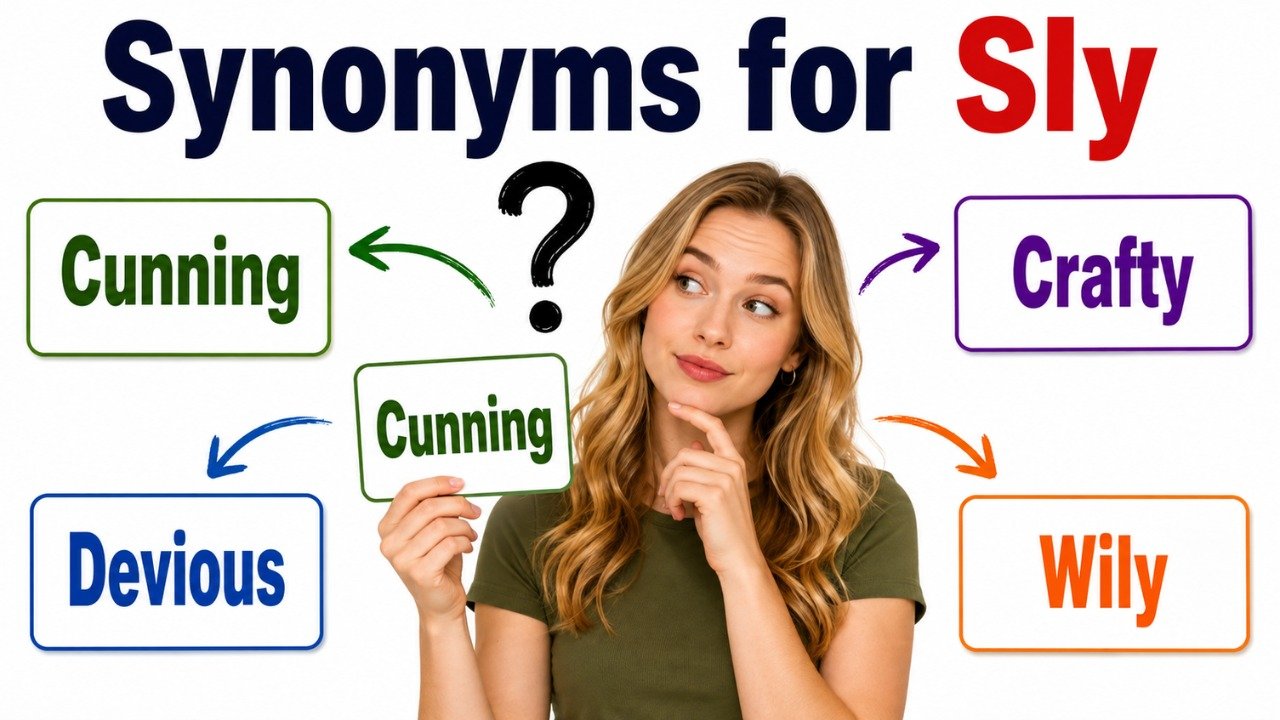
Quick Answer: Common synonyms for sly include cunning, crafty, wily, devious, sneaky, shrewd, artful, mischievous, knowing, and coy. Use cunning for clever but possibly dishonest behavior, crafty for skillful trickery, and devious for actions intended to mislead. Sneaky works well in casual speech, while shrewd is more suitable for intelligent business decisions. Mischievous describes playful behavior, and knowing fits a smile or expression that suggests secret understanding.
Pronunciation and Word Details
Word: Sly.
Pronunciation: /slaɪ/.
Part of Speech: Adjective.
Meaning: Clever at hiding intentions or achieving something through secretive, deceptive, or playful methods.
US Pronunciation:
UK Pronunciation:
What Does “Sly” Mean?
Sly means clever in a secretive, tricky, or sometimes dishonest way. It is an adjective used to describe a person, expression, comment, action, or plan.
A sly person may hide their true intentions while carefully working toward a goal. The word can carry a negative meaning when it suggests deception, manipulation, or dishonesty.
However, sly can also have a lighter and more playful meaning. A sly smile, for example, may suggest that someone knows a secret, understands a joke, or is planning harmless mischief.
For a Person: Sly describes someone who uses cleverness and secrecy to get what they want.
Example: The sly merchant convinced the customer to accept an unfair price.
For an Expression: Sly can describe a smile, glance, or look that suggests hidden knowledge.
Example: She gave her brother a sly smile before revealing the surprise.
For an Action: Sly describes something done quietly or indirectly.
Example: He made a sly attempt to change the subject.
For Humor: Sly can describe subtle humor that is not immediately obvious.
Example: The writer added a sly joke that careful readers would notice.
Meaning, Tone, and Context of “Sly”
Sly usually has a clever, secretive, or suspicious tone. Its exact meaning depends on the situation and the noun it describes.
Negative Tone: Sly can suggest dishonesty, manipulation, or an attempt to deceive someone.
Example: The sly employee changed the figures to hide the mistake.
Neutral Tone: In some contexts, sly simply means careful, subtle, or strategically clever.
Example: The negotiator made a sly move that strengthened her position.
Playful Tone: When describing a smile, joke, glance, or child, sly can sound amusing rather than dishonest.
Example: The child gave a sly grin before hiding behind the curtain.
Conversational Use: Sly is common in everyday descriptions of suspicious or playful behavior.
Example: That was a sly way to avoid answering the question.
Literary Use: Writers often use sly to create characters who are clever, mysterious, humorous, or difficult to trust.
Example: The sly stranger appeared helpful, but his motives remained unclear.
Professional Use: Sly may sound too judgmental in formal reports. Words such as strategic, shrewd, discreet, or calculated may be more precise.
Example: The manager used a strategic approach during the negotiation.
When and How to Use “Sly”
For Clever Trickery
Use sly when someone achieves a goal through clever but questionable methods.
Example: The sly competitor spread a rumor to weaken her opponent.
For Hidden Intentions
Use sly when a person does not openly reveal what they are planning.
Example: He gave a sly answer that avoided the real issue.
For Secret Actions
Use sly for behavior performed quietly so that other people will not notice.
Example: She took a sly glance at the answer sheet.
For Playful Mischief
Use sly when someone behaves in a clever but harmlessly troublesome way.
Example: The puppy made a sly attempt to steal the biscuit.
For Knowing Expressions
Use sly to describe a smile or look that suggests secret knowledge.
Example: Her sly smile showed that she already knew the result.
For Subtle Humor
Use sly when humor is indirect, quiet, or understood only by careful readers.
Example: His speech contained a sly reference to their earlier disagreement.
For Strategic Behavior
Use sly when a move is clever, indirect, and carefully timed.
Example: The player made a sly pass that surprised the opposing team.
For Suspicious Characters
Use sly when describing someone who appears untrustworthy or difficult to understand.
Example: The sly salesman avoided every direct question.
Best Synonyms for Sly
Cunning: Clever at achieving goals through secretive or deceptive methods.
Example: The cunning thief created a convincing distraction.
Crafty: Skilled at using tricks or clever plans.
Example: The crafty child found a way to avoid cleaning his room.
Wily: Experienced at deceiving or escaping from difficult situations.
Example: The wily politician avoided giving a clear response.
Devious: Using indirect and dishonest methods to achieve a goal.
Example: They uncovered a devious plan to control the committee.
Sneaky: Acting secretly because the action may be dishonest or disapproved of.
Example: He made a sneaky attempt to read the private note.
Shrewd: Showing strong judgment and practical intelligence.
Example: She made a shrewd investment at the right time.
Artful: Clever and skillful, especially when hiding an intention.
Example: His artful explanation made the mistake sound unimportant.
Mischievous: Playfully causing trouble or amusement.
Example: The mischievous child hid the remote control.
Knowing: Showing awareness of information that has not been openly discussed.
Example: They exchanged knowing smiles during the meeting.
Coy: Pretending to be shy or unwilling to reveal information.
Example: She remained coy when asked about her future plans.
50 Synonyms for Sly with Short Meanings
- Cunning: Clever in a secretive or deceptive way.
- Crafty: Skilled at using clever tricks.
- Wily: Experienced at deceiving or escaping.
- Devious: Using indirect and dishonest methods.
- Tricky: Difficult to trust because of clever behavior.
- Scheming: Secretly planning to gain an advantage.
- Calculating: Carefully planning actions for personal benefit.
- Manipulative: Controlling people through indirect methods.
- Deceitful: Intentionally causing someone to believe something false.
- Dishonest: Not truthful or fair.
- Sneaky: Acting secretly to avoid being noticed.
- Secretive: Unwilling to reveal thoughts or plans.
- Furtive: Attempting to avoid attention or discovery.
- Underhanded: Dishonest and performed secretly.
- Guileful: Skilled at deceiving people.
- Artful: Clever at hiding intentions.
- Shrewd: Showing practical intelligence and good judgment.
- Astute: Quick to understand situations accurately.
- Clever: Skilled at thinking and solving problems.
- Canny: Careful, clever, and difficult to deceive.
- Sharp: Mentally quick and observant.
- Subtle: Not obvious or direct.
- Strategic: Carefully planned to achieve a goal.
- Resourceful: Skilled at finding clever solutions.
- Ingenious: Showing original and intelligent thinking.
- Cagey: Unwilling to reveal information.
- Evasive: Avoiding a direct answer or commitment.
- Slippery: Difficult to trust, understand, or control.
- Untrustworthy: Not deserving confidence or belief.
- Treacherous: Likely to betray or deceive.
- Duplicitous: Deliberately dishonest in words or actions.
- Conniving: Secretly cooperating in a dishonest plan.
- Plotting: Secretly creating a plan against someone.
- Conspiratorial: Suggesting secret planning or shared knowledge.
- Mischievous: Playfully causing minor trouble.
- Impish: Playfully naughty or troublesome.
- Roguish: Playfully dishonest or charmingly troublesome.
- Playful: Amusing and not intended to cause harm.
- Knowing: Suggesting secret knowledge or understanding.
- Coy: Pretending to be shy or secretive.
- Teasing: Playfully provoking or suggesting something.
- Smirking: Showing private amusement through an expression.
- Arch: Playfully clever or knowingly mischievous.
- Foxlike: Clever, cautious, and difficult to deceive.
- Smooth: Clever and confident in dealing with people.
- Slick: Clever and persuasive, sometimes untrustworthy.
- Stealthy: Moving or acting without being noticed.
- Surreptitious: Done secretly to avoid attention.
- Clandestine: Kept hidden because it may be improper.
- Covert: Secret and intentionally concealed.
Read Also:
Synonyms for Hopefully
Synonyms for Sly by Context
When Sly Means Cunning or Deceptive
Cunning, crafty, wily, devious, calculating, guileful, and scheming describe someone who uses intelligence to mislead others or gain an advantage.
Cunning Example: The cunning criminal prepared several false explanations.
Crafty Example: The crafty seller made the damaged item appear new.
Wily Example: The wily leader escaped every difficult question.
Devious Example: She used a devious method to obtain confidential information.
Calculating Example: His calculating behavior made every friendship seem strategic.
When Sly Means Secretive
Sneaky, furtive, stealthy, covert, surreptitious, clandestine, and cagey describe actions or intentions that are deliberately hidden.
Sneaky Example: He took a sneaky look at the birthday presents.
Furtive Example: She cast a furtive glance toward the locked door.
Stealthy Example: The cat made a stealthy approach toward the bird.
Covert Example: They conducted a covert investigation.
Cagey Example: The director remained cagey about the upcoming changes.
When Sly Means Clever and Strategic
Shrewd, canny, astute, artful, strategic, clever, and resourceful focus more on intelligence than dishonesty.
Shrewd Example: The buyer made a shrewd offer at the perfect moment.
Canny Example: The canny investor recognized the risk immediately.
Astute Example: Her astute observation revealed the main problem.
Artful Example: He gave an artful response that pleased both sides.
Strategic Example: The team made a strategic decision to delay the launch.
When Sly Means Playfully Mischievous
Mischievous, impish, roguish, playful, arch, and teasing describe clever behavior that is amusing rather than harmful.
Mischievous Example: The child wore a mischievous grin after hiding the keys.
Impish Example: An impish smile appeared on her face.
Roguish Example: His roguish charm made the joke difficult to resist.
Arch Example: She made an arch comment about his sudden interest in cooking.
When Sly Describes a Knowing Expression
Knowing, coy, conspiratorial, teasing, and smirking can describe a look that suggests hidden knowledge or private amusement.
Knowing Example: They exchanged a knowing glance when the excuse was mentioned.
Coy Example: She gave a coy smile and refused to explain.
Conspiratorial Example: He lowered his voice and gave us a conspiratorial look.
Teasing Example: Her teasing smile suggested that a surprise was coming.
Another Word for Sly
Cunning is often the best single replacement for sly when someone uses intelligence in a secretive or deceptive way. However, the ideal alternative depends on whether the behavior is dishonest, strategic, playful, or merely private.
Use crafty for clever tricks, sneaky for secret behavior, shrewd for intelligent judgment, and mischievous for harmless trouble.
Original: The sly businessman noticed an opportunity in the contract.
Better Option: The shrewd businessman noticed an opportunity in the contract.
Original: The child gave a sly smile before opening the cupboard.
Better Option: The child gave a mischievous smile before opening the cupboard.
Original: He made a sly attempt to read the confidential file.
Better Option: He made a sneaky attempt to read the confidential file.
Original: The villain developed a sly plan to deceive the villagers.
Better Option: The villain developed a devious plan to deceive the villagers.
When Not to Use “Sly”
Do not use sly when you need a neutral or clearly positive description of intelligence. The word often suggests dishonesty, hidden motives, or questionable behavior.
In professional writing, words such as strategic, shrewd, astute, discreet, or resourceful may communicate the intended meaning more accurately.
Weak: The researcher used a sly method to organize the data.
Better: The researcher used an efficient method to organize the data.
Sly can also sound unnecessarily negative when someone is simply private or careful.
Weak: She was sly about her medical information.
Better: She was discreet about her medical information.
Avoid using sly when the behavior is openly dishonest rather than cleverly hidden.
Weak: He made a sly statement that was completely false.
Better: He made a deceitful statement that was completely false.
Do not use sly for ordinary intelligence when there is no secrecy involved.
Weak: The student gave a sly solution to the equation.
Better: The student gave an ingenious solution to the equation.
Sly may also be unclear when describing humor. Use subtle, dry, playful, or ironic when those meanings are more precise.
Weak: The article contained sly humor.
Better: The article contained subtle humor that rewarded careful reading.
Words Commonly Confused With Sly
Sly vs Cunning: Sly and cunning can both describe clever deception. Cunning places more emphasis on intelligence and planning, while sly often suggests secrecy, indirect behavior, or a revealing expression.
Sly vs Sneaky: Sly suggests cleverness combined with secrecy. Sneaky focuses more strongly on doing something hidden because it is wrong or disapproved of.
Sly vs Shrewd: Sly may imply dishonesty, but shrewd usually describes strong practical judgment. Shrewd is often more positive and appropriate in professional contexts.
Sly vs Crafty: Crafty emphasizes skill in creating clever tricks or plans. Sly can describe a broader range of people, actions, expressions, jokes, and comments.
Sly vs Devious: Devious is more strongly negative. It suggests dishonest or morally questionable methods, while sly may be playful or harmless in some situations.
Sly vs Mischievous: Sly can suggest hidden intentions, while mischievous usually describes playful trouble without serious harm.
Sly vs Secretive: Secretive means unwilling to share information. Sly adds the idea of cleverness, manipulation, or concealed purpose.
Sly vs Coy: Coy often describes someone who deliberately appears shy or unwilling to reveal information. Sly is broader and can describe deception, strategy, expressions, and humor.
Sly vs Subtle: Subtle means not obvious or direct. It does not automatically suggest dishonesty, while sly often carries a sense of concealed intention.
Which Synonym Should You Choose?
Choose cunning when someone intelligently uses deception to reach a goal.
Choose crafty when the person creates clever tricks or practical schemes.
Choose wily when someone is experienced at escaping questions, dangers, or traps.
Choose devious when the behavior is dishonest, indirect, and morally questionable.
Choose sneaky for secret actions in everyday conversation.
Choose shrewd for intelligent decisions in business, finance, planning, or negotiation.
Choose astute for accurate understanding, observation, or judgment.
Choose artful when someone skillfully hides an intention through words or behavior.
Choose mischievous for playful trouble caused without serious harm.
Choose knowing for a smile, glance, or expression that communicates secret understanding.
Choose coy when someone pretends to be shy or avoids revealing information.
Choose furtive for secret glances, movements, or actions that show nervousness.
Choose covert for organized activities that are deliberately concealed.
Choose subtle for an idea, joke, message, or effect that is indirect but not dishonest.
Real Life Examples of “Sly” in Sentences
Original: The sly customer changed the labels before asking for a refund.
Better Option: The deceitful customer changed the labels before asking for a refund.
Original: She gave me a sly smile after hearing the announcement.
Better Option: She gave me a knowing smile after hearing the announcement.
Original: The sly child placed the empty box back in the cupboard.
Better Option: The mischievous child placed the empty box back in the cupboard.
Original: He made a sly attempt to discover the password.
Better Option: He made a sneaky attempt to discover the password.
Original: The sly negotiator waited until the final minute to make an offer.
Better Option: The shrewd negotiator waited until the final minute to make an offer.
Original: The fox was too sly to enter the obvious trap.
Better Option: The fox was too wily to enter the obvious trap.
Original: Her sly reply avoided admitting responsibility.
Better Option: Her evasive reply avoided admitting responsibility.
Original: The story contains several sly jokes about office life.
Better Option: The story contains several subtle jokes about office life.
Original: They developed a sly plan to influence the vote.
Better Option: They developed a devious plan to influence the vote.
Original: He gave his friend a sly glance across the table.
Better Option: He gave his friend a conspiratorial glance across the table.
Synonym Groups and Usage Differences
Deception Group
Cunning, devious, deceitful, guileful, duplicitous, and manipulative describe behavior intended to mislead or control someone.
Cunning may show admiration for intelligence, but deceitful and duplicitous are clearly negative. Manipulative focuses on controlling another person’s feelings or decisions.
Example: The manipulative speaker used fear to influence the audience.
Secret Action Group
Sneaky, furtive, stealthy, surreptitious, covert, and clandestine describe actions performed without attracting attention.
Sneaky is informal, while surreptitious and clandestine are more formal. Stealthy often describes quiet physical movement.
Example: She made a furtive attempt to hide the document.
Clever Judgment Group
Shrewd, astute, canny, sharp, strategic, and resourceful describe intelligence and good judgment.
These words are usually more positive than sly. They work well in reports, essays, professional emails, and business discussions.
Example: His shrewd decision protected the company from unnecessary risk.
Playful Mischief Group
Mischievous, impish, roguish, playful, teasing, and arch describe behavior that is clever, amusing, and slightly troublesome.
These words are suitable when no serious deception or harm is involved.
Example: The child gave an impish grin before revealing the prank.
Hidden Knowledge Group
Knowing, coy, conspiratorial, smirking, and arch describe expressions that communicate private knowledge, amusement, or intention.
Knowing is usually neutral, while smirking may suggest pride or disrespect.
Example: Her knowing expression revealed that she understood the secret.
Planning Group
Scheming, calculating, plotting, conniving, and strategic all involve planning, but their tones differ.
Strategic is neutral or positive. Scheming, plotting, and conniving usually suggest selfish or dishonest motives.
Example: The conniving official secretly worked against his colleagues.
Antonyms of Sly
The opposite of sly depends on whether sly means deceptive, secretive, clever, or mischievous.
Honest: Truthful and free from deception.
Open: Willing to share thoughts, plans, or information.
Straightforward: Direct, clear, and easy to understand.
Sincere: Genuine in feelings and intentions.
Transparent: Open about actions, reasons, or decisions.
Direct: Communicating without secrecy or unnecessary delay.
Trustworthy: Deserving confidence and belief.
Guileless: Free from trickery or deception.
Innocent: Not responsible for dishonest behavior.
Naive: Lacking experience or awareness of deception.
Frank: Honest and direct in speech.
Candid: Open and truthful, even about difficult subjects.
Plainspoken: Expressing ideas clearly and directly.
Genuine: Real, sincere, and not intended to deceive.
Uncalculating: Acting naturally without planning for personal advantage.
Comparison of Sly and Related Words
Sly vs Cunning
Sly describes cleverness that is secretive, indirect, or visible through an expression. Cunning focuses more strongly on intelligence used to deceive or achieve a difficult goal.
Example With Sly: She gave a sly smile when the teacher mentioned the missing book.
Example With Cunning: She created a cunning plan to recover the missing book without attracting attention.
Sly vs Sneaky
Sly suggests clever secret behavior, while sneaky emphasizes that an action is hidden because it may be wrong.
Example With Sly: He made a sly comment that changed the direction of the discussion.
Example With Sneaky: He took a sneaky look at the confidential report.
Sly vs Shrewd
Sly often carries suspicion or disapproval. Shrewd usually praises practical intelligence and careful judgment.
Example With Sly: The sly seller hid the product’s defects.
Example With Shrewd: The shrewd buyer carefully examined the product before paying.
Sly vs Devious
Sly can be playful, neutral, or negative. Devious is more strongly negative and suggests dishonest methods.
Example With Sly: The boy gave a sly grin before revealing his harmless joke.
Example With Devious: The official created a devious plan to misuse public funds.
Sly vs Mischievous
Sly may suggest hidden motives or deception. Mischievous describes playful behavior that causes minor trouble.
Example With Sly: She made a sly effort to influence the decision.
Example With Mischievous: She wore a mischievous smile after moving his chair.
Sly vs Subtle
Sly suggests cleverness or concealed intention. Subtle simply means indirect, delicate, or difficult to notice.
Example With Sly: The speaker made a sly attempt to embarrass his opponent.
Example With Subtle: The speaker made a subtle reference to the earlier debate.
Common Phrases and Expressions With Sly
Sly Smile: A smile suggesting secret knowledge, amusement, or intention.
Sly Grin: A broad expression showing hidden amusement or planned mischief.
Sly Look: An expression that suggests a person knows something others do not.
Sly Glance: A quick look intended to communicate secretly.
Sly Remark: An indirect comment with a hidden meaning.
Sly Joke: A subtle joke that may not be immediately obvious.
Sly Trick: A clever action used to deceive or surprise someone.
Sly Move: A strategically clever and possibly secretive action.
Sly Fox: A person who is clever, cautious, and difficult to deceive.
On the Sly: Secretly or without other people knowing.
Common Mistakes to Avoid
Using Sly as a Completely Positive Word
Sly can imply dishonesty or hidden motives. Do not use it as a direct replacement for intelligent, talented, or wise unless secrecy is part of the meaning.
Incorrect: She is a sly scientist who produces excellent research.
Better: She is an ingenious scientist who produces excellent research.
Choosing a Synonym Without Considering Tone
Cunning, devious, and deceitful are not equally strong. Devious and deceitful are more openly negative, while shrewd and astute are often positive.
Incorrect: The deceitful manager made a profitable investment.
Better: The shrewd manager made a profitable investment.
Confusing Secretive With Sly
A secretive person may simply value privacy. A sly person usually combines secrecy with clever intention.
Incorrect: She is sly about her personal health information.
Better: She is private about her personal health information.
Repeating Sly Too Often
Using sly several times in one paragraph makes the description sound repetitive. Replace it with precise alternatives based on the intended meaning.
Repetitive: The sly man gave a sly smile before making a sly move.
Better: The cunning man gave a knowing smile before making a strategic move.
Using Sly for Open Dishonesty
Sly is most suitable when deception is clever or hidden. Use dishonest, deceitful, or fraudulent when the wrongdoing is direct and obvious.
Incorrect: He made a sly public statement that everyone knew was false.
Better: He made a dishonest public statement that everyone knew was false.
Confusing Sly With Mischievous
Mischievous usually describes harmless trouble. Sly may suggest more serious manipulation or deception.
Incorrect: The criminal gave a mischievous excuse to avoid arrest.
Better: The criminal gave a deceitful excuse to avoid arrest.
Using Sly Vaguely
Explain what makes the person, action, or expression sly. A specific description helps readers understand whether the behavior is clever, secretive, playful, or dishonest.
Vague: She behaved in a sly way.
Better: She avoided the question with a carefully worded and evasive response.
Conclusion
Understanding synonyms for sly helps you describe clever, secretive, deceptive, and playful behavior more accurately. Cunning, crafty, wily, and devious work well for calculated trickery, while sneaky, furtive, and covert emphasize secrecy. Shrewd, astute, and strategic are better for positive intelligence. Mischievous, impish, and knowing suit playful actions or expressions. Always consider the tone and context before choosing a replacement, because some alternatives suggest serious dishonesty while others communicate harmless cleverness or practical judgment.
FAQs About Synonyms for Sly
What Is the Best Synonym for Sly?
Cunning is the strongest general synonym for sly. Crafty, wily, sneaky, and devious are better in more specific contexts.
Is Sly a Positive or Negative Word?
Sly is usually negative because it can suggest deception or hidden motives. It may sound playful when describing a smile, joke, glance, or harmless prank.
What Is a Positive Synonym for Sly?
Shrewd, astute, canny, strategic, and resourceful are more positive alternatives when the intended meaning is intelligent or practical.
What Is a Casual Synonym for Sly?
Sneaky is a common casual synonym. It describes someone doing something secretly, usually because the action is wrong or disapproved of.
What Word Describes a Sly Smile?
Knowing, mischievous, coy, teasing, arch, and conspiratorial can all describe a sly smile, depending on the emotion and situation.
Are Sly and Cunning the Same?
They are similar but not identical. Cunning emphasizes intelligent deception, while sly may also describe secret actions, subtle humor, or playful expressions.
What Is the Opposite of Sly?
Honest, open, straightforward, sincere, transparent, guileless, and trustworthy are useful opposites of sly.
