
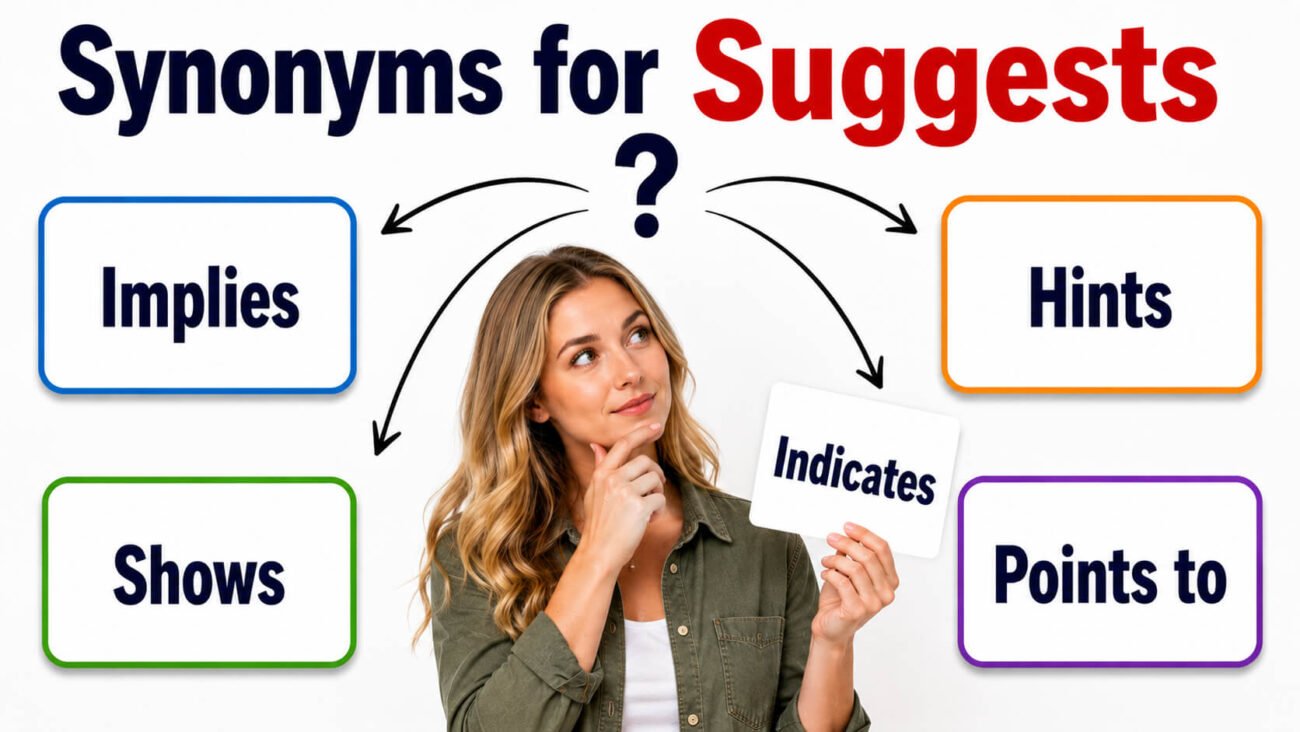
Quick Answer: The best synonyms for suggests include implies, indicates, recommends, proposes, advises, hints, signals, conveys, demonstrates, and evokes. Use recommends or advises when giving guidance. Choose proposes when presenting an idea or plan. Use implies or hints when a meaning is indirect. Indicates, signals, and demonstrates work well when evidence points toward a conclusion. Evokes is suitable when something brings a feeling, memory, or image to mind.
Pronunciation and Word Details
Word: Suggests.
Pronunciation: /səˈdʒests/
Part of Speech: Verb.
Meaning: Suggests means to present an idea, recommend an action, indicate a possibility, or bring something to mind.
US Pronunciation:
UK Pronunciation:
What Does “Suggests” Mean?
Suggests means proposes an idea, recommends an action, or causes someone to consider a particular possibility. It is the third person singular form of the verb suggest.
The word can be used when a person gives advice, when evidence points toward a conclusion, or when something creates a particular feeling or image.
Recommendation: The teacher suggests reading the chapter twice.
Proposal: Maria suggests holding the meeting on Friday.
Indirect Meaning: His expression suggests that he is worried.
Evidence: The research suggests that sleep improves concentration.
Association: The painting suggests peace and simplicity.
Meaning, Tone, and Context of “Suggests”
Suggests is usually a neutral and polite word. It can appear in everyday conversation, formal writing, academic work, professional communication, reports, essays, and research discussions.
When it means recommends, the word has a gentle and respectful tone. It presents an option without sounding like a command.
When it means indicates, it is common in academic and analytical writing. Writers use it to describe what evidence, facts, behavior, or results appear to show.
When it means implies, it communicates an indirect meaning rather than a clearly stated message.
When it means evokes, it describes something that brings a memory, emotion, image, or association to mind.
When and How to Use “Suggests”
For Giving a Recommendation
Use suggests when someone presents an action as useful, sensible, or beneficial.
Example: The doctor suggests getting more rest.
For Presenting an Idea
Use suggests when someone introduces a possible plan, solution, or topic for consideration.
Example: Liam suggests changing the project schedule.
For Describing Evidence
Use suggests when facts or results point toward a likely conclusion without proving it completely.
Example: The data suggests that customers prefer simpler designs.
For Expressing an Indirect Meaning
Use suggests when words, behavior, or circumstances communicate something without stating it directly.
Example: Her silence suggests that she disagrees.
For Creating an Association
Use suggests when an object, sound, image, or experience brings a particular thought or feeling to mind.
Example: The soft music suggests calmness and comfort.
For Offering Polite Advice
Use suggests instead of commands when you want to sound respectful and less forceful.
Example: The manager suggests reviewing the document before submission.
Best Synonyms for Suggests
Implies
Synonym: Implies means communicates an idea indirectly without stating it clearly.
Example: His response implies that the decision has already been made.
Indicates
Synonym: Indicates means points toward a fact, condition, or possible conclusion.
Example: The report indicates that sales are increasing.
Recommends
Synonym: Recommends means advises someone to choose or do something considered beneficial.
Example: The instructor recommends practicing for thirty minutes each day.
Proposes
Synonym: Proposes means presents an idea, plan, or action for consideration.
Example: The committee proposes a new method for reviewing applications.
Advises
Synonym: Advises means gives guidance about what someone should do.
Example: The guide advises visitors to arrive early.
Hints
Synonym: Hints means communicates something indirectly or gives a small clue.
Example: Her message hints that a major announcement is coming.
Signals
Synonym: Signals means shows that something exists or is likely to happen.
Example: The sudden temperature change signals the arrival of a storm.
Conveys
Synonym: Conveys means communicates an idea, feeling, or impression.
Example: The final paragraph conveys a sense of hope.
Demonstrates
Synonym: Demonstrates means provides clear evidence of a quality, fact, or result.
Example: Her performance demonstrates strong leadership skills.
Evokes
Synonym: Evokes means brings a feeling, memory, image, or association to mind.
Example: The familiar fragrance evokes memories of childhood.
50 Synonyms for Suggests with Short Meanings
- Implies: Communicates a meaning indirectly.
- Indicates: Points toward a fact or conclusion.
- Recommends: Presents something as a good choice.
- Proposes: Offers an idea or plan for consideration.
- Advises: Gives guidance about what should be done.
- Hints: Gives a small or indirect clue.
- Signals: Shows that something exists or may happen.
- Conveys: Communicates an idea, emotion, or impression.
- Demonstrates: Provides clear evidence of something.
- Evokes: Brings a memory, image, or feeling to mind.
- Shows: Makes a fact or condition noticeable.
- Reveals: Makes previously hidden information known.
- Expresses: Communicates a thought, feeling, or opinion.
- Communicates: Shares information or meaning.
- Signifies: Represents or indicates a particular meaning.
- Denotes: Refers to or stands for something specific.
- Alludes: Refers to something indirectly.
- Intimates: Communicates an idea subtly or indirectly.
- Insinuates: Suggests something indirectly, often negatively.
- Infers: Presents a conclusion drawn from evidence.
- Points: Directs attention toward a fact or possibility.
- Reflects: Shows or represents a quality or condition.
- Represents: Stands for or expresses an idea.
- Suggests indirectly: Communicates without making a direct statement.
- Offers: Presents an idea, choice, or possibility.
- Presents: Introduces something for consideration.
- Submits: Formally puts forward an idea or proposal.
- Advances: Introduces an argument, theory, or suggestion.
- Recommends strongly: Supports a choice as particularly suitable.
- Advocates: Publicly supports an idea or course of action.
- Encourages: Gives support or confidence to take action.
- Urges: Strongly advises someone to act.
- Prompts: Causes someone to think or take action.
- Counsels: Gives thoughtful or professional advice.
- Prescribes: Recommends a particular action or treatment.
- Directs: Tells or guides someone toward an action.
- Invites: Encourages consideration, discussion, or action.
- Nominates: Formally suggests someone for a role.
- Mentions: Refers briefly to an idea or possibility.
- Raises: Introduces a subject or question for discussion.
- Introduces: Brings forward a new idea or topic.
- Puts forward: Presents an idea for consideration.
- Calls for: Shows that a particular action is needed.
- Foreshadows: Suggests that a future event may occur.
- Predicts: States that something is likely to happen.
- Forecasts: Estimates a likely future event or result.
- Supports: Provides evidence for an idea or conclusion.
- Confirms: Provides strong evidence that something is true.
- Resembles: Creates an impression of being similar to something.
- Recalls: Brings a person, event, image, or feeling to mind.
Read Also:
Synonyms for Eventually

Synonyms for Suggests by Context
When Suggests Means Recommends
When suggests gives advice, suitable synonyms include recommends, advises, encourages, counsels, urges, prescribes, and advocates.
Example With Suggests: The trainer suggests taking a short break between exercises.
Example With Recommends: The trainer recommends taking a short break between exercises.
Example With Advises: The trainer advises participants to rest between exercises.
Recommends is slightly stronger than suggests. Advises often sounds more professional, while urges communicates greater importance or pressure.
When Suggests Means Proposes
When suggests introduces an idea or plan, use proposes, offers, presents, submits, advances, raises, or puts forward.
Example With Suggests: Daniel suggests creating a separate budget for advertising.
Example With Proposes: Daniel proposes creating a separate budget for advertising.
Example With Puts Forward: Daniel puts forward the idea of creating a separate advertising budget.
Proposes is useful in formal meetings, reports, and business writing. Offers sounds more flexible and conversational.
When Suggests Means Implies
When suggests communicates an indirect meaning, choose implies, hints, intimates, insinuates, alludes, or conveys.
Example With Suggests: His tone suggests that he is disappointed.
Example With Implies: His tone implies that he is disappointed.
Example With Hints: His tone hints at disappointment.
Implies is the most common replacement for an indirect meaning. Hints describes a weaker clue. Insinuates usually carries a suspicious, critical, or negative tone.
When Suggests Means Indicates
When evidence suggests a conclusion, useful alternatives include indicates, shows, signals, demonstrates, reveals, reflects, signifies, and supports.
Example With Suggests: The survey suggests that buyers value convenience.
Example With Indicates: The survey indicates that buyers value convenience.
Example With Demonstrates: The survey demonstrates the importance buyers place on convenience.
Indicates works well when evidence points toward a likely conclusion. Demonstrates sounds stronger and should be used when the evidence is clear and convincing.
When Suggests Means Evokes
When suggests means brings something to mind, use evokes, recalls, resembles, reflects, represents, or conveys.
Example With Suggests: The room suggests the elegance of an earlier period.
Example With Evokes: The room evokes the elegance of an earlier period.
Example With Recalls: The room recalls the elegance of an earlier period.
Evokes is best for emotions, memories, images, and sensory associations. Recalls usually connects something with a past experience or familiar image.
Another Word for Suggests
The best single replacement for suggests is often indicates, but the correct alternative depends on the intended meaning. Use recommends for advice, proposes for ideas, implies for indirect meaning, and evokes for memories or feelings.
Original: The evidence suggests that the treatment is effective.
Better Option: The evidence indicates that the treatment is effective.
Original: Ava suggests using a clearer heading.
Better Option: Ava recommends using a clearer heading.
Original: The director suggests a different approach.
Better Option: The director proposes a different approach.
Original: His expression suggests uncertainty.
Better Option: His expression implies uncertainty.
When Not to Use “Suggests”
Avoid suggests when you need a more precise word. It can become vague if the reader cannot determine whether it means advises, implies, proposes, or indicates.
When Evidence Is Conclusive
Do not use suggests when the evidence proves something clearly.
Weak: The test suggests that the substance contains iron.
Better: The test confirms that the substance contains iron.
When Giving a Direct Instruction
Suggests may sound too gentle when an action is required.
Weak: The safety officer suggests leaving the building immediately.
Better: The safety officer directs everyone to leave the building immediately.
When Making a Formal Proposal
Proposes may sound more specific in official writing.
Weak: The committee suggests a revised payment system.
Better: The committee proposes a revised payment system.
When Describing a Negative Implication
Insinuates may express the critical tone more accurately.
Weak: The speaker suggests that the employees acted dishonestly.
Better: The speaker insinuates that the employees acted dishonestly.
When the Word Is Repeated
Repeated use of suggests can make analytical writing sound monotonous.
Weak: The report suggests growth, suggests stability, and suggests future expansion.
Better: The report indicates growth, reflects stability, and predicts future expansion.
Words Commonly Confused With Suggests
Suggests vs Implies: Suggests has several meanings, including recommending and indicating. Implies specifically means communicating something indirectly.
Suggests vs Recommends: Suggests presents an option gently. Recommends gives stronger support to a particular choice.
Suggests vs Proposes: Suggests can introduce an informal idea. Proposes usually presents a more definite or structured plan.
Suggests vs Indicates: Suggests often expresses a possible conclusion. Indicates may sound more objective and evidence based.
Suggests vs Demonstrates: Suggests points toward a conclusion, while demonstrates provides clearer or stronger proof.
Suggests vs Advises: Suggests offers a possible action. Advises gives guidance based on knowledge or experience.
Suggests vs Insinuates: Suggests is usually neutral. Insinuates communicates something indirectly and often carries a negative tone.
Suggests vs Evokes: Suggests can bring an idea to mind, while evokes specifically awakens an emotion, memory, or mental image.
Which Synonym Should You Choose?
Choose recommends when presenting an option as useful, suitable, or beneficial.
Choose advises when giving professional, informed, or practical guidance.
Choose proposes when presenting a plan, policy, solution, or formal idea.
Choose implies when a person’s words or behavior communicate an indirect meaning.
Choose hints when the clue is subtle, incomplete, or uncertain.
Choose indicates when facts, data, symptoms, or evidence point toward a conclusion.
Choose demonstrates when the evidence clearly proves or displays something.
Choose signals when an action, event, or change warns that something may happen.
Choose conveys when writing, speech, art, or behavior communicates an idea or feeling.
Choose evokes when something brings a memory, emotion, atmosphere, or image to mind.
Choose urges when the advice is strong and immediate.
Choose foreshadows when an event gives an early sign of something that will happen later.
Real Life Examples of “Suggests” in Sentences
Original: The teacher suggests reviewing your notes before the test.
Better Option: The teacher recommends reviewing your notes before the test.
Original: The manager suggests moving the meeting to Monday.
Better Option: The manager proposes moving the meeting to Monday.
Original: Her quiet response suggests that she is uncomfortable.
Better Option: Her quiet response implies that she is uncomfortable.
Original: The results suggest that the new method saves time.
Better Option: The results indicate that the new method saves time.
Original: The dark sky suggests that rain is approaching.
Better Option: The dark sky signals that rain is approaching.
Original: The design suggests simplicity and balance.
Better Option: The design conveys simplicity and balance.
Original: The old photograph suggests memories of family gatherings.
Better Option: The old photograph evokes memories of family gatherings.
Original: The evidence suggests a connection between the two events.
Better Option: The evidence points to a connection between the two events.
Original: The introduction suggests what the final argument will be.
Better Option: The introduction foreshadows the final argument.
Original: The guide suggests avoiding the busiest travel hours.
Better Option: The guide advises travelers to avoid the busiest hours.
Synonym Groups and Usage Differences
Recommendation Group
Recommends, advises, counsels, encourages, urges, and prescribes relate to guidance or advice. Recommends is generally positive, advises sounds informed, and urges expresses greater importance.
Example: The specialist advises patients to follow a balanced routine.
Proposal Group
Proposes, offers, presents, submits, advances, and puts forward describe the introduction of an idea or plan.
Example: The team proposes a simpler approval process.
Indirect Meaning Group
Implies, hints, intimates, insinuates, and alludes communicate meanings that are not directly stated.
Example: The author hints that the character knows more than she admits.
Evidence Group
Indicates, demonstrates, shows, reveals, reflects, supports, and confirms describe what information or evidence communicates.
Example: The figures indicate a steady improvement in performance.
Communication Group
Conveys, expresses, communicates, signifies, denotes, and represents describe the transfer of meaning.
Example: The final scene conveys a feeling of relief.
Association Group
Evokes, recalls, resembles, and reflects describe ideas, emotions, or memories brought to mind.
Example: The warm lighting evokes a peaceful evening atmosphere.
Future Possibility Group
Signals, predicts, forecasts, and foreshadows relate to signs of a possible future event.
Example: The decline in demand signals a possible change in the market.
Antonyms of Suggests
The opposite of suggests changes according to its meaning. A word that is opposite to suggests as advice may not be opposite when suggests means indicates.
Commands: Gives a direct order instead of offering an option.
Demands: Requires an action rather than gently recommending it.
Discourages: Advises someone not to take an action.
Opposes: Expresses disagreement with an idea or proposal.
Rejects: Refuses to accept a suggestion or plan.
Denies: States that an implication or claim is untrue.
Conceals: Keeps information hidden instead of revealing it.
Disproves: Shows that a suggested conclusion is false.
Contradicts: Presents information that conflicts with a claim.
Forbids: Clearly prevents an action rather than merely advising against it.
Comparison: Suggests vs Related Words
Suggests vs Recommends
Suggests presents an idea or option without strong pressure. Recommends communicates greater confidence that the choice is beneficial.
Example With Suggests: The editor suggests shortening the opening paragraph.
Example With Recommends: The editor recommends shortening the opening paragraph.
Suggests vs Implies
Suggests can mean recommends, proposes, or indicates. Implies specifically communicates an unstated meaning.
Example With Suggests: Nina suggests changing the title.
Example With Implies: Nina’s reaction implies that she dislikes the title.
Suggests vs Indicates
Suggests often expresses possibility. Indicates is common when facts, signs, or evidence support a conclusion.
Example With Suggests: His behavior suggests that he is nervous.
Example With Indicates: His rapid breathing indicates that he is nervous.
Suggests vs Demonstrates
Suggests points toward a possible conclusion. Demonstrates provides stronger and clearer evidence.
Example With Suggests: The initial results suggest an improvement.
Example With Demonstrates: The final results demonstrate a significant improvement.
Suggests vs Proposes
Suggests can introduce a casual or informal idea. Proposes usually introduces a defined plan for consideration.
Example With Suggests: Amir suggests meeting after lunch.
Example With Proposes: Amir proposes a weekly meeting after lunch.
Suggests vs Advises
Suggests gently presents an option. Advises provides guidance based on knowledge, responsibility, or experience.
Example With Suggests: The assistant suggests checking the form again.
Example With Advises: The consultant advises the team to check every form carefully.
Suggests vs Evokes
Suggests may create a general impression. Evokes specifically brings a memory, emotion, or image to mind.
Example With Suggests: The decoration suggests a traditional style.
Example With Evokes: The decoration evokes memories of traditional celebrations.
Common Phrases and Expressions With Suggests
Research Suggests: Evidence from a study points toward a conclusion.
Evidence Suggests: Available facts support a possible explanation.
Data Suggests: Collected information indicates a particular result.
This Suggests That: A phrase used to introduce a conclusion or interpretation.
Strongly Suggests: Points clearly toward a likely conclusion.
Suggests a Solution: Presents a possible way to solve a problem.
Suggests an Alternative: Offers another available choice.
Suggests a Connection: Indicates that two things may be related.
Suggests a Possibility: Shows that an outcome may be possible.
Suggests otherwise: Indicates that the truth may be different from what was stated.
Common Mistakes to Avoid
Using Suggests With the Wrong Verb Form
Suggests is used with a singular third person subject in the present tense.
Correct: The report suggests a different explanation.
Incorrect: The reports suggests a different explanation.
Correct: The reports suggest a different explanation.
Treating Suggests as Proof
Suggests often communicates likelihood rather than certainty. Do not use it when evidence proves a fact conclusively.
Unclear: The verified result suggests that the answer is correct.
Better: The verified result confirms that the answer is correct.
Confusing Suggests and Implies
Suggests may refer to advice or proposals, but implies refers to indirect meaning.
Incorrect Choice: The teacher implies studying every evening.
Better: The teacher suggests studying every evening.
Choosing an Overly Strong Synonym
Demonstrates and proves are stronger than suggests. Use them only when evidence is clear and sufficient.
Too Strong: One small survey proves that every customer prefers the product.
Better: One small survey suggests that many customers prefer the product.
Repeating Suggests Too Often
Use relevant alternatives to improve clarity and sentence variety.
Repetitive: The study suggests progress and suggests that the plan is effective.
Improved: The study indicates progress and suggests that the plan is effective.
Using Suggests Without a Clear Meaning
Make sure readers understand whether suggests refers to advice, evidence, implication, or association.
Vague: The image suggests something important.
Clear: The image evokes a feeling of loss and suggests that the character is isolated.
Conclusion
Synonyms for suggests vary according to whether the word introduces advice, presents an idea, communicates an implication, describes evidence, or creates an association. Use recommends and advises for guidance, proposes for plans, implies and hints for indirect meanings, and indicates or demonstrates for evidence. Evokes is the best choice for memories and emotions. Selecting the right alternative makes sentences clearer, more precise, and better suited to formal writing, academic work, professional communication, and everyday conversation.
FAQs About Synonyms for Suggests
What is the best synonym for suggests?
The best general synonym is indicates. However, recommends is better for advice, proposes for plans, and implies for indirect meaning.
What is a formal synonym for suggests?
Proposes, recommends, indicates, demonstrates, and advises are suitable formal alternatives, depending on the sentence.
What is another word for suggests in an essay?
Use indicates, implies, demonstrates, reveals, conveys, or supports when discussing arguments, evidence, and interpretations.
What is another word for suggests in research?
Indicates is often the most appropriate choice. Demonstrates, reveals, supports, and signals may also work when supported by the evidence.
Is implies the same as suggests?
Not always. Implies specifically communicates something indirectly, while suggests can also mean recommends, proposes, indicates, or evokes.
Can recommends replace suggests?
Recommends can replace suggests when the sentence gives advice or identifies a beneficial choice. It does not work when suggests means implies or indicates.
What is a stronger word than suggests?
Demonstrates, confirms, proves, urges, and strongly recommends can be stronger alternatives. The correct choice depends on whether the sentence discusses evidence or advice.
