
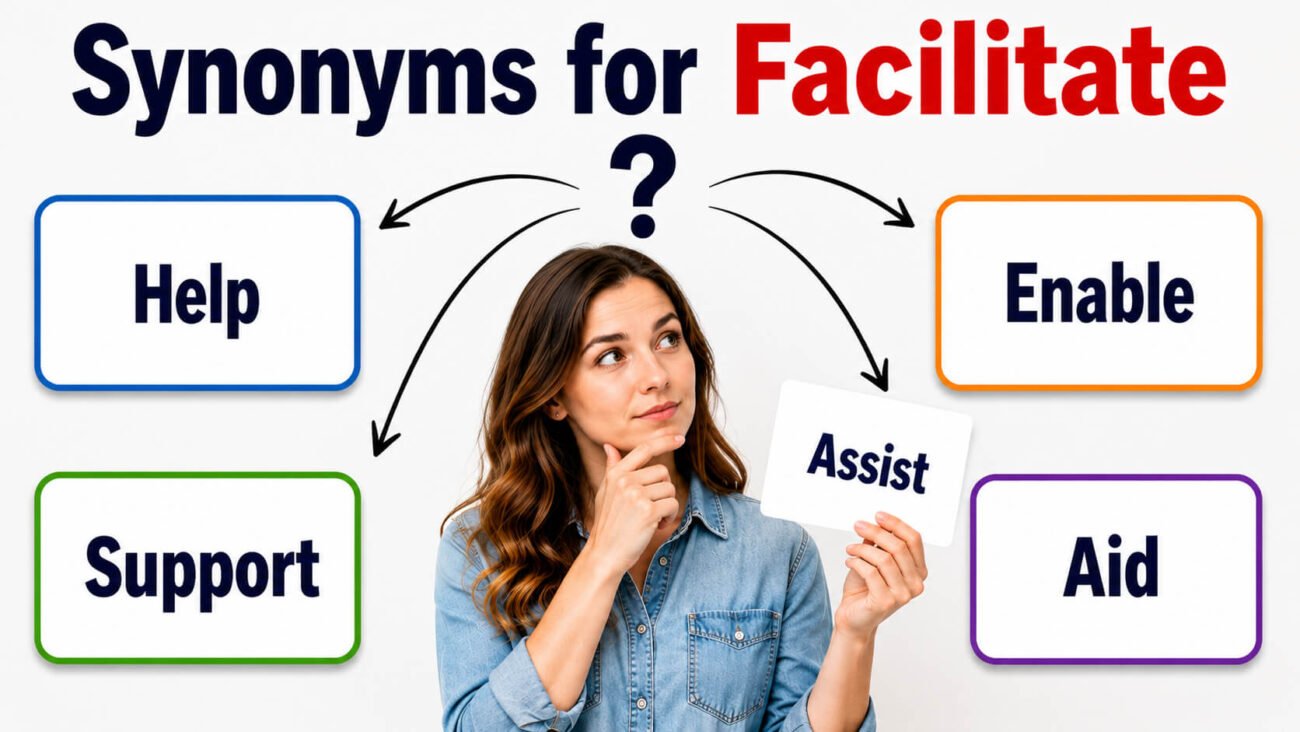
Quick Answer: Common synonyms for facilitate include enable, assist, help, ease, simplify, streamline, expedite, support, promote, and coordinate. Use enable when something makes an action possible, assist or help when a person provides support, simplify when a process becomes less complicated, and streamline when unnecessary steps are removed. Expedite is best for increasing speed, while promote and foster suit growth or development. Coordinate, guide, and moderate are useful when facilitating meetings, discussions, projects, or group activities.
Pronunciation and Word Details
Word: Facilitate
Pronunciation: /fəˈsɪləteɪt/
Part of Speech: Verb
Meaning: To make an action, process, activity, or result easier or more likely to happen.
US Pronunciation:
UK Pronunciation:
What Does “Facilitate” Mean?
Facilitate means to make an action, process, activity, or outcome easier to complete. It is a verb commonly used when someone removes difficulties, provides support, improves communication, or creates suitable conditions for progress.
The word does not always mean completing a task directly. Instead, it often describes helping other people complete the task more effectively.
Facilitate can appear in many contexts. A teacher may facilitate learning, a manager may facilitate communication, a system may facilitate access, and a coordinator may facilitate a meeting.
It can also describe arrangements, resources, tools, or conditions that make progress possible.
Meaning, Tone, and Context of “Facilitate”
Facilitate has a formal, neutral, and professional tone. It is frequently used in academic writing, business communication, education, project management, healthcare, research, training, and technical discussions.
In everyday conversation, facilitate can sound overly formal. Simpler words such as help, assist, ease, or make easier may sound more natural.
The word is often positive because it suggests support, cooperation, efficiency, and progress. However, facilitate does not necessarily mean cause or guarantee. Something that facilitates an outcome makes it easier or more likely, but it may not produce the result by itself.
In meeting contexts, facilitate can mean guiding a discussion, encouraging participation, managing time, and helping a group reach an objective. In process contexts, it means reducing obstacles or improving efficiency.
When and How to Use “Facilitate”
For Making Something Possible: Use facilitate when a tool, condition, person, or system allows an activity to happen more easily.
Example: The new software facilitates communication between remote employees.
For Simplifying a Process: Use facilitate when unnecessary difficulty is reduced.
Example: Clear instructions facilitate the application process.
For Supporting Learning: Use facilitate when someone creates conditions that help people understand or develop knowledge.
Example: Visual examples can facilitate learning in the classroom.
For Guiding a Discussion: Use facilitate when a person manages a meeting or conversation without controlling every decision.
Example: A trained moderator will facilitate the group discussion.
For Encouraging Cooperation: Use facilitate when actions help people work together effectively.
Example: Regular meetings facilitate collaboration between departments.
For Improving Access: Use facilitate when a system, service, or arrangement makes information or resources easier to reach.
Example: Digital records facilitate access to important information.
For Speeding Up Progress: Use facilitate when support or preparation helps something move forward more quickly.
Example: Early approval will facilitate the completion of the project.
For Managing Change: Use facilitate when someone helps people adapt to a new process, system, or situation.
Example: The training sessions will facilitate the transition to the new platform.
For Promoting Development: Use facilitate when conditions encourage growth, improvement, or progress.
Example: Open communication can facilitate professional development.
Best Synonyms for Facilitate
Enable: To give someone or something the ability, means, or opportunity to act.
Example: The online portal enables customers to manage their accounts easily.
Assist: To provide help or support with a task.
Example: The support team assisted employees with the new system.
Ease: To make a difficulty, burden, or process less severe.
Example: Clear guidance eased the transition into the new role.
Simplify: To make something easier to understand or complete.
Example: The revised form simplifies the registration process.
Streamline: To remove unnecessary steps and improve efficiency.
Example: The company streamlined its approval procedure.
Expedite: To make an action or process happen more quickly.
Example: Digital signatures can expedite document approval.
Support: To provide help, resources, or encouragement.
Example: Additional training supports employee development.
Promote: To encourage the growth, development, or acceptance of something.
Example: Team activities promote cooperation among employees.
Foster: To encourage and develop a positive condition over time.
Example: Honest communication fosters mutual trust.
Coordinate: To organize people, activities, or resources so they work together effectively.
Example: She coordinated the meeting between the two departments.
50 Synonyms for Facilitate with Short Meanings
- Enable: To make an action or result possible.
- Assist: To provide help with a task or activity.
- Help: To make something easier for another person.
- Aid: To give practical support or assistance.
- Ease: To reduce difficulty, effort, or discomfort.
- Simplify: To make something less complicated.
- Smooth: To remove difficulties from a process.
- Streamline: To improve efficiency by removing unnecessary steps.
- Expedite: To make a process happen more quickly.
- Accelerate: To increase the speed of progress.
- Advance: To help something move forward.
- Promote: To encourage development, acceptance, or growth.
- Encourage: To give support or confidence for an action.
- Foster: To help something develop gradually.
- Support: To provide resources, help, or encouragement.
- Further: To help something progress or develop.
- Improve: To make a situation or process better.
- Enhance: To increase the quality, value, or effectiveness of something.
- Coordinate: To organize activities so they work together.
- Organize: To arrange people, tasks, or resources systematically.
- Arrange: To prepare or plan something in advance.
- Manage: To control or direct a process effectively.
- Guide: To show people how to proceed.
- Direct: To lead or control an activity.
- Moderate: To guide a discussion and maintain balance.
- Mediate: To help people resolve disagreement.
- Conduct: To organize and lead an activity or meeting.
- Lead: To guide a person, group, or process.
- Oversee: To supervise an activity or project.
- Administer: To manage the operation of a system or program.
- Provide: To make a resource or service available.
- Supply: To give something that is needed.
- Furnish: To provide necessary information, tools, or resources.
- Equip: To give someone the tools or skills needed.
- Prepare: To make someone or something ready.
- Accommodate: To make suitable arrangements for a need.
- Permit: To allow an action to take place.
- Allow: To make it possible for something to happen.
- Authorize: To give official permission for an action.
- Empower: To give someone the ability or authority to act.
- Catalyze: To cause or encourage faster development or change.
- Activate: To make a system, process, or plan begin working.
- Initiate: To cause a process or activity to begin.
- Encourage Progress: To support movement toward an objective.
- Make Possible: To create the conditions needed for an action.
- Make Easier: To reduce the effort required for a task.
- Clear the Way: To remove obstacles that prevent progress.
- Pave the Way: To create suitable conditions for future progress.
- Open the Door: To create a new opportunity or possibility.
- Remove Barriers: To eliminate difficulties that block progress.
Read Also:
Synonyms for Discover

Synonyms for Facilitate by Context
When Facilitate Means Make Possible
Enable, allow, permit, empower, authorize, make possible, and open the door are useful when facilitate describes creating an opportunity or giving someone the ability to act.
Enable is often the strongest direct replacement. Allow is simpler and more conversational. Authorize is appropriate when official permission is involved. Empower emphasizes giving someone confidence, authority, or control.
Example: Flexible scheduling enables employees to manage their responsibilities more effectively.
When Facilitate Means Make Easier
Help, assist, aid, ease, simplify, smooth, make easier, and remove barriers are suitable when an action becomes less difficult.
Help is the most natural choice in casual speech. Assist sounds more formal. Simplify means reducing complexity, while ease means reducing effort, pressure, or difficulty.
Example: The updated instructions simplify the registration process.
When Facilitate Means Improve Efficiency
Streamline, improve, enhance, coordinate, organize, manage, and smooth are useful when discussing processes, systems, or operations.
Streamline is best when unnecessary steps are removed. Coordinate focuses on organizing different people or activities. Enhance means improving quality or effectiveness.
Example: Automated reminders streamline the appointment process.
When Facilitate Means Speed Up
Expedite, accelerate, advance, catalyze, and further are appropriate when facilitate refers to faster progress.
Expedite is common in formal and professional writing. Accelerate emphasizes increasing speed. Catalyze suggests causing or encouraging rapid change.
Example: Early planning can expedite project completion.
When Facilitate Means Encourage Growth
Promote, encourage, foster, support, further, enhance, and catalyze work well when discussing development, learning, cooperation, or change.
Promote is suitable for actively encouraging something. Foster suggests gradual development over time. Support emphasizes providing resources or encouragement.
Example: Constructive feedback fosters professional growth.
When Facilitate Means Guide a Meeting
Guide, moderate, mediate, conduct, lead, coordinate, manage, direct, and oversee are suitable for meetings, workshops, discussions, and group activities.
Moderate means managing a discussion fairly. Mediate is appropriate when resolving conflict. Conduct and lead suggest responsibility for the overall activity.
Example: An independent expert moderated the discussion.
When Facilitate Means Provide Resources
Provide, supply, furnish, equip, prepare, and accommodate work well when resources or arrangements make an activity easier.
Equip emphasizes giving tools, knowledge, or skills. Furnish is formal and often refers to supplying information or materials. Accommodate means adjusting arrangements to meet particular needs.
Example: The organization equipped volunteers with the necessary materials.
Another Word for Facilitate
Enable is often the best single replacement for facilitate because both words can mean making an action or result possible. However, enable usually focuses on ability or opportunity, while facilitate emphasizes making a process easier.
The best alternative depends on the intended context. Use assist for personal support, simplify for complexity, streamline for efficiency, expedite for speed, foster for development, and moderate for discussions.
Original: The new system will facilitate access to customer records.
Better Option: The new system will enable access to customer records.
Original: These instructions will facilitate the registration process.
Better Option: These instructions will simplify the registration process.
Original: The coordinator will facilitate the meeting.
Better Option: The coordinator will moderate the meeting.
Original: Early approval will facilitate faster completion.
Better Option: Early approval will expedite completion.
When Not to Use “Facilitate”
Avoid facilitate when a simpler word communicates the meaning more naturally. In casual conversation, help, allow, or make easier may sound clearer.
Facilitate can also be vague when the sentence does not explain what support is being provided. Use a precise verb such as organize, moderate, provide, simplify, or coordinate when the specific action matters.
Do not use facilitate as a direct replacement for cause. Facilitating a result means making it easier or more likely, while causing a result means directly producing it.
Avoid saying “facilitate someone to do something.” Use enable someone to do something, help someone do something, or facilitate an activity instead.
Weak: This guide will facilitate you to understand the process.
Better: This guide will help you understand the process.
Weak: The manager facilitated the problem.
Better: The manager resolved the problem.
Weak: The meeting facilitated improved sales.
Better: The meeting contributed to improved sales.
Weak: The application facilitates users to submit documents.
Better: The application enables users to submit documents.
Weak: She facilitated everything for the event.
Better: She organized the event and coordinated the necessary resources.
Words Commonly Confused With Facilitate
Facilitate vs Enable: Facilitate means making a process easier. Enable means giving someone or something the ability or opportunity to act.
Facilitate vs Help: Facilitate is formal and often describes creating suitable conditions. Help is broader, simpler, and more conversational.
Facilitate vs Assist: Facilitate often involves guiding a process or removing obstacles. Assist usually means helping someone perform a particular task.
Facilitate vs Simplify: Facilitate makes a process easier in any way. Simplify specifically means reducing complexity.
Facilitate vs Streamline: Facilitate is broad. Streamline means improving efficiency by removing unnecessary steps.
Facilitate vs Expedite: Facilitate makes something easier. Expedite makes it happen faster.
Facilitate vs Promote: Facilitate creates conditions that help something happen. Promote actively encourages its growth or acceptance.
Facilitate vs Coordinate: Facilitate supports progress. Coordinate organizes people, tasks, or resources so they work together.
Facilitate vs Cause: Facilitate makes an outcome easier or more likely. Cause directly produces the outcome.
Facilitate vs Lead: Facilitate often involves guiding without controlling every decision. Lead usually involves greater authority and direction.
Which Synonym Should You Choose?
Choose enable when a system, tool, resource, or condition gives someone the ability to act.
Choose assist when one person provides practical help to another.
Choose help for casual speech and simple everyday communication.
Choose simplify when reducing complexity is the main purpose.
Choose ease when reducing difficulty, pressure, effort, or discomfort.
Choose streamline when removing unnecessary steps from a process.
Choose expedite when increasing speed or reducing delays.
Choose accelerate when emphasizing faster growth, change, or progress.
Choose promote when actively encouraging an idea, activity, behavior, or objective.
Choose foster when supporting gradual development, trust, learning, or cooperation.
Choose coordinate when organizing several people, tasks, schedules, or resources.
Choose moderate when guiding a meeting, panel, or discussion fairly.
Choose mediate when helping people settle a disagreement.
Choose equip when providing tools, knowledge, resources, or skills.
Choose empower when giving people greater authority, confidence, or control.
Choose accommodate when adjusting conditions to meet a particular need.
Choose pave the way when describing preparations that create future opportunities.
Choose facilitate in formal writing when the exact method of support is broad or includes several actions.
Real Life Examples of “Facilitate” in Sentences
Original: The new platform facilitates communication among team members.
Better Option: The new platform enables communication among team members.
Original: Clear signs facilitate movement through the building.
Better Option: Clear signs guide people through the building.
Original: The assistant facilitated the booking process.
Better Option: The assistant simplified the booking process.
Original: Regular meetings facilitate cooperation between departments.
Better Option: Regular meetings promote cooperation between departments.
Original: The trainer facilitated a discussion about workplace safety.
Better Option: The trainer moderated a discussion about workplace safety.
Original: Digital forms facilitate faster approval.
Better Option: Digital forms expedite approval.
Original: The program facilitates professional development.
Better Option: The program supports professional development.
Original: Shared workspaces facilitate creative collaboration.
Better Option: Shared workspaces foster creative collaboration.
Original: Early preparation facilitated a smooth transition.
Better Option: Early preparation eased the transition.
Original: The coordinator facilitated communication between both groups.
Better Option: The coordinator managed communication between both groups.
Synonym Groups and Usage Differences
Assistance Group
Help, assist, aid, support, and provide describe different forms of practical assistance.
Help is broad and natural. Assist is more formal. Aid often suggests support during difficulty. Support can include resources, encouragement, or approval.
Example: Additional staff assisted customers with their applications.
Possibility Group
Enable, allow, permit, authorize, empower, and make possible describe creating opportunities or giving permission.
Enable focuses on ability. Permit and authorize focus on permission. Empower emphasizes authority, confidence, or independence.
Example: The new policy enables employees to work flexible hours.
Simplification Group
Ease, simplify, smooth, streamline, make easier, clear the way, and remove barriers describe reducing difficulty.
Simplify reduces complexity. Streamline improves efficiency. Ease reduces effort or pressure. Clear the way means removing obstacles.
Example: The revised process removes barriers to participation.
Speed Group
Expedite, accelerate, advance, catalyze, and further relate to faster progress.
Expedite is commonly used for applications, deliveries, approvals, and procedures. Accelerate emphasizes speed. Catalyze often describes rapid development or change.
Example: Additional funding accelerated the research process.
Development Group
Promote, encourage, foster, support, improve, enhance, further, and advance describe growth or improvement.
Foster suggests gradual development. Promote suggests active encouragement. Enhance means increasing quality or effectiveness.
Example: Mentoring programs foster employee development.
Organization Group
Coordinate, organize, arrange, manage, direct, oversee, and administer involve planning or controlling activities.
Coordinate connects different activities. Organize creates order. Oversee means supervising progress, while administer involves managing a formal program or system.
Example: She coordinated travel arrangements for the entire group.
Discussion Group
Guide, moderate, mediate, conduct, and lead are useful for conversations, meetings, workshops, and negotiations.
Moderate focuses on fairness and balanced participation. Mediate focuses on resolving conflict. Conduct means managing the activity from beginning to end.
Example: A neutral representative mediated the discussion.
Resource Group
Provide, supply, furnish, equip, prepare, and accommodate describe giving people what they need.
Equip often refers to tools or skills. Prepare means making someone ready. Accommodate means modifying arrangements to meet individual needs.
Example: The workshop equipped participants with practical skills.
Antonyms of Facilitate
The opposite of facilitate depends on the intended meaning. When facilitate means making something easier, hinder, obstruct, and complicate are strong antonyms. When it means speeding up progress, delay and slow are appropriate. When it means supporting growth, discourage or suppress may express the opposite.
Hinder: To make progress more difficult.
Obstruct: To block movement, action, or development.
Impede: To slow or prevent progress.
Complicate: To make something more difficult to understand or complete.
Hamper: To restrict or interfere with progress.
Delay: To make something happen later than expected.
Slow: To reduce the speed of an activity or process.
Prevent: To stop something from happening.
Block: To create a barrier against action or movement.
Restrict: To limit freedom, access, or activity.
Discourage: To reduce someone’s confidence or willingness.
Suppress: To prevent growth, expression, or development.
Disrupt: To interrupt the normal progress of an activity.
Confuse: To make something difficult to understand.
Inhibit: To restrain or prevent an action or process.
Comparison Facilitate vs Related Words
Facilitate vs Enable
Facilitate means making a process easier, while enable means giving someone the ability or opportunity to complete it.
Example With Facilitate: Clear instructions facilitate the application process.
Example With Enable: The online system enables applicants to submit forms remotely.
Facilitate vs Assist
Facilitate often involves creating suitable conditions or managing a process. Assist means directly helping someone with a task.
Example With Facilitate: The coordinator facilitated communication between both teams.
Example With Assist: The coordinator assisted the team with its presentation.
Facilitate vs Simplify
Facilitate is broader and may involve support, resources, guidance, or organization. Simplify specifically means making something less complicated.
Example With Facilitate: The portal facilitates access to financial information.
Example With Simplify: The new layout simplifies account management.
Facilitate vs Streamline
Facilitate means making progress easier. Streamline means improving efficiency by removing unnecessary stages.
Example With Facilitate: The new procedure facilitates document approval.
Example With Streamline: The new procedure streamlines document approval by removing two review stages.
Facilitate vs Expedite
Facilitate focuses on ease, while expedite focuses on speed.
Example With Facilitate: Clear communication facilitates the approval process.
Example With Expedite: Electronic signatures expedite the approval process.
Facilitate vs Promote
Facilitate creates conditions that make something easier. Promote actively encourages growth, acceptance, or participation.
Example With Facilitate: Shared tools facilitate collaboration.
Example With Promote: Team activities promote collaboration.
Facilitate vs Foster
Facilitate can describe immediate practical support. Foster usually describes encouraging gradual growth or development.
Example With Facilitate: The online forum facilitates communication.
Example With Foster: The online forum fosters a sense of community.
Facilitate vs Coordinate
Facilitate supports progress in a broad sense. Coordinate specifically means organizing people, schedules, resources, or activities.
Example With Facilitate: She facilitated the successful completion of the event.
Example With Coordinate: She coordinated the speakers, schedule, and venue.
Facilitate vs Moderate
Facilitate can describe guiding an entire activity. Moderate specifically means managing a discussion and maintaining fairness or order.
Example With Facilitate: He facilitated the training workshop.
Example With Moderate: He moderated the question and answer session.
Facilitate vs Cause
Facilitate makes something easier or more likely, while cause directly produces the result.
Example With Facilitate: Better communication facilitated the improvement.
Example With Cause: A technical error caused the delay.
Common Phrases and Expressions With Facilitate
Facilitate Communication: To make the exchange of information easier.
Example: Regular updates facilitate communication between employees and managers.
Facilitate Learning: To create conditions that help people gain knowledge.
Example: Practical activities facilitate learning and understanding.
Facilitate Discussion: To guide a conversation and encourage participation.
Example: The teacher asked open questions to facilitate discussion.
Facilitate Access: To make information, services, or resources easier to reach.
Example: The digital archive facilitates access to historical records.
Facilitate Collaboration: To make it easier for people to work together.
Example: Shared planning tools facilitate collaboration across departments.
Facilitate Growth: To create conditions that support development.
Example: Regular feedback can facilitate professional growth.
Facilitate Change: To help people or systems move through a period of change.
Example: Clear leadership can facilitate organizational change.
Facilitate Development: To support the improvement of skills, systems, or ideas.
Example: Mentoring can facilitate leadership development.
Facilitate Implementation: To make it easier to put a plan or policy into action.
Example: Detailed instructions facilitate successful implementation.
Facilitate a Transition: To make movement from one situation or system to another easier.
Example: Training sessions facilitated the transition to the new process.
Common Mistakes to Avoid
One common mistake is using facilitate when a simpler verb would sound clearer. In everyday writing, help, allow, simplify, or organize may communicate the intended meaning more directly.
Avoid writing “facilitate someone to do something.” Facilitate is normally followed by a noun, activity, or process. Write “facilitate communication” or “facilitate the completion of the task.” Use enable when the sentence requires a person followed by an infinitive.
Incorrect: The program facilitates students to find employment.
Correct: The program enables students to find employment.
Do not confuse facilitate with cause. Facilitating an outcome does not mean directly producing or guaranteeing it.
Avoid vague claims such as “the manager facilitated everything.” Explain whether the manager organized, coordinated, guided, supplied, or approved something.
Do not use expedite when the main idea is ease rather than speed. Similarly, do not use simplify unless complexity is being reduced.
Avoid repeating facilitate in every sentence of a formal paragraph. Use precise alternatives such as enable, support, coordinate, streamline, and promote where appropriate.
Check whether the subject truly makes the process easier. A person who merely attends a meeting does not necessarily facilitate it.
Conclusion
Synonyms for facilitate include enable, assist, ease, simplify, streamline, expedite, support, foster, coordinate, and moderate. The best alternative depends on the intended meaning. Use enable for possibility, assist for direct help, simplify for reduced complexity, and streamline for greater efficiency. Expedite emphasizes speed, while promote and foster relate to growth. Coordinate suits organized activities, and moderate fits discussions. Choosing a precise synonym makes writing clearer, more natural, and better suited to formal, academic, professional, or conversational contexts.
FAQs About Synonyms for Facilitate
What is the best synonym for facilitate?
Enable is often the best general synonym. However, assist, simplify, streamline, support, or coordinate may be more accurate in specific contexts.
What is a simple word for facilitate?
Help is the simplest everyday alternative. Make easier is another clear option for casual communication.
Is enable a synonym for facilitate?
Yes. Enable means making something possible, while facilitate usually means making it easier to complete.
What is a formal synonym for facilitate?
Expedite, coordinate, administer, enhance, promote, and enable are useful formal alternatives, depending on the context.
What is another word for facilitating a meeting?
Moderating, guiding, leading, conducting, or coordinating can describe facilitating a meeting.
What is the opposite of facilitate?
Hinder, obstruct, impede, complicate, delay, and prevent are common antonyms of facilitate.
Can facilitate mean help?
Yes. Facilitate can mean help, especially when someone makes a process easier by providing guidance, resources, organization, or support.
