
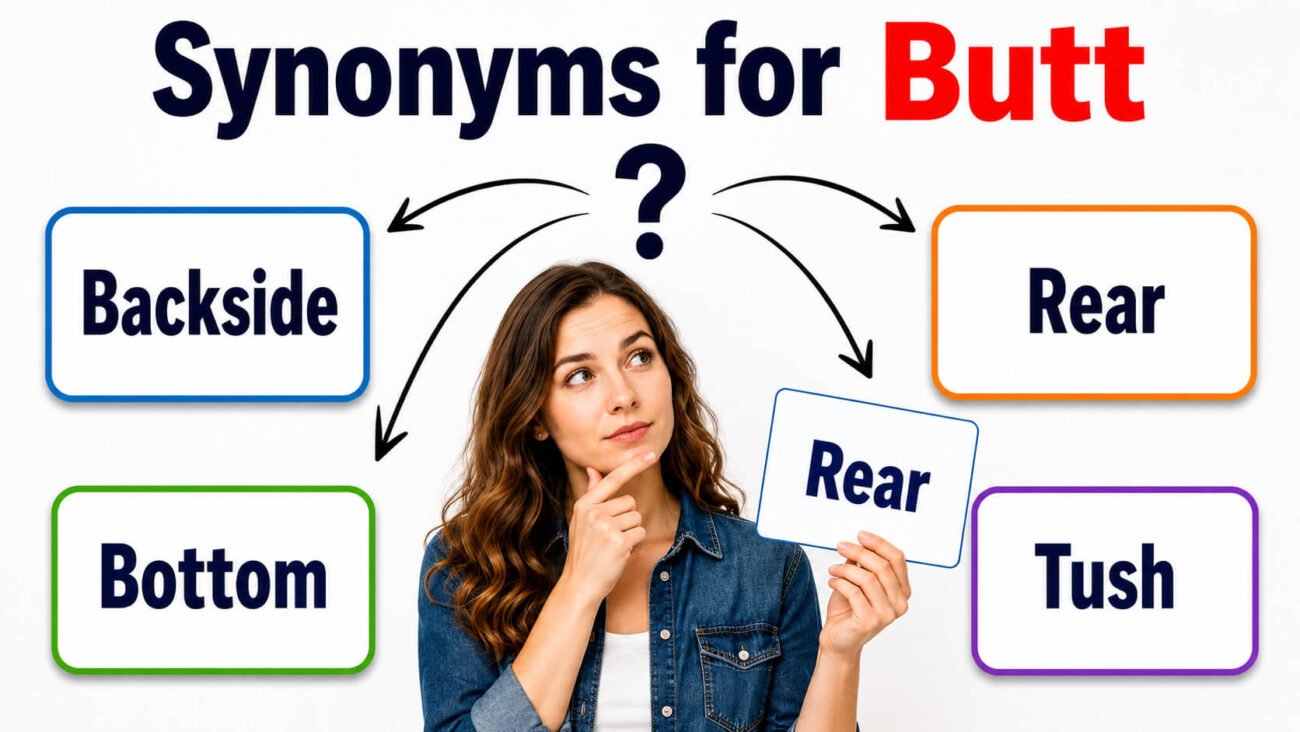
Quick Answer: Common synonyms for butt include buttocks, backside, rear, bottom, behind, posterior, rump, seat, target, and end. Buttocks is best for formal or anatomical writing, while backside, bottom, and behind sound more polite in everyday conversation. Rump and tush often create a humorous tone. When butt means the final part of an object, end, stub, or base may be more accurate. When someone is the butt of a joke, target or laughingstock is the clearest replacement.
Pronunciation and Word Details
Word: Butt
Pronunciation: /bʌt/
Part of Speech: Noun and verb
Meaning: Butt can refer to the part of the body used for sitting, the end of an object, the target of ridicule, or the action of striking or pressing against something.
US Pronunciation:
UK Pronunciation:
What Does “Butt” Mean?
Butt is an informal word with several meanings. As a noun, it commonly refers to the two rounded parts of the body on which a person sits. In this sense, it is often replaced by buttocks, backside, rear, bottom, or behind.
Butt can also describe the thick, blunt, final, or remaining part of an object. A cigarette butt, for example, is the small part left after most of the cigarette has been used.
In the expression “the butt of the joke,” butt means the person or subject receiving ridicule. As a verb, butt can mean to strike with the head, press against something, meet at an edge, or enter a conversation without permission.
Meaning, Tone, and Context of “Butt”
Butt usually has an informal and conversational tone when it refers to the body. It is common in casual speech, humorous writing, idioms, and everyday descriptions. It may sound too direct in medical, academic, professional, or polite situations.
Buttocks is a more neutral anatomical word. Posterior sounds formal or clinical, while bottom and behind are milder choices. Rump, tush, derriere, and booty can sound playful or humorous.
When butt refers to the end of an object, its tone is usually neutral. When used as a verb, it may describe forceful contact, unwanted interruption, or two surfaces meeting at a boundary.
The surrounding sentence determines which meaning and synonym are most suitable.
When and How to Use “Butt”
For Casual Anatomy: Use butt when referring informally to the part of the body used for sitting.
Example: He slipped on the wet floor and landed on his butt.
For Formal Anatomy: Use buttocks, posterior, or gluteal region in medical, academic, and professional contexts.
Example: The exercise strengthens the muscles of the buttocks.
For Polite Conversation: Use bottom, backside, or behind when butt may sound too direct.
Example: The child fell and hurt her bottom.
For Animals: Use rump, hindquarters, or haunches when describing the rear part of an animal.
Example: The horse had a dark patch on its hindquarters.
For the End of an Object: Use butt when describing a thick, blunt, or remaining end.
Example: Only the butt of the candle remained.
For Ridicule: Use butt in the expression “butt of the joke” when someone becomes the target of mockery.
Example: His unusual answer made him the butt of several jokes.
For Physical Contact: Use butt as a verb when a person or animal strikes something with the head.
Example: The goat tried to butt the wooden gate.
For Interruption: Use butt in when someone enters a conversation without being invited.
Example: She apologized for butting in during the discussion.
For Shared Boundaries: Use butt or abut when two surfaces, buildings, or pieces meet at an edge.
Example: The two wooden panels butt against each other.
Best Synonyms for Butt
Buttocks: The two rounded parts of the body on which a person sits.
Example: The workout strengthens the thighs and buttocks.
Backside: A polite and informal word for the rear part of the body.
Example: He landed on his backside after missing the chair.
Rear: The back part of a body, object, vehicle, or place.
Example: The cyclist injured his rear during the fall.
Bottom: A mild and polite term for the body part used for sitting.
Example: The child sat on her bottom and refused to move.
Behind: A gentle and conversational alternative to butt.
Example: Brush the dust from your behind before entering the room.
Posterior: A formal or humorous word for the rear part of the body.
Example: The patient reported discomfort in the posterior area.
Rump: The rear part of a person or animal, often used descriptively or humorously.
Example: The dog rested its rump on the cool floor.
Seat: The part of the body that rests on a chair.
Example: He fell heavily on his seat.
Target: A person or subject receiving jokes, ridicule, or criticism.
Example: His mistake made him the target of several jokes.
End: The final, thick, or remaining part of an object.
Example: Hold the blunt end of the tool firmly.
50 Synonyms for Butt with Short Meanings
- Buttocks: The two rounded parts of the body used for sitting.
- Backside: The rear part of a person’s body.
- Rear: The part positioned at the back.
- Rear End: The back part of a body or object.
- Bottom: A mild word for the body part used for sitting.
- Behind: A polite and informal term for the rear of the body.
- Posterior: A formal term for the back part of the body.
- Rump: The rear part of a person or animal.
- Seat: The body area that rests on a chair.
- Hindquarters: The rear part of a person or animal.
- Haunches: The hips, upper thighs, and rear area.
- Derriere: A polite or humorous term for the buttocks.
- Glutes: The muscles that form the buttocks.
- Gluteal Region: The formal anatomical area containing the buttocks.
- Tush: A playful and mild word for the buttocks.
- Booty: A playful slang term for the buttocks.
- Ass: A vulgar slang term for the buttocks.
- Arse: A vulgar regional term for the buttocks.
- End: The final part of an object.
- Back End: The section located at the rear.
- Tail End: The final or last part of something.
- Blunt End: The thick or unsharpened end of an object.
- Base: The lowest or supporting part of something.
- Stub: A short piece remaining after most has been removed.
- Stump: The base left after something has been cut or broken.
- Remnant: A small part left after the rest is gone.
- Extremity: The farthest end of an object or area.
- Terminus: The final point or ending place.
- Tip: The outermost end of something.
- Tail: The rear or final section of something.
- Target: A person or subject receiving jokes or criticism.
- Object: The person or thing toward which attention is directed.
- Victim: Someone who receives unfair jokes or ridicule.
- Laughingstock: A person or thing widely mocked.
- Subject: The person or matter being discussed or joked about.
- Focus: The central point of attention.
- Recipient: The person receiving an action, joke, or remark.
- Scapegoat: A person unfairly blamed or targeted.
- Collide: To strike or come into contact with force.
- Bump: To make light or accidental contact.
- Strike: To hit something forcefully.
- Ram: To drive against something with force.
- Push: To apply force that moves something away.
- Shove: To push something roughly or strongly.
- Nudge: To push something gently.
- Jab: To strike or push with a quick movement.
- Prod: To press or poke something.
- Thrust: To push suddenly and forcefully.
- Abut: To touch or share a boundary with something.
- Adjoin: To be next to or connected with something.
Read Also:
Synonyms for Foundation
Synonyms for Butt by Context
When Butt Refers to the Body
Buttocks, backside, rear, bottom, behind, posterior, rump, seat, hindquarters, and derriere can replace butt when referring to the body.
Buttocks is the most accurate anatomical choice. Backside, bottom, and behind are polite conversational options. Rear is neutral but informal. Posterior sounds formal or intentionally humorous. Rump is often used for animals or playful descriptions.
Example: He lost his balance and landed on his backside.
When Butt Refers to Body Muscles
Glutes and gluteal region are useful when discussing fitness, exercise, anatomy, or physical movement.
Glutes refers specifically to the gluteal muscles. Gluteal region refers to the broader anatomical area. These options are more precise than butt in instructional or professional writing.
Example: Squats can help strengthen the glutes.
When Butt Refers to the End of an Object
End, back end, tail end, blunt end, base, stub, stump, remnant, extremity, and terminus can describe the final or remaining part of something.
End is the broadest choice. Stub and remnant describe a small amount that remains. Blunt end describes the thick or unsharpened side of an object. Terminus is more formal and usually refers to a final point or destination.
Example: She held the blunt end of the tool.
When Butt Means the Target of a Joke
Target, object, victim, laughingstock, subject, focus, recipient, and scapegoat can replace butt when a person receives mockery or criticism.
Target is usually the clearest replacement. Laughingstock is stronger because it suggests repeated or widespread ridicule. Victim emphasizes unfair treatment, while subject is more neutral.
Example: His unusual outfit made him the target of several jokes.
When Butt Means to Strike
Collide, bump, strike, ram, push, shove, nudge, jab, prod, and thrust can replace butt when it describes physical contact.
Bump and nudge suggest light contact. Strike and shove indicate greater force. Ram and thrust suggest powerful and often deliberate movement.
Example: The goat rammed its head against the gate.
When Butt Means to Touch at an Edge
Abut and adjoin are suitable when two buildings, areas, walls, or objects meet along a boundary.
Abut means to touch directly at an edge. Adjoin means to be next to or connected with something. These words are especially useful in property, construction, and location descriptions.
Example: The garden adjoins the rear wall of the house.
Another Word for Butt
Backside is often the best general replacement for butt when referring to the body because it is clear, mild, and widely understood. However, the best alternative always depends on the intended meaning.
Use buttocks for formal anatomy, bottom for polite conversation, glutes for fitness, end for an object, target for ridicule, ram for forceful contact, and abut for shared boundaries.
Original: He fell and landed on his butt.
Better Option: He fell and landed on his backside.
Original: This exercise strengthens your butt.
Better Option: This exercise strengthens your glutes.
Original: Only the butt of the candle remained.
Better Option: Only the stub of the candle remained.
Original: She became the butt of their jokes.
Better Option: She became the target of their jokes.
When Not to Use “Butt”
Avoid butt in medical, academic, professional, or formal writing when a more precise word is available. Buttocks, posterior, and gluteal region are more suitable for anatomical descriptions.
Butt can also sound impolite when used directly about another person’s body. Bottom, backside, or behind may create a gentler tone.
Do not use an anatomical synonym when butt refers to an object, joke, collision, or shared boundary. The replacement must match the intended meaning rather than the spelling alone.
Weak: The patient reported severe pain in his butt.
Better: The patient reported severe pain in his buttocks.
Weak: This movement develops a stronger butt.
Better: This movement develops stronger gluteal muscles.
Weak: He became the buttocks of the joke.
Better: He became the target of the joke.
Weak: The two buildings collide along one wall.
Better: The two buildings abut along one wall.
Weak: The butt of the rope was damaged.
Better: The end of the rope was damaged.
Words Commonly Confused With Butt
Butt vs But: Butt is a noun or verb, while but is a conjunction used to introduce a contrast.
Example With Butt: He slipped and landed on his butt.
Example With But: He wanted to leave, but the door was locked.
Butt vs Buttocks: Butt is informal, while buttocks is a neutral anatomical term that fits medical and professional writing.
Butt vs Bottom: Butt is more direct and casual. Bottom is milder and more polite, especially when speaking with children.
Butt vs Backside: Both refer to the rear of the body, but backside usually sounds softer and more considerate.
Butt vs Posterior: Butt is conversational. Posterior is formal, clinical, or sometimes humorous.
Butt vs Rump: Butt commonly refers to a person, while rump is frequently used for animals or humorous descriptions.
Butt vs Glutes: Butt refers to the entire body area, while glutes specifically refers to the muscles in that area.
Butt vs Abut: Butt can mean to strike, push, or meet. Abut specifically means to touch or share a boundary.
Butt vs End: Butt often describes a thick, blunt, or remaining end, while end is a broader word for any final part.
Which Synonym Should You Choose?
Choose buttocks when writing about anatomy, health, injuries, physical examinations, or body structure.
Choose glutes when discussing exercise, fitness, strength training, or muscle development.
Choose backside when you need a mild and widely understood conversational alternative.
Choose bottom when speaking politely, especially in family settings or when addressing children.
Choose behind when you want a gentle and informal word.
Choose posterior when writing formally or creating a humorous contrast through overly formal wording.
Choose rump when describing an animal’s rear or creating a playful tone.
Choose end when referring to the last part of an object.
Choose stub when only a small remaining piece is being described.
Choose target when someone is receiving jokes, ridicule, criticism, or unwanted attention.
Choose laughingstock when a person or thing is widely and repeatedly mocked.
Choose ram when describing a forceful strike with the head or body.
Choose bump when the contact is light or accidental.
Choose abut when two areas, walls, buildings, or objects meet directly at an edge.
Choose adjoin when two places are located next to each other or share a connection.
Real Life Examples of “Butt” in Sentences
Original: He slipped on the stairs and landed on his butt.
Better Option: He slipped on the stairs and landed on his backside.
Original: The child sat on her butt and refused to move.
Better Option: The child sat on her bottom and refused to move.
Original: The exercise will strengthen your butt.
Better Option: The exercise will strengthen your glutes.
Original: The dog rested its butt on the cold floor.
Better Option: The dog rested its rump on the cold floor.
Original: Only the butt of the candle remained.
Better Option: Only the stub of the candle remained.
Original: He became the butt of every joke in the room.
Better Option: He became the target of every joke in the room.
Original: The goat butted the wooden fence.
Better Option: The goat rammed its head against the wooden fence.
Original: She tried to butt into their private conversation.
Better Option: She tried to interrupt their private conversation.
Original: The two storage units butt against each other.
Better Option: The two storage units abut each other.
Original: He brushed the dirt from his butt.
Better Option: He brushed the dirt from his backside.
Synonym Groups and Usage Differences
Anatomy Group
Buttocks, backside, rear, bottom, behind, posterior, rump, seat, hindquarters, and derriere all refer to the rear part of the body.
Buttocks is anatomical and neutral. Backside and bottom are mild. Posterior is formal. Rump is descriptive or humorous. Derriere can sound playful or refined.
Example: The patient felt discomfort in the buttocks after the fall.
Fitness Group
Glutes and gluteal region are more precise when discussing muscles, exercises, posture, or physical performance.
Glutes is common in fitness language, while gluteal region is more formal and anatomical.
Example: Lunges activate the glutes and upper legs.
Informal and Slang Group
Tush, booty, ass, and arse are informal alternatives with different levels of politeness.
Tush is mild and playful. Booty is casual slang. Ass and arse are vulgar and should be avoided in formal, polite, or professional communication.
Example: The humorous character fell directly on his tush.
Object End Group
End, back end, tail end, blunt end, base, stub, stump, remnant, extremity, and terminus describe the final or remaining part of an object.
Stub and remnant suggest that only a small amount remains. Base refers to the supporting or lowest part. Terminus is formal and refers to a final point.
Example: A small stub of the candle remained on the table.
Ridicule Group
Target, object, victim, laughingstock, subject, focus, recipient, and scapegoat describe someone receiving jokes, blame, criticism, or mockery.
Target is flexible and neutral. Laughingstock is much stronger. Scapegoat relates more closely to unfair blame than humor.
Example: His repeated mistakes made him the laughingstock of the group.
Contact Group
Collide, bump, strike, ram, push, shove, nudge, jab, prod, and thrust describe different levels of physical contact.
Bump and nudge suggest gentle contact. Strike, ram, shove, and thrust indicate greater force.
Example: The cart bumped against the wall.
Boundary Group
Abut and adjoin describe objects or areas that meet or sit next to one another.
Abut emphasizes direct contact along an edge. Adjoin emphasizes location and connection.
Example: The two properties adjoin near the river.
Antonyms of Butt
The antonym of butt depends on its meaning. When butt refers to the rear of the body or an object, front and beginning are common opposites. When it means the target of ridicule, admirer or respected person may provide a contrasting idea. When butt means to collide, separate or withdraw may work as opposites.
Front: The part facing forward.
Beginning: The first part of something.
Start: The point where something begins.
Head: The front or leading part of an object or group.
Face: The forward surface or side.
Admiration: Approval or respect instead of ridicule.
Praise: Positive recognition rather than mockery.
Supporter: A person who encourages rather than targets someone.
Separate: To move apart rather than make contact.
Withdraw: To move away instead of pushing forward.
Avoid: To prevent contact or collision.
Detach: To disconnect things that were touching.
Comparison Butt vs Related Words
Butt vs Buttocks
Butt is informal and common in casual speech. Buttocks is anatomically precise and better suited to formal, medical, or educational writing.
Example With Butt: He fell backward and landed on his butt.
Example With Buttocks: The injury caused pain in both buttocks.
Butt vs Backside
Butt is more direct, while backside sounds milder and more polite. Both are common in everyday conversation.
Example With Butt: There was mud on the back of his pants near his butt.
Example With Backside: He brushed the mud from his backside.
Butt vs Bottom
Butt is casual and sometimes blunt. Bottom is softer and is frequently used when speaking with children.
Example With Butt: He landed on his butt.
Example With Bottom: The child landed on her bottom.
Butt vs Posterior
Butt is informal, while posterior is formal, clinical, or intentionally humorous.
Example With Butt: He injured his butt during the fall.
Example With Posterior: The patient experienced pain in the posterior region.
Butt vs Rump
Butt usually refers to a person’s rear. Rump is commonly used for animals and sometimes for humorous descriptions of people.
Example With Butt: He sat on his butt near the fire.
Example With Rump: The horse had a white mark on its rump.
Butt vs Glutes
Butt refers to the general body area. Glutes refers specifically to the muscles that form that area.
Example With Butt: He landed directly on his butt.
Example With Glutes: Squats strengthen the glutes.
Butt vs End
Butt often refers to a thick, blunt, or remaining end. End is broader and can describe the final part of almost anything.
Example With Butt: He placed the butt of the tool against the wall.
Example With End: He held the end of the tool firmly.
Butt vs Target
Butt appears in the expression “butt of the joke.” Target directly describes the person receiving ridicule or criticism.
Example With Butt: She was the butt of their jokes.
Example With Target: She was the target of their jokes.
Butt vs Abut
Butt can mean to strike, push, or meet. Abut has the narrower meaning of sharing a boundary or touching directly at an edge.
Example With Butt: The two boards butt against the wall.
Example With Abut: The two properties abut along the northern boundary.
Common Phrases and Expressions With Butt
Butt of the Joke: The person or subject receiving ridicule.
Example: He became the butt of the joke after giving the wrong answer.
Butt In: To interrupt or enter a conversation without permission.
Example: Please do not butt in while she is speaking.
Butt Out: To stop interfering in another person’s affairs.
Example: He told his friend to butt out of the disagreement.
Kick Butt: To perform very well or act with determination.
Example: The team was ready to work hard and kick butt.
Move Your Butt: An informal command telling someone to hurry or take action.
Example: Move your butt or we will miss the bus.
Get Off Your Butt: To stop being inactive and begin working.
Example: He decided to get off his butt and clean the room.
Work Your Butt Off: To work extremely hard.
Example: She worked her butt off to complete the project.
Save Your Butt: To prevent someone from experiencing trouble or failure.
Example: His careful preparation saved his butt during the interview.
Cover Your Butt: To protect yourself from blame or consequences.
Example: Keep written records to cover your butt if a problem develops.
Butt Heads: To argue or disagree strongly.
Example: The two managers often butt heads over important decisions.
Common Mistakes to Avoid
A common mistake is using butt in a formal context where buttocks, posterior, or gluteal region would sound more accurate. Match the word to the audience and purpose of the sentence.
Do not assume that every synonym can replace butt in every context. Bottom cannot replace butt in “the butt of the joke,” and target cannot replace butt when discussing anatomy.
Avoid confusing butt with but. Butt refers to a body part, object end, target, or action. But introduces contrast between ideas.
Do not use vulgar alternatives such as ass or arse in professional, academic, family, or polite writing. Their tone is much stronger than butt.
Avoid repeating butt too often in one paragraph. Use backside, buttocks, rear, or another suitable alternative when the meaning remains clear.
Do not use posterior when a simple conversational word would sound more natural. It can make an ordinary sentence feel unnecessarily formal.
Use abut rather than butt when describing legal boundaries, property lines, buildings, or formal structural relationships.
Always check the intended meaning before selecting a synonym. A correct replacement should match both the definition and the tone.
Conclusion
Synonyms for butt vary according to meaning, tone, and context. Buttocks, posterior, and gluteal region suit formal anatomical writing, while backside, bottom, and behind are better for polite conversation. Glutes works well in fitness discussions, and rump is useful for animals or humor. End, stub, and base describe parts of objects, while target and laughingstock relate to ridicule. For actions, choose ram, strike, bump, abut, or adjoin according to the type of contact being described.
FAQs About Synonyms for Butt
What is the most common synonym for butt?
Backside is one of the most common polite synonyms for butt. Buttocks is more suitable for formal or anatomical writing.
What is a polite word for butt?
Bottom, backside, behind, and derriere are polite alternatives. The best choice depends on the audience and tone.
What is the formal word for butt?
Buttocks is the standard formal anatomical word. Posterior and gluteal region may also be appropriate in medical or technical contexts.
What is another word for butt in fitness?
Glutes is the most common fitness term. It refers specifically to the gluteal muscles that form the buttocks.
What does “butt of the joke” mean?
The butt of the joke is the person or subject being mocked. Target, victim, or laughingstock can replace butt in this expression.
What is another word for the butt of an object?
End, blunt end, back end, base, stub, and remnant may be suitable, depending on the object being described.
What is the difference between butt and but?
Butt is a noun or verb related to anatomy, objects, ridicule, or contact. But is a conjunction used to connect contrasting ideas.
