
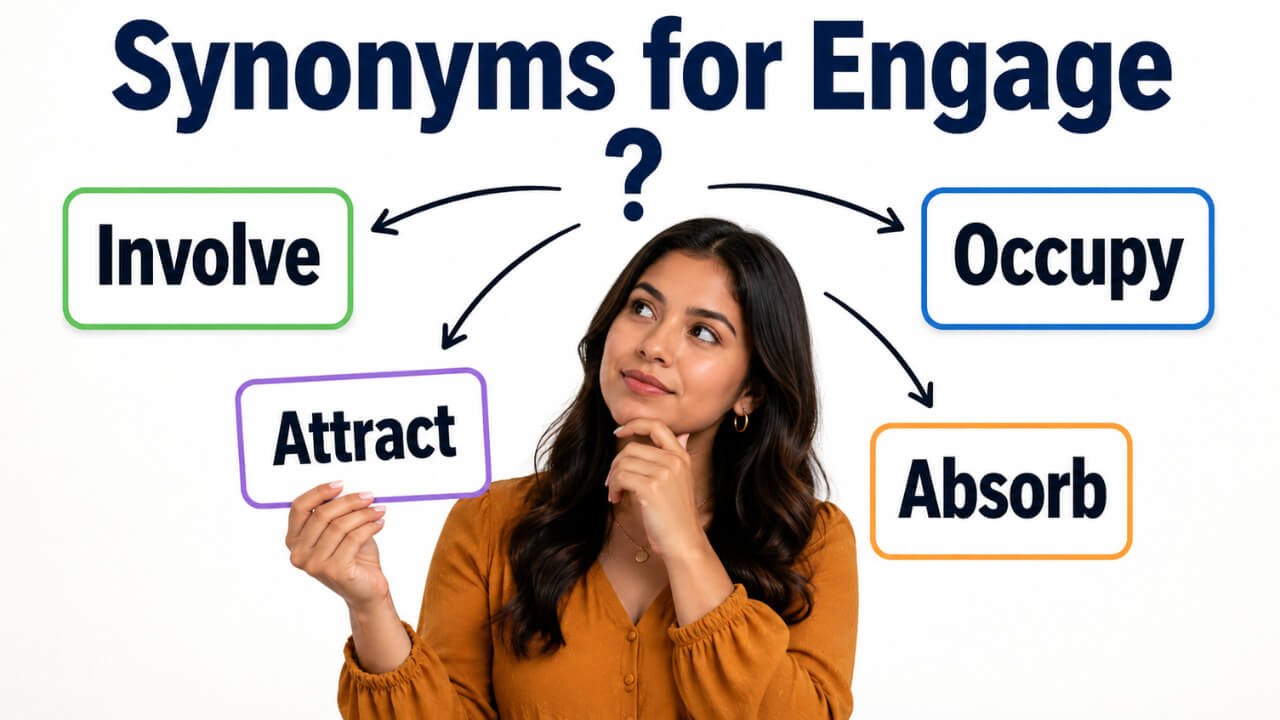
Quick Answer: Common synonyms for engage include involve, participate, attract, interest, occupy, employ, hire, connect, interact, and commit. Use involve when including someone in an activity, participate when taking part, and attract when gaining attention. Interest works for holding curiosity, while employ and hire relate to giving someone work. Choose interact for communication, connect for building relationships, occupy for keeping someone busy, and commit for promising time, effort, or support.
Pronunciation and Word Details
Word: Engage
Pronunciation: /ɪnˈɡeɪdʒ/
Part of Speech: Verb
Meaning: To involve someone in an activity, attract attention, communicate with others, hire a person, or commit to an action.
US Pronunciation:
UK Pronunciation:
What Does “Engage” Mean?
Engage means to become involved in an activity, attract someone’s interest, communicate with another person, or employ someone for work.
It is mainly used as a verb and has several meanings depending on the sentence. A person may engage in a discussion, engage an audience, engage an employee, or engage with a community.
The word can also describe committing to a task, entering a conflict, or causing mechanical parts to connect. Its exact meaning depends on what follows it and the situation being described.
Meaning, Tone, and Context of “Engage”
Engage usually has a neutral, positive, and professional tone. It is commonly used in business, education, communication, marketing, relationships, employment, and everyday conversation.
In formal writing, engage often means participate, involve, employ, or interact. In educational settings, it describes gaining and maintaining a learner’s attention. In conversation, it may mean communicating actively with another person.
Engage can also sound purposeful because it suggests active participation rather than passive presence. However, writers should choose a more specific synonym when the intended meaning is unclear.
When and How to Use “Engage”
For Participation: Use engage when someone actively takes part in an activity, event, or discussion.
Example: Students were encouraged to engage in the classroom debate.
For Attention: Use engage when something attracts and holds a person’s interest.
Example: The opening story immediately engaged the audience.
For Communication: Use engage when people speak, cooperate, or exchange ideas.
Example: The manager engaged with employees before making the decision.
For Employment: Use engage when a person is hired to provide a professional service.
Example: The company engaged a consultant to review its procedures.
For Commitment: Use engage when someone gives time, effort, or attention to a task.
Example: She engaged fully with the research project.
For Mechanical Connection: Use engage when parts of a machine connect and begin working together.
Example: Press the lever until the gears engage.
Best Synonyms for Engage
Involve: To include someone in an activity, decision, or situation.
Example: The project will involve several experienced designers.
Participate: To take part in an activity or event.
Example: Every student was invited to participate in the competition.
Attract: To gain someone’s notice, interest, or attention.
Example: The bright display attracted many visitors.
Interest: To make someone curious or attentive.
Example: The unusual topic interested the entire class.
Occupy: To keep someone busy, interested, or active.
Example: The puzzle occupied the children during the journey.
Employ: To give someone paid work or use something for a purpose.
Example: The organization employs more than one hundred people.
Hire: To pay someone to perform a particular job.
Example: They hired an expert to inspect the building.
Interact: To communicate or act with another person.
Example: The program allows learners to interact with their instructor.
Connect: To establish communication, understanding, or a relationship.
Example: The speaker connected with the audience through personal stories.
Commit: To devote time, effort, or resources to something.
Example: She committed herself to completing the project successfully.
50 Synonyms for Engage with Short Meanings
- Involve: To include someone in an activity or situation.
- Participate: To take part in an event or action.
- Attract: To gain attention or interest.
- Interest: To make someone curious or attentive.
- Occupy: To keep someone busy or interested.
- Employ: To give someone paid work.
- Hire: To pay someone for a job or service.
- Interact: To communicate or act with others.
- Connect: To form a relationship or understanding.
- Commit: To devote time, effort, or support.
- Include: To make someone part of something.
- Entangle: To involve someone in a complicated situation.
- Immerse: To involve someone deeply in an activity.
- Absorb: To hold someone’s complete attention.
- Captivate: To attract and hold strong interest.
- Fascinate: To create intense curiosity or attention.
- Intrigue: To make someone interested through mystery.
- Entertain: To keep someone interested or amused.
- Hold: To maintain someone’s attention.
- Draw: To attract someone toward something.
- Appeal: To attract interest or admiration.
- Invite: To encourage involvement or participation.
- Encourage: To give support for taking part.
- Motivate: To inspire someone to act.
- Activate: To make someone or something active.
- Stimulate: To encourage interest, thought, or action.
- Contact: To communicate with another person.
- Approach: To begin communication with someone.
- Address: To speak or communicate directly.
- Consult: To discuss something to gain advice.
- Collaborate: To work together toward a goal.
- Cooperate: To act together for a shared purpose.
- Communicate: To exchange information or ideas.
- Converse: To talk with another person.
- Discuss: To examine a subject through conversation.
- Associate: To connect or spend time with others.
- Recruit: To bring someone into a group or role.
- Appoint: To select someone for a position.
- Retain: To hire and continue using a professional service.
- Commission: To formally hire someone for specific work.
- Contract: To hire through a formal agreement.
- Enlist: To obtain someone’s help or participation.
- Undertake: To accept responsibility for a task.
- Pursue: To continue an activity or goal.
- Practice: To perform an activity regularly.
- Enter: To begin taking part in an activity.
- Join: To become part of a group or action.
- Encounter: To meet or become involved with something.
- Confront: To face a difficult situation directly.
- Mesh: To connect and work together effectively.
Read Also:
Synonyms for Multiple

Synonyms for Engage by Context
When Engage Means Participate
Use participate, join, enter, undertake, pursue, or practice when someone actively takes part in an activity.
Example: Many residents participated in the community meeting.
Participate is the most direct choice for events, discussions, programs, and group activities. Join works well when becoming part of a group, while undertake emphasizes accepting responsibility for a task.
When Engage Means Attract Attention
Use attract, interest, captivate, fascinate, intrigue, absorb, entertain, or hold when something gains and keeps attention.
Example: The documentary captivated viewers with its powerful story.
Captivate and fascinate suggest strong interest. Interest is more neutral, while intrigue is useful when curiosity comes from mystery or uncertainty.
When Engage Means Communicate
Use interact, communicate, connect, converse, discuss, consult, address, or contact when people exchange thoughts or information.
Example: The adviser consulted with the team before changing the plan.
Interact describes communication between people. Connect often suggests developing understanding or trust, while consult involves requesting advice or professional guidance.
When Engage Means Employ
Use employ, hire, recruit, appoint, commission, retain, or contract when someone is given work or professional responsibilities.
Example: The organization hired an editor to review the document.
Hire is common in everyday language. Employ is suitable for ongoing work, while commission is often used for a specific creative or professional assignment.
When Engage Means Involve
Use involve, include, immerse, entangle, enlist, or associate when someone becomes part of a situation or activity.
Example: The assignment involved detailed research and careful planning.
Involve is the strongest general replacement. Immerse suggests deep participation, while entangle often has a negative meaning involving difficulty or complication.
Another Word for Engage
Involve is one of the best general replacements for engage because it works when someone is included in an activity, process, or situation. However, the strongest alternative depends on whether engage means participate, attract, communicate, employ, or commit.
Original: The activity will engage every student.
Better Option: The activity will involve every student.
Original: The story engaged the readers immediately.
Better Option: The story captivated the readers immediately.
Original: The manager engaged an experienced adviser.
Better Option: The manager hired an experienced adviser.
Original: Employees should engage with one another respectfully.
Better Option: Employees should interact with one another respectfully.
When Not to Use “Engage”
Avoid engage when it creates uncertainty about the intended action. The word has several meanings, so a specific synonym may communicate the idea more effectively.
Weak: The organization engaged several people.
Better: The organization hired several people.
Do not use engage repeatedly in business or educational writing when participate, involve, interact, or attract would be clearer.
Weak: Teachers should engage students and encourage them to engage in lessons.
Better: Teachers should interest students and encourage them to participate in lessons.
Avoid engage with when a direct verb expresses the meaning naturally.
Weak: The adviser engaged with the issue carefully.
Better: The adviser examined the issue carefully.
Do not use engage to describe passive attendance. Engagement requires attention, communication, or active participation.
Words Commonly Confused With Engage
Engage vs Involve: Engage often suggests active participation or attention. Involve simply means including someone or making something a necessary part of an activity.
Engage vs Participate: Engage has several meanings, including attracting attention and communicating. Participate specifically means taking part in an activity.
Engage vs Interact: Engage may mean becoming involved or interested. Interact focuses on communication or actions between people or things.
Engage vs Attract: Engage means gaining and often maintaining attention. Attract mainly means drawing initial notice or interest.
Engage vs Employ: Engage can mean hiring someone for a particular service. Employ commonly refers to providing regular paid work.
Engage vs Commit: Engage means becoming involved. Commit expresses a stronger promise of time, effort, loyalty, or resources.
Which Synonym Should You Choose?
Choose involve when including someone in a process, activity, or decision.
Choose participate for events, discussions, programs, and group activities.
Choose attract when describing how something gains attention or interest.
Choose captivate when attention is held strongly through beauty, emotion, or excitement.
Choose interact for communication and shared activity between people.
Choose connect when building understanding, trust, or a relationship.
Choose employ for regular paid work in formal writing.
Choose hire for the common act of paying someone to complete a job.
Choose commit when someone devotes serious time, effort, or support.
Choose mesh when describing mechanical parts or ideas that connect effectively.
Real Life Examples of “Engage” in Sentences
Original: The teacher used questions to engage the class.
Better Option: The teacher used questions to interest the class.
Original: Everyone should engage in the discussion.
Better Option: Everyone should participate in the discussion.
Original: The campaign engaged many young volunteers.
Better Option: The campaign involved many young volunteers.
Original: The story engaged readers from the first page.
Better Option: The story captivated readers from the first page.
Original: The company engaged a legal adviser.
Better Option: The company hired a legal adviser.
Original: She engaged with customers politely.
Better Option: She interacted with customers politely.
Original: The game engaged the children for several hours.
Better Option: The game occupied the children for several hours.
Original: The speaker engaged the audience through humor.
Better Option: The speaker connected with the audience through humor.
Original: He engaged fully with the training program.
Better Option: He committed fully to the training program.
Original: The gears failed to engage properly.
Better Option: The gears failed to mesh properly.
Synonym Groups and Usage Differences
Participation Group
Participate, join, enter, undertake, and pursue describe active involvement in an activity.
Participate is best for organized activities. Join emphasizes becoming part of a group, while undertake highlights responsibility.
Example: She undertook the assignment with confidence.
Attention Group
Attract, captivate, fascinate, intrigue, absorb, and entertain describe gaining or holding attention.
Attract may describe initial interest. Captivate and fascinate suggest stronger and longer attention.
Example: The unusual design fascinated the visitors.
Communication Group
Interact, communicate, converse, discuss, consult, and connect describe exchanging ideas or building relationships.
Interact is broad and neutral. Consult is more formal and often involves professional advice.
Example: The team consulted an expert before proceeding.
Employment Group
Employ, hire, recruit, appoint, commission, retain, and contract relate to obtaining someone’s work or service.
Employ and hire are general choices. Recruit focuses on finding candidates, while appoint means selecting someone for a role.
Example: The committee appointed her as project leader.
Involvement Group
Involve, include, immerse, enlist, and associate describe becoming part of an activity or situation.
Immerse suggests deep attention and participation. Enlist means gaining someone’s help or support.
Example: The group enlisted several volunteers for the event.
Antonyms of Engage
Exclude: To leave someone out of an activity.
Ignore: To give no attention to someone or something.
Avoid: To stay away from involvement.
Withdraw: To stop participating in an activity.
Disengage: To separate or stop being involved.
Detach: To disconnect from a person, activity, or object.
Release: To free something from a connection.
Dismiss: To reject or stop considering something.
Bore: To fail to hold someone’s interest.
Repel: To cause someone to move away or lose interest.
Disconnect: To break communication or connection.
Neglect: To fail to give proper attention.
Comparison: Engage vs Related Words
Engage vs Involve
Engage usually suggests active interest, communication, or participation. Involve means including someone or making something part of a process.
Example With Engage: The instructor engaged students through practical activities.
Example With Involve: The project involved students from three classes.
Engage vs Participate
Engage can mean taking part, attracting attention, communicating, or hiring. Participate only refers to taking part.
Example With Engage: The presentation engaged the audience.
Example With Participate: The audience participated in the question session.
Engage vs Attract
Attract means gaining initial attention. Engage suggests holding that attention or encouraging active involvement.
Example With Engage: The activity engaged visitors for several minutes.
Example With Attract: The colorful entrance attracted visitors.
Engage vs Interact
Engage may describe attention or participation. Interact specifically refers to communication or mutual action.
Example With Engage: Learners engaged with the course material.
Example With Interact: Learners interacted with their classmates.
Engage vs Employ
Engage may refer to hiring someone for a specific service. Employ more commonly describes providing continuing paid work.
Example With Engage: They engaged a photographer for the ceremony.
Example With Employ: The studio employs five photographers.
Common Phrases and Expressions With “Engage”
Engage in Conversation: To take part in a discussion.
Engage the Audience: To gain and hold listeners’ attention.
Engage With Others: To communicate or interact with people.
Engage in Activities: To participate in particular actions.
Engage Someone’s Interest: To make someone curious or attentive.
Engage the Services: To hire a person or business for professional work.
Fully Engage: To participate with complete attention and effort.
Actively Engage: To become directly and energetically involved.
Engage the Gears: To connect mechanical parts so they work together.
Engage in Debate: To take part in an organized argument or discussion.
Common Mistakes to Avoid
Avoid using engage without enough context. Because the word has several meanings, readers may not know whether it refers to hiring, participating, communicating, or attracting attention.
Do not confuse engage with participate. A presentation can engage an audience, but the presentation itself does not participate.
Avoid unnatural combinations such as engage into a discussion.
Incorrect: She engaged into the conversation.
Correct: She engaged in the conversation.
Use engage with for interaction and engage in for participation.
Interaction: The manager engaged with the employees.
Participation: The employees engaged in the workshop.
Avoid overusing engagement related language in one paragraph. Replace repeated uses with involve, interest, communicate, participate, or connect when appropriate.
Conclusion
Synonyms for engage vary according to whether the word means participate, involve, attract, communicate, employ, or commit. Use participate for activities, involve for inclusion, captivate for strong attention, and interact for communication. Employ and hire are suitable for work, while commit expresses serious effort or dedication. Choosing a precise alternative makes writing clearer and prevents readers from misunderstanding the intended meaning. Always consider the sentence context before replacing engage with another word.
FAQs About Synonyms for Engage
What is the best synonym for engage?
Involve is a strong general synonym, but participate, attract, interact, or hire may be better depending on the context.
What is another word for engage in an activity?
Participate, join, undertake, pursue, and take part are useful alternatives for engaging in an activity.
What is a synonym for engaging an audience?
Attract, interest, captivate, fascinate, entertain, and hold are suitable choices.
Can interact replace engage?
Interact can replace engage when the sentence refers to communication or shared action between people.
What is a formal synonym for engage?
Involve, participate, employ, commission, consult, and collaborate are useful formal alternatives.
What is the opposite of engage?
Common opposites include disengage, withdraw, ignore, exclude, avoid, detach, and disconnect.
Should I use engage in or engage with?
Use engage in before an activity, such as engage in discussion. Use engage with before a person, group, subject, or idea, such as engage with customers.
