
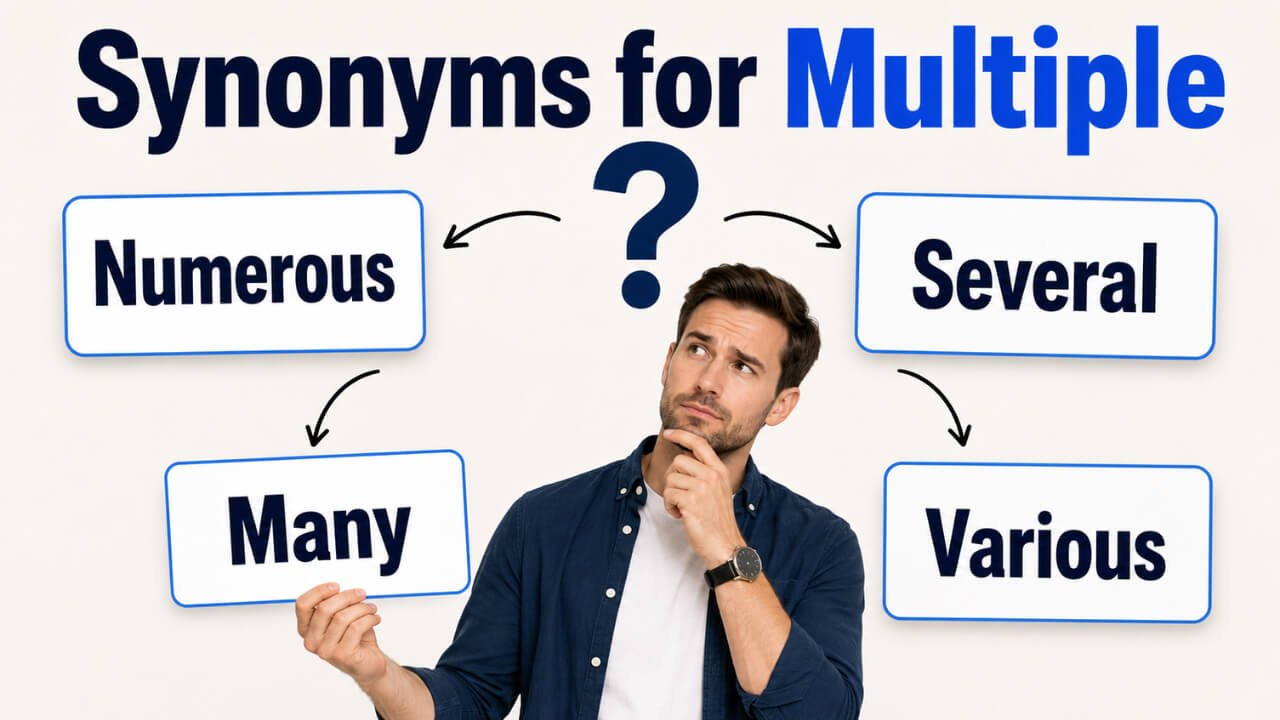
Quick Answer: The best synonyms for multiple include many, numerous, several, various, countless, abundant, diverse, repeated, manifold, and numerous. Use many in general conversation, numerous in formal writing, several for a limited but unspecified number, and various when emphasizing different types. Diverse works best for noticeable variety, repeated describes something occurring more than once, and manifold suits formal or literary contexts. The best replacement depends on whether multiple refers to quantity, variety, repetition, choices, causes, or separate parts.
Pronunciation and Word Details
Word: Multiple.
Pronunciation: /ˈmʌltɪpəl/.
Part of Speech: Adjective and noun.
Meaning: Multiple describes something involving, containing, or consisting of more than one person, object, type, cause, or occurrence.
US Pronunciation:
UK Pronunciation:
What Does “Multiple” Mean?
Multiple means more than one or involving several people, objects, causes, choices, or events. It is commonly used as an adjective before a noun, as in “multiple answers,” “multiple injuries,” or “multiple reasons.”
The word may describe a large quantity, several separate elements, repeated occurrences, or a variety of options. In mathematics, a multiple is a number produced by multiplying one number by another whole number. Its exact meaning therefore depends on the sentence and subject.
Meaning, Tone, and Context of “Multiple”
Multiple has a neutral and slightly formal tone. It appears frequently in academic writing, reports, instructions, medicine, mathematics, technology, and professional communication.
In everyday conversation, people often replace it with many, several, or various. In formal writing, multiple is useful because it clearly suggests that more than one factor, object, or occurrence is involved.
The word does not always mean a very large number. “Multiple reasons” simply means more than one reason, while “numerous reasons” usually suggests a noticeably large number.
When and How to Use “Multiple”
For Quantity: Use multiple when more than one object, person, or item is involved.
Example: The package contains multiple components.
For Variety: Use multiple when several different options or types are available.
Example: The course offers multiple learning methods.
For Repetition: Use multiple when an event or action happens more than once.
Example: She contacted the office on multiple occasions.
For Causes: Use multiple when a result has several contributing reasons.
Example: The problem developed because of multiple factors.
For Choices: Use multiple when a person can select from several possibilities.
Example: Applicants may choose from multiple payment options.
For Mathematics: Use multiple as a noun for a number that can be divided by another number without leaving a remainder.
Example: Twelve is a multiple of four.
Best Synonyms for Multiple
Many: A large or noticeable number of people or things.
Example: Many students attended the workshop.
Numerous: Existing in a large quantity.
Example: The report identified numerous errors.
Several: More than two but not usually a large number.
Example: Several guests arrived early.
Various: Several different kinds or types.
Example: The store sells various styles of furniture.
Manifold: Many and varied in form or type.
Example: The decision created manifold challenges.
Diverse: Showing considerable difference or variety.
Example: The program attracts a diverse group of learners.
Repeated: Happening or occurring more than once.
Example: Repeated delays affected the schedule.
Countless: Too many to be easily counted.
Example: She received countless messages of support.
Abundant: Available in a large or generous quantity.
Example: The region has abundant natural resources.
Severalfold: Increased or repeated by several times.
Example: Demand grew severalfold during the season.
50 Synonyms for Multiple with Short Meanings
- Many: A large number of people or things.
- Numerous: Existing in great quantity.
- Several: More than two but not many.
- Various: Consisting of different kinds.
- Manifold: Many and varied.
- Diverse: Showing noticeable variety.
- Countless: Too many to count easily.
- Abundant: Present in large amounts.
- Repeated: Occurring more than once.
- Frequent: Happening often.
- Severalfold: Multiplied by several times.
- Multitudinous: Extremely numerous.
- Myriad: Very large in number.
- Plentiful: Available in generous amounts.
- Copious: Existing in large quantities.
- Ample: More than enough in quantity.
- Considerable: Fairly large in amount or number.
- Substantial: Large or significant in quantity.
- Different: Not the same as one another.
- Distinct: Clearly separate or different.
- Separate: Existing independently from others.
- Assorted: Made up of different types.
- Mixed: Containing different elements.
- Varied: Including several different forms.
- Sundry: Various and miscellaneous.
- Miscellaneous: Consisting of unrelated types.
- Collective: Involving several people or things together.
- Combined: Joined from more than one part.
- Composite: Formed from several elements.
- Compound: Made from two or more parts.
- Complex: Containing many connected parts.
- Plural: More than one in number.
- Multifold: Existing in many forms or quantities.
- Repeatedly occurring: Happening on several occasions.
- Recurring: Returning or happening again.
- Successive: Following one after another.
- Consecutive: Occurring in an uninterrupted sequence.
- Simultaneous: Happening at the same time.
- Parallel: Existing or happening alongside another.
- Additional: Added to something already present.
- Extra: More than the original amount.
- Alternative: Offering another possible choice.
- Numeral: Relating to a number or quantity.
- Plurality: A state of being more than one.
- Multiplicity: A large number or variety.
- A range of: A selection of different options.
- A number of: An unspecified quantity greater than one.
- More than one: Consisting of at least two.
- A variety of: Several different kinds.
- A series of: Several related things in sequence.
Read Also:
Synonyms for Clearly

Synonyms for Multiple by Context
When Multiple Means Many
When multiple refers to a general quantity greater than one, useful alternatives include many, numerous, several, countless, and plentiful.
Example: The investigation uncovered numerous problems.
Example: Several employees contributed to the project.
When Multiple Means Different Types
When the word emphasizes variety, use various, diverse, assorted, varied, mixed, or miscellaneous.
Example: The menu includes various vegetarian dishes.
Example: The event welcomed people from diverse backgrounds.
When Multiple Means Repeated
When multiple describes something happening more than once, choose repeated, recurring, frequent, successive, or consecutive.
Example: Repeated interruptions made concentration difficult.
Example: The system experienced recurring errors.
When Multiple Means Combined Parts
When multiple refers to several connected elements, use combined, composite, compound, collective, or complex.
Example: The machine has a composite structure.
Example: The conclusion was based on combined evidence.
When Multiple Means Several Choices
When discussing options or possibilities, alternatives such as various, several, a range of, and a variety of are usually natural.
Example: Customers can select from a range of plans.
Example: The application provides several payment methods.
Another Word for Multiple
The best general replacement for multiple is often several. It sounds natural and clearly communicates that more than one person, item, or factor is involved. However, numerous is better for a large quantity, while various is stronger when the items are different from one another.
Original: The project faced multiple difficulties.
Better Option: The project faced several difficulties.
Original: The study considered multiple sources.
Better Option: The study considered numerous sources.
Original: The shop offers multiple designs.
Better Option: The shop offers various designs.
Original: She made multiple attempts to solve the issue.
Better Option: She made repeated attempts to solve the issue.
When Not to Use “Multiple”
Avoid multiple when a more precise number is available. Writing “three reasons” is clearer than writing “multiple reasons” when the exact quantity is known.
The word may also sound unnecessarily formal in casual speech. In simple conversation, many or several often feels more natural. Do not use multiple when you mean different, because several items can be multiple without being different.
Weak: I bought multiple apples at the market.
Better: I bought several apples at the market.
Weak: The document lists multiple different options.
Better: The document lists various options.
Weak: She called multiple times three times.
Better: She called three times.
Weak: Multiple people, including two employees, attended.
Better: Several people, including two employees, attended.
Words Commonly Confused With Multiple
Multiple vs Many: Multiple means more than one, while many usually suggests a relatively large number.
Multiple vs Several: Both mean more than one, but several often suggests a small or moderate quantity.
Multiple vs Various: Multiple focuses on number, while various emphasizes difference in type.
Multiple vs Numerous: Numerous strongly suggests a large number, while multiple may refer to only two or three.
Multiple vs Diverse: Diverse highlights differences among people, objects, ideas, or experiences.
Multiple vs Repeated: Repeated describes the same action or event happening again, while multiple can describe separate items or events.
Multiple vs Compound: Compound describes something formed by joining two or more elements.
Multiple vs Plural: Plural is mainly a grammatical term meaning more than one, while multiple has broader uses.
Which Synonym Should You Choose?
Choose many for natural everyday statements about a large number.
Choose several when the quantity is limited but not exactly stated.
Choose numerous for formal reports, essays, studies, and professional writing.
Choose various when discussing different types, categories, or choices.
Choose diverse when emphasizing meaningful differences among people, ideas, cultures, or experiences.
Choose repeated when the same action or event occurs more than once.
Choose recurring when an issue or event returns at intervals.
Choose composite when an object is made from several separate materials or parts.
Choose collective when several people or things are considered as one group.
Choose manifold in formal or literary writing when describing many varied forms.
Real Life Examples of “Multiple” in Sentences
Original: The teacher gave multiple examples.
Better Option: The teacher gave several examples.
Original: The company received multiple complaints.
Better Option: The company received numerous complaints.
Original: The website provides multiple themes.
Better Option: The website provides various themes.
Original: He made multiple visits to the clinic.
Better Option: He made repeated visits to the clinic.
Original: The issue has multiple causes.
Better Option: The issue has several contributing causes.
Original: The festival included multiple traditions.
Better Option: The festival included diverse traditions.
Original: The plan contains multiple stages.
Better Option: The plan contains a series of stages.
Original: Multiple departments worked on the campaign.
Better Option: Several departments worked on the campaign.
Original: The machine performs multiple tasks.
Better Option: The machine performs numerous tasks.
Original: The artist experimented with multiple materials.
Better Option: The artist experimented with assorted materials.
Synonym Groups and Usage Differences
Quantity Group
Many, numerous, several, countless, abundant, and plentiful describe quantity. Several suggests a moderate amount, while countless suggests an extremely large number.
Example: Numerous participants completed the survey.
Variety Group
Various, diverse, assorted, mixed, varied, and miscellaneous emphasize differences among items or groups.
Example: The collection contains assorted decorative pieces.
Repetition Group
Repeated, recurring, frequent, successive, and consecutive describe actions or events that happen again or follow one another.
Example: Recurring technical problems delayed the launch.
Combination Group
Combined, composite, compound, collective, and complex describe something made from several connected parts.
Example: The final score reflects combined results from three tests.
Choice Group
Alternative, a range of, a variety of, and several refer to available possibilities.
Example: The service offers a variety of subscription options.
Antonyms of Multiple
The opposite of multiple depends on whether the word refers to number, variety, repetition, or complexity.
Single: Consisting of only one person or thing.
One: A single number, amount, or unit.
Sole: Being the only one.
Individual: Existing separately as one person or object.
Unique: Being the only example of its kind.
Singular: Referring to one rather than more than one.
Uniform: Remaining the same without variation.
Identical: Exactly the same in every relevant way.
Simple: Containing few parts or little complexity.
Isolated: Existing alone or separately.
Occasional: Happening infrequently rather than repeatedly.
Limited: Small or restricted in number.
Comparison: Multiple vs Related Words
Multiple vs Several
Multiple means more than one and can describe either a small or large quantity. Several usually suggests a small or moderate number.
Example With Multiple: The patient reported multiple symptoms.
Example With Several: The patient reported several mild symptoms.
Multiple vs Numerous
Multiple only confirms that more than one exists. Numerous indicates that the number is large.
Example With Multiple: The form contains multiple questions.
Example With Numerous: The investigation raised numerous questions.
Multiple vs Various
Multiple emphasizes quantity, while various emphasizes differences among the items.
Example With Multiple: She completed multiple assignments.
Example With Various: She completed assignments on various subjects.
Multiple vs Diverse
Multiple describes more than one, but diverse suggests meaningful variety or contrast.
Example With Multiple: Multiple teams joined the event.
Example With Diverse: Diverse teams brought different perspectives.
Multiple vs Repeated
Multiple may describe separate events, objects, or causes. Repeated means the same action or event happened again.
Example With Multiple: Multiple accidents occurred on the road.
Example With Repeated: Repeated accidents led to safety improvements.
Common Phrases and Expressions With “Multiple”
Multiple Choice: A question format offering several possible answers.
Multiple Times: On more than one occasion.
Multiple Options: Several available choices.
Multiple Causes: More than one reason behind an event or result.
Multiple Factors: Several elements affecting a situation.
Multiple Sources: Information or material obtained from more than one place.
Multiple Roles: Several duties or positions held by one person.
Multiple Meanings: More than one definition or interpretation.
Multiple Examples: Several illustrations used to explain something.
Multiple Perspectives: Different ways of viewing or understanding an issue.
Common Mistakes to Avoid
A common mistake is using multiple when the exact number is already known. Precise numbers usually make a sentence clearer.
Writers also sometimes combine multiple with unnecessary words, such as “multiple various choices.” Choose either multiple or various according to the intended meaning.
Avoid assuming that multiple always means many. Two objects are technically multiple, although several may sound more natural in everyday writing.
Do not replace multiple with diverse unless variety is important. Multiple people may share similar qualities, while diverse people have noticeable differences.
Repeated use of multiple can also make writing sound mechanical. Change it to several, numerous, various, repeated, or a range of when those words express the intended meaning more precisely.
Conclusion
Understanding synonyms for multiple helps you describe quantity, variety, repetition, choices, and combined parts more accurately. Several is often the most natural general replacement, while numerous suits large quantities and formal writing. Various and diverse highlight different types, whereas repeated and recurring describe actions that happen again. Composite and combined work well for connected parts. Select the synonym that matches the sentence rather than replacing multiple automatically, because each alternative carries a slightly different meaning and tone.
FAQs About Synonyms for Multiple
What is the best synonym for multiple?
Several is the best general synonym because it naturally means more than one. The ideal choice still depends on the context.
Can many replace multiple?
Yes, many can replace multiple when the sentence refers to a large number. It may not work when only two or three items are involved.
What is a formal synonym for multiple?
Numerous is a strong formal alternative for reports, essays, research, and professional documents.
What synonym describes multiple different types?
Various, diverse, assorted, and varied are suitable when emphasizing different types or categories.
What is another word for multiple attempts?
Repeated attempts or several attempts are natural alternatives. Repeated emphasizes that the action happened again.
Are multiple and several exactly the same?
Not always. Both mean more than one, but several usually suggests a limited number, while multiple does not indicate a specific size.
What is the opposite of multiple?
Single, sole, individual, and singular are common opposites of multiple when referring to number.
