
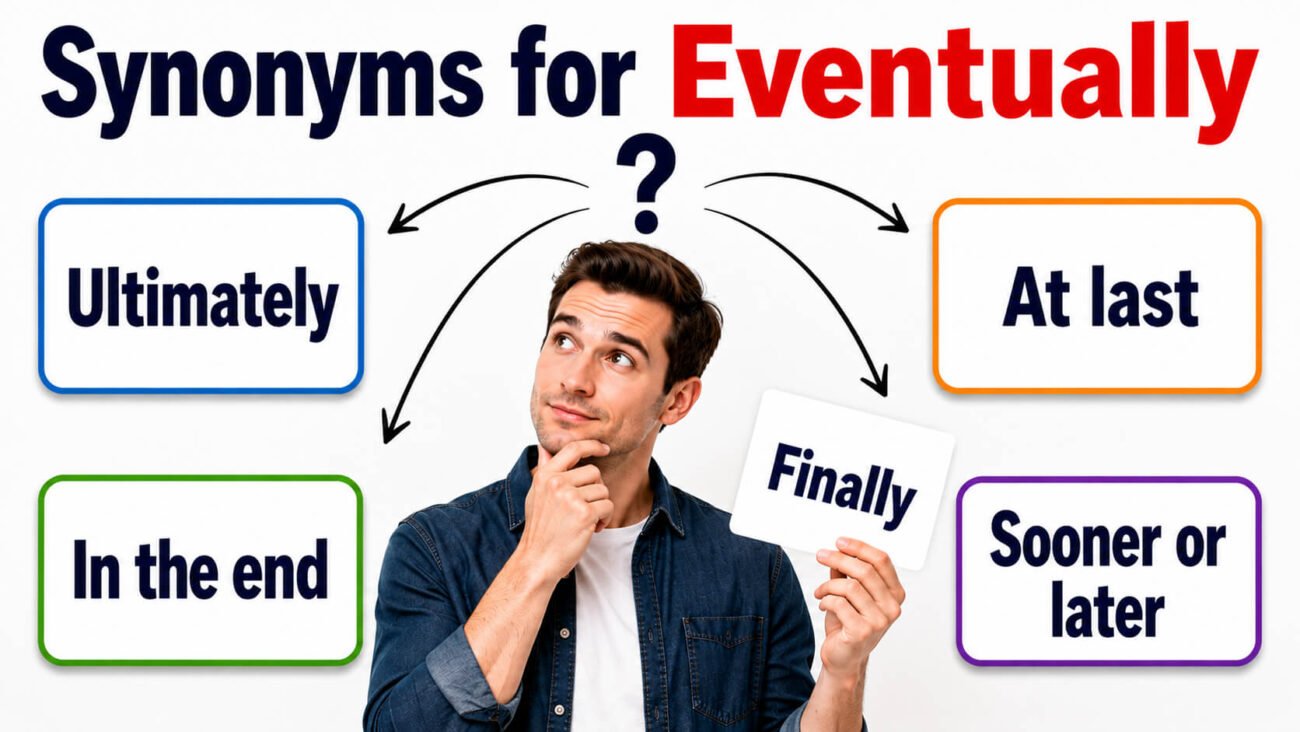
Quick Answer: The best synonyms for eventually include finally, ultimately, in the end, at last, sooner or later, in time, over time, after a while, in due course, and someday. Use finally when something happens after delay or difficulty, ultimately for a final result or conclusion, and in the end when summarizing an outcome. Choose sooner or later when an event is considered certain, in due course for formal writing, and over time when a gradual change takes place.
Pronunciation and Word Details
Word: Eventually.
Pronunciation: /ɪˈven.tʃu.ə.li/.
Part of Speech: Adverb.
Meaning: At some later time, especially after a delay, process, difficulty, or series of events.
US Pronunciation:
UK Pronunciation:
What Does “Eventually” Mean?
Eventually means at a later time, usually after a delay, a gradual process, or several earlier events.
The word is an adverb. It modifies a verb, an adjective, or an entire statement by showing that something happened after time passed.
In “She eventually found the answer,” eventually means that she found the answer after searching or thinking for some time. In “The weather will eventually improve,” it means the improvement is expected to happen in the future.
Eventually can describe a delayed event, a final result, a gradual development, or an outcome reached after difficulties. It does not tell the reader exactly when something will happen.
Meaning, Tone, and Context of “Eventually”
Eventually has a neutral and flexible tone. It appears naturally in everyday conversation, essays, reports, stories, professional communication, academic discussions, and explanations of change.
The word often suggests patience, delay, development, or persistence. It can communicate that something did not happen immediately but occurred after enough time passed.
Eventually may sound hopeful when it introduces a positive result.
Example: The injured player eventually returned to the team.
It can sound negative when describing an unavoidable problem.
Example: The neglected roof eventually collapsed.
In formal writing, ultimately or in due course may be stronger choices. In casual conversation, finally, after a while, or sooner or later may sound more natural.
When and How to Use “Eventually”
For a Delayed Result: Use eventually when an outcome happens after waiting, effort, or difficulty.
Example: The team eventually solved the technical problem.
For a Future Event: Use eventually when something is expected to happen at an unspecified future time.
Example: Technology will eventually change the way the process works.
For Gradual Change: Use eventually when a condition develops slowly over time.
Example: The small business eventually became a successful company.
For a Final Outcome: Use eventually when explaining the result reached after several events or decisions.
Example: After considering every option, they eventually accepted the proposal.
For Personal Progress: Use eventually when a person improves, learns, or succeeds after continued effort.
Example: She eventually became confident enough to speak in public.
For an Unavoidable Consequence: Use eventually when something is likely to happen if the present situation continues.
Example: Without regular maintenance, the machine will eventually stop working.
For Storytelling: Use eventually to move a narrative toward a later event or conclusion.
Example: After travelling for several weeks, the group eventually reached the coast.
Best Synonyms for Eventually
Finally: After a long wait, delay, effort, or series of events.
Example: The guests finally arrived after midnight.
Ultimately: In the final result or after everything has been considered.
Example: The final decision ultimately belonged to the director.
In the End: At the conclusion of a situation or process.
Example: In the end, both sides agreed to compromise.
At Last: After a long and often frustrating wait.
Example: The missing package arrived at last.
Sooner or Later: At some future time that is considered certain.
Example: Sooner or later, the truth will become known.
In Time: After enough time has passed.
Example: In time, she became comfortable in her new role.
Over Time: Gradually as time passes.
Example: The material becomes weaker over time.
After a While: Following a period of time.
Example: After a while, the children became tired.
In Due Course: At the proper or expected future time.
Example: The documents will be reviewed in due course.
Someday: At an unspecified time in the future.
Example: Someday, he hopes to open his own restaurant.
50 Synonyms for Eventually with Short Meanings
- Finally: After a delay, effort, or long period.
- Ultimately: In the final result or conclusion.
- In the End: At the conclusion of a process or situation.
- At Last: After a long or frustrating wait.
- Sooner or Later: At some future time that is certain to arrive.
- In Time: After enough time has passed.
- Over Time: Gradually as time passes.
- After a While: Following a period of waiting.
- In Due Course: At the proper or expected time.
- Someday: At an unknown time in the future.
- One Day: At an unspecified future time.
- At Length: Finally, after a long period or discussion.
- Before Long: After a relatively short period.
- In the Long Run: After a long period and considering the final result.
- In the Fullness of Time: When the appropriate amount of time has passed.
- At Some Point: At an unspecified moment.
- At Some Stage: During an unspecified part of a process.
- Later: At a time after the present or another event.
- Later On: At a subsequent time.
- Thereafter: After a particular event or point in time.
- Subsequently: At a later time following another event.
- In the Future: At a time that has not yet arrived.
- Down the Road: At a later time in the future.
- By and By: After some time has passed.
- In the Course of Time: Gradually or after time passes.
- As Time Goes By: While time continues to pass.
- As Time Passes: Gradually during the passage of time.
- With Time: After time produces change or understanding.
- Given Time: When enough time is allowed.
- After Some Time: Following an unspecified period.
- Afterward: At a time following an event.
- Afterwards: Later, following a particular occurrence.
- At a Later Date: At an unspecified future date.
- At a Later Time: At some point after the present.
- In the Long Term: Over an extended future period.
- In the Final Analysis: After considering all facts and results.
- When All Is Said and Done: After everything has happened or been considered.
- At the End of the Day: When the final result is considered.
- In Conclusion: At the final stage of reasoning or discussion.
- In the Final Outcome: In the result reached at the end.
- As a Final Result: As the concluding consequence.
- In the Final Event: At the ultimate stage or result.
- At the Finish: When a process or event ends.
- By the End: Before or at the final point.
- In the Meantime: During the period before a later event.
- Once the Time Comes: When the appropriate future moment arrives.
- When the Time Is Right: At the most suitable future moment.
- After Everything: Following all earlier events or difficulties.
- At the Last: At the final point after delay.
- Eventuality: As the result that finally occurs.
Read Also:
Synonyms for Facilitate

Synonyms for Eventually by Context
When Eventually Means Finally
Finally, at last, at length, and in the end are useful when an action happens after waiting, difficulty, or repeated attempts.
Example: The mechanic eventually identified the fault.
Alternative: The mechanic finally identified the fault.
Finally is the most natural general replacement. At last adds a stronger sense of relief or impatience. At length sounds more formal and can suggest that something took considerable time.
When Eventually Means Ultimately
Ultimately, in the end, in the final analysis, and when all is said and done describe a final conclusion, decision, or outcome.
Example: The committee eventually decided to approve the project.
Alternative: The committee ultimately decided to approve the project.
Ultimately works especially well in formal explanations, essays, reports, and discussions of consequences.
When Eventually Means at a Future Time
Someday, one day, later, at some point, and down the road refer to an unspecified future time.
Example: She hopes to eventually write a novel.
Alternative: She hopes to write a novel someday.
Someday often expresses a hope or ambition. At some point is neutral, while down the road is conversational.
When Eventually Means Gradually
Over time, with time, in the course of time, as time passes, and in the long term describe slow development.
Example: The pain eventually became less severe.
Alternative: The pain became less severe over time.
Over time is the clearest choice for gradual physical, emotional, social, or economic change.
When Eventually Means After a Delay
After a while, after some time, in due course, and by and by describe something happening after waiting.
Example: The noise eventually stopped.
Alternative: The noise stopped after a while.
After a while is natural in conversation. In due course sounds formal and suggests that an event will happen at the appropriate time.
When Eventually Means Inevitably
Sooner or later, in time, and ultimately can suggest that an event is expected or unavoidable.
Example: Poor planning will eventually cause problems.
Alternative: Poor planning will cause problems sooner or later.
Sooner or later emphasizes certainty more strongly than eventually.
Another Word for Eventually
Finally is the best general replacement for eventually when something happens after waiting, effort, or delay. However, the most suitable alternative depends on whether the sentence emphasizes time, gradual change, certainty, or a final result.
Use ultimately for conclusions, over time for gradual development, and sooner or later for an expected or unavoidable event.
Original: The rain eventually stopped.
Better Option: The rain finally stopped.
Original: The company eventually became profitable.
Better Option: The company became profitable over time.
Original: They eventually chose the less expensive plan.
Better Option: They ultimately chose the less expensive plan.
Original: The mistake will eventually be noticed.
Better Option: The mistake will be noticed sooner or later.
When Not to Use “Eventually”
Do not use eventually when the exact time of an event is important. The word is vague because it does not explain whether something happened after minutes, months, or years.
Weak: The meeting will eventually begin.
Better: The meeting will begin at three o’clock.
Avoid eventually when describing an immediate action.
Weak: She eventually answered the phone on the first ring.
Better: She immediately answered the phone on the first ring.
Do not use eventually repeatedly in the same paragraph. Select alternatives that explain the specific relationship between events.
Weak: He eventually finished college and eventually found a job.
Better: He finally finished college and later found a job.
Eventually may also sound weak in formal conclusions when ultimately would be more precise.
Weak: The evidence eventually supports the original argument.
Better: The evidence ultimately supports the original argument.
Avoid placing eventually where its position makes the sentence unclear.
Weak: They agreed eventually to revise the policy.
Better: They eventually agreed to revise the policy.
Words Commonly Confused With Eventually
Eventually vs Finally: Eventually focuses on something happening after time passes. Finally often emphasizes relief, completion, or the end of repeated attempts.
Eventually vs Ultimately: Eventually mainly relates to time. Ultimately relates to a final result, conclusion, cause, or decision.
Eventually vs Gradually: Eventually describes when the final event occurs. Gradually describes how slowly a change takes place.
Eventually vs Immediately: Eventually means after some time. Immediately means without delay.
Eventually vs Subsequently: Eventually suggests an unspecified delay or process. Subsequently simply means that one event happened after another.
Eventually vs Later: Later means after the present or another time. Eventually often implies that a result is reached after difficulty, change, or waiting.
Eventually vs Someday: Eventually suggests that something is expected to happen after a process. Someday refers more generally to an unspecified future day or time.
Eventually vs Inevitably: Eventually concerns timing. Inevitably means that an event cannot be avoided.
Which Synonym Should You Choose?
Choose finally when something happens after a long wait, repeated effort, or frustration.
Choose ultimately when discussing a final decision, conclusion, result, cause, or responsibility.
Choose in the end when summarizing how a story, disagreement, plan, or experience concluded.
Choose at last when you want to express relief, satisfaction, or impatience after waiting.
Choose sooner or later when an event is expected to happen and may be unavoidable.
Choose over time when describing gradual improvement, damage, growth, learning, or change.
Choose in due course in formal emails, notices, reports, and professional communication.
Choose someday or one day for hopes, ambitions, dreams, and uncertain future plans.
Choose subsequently in formal writing when one event simply follows another.
Choose after a while in casual speech when a moderate but unspecified period passes.
Choose in the long run when discussing results that become clear over an extended period.
Choose before long when something is expected to happen relatively soon.
Real Life Examples of “Eventually” in Sentences
Original: The students eventually understood the difficult concept.
Better Option: The students finally understood the difficult concept.
Original: She eventually decided to accept the offer.
Better Option: She ultimately decided to accept the offer.
Original: The old building will eventually require major repairs.
Better Option: Sooner or later, the old building will require major repairs.
Original: His confidence eventually improved.
Better Option: His confidence improved over time.
Original: The children eventually became quiet.
Better Option: After a while, the children became quiet.
Original: They will eventually receive an official response.
Better Option: They will receive an official response in due course.
Original: He hopes to eventually travel around the country.
Better Option: He hopes to travel around the country someday.
Original: The two departments eventually reached an agreement.
Better Option: In the end, the two departments reached an agreement.
Original: The symptoms eventually disappeared.
Better Option: In time, the symptoms disappeared.
Original: The missing documents were eventually located.
Better Option: The missing documents were located at last.
Synonym Groups and Usage Differences
Final Result Group
Ultimately, in the end, in the final analysis, and when all is said and done describe the final outcome of a situation.
Ultimately is formal and analytical. In the end is natural in both writing and conversation.
Example: Ultimately, the success of the plan depends on careful preparation.
Delayed Completion Group
Finally, at last, at length, and after a while describe something that happens after waiting or difficulty.
Finally is neutral, while at last often communicates emotion or relief.
Example: After several attempts, the door finally opened.
Future Time Group
Someday, one day, later, at some point, and down the road refer to an unspecified future time.
Someday commonly describes hopes. At some point is broader and more neutral.
Example: At some point, the company will need a larger office.
Gradual Change Group
Over time, with time, as time passes, and in the long term describe development that occurs slowly.
These phrases are useful for changes in ability, health, relationships, habits, and conditions.
Example: With time, the new routine became easier to follow.
Expected Outcome Group
Sooner or later, in time, and in due course suggest that an event is expected to occur.
Sooner or later expresses strong certainty. In due course suggests an orderly or appropriate delay.
Example: The application will be processed in due course.
Sequence Group
Later, thereafter, subsequently, afterward, and afterwards show that one event follows another.
These words focus more on sequence than on a long delay.
Example: The report was reviewed and subsequently approved.
Antonyms of Eventually
The opposite of eventually depends on whether the word refers to delay, gradual change, or a final outcome.
Immediately: Without any delay.
Instantly: At once or in an extremely short time.
At Once: Without waiting.
Straightaway: Immediately after a request or event.
Promptly: Quickly and at the expected time.
Directly: Without interruption or delay.
Right Away: At the present moment without waiting.
Initially: At the beginning rather than at the end.
Originally: At the earliest stage or first condition.
First: Before anything else happens.
Suddenly: Quickly and unexpectedly rather than gradually.
Never: At no time in the future.
Comparison Eventually vs Related Words
Eventually vs Finally
Eventually shows that something happens after time passes. Finally often adds a sense of completion, relief, or frustration.
Example With Eventually: The town eventually developed into a busy city.
Example With Finally: After waiting for two hours, the bus finally arrived.
Eventually vs Ultimately
Eventually concerns the time at which something happens. Ultimately concerns the final result or most important conclusion.
Example With Eventually: She eventually returned to work.
Example With Ultimately: She was ultimately responsible for the final decision.
Eventually vs Gradually
Eventually identifies the final point reached after time. Gradually describes a slow and continuous process.
Example With Eventually: The wound eventually healed.
Example With Gradually: The wound gradually became less painful.
Eventually vs Later
Later means after a particular time. Eventually suggests a longer process, delay, or final outcome.
Example With Eventually: The small disagreement eventually became a serious conflict.
Example With Later: We discussed the issue later that afternoon.
Eventually vs Subsequently
Eventually suggests that time, effort, or several developments occurred before the result. Subsequently only shows that something happened afterward.
Example With Eventually: The company eventually recovered from its losses.
Example With Subsequently: The manager resigned and was subsequently replaced.
Eventually vs Someday
Eventually implies an expected outcome after time or effort. Someday expresses a less certain hope or future possibility.
Example With Eventually: Regular practice will eventually improve your accuracy.
Example With Someday: She hopes to become a pilot someday.
Eventually vs Sooner or Later
Eventually is neutral about whether an event is certain. Sooner or later often suggests that the event is unavoidable.
Example With Eventually: He eventually learned how to use the system.
Example With Sooner or Later: Sooner or later, every outdated system must be replaced.
Common Phrases and Expressions With “Eventually”
Eventually Become: To develop into a particular role, condition, or form over time.
Eventually Lead To: To produce a result after a process or series of events.
Eventually Result In: To cause a final consequence.
Eventually Find: To locate something after searching or waiting.
Eventually Realize: To understand something after time or experience.
Eventually Decide: To reach a decision after considering different choices.
Eventually Return: To come back after an unspecified period.
Eventually Succeed: To achieve a goal after continued effort.
Eventually Happen: To occur at some later time.
Eventually Reach: To arrive at a place, condition, conclusion, or agreement after progress.
Common Mistakes to Avoid
A common mistake is using eventually as though it means possibly. Eventually suggests that something does happen or is expected to happen later. Possibly only shows that an event may happen.
Another mistake is using eventually for immediate events. Select immediately, instantly, or at once when no delay occurs.
Writers should avoid using eventually when an exact time is available and important. A specific date, hour, or period gives readers clearer information.
Do not confuse eventually with gradually. Eventually describes the final occurrence, while gradually explains the slow manner of change.
Avoid unnecessary repetition. Instead of using eventually several times, choose finally, later, ultimately, or over time according to the intended meaning.
Word placement also matters. Eventually usually appears before the main verb but after forms of the verb be.
Correct: She eventually accepted the result.
Correct: The problem was eventually resolved.
Conclusion
Synonyms for eventually allow writers to express delay, gradual development, future possibility, and final results more precisely. Use finally for completion after difficulty, ultimately for a conclusion, and in the end for a final outcome. Over time works best for gradual change, while sooner or later suggests certainty. In due course suits formal communication, and someday expresses a future hope. Choosing the right alternative makes sentences clearer by showing whether an event happens after waiting, through gradual progress, or as an expected result.
FAQs About Synonyms for Eventually
What Is the Best Synonym for Eventually?
Finally is the best general synonym when something happens after a delay. Ultimately may be better when the sentence focuses on a final result or conclusion.
What Is a Formal Synonym for Eventually?
Ultimately, subsequently, in due course, at length, and in the fullness of time are formal alternatives, although each has a slightly different meaning.
What Is a Casual Synonym for Eventually?
Finally, later on, after a while, down the road, and sooner or later are natural choices in casual conversation.
Can Finally Replace Eventually?
Finally can replace eventually when an event happens after waiting, effort, or repeated attempts. It may add a stronger sense of completion or relief.
What Is the Difference Between Eventually and Ultimately?
Eventually mainly shows that something happens after time passes. Ultimately focuses on the final conclusion, result, cause, or responsibility.
Is Sooner or Later a Synonym for Eventually?
Yes. Sooner or later is a suitable synonym when an event is expected or considered unavoidable.
What Is Another Word for Eventually in an Essay?
Ultimately is often the strongest choice in an essay, especially when introducing a final argument, consequence, or conclusion.
