
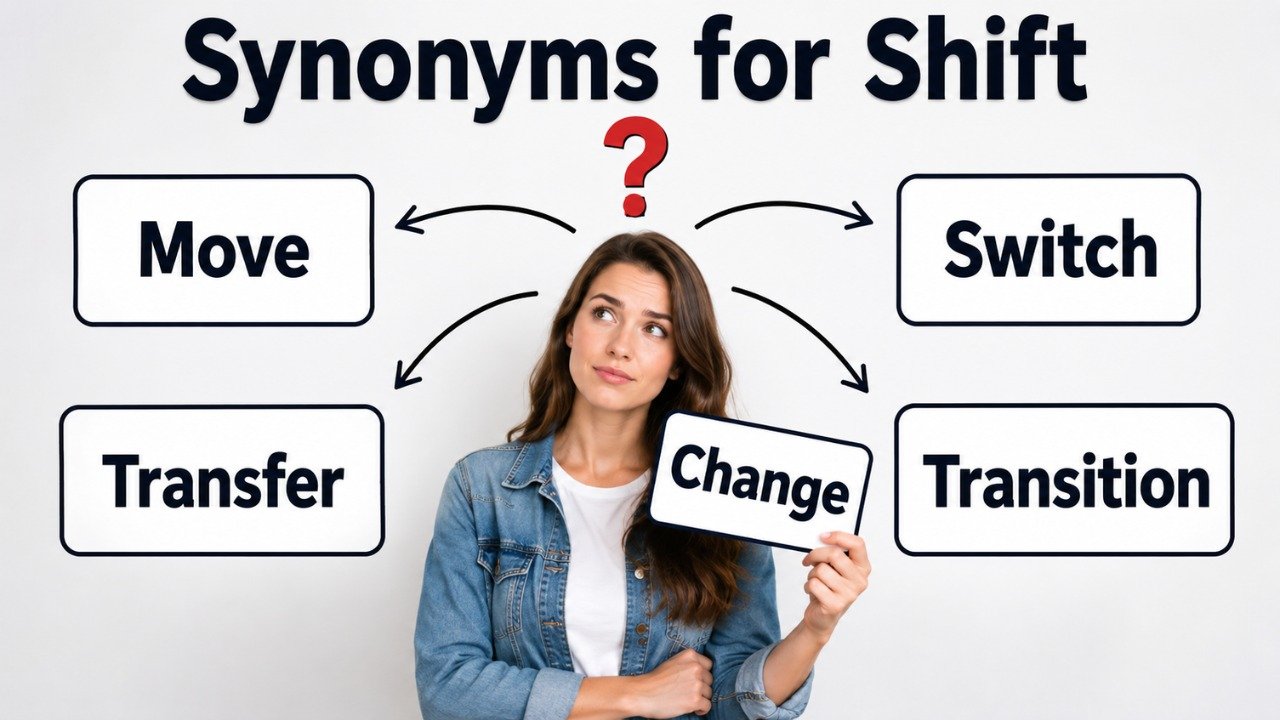
Quick Answer: The best synonyms for shift include change, move, switch, transfer, transition, adjustment, relocation, transformation, rotation, and turn. Use change for a general difference, move for a physical action, switch for replacing one option with another, transfer for moving something between places, and transition for a gradual development. Rotation is useful for work schedules, while turn works well for a change in direction, condition, opinion, or events.
Pronunciation and Word Details
Word: Shift.
Pronunciation: /ʃɪft/
Part of Speech: Noun and verb.
Meaning: Shift means to move, change, transfer, or become different in position, direction, condition, responsibility, or opinion.
US Pronunciation:
UK Pronunciation:
What Does “Shift” Mean?
Shift means to move something from one place or position to another or to experience a change in condition, direction, attitude, or focus. It can function as both a noun and a verb.
As a verb, shift describes the action of moving or changing something.
Example: She shifted the chair closer to the window.
As a noun, shift refers to a change, movement, or scheduled period of work.
Example: There has been a noticeable shift in public opinion.
The word can describe physical movement, changes in thought, workplace schedules, responsibility, attention, direction, or strategy. Its exact meaning depends on the sentence in which it appears.
Physical Movement: Moving an object or person to a different position.
Example: Please shift the table slightly to the left.
Change in Focus: Directing attention toward a different subject.
Example: The discussion shifted toward financial planning.
Change in Opinion: Developing a different belief or attitude.
Example: His position on the issue has shifted considerably.
Work Period: A fixed period during which someone works.
Example: She works the evening shift at the hospital.
Transfer of Responsibility: Moving a duty, burden, or decision to another person.
Example: The manager shifted responsibility to the project leader.
Meaning, Tone, and Context of “Shift”
Shift is generally a neutral and flexible word. It can appear in casual conversation, professional communication, academic writing, technical reports, business discussions, and workplace instructions.
In everyday speech, shift often refers to moving an object or changing position.
Example: Can you shift your bag so I can sit down?
In professional writing, it often describes a change in strategy, attention, responsibility, demand, or performance.
Example: The organization announced a shift in its long term priorities.
In academic and analytical writing, shift can describe changes in culture, language, behavior, population, economics, or public attitudes.
Example: Researchers identified a significant shift in consumer behavior.
The tone can become more serious when the word describes a major transformation.
Example: The discovery caused a fundamental shift in scientific thinking.
It can also be practical and specific when referring to employment.
Example: He begins his morning shift at seven.
Because shift has several meanings, readers should choose a synonym that accurately reflects whether the sentence concerns movement, change, work, responsibility, or opinion.
When and How to Use “Shift”
For Physical Movement
Use shift when something changes position without necessarily traveling a long distance.
Example: She shifted the lamp to the other side of the desk.
For a Change in Direction
Use shift when a plan, conversation, policy, or activity begins moving in another direction.
Example: The campaign shifted its focus toward younger customers.
For a Change in Opinion
Use shift to describe a gradual or noticeable change in belief, preference, attitude, or perspective.
Example: His attitude shifted after hearing the full explanation.
For Transferring Responsibility
Use shift when a task, duty, blame, cost, or responsibility is moved to another person or group.
Example: The new policy shifts more responsibility to local managers.
For Workplace Schedules
Use shift for a specific period during which an employee performs their duties.
Example: My afternoon shift ends at six.
For Changing Attention
Use shift when someone begins concentrating on a different topic or objective.
Example: Let us shift our attention to the next question.
For Changes in Conditions
Use shift when weather, demand, mood, prices, or circumstances become different.
Example: Market demand shifted unexpectedly during the summer.
For Changing Gears
Use shift when changing from one gear to another in a vehicle or machine.
Example: The driver shifted into a lower gear before the hill.
Best Synonyms for Shift
Change
Synonym: Change means to become different or make something different.
Example: The company changed its approach to customer service.
Move
Synonym: Move means to change the physical position or location of something.
Example: Please move the box away from the doorway.
Switch
Synonym: Switch means to replace one person, thing, method, or option with another.
Example: We switched seats before the presentation began.
Transfer
Synonym: Transfer means to move someone or something from one place, person, or system to another.
Example: The office transferred the documents to a secure location.
Transition
Synonym: Transition means a gradual or organized movement from one condition to another.
Example: The team managed the transition to the new system carefully.
Adjustment
Synonym: Adjustment means a small change made to improve accuracy, comfort, or effectiveness.
Example: A slight adjustment to the schedule solved the problem.
Relocation
Synonym: Relocation means movement to a new place or position.
Example: The relocation of the equipment created more working space.
Transformation
Synonym: Transformation means a major or complete change in appearance, character, or condition.
Example: The building underwent a remarkable transformation.
Rotation
Synonym: Rotation means an organized change in position, order, or work duty.
Example: Staff members follow a weekly rotation.
Turn
Synonym: Turn means a change in direction, condition, opinion, or course of events.
Example: The conversation took an unexpected turn.
50 Synonyms for Shift with Short Meanings
- Change: A general movement from one state to another.
- Move: A change in physical position or location.
- Transfer: Movement from one person, place, system, or department to another.
- Switch: A replacement of one option with another.
- Transition: A gradual change between conditions or stages.
- Alteration: A change made to form, condition, or appearance.
- Adjustment: A small change made for improvement or accuracy.
- Modification: A limited change made to something existing.
- Transformation: A major or complete change.
- Conversion: A change from one form, purpose, system, or belief to another.
- Turn: A change in direction, attitude, condition, or events.
- Variation: A difference or change from the usual form.
- Movement: The act of changing position or location.
- Relocation: Movement to a different place.
- Displacement: The act of moving something from its original position.
- Repositioning: Placing something in a new or more useful position.
- Exchange: The replacement of one thing with another.
- Substitution: The use of one person or thing in place of another.
- Replacement: A person or thing that takes the place of another.
- Reassignment: The transfer of a duty, role, or employee to another position.
- Rotation: A planned change in position, order, or work duty.
- Realignment: A change made to restore or improve direction or organization.
- Redirection: The act of sending attention, effort, or movement elsewhere.
- Revision: A change made to improve written work, plans, or ideas.
- Evolution: A gradual process of development and change.
- Fluctuation: An irregular rise, fall, or variation.
- Drift: A slow and often unplanned movement or change.
- Swing: A noticeable movement from one position or opinion to another.
- Deviation: A movement away from an expected course or standard.
- Migration: Movement from one region, system, or platform to another.
- Changeover: A complete switch from one system or method to another.
- Shuffle: A small or repeated rearrangement of position or order.
- Rearrangement: A change in the order or position of things.
- Reorganization: A change in the structure or arrangement of an organization.
- Rescheduling: Moving an event or duty to a different time.
- Pivot: A deliberate change in strategy, direction, or focus.
- Veer: To change direction suddenly or unexpectedly.
- Slide: To move smoothly across a surface or into another position.
- Budge: To move slightly from a position.
- Relocate: To move to a new place or position.
- Reposition: To place something differently.
- Alter: To make something different without replacing it completely.
- Modify: To make a limited or practical change.
- Transform: To change something greatly in form or character.
- Convert: To change something into another form, purpose, or system.
- Redirect: To send movement, attention, or effort in another direction.
- Stint: A limited period spent doing a particular job.
- Duty: A period or responsibility assigned to a worker.
- Watch: A scheduled period of duty, especially for observation or security.
- Spell: A limited period of work or activity.
Read Also:
Synonyms for Civilization

Synonyms for Shift by Context
When Shift Means a General Change
The strongest alternatives are change, alteration, modification, adjustment, transformation, evolution, and variation. These words describe something becoming different, but they suggest different levels of change.
Change: The broadest and most neutral alternative.
Example: There was a change in the meeting schedule.
Adjustment: A small and practical change.
Example: We made an adjustment to the project timeline.
Transformation: A deep or complete change.
Example: The neighborhood experienced a dramatic transformation.
Evolution: A slow and continuous change.
Example: The design reflects the evolution of modern architecture.
When Shift Means Physical Movement
Use move, relocation, displacement, repositioning, slide, budge, or rearrangement when discussing physical position.
Move: Suitable for most everyday situations.
Example: Move the chair closer to the table.
Relocation: Best for movement to a clearly different place.
Example: The relocation of the office will begin next month.
Repositioning: Best when an object is placed more effectively.
Example: Repositioning the screen reduced the glare.
Budge: Best for a very small movement.
Example: The heavy cabinet would not budge.
When Shift Means a Change in Focus or Direction
Useful alternatives include redirect, pivot, turn, realignment, redirection, and veer.
Redirect: Means to send attention or effort elsewhere.
Example: The teacher redirected the discussion toward the main topic.
Pivot: Describes an intentional strategic change.
Example: The business pivoted toward affordable products.
Turn: Describes a change in direction or course.
Example: The debate took a more serious turn.
Veer: Suggests an unexpected or sudden change in direction.
Example: The conversation veered away from the original question.
When Shift Means Switching Options
Use switch, exchange, substitution, replacement, conversion, or changeover when one thing is replaced by another.
Switch: A direct and natural replacement.
Example: We switched from paper records to digital files.
Exchange: Often involves giving one thing and receiving another.
Example: She exchanged her damaged item for a new one.
Substitution: Indicates that one option is used in place of another.
Example: The recipe allows the substitution of oil for butter.
Changeover: Describes an organized replacement of an entire process.
Example: The factory completed the changeover to new equipment.
When Shift Means a Work Period
The most useful alternatives are stint, duty, watch, spell, and rotation.
Stint: A limited period in a job or role.
Example: He completed a short stint in the sales department.
Duty: A scheduled period of responsibility.
Example: The nurse begins duty at eight in the morning.
Watch: A period of observation or security work.
Example: The officer remained on watch throughout the night.
Spell: A period spent performing a task.
Example: She completed a brief spell at the reception desk.
Rotation: A planned system of changing duties or schedules.
Example: Weekend duties are assigned through a monthly rotation.
When Shift Means Transferring Responsibility
Use transfer, reassignment, redirection, delegation, or realignment when responsibility, authority, work, or blame moves elsewhere.
Transfer: A formal movement of responsibility.
Example: The transfer of authority was completed on Monday.
Reassignment: A new duty or position given to someone.
Example: His reassignment placed him in the training department.
Realignment: A strategic redistribution of roles or priorities.
Example: The realignment gave regional teams greater control.
Another Word for Shift
The best general replacement for shift is change because it works in the widest range of situations. However, the most accurate choice depends on whether shift refers to movement, a workplace schedule, a change of opinion, or a new direction.
Original: We noticed a shift in customer preferences.
Better Option: We noticed a change in customer preferences.
Original: She shifted the books to another shelf.
Better Option: She moved the books to another shelf.
Original: The organization shifted its attention to safety.
Better Option: The organization redirected its attention to safety.
Original: He requested a different work shift.
Better Option: He requested a different work rotation.
When Not to Use “Shift”
Shift should not be used when a more exact word would make the sentence clearer. It may sound vague when the reader needs to understand the size, speed, cause, or type of change.
When the Change Is Complete
Use transformation or conversion when something changes completely.
Weak: The renovation caused a shift in the building.
Better: The renovation caused a complete transformation of the building.
When Describing Simple Physical Movement
Use move when the action is ordinary and direct.
Weak: Shift the cup away from the edge.
Better: Move the cup away from the edge.
When Describing a Gradual Process
Use transition or evolution when the change happens over time.
Weak: The shift from childhood to adulthood can be challenging.
Better: The transition from childhood to adulthood can be challenging.
When Discussing Formal Transfers
Use transfer or reassignment when a person, document, responsibility, or payment moves officially.
Weak: Her shift to another department was approved.
Better: Her transfer to another department was approved.
When the Word Becomes Repetitive
Repeating shift several times can make a paragraph sound dull or unclear.
Weak: The market shift caused a shift in strategy, which created another shift in spending.
Better: The market change led to a new strategy and redirected spending.
Words Commonly Confused With Shift
Shift vs Change: Shift often suggests movement in position, focus, or direction. Change is broader and can describe any difference between two conditions.
Shift vs Switch: Shift may be gradual or partial. Switch usually means replacing one option with another.
Shift vs Move: Shift often describes a small movement or change of position. Move can describe movement of any distance.
Shift vs Transfer: Shift is general, while transfer usually describes an organized movement between people, places, accounts, or departments.
Shift vs Transition: Shift may happen suddenly or gradually. Transition normally describes a gradual process between stages.
Shift vs Transformation: Shift can be small or moderate. Transformation suggests a major and noticeable change.
Shift vs Drift: Shift may be intentional, but drift usually describes slow movement without a clear plan.
Shift vs Pivot: Shift is neutral and general. Pivot often describes a deliberate strategic change made in response to new circumstances.
Which Synonym Should You Choose?
Choose change when you need a broad and familiar alternative that does not require additional explanation.
Choose move when discussing the physical position of an object or person.
Choose switch when replacing one option, method, product, or arrangement with another.
Choose transfer for the formal movement of money, documents, employees, authority, or responsibility.
Choose transition when describing a gradual movement between stages, conditions, or systems.
Choose adjustment for a small change intended to improve performance, comfort, or accuracy.
Choose transformation when the change is major, deep, or complete.
Choose pivot when discussing a deliberate change in business strategy, planning, or direction.
Choose rotation when referring to scheduled work duties or changing responsibilities.
Choose redirection when attention, resources, effort, or movement is sent toward a different goal.
Choose fluctuation for repeated rises and falls in prices, demand, temperature, or performance.
Choose relocation when a person, business, object, or service moves to a new place.
Choose revision when a written document, policy, plan, or idea is changed for improvement.
Choose drift when a gradual change occurs without a clear decision or direction.
Choose turn when describing a change in events, behavior, health, opinion, or direction.
Real Life Examples of “Shift” in Sentences
Original: The company shifted its focus toward customer satisfaction.
Better Option: The company redirected its focus toward customer satisfaction.
Original: She shifted the chair closer to the window.
Better Option: She moved the chair closer to the window.
Original: Public opinion has shifted during the past year.
Better Option: Public opinion has changed during the past year.
Original: The discussion shifted to environmental concerns.
Better Option: The discussion turned to environmental concerns.
Original: He shifted responsibility to another employee.
Better Option: He transferred responsibility to another employee.
Original: The team shifted to a more flexible working method.
Better Option: The team transitioned to a more flexible working method.
Original: A small shift in the schedule solved the problem.
Better Option: A small adjustment to the schedule solved the problem.
Original: Demand shifted throughout the season.
Better Option: Demand fluctuated throughout the season.
Original: The organization shifted its long term strategy.
Better Option: The organization revised its long term strategy.
Original: She works the night shift twice a week.
Better Option: She works the night rotation twice a week.
Synonym Groups and Usage Differences
General Change Group
This group includes change, alteration, adjustment, modification, variation, and revision. These words describe something becoming different without always suggesting movement.
Change is the broadest option. Adjustment usually indicates a small improvement, while revision commonly relates to plans, policies, or written material.
Example: The editor recommended a revision to the final paragraph.
Physical Movement Group
Move, relocation, displacement, repositioning, slide, and budge belong to this group. They describe a person or object changing position.
Move is general. Relocation involves a new place, while budge describes only a slight movement.
Example: The technician repositioned the monitor for better visibility.
Major Change Group
Transformation, conversion, transition, evolution, and changeover describe more substantial changes.
Transformation suggests a dramatic result. Transition focuses on the process, while evolution suggests slow development.
Example: The community experienced a remarkable transformation.
Direction and Focus Group
Turn, pivot, redirection, realignment, veer, and redirect describe changes in direction, strategy, or attention.
Pivot is often intentional and strategic. Veer may suggest that the change was sudden or unplanned.
Example: The team pivoted toward a more practical solution.
Replacement Group
Switch, exchange, substitution, replacement, and changeover describe one option taking the place of another.
Switch is direct and conversational. Substitution is more formal and precise.
Example: The substitution improved the quality of the recipe.
Workplace Group
Stint, duty, watch, spell, and rotation can replace shift when it refers to work.
Rotation is useful for planned schedules. Watch is common when someone observes, guards, or monitors something.
Example: Each employee follows the same weekend rotation.
Transfer Group
Transfer, reassignment, relocation, and redirection describe movement between roles, places, or areas of responsibility.
Transfer is the most flexible formal option. Reassignment specifically involves receiving a different role or duty.
Example: Her reassignment will begin next month.
Antonyms of Shift
The opposite of shift depends on whether the word refers to movement, change, direction, or work arrangements.
Stability: A condition that remains firm and unchanged.
Permanence: The quality of lasting without change.
Stillness: A complete absence of movement.
Immobility: The inability or refusal to move.
Constancy: The quality of remaining steady over time.
Sameness: A lack of noticeable difference or variation.
Continuity: The uninterrupted continuation of a condition or process.
Fixedness: The state of being firmly established in one position.
Retention: The act of keeping something rather than transferring it.
Consistency: The quality of remaining regular and dependable.
Steadiness: A condition without sudden movement or variation.
Resistance: An unwillingness to accept movement or change.
Comparison: Shift vs Related Words
Shift vs Change
Shift often suggests movement in direction, position, opinion, or focus. Change is a broader word that can describe any difference.
Example With Shift: There has been a shift in the team’s priorities.
Example With Change: There has been a change in the team’s priorities.
Shift vs Switch
Shift can be gradual, while switch usually describes a direct replacement.
Example With Shift: Her attention gradually shifted toward the audience.
Example With Switch: She switched from one computer to another.
Shift vs Move
Shift often describes a small movement or adjustment. Move can refer to any change of location.
Example With Shift: He shifted slightly in his seat.
Example With Move: He moved to another city.
Shift vs Transition
Shift may happen quickly or slowly. Transition emphasizes the process of moving between stages.
Example With Shift: The conversation shifted toward business matters.
Example With Transition: The organization completed its transition to a new system.
Shift vs Transfer
Shift is less formal and more general. Transfer usually involves an official or organized movement.
Example With Shift: She shifted the files to another table.
Example With Transfer: She transferred the files to another department.
Shift vs Transformation
Shift may describe a small or moderate change. Transformation describes a dramatic or complete change.
Example With Shift: The room showed a slight shift in style.
Example With Transformation: The renovation produced a complete transformation.
Shift vs Pivot
Shift can be intentional or unplanned. Pivot usually describes a deliberate strategic decision.
Example With Shift: Demand shifted toward smaller products.
Example With Pivot: The company pivoted toward smaller products.
Common Phrases and Expressions With “Shift”
Shift Focus: Direct attention toward a different subject or objective.
Shift Position: Move to another physical or argumentative position.
Shift Direction: Begin moving or developing toward another course.
Shift Responsibility: Transfer a duty or obligation to someone else.
Shift the Blame: Attempt to make another person responsible for a mistake.
Work a Shift: Complete a scheduled period of employment.
Night Shift: A period of work that takes place during the night.
Day Shift: A scheduled work period during daytime hours.
Paradigm Shift: A major change in established ideas, methods, or beliefs.
Gear Shift: A device or action used to change gears.
Shift in Attitude: A change in someone’s feelings, beliefs, or behavior.
Shift in Demand: A change in how much of a product or service people want.
Shift Attention: Begin concentrating on something different.
Make a Shift: Carry out a change in direction, position, or method.
Sudden Shift: A change that happens quickly and unexpectedly.
Common Mistakes to Avoid
Using Shift for Every Type of Change
Shift is broad, but it is not always the clearest option. Use transformation for a complete change, adjustment for a small correction, and transition for a gradual process.
Unclear: The project experienced a shift.
Clearer: The project experienced a major transformation.
Confusing Shift With Switch
Shift can describe gradual movement, while switch commonly refers to replacing one choice with another.
Incorrect: His opinion switched gradually over several years.
Better: His opinion shifted gradually over several years.
Using Shift Instead of Transfer
Use transfer when movement is official, recorded, or organized.
Less Precise: The bank shifted the money to another account.
More Precise: The bank transferred the money to another account.
Repeating Shift Too Often
Repeated use can weaken the flow of a paragraph. Replace it with change, move, transition, adjustment, or redirection where appropriate.
Repetitive: The shift in demand caused a shift in production and a shift in staffing.
Improved: The change in demand affected production and led to a staffing adjustment.
Choosing an Overly Strong Synonym
Do not use transformation when only a small adjustment occurred.
Exaggerated: Moving the chair caused a transformation in the room.
Better: Moving the chair caused a slight change in the room.
Ignoring the Part of Speech
Some alternatives work mainly as nouns, while others function naturally as verbs.
Noun: The transition required careful planning.
Verb: The team transitioned to the new process.
Using Vague Language
Explain what changed when the context is not already clear.
Vague: A shift happened during the meeting.
Clear: The discussion shifted from costs to employee safety.
Conclusion
Synonyms for shift vary according to whether the word describes change, movement, work, responsibility, opinion, or direction. Change is the strongest general replacement, while move suits physical position, transition describes gradual development, and transfer works for formal movement. Choose adjustment for a small correction, transformation for a major result, pivot for a strategic decision, and rotation for a work schedule. Selecting the most precise alternative makes every sentence clearer, more natural, and more informative.
FAQs About Synonyms for Shift
What Is the Best Synonym for Shift?
Change is the best general synonym for shift. Move, switch, transition, transfer, and adjustment may be more precise in specific contexts.
What Is Another Word for a Shift in Opinion?
Change, turn, swing, movement, and transition can describe a shift in opinion. Swing often suggests a noticeable movement between opposing views.
What Is a Formal Synonym for Shift?
Transition, transfer, modification, realignment, and transformation are suitable formal alternatives. The correct word depends on the type and size of the change.
What Is Another Word for a Work Shift?
Rotation, duty, watch, stint, and spell can refer to a scheduled period of work. Rotation is especially useful for regularly changing schedules.
Is Switch the Same as Shift?
Not completely. Switch usually means replacing one option with another, while shift can describe movement, gradual change, attention, opinion, or a period of work.
What Is a Synonym for a Major Shift?
Transformation, conversion, changeover, realignment, and major transition can describe a large or important shift.
What Is a Synonym for a Small Shift?
Adjustment, movement, variation, modification, slide, and repositioning can describe a small shift, depending on whether the change is physical or abstract
