
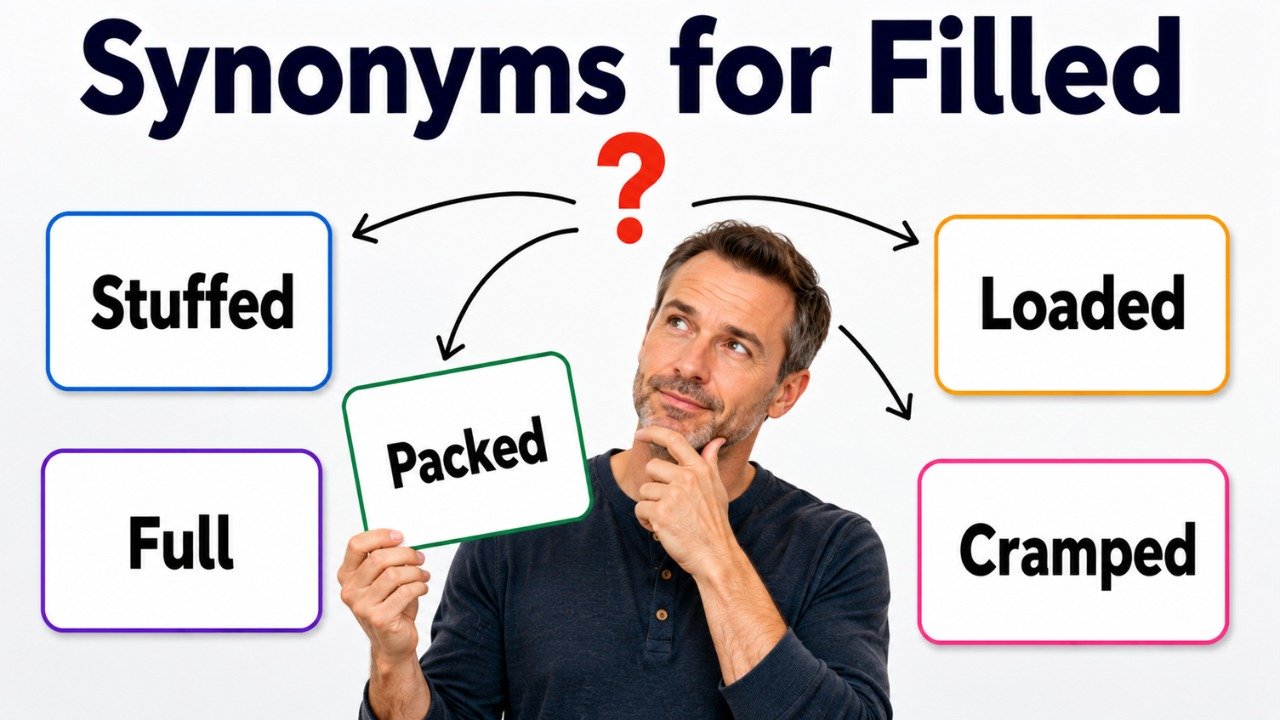
Quick Answer: The best synonyms for filled are full, packed, stuffed, loaded, brimming, saturated, occupied, completed, stocked, and infused. Use full when a container has no available space, packed when many objects or people are placed closely together, and stuffed when something contains more than usual. Occupied works best for positions, seats, and spaces. Completed is suitable for forms and documents, while infused and imbued describe something containing a feeling, quality, flavor, or influence.
Pronunciation and Word Details
Word: Filled
Pronunciation: /fɪld/
Part of Speech: Adjective, past tense verb, and past participle of fill
Meaning: Containing as much as possible or having something placed, added, supplied, completed, or present within it.
US Pronunciation:
UK Pronunciation:
What Does “Filled” Mean?
Filled means containing something that has been placed, poured, added, written, supplied, or introduced. It can describe a container that contains material, a room containing people, a form containing information, or a person experiencing a strong emotion.
As an adjective, filled describes the condition of something after contents have been added. In the sentence “The basket was filled with fruit,” it describes the basket’s condition.
As a verb, filled is the past tense and past participle of fill. In “She filled the bottle with water,” it describes an action completed in the past.
Filled can also have figurative meanings. A person may be filled with happiness, fear, confidence, or doubt. In these examples, no physical substance is being added. Instead, the word describes a powerful emotional or mental state.
Meaning, Tone, and Context of “Filled”
Filled is a neutral and flexible word used in everyday conversation, descriptive writing, instructions, reports, and formal communication. Its tone depends mainly on what follows it.
In physical descriptions, filled means that something contains a substance, object, or group of people. A filled glass contains liquid, while a filled auditorium contains an audience.
In administrative writing, filled may describe a completed form or an occupied position. However, completed and occupied are often more precise choices in these contexts.
In emotional language, filled can create a vivid or expressive tone. Phrases such as filled with gratitude, filled with sorrow, and filled with excitement communicate a strong emotional state.
In technical or academic writing, more specific alternatives such as saturated, populated, supplied, occupied, or completed may communicate the intended meaning more clearly.
When and How to Use “Filled”
For Containers and Physical Spaces
Use filled when something contains a substance, object, or material.
Example: The jar was filled with fresh honey.
The word does not always mean that every available space is occupied. It may simply mean that a noticeable amount has been placed inside.
For Crowded Places
Use filled when a room, hall, street, or other space contains many people or objects.
Example: The hall was filled with excited guests.
Packed or crowded may be better when you want to emphasize that very little space remains.
For Forms and Documents
Use filled when information has been entered into blank spaces.
Example: Every section of the application was filled correctly.
Completed is usually more natural when referring to the entire form.
Better Example: Every section of the application was completed correctly.
For Jobs and Positions
Use filled when someone has been selected for an available position.
Example: The vacant position was filled last week.
Occupied or assigned may be more precise when discussing the current status of a role.
For Emotions and Thoughts
Use filled to describe a person strongly affected by an emotion, thought, or attitude.
Example: She was filled with hope after hearing the good news.
Imbued, overwhelmed, consumed, or inspired may provide a more exact emotional meaning.
For Food and Hunger
Use filled informally when food makes someone feel full.
Example: The warm meal filled everyone at the table.
Satisfied, fed, nourished, or satiated may sound more natural depending on the intended meaning.
For Supplies and Resources
Use filled when a place or container has received the necessary materials.
Example: The shelves were filled with essential supplies.
Stocked is usually the strongest alternative for shops, kitchens, storage areas, and supply rooms.
Best Synonyms for Filled
Full
Synonym: Containing as much as possible or having little space remaining.
Example: The glass was full of cold water.
Full is the most common replacement when filled describes the current condition of a container or space.
Packed
Synonym: Containing many people or objects placed closely together.
Example: The train was packed with passengers.
Packed emphasizes crowding, closeness, or limited available space.
Stuffed
Synonym: Filled tightly or with more contents than usual.
Example: The drawer was stuffed with old papers.
Stuffed is common in casual descriptions and often suggests excessive filling.
Brimming
Synonym: Filled almost to the point of overflowing.
Example: The bowl was brimming with fresh berries.
Brimming can also describe strong positive emotions, such as confidence, pride, or excitement.
Saturated
Synonym: Completely filled, soaked, or affected by a substance.
Example: The soil was saturated with rainwater.
Saturated is useful in scientific, technical, and detailed descriptive writing.
Occupied
Synonym: Being used, taken, or held by someone.
Example: Every seat in the waiting area was occupied.
Occupied is the best choice for seats, rooms, spaces, positions, and territories.
Completed
Synonym: Finished by adding all necessary information or parts.
Example: The completed form was placed on the desk.
Completed is more accurate than filled when discussing forms, applications, surveys, and documents.
Stocked
Synonym: Supplied with necessary goods or materials.
Example: The kitchen was stocked with fresh ingredients.
Stocked works well for shelves, kitchens, stores, warehouses, and supply areas.
Infused
Synonym: Filled with a quality, flavor, feeling, or influence.
Example: The tea was infused with the flavor of mint.
Infused often describes flavors, aromas, ideas, energy, or artistic qualities.
Satisfied
Synonym: Having a need, desire, or hunger adequately met.
Example: The generous meal left everyone satisfied.
Satisfied is useful when filled refers to hunger, needs, expectations, or emotional contentment.
50 Synonyms for Filled With Short Meanings
- Full: Containing as much as possible.
- Packed: Containing many things placed closely together.
- Stuffed: Filled tightly or excessively.
- Crammed: Forced full with limited remaining space.
- Crowded: Containing too many people or objects.
- Loaded: Carrying or containing a large amount.
- Brimming: Almost overflowing with contents.
- Overflowing: Containing more than the available space allows.
- Saturated: Completely soaked or thoroughly affected.
- Soaked: Filled with or covered in liquid.
- Flooded: Filled rapidly with a large amount of liquid, light, or information.
- Replenished: Filled again after supplies were reduced.
- Refilled: Filled again after becoming empty.
- Stocked: Supplied with goods or materials.
- Supplied: Provided with something necessary.
- Furnished: Supplied with furniture, equipment, or useful items.
- Equipped: Provided with necessary tools or resources.
- Covered: Spread over or occupied by something.
- Blanketed: Completely covered by a layer or mass.
- Occupied: Taken, used, or held by someone.
- Taken: Not available because someone is using it.
- Assigned: Given to a person, purpose, or position.
- Appointed: Officially selected for a role.
- Inhabited: Lived in by people or animals.
- Populated: Supplied or occupied with people, items, or information.
- Completed: Finished with all necessary details.
- Entered: Added to a form, record, or system.
- Recorded: Written or stored as information.
- Inscribed: Written, marked, or engraved on a surface.
- Infused: Filled with a quality, flavor, or influence.
- Imbued: Deeply filled with a feeling or characteristic.
- Permeated: Spread throughout every part.
- Steeped: Deeply influenced or surrounded by something.
- Charged: Filled with energy, emotion, or tension.
- Consumed: Completely controlled by a feeling or thought.
- Overwhelmed: Strongly affected by emotion or pressure.
- Satisfied: Having a need or desire fully met.
- Satiated: Completely satisfied, especially after eating.
- Fed: Given enough food.
- Nourished: Supplied with food, care, or support.
- Fulfilled: Satisfied, completed, or brought into reality.
- Contented: Feeling peaceful and satisfied.
- Abundant: Existing in a large amount.
- Replete: Completely supplied or filled with something.
- Laden: Heavily loaded with something.
- Teeming: Containing a large number of living or active things.
- Congested: Overfilled with people, traffic, or material.
- Jammed: Packed so tightly that movement is difficult.
- Bursting: Extremely full and close to breaking or overflowing.
- Flush: Having an abundant supply of something.
Read Also:
Synonyms for Loyal

Synonyms for Filled by Context
When Filled Means Full
Use full when something contains enough material to leave little or no available space.
Useful alternatives include full, loaded, packed, stuffed, crammed, brimming, overflowing, and bursting.
Example: The container was full of clean drinking water.
Example: Her suitcase was packed with winter clothing.
Full is neutral, while stuffed and crammed suggest that too much has been placed inside.
When Filled Means Crowded
Use crowded, packed, congested, jammed, or teeming when a space contains many people, vehicles, animals, or objects.
Example: The stadium was packed with cheering spectators.
Example: The narrow street was congested with traffic.
Crowded focuses on limited space. Teeming often suggests lively movement or a large number of living things.
When Filled Means Supplied
Use stocked, supplied, replenished, furnished, or equipped when necessary resources have been provided.
Example: The storage room was stocked with emergency supplies.
Example: The laboratory was equipped with modern instruments.
Stocked is best for goods and materials, while equipped is better for tools, devices, and practical resources.
When Filled Means Completed
Use completed, entered, recorded, or inscribed when information has been added to a form, document, record, or surface.
Example: The completed application was ready for review.
Example: The information was entered into the correct fields.
Completed describes the whole task. Entered describes the action of adding individual details.
When Filled Means Occupied
Use occupied, taken, assigned, appointed, inhabited, or populated when a place or role is no longer vacant.
Example: Every table in the dining area was occupied.
Example: The vacant position was assigned to an experienced employee.
Occupied is suitable for spaces and seats. Appointed is best for official roles.
When Filled Describes Emotion
Use infused, imbued, charged, consumed, overwhelmed, or permeated when a person, place, or piece of writing contains a strong feeling or quality.
Example: Her speech was imbued with genuine compassion.
Example: The room was charged with nervous energy.
Imbued suggests a deep quality, while overwhelmed describes an emotion that is difficult to control.
When Filled Means Satisfied
Use satisfied, satiated, fed, nourished, fulfilled, or contented when a need, hunger, or desire has been met.
Example: The nourishing meal left the travelers satisfied.
Example: Completing the project made her feel fulfilled.
Satiated usually relates to appetite, while fulfilled often relates to goals, purpose, or emotional needs.
Another Word for Filled
Full is the best general replacement for filled when describing a container, room, or space. However, the strongest alternative depends on what is being added and how completely the space is occupied.
Original: The glass was filled with juice.
Better Option: The glass was full of juice.
Original: The theater was filled with visitors.
Better Option: The theater was packed with visitors.
Original: The available position was filled yesterday.
Better Option: The available position was occupied yesterday.
Original: The application was filled before the deadline.
Better Option: The application was completed before the deadline.
Different synonyms communicate fullness, crowding, completion, supply, occupation, and emotion more precisely than one general word.
When Not to Use “Filled”
Avoid filled when another word can express the exact condition more clearly. The word may sound vague when readers need to know whether something was completed, occupied, crowded, supplied, or emotionally influenced.
When Describing a Completed Form
Filled can sound incomplete because it may refer only to individual blanks rather than the entire document.
Weak: She submitted the filled application.
Better: She submitted the completed application.
When Describing an Occupied Position
Filled is acceptable, but occupied or appointed may sound more precise in formal writing.
Weak: The management position is filled.
Better: The management position is now occupied.
When Describing Extreme Crowding
Filled does not clearly communicate how tightly people or objects are arranged.
Weak: The small room was filled with guests.
Better: The small room was packed with guests.
When Describing Complete Absorption
Use saturated or soaked when a material has absorbed a large amount of liquid.
Weak: The cloth was filled with water.
Better: The cloth was saturated with water.
When Describing Deep Emotional Influence
Infused, imbued, consumed, or overwhelmed may provide stronger emotional detail.
Weak: His voice was filled with sadness.
Better: His voice was imbued with sadness.
When Repetition Reduces Impact
Repeating filled several times in one paragraph can make writing sound basic.
Weak: The room was filled with flowers, filled with guests, and filled with music.
Better: The room overflowed with flowers, welcomed numerous guests, and echoed with music.
Words Commonly Confused With Filled
Filled vs Full: Filled often emphasizes the action or process of adding contents. Full emphasizes the resulting condition. A person fills a cup, and afterward the cup is full.
Filled vs Stuffed: Filled is neutral, while stuffed suggests tight packing or an excessive amount. A basket may be filled with towels, but an overpacked drawer is stuffed with clothing.
Filled vs Fulfilled: Filled means that contents were added. Fulfilled means that a promise, duty, wish, need, or goal was satisfied or completed.
Filled vs Completed: Filled often describes adding information to blanks. Completed means the entire form or task is finished.
Filled vs Occupied: Filled may describe a role or space that is no longer empty. Occupied focuses more clearly on current use or possession.
Filled vs Infused: Filled is general. Infused means a flavor, quality, influence, or feeling has been introduced and spread throughout something.
Filled vs Saturated: Filled means something contains material. Saturated means it has absorbed or received as much as possible.
Which Synonym Should You Choose?
Choose full when describing a container, room, schedule, or space that has little or no capacity remaining.
Choose packed when many people or objects are placed closely together.
Choose stuffed when something contains an excessive amount or has been filled tightly.
Choose brimming when contents reach almost to the top or when someone displays strong positive emotion.
Choose overflowing when the contents extend beyond the normal limit.
Choose saturated for materials completely affected by liquid, color, information, or market presence.
Choose completed when every required part of a form, document, or task is finished.
Choose occupied when referring to seats, rooms, spaces, positions, or territories.
Choose stocked when a location has been supplied with goods, food, equipment, or materials.
Choose populated when a table, list, database, or area contains people, objects, or information.
Choose imbued when a person, object, speech, or piece of writing contains a deep quality or feeling.
Choose infused when describing flavors, aromas, energy, creativity, or influence.
Choose satisfied or satiated when referring to hunger or physical needs.
Choose fulfilled when discussing goals, promises, dreams, responsibilities, or emotional purpose.
Real Life Examples of “Filled” in Sentences
Original: The basket was filled with fresh vegetables.
Better Option: The basket was loaded with fresh vegetables.
Original: The auditorium was filled with students.
Better Option: The auditorium was packed with students.
Original: Her eyes were filled with tears.
Better Option: Her eyes brimmed with tears.
Original: The shelves were filled with useful supplies.
Better Option: The shelves were stocked with useful supplies.
Original: Every seat was filled before the presentation began.
Better Option: Every seat was occupied before the presentation began.
Original: He returned the filled form to the office.
Better Option: He returned the completed form to the office.
Original: The air was filled with the smell of flowers.
Better Option: The air was infused with the scent of flowers.
Original: She was filled with confidence before the interview.
Better Option: She was brimming with confidence before the interview.
Original: The soil was filled with rainwater.
Better Option: The soil was saturated with rainwater.
Original: The story was filled with mystery and suspense.
Better Option: The story was steeped in mystery and suspense.
Synonym Groups and Usage Differences
Fullness Group
Full, packed, stuffed, crammed, brimming, overflowing, and bursting describe different levels of fullness.
Full is neutral. Packed and crammed emphasize limited space. Brimming suggests contents reaching the top, while overflowing means they have exceeded the limit.
Example: The basket was brimming with ripe fruit.
Supply Group
Stocked, supplied, furnished, equipped, replenished, and refilled describe the addition of useful materials or resources.
Stocked refers to goods and supplies. Furnished often relates to furniture. Equipped refers to tools or practical resources. Replenished means supplies were restored.
Example: The medical room was equipped with essential tools.
Occupation Group
Occupied, taken, assigned, appointed, inhabited, and populated describe spaces, positions, or areas that are no longer vacant.
Occupied and taken are common for seats and rooms. Appointed is formal and relates to roles. Inhabited refers to places where people or animals live.
Example: The previously vacant house is now inhabited.
Completion Group
Completed, entered, recorded, populated, and inscribed relate to forms, fields, records, tables, and written information.
Completed refers to the finished document. Entered and recorded describe how information was added. Populated is common for tables, lists, and data fields.
Example: All required details were entered correctly.
Emotional Quality Group
Infused, imbued, permeated, steeped, charged, consumed, and overwhelmed describe feelings, qualities, or influences.
Infused and imbued suggest that a quality has spread throughout something. Charged suggests emotional tension or energy. Consumed and overwhelmed describe powerful personal emotions.
Example: The conversation was charged with excitement.
Satisfaction Group
Satisfied, satiated, fed, nourished, fulfilled, and contented relate to meeting physical or emotional needs.
Satisfied is broad. Satiated usually describes complete relief from hunger. Fulfilled relates to goals, purpose, or emotional needs.
Example: Her meaningful work left her feeling fulfilled.
Antonyms of Filled
The opposite of filled changes according to the intended meaning. Empty is the most direct antonym for physical containers, while vacant applies to spaces and positions. Incomplete is the opposite when filled means completed.
Empty: Containing nothing.
Vacant: Not occupied or currently used.
Unoccupied: Available because no person is using it.
Blank: Containing no written information.
Incomplete: Missing necessary details or parts.
Unfilled: Not yet containing the required material or information.
Drained: Emptied of liquid, energy, or resources.
Depleted: Greatly reduced or completely used.
Unsupplied: Not provided with necessary materials.
Bare: Empty, uncovered, or lacking contents.
Sparse: Containing only a small amount.
Barren: Producing or containing very little.
Hungry: Needing food.
Unsatisfied: Having a need or expectation that remains unmet.
Unfulfilled: Not completed or emotionally satisfied.
Comparison of Filled vs Related Words
Filled vs Full
Filled can emphasize that someone added contents. Full describes the condition after the action.
Example With Filled: She filled the glass with milk.
Example With Full: The glass was full of milk.
Use filled when the action matters. Use full when the condition matters.
Filled vs Packed
Filled is neutral and does not always suggest crowding. Packed means many things are placed close together with very little free space.
Example With Filled: The room was filled with chairs.
Example With Packed: The room was packed with spectators.
Packed creates a stronger sense of crowding.
Filled vs Stuffed
Filled can describe any normal amount. Stuffed suggests tight or excessive filling.
Example With Filled: The bag was filled with clothes.
Example With Stuffed: The bag was stuffed with more clothes than it could hold.
Stuffed is more casual and expressive.
Filled vs Saturated
Filled means that something contains a substance. Saturated means a material has absorbed as much liquid or influence as possible.
Example With Filled: The bucket was filled with water.
Example With Saturated: The towel was saturated with water.
Use saturated for complete absorption or intense exposure.
Filled vs Occupied
Filled can refer generally to a position or space that is no longer empty. Occupied directly states that someone or something is using it.
Example With Filled: All positions have been filled.
Example With Occupied: Every seat is occupied.
Occupied is usually clearer for physical spaces.
Filled vs Completed
Filled refers to adding information. Completed means that all necessary work has been finished.
Example With Filled: She filled the blank fields.
Example With Completed: She completed the application.
Use completed for the whole form and filled for its individual sections.
Filled vs Fulfilled
Filled describes adding contents. Fulfilled describes satisfying a promise, goal, responsibility, desire, or emotional need.
Example With Filled: He filled the basket with food.
Example With Fulfilled: He fulfilled his promise to help.
These words cannot normally replace each other.
Filled vs Infused
Filled is broad and literal. Infused suggests that a flavor, quality, energy, or influence has spread throughout something.
Example With Filled: The room was filled with music.
Example With Infused: The performance was infused with energy.
Infused sounds more descriptive and expressive.
Common Phrases and Expressions With “Filled”
Filled With Joy: Experiencing or expressing great happiness.
Filled With Hope: Feeling strongly optimistic about the future.
Filled With Fear: Experiencing a strong sense of danger or anxiety.
Filled With Doubt: Feeling uncertain or lacking confidence.
Filled to Capacity: Containing the maximum possible number or amount.
Filled to the Top: Containing material up to the upper edge.
Filled In: Completed missing details or temporarily replaced another person.
Filled Out: Added all required information to a form.
Filled Up: Made something full or reached full capacity.
Filled With Meaning: Containing an important message or deep significance.
Common Mistakes to Avoid
Confusing Filled With Full
Do not use filled when you only want to describe a current condition.
Less Natural: The bottle is filled.
Better: The bottle is full.
Filled is more natural when the contents are mentioned or when the filling process matters.
Using Filled Instead of Completed
A form is usually completed, while its individual blanks or fields are filled.
Less Precise: Please submit the filled application.
Better: Please submit the completed application.
Confusing Filled and Fulfilled
Fulfilled does not mean physically full. It relates to completing duties, promises, wishes, requirements, or goals.
Incorrect: She filled her promise.
Correct: She fulfilled her promise.
Using the Wrong Preposition
Filled with normally introduces the contents of something. Filled by normally identifies the person, action, or process responsible.
Contents: The box was filled with books.
Agent: The box was filled by an assistant.
Choosing an Overly Strong Synonym
Do not use overflowing, bursting, or stuffed unless the amount is unusually large.
Exaggerated: The cup was bursting with tea.
Natural: The cup was filled with tea.
Repeating Filled Too Often
Replace repeated uses with precise alternatives such as packed, occupied, stocked, saturated, completed, or infused.
Repetitive: The hall was filled with people and filled with noise.
Improved: The hall was packed with people and echoed with noise.
Using Filled Vaguely
State what fills the object, space, or person whenever the information is important.
Vague: The container was filled.
Clear: The container was filled with clean water.
Conclusion
Synonyms for filled include full, packed, stuffed, brimming, occupied, completed, stocked, saturated, and infused. The best choice depends on what the sentence describes. Use full for containers, packed for crowded spaces, occupied for seats and positions, and completed for forms. Stocked suits supplies, while saturated describes complete absorption. For emotions or qualities, imbued and infused create a more expressive tone. Choosing a precise alternative makes descriptions clearer, more natural, and easier for readers to understand.
FAQs About Synonyms for Filled
What Is the Best Synonym for Filled?
Full is the best general synonym for filled. However, packed, occupied, completed, stocked, or infused may be more accurate in specific contexts.
Is Filled an Adjective or a Verb?
Filled can function as an adjective, the past tense of fill, or the past participle of fill. Its grammatical role depends on the sentence.
What Is the Difference Between Filled and Full?
Filled often emphasizes the action of adding contents, while full describes the resulting condition.
What Is a Formal Synonym for Filled?
Suitable formal alternatives include occupied, completed, populated, saturated, supplied, infused, and imbued.
What Is Another Word for a Filled Room?
Packed, crowded, occupied, congested, or full can describe a filled room. The best choice depends on how crowded it is.
What Is Another Word for a Filled Form?
Completed is usually the best alternative for a filled form. Entered and recorded may describe the addition of specific information.
Can Packed Always Replace Filled?
No. Packed is suitable when many items or people are placed closely together. It does not work naturally for emotions, forms, positions, or absorbed liquids.
