
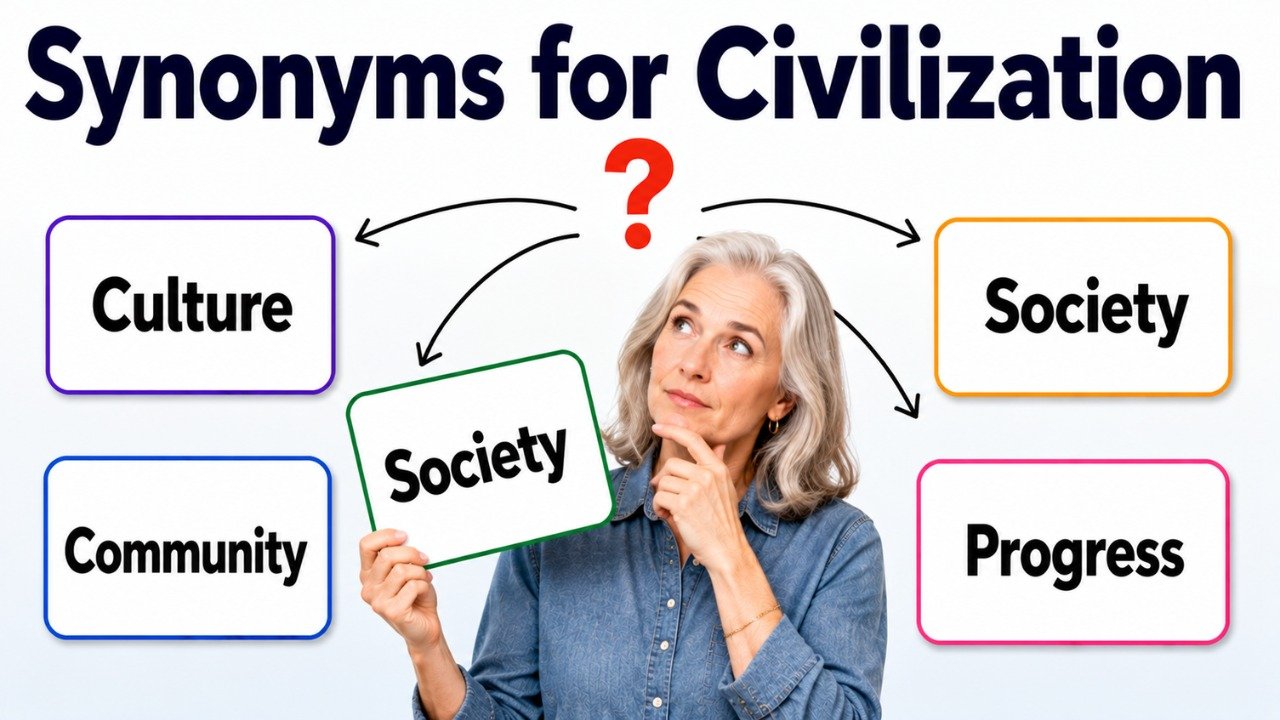
Quick Answer: The best synonyms for civilization are society, culture, social order, organized society, human society, civil society, cultural system, way of life, social structure, and civilized world. Use society when referring to people living under shared institutions. Use culture for beliefs, customs, art, and traditions. Social order works well when discussing laws and stability, while organized society suits historical or academic writing. Civilization can also mean human progress, refinement, or an advanced stage of social development.
Pronunciation and Word Details
Word: Civilization
Pronunciation: /ˌsɪv.əl.əˈzeɪ.ʃən/
Part of Speech: Noun
Meaning: A developed human society with organized institutions, shared culture, laws, knowledge, and ways of living.
US Pronunciation:
UK Pronunciation:
What Does “Civilization” Mean?
Civilization means an organized and developed human society with systems of government, education, culture, trade, law, technology, and public life. It is a noun that can describe either human society in general or a particular historical culture.
The word often refers to a society that has developed cities, institutions, written knowledge, economic systems, and social structures. Ancient Egyptian civilization, for example, included government, architecture, religion, writing, agriculture, and artistic traditions.
Civilization can also describe the process of social and cultural development. In this sense, it is connected with progress, education, refinement, and organized living.
In everyday conversation, civilization may refer to a populated or developed place. Someone returning from a remote area might say that they are happy to be back in civilization.
The exact meaning depends on whether the sentence discusses history, culture, society, progress, behavior, or modern life.
Meaning, Tone, and Context of “Civilization”
Civilization is generally a neutral or formal word. It appears frequently in history, archaeology, sociology, anthropology, political studies, cultural discussions, and academic writing.
In historical contexts, civilization describes an organized society from a particular period or region. Writers may discuss an ancient civilization, a river valley civilization, or the development of early civilizations.
In cultural contexts, the word includes shared beliefs, customs, languages, arts, traditions, and knowledge. However, culture is often more precise when the focus is mainly on customs and beliefs.
In social and political discussions, civilization can refer to laws, institutions, government, civic responsibility, and public order. Social order or organized society may be stronger alternatives in these contexts.
Civilization may also carry a positive tone when it suggests progress, knowledge, education, or refinement. However, writers should avoid using it to unfairly rank cultures or suggest that one group is naturally superior to another.
The word is more formal than community or way of life. It is broader than nation because a civilization may include several nations, regions, languages, or political systems.
When and How to Use “Civilization”
For Historical Societies: Use civilization when discussing a large, organized society from history.
Example: The civilization developed an advanced system of writing and agriculture.
For Human Culture: Use civilization when referring to the combined knowledge, customs, institutions, and achievements of a society.
Example: Art and education played important roles in the growth of civilization.
For Social Organization: Use civilization when describing an established society with laws, institutions, and public systems.
Example: Stable institutions helped the civilization maintain social order.
For Human Progress: Use civilization when discussing the development of knowledge, technology, government, or public life.
Example: The invention of writing transformed the course of civilization.
For Modern Society: Use civilization when referring broadly to developed and populated human communities.
Example: After several weeks in the wilderness, the travelers were ready to return to civilization.
For Cultural Achievement: Use civilization when highlighting architecture, literature, philosophy, science, or artistic accomplishments.
Example: The buildings reveal the creativity and skill of the ancient civilization.
For Social Refinement: Use civilization carefully when referring to education, manners, or refined behavior.
Example: The writer associated civilization with learning, cooperation, and respect for law.
Best Synonyms for Civilization
Society
Synonym: A group of people living together under shared institutions, customs, and rules.
Example: The discovery changed the structure of society.
Culture
Synonym: The beliefs, customs, arts, values, and traditions shared by a group.
Example: The museum preserves the culture of the ancient people.
Social Order
Synonym: An organized system that maintains stability, laws, and accepted behavior.
Example: Effective institutions helped preserve social order.
Organized Society
Synonym: A community with established institutions, leadership, laws, and social roles.
Example: Agriculture allowed the population to form an organized society.
Human Society
Synonym: People considered collectively through their relationships and institutions.
Example: Language has shaped the development of human society.
Civil Society
Synonym: The organized public life and institutions that exist outside private family life.
Example: Education and public participation strengthened civil society.
Cultural System
Synonym: A connected set of beliefs, customs, practices, and values.
Example: Religion was central to the cultural system of the region.
Way of Life
Synonym: The habits, customs, values, and daily practices of a group.
Example: Farming transformed the traditional way of life.
Social Structure
Synonym: The organized pattern of roles, classes, relationships, and institutions within society.
Example: Trade influenced the social structure of the kingdom.
Civilized World
Synonym: Developed human society considered as a whole.
Example: The invention eventually spread throughout the civilized world.
50 Synonyms for Civilization with Short Meanings
Civilization has several meanings, so some words below are close contextual alternatives rather than exact replacements in every sentence.
- Society: A group organized through shared institutions and relationships.
- Culture: The customs, beliefs, arts, and traditions of a people.
- Social Order: A stable system of laws, roles, and accepted behavior.
- Organized Society: A community with established institutions and leadership.
- Human Society: People living collectively through shared systems and relationships.
- Civil Society: Organized public life supported by civic institutions.
- Advanced Society: A society with developed institutions, knowledge, and technology.
- Developed Society: A society with established economic and public systems.
- Cultural System: A connected structure of beliefs, values, and traditions.
- Social System: An organized pattern of social relationships and institutions.
- Community: A group connected by location, identity, or shared interests.
- Nation: A large community united by identity, history, or government.
- State: A politically organized territory with a government.
- Polity: An organized political community or system of government.
- Commonwealth: A political community formed for shared welfare.
- Social Structure: The arrangement of institutions, roles, and relationships.
- Cultural World: The shared intellectual, artistic, and social life of a people.
- Way of Life: The customs, habits, and values followed by a group.
- Cultural Tradition: Beliefs and practices passed through generations.
- Cultural Heritage: Knowledge, customs, art, and history inherited from the past.
- Social Organization: The structured arrangement of people and institutions.
- Civil Order: A condition of lawful and organized public life.
- Urban Society: A society centered around towns and cities.
- Settled Society: A permanent community established in one location.
- Complex Society: A society with specialized roles and advanced institutions.
- Human Culture: The shared knowledge, customs, and achievements of people.
- Collective Life: The shared social experience of a community.
- Public Order: A condition of social stability and lawful behavior.
- Social World: The network of people, institutions, and relationships in society.
- Cultural Community: A group united by shared traditions and values.
- Organized Community: A group with established rules, roles, and institutions.
- Civic Life: Public participation and involvement within a community.
- Communal Life: Life based on shared responsibilities and group relationships.
- Social Framework: The structure supporting social interaction and institutions.
- Cultural Framework: The beliefs and values shaping how people understand life.
- Institutional Order: A society organized through established institutions.
- Societal System: The complete arrangement of social institutions and relationships.
- Civilized World: Developed human society considered collectively.
- Modern Society: Present day society with developed systems and institutions.
- Settled World: Populated regions with permanent communities.
- Empire: A large political system controlling several territories or peoples.
- Kingdom: A territory and society governed by a monarch.
- Realm: A kingdom, territory, or area of organized authority.
- Nationhood: The condition of existing as a recognized national community.
- Advancement: Movement toward greater knowledge or development.
- Progress: Improvement in social, intellectual, or technological conditions.
- Development: The process of becoming more organized or advanced.
- Refinement: Improvement in manners, knowledge, taste, or behavior.
- Cultivation: The development of education, knowledge, or refined qualities.
- Sophistication: Advanced cultural knowledge, experience, or social refinement.
Read Also:
Synonyms For Filled

Synonyms for Civilization by Context
When Civilization Means an Organized Society
Society, organized society, social system, civil society, social structure, polity, and institutional order work well when civilization refers to people living under established rules and institutions.
Example: The organized society created laws to regulate trade and property.
Example: A stable social system allowed towns to expand.
Example: The polity developed a central government and legal code.
When Civilization Means Culture
Culture, human culture, cultural system, way of life, cultural heritage, cultural tradition, and cultural world are useful when the focus is on beliefs, art, customs, language, or values.
Example: The pottery offers valuable information about the culture of the region.
Example: Storytelling was an important part of their way of life.
Example: The temple remains part of the country’s cultural heritage.
When Civilization Means Social Development
Advanced society, developed society, complex society, advancement, progress, and development fit discussions about social, intellectual, scientific, or technological growth.
Example: Writing contributed greatly to the development of the society.
Example: Irrigation supported the growth of a complex society.
Example: Medical knowledge represented an important form of advancement.
When Civilization Means Public Order
Social order, civil order, public order, institutional order, and social organization emphasize laws, stability, leadership, and organized public life.
Example: The legal system helped maintain public order.
Example: Strong institutions supported civil order during the transition.
Example: Social organization became more complex as the population increased.
When Civilization Means a Historical Power
Empire, kingdom, nation, state, realm, and commonwealth may replace civilization when the focus is political authority rather than the entire culture.
Example: The empire controlled several important trade routes.
Example: The kingdom became known for its impressive architecture.
Example: The state collected taxes from surrounding agricultural communities.
When Civilization Means Refinement
Refinement, cultivation, sophistication, and advancement work when civilization refers to education, manners, intellectual growth, or polished behavior.
Example: Her education gave her confidence and cultural sophistication.
Example: The library encouraged learning and intellectual cultivation.
These terms should describe qualities or development rather than rank one culture above another.
Another Word for Civilization
Society is often the best single replacement for civilization because it naturally describes people living together under shared laws, institutions, and customs. However, the strongest alternative depends on the intended meaning.
Use culture when discussing beliefs and traditions. Use social order when discussing stability and law. Use way of life when describing everyday practices. Use empire or kingdom when the focus is political power.
Original: The civilization developed beside a major river.
Better Option: The society developed beside a major river.
Original: Music was important to their civilization.
Better Option: Music was important to their culture.
Original: Trade shaped every part of the civilization.
Better Option: Trade shaped every part of their way of life.
Original: The ruler expanded the civilization across neighboring territories.
Better Option: The ruler expanded the empire across neighboring territories.
When Not to Use “Civilization”
Avoid civilization when a more precise word would communicate the intended meaning more clearly. The word is extremely broad and may include government, religion, culture, trade, technology, education, and social organization.
Do not use civilization when referring only to customs or artistic traditions. Culture is usually more accurate.
Weak: The festival represents the civilization of the local people.
Better: The festival represents the culture of the local people.
Avoid civilization when discussing one small town or informal group unless it is part of a larger historical discussion.
Weak: Our neighborhood has created a friendly civilization.
Better: Our neighborhood has created a friendly community.
Do not use civilization as a direct synonym for country. A country is a political territory, while a civilization may extend across several countries.
Weak: The civilization introduced a new national tax.
Better: The state introduced a new national tax.
Avoid civilization when describing only political control.
Weak: The civilization conquered several neighboring regions.
Better: The empire conquered several neighboring regions.
Do not use the word to suggest that unfamiliar or traditional cultures are inferior. More neutral terms such as society, community, culture, or way of life are usually more respectful and precise.
Words Commonly Confused With Civilization
Civilization vs Society: Civilization often describes a large and developed society with established institutions and cultural achievements. Society is broader and can describe any organized group of people.
Civilization vs Culture: Civilization includes institutions, government, technology, economy, and social organization. Culture focuses more directly on customs, values, language, art, and traditions.
Civilization vs Civility: Civilization refers to organized human society. Civility means polite and respectful behavior.
Civilization vs Civilisation: These are spelling variations of the same word. Civilization is the common American spelling, while civilisation is commonly used in British writing.
Civilization vs Nation: Civilization may cover several nations and historical periods. A nation is a community connected by shared identity, government, or territory.
Civilization vs Empire: Civilization includes the full social and cultural life of a people. Empire refers mainly to a political power controlling several territories.
Civilization vs Urbanization: Civilization describes an organized society. Urbanization is the process through which populations move toward towns and cities.
Civilization vs Development: Civilization is the society or stage of social organization itself. Development is the process of growth or improvement.
Which Synonym Should You Choose?
Choose society when discussing people, institutions, relationships, or shared rules.
Choose culture when writing about beliefs, values, customs, art, language, or traditions.
Choose organized society when explaining how early communities formed governments, occupations, and public systems.
Choose social order when focusing on law, stability, authority, and accepted behavior.
Choose social structure when discussing classes, roles, institutions, or relationships between groups.
Choose way of life when describing daily habits, family customs, work, food, or community practices.
Choose cultural heritage when discussing traditions, monuments, knowledge, and achievements inherited from earlier generations.
Choose empire when referring to a political power that controlled several territories.
Choose kingdom when describing a society ruled by a king or queen.
Choose advancement or progress when civilization refers to improvement in knowledge, science, technology, or public systems.
Choose refinement or sophistication when discussing education, manners, taste, or intellectual development.
In reports and essays, society, culture, social structure, and social organization are usually clearer than civilization because they identify the exact subject being discussed.
Real Life Examples of “Civilization” in Sentences
Original: The civilization created an effective irrigation system.
Better Option: The society created an effective irrigation system.
Original: The ruins reveal much about the ancient civilization.
Better Option: The ruins reveal much about the ancient culture.
Original: Written laws helped strengthen the civilization.
Better Option: Written laws helped strengthen the social order.
Original: Trade connected the civilization with distant regions.
Better Option: Trade connected the kingdom with distant regions.
Original: The river supported the growth of civilization.
Better Option: The river supported the growth of an organized society.
Original: Education is essential to the future of civilization.
Better Option: Education is essential to the future of human society.
Original: Their clothing reflected the values of the civilization.
Better Option: Their clothing reflected the values of the culture.
Original: The travelers finally returned to civilization.
Better Option: The travelers finally returned to the settled world.
Original: Agriculture changed the direction of civilization.
Better Option: Agriculture changed the direction of human development.
Original: The civilization became famous for its literature and philosophy.
Better Option: The cultural world became famous for its literature and philosophy.
Synonym Groups and Usage Differences
Society and Organization Group
Society, organized society, social system, social organization, and institutional order describe people living within structured institutions and relationships. These words are suitable for sociology, government, and historical analysis.
Example: A reliable social system supported trade, education, and public safety.
Culture and Tradition Group
Culture, cultural tradition, cultural heritage, human culture, and way of life focus on shared customs, beliefs, art, language, and knowledge.
Example: Oral poetry remained an important part of the cultural tradition.
Government and Political Power Group
State, polity, empire, kingdom, nation, and realm describe political authority, territory, or government. They are narrower than civilization because they do not always include every cultural feature.
Example: The empire established control over major ports and trade routes.
Progress and Development Group
Advancement, progress, development, advanced society, and complex society emphasize growth in institutions, technology, education, or social organization.
Example: Improved farming methods supported social and economic development.
Refinement and Learning Group
Refinement, cultivation, sophistication, and advancement describe education, intellectual achievement, manners, or cultural knowledge.
Example: The city became a center of intellectual cultivation and artistic sophistication.
Antonyms of Civilization
The opposite of civilization depends on whether the word means social order, organized society, cultural progress, or refined behavior.
Chaos: Complete disorder and lack of organization.
Anarchy: Absence of government or effective authority.
Disorder: A condition without stability or proper organization.
Lawlessness: Lack of respect for laws or legal authority.
Collapse: The failure of a social, political, or institutional system.
Decline: A gradual loss of strength, achievement, or development.
Destruction: Severe damage to institutions, communities, or cultural achievements.
Isolation: Separation from established communities or social systems.
Incivility: Rude or disrespectful behavior toward others.
Crudeness: A lack of refinement, care, or sophistication.
Instability: A condition in which social or political systems are not secure.
Fragmentation: The breaking of a society or system into disconnected parts.
Terms such as barbarism and savagery have historically been used as opposites of civilization. However, they can sound judgmental or offensive when applied to cultures or groups of people. Neutral words such as disorder, collapse, lawlessness, or social instability are often better choices.
Comparison: Civilization vs Related Words
Civilization vs Society
Civilization usually suggests a developed society with organized institutions, knowledge, technology, and cultural achievements. Society is a broader term for any group of people connected through relationships and shared systems.
Example With Civilization: The civilization developed writing, architecture, and formal government.
Example With Society: The society depended heavily on farming and trade.
Civilization vs Culture
Civilization covers the complete organization of a society, including government, economy, law, technology, and culture. Culture mainly concerns values, beliefs, language, customs, art, and traditions.
Example With Civilization: The civilization built roads and established legal institutions.
Example With Culture: The culture valued music, storytelling, and family traditions.
Civilization vs Community
Civilization usually describes a large society or historical system. Community describes a smaller group connected by location, identity, or shared interests.
Example With Civilization: The river supported one of the earliest civilizations in the region.
Example With Community: The fishing community depended on the nearby lake.
Civilization vs Empire
Civilization describes a society’s institutions, knowledge, culture, and way of life. Empire refers to political control over several territories or peoples.
Example With Civilization: The civilization produced remarkable achievements in mathematics.
Example With Empire: The empire expanded through military conquest and political alliances.
Civilization vs Nation
Civilization can include many nations, languages, and governments. Nation refers to a people united by shared identity, territory, history, or political institutions.
Example With Civilization: The civilization influenced several later societies.
Example With Nation: The nation adopted a new constitution.
Civilization vs Civility
Civilization is an organized human society. Civility is polite and respectful behavior.
Example With Civilization: Written language contributed to the growth of civilization.
Example With Civility: The disagreement was handled with patience and civility.
Common Phrases and Expressions With Civilization
Ancient Civilization: A developed society from the distant past.
Modern Civilization: Present day human society with developed institutions and technology.
Human Civilization: The collective development and achievements of humanity.
Western Civilization: Historical societies and traditions associated with Europe and related regions.
Early Civilization: One of the first organized and complex human societies.
Lost Civilization: A past society whose cities, systems, or history disappeared or became unknown.
Advanced Civilization: A society with highly developed knowledge, institutions, or technology.
Rise of Civilization: The emergence and development of organized societies.
Fall of Civilization: The decline or collapse of an organized society.
Cradle of Civilization: A region where an early influential society developed.
Return to Civilization: To return to a populated or developed area after isolation.
Development of Civilization: The growth of social institutions, knowledge, culture, and technology.
Common Mistakes to Avoid
One common mistake is treating civilization as an exact synonym for culture. Culture describes beliefs, customs, arts, language, and traditions, while civilization includes wider social systems such as government, law, trade, and technology.
Another mistake is using civilization when society would be clearer. In many general sentences, society communicates the idea more naturally and directly.
Avoid replacing civilization with country in every context. A civilization may include several countries, and a country may contain several cultural communities.
Writers should also avoid repeating civilization throughout a paragraph. Use precise alternatives such as society, culture, social order, empire, way of life, social structure, or cultural heritage when they match the intended meaning.
Do not use advanced civilization merely to judge one culture as better than another. Explain the specific development being discussed, such as writing, public institutions, architecture, agriculture, or scientific knowledge.
Avoid confusing civilization with civility. Civilization concerns organized society, while civility concerns respectful behavior.
Finally, choose alternatives according to context. Empire is appropriate for political control, culture for traditions, society for people and institutions, and progress for social or technological improvement.
Conclusion
The most useful synonyms for civilization include society, culture, organized society, social order, human society, cultural system, way of life, social structure, and civilized world. Society is the strongest general replacement, while culture works best for customs, art, values, and traditions. Use social order for laws and stability, empire for political power, and progress for human development. Understanding these differences will help you use synonyms for civilization clearly, respectfully, and accurately in essays, reports, historical writing, and everyday communication.
FAQs About Synonyms for Civilization
What Is the Best Synonym for Civilization?
Society is usually the best general synonym. It describes people living together through shared institutions, rules, customs, and relationships.
Is Culture a Synonym for Civilization?
Culture can be a synonym when the focus is on beliefs, customs, art, language, or traditions. Civilization is broader because it can also include government, law, trade, and technology.
Can Society Replace Civilization in Every Sentence?
No. Society works in many contexts, but civilization may emphasize historical development, cultural achievement, or advanced social organization.
What Is Another Word for an Ancient Civilization?
Ancient society, early society, ancient culture, kingdom, empire, and historical society may work, depending on the context.
What Is a Formal Synonym for Civilization?
Organized society, social order, social system, polity, and institutional order are useful formal alternatives.
What Is the Difference Between Civilization and Civility?
Civilization means an organized human society. Civility means polite, respectful, and considerate behavior.
What Is the Opposite of Civilization?
Possible opposites include chaos, disorder, lawlessness, collapse, instability, and social fragmentation. The best antonym depends on the intended meaning.
