
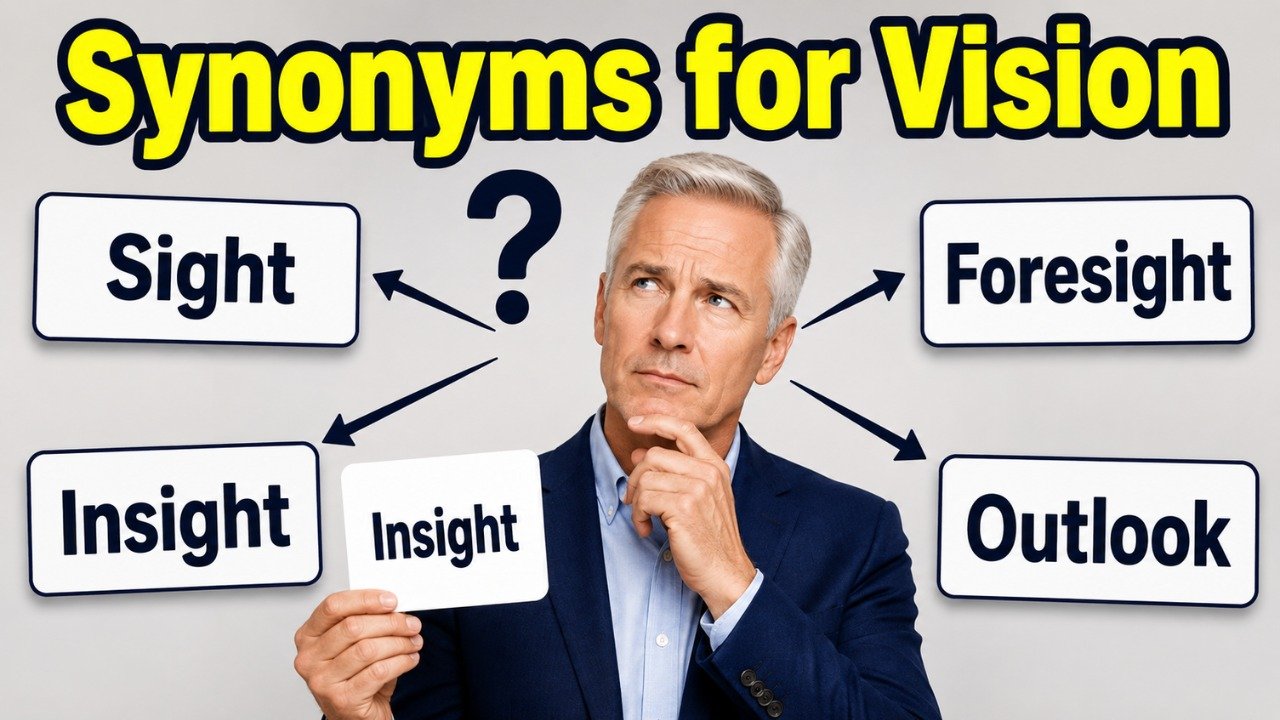
Quick Answer: The best synonyms for vision include sight, eyesight, view, perception, perspective, insight, foresight, dream, aspiration, and plan. Use sight or eyesight for the physical ability to see, perspective for a way of understanding something, insight for deep understanding, foresight for anticipating future needs, dream or aspiration for a desired future, and plan for a clear course of action. The best replacement depends on whether vision refers to seeing, imagination, leadership, future goals, spiritual experiences, or personal understanding.
Pronunciation and Word Details
Word: Vision.
Pronunciation: /ˈvɪʒən/
Part of Speech: Noun.
Meaning: The ability to see, a mental picture, or a clear idea of what the future should become.
US Pronunciation:
UK Pronunciation:
What Does “Vision” Mean?
Vision means the ability to see, a mental image, or an idea about a desirable future. It is mainly used as a noun and has several meanings in physical, personal, professional, creative, and spiritual contexts.
In a physical context, vision refers to eyesight or visual perception. A person may have clear vision, poor vision, night vision, or limited vision.
In a mental context, vision describes an image formed in the mind. Writers, artists, designers, and inventors may begin with a vision of what they want to create.
In leadership and planning, vision means a clear and inspiring picture of the future. A leader may have a vision for a community, organization, project, or social improvement.
Vision can also describe a dream, unusual visual experience, revelation, or imagined scene. The intended meaning usually becomes clear from the surrounding sentence.
Meaning, Tone, and Context of “Vision”
Vision usually has a neutral, positive, and sometimes inspirational tone. Its tone changes according to the subject being discussed.
Medical Context: Vision refers to the physical ability to see clearly.
Professional Context: Vision describes a long term purpose, direction, or desired result.
Leadership Context: Vision represents an inspiring idea that guides decisions and motivates people.
Creative Context: Vision means a mental picture of a finished design, story, artwork, or project.
Personal Context: Vision can describe an ambition, dream, life goal, or preferred future.
Academic Context: Vision may refer to perception, visual processing, imagination, or strategic thinking.
Spiritual Context: Vision can describe a revelation, symbolic image, or supernatural experience.
Conversational Context: People often use vision when describing what they hope to achieve or how they imagine something developing.
Vision is common in formal reports, essays, presentations, planning documents, personal development writing, medical discussions, and everyday speech.
When and How to Use “Vision”
For Physical Sight
Use vision when referring to the ability of the eyes and brain to recognize visual information.
Example: Her vision improved after receiving the correct treatment.
For a Mental Picture
Use vision when someone imagines how a person, place, object, or situation might appear.
Example: The architect had a clear vision of the completed building.
For Future Direction
Use vision when discussing a clear idea about what a project, group, or community should achieve.
Example: The director shared her vision for the future of the program.
For Leadership
Use vision when describing the ability to identify meaningful opportunities and guide others toward a future goal.
Example: Strong leadership requires vision, patience, and practical judgment.
For Personal Ambition
Use vision when discussing an individual’s hopes, aspirations, or desired life.
Example: His vision was to create a peaceful and meaningful life.
For Creative Planning
Use vision when describing the central idea behind a story, design, performance, or work of art.
Example: Every detail supported the designer’s original vision.
For Insight and Understanding
Use vision when someone can recognize possibilities or understand a situation beyond its immediate appearance.
Example: Her vision allowed the team to recognize an opportunity others had missed.
For a Spiritual Experience
Use vision when referring to a vivid symbolic, religious, or supernatural experience.
Example: He described a vision that gave him hope during a difficult time.
Best Synonyms for Vision
Sight: The physical ability to see.
Example: His sight became clearer after he received new glasses.
Eyesight: A person’s ability to see with the eyes.
Example: Regular examinations can help identify changes in eyesight.
Perception: The way something is seen, understood, or interpreted.
Example: Public perception of the proposal gradually improved.
Perspective: A particular way of thinking about or viewing something.
Example: Traveling gave her a broader perspective on life.
Insight: A deep and accurate understanding of a person, problem, or situation.
Example: The survey offered valuable insight into customer needs.
Foresight: The ability to anticipate future events, needs, or difficulties.
Example: Careful preparation showed remarkable foresight.
Outlook: A general attitude toward life or an expectation about the future.
Example: His positive outlook helped the team remain confident.
Dream: A deeply desired idea or future achievement.
Example: Her dream was to open a community learning center.
Aspiration: A strong hope or ambition to achieve something important.
Example: Becoming a skilled writer was one of his greatest aspirations.
Plan: A detailed idea about what should happen and how it will be achieved.
Example: The team developed a practical plan for improving the service.
50 Synonyms for Vision With Short Meanings
- Sight: The physical ability to see.
- Eyesight: A person’s natural visual ability.
- Seeing: The act or process of noticing with the eyes.
- Visual Perception: The ability to interpret visible information.
- View: What can be seen or a particular opinion.
- Field of View: The complete area visible at one time.
- Visibility: The degree to which something can be seen.
- Perception: The way something is noticed or understood.
- Perspective: A particular way of viewing a situation.
- Viewpoint: A position or opinion from which something is considered.
- Point of View: A person’s way of seeing or judging something.
- Outlook: An attitude or expectation about the future.
- Awareness: Knowledge or understanding of what is happening.
- Discernment: The ability to recognize important differences clearly.
- Insight: Deep understanding of a subject or situation.
- Foresight: The ability to anticipate future needs or events.
- Imagination: The ability to form new pictures or ideas in the mind.
- Conception: An idea formed through thought or imagination.
- Idea: A thought, suggestion, or possible course of action.
- Image: A picture formed visually or mentally.
- Mental Image: A picture created in the mind.
- Picture: A visual or imagined representation of something.
- Visualization: The act of forming a clear mental picture.
- Impression: An idea or feeling formed about something.
- Dream: A desired future or imagined experience.
- Aspiration: A strong hope to achieve something.
- Ambition: A determined desire for success or progress.
- Goal: A result that someone wants to achieve.
- Objective: A specific result toward which effort is directed.
- Purpose: The main reason something exists or is done.
- Mission: An important purpose that guides action.
- Direction: The general path toward a future result.
- Plan: A method created to achieve a result.
- Strategy: A carefully organized approach to reaching a goal.
- Blueprint: A detailed model or plan for future action.
- Roadmap: A clear outline of planned stages and goals.
- Concept: A general idea or guiding thought.
- Ideal: A perfect standard or desired future condition.
- Expectation: A belief about what is likely to happen.
- Anticipation: Awareness or expectation of a future event.
- Prediction: A statement about what may happen.
- Forecast: An estimate of future conditions or events.
- Prophecy: A prediction believed to have special authority.
- Revelation: A striking truth or message that becomes known.
- Apparition: A mysterious figure or image that appears.
- Hallucination: A sensory experience without an external cause.
- Scene: A viewed, remembered, or imagined setting.
- Vista: A broad and attractive view.
- Panorama: A wide and complete visual scene.
- Design: A planned idea for how something should appear or function.
Read Also:
Synonyms for Pattern

Synonyms for Vision by Context
When Vision Means Physical Sight
Sight, eyesight, seeing, visual perception, field of view, and visibility refer to the physical process or ability of seeing.
Example: The condition affected his eyesight in low light.
Example: The trees blocked her field of view.
Sight is the strongest general alternative. Eyesight refers more specifically to a person’s visual ability. Visibility describes how easily an object can be seen.
When Vision Means a Way of Thinking
Perspective, perception, viewpoint, point of view, outlook, awareness, and discernment describe how a person understands or interprets something.
Example: The discussion gave everyone a different perspective.
Example: Her perception of the situation changed after hearing both sides.
Perspective is useful when discussing beliefs or attitudes. Perception often describes an interpretation that may or may not be completely accurate.
When Vision Means Deep Understanding
Insight, discernment, awareness, and foresight work when vision refers to intelligence, judgment, or the ability to recognize possibilities.
Example: His insight helped solve a complicated problem.
Example: The decision demonstrated considerable foresight.
Insight focuses on understanding a current situation. Foresight focuses on anticipating future developments.
When Vision Means a Mental Picture
Image, mental image, picture, visualization, conception, impression, imagination, and scene are useful when describing something formed in the mind.
Example: She formed a mental image of the finished garden.
Example: The writer’s imagination created a convincing fictional world.
Visualization often describes the deliberate act of imagining a result. Mental image refers to the picture itself.
When Vision Means a Desired Future
Dream, aspiration, ambition, goal, objective, ideal, and expectation describe something a person hopes to achieve.
Example: His aspiration was to improve education in his community.
Example: Their shared dream gave the project emotional meaning.
Dream is emotional and conversational. Aspiration is more formal. Goal and objective are practical and measurable.
When Vision Means Strategic Direction
Plan, strategy, blueprint, roadmap, direction, mission, purpose, concept, and design are suitable for leadership, planning, and professional writing.
Example: The roadmap explains how the team will reach its goals.
Example: Their strategy supports the wider vision for growth.
Mission explains why a group exists. Vision explains what it hopes the future will look like. Strategy explains how it plans to reach that future.
When Vision Means a Spiritual or Unusual Experience
Revelation, prophecy, apparition, hallucination, image, and dream can describe a vivid experience that appears real or carries symbolic meaning.
Example: The character believed the dream was a revelation.
Example: The patient reported seeing an apparition in the room.
These words are not interchangeable in every situation. Revelation and prophecy may carry spiritual meanings, while hallucination is generally used in medical or psychological contexts.
Another Word for Vision
Sight is the best single replacement when vision refers to physical seeing. However, perspective is better for opinions, dream is better for a hoped for future, foresight is better for future awareness, and plan is better for organized action.
Original: The illness affected her vision.
Better Option: The illness affected her eyesight.
Original: The leader presented his vision for the community.
Better Option: The leader presented his plan for the community’s future.
Original: The experience changed her vision of success.
Better Option: The experience changed her perspective on success.
Original: He had the vision to prepare for future challenges.
Better Option: He had the foresight to prepare for future challenges.
When Not to Use “Vision”
Vision may sound vague when a more exact word would communicate the intended meaning. Readers may not know whether vision refers to eyesight, an opinion, a dream, a mental image, or a strategic plan.
When Discussing Medical Sight
Use eyesight or visual ability when the physical meaning needs to be completely clear.
Weak: His vision has become weaker recently.
Better: His eyesight has become weaker recently.
When Discussing a Specific Goal
Use goal or objective when the desired result can be measured.
Weak: Our vision is to increase participation by twenty percent.
Better: Our objective is to increase participation by twenty percent.
When Discussing an Opinion
Use perspective or viewpoint when describing someone’s way of thinking.
Weak: I understand your vision of the issue.
Better: I understand your perspective on the issue.
When Discussing a Practical Method
Use plan or strategy when explaining how an outcome will be achieved.
Weak: The team created a vision for completing the project.
Better: The team created a plan for completing the project.
When Discussing Future Awareness
Use foresight when the sentence focuses on anticipating consequences or needs.
Weak: She showed vision by saving emergency funds.
Better: She showed foresight by saving emergency funds.
When Discussing an Imagined Picture
Use mental image or visualization when describing a picture created in the mind.
Weak: He developed a vision of the new room.
Better: He developed a mental image of the new room.
Avoid repeating vision throughout professional or motivational writing. Replace it with specific words such as purpose, direction, aspiration, strategy, or goal when those meanings are intended.
Words Commonly Confused With Vision
Vision vs Sight: Vision can mean physical seeing, imagination, or future direction. Sight mainly refers to the ability to see or something that is visible.
Vision vs Eyesight: Vision has several abstract meanings. Eyesight refers specifically to the ability of the eyes to see.
Vision vs Perspective: Vision can describe an imagined future. Perspective describes a particular way of understanding or judging something.
Vision vs Insight: Vision may refer to a broad future idea. Insight is a deep understanding of a current person, problem, or situation.
Vision vs Foresight: Vision is an idea of a desired future. Foresight is the ability to anticipate future events and prepare for them.
Vision vs Mission: Vision explains the future someone hopes to create. Mission explains the present purpose and responsibilities guiding the work.
Vision vs Goal: Vision is usually broad and inspirational. A goal is a specific result that can often be measured.
Vision vs Strategy: Vision describes the desired destination. Strategy describes the organized method used to reach it.
Vision vs Dream: Vision may be inspirational but often includes direction and purpose. Dream can be more personal, emotional, or imaginative.
Vision vs Hallucination: Vision can describe many ordinary and positive ideas. Hallucination specifically refers to a sensory experience that occurs without an external stimulus.
Which Synonym Should You Choose?
Choose sight when referring generally to the physical ability to see.
Choose eyesight when discussing a person’s visual health or ability.
Choose perception when explaining how someone interprets information, events, or people.
Choose perspective when discussing an opinion, attitude, or way of understanding life.
Choose insight when describing deep understanding of a problem, person, or subject.
Choose foresight when describing the ability to anticipate future needs, risks, or opportunities.
Choose outlook when discussing a person’s attitude toward life or expectations about the future.
Choose dream when describing an emotional or deeply desired future.
Choose aspiration when writing formally about personal or professional hopes.
Choose goal when the desired result is specific and measurable.
Choose objective in reports, projects, essays, and professional planning.
Choose mission when explaining the central purpose of a person, group, or organization.
Choose plan when discussing a practical series of actions.
Choose strategy when describing a carefully designed method for reaching a result.
Choose blueprint or roadmap when presenting an organized model for future progress.
Choose mental image or visualization when describing something imagined clearly.
Choose revelation, prophecy, or apparition only when the spiritual or unusual meaning is genuinely intended.
Real Life Examples of “Vision” in Sentences
Original: Her vision became unclear while she was driving.
Better Option: Her eyesight became unclear while she was driving.
Original: The trip changed his vision of the world.
Better Option: The trip changed his perspective on the world.
Original: The manager explained her vision for the department.
Better Option: The manager explained her plan for the department’s future.
Original: His vision helped him recognize the coming challenge.
Better Option: His foresight helped him recognize the coming challenge.
Original: She had a vision of becoming a successful author.
Better Option: She had an aspiration to become a successful author.
Original: The designer brought his vision to life.
Better Option: The designer brought his concept to life.
Original: The report provides a clearer vision of public attitudes.
Better Option: The report provides clearer insight into public attitudes.
Original: Their vision was to build a safer neighborhood.
Better Option: Their goal was to build a safer neighborhood.
Original: I could see the entire vision clearly in my mind.
Better Option: I could see the entire mental image clearly.
Original: The group needs a shared vision before making decisions.
Better Option: The group needs a shared direction before making decisions.
Synonym Groups and Usage Differences
Physical Sight Group
Sight, eyesight, seeing, visual perception, visibility, and field of view relate to the eyes and the process of seeing.
Sight is broad and natural. Eyesight focuses on personal visual ability. Visual perception describes how the brain interprets what the eyes observe.
Example: Good lighting improves visibility and reduces eye strain.
Understanding Group
Perception, perspective, viewpoint, awareness, discernment, and insight describe ways of noticing or understanding information.
Perception may be subjective. Perspective is a particular way of thinking. Insight suggests deeper understanding. Discernment emphasizes careful judgment.
Example: Her insight revealed the real cause of the disagreement.
Future Thinking Group
Foresight, outlook, anticipation, prediction, forecast, and expectation relate to future possibilities.
Foresight is an ability. Prediction and forecast are statements about what may happen. Expectation is a belief about a likely result.
Example: The forecast suggests that demand will increase.
Imagination Group
Imagination, image, mental image, visualization, picture, conception, impression, and scene describe ideas or pictures formed in the mind.
Imagination is the creative ability. Visualization is the process of forming a picture. A mental image is the result of that process.
Example: Visualization helped her prepare for the presentation.
Ambition Group
Dream, aspiration, ambition, goal, objective, and ideal describe desired future results.
Dream is emotional. Aspiration sounds thoughtful and formal. Ambition emphasizes determination. Goal and objective are more practical.
Example: His main objective was to complete the training successfully.
Leadership Group
Mission, purpose, direction, plan, strategy, blueprint, roadmap, design, and concept describe organized future thinking.
Purpose explains why something matters. Direction identifies the path. Strategy describes the method. A roadmap outlines the stages.
Example: The roadmap provides clear direction for the next phase.
Spiritual Experience Group
Revelation, prophecy, apparition, dream, and vision may describe symbolic or supernatural experiences.
Revelation suggests that a hidden truth has been revealed. Prophecy predicts a future event. Apparition describes a mysterious visible figure.
Example: The story begins with a prophecy about the kingdom’s future.
Antonyms of Vision
The antonyms of vision depend on whether it means eyesight, understanding, planning, or future ambition.
Blindness: The inability to see.
Sightlessness: A condition in which vision is absent.
Obscurity: A lack of clarity or visibility.
Confusion: An inability to understand something clearly.
Ignorance: A lack of knowledge or awareness.
Misunderstanding: An incorrect interpretation of something.
Shortsightedness: A failure to consider long term effects.
Improvidence: A lack of preparation for future needs.
Aimlessness: A lack of goals, purpose, or direction.
Uncertainty: A lack of confidence about what will happen.
Indecision: Difficulty choosing a course of action.
Purposelessness: The absence of a meaningful reason or goal.
Reality: Actual circumstances rather than an imagined scene or dream.
Fact: Something known to be true rather than imagined.
Forgetfulness: Failure to retain an image, idea, or intention.
Comparison: Vision vs Related Words
Vision vs Sight
Vision is broader than sight. It can describe eyesight, imagination, judgment, or a future goal. Sight usually refers to physical seeing.
Example With Vision: The director shared her vision for the new project.
Example With Sight: His sight improved after the procedure.
Vision vs Eyesight
Vision may be physical or abstract. Eyesight only describes a person’s visual ability.
Example With Vision: Her vision for the community inspired many volunteers.
Example With Eyesight: Her eyesight is excellent in daylight.
Vision vs Perspective
Vision often describes a future possibility or mental image. Perspective describes a way of interpreting something.
Example With Vision: They have a clear vision of a greener city.
Example With Perspective: The conversation changed my perspective on the problem.
Vision vs Insight
Vision is often broad and future focused. Insight is a deep understanding of a specific issue.
Example With Vision: His vision guided the company’s long term development.
Example With Insight: His insight helped identify the source of the failure.
Vision vs Foresight
Vision describes what someone hopes the future will become. Foresight describes the ability to predict needs and prepare wisely.
Example With Vision: Her vision was to create an accessible public library.
Example With Foresight: Her foresight led her to reserve additional funding.
Vision vs Mission
Vision describes the future destination. Mission describes the present purpose and actions.
Example With Vision: Our vision is a community where every child can learn.
Example With Mission: Our mission is to provide affordable educational support.
Vision vs Goal
Vision is broad and inspirational. A goal is specific, practical, and often measurable.
Example With Vision: The school’s vision is to encourage lifelong learning.
Example With Goal: The school’s goal is to improve reading scores this term.
Vision vs Strategy
Vision identifies the desired future. Strategy explains how that future will be achieved.
Example With Vision: The team’s vision is to offer faster service.
Example With Strategy: The team’s strategy includes better training and simpler procedures.
Vision vs Dream
Vision often includes purpose and direction. Dream may describe a personal hope without a detailed plan.
Example With Vision: She created a vision for expanding the program.
Example With Dream: Her dream was to help children discover a love of books.
Common Phrases and Expressions With “Vision”
Clear Vision: A well defined idea or the ability to see clearly.
Blurred Vision: Sight that appears unclear or unfocused.
Double Vision: A condition in which one object appears as two.
Night Vision: The ability to see in low light conditions.
Peripheral Vision: The ability to see objects outside the direct line of sight.
Vision for the Future: A clear idea of what should happen in later years.
Shared Vision: A future goal accepted by several people.
Creative Vision: An original idea guiding artistic or design work.
Strategic Vision: A long term idea that guides planning and decisions.
Personal Vision: An individual’s picture of a meaningful future.
Vision Statement: A brief explanation of a desired future condition.
Bring a Vision to Life: Turn an imagined idea into reality.
Common Mistakes to Avoid
Using Vision Without Clear Context
Vision has several meanings. Make the sentence clear enough to show whether it refers to sight, imagination, planning, or ambition.
Unclear: Her vision suddenly changed.
Clearer: Her vision for the project suddenly changed.
Clearer: Her eyesight suddenly became blurred.
Confusing Vision With Mission
A vision describes the future you hope to create. A mission explains what you do now and why you do it.
Incorrect: Our vision is to provide daily educational support.
Better: Our mission is to provide daily educational support.
Using Vision Instead of a Measurable Goal
Vision is broad. Use goal or objective when a result is specific and measurable.
Weak: Our vision is to gain five hundred new members.
Better: Our goal is to gain five hundred new members.
Confusing Vision With Foresight
Vision describes a desired future. Foresight is the ability to anticipate what may happen.
Unclear: He had the vision to prepare for the shortage.
Better: He had the foresight to prepare for the shortage.
Repeating Vision Too Often
Frequent repetition can make professional writing sound vague or promotional.
Repetitive: Our vision supports our vision for growth and our vision for better service.
Better: Our purpose supports long term growth and improved service.
Choosing an Overly Formal Alternative
Words such as strategic vision or long term objective may sound unnatural in casual conversation.
Formal: My personal vision is to learn how to cook.
Natural: My goal is to learn how to cook.
Using Hallucination as a General Synonym
Hallucination is appropriate only when someone experiences something that appears real without an external cause. It should not replace vision in ordinary planning or imagination contexts.
Treating Every Synonym as Interchangeable
Sight, perspective, dream, insight, and strategy represent different meanings. Always identify the intended meaning before choosing a replacement.
Conclusion
Synonyms for vision change according to whether the word refers to physical sight, personal understanding, imagination, ambition, or future planning. Use sight or eyesight for visual ability, perspective for a way of thinking, insight for deep understanding, and foresight for future awareness. Dream and aspiration suit personal hopes, while goal, mission, plan, and strategy work well in professional contexts. Choosing a precise alternative makes each sentence clearer, more natural, and easier for readers to understand.
FAQs About Synonyms for Vision
What Is the Best Synonym for Vision?
Sight is the best synonym when vision refers to seeing. Perspective, dream, insight, foresight, or plan may be better for abstract meanings.
What Is Another Word for a Future Vision?
Dream, aspiration, goal, ideal, outlook, plan, blueprint, and roadmap can describe a future vision.
What Is a Synonym for Strong Vision?
Foresight, insight, strategic thinking, clear direction, and long term perspective can describe strong vision in leadership or planning.
Is Perspective a Synonym for Vision?
Perspective can replace vision when the word means a way of viewing or understanding something. It cannot replace vision when referring to eyesight.
What Is the Difference Between Vision and Mission?
Vision describes the future someone hopes to create. Mission describes the current purpose and work used to move toward that future.
Can Dream Replace Vision?
Dream can replace vision when discussing a personal hope or imagined future. Vision usually suggests more direction, clarity, and purpose than dream.
What Is the Opposite of Vision?
Possible antonyms include blindness, confusion, ignorance, shortsightedness, aimlessness, uncertainty, and purposelessness, depending on the meaning.
