
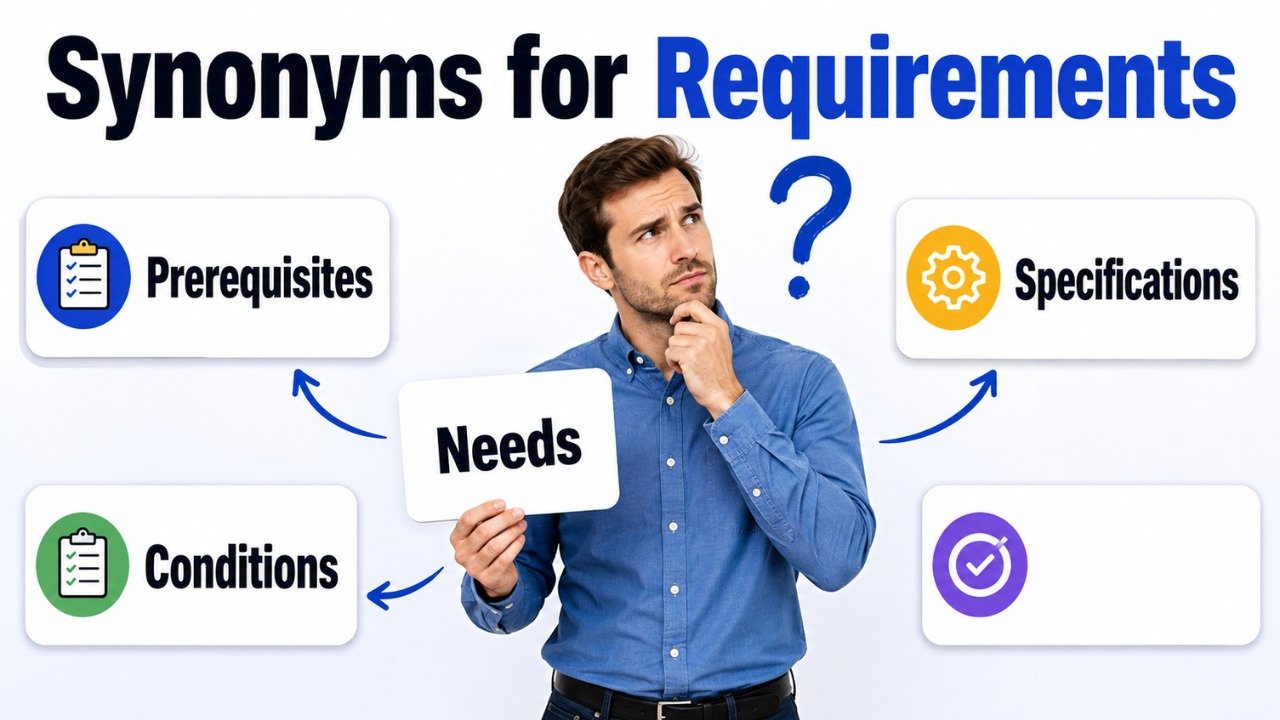
Quick Answer: The best synonyms for requirements are needs, conditions, criteria, standards, specifications, prerequisites, qualifications, obligations, stipulations, and demands. Use needs for necessary things, conditions for rules that must be satisfied, criteria for judging eligibility, and specifications for precise technical details. Prerequisites work best for things needed beforehand, while obligations describe duties. The correct alternative depends on whether you are discussing personal needs, formal rules, employment qualifications, project expectations, or legal responsibilities.
Pronunciation and Word Details
Word: Requirements.
Pronunciation: /rɪˈkwaɪərmənts/
Part of Speech: Plural noun.
Meaning: Things, conditions, abilities, or standards that are necessary or must be provided.
US Pronunciation:
UK Pronunciation:
What Does “Requirements” Mean?
Requirements are the things, conditions, standards, or qualifications that are necessary for a particular purpose.
The word requirements is the plural form of requirement. It is commonly used as a noun when discussing rules, applications, employment, education, technology, projects, safety, and personal needs.
Requirements can describe physical things that someone needs. They can also refer to formal conditions that a person must satisfy.
Need Context: The basic requirements for the trip include food, water, and suitable clothing.
Eligibility Context: Applicants must meet the admission requirements.
Work Context: The manager explained the requirements of the position.
Technical Context: The computer meets the software requirements.
Legal Context: The business followed all safety requirements.
The exact meaning depends on the sentence. In one context, requirements may mean needs. In another, they may mean rules, qualifications, specifications, or obligations.
Meaning, Tone, and Context of “Requirements”
Requirements is generally a neutral or formal word. It often suggests that something is necessary rather than optional.
The word appears frequently in professional, academic, technical, administrative, and legal writing. It is also common in everyday conversation when people discuss what they need.
Formal Tone: Requirements is suitable for applications, reports, contracts, policies, and official instructions.
Professional Tone: Employers use the word when describing the education, skills, or experience needed for a position.
Academic Tone: Schools use requirements for courses, grades, documents, and admission conditions.
Technical Tone: Developers, engineers, and project teams use requirements for functions, specifications, resources, and expected results.
Conversational Tone: Requirements may sound slightly formal in casual speech. Needs is often more natural when discussing ordinary personal necessities.
Requirements usually carries a stronger sense of necessity than preferences, wishes, or suggestions.
When and How to Use “Requirements”
For Essential Needs
Use requirements when referring to the things necessary for an activity, person, or process.
Example: The shelter provides the basic requirements for the animals.
For Entry Conditions
Use requirements for conditions that a person must satisfy before entering a school, program, profession, or organization.
Example: She reviewed the entry requirements before applying.
For Employment Qualifications
Use requirements when discussing the education, skills, experience, or certifications needed for a job.
Example: Three years of experience is one of the main job requirements.
For Technical Specifications
Use requirements for exact features, capabilities, or resources that a product or system must have.
Example: The new computer satisfies the system requirements.
For Rules and Regulations
Use requirements when describing official rules that people or organizations must follow.
Example: The building meets all current safety requirements.
For Project Expectations
Use requirements for tasks, features, resources, or results expected within a project.
Example: The team discussed the project requirements before starting the work.
For Personal Needs
Requirements can describe what a person needs, although needs often sounds more natural in casual speech.
Example: Each guest has different dietary requirements.
Best Synonyms for Requirements
Needs
Synonym: Needs are things that are necessary for a person, activity, or situation.
Example: The program was designed around the needs of new learners.
Conditions
Synonym: Conditions are rules or circumstances that must be accepted or satisfied.
Example: Candidates must satisfy several conditions before joining the course.
Criteria
Synonym: Criteria are standards used to judge, select, or evaluate something.
Example: Experience and communication skills are important selection criteria.
Standards
Synonym: Standards are expected levels of quality, safety, behavior, or performance.
Example: The product meets the required safety standards.
Specifications
Synonym: Specifications are precise descriptions of required features, dimensions, or functions.
Example: The engineer checked the design specifications carefully.
Prerequisites
Synonym: Prerequisites are things that must be completed or obtained before something else can happen.
Example: Basic mathematics is one of the prerequisites for the course.
Qualifications
Synonym: Qualifications are skills, achievements, education, or experience needed for a position.
Example: Her qualifications made her suitable for the role.
Obligations
Synonym: Obligations are duties or responsibilities that a person is expected or required to fulfill.
Example: Both parties must understand their legal obligations.
Stipulations
Synonym: Stipulations are clearly stated conditions included in an agreement or arrangement.
Example: The agreement contains several payment stipulations.
Demands
Synonym: Demands are strong needs or expectations that require attention or action.
Example: The demands of the position include frequent travel.
50 Synonyms for Requirements with Short Meanings
- Needs: Things that are necessary.
- Necessities: Essential things that cannot easily be avoided.
- Essentials: The most important or basic things needed.
- Requisites: Necessary items, qualities, or conditions.
- Prerequisites: Things that must be completed beforehand.
- Preconditions: Conditions that must exist before an action.
- Conditions: Terms or circumstances that must be satisfied.
- Criteria: Standards used for judgment or selection.
- Standards: Expected levels of quality or performance.
- Specifications: Exact details describing what is required.
- Qualifications: Skills or achievements needed for a role.
- Obligations: Duties that must be fulfilled.
- Duties: Tasks that someone is responsible for performing.
- Responsibilities: Work or commitments someone is expected to handle.
- Demands: Strong needs or expectations.
- Expectations: Results or behavior that people anticipate.
- Stipulations: Clearly stated conditions in an agreement.
- Rules: Principles that control actions or behavior.
- Regulations: Official rules established by an authority.
- Guidelines: Directions that recommend how something should be done.
- Instructions: Directions explaining what must be completed.
- Directives: Authoritative instructions or orders.
- Mandates: Official commands that must be followed.
- Terms: Agreed conditions of an arrangement.
- Clauses: Individual conditions within a formal agreement.
- Provisions: Formal conditions or arrangements within a document.
- Parameters: Fixed limits or boundaries for an activity.
- Restrictions: Rules that limit what is permitted.
- Constraints: Conditions that limit choices or actions.
- Benchmarks: Reference levels used to measure performance.
- Measures: Standards or actions used for evaluation.
- Minimums: The lowest acceptable amounts or levels.
- Targets: Specific results that should be achieved.
- Objectives: Goals that a person or project must accomplish.
- Deliverables: Required results or items produced by a project.
- Features: Particular qualities expected in a product.
- Functions: Actions that a system or product must perform.
- Capabilities: Abilities that a person or system must possess.
- Components: Necessary parts of a larger system.
- Inputs: Information or resources needed for a process.
- Resources: Money, people, tools, or time needed for work.
- Materials: Physical items needed to complete an activity.
- Documentation: Written records or evidence that must be provided.
- Credentials: Proof of identity, education, or ability.
- Approvals: Official permissions needed before proceeding.
- Permits: Formal authorizations for particular activities.
- Certifications: Official proof that standards have been met.
- Eligibility Conditions: Standards that determine whether someone qualifies.
- Musts: Informal term for things considered essential.
- Requests: Things that a person or client asks to receive.
Read Also:
Synonyms for Vision

Synonyms for Requirements by Context
When Requirements Means Necessary Needs
When requirements refers to basic or essential things, use needs, necessities, essentials, or requisites.
Needs is the most natural word in everyday communication. Necessities emphasizes that the items are essential. Essentials refers to the most important items, while requisites sounds more formal.
Example With Requirements: The family explained its housing requirements.
Example With Needs: The family explained its housing needs.
Example With Essentials: Pack the essentials for the journey.
When Requirements Means Conditions
Use conditions, terms, stipulations, or provisions for rules that must be accepted or satisfied.
Conditions works in both formal and general writing. Terms is common for agreements. Stipulations and provisions are more formal and are often connected with contracts or policies.
Example With Requirements: You must accept the requirements of the agreement.
Example With Terms: You must accept the terms of the agreement.
Example With Stipulations: The contract includes several important stipulations.
When Requirements Means Selection Standards
Use criteria, qualifications, prerequisites, credentials, or eligibility conditions when discussing admission, employment, or selection.
Criteria are standards used for judgment. Qualifications describe relevant skills, education, or experience. Prerequisites are things needed before participation.
Example With Requirements: She meets all the requirements for the position.
Example With Qualifications: She has all the qualifications for the position.
Example With Criteria: Every application will be judged according to the same criteria.
When Requirements Means Technical Details
Use specifications, parameters, features, functions, capabilities, or components for technical and product related contexts.
Specifications is the strongest choice for exact technical details. Parameters describe fixed boundaries. Features and functions describe what a product includes and what it can do.
Example With Requirements: The device was built according to the client’s requirements.
Example With Specifications: The device was built according to the client’s specifications.
Example With Parameters: The design stays within the approved parameters.
When Requirements Means Duties
Use obligations, duties, responsibilities, mandates, or directives when requirements describes something a person must do.
Obligations often has a formal or legal meaning. Duties refers to assigned tasks. Responsibilities describes work or commitments that someone is expected to manage.
Example With Requirements: Employees must understand the requirements of their roles.
Example With Responsibilities: Employees must understand the responsibilities of their roles.
Example With Obligations: The tenant fulfilled all contractual obligations.
When Requirements Means Expected Results
Use expectations, standards, benchmarks, targets, objectives, or deliverables when discussing performance or project results.
Expectations describes what someone anticipates. Standards and benchmarks describe quality or performance levels. Deliverables are specific outputs that must be produced.
Example With Requirements: The project requirements were explained during the meeting.
Example With Deliverables: The project deliverables were explained during the meeting.
Example With Objectives: The team completed all project objectives.
Another Word for Requirements
Needs is usually the best general replacement for requirements. It is clear, familiar, and suitable when discussing necessary things.
However, the best alternative depends on the context. Conditions may be better for rules, qualifications for employment, specifications for technical details, and obligations for duties.
Original: We discussed the customer’s requirements.
Better Option: We discussed the customer’s needs.
Original: She satisfies the requirements for the job.
Better Option: She has the qualifications for the job.
Original: The machine meets all performance requirements.
Better Option: The machine meets all performance standards.
Original: Please review the design requirements.
Better Option: Please review the design specifications.
When Not to Use “Requirements”
Requirements may sound unnecessarily formal when you are discussing simple personal needs.
Weak: Tell me your lunch requirements.
Better: Tell me what you need for lunch.
Avoid requirements when a more precise term can explain the type of information you mean.
Weak: The designer followed the requirements.
Better: The designer followed the technical specifications.
Do not use requirements for optional preferences unless those preferences are truly necessary.
Weak: My requirements include a blue chair, although another color is acceptable.
Better: I would prefer a blue chair, although another color is acceptable.
Requirements can also become repetitive in professional documents. Replace repeated uses with conditions, criteria, standards, specifications, or obligations where appropriate.
Weak: The requirements document lists the requirements that satisfy the project requirements.
Better: The project document lists the specifications and conditions that the final product must satisfy.
Avoid using requirements when you mean suggestions or recommendations. Requirements are normally mandatory, while suggestions are optional.
Weak: These optional requirements may help you improve.
Better: These optional guidelines may help you improve.
Words Commonly Confused With Requirements
Requirements vs Needs: Requirements often sounds formal and may describe mandatory conditions. Needs is more natural for essential things in everyday conversation.
Requirements vs Criteria: Requirements are things that must be provided or satisfied. Criteria are standards used to evaluate or judge a person, product, or result.
Requirements vs Qualifications: Requirements can include documents, conditions, skills, and experience. Qualifications specifically refer to the abilities, education, or achievements that make someone suitable.
Requirements vs Specifications: Requirements describe what is needed generally. Specifications give exact technical details about features, dimensions, materials, or performance.
Requirements vs Prerequisites: Requirements may apply at any stage. Prerequisites must be completed or obtained before another activity can begin.
Requirements vs Expectations: Requirements are usually mandatory. Expectations describe what someone believes or hopes will happen, but they may not always be compulsory.
Requirements vs Guidelines: Requirements must normally be followed. Guidelines provide recommended directions and may allow flexibility.
Requirements vs Regulations: Requirements may be created by any person, organization, project, or process. Regulations are official rules established by an authority.
Which Synonym Should You Choose?
Choose Needs: When discussing necessary personal, customer, community, or practical things.
Choose Conditions: When explaining rules that must be accepted or satisfied.
Choose Criteria: When discussing how people, applications, products, or results will be judged.
Choose Standards: When describing expected levels of safety, quality, accuracy, or performance.
Choose Specifications: When writing about technical details, measurements, materials, functions, or product features.
Choose Prerequisites: When something must be completed before a course, activity, or process can begin.
Choose Qualifications: When describing the skills, education, knowledge, or experience needed for employment.
Choose Obligations: When discussing legal, contractual, professional, or moral duties.
Choose Stipulations: When referring to clearly stated conditions in a formal agreement.
Choose Deliverables: When identifying the results, reports, designs, or products that a project must produce.
Choose Expectations: When discussing anticipated performance or behavior that may not be strictly mandatory.
Choose Musts: When speaking casually about essential items or actions.
Real Life Examples of “Requirements” in Sentences
Original: The applicant meets all the requirements for the position.
Better Option: The applicant has all the qualifications for the position.
Original: Please explain your requirements before we begin the design.
Better Option: Please explain your needs before we begin the design.
Original: The product meets the company’s quality requirements.
Better Option: The product meets the company’s quality standards.
Original: Students should review the course requirements.
Better Option: Students should review the course prerequisites and conditions.
Original: The engineer documented the system requirements.
Better Option: The engineer documented the system specifications.
Original: We completed all the requirements listed in the agreement.
Better Option: We fulfilled all the obligations listed in the agreement.
Original: The application requirements include proof of education.
Better Option: The application criteria include proof of education.
Original: The project requirements changed after the meeting.
Better Option: The project objectives and deliverables changed after the meeting.
Original: The hotel can accommodate your dietary requirements.
Better Option: The hotel can accommodate your dietary needs.
Original: The building satisfies all safety requirements.
Better Option: The building satisfies all safety regulations.
Synonym Groups and Usage Differences
Necessity Group
This group includes needs, necessities, essentials, requisites, and musts.
These words describe things that are necessary. Needs is the most natural general term. Necessities and essentials emphasize importance. Requisites is more formal, while musts is informal.
Example: Clean water is one of the community’s most urgent needs.
Condition Group
This group includes conditions, terms, stipulations, clauses, and provisions.
These words describe rules or arrangements that must be accepted. Conditions and terms are widely used. Stipulations, clauses, and provisions are more suitable for formal agreements.
Example: Read all the terms before accepting the agreement.
Selection Group
This group includes criteria, qualifications, prerequisites, credentials, and eligibility conditions.
These alternatives are useful in job, education, membership, and application contexts.
Example: Relevant experience is an important qualification for the role.
Standard Group
This group includes standards, benchmarks, measures, minimums, and expectations.
These words describe levels of performance, quality, safety, or behavior. Standards are usually established levels, while benchmarks are reference points used for comparison.
Example: Every product must meet the same quality standards.
Duty Group
This group includes obligations, duties, responsibilities, mandates, and directives.
These words describe actions that must be completed. Obligations often has a formal meaning, duties refers to assigned work, and responsibilities covers broader commitments.
Example: Managers have a responsibility to support their teams.
Technical and Project Group
This group includes specifications, parameters, features, functions, components, objectives, and deliverables.
These words describe what a product, system, or project must include or accomplish.
Example: The document lists the functions that the new system must perform.
Antonyms of Requirements
The opposite of requirements depends on whether the word refers to needs, rules, duties, or mandatory conditions.
Options: Things that may be chosen rather than required.
Preferences: Things that someone would like but does not necessarily need.
Choices: Alternatives that a person is free to select.
Flexibility: Freedom to adjust rules, methods, or conditions.
Freedom: The ability to act without strict requirements.
Exemptions: Official releases from particular requirements.
Waivers: Formal decisions that remove a requirement.
Permissions: Approvals allowing an action rather than demanding it.
Luxuries: Desirable things that are not essential.
Extras: Additional items that are not necessary.
Nonessentials: Things that are useful but not required.
Suggestions: Ideas offered for consideration rather than compulsory actions.
Comparison: Requirements vs Related Words
Requirements vs Needs
Requirements often refers to formal or mandatory conditions. Needs refers more generally to things that are necessary.
Example With Requirements: Applicants must satisfy the program requirements.
Example With Needs: The program supports the needs of adult learners.
Requirements vs Criteria
Requirements are conditions that must be met. Criteria are standards used to judge whether those conditions have been met.
Example With Requirements: A completed form is one of the application requirements.
Example With Criteria: Applications are evaluated according to five criteria.
Requirements vs Specifications
Requirements describe what a product or project must achieve. Specifications describe the exact details of how it should be constructed or operate.
Example With Requirements: The client explained what the system must accomplish.
Example With Specifications: The document lists the required dimensions and materials.
Requirements vs Qualifications
Requirements may include documents, conditions, availability, or skills. Qualifications specifically describe education, knowledge, training, and experience.
Example With Requirements: The position requires weekend availability.
Example With Qualifications: The position requires professional training and relevant experience.
Requirements vs Prerequisites
A requirement may apply before, during, or after a process. A prerequisite must be completed before another step begins.
Example With Requirements: Attendance is a requirement throughout the course.
Example With Prerequisites: Basic training is a prerequisite for the advanced course.
Requirements vs Obligations
Requirements are conditions or things that are necessary. Obligations are duties that a person or organization must fulfill.
Example With Requirements: The application has several documentation requirements.
Example With Obligations: The organization fulfilled its reporting obligations.
Common Phrases and Expressions With “Requirements”
Meet the Requirements: Satisfy all necessary conditions or standards.
Minimum Requirements: The lowest acceptable conditions, abilities, or standards.
Basic Requirements: The essential things needed for a purpose.
Entry Requirements: Conditions that must be met before joining a program or organization.
Job Requirements: Skills, education, experience, and duties connected with a position.
Legal Requirements: Conditions or actions required by law.
Safety Requirements: Rules and standards intended to prevent harm.
System Requirements: Hardware, software, memory, or other resources needed for a system.
Project Requirements: Features, resources, tasks, and results needed for a project.
Reporting Requirements: Information or documents that must be submitted.
Specific Requirements: Clearly identified needs or conditions.
Fulfill the Requirements: Complete or provide everything that is necessary.
Common Mistakes to Avoid
Using Requirements for Optional Preferences
A preference is something a person would like. A requirement is something that is necessary.
Incorrect: My preferred color is an important requirement, but any color is acceptable.
Correct: My preferred color is blue, but any color is acceptable.
Treating Guidelines as Requirements
Guidelines usually provide recommendations, while requirements normally describe mandatory conditions.
Incorrect: These optional requirements may be followed when convenient.
Correct: These optional guidelines may be followed when convenient.
Confusing Criteria and Criterion
Criteria is plural, while criterion is singular.
Incorrect: Experience is one of the main selection criteria, and it is the most important criteria.
Correct: Experience is one of the main selection criteria, and it is the most important criterion.
Using Requirements When Specifications Is More Precise
In technical writing, specifications often communicates exact details more clearly.
Weak: The requirements say the table must be 120 centimeters wide.
Better: The specifications state that the table must be 120 centimeters wide.
Using the Wrong Verb Form
Requirements is plural and normally takes a plural verb. Requirement is singular and takes a singular verb.
Incorrect: The requirements is clearly explained.
Correct: The requirements are clearly explained.
Incorrect: The main requirement are relevant experience.
Correct: The main requirement is relevant experience.
Repeating Requirements Too Often
Repeated use can make professional writing sound mechanical.
Weak: The requirements document describes the requirements needed to meet the client’s requirements.
Better: The project document describes the specifications and conditions needed to satisfy the client’s expectations.
Using Mandatory Requirements Unnecessarily
A requirement is normally mandatory by definition. The phrase mandatory requirements may be useful when distinguishing them from recommendations, but it is often repetitive.
Wordy: Applicants must satisfy all mandatory requirements.
Better: Applicants must satisfy all requirements.
Leaving Requirements Unclear
Do not mention requirements without explaining what they include.
Vague: Please submit all requirements soon.
Clear: Please submit your identification, application form, and proof of education by Friday.
Conclusion
Synonyms for requirements include needs, conditions, criteria, standards, specifications, prerequisites, qualifications, and obligations. Needs is the clearest choice for everyday necessities, while conditions and criteria suit formal applications and agreements. Use specifications for technical details, qualifications for employment, prerequisites for prior conditions, and obligations for duties. Choosing a precise synonym makes your writing clearer and helps readers understand whether you mean essential items, official rules, expected standards, technical details, or required responsibilities.
FAQs About Synonyms for Requirements
What Is the Best Synonym for Requirements?
Needs is the best general synonym. Conditions, criteria, specifications, qualifications, and obligations may be more accurate in specific contexts.
What Is a Formal Synonym for Requirements?
Requisites, stipulations, provisions, obligations, and prerequisites are formal alternatives. The best choice depends on the intended meaning.
What Is Another Word for Job Requirements?
Qualifications is best for skills, education, and experience. Responsibilities is better for tasks that an employee must perform.
Can Criteria Replace Requirements?
Criteria can replace requirements when referring to standards used for selection or evaluation. It is less suitable when referring to necessary objects or resources.
What Is Another Word for Technical Requirements?
Specifications is usually the strongest alternative. Parameters, features, functions, capabilities, and system needs may also work.
Are Requirements and Needs the Same?
They are similar, but requirements often sounds more formal and mandatory. Needs is more natural for personal or practical necessities.
What Is the Difference Between Requirements and Prerequisites?
Requirements are things that must be satisfied at any relevant stage. Prerequisites are conditions that must be completed before another activity can begin.
