
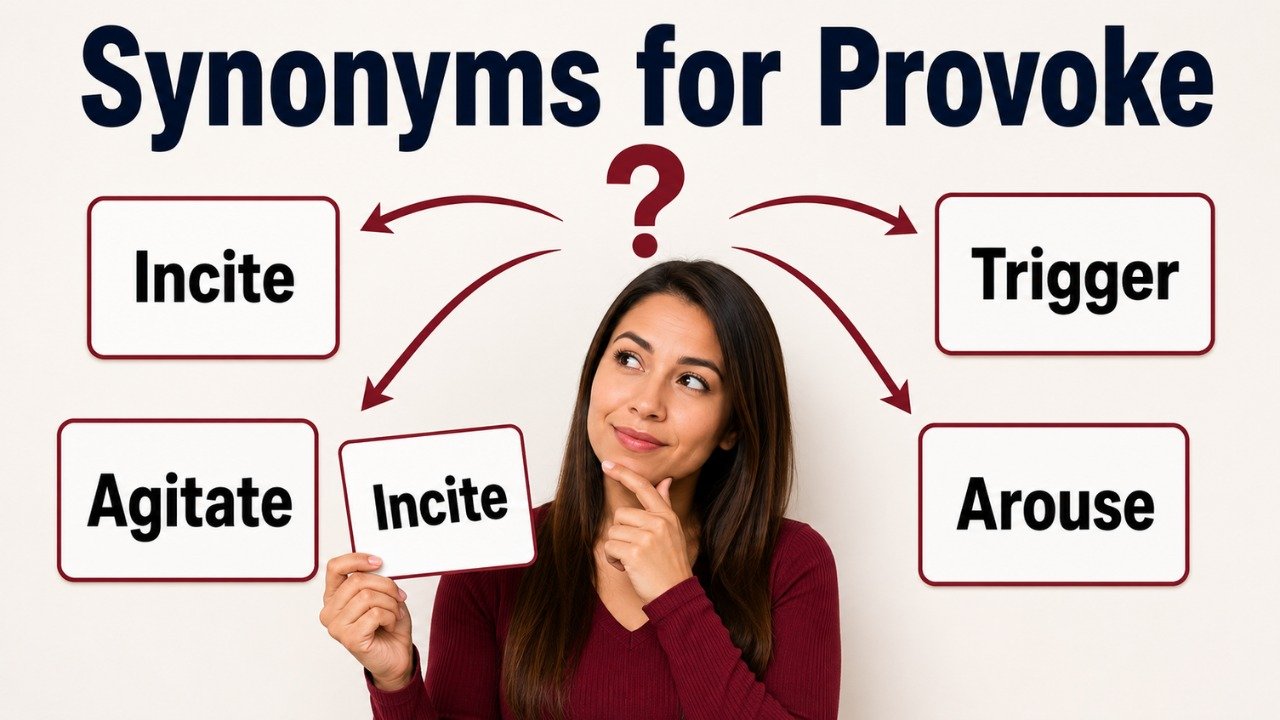
Quick Answer: Synonyms for provoke include incite, trigger, cause, arouse, stimulate, elicit, stir, irritate, antagonize, and inspire. Use incite when encouraging strong or harmful action, trigger when something causes an immediate reaction, and elicit when drawing out a response or answer. Irritate and antagonize suit anger or conflict, while stimulate and inspire work better for ideas, curiosity, creativity, and productive discussion. The best synonym depends on whether provoke means causing a reaction, creating anger, encouraging action, or stimulating thought.
Pronunciation and Word Details
Word: Provoke
Pronunciation: /prəˈvoʊk/
Part of Speech: Verb
Meaning: To cause a reaction, feeling, action, or response, especially one that is strong or noticeable.
US Pronunciation:
UK Pronunciation:
What Does “Provoke” Mean?
Provoke means to cause a person, group, event, feeling, or situation to react in a particular way. It is a verb that often describes the deliberate or accidental creation of anger, thought, action, discussion, curiosity, or emotion.
The word can have a negative meaning when someone intentionally annoys another person.
Example: He tried to provoke his opponent with insulting remarks.
Provoke can also have a neutral meaning when something causes a response.
Example: The announcement provoked several questions from the audience.
In academic, creative, and professional contexts, provoke may have a positive meaning. A book, idea, speech, or question may provoke thought, discussion, curiosity, or reflection.
Example: The documentary provoked a thoughtful conversation about personal responsibility.
The exact meaning therefore depends on what follows the verb. Provoke anger suggests irritation, provoke debate suggests stimulation, and provoke a reaction simply means to cause a response.
Meaning, Tone, and Context of “Provoke”
Provoke has a strong and active tone. It suggests that one action, statement, event, or idea produces a noticeable response.
In everyday conversation, provoke often refers to making someone angry or encouraging a confrontation. It may suggest that a person deliberately said or did something to create conflict.
Example: She remained calm even though he was trying to provoke her.
In formal writing, provoke can describe the cause of a reaction without suggesting bad intentions.
Example: The policy change provoked concern among employees.
In academic and analytical writing, the word is commonly used with nouns such as thought, debate, discussion, inquiry, reflection, criticism, and response.
Example: The research findings may provoke further investigation.
In medical or technical contexts, provoke can mean causing a physical response, symptom, or condition to appear.
Example: Certain movements may provoke discomfort in the injured area.
The word may therefore sound negative, neutral, intellectual, emotional, or technical according to its object and surrounding context.
When and How to Use “Provoke”
For Causing Anger: Use provoke when someone deliberately or unintentionally makes another person angry.
Example: His dismissive tone provoked anger among the residents.
For Starting Conflict: Use it when words or actions encourage an argument, confrontation, or hostile response.
Example: The rude comment provoked an unnecessary dispute.
For Causing a Reaction: Use provoke when an event or action produces a noticeable response.
Example: The unexpected decision provoked a mixed reaction from the committee.
For Encouraging Thought: Use it when an idea, question, or creative work makes people think deeply.
Example: The final chapter provoked reflection on the meaning of success.
For Starting Discussion: Use provoke when a subject leads people to exchange opinions or arguments.
Example: The proposal provoked a lively discussion about community priorities.
For Creating Emotion: Use it when something causes sadness, fear, sympathy, excitement, or another strong feeling.
Example: The photograph provoked a powerful sense of nostalgia.
For Encouraging Action: Use provoke when an event leads people to act.
Example: The shortage provoked immediate efforts to improve distribution.
For Producing a Physical Response: Use it when an action or substance causes a bodily reaction.
Example: Bright light may provoke discomfort in sensitive eyes.
Best Synonyms for Provoke
Incite: To encourage strong, disruptive, or harmful action.
Example: The speaker was accused of trying to incite unrest.
Trigger: To cause an event, feeling, memory, or reaction to begin.
Example: The sudden sound triggered a feeling of alarm.
Elicit: To draw out a response, answer, emotion, or reaction.
Example: The question elicited several honest responses.
Arouse: To awaken a feeling, interest, suspicion, or emotion.
Example: The unusual pattern aroused the researcher’s curiosity.
Stimulate: To encourage activity, thought, growth, or interest.
Example: The exercise was designed to stimulate creative thinking.
Stir: To awaken or increase a feeling, reaction, or activity.
Example: The speech stirred hope among the listeners.
Irritate: To make someone feel annoyed, uncomfortable, or impatient.
Example: His constant interruptions irritated the other participants.
Antagonize: To make someone hostile, angry, or opposed.
Example: The harsh response antagonized people who had initially offered support.
Inspire: To encourage an idea, feeling, decision, or action.
Example: Her courage inspired others to speak honestly.
Cause: To make something happen.
Example: The misunderstanding caused unnecessary tension.
50 Synonyms for Provoke with Short Meanings
- Incite: To encourage forceful or disruptive action.
- Trigger: To cause something to begin suddenly.
- Cause: To make an event or reaction happen.
- Elicit: To draw out an answer or response.
- Arouse: To awaken a feeling or interest.
- Stimulate: To encourage thought, activity, or growth.
- Stir: To awaken or strengthen an emotion.
- Irritate: To make someone annoyed or uncomfortable.
- Antagonize: To create hostility or opposition.
- Inspire: To encourage thought, feeling, or action.
- Instigate: To start or encourage an action or event.
- Inflame: To increase anger, conflict, or emotion.
- Agitate: To make someone worried, upset, or excited.
- Annoy: To cause mild anger or impatience.
- Enrage: To make someone extremely angry.
- Infuriate: To cause intense anger.
- Exasperate: To make someone deeply irritated or frustrated.
- Vex: To annoy, trouble, or frustrate.
- Needle: To annoy someone through repeated remarks.
- Taunt: To provoke through insulting or mocking comments.
- Goad: To push someone into reacting or acting.
- Prod: To encourage someone through pressure or reminders.
- Urge: To strongly encourage a particular action.
- Prompt: To cause or encourage a response.
- Spur: To encourage faster or stronger action.
- Motivate: To give someone a reason to act.
- Encourage: To increase confidence or willingness to act.
- Move: To cause a strong emotional response.
- Awaken: To bring a feeling or awareness into existence.
- Kindle: To begin or strengthen an emotion or interest.
- Rouse: To awaken someone or stir a reaction.
- Excite: To create enthusiasm, emotion, or activity.
- Evoke: To bring a feeling, memory, or image to mind.
- Generate: To produce a reaction, idea, or result.
- Produce: To cause a particular effect or outcome.
- Create: To bring a condition or reaction into existence.
- Induce: To cause a condition, response, or action.
- Bring About: To cause an event or change to happen.
- Set Off: To cause a sudden reaction or event.
- Spark: To begin an idea, feeling, discussion, or conflict.
- Ignite: To start a strong feeling, reaction, or dispute.
- Foment: To encourage the development of conflict or unrest.
- Enflame: To intensify anger or emotional tension.
- Displease: To cause annoyance or dissatisfaction.
- Offend: To cause hurt, anger, or resentment.
- Rile: To make someone annoyed or angry.
- Perturb: To make someone worried or unsettled.
- Unsettle: To make someone anxious or uncertain.
- Challenge: To invite a response, effort, or disagreement.
- Provoke a Response: To cause someone to react in a noticeable way.
Read Also:
Synonyms for Subtle

Synonyms for Provoke by Context
When Provoke Means Cause a Reaction
Use trigger, cause, prompt, elicit, induce, generate, and produce when one thing creates a response or result.
Example: The announcement triggered widespread concern.
Example: Her question elicited an honest answer.
Example: The new evidence prompted officials to review the decision.
Trigger often suggests a quick or immediate reaction. Elicit means drawing out a response, especially an answer, emotion, or comment. Induce is more formal and often appears in scientific, medical, or technical writing.
When Provoke Means Make Someone Angry
Use irritate, annoy, antagonize, enrage, infuriate, exasperate, rile, and vex when describing anger or frustration.
Example: His careless remarks irritated the entire group.
Example: The unfair accusation infuriated her.
Example: Repeated delays exasperated the customers.
Annoy describes mild irritation, while enrage and infuriate express extreme anger. Antagonize suggests causing someone to become hostile or opposed.
When Provoke Means Encourage Conflict
Use incite, instigate, inflame, foment, ignite, and agitate when words or actions encourage hostility, disorder, or confrontation.
Example: The false story inflamed existing tensions.
Example: The remarks threatened to ignite another dispute.
Example: Several individuals attempted to foment unrest.
These alternatives are stronger than provoke and often carry a negative meaning. They are especially common in formal reports, historical writing, and discussions of social conflict.
When Provoke Means Encourage Action
Use goad, prod, urge, spur, motivate, prompt, and encourage when something pushes a person to act.
Example: The disappointing result spurred the team to improve.
Example: Her friend urged her to submit the application.
Example: Public criticism prompted the organization to respond.
Goad often suggests pressure or irritation. Spur and motivate can sound more positive. Prompt is neutral and works well in professional writing.
When Provoke Means Stimulate Thought
Use stimulate, inspire, challenge, spark, arouse, awaken, and kindle when something encourages thought, creativity, interest, or curiosity.
Example: The lecture stimulated interest in language development.
Example: The question sparked a thoughtful discussion.
Example: The discovery aroused scientific curiosity.
These words are useful in educational, academic, creative, and intellectual contexts. They often sound more positive than provoke.
When Provoke Means Cause Emotion
Use evoke, move, stir, arouse, awaken, rouse, and excite when something causes an emotional response.
Example: The familiar melody evoked memories of childhood.
Example: Her story moved the audience deeply.
Example: The announcement stirred excitement throughout the community.
Evoke commonly refers to memories, images, and feelings. Move suggests a deep emotional response, while excite usually refers to enthusiasm or energy.
Another Word for Provoke
The best general replacement for provoke is trigger when something causes a reaction. However, the most accurate alternative depends on the intended meaning.
Use elicit for answers and responses, stimulate for thought, incite for harmful action, irritate for annoyance, and inspire for positive motivation.
Original: The announcement provoked concern among local residents.
Better Option: The announcement triggered concern among local residents.
Original: The teacher’s question provoked several thoughtful answers.
Better Option: The teacher’s question elicited several thoughtful answers.
Original: The article provoked discussion about workplace fairness.
Better Option: The article stimulated discussion about workplace fairness.
Original: His rude behavior provoked the other players.
Better Option: His rude behavior antagonized the other players.
When Not to Use “Provoke”
Avoid using provoke when a more precise verb can explain the exact type of reaction. The word may sound vague if the reader does not know whether the result was anger, thought, fear, action, or discussion.
Weak: The report provoked people.
Better: The report alarmed residents and prompted officials to investigate.
Do not use provoke for positive encouragement when inspire, motivate, or stimulate would create a warmer tone.
Weak: The teacher provoked students to become more creative.
Better: The teacher inspired students to become more creative.
Avoid provoke when describing a simple cause and effect relationship that has no emotional or intentional quality.
Weak: Pressing the button provoked the machine to start.
Better: Pressing the button caused the machine to start.
Do not use incite as a replacement when the action is harmless or constructive. Incite usually refers to harmful, unlawful, hostile, or disruptive behavior.
Weak: The instructor incited the class to ask questions.
Better: The instructor encouraged the class to ask questions.
Avoid describing someone as provoking anger when the reaction was mild.
Weak: The small delay enraged several customers.
Better: The small delay annoyed several customers.
Words Commonly Confused With Provoke
Provoke vs Evoke: Provoke means causing a reaction or response. Evoke means bringing a memory, image, or feeling to mind.
Provoke vs Invoke: Provoke means producing a reaction. Invoke means calling upon an authority, rule, principle, or higher power.
Provoke vs Incite: Provoke is broad and may describe any reaction. Incite usually means encouraging harmful, violent, or disruptive action.
Provoke vs Trigger: Provoke may suggest a deliberate act or strong influence. Trigger usually describes something that immediately causes a reaction or event.
Provoke vs Elicit: Provoke can cause any response, including anger or action. Elicit means drawing out a response, answer, or emotion.
Provoke vs Stimulate: Provoke can sound negative or confrontational. Stimulate usually has a neutral or positive meaning related to thought, interest, activity, or growth.
Provoke vs Irritate: Provoke can mean causing many kinds of reactions. Irritate specifically means causing annoyance or discomfort.
Provoke vs Antagonize: Provoke may cause a temporary reaction. Antagonize means making someone hostile, resentful, or opposed.
Provoke vs Prompt: Provoke often suggests a strong reaction. Prompt means causing or encouraging a response and usually sounds more neutral.
Which Synonym Should You Choose?
Choose trigger when an event, statement, or action causes an immediate reaction.
Choose elicit when a question, comment, or situation draws out an answer, feeling, or response.
Choose stimulate when discussing ideas, creativity, learning, debate, interest, or economic activity.
Choose incite when someone encourages harmful, violent, illegal, or disruptive action.
Choose instigate when someone starts a conflict, event, argument, or troublesome action.
Choose irritate when someone causes mild anger, impatience, or discomfort.
Choose antagonize when words or behavior make another person hostile or strongly opposed.
Choose enrage or infuriate when the reaction involves extreme anger.
Choose prompt in reports, essays, and professional writing when an event causes a decision or response.
Choose spark when something begins a conversation, idea, interest, debate, or conflict.
Choose inspire when the influence is positive and encourages creativity, courage, hope, or action.
Choose evoke when something brings a memory, feeling, or mental image to mind.
Choose induce in formal, medical, scientific, or technical writing about causing a condition or response.
Real Life Examples of “Provoke” in Sentences
Original: His comment provoked an angry response.
Better Option: His comment triggered an angry response.
Original: The teacher used a difficult question to provoke discussion.
Better Option: The teacher used a difficult question to stimulate discussion.
Original: The announcement provoked fear among employees.
Better Option: The announcement aroused fear among employees.
Original: The article provoked readers to reconsider their assumptions.
Better Option: The article challenged readers to reconsider their assumptions.
Original: Her speech provoked people to take action.
Better Option: Her speech inspired people to take action.
Original: The rude joke provoked several members of the audience.
Better Option: The rude joke offended several members of the audience.
Original: The new rule provoked widespread criticism.
Better Option: The new rule generated widespread criticism.
Original: The interview question provoked an emotional answer.
Better Option: The interview question elicited an emotional answer.
Original: His repeated complaints provoked the manager.
Better Option: His repeated complaints irritated the manager.
Original: The discovery provoked interest among researchers.
Better Option: The discovery sparked interest among researchers.
Synonym Groups and Usage Differences
Reaction Group
This group includes trigger, cause, prompt, elicit, induce, and generate. These verbs describe the production of a response, result, condition, or event.
Example: The sudden change triggered confusion among the participants.
Anger Group
This group includes irritate, annoy, antagonize, enrage, infuriate, and exasperate. These words differ mainly in the strength of anger they describe.
Example: The repeated interruptions exasperated the speaker.
Conflict Group
This group includes incite, instigate, inflame, foment, ignite, and agitate. They describe starting or increasing hostility, unrest, or confrontation.
Example: The misleading claim inflamed an already tense debate.
Action Group
This group includes goad, prod, urge, spur, motivate, and encourage. These words describe pressure or influence that leads someone to act.
Example: The setback spurred the group to develop a stronger plan.
Thought Group
This group includes stimulate, challenge, spark, inspire, arouse, and kindle. These alternatives are common when discussing learning, creativity, curiosity, and ideas.
Example: The assignment challenged students to examine the issue from several perspectives.
Emotion Group
This group includes evoke, move, stir, awaken, rouse, and excite. They describe the creation or strengthening of feelings.
Example: The closing scene stirred feelings of hope and relief.
Antonyms of Provoke
The opposite of provoke depends on whether the word means causing anger, encouraging action, or producing a reaction.
Calm: To reduce anger, fear, or excitement.
Soothe: To make someone feel less upset or uncomfortable.
Pacify: To bring a person or group into a peaceful state.
Appease: To reduce anger by satisfying a demand or concern.
Reassure: To remove fear, doubt, or worry.
Comfort: To give emotional support and relief.
Placate: To make an angry person less hostile.
Restrain: To prevent someone from acting or reacting.
Discourage: To reduce willingness or confidence to act.
Deter: To prevent action through fear of consequences.
Suppress: To prevent a feeling, reaction, or activity from developing.
Prevent: To stop something from happening.
Hinder: To make an action or result more difficult.
Inhibit: To hold back a reaction, behavior, or process.
Defuse: To reduce tension or prevent conflict from increasing.
Comparison of Provoke and Related Words
Provoke vs Trigger
Provoke means causing a reaction and may suggest deliberate pressure or stimulation. Trigger usually describes an immediate cause that starts a reaction, feeling, memory, or event.
Example With Provoke: His mocking tone provoked an argument.
Example With Trigger: The sudden announcement triggered confusion.
Provoke vs Elicit
Provoke is broad and can describe anger, debate, action, or emotion. Elicit specifically means drawing out an answer, response, or feeling.
Example With Provoke: The decision provoked strong criticism.
Example With Elicit: The question elicited useful feedback.
Provoke vs Incite
Provoke may describe any strong response. Incite is stronger and normally refers to encouraging harmful, violent, illegal, or disruptive behavior.
Example With Provoke: His remark provoked a heated disagreement.
Example With Incite: The message attempted to incite disorder.
Provoke vs Stimulate
Provoke may carry a negative or confrontational tone. Stimulate usually sounds neutral or positive and refers to encouraging thought, interest, activity, or growth.
Example With Provoke: The essay provoked debate about ethical responsibility.
Example With Stimulate: The exercise stimulated creative thinking.
Provoke vs Evoke
Provoke causes a reaction. Evoke brings a feeling, memory, image, or association into the mind.
Example With Provoke: The decision provoked public anger.
Example With Evoke: The old photograph evoked memories of childhood.
Provoke vs Antagonize
Provoke may cause a single reaction. Antagonize usually means creating lasting hostility or opposition through words or behavior.
Example With Provoke: The accusation provoked an immediate response.
Example With Antagonize: His repeated insults antagonized his colleagues.
Common Phrases and Expressions With “Provoke”
Provoke a Reaction: To cause someone to respond emotionally or physically.
Provoke Anger: To make someone feel angry.
Provoke Debate: To cause people to discuss opposing views.
Provoke Discussion: To encourage an exchange of ideas.
Provoke Thought: To encourage careful or deep thinking.
Provoke Curiosity: To make someone eager to learn more.
Provoke Laughter: To cause people to laugh.
Provoke Criticism: To cause people to express disapproval.
Provoke Conflict: To start or increase disagreement.
Provoke a Response: To cause an answer, action, or emotional reaction.
Common Mistakes to Avoid
A common mistake is treating provoke as a completely negative word. It can describe anger and conflict, but it can also refer to useful thought, discussion, curiosity, and reflection.
Avoid using provoke without naming the reaction it causes. A sentence becomes clearer when it explains whether the result was anger, fear, discussion, laughter, criticism, or action.
Do not confuse provoke with evoke. Provoke causes a reaction, while evoke brings a memory, feeling, or image to mind.
Do not confuse provoke with invoke. Invoke means referring to a rule, authority, principle, or power.
Avoid using incite for positive or harmless encouragement. Incite usually has a strong negative meaning connected with disorder or harmful action.
Do not choose an anger synonym that is stronger than the situation requires. Use annoy for mild irritation, irritate for continued annoyance, and infuriate for extreme anger.
Avoid repeating provoke throughout an essay or report. Use precise alternatives such as trigger, elicit, stimulate, prompt, inspire, or antagonize according to the intended meaning.
Conclusion
Understanding synonyms for provoke helps you describe reactions, emotions, arguments, ideas, and actions with greater precision. Use trigger for an immediate response, elicit for an answer, and stimulate for thought or discussion. Choose irritate or antagonize for anger, while incite and instigate suit conflict or harmful action. Inspire, spark, and motivate are better for positive influence. Selecting the right alternative makes your sentences clearer, more natural, and better suited to formal writing, conversation, academic work, and professional communication.
FAQs About Synonyms for Provoke
What Is the Best Synonym for Provoke?
Trigger is the best general synonym when provoke means causing a reaction. Elicit, stimulate, irritate, and incite are better in more specific contexts.
What Is a Formal Synonym for Provoke?
Elicit, induce, stimulate, instigate, and generate are useful formal alternatives. The correct word depends on the type of reaction being caused.
What Is Another Word for Provoking Anger?
Irritating, antagonizing, infuriating, enraging, and exasperating can describe actions that cause anger.
Can Trigger Replace Provoke?
Trigger can replace provoke when something causes an immediate reaction, feeling, memory, or event. It may not fit when provoke means intentionally annoying someone.
What Is the Difference Between Provoke and Evoke?
Provoke means to cause a reaction. Evoke means to bring a memory, emotion, image, or association into someone’s mind.
Is Provoke Always Negative?
No. Provoke can describe anger or conflict, but it can also describe positive thought, curiosity, reflection, debate, and creative discussion.
What Is a Positive Synonym for Provoke?
Inspire, stimulate, motivate, spark, encourage, and awaken are positive alternatives when provoke means encouraging thought, interest, or action.
