
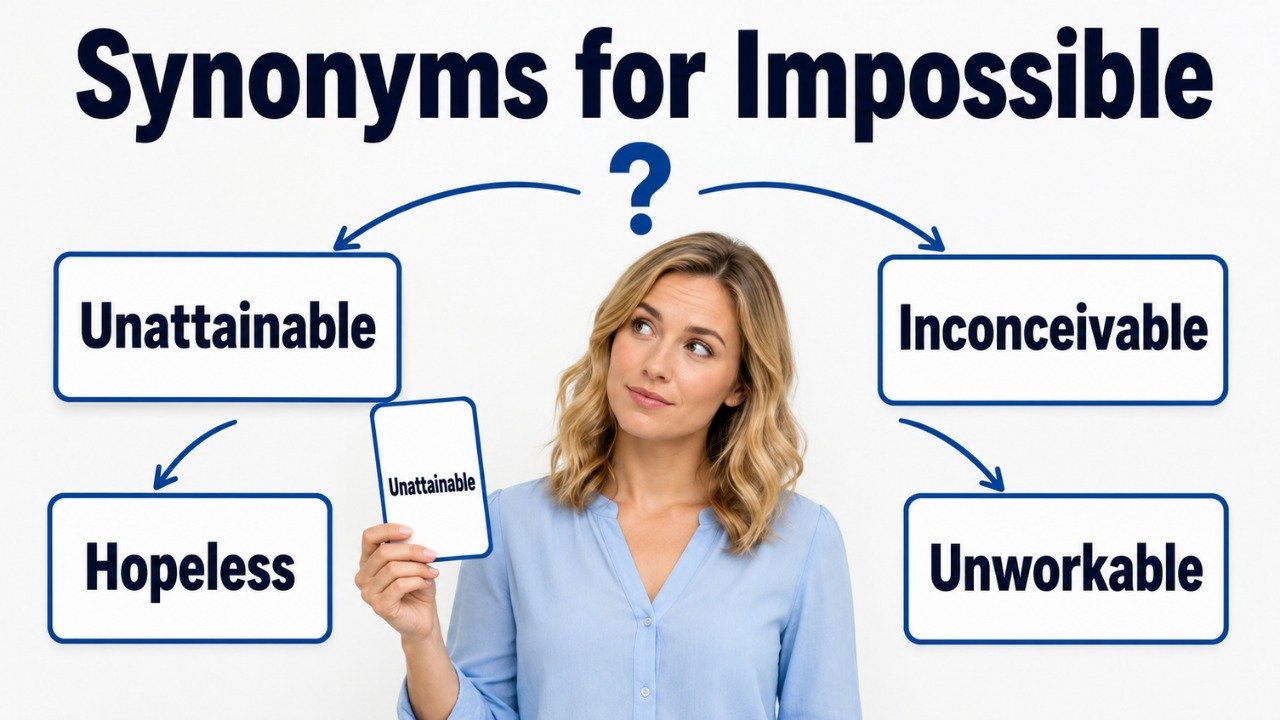
Quick Answer: Synonyms for impossible include unattainable, unachievable, infeasible, impracticable, unworkable, inconceivable, unlikely, unrealistic, insurmountable, and hopeless. Use unattainable for goals that cannot be reached, infeasible for plans that cannot succeed under current conditions, and impracticable for methods that cannot be carried out effectively. Inconceivable suits ideas that are difficult to imagine, while unlikely describes something that probably will not happen. The best alternative depends on whether you mean unachievable, improbable, unreasonable, or extremely difficult.
Pronunciation and Word Details
Word: Impossible
Pronunciation: /ɪmˈpɒsəbəl/
Part of Speech: Adjective
Meaning: Not able to happen, exist, succeed, or be completed.
US Pronunciation:
UK Pronunciation:
What Does “Impossible” Mean?
Impossible means unable to happen, exist, be achieved, or be completed. It is an adjective commonly used to describe tasks, goals, situations, claims, conditions, and behavior.
The word can describe something that is completely beyond possibility.
Example: It is impossible for a person to be in two distant places at the same time.
It can also describe a task that is extremely difficult, even when it may not be completely beyond possibility.
Example: Finishing the entire project in one hour seemed impossible.
Impossible may describe an unrealistic request, an unlikely event, an unreasonable person, or a situation that cannot continue.
Example: The schedule became impossible after three important deadlines were moved forward.
In conversation, people sometimes use impossible for emphasis rather than literal impossibility.
Example: This puzzle is impossible.
In this sentence, the speaker may simply mean that the puzzle is extremely difficult.
Meaning, Tone, and Context of “Impossible”
Impossible has a strong and definite tone. It usually communicates that something cannot be done or cannot occur.
In formal writing, impossible should be used carefully because it makes an absolute claim. Writers may prefer unlikely, improbable, infeasible, or impracticable when there is still a small chance of success.
In academic and technical contexts, impossible may describe something that violates established conditions, evidence, calculations, or logical principles.
Example: The proposed result is impossible under the stated mathematical conditions.
In professional contexts, the word may describe an unworkable deadline, an unrealistic expectation, or an infeasible plan.
Example: Completing the construction safely within two days would be impossible.
In casual conversation, impossible often means extremely difficult, frustrating, or unreasonable.
Example: He is impossible to convince once he has made a decision.
The tone can therefore be neutral, serious, emotional, critical, or exaggerated depending on the sentence.
When and How to Use “Impossible”
For Unachievable Goals: Use impossible when a goal cannot realistically be reached.
Example: Winning without entering the competition is impossible.
For Infeasible Plans: Use it when a plan cannot work because of limited time, money, equipment, or resources.
Example: The original budget made the design impossible to complete.
For Unlikely Events: Use impossible when there is no realistic chance that an event will occur.
Example: It would be impossible for the package to arrive before it was sent.
For Logical Contradictions: Use it when two ideas cannot both be true.
Example: It is impossible for the door to be completely open and completely closed at the same moment.
For Extreme Difficulty: Use impossible informally when something feels exceptionally difficult.
Example: The final question felt impossible without additional information.
For Unreasonable Requests: Use it when an expectation is unrealistic or cannot be satisfied.
Example: The client gave the team an impossible deadline.
For Difficult Behavior: Use impossible to describe someone who is extremely unreasonable, uncooperative, or difficult to manage.
Example: The child became impossible to calm after missing his usual rest.
For Strong Emotional Emphasis: Use it to emphasize that something is difficult to believe, imagine, or tolerate.
Example: It was impossible to ignore the tension in the room.
Best Synonyms for Impossible
Unattainable: Not able to be reached or achieved.
Example: The target became unattainable after the available funding was reduced.
Unachievable: Not capable of being successfully completed.
Example: The goal was unachievable within the limited time.
Infeasible: Not practical or possible under existing conditions.
Example: The engineers concluded that the original proposal was infeasible.
Impracticable: Too difficult or unsuitable to carry out successfully.
Example: Daily travel between the two distant offices proved impracticable.
Unworkable: Unable to function successfully in practice.
Example: The agreement was rejected because its conditions were unworkable.
Insurmountable: Too great or difficult to overcome.
Example: A lack of funding created an insurmountable obstacle.
Inconceivable: So unlikely or unusual that it is difficult to imagine.
Example: A complete failure seemed inconceivable after months of careful preparation.
Implausible: Not appearing reasonable, believable, or likely.
Example: His explanation sounded implausible to the investigators.
Unrealistic: Not based on practical expectations or actual conditions.
Example: Expecting immediate perfection is unrealistic.
Hopeless: Having no reasonable chance of success or improvement.
Example: The situation looked hopeless until additional help arrived.
50 Synonyms for Impossible with Short Meanings
- Unattainable: Not able to be reached or achieved.
- Unachievable: Not capable of being completed successfully.
- Impracticable: Too difficult or unsuitable to carry out.
- Infeasible: Not possible under the existing conditions.
- Unfeasible: Unable to work successfully in practice.
- Unworkable: Not capable of functioning effectively.
- Undoable: Not possible to perform or complete.
- Insurmountable: Too difficult to overcome.
- Hopeless: Having no reasonable possibility of success.
- Futile: Incapable of producing a useful result.
- Inconceivable: Too unlikely or extraordinary to imagine.
- Unthinkable: Too extreme or unlikely to consider possible.
- Unimaginable: Extremely difficult to picture or understand.
- Unbelievable: Too unlikely or surprising to accept easily.
- Implausible: Not appearing reasonable or believable.
- Unlikely: Not expected to happen.
- Improbable: Having very little chance of occurring.
- Unrealistic: Not based on practical expectations.
- Unreasonable: Beyond what is fair, sensible, or practical.
- Absurd: Completely unreasonable or illogical.
- Preposterous: Extremely unreasonable or unbelievable.
- Ridiculous: Deserving disbelief because it is unreasonable.
- Nonsensical: Having no logical or sensible meaning.
- Outlandish: Extremely unusual and difficult to believe.
- Far Fetched: Very unlikely or difficult to accept as true.
- Beyond Reach: Unable to be obtained or achieved.
- Beyond Possibility: Completely unable to happen.
- Out of the Question: Not allowed or not possible.
- Beyond Hope: Having no realistic chance of improvement.
- Inaccessible: Unable to be reached, entered, or obtained.
- Unobtainable: Not available or able to be acquired.
- Unrealizable: Not capable of becoming a reality.
- Unmanageable: Too difficult to control or complete.
- Overwhelming: So difficult or powerful that success seems impossible.
- Prohibitive: So costly or difficult that it prevents action.
- Impractical: Not sensible or effective in real conditions.
- Unviable: Not capable of working or succeeding.
- Unsustainable: Unable to continue successfully over time.
- Unreal: Seeming too extraordinary to be real.
- Doomed: Certain or highly likely to fail.
- Ruled Out: Removed from consideration as impossible or unsuitable.
- Unsolvable: Not capable of being solved.
- Insoluble: Unable to be solved or explained.
- Intractable: Extremely difficult to manage or resolve.
- Irresolvable: Not capable of being settled or corrected.
- Unanswerable: Not capable of being answered convincingly.
- Unreachable: Not able to be reached physically or figuratively.
- Insuperable: Too great or difficult to overcome.
- Unconquerable: Not capable of being defeated or overcome.
- Untenable: Unable to be defended, supported, or continued.
Read Also:
Synonyms for Revenge

Synonyms for Impossible by Context
When Impossible Means Unachievable
Use unattainable, unachievable, unrealizable, unreachable, and beyond reach for goals, ambitions, results, and standards that cannot be reached.
Example: The sales target became unattainable after several stores closed.
Example: Perfect accuracy may be an unachievable goal in situations involving incomplete information.
Example: Without sufficient support, the original vision remained unrealizable.
These alternatives are especially useful in professional, academic, and motivational writing because they identify a goal that cannot be achieved under particular conditions.
When Impossible Means Impractical
Use infeasible, impracticable, impractical, unworkable, unviable, and untenable for plans, proposals, systems, schedules, or methods that cannot operate successfully.
Example: Building the structure on unstable ground was considered infeasible.
Example: The complicated approval process made the plan impracticable.
Example: The policy became untenable after its financial weaknesses were revealed.
These words are more precise than impossible when discussing planning, management, engineering, finance, or workplace decisions.
When Impossible Means Extremely Difficult
Use insurmountable, insuperable, unmanageable, intractable, overwhelming, and unconquerable when something is exceptionally hard to overcome.
Example: The team faced what appeared to be an insurmountable challenge.
Example: The dispute became intractable because neither side would compromise.
Example: Without assistance, the workload felt overwhelming.
These words do not always mean that success is literally impossible. They often emphasize the scale or difficulty of a challenge.
When Impossible Means Unlikely
Use unlikely, improbable, implausible, inconceivable, and far fetched when describing an event, explanation, claim, or prediction that probably is not true.
Example: Heavy snowfall in the region during midsummer is highly improbable.
Example: His claim sounded implausible because it contradicted the available evidence.
Example: The idea that nobody noticed the noise seemed far fetched.
Use unlikely for a cautious and neutral tone. Use implausible when a claim lacks credibility. Use inconceivable for something that is exceptionally difficult to imagine.
When Impossible Means Unreasonable
Use unrealistic, unreasonable, absurd, preposterous, ridiculous, and nonsensical for demands, expectations, arguments, or ideas that do not make sense.
Example: Expecting one employee to complete the work of an entire department is unrealistic.
Example: The demand was unreasonable because the deadline had already passed.
Example: The suggestion that preparation was unnecessary seemed absurd.
These choices vary in strength. Unrealistic is relatively neutral, while preposterous and ridiculous express strong criticism.
When Impossible Means Unsolvable
Use unsolvable, insoluble, irresolvable, intractable, and unanswerable for problems, questions, conflicts, and mysteries that cannot be settled.
Example: The puzzle appeared unsolvable until a missing clue was discovered.
Example: The disagreement seemed irresolvable because both sides rejected negotiation.
Example: The question remained unanswerable with the available evidence.
Another Word for Impossible
The best general replacement for impossible is unachievable when describing a goal or result that cannot be completed. However, the best alternative depends on the context.
Use infeasible for plans, unlikely for events, implausible for doubtful claims, and insurmountable for severe challenges.
Original: Completing the project by tomorrow is impossible.
Better Option: Completing the project by tomorrow is infeasible.
Original: The performance target was impossible to reach.
Better Option: The performance target was unattainable.
Original: His explanation seemed impossible.
Better Option: His explanation seemed implausible.
Original: It is impossible that the missing records will appear today.
Better Option: It is highly unlikely that the missing records will appear today.
When Not to Use “Impossible”
Avoid impossible when you cannot prove that something has absolutely no chance of happening. The word makes a definite claim, so a more cautious alternative may be more accurate.
Weak: It is impossible that the event will be delayed.
Better: It is unlikely that the event will be delayed.
Do not use impossible when you mean that a plan is merely inconvenient, expensive, or difficult.
Weak: Traveling by train would be impossible.
Better: Traveling by train would be impractical because of the limited schedule.
Avoid using impossible repeatedly in professional reports. More specific words can explain why something cannot succeed.
Weak: The budget is impossible, and the schedule is also impossible.
Better: The budget is unrealistic, and the schedule is unworkable.
Do not call a person impossible unless the context clearly refers to difficult behavior. The description may sound harsh or insulting.
Weak: The new employee is impossible.
Better: The new employee has been difficult to manage during stressful situations.
Avoid using impossible for a challenge that is simply demanding.
Weak: Learning the skill is impossible.
Better: Learning the skill is challenging and requires consistent practice.
Words Commonly Confused With Impossible
Impossible vs Improbable: Impossible means something cannot happen. Improbable means it can happen, but the chance is very low.
Impossible vs Unlikely: Impossible allows no realistic possibility. Unlikely means something is not expected but remains possible.
Impossible vs Infeasible: Impossible is broad and absolute. Infeasible usually means a plan cannot work because of practical limits.
Impossible vs Impractical: Impossible means something cannot be done. Impractical means it could be done, but it would not be sensible, efficient, or worthwhile.
Impossible vs Unattainable: Impossible can describe any event, task, or condition. Unattainable usually describes a goal, standard, position, or object that cannot be reached.
Impossible vs Implausible: Impossible means unable to happen. Implausible means difficult to believe but not necessarily impossible.
Impossible vs Insurmountable: Impossible describes the overall lack of possibility. Insurmountable describes a barrier or challenge that appears too difficult to overcome.
Impossible vs Hopeless: Impossible focuses on whether something can happen. Hopeless focuses on the absence of hope, improvement, or success.
Which Synonym Should You Choose?
Choose unattainable when describing goals, standards, ambitions, or targets that cannot be reached.
Choose unachievable when discussing results or objectives that cannot be completed successfully.
Choose infeasible for formal reports about plans, projects, proposals, budgets, or technical decisions.
Choose impracticable when a method could exist in theory but cannot be carried out effectively.
Choose unworkable when a policy, system, schedule, or agreement cannot function in practice.
Choose unlikely when something probably will not happen but remains possible.
Choose improbable for formal writing about events with a very low chance of occurring.
Choose implausible when a story, argument, claim, or explanation is difficult to believe.
Choose unrealistic for expectations, demands, deadlines, and assumptions that do not match actual conditions.
Choose insurmountable for obstacles or challenges that appear too great to overcome.
Choose absurd or preposterous when strongly criticizing an idea that lacks reason or logic.
Choose unsolvable for problems, puzzles, equations, and mysteries that cannot be solved.
Choose untenable for positions, arguments, policies, or situations that cannot be defended or continued.
Real Life Examples of “Impossible” in Sentences
Original: It was impossible to complete the report before noon.
Better Option: It was infeasible to complete the report before noon.
Original: The team was given an impossible sales target.
Better Option: The team was given an unattainable sales target.
Original: His story sounded impossible.
Better Option: His story sounded implausible.
Original: The cost made the renovation impossible.
Better Option: The cost made the renovation prohibitive.
Original: Solving the disagreement seemed impossible.
Better Option: Resolving the disagreement seemed intractable.
Original: The proposed schedule was impossible for the staff.
Better Option: The proposed schedule was unworkable for the staff.
Original: It is impossible that she forgot every detail.
Better Option: It is highly unlikely that she forgot every detail.
Original: The mountain created an impossible barrier.
Better Option: The mountain created an insurmountable barrier.
Original: The manager made an impossible request.
Better Option: The manager made an unreasonable request.
Original: Their plan to continue without funding was impossible.
Better Option: Their plan to continue without funding was unsustainable.
Synonym Groups and Usage Differences
Achievement Group
This group includes unattainable, unachievable, unrealizable, unobtainable, and unreachable. These words describe goals, results, objects, or positions that cannot be reached.
Example: The original growth target became unattainable after demand declined.
Practicality Group
This group includes infeasible, impracticable, impractical, unworkable, and unviable. These alternatives describe plans and methods that cannot succeed under real conditions.
Example: The proposal was technically possible but financially unviable.
Probability Group
This group includes unlikely, improbable, implausible, inconceivable, and far fetched. These words describe events or explanations with little credibility or chance of occurring.
Example: A sudden recovery remained possible but highly improbable.
Difficulty Group
This group includes insurmountable, insuperable, unmanageable, intractable, and overwhelming. These terms emphasize severe difficulty rather than absolute impossibility.
Example: The organization overcame several seemingly insurmountable obstacles.
Unreasonableness Group
This group includes unrealistic, unreasonable, absurd, preposterous, and ridiculous. These words describe demands, expectations, or ideas that lack practical sense.
Example: Expecting perfect results without preparation is unrealistic.
Problem Group
This group includes unsolvable, insoluble, irresolvable, and unanswerable. These words are used for problems, questions, conflicts, and mysteries that cannot be settled.
Example: The mystery remained unsolvable because the central evidence had disappeared.
Antonyms of Impossible
The opposite of impossible depends on whether the sentence concerns possibility, achievement, practicality, or probability.
Possible: Able to happen, exist, or be done.
Achievable: Capable of being completed successfully.
Attainable: Able to be reached or obtained.
Feasible: Possible and practical under existing conditions.
Practicable: Capable of being carried out effectively.
Workable: Able to function successfully in practice.
Realistic: Based on practical expectations and actual conditions.
Likely: Expected to happen.
Probable: Having a strong chance of occurring.
Plausible: Appearing reasonable or believable.
Manageable: Able to be controlled or completed.
Solvable: Capable of being solved.
Reachable: Able to be reached physically or figuratively.
Viable: Capable of working, developing, or succeeding.
Reasonable: Fair, practical, and based on sound judgment.
Comparison of Impossible and Related Words
Impossible vs Unattainable
Impossible is a broad term for anything that cannot happen or be done. Unattainable usually refers to goals, standards, positions, or objects that cannot be reached.
Example With Impossible: It is impossible to complete the journey without crossing the river.
Example With Unattainable: The original target became unattainable after production slowed.
Impossible vs Infeasible
Impossible means completely unable to happen or be completed. Infeasible means a plan cannot work under existing practical conditions.
Example With Impossible: It is impossible to change an event that has already happened.
Example With Infeasible: Expanding the building this year is financially infeasible.
Impossible vs Impractical
Impossible describes something that cannot be done. Impractical describes something that can perhaps be done but would be inefficient, inconvenient, or unwise.
Example With Impossible: It is impossible to enter the locked room without opening a door or window.
Example With Impractical: Carrying every book at once would be impractical.
Impossible vs Unlikely
Impossible means there is no possibility. Unlikely means the chance is low but still exists.
Example With Impossible: It is impossible for the meeting to begin before it is scheduled.
Example With Unlikely: It is unlikely that every guest will arrive early.
Impossible vs Implausible
Impossible means unable to occur. Implausible means difficult to believe because it lacks credibility or supporting evidence.
Example With Impossible: It is impossible for the same document to be both completely blank and full of text.
Example With Implausible: His claim that he noticed nothing seemed implausible.
Impossible vs Insurmountable
Impossible describes the whole task or outcome. Insurmountable describes an obstacle that is too difficult to overcome.
Example With Impossible: Completing the task without the required information was impossible.
Example With Insurmountable: The missing information created an insurmountable obstacle.
Common Phrases and Expressions With “Impossible”
Almost Impossible: Extremely difficult but not completely beyond possibility.
Virtually Impossible: So difficult or unlikely that it can be treated as impossible.
Seemingly Impossible: Appearing impossible at first.
Physically Impossible: Unable to occur because of physical limitations.
Logically Impossible: Unable to be true because it creates a contradiction.
Mathematically Impossible: Unable to occur under particular mathematical conditions.
Impossible Task: A job that cannot be completed or is extremely difficult.
Impossible Situation: A condition with no clear or successful solution.
Impossible Dream: A goal that appears beyond achievement.
Impossible Deadline: A completion date that cannot realistically be met.
Common Mistakes to Avoid
One common mistake is using impossible when unlikely would be more accurate. If something still has a small chance of happening, it is unlikely or improbable rather than impossible.
Another mistake is using impossible for every difficult task. A demanding task may be challenging, complicated, or time consuming without being impossible.
Avoid confusing infeasible with impossible. A proposal may be infeasible because of current costs or resources, even though it could become possible under different conditions.
Do not use unattainable for every type of impossibility. It is most natural for goals, standards, ambitions, and objects that cannot be reached.
Avoid calling an explanation impossible when you simply doubt it. Use implausible, unlikely, or unbelievable unless the claim truly cannot be correct.
Do not repeat impossible several times in one paragraph. Choose precise alternatives that explain whether the issue involves probability, cost, difficulty, logic, or practicality.
Avoid exaggerated statements in formal writing. Instead of saying a deadline is impossible without explanation, state that it is infeasible because the available time and resources are insufficient.
Conclusion
Understanding synonyms for impossible allows you to express different levels of difficulty, probability, and practicality more accurately. Use unattainable or unachievable for goals, infeasible for plans, and unworkable for systems or schedules. Choose unlikely or improbable when an event still has a small chance of happening. Implausible suits doubtful explanations, while insurmountable describes overwhelming obstacles. Choosing the right alternative makes your writing clearer, more precise, and better suited to formal reports, essays, workplace communication, and everyday conversation.
FAQs About Synonyms for Impossible
What Is the Best Synonym for Impossible?
Unachievable is a strong general synonym for a goal or result that cannot be completed. Infeasible is better for plans, while unlikely suits events.
What Is a Formal Word for Impossible?
Infeasible, impracticable, unattainable, and untenable are formal alternatives. The correct choice depends on what makes the situation impossible.
Is Unlikely the Same as Impossible?
No. Unlikely means something has a small chance of happening. Impossible means it has no possibility of happening.
What Is Another Word for an Impossible Goal?
Unattainable and unachievable are the best alternatives for a goal that cannot be reached.
What Is Another Word for an Impossible Plan?
Infeasible, impracticable, unworkable, and unviable are useful choices for a plan that cannot succeed.
Can Unrealistic Replace Impossible?
Unrealistic can replace impossible when discussing expectations, demands, deadlines, or assumptions that do not match real conditions.
What Is a Stronger Word Than Difficult?
Impossible, insurmountable, overwhelming, and intractable are stronger than difficult. However, they should only be used when the challenge is exceptionally severe.
