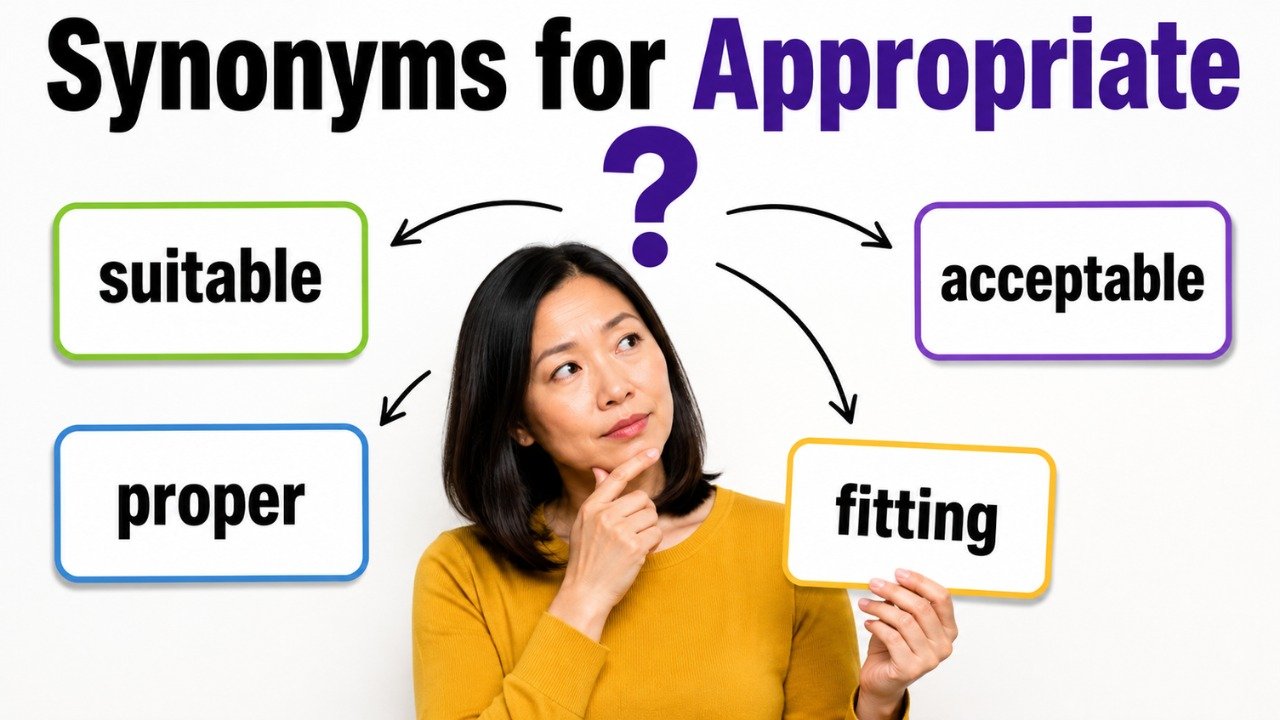
Quick Answer: The best synonyms for appropriate include suitable, proper, fitting, apt, relevant, applicable, acceptable, befitting, timely, and reasonable. Use suitable for general compatibility, proper for correct behavior, fitting for a situation or occasion, apt for an accurate description, relevant for connected information, and applicable for rules or ideas that relate to a case. Timely works for the right moment, while acceptable describes something that meets a required standard.
Pronunciation and Word Details
Word: Appropriate.
Pronunciation: /əˈproʊ.pri.ət/ as an adjective and /əˈproʊ.pri.eɪt/ as a verb.
Part of Speech: Adjective and verb.
Meaning: Appropriate usually means suitable, correct, or acceptable for a particular person, purpose, situation, or occasion.
US Pronunciation:
UK Pronunciation:
What Does “Appropriate” Mean?
Appropriate means suitable, correct, or acceptable for a particular situation, purpose, person, or occasion. It is most commonly used as an adjective, but it can also function as a verb.
As an adjective, appropriate describes something that matches the needs, expectations, tone, or conditions of a situation. Appropriate clothing is suitable for an occasion. An appropriate response matches the seriousness or emotion of a conversation. Appropriate language is respectful and suitable for the audience.
The word is common in professional, academic, educational, legal, and everyday contexts. It can describe behavior, timing, language, clothing, methods, decisions, tools, evidence, or actions.
As a verb, appropriate has a different meaning. It can mean to take something for a particular use, sometimes without permission, or to officially allocate money or resources. For example, an organization may appropriate funds for a new project.
In most vocabulary and synonym contexts, appropriate refers to the adjective meaning suitable or proper.
Meaning, Tone, and Context of “Appropriate”
Appropriate has a neutral and slightly formal tone. It is widely used in professional communication, academic writing, workplace policies, educational guidance, and polite conversation.
The word often communicates judgment about whether something matches accepted standards. An appropriate answer is relevant and suitable. Appropriate conduct follows expected behavior. Appropriate evidence supports the subject being discussed.
In formal writing, appropriate is useful because it sounds measured and objective. It does not usually express strong emotion. Instead, it evaluates whether something fits a particular need, rule, condition, or context.
In casual speech, people may use right, suitable, fine, or okay instead. Appropriate can sometimes sound distant or overly formal in relaxed conversation.
The tone may also depend on what is being evaluated. Appropriate behavior suggests politeness and social awareness. Appropriate timing means an action happened at a suitable moment. Appropriate measures are actions that correctly respond to a problem.
Because appropriate has several possible meanings, a more precise synonym can often improve clarity.
When and How to Use “Appropriate”
For Suitability: Use appropriate when something matches a particular purpose, need, or situation.
Example: This software is appropriate for small research projects.
For Behavior: Use appropriate to describe actions that follow social, professional, or moral expectations.
Example: Her calm response was appropriate for the situation.
For Clothing: Use appropriate when clothing suits an occasion, environment, or activity.
Example: Guests should wear appropriate clothing for the formal dinner.
For Language: Use appropriate to describe words that are respectful and suitable for an audience.
Example: The teacher reminded students to use appropriate language.
For Timing: Use appropriate when something happens at a suitable or helpful moment.
Example: We will discuss the matter at an appropriate time.
For Academic Writing: Use appropriate when selecting evidence, methods, vocabulary, or sources that fit the subject.
Example: The researcher selected an appropriate method for collecting data.
For Decisions: Use appropriate when an action or choice correctly responds to a particular condition.
Example: The manager took appropriate action after reviewing the complaint.
For Formal Requirements: Use appropriate when something meets established rules, standards, or expectations.
Example: Applicants must provide appropriate identification.
Best Synonyms for Appropriate
Suitable: Right for a particular purpose, person, or situation.
Example: This room is suitable for a small meeting.
Proper: Correct according to rules, standards, or accepted behavior.
Example: Employees received training in proper safety procedures.
Fitting: Suitable and natural for a particular occasion or situation.
Example: The award was a fitting recognition of her contribution.
Apt: Especially suitable or accurate in a particular context.
Example: The title is an apt description of the story.
Relevant: Directly connected with the subject being discussed.
Example: Include only relevant details in your answer.
Applicable: Able to be used or considered in a particular situation.
Example: The new policy is applicable to every department.
Acceptable: Good enough to meet a required standard.
Example: The revised proposal is now acceptable.
Befitting: Suitable for a person, position, or occasion.
Example: The hall was decorated in a style befitting the celebration.
Timely: Occurring at a useful or suitable moment.
Example: Her timely advice prevented a serious mistake.
Reasonable: Sensible, fair, and suitable in the circumstances.
Example: The committee reached a reasonable decision.
50 Synonyms for Appropriate with Short Meanings
- Suitable: Right for a particular purpose or situation.
- Proper: Correct according to rules or accepted behavior.
- Fitting: Suitable for a particular occasion or condition.
- Apt: Especially suitable, accurate, or well chosen.
- Right: Correct or suitable for the circumstances.
- Correct: Free from error and suitable according to a standard.
- Relevant: Directly connected to the subject or situation.
- Applicable: Able to be used in a particular case.
- Acceptable: Meeting a required or expected standard.
- Befitting: Suitable for a person, position, or occasion.
- Becoming: Attractive or suitable for a person.
- Seemly: Proper according to social expectations.
- Decorous: Polite, controlled, and socially proper.
- Reasonable: Fair, sensible, and suitable in the circumstances.
- Adequate: Sufficient and suitable for a particular need.
- Compatible: Able to work or exist successfully with something else.
- Convenient: Suitable for a person’s needs, plans, or schedule.
- Opportune: Happening at a particularly suitable moment.
- Timely: Occurring at the right or useful time.
- Due: Expected, deserved, or suitable according to circumstances.
- Warranted: Justified by the facts or situation.
- Justified: Supported by a good reason or explanation.
- Advisable: Sensible and recommended in a particular situation.
- Recommended: Suggested as suitable or beneficial.
- Permissible: Allowed according to rules or standards.
- Allowable: Officially accepted or permitted.
- Legitimate: Lawful, reasonable, or acceptable.
- Authorized: Officially approved or permitted.
- Valid: Reasonable, acceptable, or legally effective.
- Pertinent: Directly relevant to the subject.
- Germane: Closely connected with the matter being discussed.
- Well suited: Highly suitable for a purpose or role.
- Tailored: Designed or adjusted for a particular need.
- Adapted: Changed to suit a new purpose or condition.
- Apposite: Highly relevant and suitable in context.
- Felicitous: Particularly suitable, effective, or well chosen.
- Sensible: Showing practical and reasonable judgment.
- Practical: Suitable for actual use or real conditions.
- Ideal: Perfectly suitable for a purpose or situation.
- Preferable: More suitable or desirable than another option.
- Desirable: Worth choosing because it is suitable or beneficial.
- Satisfactory: Good enough to meet expectations.
- Sufficient: Enough to meet a particular need.
- Congruous: Suitable because it agrees with the surroundings or context.
- Judicious: Sensible and appropriate because of careful judgment.
- In Order: Correct, acceptable, or properly arranged.
- In Keeping: Suitable because it matches a style or situation.
- In Line: Consistent with rules, standards, or expectations.
- Well Chosen: Selected carefully and suitably.
- Well Timed: Happening at a particularly suitable moment.
Read Also:
Synonyms for Rules
Synonyms for Appropriate by Context
When Appropriate Means Suitable
Suitable, fitting, well suited, ideal, practical, adequate, compatible, and convenient describe something that matches a purpose, person, or situation.
Example: This location is ideal for a quiet family gathering.
Suitable is the most flexible general replacement. Fitting often describes occasions, rewards, endings, or reactions. Compatible is best when two things can work together successfully.
When Appropriate Means Proper Behavior
Proper, seemly, decorous, becoming, respectable, and befitting describe actions or appearances that follow accepted social expectations.
Example: The speaker maintained a decorous tone throughout the discussion.
Proper is a common choice for correct behavior. Seemly and decorous are more formal and often refer to politeness, dignity, or public conduct. Befitting suggests that something matches a person’s role or status.
When Appropriate Means Relevant
Relevant, applicable, pertinent, germane, apposite, and apt describe information or ideas connected to a subject.
Example: The report includes only information pertinent to the investigation.
Relevant is the clearest general choice. Applicable often describes laws, policies, rules, or methods that can be used in a particular case. Germane and apposite are more formal alternatives.
When Appropriate Means Acceptable
Acceptable, permissible, allowable, legitimate, authorized, valid, and satisfactory describe something that meets rules or expected standards.
Example: Written permission is required before the action becomes permissible.
Acceptable means good enough for a particular purpose. Permissible and allowable focus on whether something is allowed. Authorized indicates formal approval from someone with authority.
When Appropriate Means Reasonable
Reasonable, sensible, judicious, advisable, justified, warranted, and practical describe choices supported by good judgment.
Example: Delaying the event was a sensible response to the weather conditions.
Reasonable emphasizes fairness and logic. Judicious suggests careful judgment. Warranted and justified mean that facts or circumstances provide a good reason for an action.
When Appropriate Means Timely
Timely, opportune, well timed, due, and convenient describe something happening at a suitable moment.
Example: The announcement came at an opportune moment.
Timely emphasizes usefulness and promptness. Opportune describes a moment that is especially favorable. Convenient focuses more on personal plans or ease.
When Appropriate Means Designed for a Need
Tailored, adapted, well suited, practical, and specialized describe something created or changed for a particular purpose.
Example: The training program was tailored to the needs of new employees.
Tailored suggests careful adjustment for a particular person or group. Adapted means changed to work in a new situation. Practical emphasizes usefulness in real conditions.
Another Word for Appropriate
Suitable is often the best single replacement for appropriate because it works naturally in many situations. It can describe clothing, tools, methods, language, locations, activities, and decisions.
However, the most precise alternative depends on context. Proper is better for conduct, relevant for information, timely for timing, and acceptable for standards.
Original: Please choose appropriate clothing for the event.
Better Option: Please choose suitable clothing for the event.
Original: The report includes appropriate information.
Better Option: The report includes relevant information.
Original: The manager took appropriate action.
Better Option: The manager took reasonable action.
Original: We will respond at the appropriate moment.
Better Option: We will respond at an opportune moment.
When Not to Use “Appropriate”
Avoid appropriate when a more precise word can explain why something is suitable. The word may sound vague if the reader does not know whether you mean legal, polite, relevant, useful, or timely.
Weak: The employee took appropriate steps.
Better: The employee followed the required safety procedures.
Appropriate may sound too formal in casual conversation.
Weak: Is this an appropriate place to have lunch?
Better: Is this a good place to have lunch?
Do not use appropriate repeatedly in the same paragraph.
Weak: The teacher selected an appropriate topic, appropriate examples, and an appropriate activity.
Better: The teacher selected a suitable topic, relevant examples, and a practical activity.
Avoid appropriate when discussing exact legal permission. Authorized, lawful, permissible, or valid may be clearer.
Weak: Only appropriate visitors may enter the restricted area.
Better: Only authorized visitors may enter the restricted area.
Appropriate may also be too weak when a strong recommendation is intended.
Weak: It is appropriate to wear protective equipment.
Better: It is essential to wear protective equipment.
Do not confuse appropriate with accurate. Appropriate means suitable, while accurate means correct and free from factual error.
Weak: The figures in the report are appropriate.
Better: The figures in the report are accurate.
Words Commonly Confused With Appropriate
Appropriate vs Suitable: Both describe something that fits a purpose or situation. Appropriate often includes a sense of correct behavior or accepted standards, while suitable mainly focuses on practical compatibility.
Appropriate vs Proper: Appropriate means suitable for the circumstances. Proper often means correct according to rules, manners, or accepted procedures.
Appropriate vs Relevant: Appropriate describes something suitable. Relevant describes something directly connected to the subject being discussed.
Appropriate vs Applicable: Appropriate means suitable or proper. Applicable means that a rule, method, or idea can be used in a specific case.
Appropriate vs Acceptable: Appropriate means suitable for a situation. Acceptable means good enough to meet a standard or receive approval.
Appropriate vs Accurate: Appropriate means suitable. Accurate means correct, exact, and free from error.
Appropriate vs Adequate: Appropriate means well matched to a need. Adequate means sufficient, although it may not be the best possible choice.
Appropriate vs Timely: Appropriate can describe any suitable choice. Timely specifically describes something happening at a useful or suitable moment.
Appropriate vs Apt: Appropriate is a broad word for suitability. Apt often describes a particularly accurate description, example, phrase, or comparison.
Appropriate vs Properly: Appropriate is usually an adjective, while properly is an adverb describing how an action is performed.
Which Synonym Should You Choose?
Choose suitable when describing a general match between something and its intended purpose.
Choose proper when discussing correct behavior, manners, procedures, clothing, or methods.
Choose fitting when something matches the importance, emotion, or character of an occasion.
Choose apt when describing a particularly accurate phrase, example, comparison, or observation.
Choose relevant when selecting information, evidence, details, or discussion points connected to a subject.
Choose applicable when referring to laws, policies, rules, methods, or principles that can be used in a particular case.
Choose acceptable when something meets a required standard but may not be perfect.
Choose adequate when something is sufficient for a need.
Choose befitting when something suits a person’s role, achievement, or social position.
Choose timely when an action, warning, message, or decision happens at a useful moment.
Choose opportune when circumstances create an especially favorable time.
Choose permissible when emphasizing that an action is allowed under rules.
Choose authorized when official approval has been given.
Choose warranted when available facts justify a reaction, concern, or decision.
Choose judicious when a decision demonstrates careful and sensible judgment.
Choose tailored when something has been specifically adjusted for a particular person, audience, or purpose.
Real Life Examples of “Appropriate” in Sentences
Original: She wore appropriate clothes for the interview.
Better Option: She wore suitable clothes for the interview.
Original: The teacher selected an appropriate example.
Better Option: The teacher selected a relevant example.
Original: The manager gave an appropriate response.
Better Option: The manager gave a measured response.
Original: We need an appropriate place for the meeting.
Better Option: We need a suitable place for the meeting.
Original: The committee took appropriate action.
Better Option: The committee took justified action.
Original: His language was not appropriate for the audience.
Better Option: His language was not acceptable for the audience.
Original: The warning arrived at an appropriate time.
Better Option: The warning arrived at a timely moment.
Original: This rule is appropriate to every department.
Better Option: This rule is applicable to every department.
Original: The award was appropriate for her achievement.
Better Option: The award was befitting her achievement.
Original: The researcher chose an appropriate method.
Better Option: The researcher chose a practical method.
Synonym Groups and Usage Differences
General Suitability Group
Suitable, fitting, well suited, ideal, adequate, compatible, and convenient belong to the general suitability group.
Suitable is broad and neutral. Fitting adds a sense of emotional or social harmony. Ideal describes the best possible match, while adequate means sufficient rather than perfect.
Example: The smaller room is adequate for a brief meeting.
Correct Conduct Group
Proper, seemly, decorous, becoming, befitting, and respectable relate to accepted behavior, appearance, or manners.
Proper is the most common choice. Seemly and decorous sound more formal. Becoming often describes clothing or behavior that suits a person.
Example: Her respectful reply was proper and professional.
Relevance Group
Relevant, pertinent, germane, apposite, applicable, and apt describe connections between information and a subject.
Relevant works in most contexts. Pertinent and germane are common in formal discussion. Apposite often describes a particularly suitable remark or example.
Example: Please provide only the details pertinent to your application.
Permission Group
Acceptable, permissible, allowable, authorized, legitimate, and valid describe approval or compliance with rules.
Acceptable focuses on standards. Permissible and allowable mean that something is allowed. Authorized indicates official permission, while legitimate can suggest legal or reasonable acceptance.
Example: Photography is permissible in designated areas.
Judgment Group
Reasonable, sensible, judicious, practical, warranted, justified, and advisable describe decisions based on logic or good judgment.
Judicious suggests careful consideration. Warranted and justified focus on whether evidence supports an action. Advisable means that something is recommended.
Example: Seeking professional guidance would be advisable.
Timing Group
Timely, opportune, convenient, due, and well timed describe actions or events in relation to time.
Timely means early enough to be useful. Opportune suggests favorable circumstances. Convenient focuses on personal comfort or scheduling.
Example: Her well timed question helped clarify the discussion.
Customization Group
Tailored, adapted, specialized, practical, and well suited describe something designed or changed for a particular need.
Tailored emphasizes individual requirements. Adapted describes modification. Well suited shows a strong natural match.
Example: The materials were adapted for younger readers.
Antonyms of Appropriate
The opposite of appropriate depends on whether the word refers to suitability, behavior, relevance, permission, or timing.
Inappropriate: Not suitable or proper for a situation.
Unsuitable: Not right for a particular purpose or person.
Improper: Incorrect according to rules, manners, or standards.
Unfitting: Not suitable for an occasion or condition.
Irrelevant: Not connected with the subject.
Inapplicable: Unable to be used in a particular case.
Unacceptable: Failing to meet required standards.
Indecent: Offensive or improper according to social standards.
Unseemly: Not polite, dignified, or socially proper.
Untimely: Happening at an unsuitable or inconvenient time.
Inopportune: Occurring at an unfavorable moment.
Unauthorized: Lacking official permission.
Impermissible: Not allowed by rules or standards.
Unreasonable: Not fair, logical, or sensible.
Unjustified: Not supported by a sufficient reason.
Inadequate: Not sufficient for a particular need.
Incompatible: Unable to work or exist successfully together.
Invalid: Not acceptable, effective, or legally recognized.
Comparison: Appropriate vs Related Words
Appropriate vs Suitable
Appropriate often includes social expectations, correctness, or accepted standards. Suitable mainly describes whether something fits a practical purpose.
Example With Appropriate: His respectful tone was appropriate for the formal discussion.
Example With Suitable: This desk is suitable for a small office.
Appropriate vs Proper
Appropriate means suitable for the circumstances. Proper emphasizes correctness according to rules, manners, or established procedures.
Example With Appropriate: The team selected an appropriate response.
Example With Proper: The equipment must be stored using the proper procedure.
Appropriate vs Relevant
Appropriate describes suitability. Relevant describes a direct connection to the subject.
Example With Appropriate: Choose an appropriate tone for the letter.
Example With Relevant: Include relevant evidence in the report.
Appropriate vs Applicable
Appropriate means suitable or correct. Applicable means capable of being used in a specific situation.
Example With Appropriate: The manager selected an appropriate solution.
Example With Applicable: This regulation is applicable to every employee.
Appropriate vs Acceptable
Appropriate means well matched to the circumstances. Acceptable means good enough to meet a standard or receive approval.
Example With Appropriate: Her formal clothing was appropriate for the ceremony.
Example With Acceptable: The final draft is acceptable for publication.
Appropriate vs Adequate
Appropriate describes a good match. Adequate describes something sufficient to meet a basic need.
Example With Appropriate: This is an appropriate method for the investigation.
Example With Adequate: The available evidence is adequate for an initial review.
Appropriate vs Apt
Appropriate is a general term for suitability. Apt often describes words, comparisons, or observations that are especially accurate.
Example With Appropriate: The teacher chose an appropriate activity.
Example With Apt: The phrase was an apt description of the situation.
Appropriate vs Timely
Appropriate can refer to any suitable choice or action. Timely refers specifically to something happening early enough to be useful.
Example With Appropriate: The organization took appropriate measures.
Example With Timely: The timely warning allowed residents to prepare.
Common Phrases and Expressions With “Appropriate”
Appropriate Action: A suitable response to a situation.
Appropriate Behavior: Conduct that meets social or professional expectations.
Appropriate Clothing: Clothes suitable for an occasion or environment.
Appropriate Language: Words that are respectful and suitable for an audience.
Appropriate Time: A suitable moment for an action or discussion.
Appropriate Measures: Suitable steps taken to address a problem.
Appropriate Response: A reaction that matches the circumstances.
Appropriate Use: Correct or suitable use of something.
Appropriate Method: A process that fits a particular goal.
As Appropriate: According to what is suitable in each situation.
Common Mistakes to Avoid
One common mistake is using appropriate when a more precise word is available. If you mean connected to the subject, use relevant. If you mean officially allowed, use authorized or permissible. If you mean occurring at the right moment, use timely.
Another mistake is confusing appropriate with accurate. An appropriate answer suits the situation, while an accurate answer contains correct information.
Writers may also overuse appropriate in professional documents. Repeating the same general adjective can make writing vague. Use suitable, proper, applicable, relevant, justified, or acceptable when those words communicate the intended meaning more clearly.
Avoid treating every synonym as interchangeable. Adequate means sufficient, but it does not necessarily mean ideal. Acceptable means something meets a standard, while fitting suggests that it naturally matches an occasion.
Another common error is using appropriate with the wrong preposition. Something is generally appropriate for a person, purpose, occasion, or situation. An action may be appropriate in particular circumstances.
Avoid using appropriate as a polite substitute when stronger language is needed. Unsafe behavior may be prohibited rather than merely inappropriate. Essential action may be required rather than simply appropriate.
Finally, remember that the verb appropriate has a different pronunciation and meaning. It may describe taking something for a particular use or officially assigning funds.
Conclusion
Understanding synonyms for appropriate helps you select language that clearly expresses suitability, relevance, permission, timing, or proper behavior. Suitable is the best general alternative, while proper works for conduct, relevant for information, applicable for rules, and timely for actions occurring at the right moment. Use acceptable for standards, befitting for occasions, and warranted for justified decisions. Choosing the correct synonym makes sentences more precise, reduces repetition, and helps readers understand exactly why something fits a particular purpose or situation.
FAQs About Synonyms for Appropriate
What is the best synonym for appropriate?
Suitable is the best general synonym because it works for purposes, people, clothing, methods, places, and situations.
What is a formal synonym for appropriate?
Formal alternatives include pertinent, applicable, apposite, befitting, judicious, permissible, and warranted.
Is proper the same as appropriate?
The words are similar, but proper often emphasizes rules, manners, or correct procedures. Appropriate focuses more broadly on suitability for the circumstances.
What is another word for appropriate behavior?
Proper, seemly, decorous, respectable, and becoming can describe appropriate behavior.
What is another word for appropriate time?
Timely, opportune, convenient, suitable, and well timed can describe an appropriate time.
What is the difference between appropriate and relevant?
Appropriate means suitable for a situation or purpose. Relevant means directly connected with the subject being discussed.
What is the opposite of appropriate?
Common opposites include inappropriate, unsuitable, improper, irrelevant, unacceptable, untimely, and unauthorized.
