
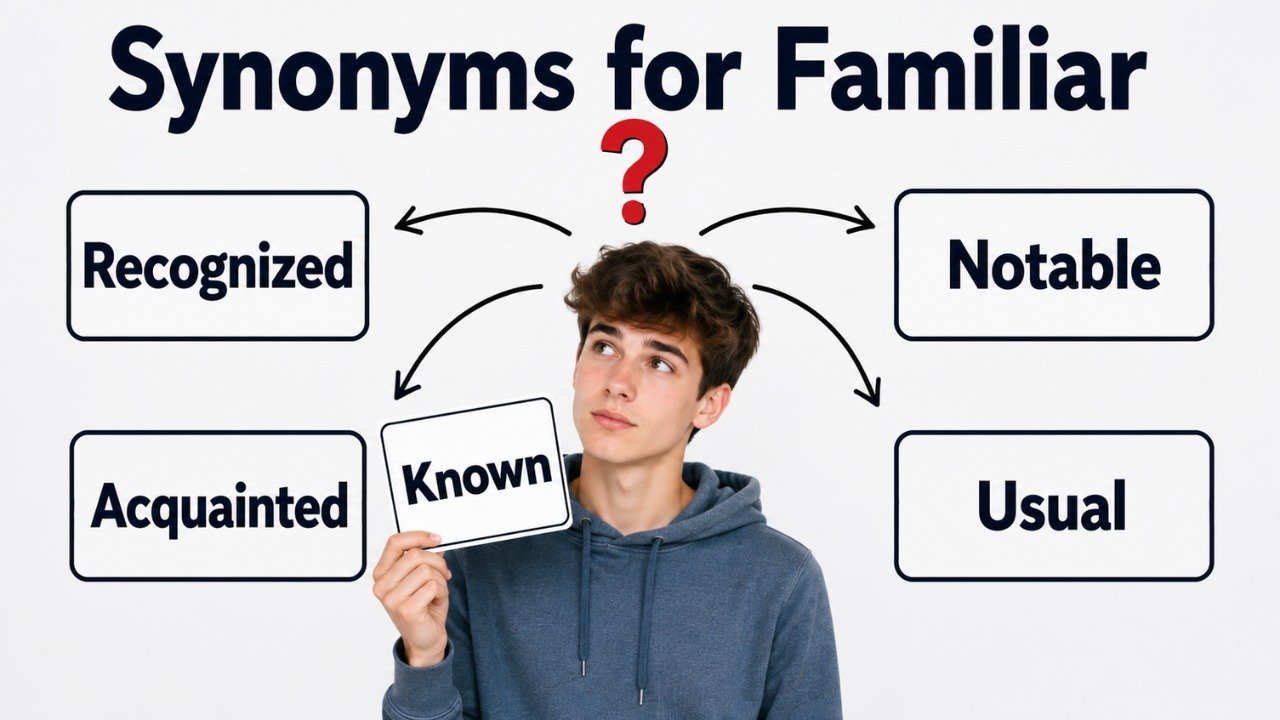
Quick Answer: The best synonyms for familiar include well known, recognized, recognizable, common, usual, accustomed, acquainted, knowledgeable, comfortable, and established. Use well known for a person, place, or fact that many people recognize. Choose acquainted when someone has met another person or has basic knowledge of a subject. Accustomed is best for something experienced regularly, while recognizable describes something that can be identified easily. Common and usual are suitable for ordinary situations, repeated behavior, and expected events.
Pronunciation and Word Details
Word: Familiar.
Pronunciation: /fəˈmɪliər/
Part of Speech: Adjective.
Meaning: Familiar describes someone or something that is known, recognized, frequently experienced, or understood through previous contact.
US Pronunciation:
UK Pronunciation:
What Does “Familiar” Mean?
Familiar means known or easily recognized because it has been seen, heard, experienced, or learned before.
The word familiar is mainly used as an adjective. It can describe people, places, sounds, ideas, situations, habits, and subjects. A familiar face is someone you recognize, while a familiar topic is one you already understand.
Familiar can also describe knowledge or experience. When someone is familiar with a subject, that person knows something about it. The level of knowledge may be basic or detailed, depending on the context.
It can also mean comfortable because of repeated experience. A familiar environment feels natural and reassuring because it is not new or strange.
In social situations, familiar may describe friendly and informal behavior. However, saying that someone is being too familiar can suggest that the person is behaving with more closeness than the relationship allows.
Meaning, Tone, and Context of “Familiar”
Familiar is generally a neutral and widely used word. It appears naturally in formal writing, everyday conversation, education, workplace communication, literature, and descriptive writing.
When familiar means recognized, its tone is neutral and descriptive. A familiar sound, face, smell, or location is simply something that a person remembers from an earlier experience.
When it describes knowledge, familiar can sound professional or academic. For example, a job description may ask whether someone is familiar with a particular process or area of study.
Familiar may also have a warm and emotional tone. A familiar voice, room, tradition, or scent can create feelings of comfort, safety, memory, or belonging.
In social contexts, familiar can have a negative meaning. The phrase too familiar suggests behavior that is overly personal, informal, or disrespectful.
The correct synonym therefore depends on whether familiar means recognized, common, knowledgeable, accustomed, comfortable, or socially close.
When and How to Use “Familiar”
For Recognition: Use familiar when a person can identify someone or something from a previous experience.
Example: The speaker’s voice sounded familiar.
For Knowledge: Use familiar when someone understands a subject, method, place, or situation.
Example: She is familiar with the basic rules of formal writing.
For Repeated Experience: Use familiar when something has been experienced many times.
Example: The team faced a familiar problem during the project.
For Comfort: Use familiar when a place, sound, activity, or object creates a sense of ease.
Example: Returning to the familiar house made him feel relaxed.
For Common Occurrences: Use familiar to describe something regularly seen or widely known.
Example: Heavy traffic is a familiar sight in the city center.
For Social Closeness: Use familiar when people communicate in an informal or friendly manner.
Example: The two colleagues spoke in a familiar tone.
For Excessive Informality: Use too familiar when someone behaves as though a relationship is closer than it actually is.
Example: His questions became too familiar for a professional conversation.
Best Synonyms for Familiar
Well Known: Recognized or understood by many people.
Example: The building is a well known example of traditional architecture.
Recognized: Identified because it has been seen, heard, or experienced before.
Example: She recognized the familiar melody immediately.
Recognizable: Easy to identify from a particular feature.
Example: His writing has a recognizable style.
Common: Frequently seen, experienced, or found.
Example: This is a common concern among new students.
Usual: Expected because it normally happens in a particular way.
Example: He arrived at his usual time.
Accustomed: Comfortable with something because of repeated experience.
Example: The workers were accustomed to early morning meetings.
Acquainted: Having some knowledge of a person, place, or subject.
Example: She is acquainted with the main ideas of the theory.
Knowledgeable: Having a strong understanding of a subject.
Example: The guide was knowledgeable about local history.
Comfortable: Feeling relaxed because something is understood or previously experienced.
Example: He feels comfortable using the new process.
Established: Known, accepted, or used for a considerable period.
Example: The researchers followed an established method.
50 Synonyms for Familiar with Short Meanings
- Well Known: Recognized or understood by many people.
- Known: Identified or understood from previous knowledge.
- Recognized: Identified because of an earlier experience.
- Recognizable: Easy to identify by appearance, sound, or quality.
- Identifiable: Able to be named or recognized.
- Remembered: Kept in the mind from a previous experience.
- Common: Frequently seen, found, or experienced.
- Usual: Normal or expected in a particular situation.
- Customary: Commonly practiced according to habit or tradition.
- Ordinary: Normal and not unusual.
- Everyday: Commonly experienced in daily life.
- Routine: Regularly performed in the same way.
- Regular: Occurring repeatedly or according to a pattern.
- Standard: Generally accepted, used, or expected.
- Conventional: Following accepted practices or traditions.
- Established: Known and accepted over time.
- Traditional: Connected with customs followed for a long period.
- Typical: Having the qualities normally expected.
- Expected: Considered likely or normal.
- Predictable: Easy to anticipate because of a known pattern.
- Habitual: Done regularly as a habit.
- Frequent: Happening often.
- Recurring: Appearing or happening repeatedly.
- Prevalent: Commonly existing within a group or area.
- Widespread: Existing or recognized in many places.
- Popular: Known and liked by many people.
- Ubiquitous: Present or noticed almost everywhere.
- Acquainted: Having some knowledge or experience of something.
- Well Acquainted: Having considerable knowledge of someone or something.
- Conversant: Familiar with a subject through knowledge or experience.
- Knowledgeable: Possessing useful or detailed understanding.
- Informed: Having relevant facts or information.
- Aware: Knowing that something exists or has happened.
- Versed: Experienced or skilled in a particular subject.
- Experienced: Having knowledge gained through practical involvement.
- Accustomed: Used to something through repeated experience.
- Used: Comfortable with something because it is not new.
- Habituated: Made accustomed to a repeated condition.
- Comfortable: Relaxed and confident with something known.
- Intimate: Closely known or deeply understood.
- Close: Having a strong personal connection.
- Friendly: Warm, informal, and socially welcoming.
- Informal: Relaxed and not strictly formal.
- Personal: Connected with private knowledge or close relationships.
- Approachable: Friendly and easy to communicate with.
- Accessible: Easy to understand, reach, or use.
- Homelike: Comfortable and similar to one’s home.
- Reassuring: Creating comfort because it feels safe or known.
- Understood: Clearly known or comprehended.
- Distinctive: Recognizable because of a special quality.
Read Also:
Synonyms for Honored

Synonyms for Familiar by Context
When Familiar Means Known or Recognized
Well known, known, recognized, recognizable, identifiable, remembered, and distinctive describe something that can be identified because it has been experienced before.
Well Known: Best for a person, fact, place, or work recognized by many people.
Example: The writer is well known for her clear descriptions.
Recognizable: Best for a noticeable appearance, sound, voice, or style.
Example: The musician has a recognizable voice.
Identifiable: Best when particular qualities make something possible to identify.
Example: The building is identifiable by its tall entrance.
When Familiar Means Common or Usual
Common, usual, customary, routine, regular, ordinary, everyday, and typical describe things that happen frequently or are considered normal.
Common: Emphasizes frequency among many people or situations.
Example: Nervousness is common before an important interview.
Usual: Describes what normally happens in a particular situation.
Example: She followed her usual morning routine.
Customary: Refers to behavior accepted through tradition or repeated practice.
Example: It is customary to greet every guest politely.
When Familiar Means Knowledgeable
Acquainted, conversant, knowledgeable, informed, aware, versed, and experienced describe different levels of knowledge.
Acquainted: Suggests basic or moderate knowledge.
Example: He is acquainted with the main principles of grammar.
Conversant: Suggests practical knowledge and the ability to discuss a subject.
Example: The editor is conversant with several writing styles.
Versed: Suggests considerable knowledge developed through study or experience.
Example: She is well versed in traditional poetry.
When Familiar Means Accustomed
Accustomed, used, habituated, experienced, and comfortable describe someone who has adjusted to a situation through repetition.
Accustomed: Emphasizes adjustment over time.
Example: The students became accustomed to the new timetable.
Used: A conversational alternative meaning no longer surprised or uncomfortable.
Example: He is used to working in a quiet environment.
Comfortable: Emphasizes confidence and ease rather than repetition alone.
Example: She is comfortable speaking before a large audience.
When Familiar Means Friendly or Informal
Friendly, informal, personal, intimate, close, and approachable describe social warmth or a relaxed relationship.
Friendly: Suggests kindness and welcoming behavior.
Example: The receptionist greeted everyone in a friendly manner.
Informal: Describes relaxed language or behavior without strict formality.
Example: The conversation became more informal after the meeting.
Intimate: Describes deep personal knowledge or emotional closeness.
Example: The memoir provides an intimate view of family life.
Another Word for Familiar
A strong general replacement for familiar is known. It works when something has been seen, experienced, understood, or identified before. However, known does not express every meaning of familiar.
Use recognizable when something can be identified easily. Use acquainted when discussing basic knowledge. Choose accustomed when repeated experience has made something feel normal. Use common when something happens frequently.
Original: Her face looked familiar.
Better Option: Her face looked recognizable.
Original: I am familiar with the procedure.
Better Option: I am acquainted with the procedure.
Original: He is familiar with working under pressure.
Better Option: He is accustomed to working under pressure.
Original: This is a familiar mistake among beginners.
Better Option: This is a common mistake among beginners.
When Not to Use “Familiar”
Avoid familiar when a more precise word can communicate the intended meaning. The word can become vague because it may refer to recognition, knowledge, frequency, comfort, or social closeness.
Do not use familiar to describe expert knowledge unless the person genuinely has only general understanding. Familiar with a subject does not always mean skilled or highly knowledgeable.
Weak: She is familiar with advanced financial analysis.
Better: She is experienced in advanced financial analysis.
Avoid familiar when describing something that merely happens often. Common, regular, or recurring may be more direct.
Weak: Delays are familiar during the busiest season.
Better: Delays are common during the busiest season.
Do not use familiar when recognizable is needed to describe an appearance, voice, style, or pattern.
Weak: The artist’s familiar style was easy to identify.
Better: The artist’s recognizable style was easy to identify.
Be careful when familiar describes social behavior. It may suggest excessive personal closeness.
Weak: The manager became familiar with the new employee.
Better: The manager became friendly with the new employee.
Words Commonly Confused With Familiar
Familiar vs Similar: Familiar means known from previous experience. Similar means sharing qualities with someone or something else.
Familiar vs Common: Familiar describes something recognized or understood. Common describes something that exists or happens frequently.
Familiar vs Recognizable: Familiar describes the feeling of having experienced something before. Recognizable means possessing clear features that make identification possible.
Familiar vs Acquainted: Familiar can describe knowledge, recognition, or repeated experience. Acquainted usually refers to limited knowledge of a person or subject.
Familiar vs Accustomed: Familiar means known or understood. Accustomed means comfortable with a condition because it has been experienced repeatedly.
Familiar vs Intimate: Familiar may indicate general knowledge or informal behavior. Intimate suggests deep personal knowledge, privacy, or emotional closeness.
Familiar vs Knowledgeable: Familiar suggests some understanding. Knowledgeable indicates a stronger and more detailed command of a subject.
Which Synonym Should You Choose?
Choose well known when describing a person, place, fact, book, idea, or event recognized by many people.
Choose recognizable when an appearance, voice, design, sound, or style can be identified easily.
Choose common when describing a problem, behavior, feature, or experience that occurs frequently.
Choose usual when referring to someone’s normal time, place, behavior, or method.
Choose customary when discussing traditions, accepted practices, or expected social behavior.
Choose acquainted when someone has basic knowledge of a person, subject, or process.
Choose conversant when a person can understand and discuss a topic confidently.
Choose knowledgeable when describing strong knowledge based on study or experience.
Choose accustomed when someone has adjusted to a condition through repetition.
Choose comfortable when familiarity produces confidence, ease, or relaxation.
Choose informal when familiar refers to relaxed language, clothing, or behavior.
Choose recognizable in descriptive writing, knowledgeable in professional writing, common in reports, acquainted in formal communication, and used to in casual conversation.
Real Life Examples of “Familiar” in Sentences
Original: The street looked familiar to me.
Better Option: The street looked recognizable to me.
Original: She is familiar with the basic editing process.
Better Option: She is acquainted with the basic editing process.
Original: This is a familiar challenge for young writers.
Better Option: This is a common challenge for young writers.
Original: He heard a familiar voice outside the room.
Better Option: He heard a recognizable voice outside the room.
Original: We returned to our familiar meeting place.
Better Option: We returned to our usual meeting place.
Original: The workers are familiar with long shifts.
Better Option: The workers are accustomed to long shifts.
Original: The design follows a familiar pattern.
Better Option: The design follows an established pattern.
Original: Her familiar manner helped the guests relax.
Better Option: Her friendly manner helped the guests relax.
Original: The conclusion presents a familiar argument.
Better Option: The conclusion presents a well known argument.
Original: He became familiar with the local customs.
Better Option: He became knowledgeable about the local customs.
Synonym Groups and Usage Differences
Recognition Group
Known, recognized, recognizable, identifiable, remembered, and distinctive belong to the recognition group. They describe people, objects, sounds, places, and ideas that can be identified.
Recognizable and identifiable focus on the ability to recognize something. Remembered emphasizes memory, while distinctive explains why something is easy to identify.
Example: Her distinctive voice was immediately recognizable.
Frequency Group
Common, usual, regular, routine, frequent, recurring, and everyday describe something that appears or happens repeatedly.
Common refers to general frequency, while usual describes what normally happens in a particular situation. Routine suggests an organized repeated activity.
Example: Reviewing notes became part of his regular routine.
Knowledge Group
Acquainted, conversant, informed, aware, knowledgeable, versed, and experienced express different levels of understanding.
Aware suggests simple knowledge of a fact. Acquainted indicates some understanding, while knowledgeable and versed suggest deeper knowledge.
Example: The teacher is well versed in language development.
Adjustment Group
Accustomed, used, habituated, experienced, and comfortable refer to ease created through repeated exposure.
Accustomed is suitable for formal writing, while used is more conversational. Comfortable focuses on confidence and ease.
Example: The new employees quickly became accustomed to the schedule.
Social Closeness Group
Friendly, close, personal, informal, intimate, and approachable describe relationships or relaxed communication.
Friendly suggests warmth, while intimate indicates a much deeper connection. Informal describes a relaxed style rather than emotional closeness.
Example: The speaker used an informal and approachable tone.
Antonyms of Familiar
The opposite of familiar changes according to its meaning. Unfamiliar is the most direct antonym when something is not recognized or understood. Unknown describes something that has not been identified, while strange suggests that something feels unusual or unexpected.
Unfamiliar: Not previously known, seen, or experienced.
Unknown: Not recognized, identified, or understood.
Strange: Unusual or difficult to recognize.
Unrecognized: Not identified from a previous experience.
Uncommon: Not frequently found or experienced.
Unusual: Different from what normally happens.
Foreign: Not known because it comes from another place or experience.
New: Not previously seen, used, or experienced.
Inexperienced: Lacking practical knowledge or previous involvement.
Unaware: Having no knowledge of a fact or situation.
Distant: Not emotionally or socially close.
Uncomfortable: Not feeling relaxed or confident in a situation.
Comparison of Familiar and Related Words
Familiar vs Well Known
Familiar describes something recognized by a particular person because of previous experience. Well known often means recognized by many people.
Example With Familiar: The path seemed familiar because I had walked there before.
Example With Well Known: The path is well known among local hikers.
Familiar vs Recognizable
Familiar expresses a sense of previous knowledge. Recognizable emphasizes clear features that allow identification.
Example With Familiar: His voice sounded familiar.
Example With Recognizable: His voice was recognizable because of its deep tone.
Familiar vs Common
Familiar means previously known or experienced. Common means frequently found or occurring.
Example With Familiar: The painting looked familiar to her.
Example With Common: Bright colors are common in this style of painting.
Familiar vs Acquainted
Familiar has a broad meaning that includes recognition, knowledge, and repeated experience. Acquainted usually means having limited knowledge or contact.
Example With Familiar: She is familiar with the complete process.
Example With Acquainted: She is acquainted with the basic process.
Familiar vs Accustomed
Familiar describes knowledge or recognition. Accustomed describes adjustment caused by repeated experience.
Example With Familiar: He is familiar with the office rules.
Example With Accustomed: He is accustomed to following the office rules.
Familiar vs Knowledgeable
Familiar suggests general awareness or basic understanding. Knowledgeable suggests deeper and more reliable knowledge.
Example With Familiar: She is familiar with gardening methods.
Example With Knowledgeable: She is knowledgeable about soil preparation and plant care.
Common Phrases and Expressions With Familiar
Familiar Face: A person recognized from a previous meeting or experience.
Familiar Voice: A voice that has been heard and remembered before.
Familiar Name: A name that someone recognizes.
Familiar Sound: A sound remembered from an earlier experience.
Familiar Sight: Something seen often or recognized easily.
Familiar Place: A location known through previous visits.
Familiar Feeling: An emotion or physical sensation experienced before.
Familiar Pattern: A repeated or recognizable arrangement of events.
Familiar Territory: A subject, place, or situation that is already understood.
Familiar With: Having knowledge or experience of someone or something.
Sound Familiar: An expression used to ask whether something is recognized.
All Too Familiar: Known extremely well, often through an unpleasant repeated experience.
Common Mistakes to Avoid
One common mistake is using familiar when expert, experienced, or knowledgeable would be more accurate. Being familiar with a subject may only mean having basic awareness.
Avoid repeating familiar several times within the same paragraph. Replace it with known, recognizable, common, usual, or accustomed when the meaning allows.
Do not confuse familiar with similar. Two objects can be similar because they share qualities, but an object is familiar because it has been seen or experienced before.
Be careful with the phrase familiar to and familiar with. Something is familiar to a person, while a person is familiar with something.
Correct: The song is familiar to me.
Correct: I am familiar with the song.
Avoid saying familiar about when familiar with is required.
Incorrect: She is familiar about the policy.
Correct: She is familiar with the policy.
Do not use familiar as a complete replacement for friendly. Familiar behavior may be warm, but it can also be excessively personal or disrespectfully informal.
Always identify the intended meaning before selecting a synonym. Recognition, frequency, knowledge, comfort, and closeness require different word choices.
Conclusion
The most useful synonyms for familiar include well known, recognized, recognizable, common, usual, acquainted, knowledgeable, accustomed, comfortable, and established. The correct choice depends on whether familiar describes recognition, repeated experience, knowledge, social closeness, or something ordinary. Choose recognizable for identifiable features, common for frequent situations, acquainted for basic understanding, and accustomed for adjustment through repetition. Understanding these differences will help you use synonyms for familiar naturally and accurately in conversations, essays, reports, descriptions, and professional writing.
FAQs About Synonyms for Familiar
What Is the Best Synonym for Familiar?
The best general synonym is known. Recognizable is better for something easily identified, while acquainted is suitable for basic knowledge.
What Is Another Word for a Familiar Person?
A familiar person may be described as known, recognized, acquainted, close, or friendly, depending on the relationship.
What Is a Formal Synonym for Familiar With?
Conversant with, acquainted with, knowledgeable about, informed about, and versed in are suitable formal alternatives.
Can Common Replace Familiar?
Common can replace familiar when describing something frequently seen or experienced. It cannot always replace familiar when the meaning involves recognition or knowledge.
What Is a Synonym for a Familiar Place?
A familiar place may be described as a known place, usual location, recognizable setting, regular destination, or comfortable environment.
Is Familiar the Same as Recognizable?
No. Familiar means that something feels known from previous experience. Recognizable means that clear qualities make it possible to identify.
What Is the Opposite of Familiar?
The most direct opposite is unfamiliar. Other antonyms include unknown, strange, unusual, unrecognized, inexperienced, and foreign.
