
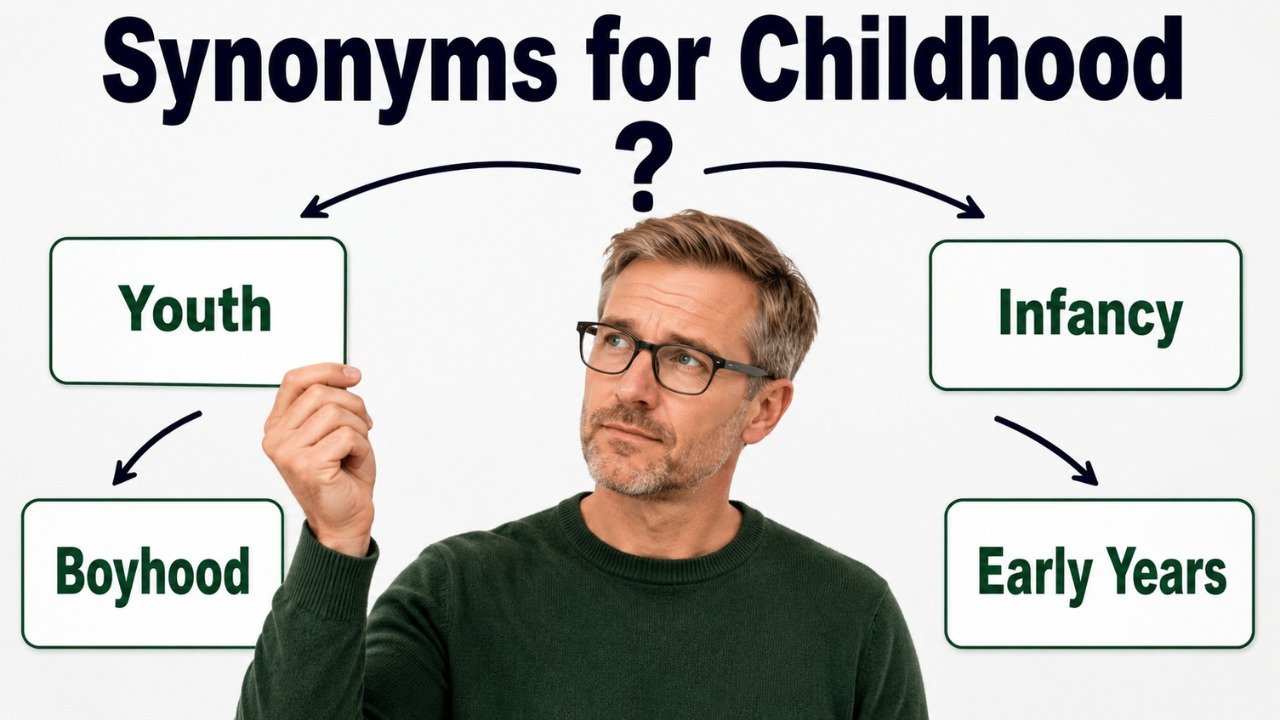
Quick Answer: The best synonyms for childhood include youth, early years, infancy, formative years, younger days, tender years, early life, school days, upbringing, and growing up. Use youth as the most general replacement, infancy for the earliest stage of life, formative years when discussing development, upbringing when focusing on family influence, and younger days when recalling personal memories.
Pronunciation and Word Details
Word: Childhood.
Pronunciation: /ˈtʃaɪld.hʊd/
Part of Speech: Noun.
Meaning: The period of a person’s life when they are a child.
US Pronunciation:
UK Pronunciation:
What Does “Childhood” Mean?
Childhood means the period of life between birth and adolescence when a person is developing physically, mentally, emotionally, and socially.
The word childhood is a noun. It can describe a general stage of human life, a person’s early experiences, or the memories connected with being young.
In everyday conversation, childhood often refers to the years when someone lived with parents, attended school, played games, and depended on adults.
In academic or developmental contexts, childhood may be divided into stages such as infancy, early childhood, middle childhood, and late childhood.
General Meaning: Childhood is the stage of being a child.
Personal Meaning: It can describe someone’s early memories and experiences.
Developmental Meaning: It can refer to the years in which important mental, emotional, and social growth takes place.
Example: She spent most of her childhood in a quiet coastal town.
Meaning, Tone, and Context of “Childhood”
Childhood is usually a neutral and widely understood word. It can become emotional, nostalgic, academic, or serious depending on the context.
Neutral Tone: Childhood is neutral when it simply identifies a stage of life.
Example: Childhood normally comes before adolescence.
Nostalgic Tone: The word can express warm memories of earlier years.
Example: The smell of fresh bread reminded him of his childhood.
Emotional Tone: Childhood may be used when discussing difficult, joyful, or influential experiences.
Example: Her childhood shaped the way she understood family relationships.
Academic Tone: The word appears in discussions of education, psychology, health, behavior, and human development.
Example: Early childhood is an important period of language development.
Conversational Tone: Childhood is common in everyday speech when people discuss memories, family life, or school experiences.
Example: What was your childhood like?
When and How to Use “Childhood”
Use childhood when referring to the years during which someone was a child or to the experiences connected with those years.
For a Stage of Life
Use childhood to describe the period before adolescence.
Example: Childhood is a time of rapid learning and growth.
For Personal Memories
Use childhood when recalling events, places, people, or feelings from someone’s younger years.
Example: This song brings back memories of my childhood.
For Development
Use childhood when discussing physical, mental, emotional, or social growth.
Example: Healthy routines established during childhood can continue into adult life.
For Family Experiences
Use childhood when describing the environment in which someone grew up.
Example: He had a peaceful childhood surrounded by supportive relatives.
For Education
Use childhood when discussing learning, schools, play, and early intellectual development.
Example: Reading played an important role throughout her childhood.
For Difficult Experiences
Use childhood when referring to challenges or hardships that happened during someone’s early life.
Example: The character struggles to understand the events of his childhood.
For Nostalgia
Use childhood when expressing affection for earlier experiences.
Example: The old playground reminded us of our childhood adventures.
Best Synonyms for Childhood
Youth
Synonym: The period of life when someone is young.
Example: She spent her youth exploring the countryside.
Early Years
Synonym: The first years of a person’s life.
Example: Music was an important part of his early years.
Infancy
Synonym: The earliest stage of childhood, especially when a person is a baby.
Example: The photographs recorded her growth from infancy.
Formative Years
Synonym: The early years during which personality, beliefs, and abilities develop.
Example: His formative years strongly influenced his career choices.
Younger Days
Synonym: A person’s earlier years, usually remembered from later life.
Example: She often told stories about her younger days.
Tender Years
Synonym: The early and vulnerable years of childhood.
Example: Children need security and encouragement during their tender years.
Early Life
Synonym: The beginning period of someone’s life.
Example: The biography describes the writer’s early life.
School Days
Synonym: The period of childhood spent attending school.
Example: They remained friends after their school days ended.
Upbringing
Synonym: The way a child is raised and taught by family or caregivers.
Example: His respectful manner reflected his upbringing.
Growing Up
Synonym: The process of developing from a child into an adult.
Example: Growing up in a large family taught her patience.
50 Synonyms for Childhood with Short Meanings
- Youth: The period when a person is young.
- Early Years: The first years of someone’s life.
- Infancy: The earliest stage of childhood.
- Babyhood: The period when someone is a baby.
- Toddlerhood: The stage when a young child begins walking.
- Early Childhood: The first major stage after infancy.
- Middle Childhood: The stage between early childhood and the preteen years.
- Late Childhood: The final stage before adolescence.
- Preschool Years: The years before formal schooling begins.
- School Years: The period spent attending school as a child.
- Formative Years: The years when character and abilities develop.
- Growing Years: The period of physical and emotional development.
- Younger Days: A person’s earlier years.
- Tender Years: The early and vulnerable years of life.
- Juvenile Years: The period when someone is legally or socially young.
- Minority: The legal period before adulthood.
- Juvenility: The condition or quality of being young.
- Juvenescence: The state or period of youthfulness.
- Boyhood: The period when a male person is a boy.
- Girlhood: The period when a female person is a girl.
- Kidhood: An informal term for the years of being a child.
- Early Life: The beginning stage of a person’s life.
- Young Life: Life during one’s younger years.
- Youthful Days: The days when someone was young.
- Youthful Years: The period associated with youth.
- Childhood Years: The years during which someone is a child.
- Days of Youth: The earlier years of life.
- Days of Innocence: Early years associated with simplicity and innocence.
- Innocent Years: A nostalgic description of early childhood.
- Growing Up: The process of developing toward adulthood.
- Upbringing: The way someone is raised during childhood.
- Early Upbringing: A person’s earliest family guidance and care.
- Developmental Years: The years of major physical and mental growth.
- Early Development: The beginning period of human growth.
- Period of Growth: A stage when important development occurs.
- Growth Stage: A particular period of physical or emotional development.
- Juvenile Period: The stage before legal adulthood.
- Youthful Period: A time characterized by youth.
- Early Age: A young stage of life.
- Young Age: The period when a person is still young.
- Earliest Years: The first part of someone’s life.
- First Years: The initial years after birth.
- Nursery Years: The years associated with nursery care or education.
- Primary School Years: The childhood period spent in primary education.
- School Days: The years remembered from school.
- Preteen Years: The years immediately before adolescence.
- Preadolescence: The developmental stage before adolescence.
- Years as a Minor: The legal period before adulthood.
- Early Stage of Life: The beginning portion of human life.
- Youthful Beginnings: A descriptive phrase for someone’s earliest years.
Read Also:
Synonyms for Cruelty

Synonyms for Childhood by Context
When Childhood Means a General Life Stage
Youth is usually the best broad synonym when childhood refers to the period before adulthood.
Other useful alternatives include early life, younger years, juvenile years, and youthful period.
Example With Childhood: She spent her childhood in the countryside.
Example With Youth: She spent her youth in the countryside.
Youth can include teenage years, so it may cover a longer period than childhood.
When Childhood Means the Earliest Years
Use infancy, babyhood, toddlerhood, early childhood, or preschool years when describing a precise early stage.
Example: The condition was identified during infancy.
Example: He developed an interest in music during early childhood.
Infancy is limited to the baby stage, while early childhood usually includes the years after infancy.
When Childhood Means Personal Memories
Use younger days, youthful days, school days, days of youth, or days of innocence when recalling past experiences.
Example: The photograph reminded her of her younger days.
Example: He often spoke fondly of his school days.
These alternatives often create a nostalgic or emotional tone.
When Childhood Means Development
Use formative years, developmental years, growing years, or period of growth when focusing on learning and personal development.
Example: Her formative years helped shape her confidence.
Example: Children need consistent support during their developmental years.
Formative years is especially useful when explaining how early experiences influenced a person’s later personality or decisions.
When Childhood Means Family Influence
Use upbringing or early upbringing when discussing how parents, relatives, or caregivers raised someone.
Example: His upbringing encouraged honesty and responsibility.
Childhood describes the entire stage of life, while upbringing focuses on care, teaching, discipline, values, and family environment.
When Childhood Means School Age
Use school years, school days, primary school years, or preteen years when education is the main subject.
Example: She discovered her talent for writing during her school years.
School days often sounds nostalgic, while school years is more neutral.
Another Word for Childhood
The best single replacement for childhood is usually youth. However, the most accurate alternative depends on the meaning of the sentence.
Use infancy for the baby stage, formative years for development, upbringing for family influence, and younger days for nostalgic memories.
Original: She lived abroad throughout her childhood.
Better Option: She lived abroad throughout her youth.
Original: His childhood shaped his personality.
Better Option: His formative years shaped his personality.
Original: She received strong moral guidance during her childhood.
Better Option: She received strong moral guidance through her upbringing.
Original: He enjoyed visiting the farm during his childhood.
Better Option: He enjoyed visiting the farm during his younger days.
When Not to Use “Childhood”
Childhood is clear and natural, but another word may be more accurate in certain situations.
When Referring Only to Babies
Use infancy or babyhood instead of childhood when the sentence concerns the first stage after birth.
Weak: The child learned to recognize familiar voices during childhood.
Better: The child learned to recognize familiar voices during infancy.
When Discussing Parenting and Family Influence
Use upbringing when the focus is how someone was raised rather than the entire period of being young.
Weak: Her disciplined childhood taught her responsibility.
Better: Her disciplined upbringing taught her responsibility.
When Discussing Personality Development
Use formative years when early experiences shaped later behavior, beliefs, or abilities.
Weak: His childhood influenced his approach to leadership.
Better: His formative years influenced his approach to leadership.
When Referring to School Memories
Use school days or school years when the experience happened specifically at school.
Weak: They became friends during childhood.
Better: They became friends during their school days.
When Childhood Becomes Repetitive
Repeated use of childhood can make personal or biographical writing sound monotonous.
Weak: Her childhood was peaceful. During her childhood, she read constantly. Her childhood also included frequent travel.
Better: Her early years were peaceful. During that period, she read constantly and travelled frequently.
Words Commonly Confused With Childhood
Childhood vs Youth: Childhood specifically refers to the years of being a child. Youth can include both childhood and adolescence.
Childhood vs Infancy: Childhood is a broad life stage. Infancy refers only to the earliest period when someone is a baby.
Childhood vs Adolescence: Childhood comes before adolescence. Adolescence is the transitional stage between childhood and adulthood.
Childhood vs Upbringing: Childhood describes a period of life. Upbringing describes the way someone was raised.
Childhood vs Early Life: Childhood usually ends around adolescence. Early life is broader and may include childhood, adolescence, and early adulthood.
Childhood vs Boyhood: Childhood can refer to any child. Boyhood specifically refers to the childhood of a boy.
Childhood vs Girlhood: Childhood is gender neutral. Girlhood specifically refers to the childhood of a girl.
Childhood vs Preadolescence: Childhood covers many years. Preadolescence refers only to the years immediately before adolescence.
Which Synonym Should You Choose?
Choose youth when you need a broad and natural replacement for childhood.
Choose early years when describing the beginning of someone’s life in a neutral way.
Choose infancy when discussing babies, early medical development, or the first stage after birth.
Choose babyhood when writing warmly or informally about the baby stage.
Choose toddlerhood when discussing children who are beginning to walk, speak, and explore independently.
Choose formative years when explaining how early experiences shaped personality, beliefs, talents, or behavior.
Choose upbringing when focusing on parenting, family values, education at home, or social environment.
Choose younger days when recalling personal memories in a warm or nostalgic tone.
Choose school days when discussing friendships, teachers, classrooms, or school memories.
Choose developmental years in academic, educational, psychological, or medical writing.
Choose tender years when emphasizing vulnerability, care, innocence, or protection.
Choose boyhood or girlhood when gender is relevant to the person’s early experiences.
Real Life Examples of “Childhood” in Sentences
Original: She spent her childhood near the mountains.
Better Option: She spent her early years near the mountains.
Original: His childhood influenced his love of nature.
Better Option: His formative years influenced his love of nature.
Original: They were close friends throughout childhood.
Better Option: They were close friends throughout their school years.
Original: She developed the habit during childhood.
Better Option: She developed the habit during her younger years.
Original: His childhood was filled with music and books.
Better Option: His youth was filled with music and books.
Original: The illness began in childhood.
Better Option: The illness began during early childhood.
Original: She received excellent guidance throughout her childhood.
Better Option: She received excellent guidance through her upbringing.
Original: He remembered the summers of his childhood.
Better Option: He remembered the summers of his younger days.
Original: Good nutrition is important during childhood.
Better Option: Good nutrition is important during the developmental years.
Original: The story describes her childhood in a farming community.
Better Option: The story describes her early life in a farming community.
Synonym Groups and Usage Differences
General Life Stage Group
This group includes youth, early years, early life, young life, and youthful years.
These words describe the general period when someone is young.
Example: His youth was spent in a small village.
Youth is broader than childhood because it may include adolescence.
Earliest Age Group
This group includes infancy, babyhood, toddlerhood, nursery years, and early childhood.
These terms identify specific stages at the beginning of life.
Example: Language development begins during infancy and continues through early childhood.
Use these alternatives when age precision is important.
Development Group
This group includes formative years, developmental years, growing years, early development, and period of growth.
These alternatives emphasize learning, emotional growth, personality, or physical change.
Example: Her formative years encouraged independence and creativity.
Memory Group
This group includes younger days, youthful days, school days, days of youth, and days of innocence.
These phrases are useful when looking back on earlier experiences.
Example: The old photograph brought back memories of his school days.
Family Influence Group
This group includes upbringing, early upbringing, and growing up.
These alternatives focus on home life, caregivers, values, discipline, and family experiences.
Example: Her upbringing taught her to treat others with kindness.
Gender Specific Group
This group includes boyhood and girlhood.
Use these words when a person’s gender is relevant to the sentence.
Example: The novel follows the main character from boyhood to adulthood.
Formal and Technical Group
This group includes minority, juvenility, juvenile period, preadolescence, and developmental years.
These terms are more common in legal, academic, psychological, or scientific contexts.
Example: The study examined emotional changes during preadolescence.
Informal Group
Kidhood is an informal alternative that may appear in friendly or conversational writing.
Example: That television program was a favorite during my kidhood.
Kidhood is less suitable for formal essays, reports, and academic writing.
Antonyms of Childhood
The opposite of childhood depends on whether the sentence concerns age, development, responsibility, or life experience.
Adulthood: The stage of life after childhood and adolescence.
Maturity: The state of being fully developed or emotionally responsible.
Later Life: The period that occurs well after youth.
Old Age: The final stage of the human lifespan.
Independence: The condition of no longer depending on adult caregivers.
Middle Age: The period between early adulthood and old age.
Elderhood: The stage of being an older adult.
Grown Adulthood: The condition of being fully grown.
Parenthood: The life stage in which someone is responsible for raising a child.
Adult Years: The years following childhood and adolescence.
Comparison: Childhood vs Related Words
Childhood vs Youth
Childhood refers specifically to the period when someone is a child. Youth is broader and may include adolescence or early adulthood.
Example With Childhood: She learned to swim during childhood.
Example With Youth: She travelled widely during her youth.
Childhood vs Infancy
Childhood includes several stages of early life. Infancy refers only to the baby stage.
Example With Childhood: Reading became important during his childhood.
Example With Infancy: His hearing difficulty was discovered during infancy.
Childhood vs Adolescence
Childhood is the period before adolescence. Adolescence is the transitional stage when a young person develops toward adulthood.
Example With Childhood: She enjoyed imaginative games during childhood.
Example With Adolescence: She became more independent during adolescence.
Childhood vs Upbringing
Childhood describes when early experiences occurred. Upbringing describes how someone was raised.
Example With Childhood: He lived in several cities during childhood.
Example With Upbringing: His upbringing emphasized education and discipline.
Childhood vs Early Life
Childhood is a clearly defined period before adolescence. Early life is a broader phrase that may include later stages.
Example With Childhood: She began painting in childhood.
Example With Early Life: She faced several career challenges in her early life.
Childhood vs Formative Years
Childhood identifies a stage of life. Formative years emphasizes the period when personality, values, and abilities were shaped.
Example With Childhood: He moved abroad during childhood.
Example With Formative Years: Living abroad during his formative years shaped his worldview.
Childhood vs School Days
Childhood includes experiences at home, school, and elsewhere. School days refers specifically to the years spent attending school.
Example With Childhood: She loved outdoor activities throughout childhood.
Example With School Days: She joined several sports clubs during her school days.
Common Phrases and Expressions With “Childhood”
Early Childhood: The first stage of childhood after infancy.
Happy Childhood: Early years filled with positive experiences.
Difficult Childhood: Early years involving hardship, instability, or challenges.
Childhood Memories: Recollections of experiences from a person’s younger years.
Childhood Friend: A person someone became friends with while young.
Childhood Dream: An ambition or hope formed during childhood.
Childhood Home: The house or place where someone grew up.
Childhood Experience: An event or situation that happened when someone was a child.
Childhood Development: Physical, mental, emotional, and social growth during childhood.
Childhood Education: Learning and instruction provided during the early years.
Common Mistakes to Avoid
Using Childhood and Upbringing as Exact Synonyms
Childhood is a time period, while upbringing is the way a person is raised.
Incorrect: Her childhood taught her strict manners.
Better: Her upbringing taught her strict manners.
Using Infancy for All Childhood Years
Infancy refers only to the earliest stage of life.
Incorrect: He attended primary school during infancy.
Better: He attended primary school during childhood.
Using Youth When Precise Age Matters
Youth may include adolescence, so it is not always an exact replacement for childhood.
Unclear: The condition appeared during his youth.
Clearer: The condition appeared during early childhood.
Repeating Childhood Too Often
Use natural alternatives when writing biographies, memories, or personal essays.
Repetitive: Her childhood was active, and her childhood included many outdoor adventures.
Improved: Her early years were active and included many outdoor adventures.
Choosing an Overly Formal Alternative
Words such as juvenescence and juvenility may sound unnatural in everyday conversation.
Unnatural: I enjoyed many games during my juvenescence.
Natural: I enjoyed many games during my childhood.
Confusing Childhood With Childishness
Childhood is a stage of life. Childishness means immature behavior.
Incorrect: His childhood annoyed his coworkers.
Correct: His childishness annoyed his coworkers.
Using Boyhood or Girlhood Unnecessarily
Use childhood when gender is irrelevant.
Limited: Every person’s boyhood or girlhood affects later development.
Better: Every person’s childhood can affect later development.
Using Vague Alternatives
Choose synonyms that match the exact meaning instead of replacing childhood mechanically.
Vague: Her period was filled with happy memories.
Better: Her younger days were filled with happy memories.
Conclusion
Synonyms for childhood include youth, early years, infancy, formative years, younger days, school days, upbringing, and early life. Youth is the best broad replacement, while infancy describes the baby stage. Formative years highlights development, upbringing focuses on family influence, and younger days creates a nostalgic tone. Choosing the correct alternative depends on whether you are discussing age, memories, education, personal growth, or the environment in which someone was raised.
FAQs About Synonyms for Childhood
What Is the Best Synonym for Childhood?
Youth is the best general synonym for childhood. However, it may also include adolescence, so early years may be more precise in some sentences.
Is Infancy the Same as Childhood?
No. Infancy is the earliest stage of childhood when a person is a baby. Childhood covers a much longer period.
Can Upbringing Replace Childhood?
Upbringing can replace childhood only when the sentence focuses on how someone was raised, taught, or cared for.
What Is a Formal Synonym for Childhood?
Formative years, developmental years, juvenile period, and early life are suitable formal alternatives, depending on the context.
What Is a Nostalgic Synonym for Childhood?
Younger days, school days, days of youth, and days of innocence are useful nostalgic alternatives.
What Is Another Word for a Happy Childhood?
Useful phrases include happy early years, joyful youth, carefree younger days, and pleasant formative years.
What Is the Difference Between Childhood and Youth?
Childhood refers to the years when someone is a child. Youth is broader and can include childhood, adolescence, and sometimes early adulthood.
