
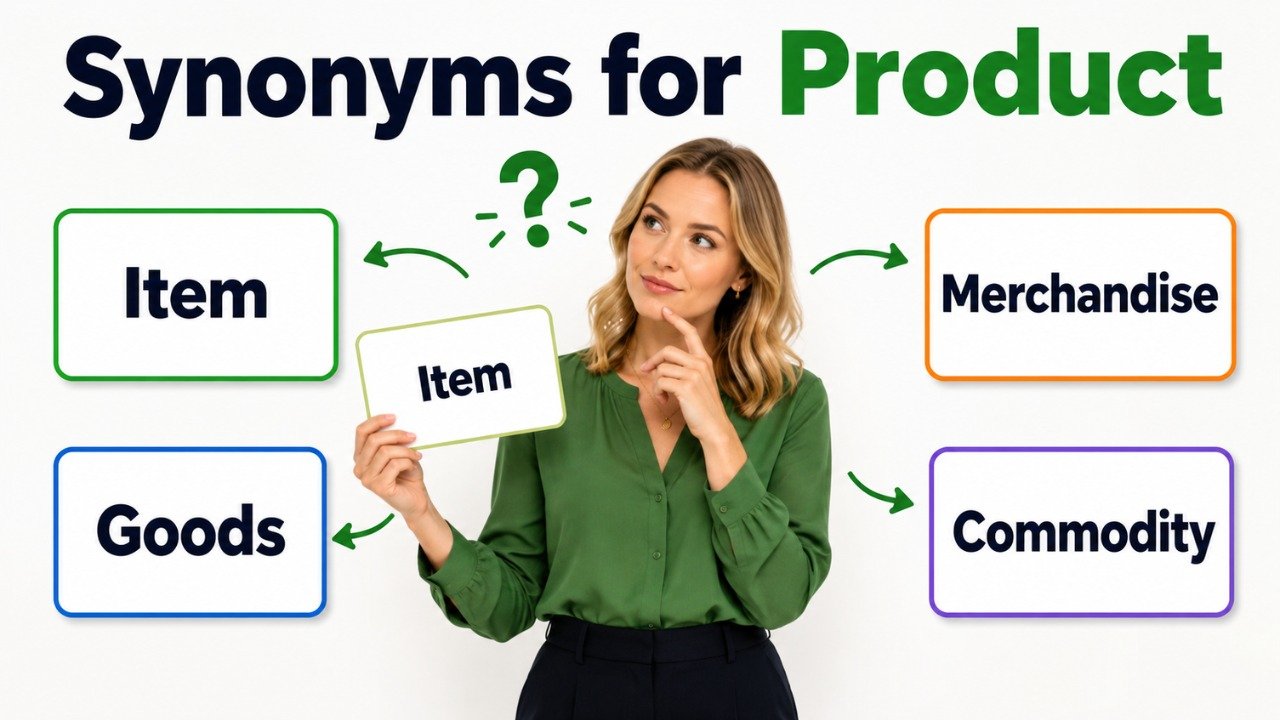
Quick Answer: Common synonyms for product include item, goods, commodity, merchandise, offering, creation, output, result, deliverable, and invention. Use item for a single physical object, goods for items sold commercially, commodity for something traded, merchandise for retail stock, offering for something provided to customers, output for completed work, and result for an effect or outcome. The best synonym depends on whether product refers to something manufactured, sold, created, produced, or calculated.
Pronunciation and Word Details
Word: Product.
Pronunciation: /ˈprɒdʌkt/.
Part of Speech: Noun.
Meaning: Something that is made, created, grown, sold, or produced as a result of a process.
US Pronunciation:
UK Pronunciation:
What Does “Product” Mean?
Product means something that has been made, created, developed, grown, or produced. It can refer to a physical item, a commercial offering, a creative result, a chemical substance, or the answer to a multiplication problem.
Product is mainly used as a noun.
Physical Item: The factory produces a new household product.
Commercial Offering: The company introduced a useful product for small businesses.
Result: His confidence was the product of years of practice.
Mathematics: The product of four and five is twenty.
The word also works before another noun to describe something related to commercial goods.
Example: The team improved the product design.
In this sentence, product describes the type of design being discussed.
Meaning, Tone, and Context of “Product”
Product is a neutral and widely used word. It appears in formal, professional, academic, technical, commercial, and conversational writing.
In business contexts, product usually means an item or service created for customers.
Example: The business is developing a new product.
In manufacturing, product refers to something made through a production process.
Example: Each finished product is inspected for quality.
In academic or analytical writing, product can mean the result of certain conditions, experiences, or actions.
Example: The policy was a product of careful planning.
In mathematics, product means the number obtained when two or more numbers are multiplied.
Example: Find the product of six and nine.
In chemistry, product refers to a substance formed during a chemical reaction.
Example: Water is one of the products of the reaction.
The tone of product is usually neutral. However, more precise alternatives such as merchandise, commodity, output, result, or creation may communicate the intended meaning more clearly.
When and How to Use “Product”
For a Manufactured Item
Use product for an object created through a manufacturing or production process.
Example: The finished product passed every safety inspection.
For Something Being Sold
Product can describe an item, digital resource, or commercial solution offered to customers.
Example: Customers responded positively to the new product.
For a Creative Result
Use product for something created through imagination, skill, or effort.
Example: The sculpture was the product of months of careful work.
For an Outcome
Product can mean the result of actions, experiences, conditions, or influences.
Example: Her success was the product of patience and discipline.
For Agricultural Goods
Product can refer to something grown, harvested, or obtained from natural resources.
Example: The region exports several agricultural products.
For a Chemical Result
In scientific writing, product means a substance formed by a reaction.
Example: The final product of the reaction was carefully measured.
For Mathematics
Product is the standard word for the result of multiplication.
Example: The product of eight and seven is fifty six.
For Professional Planning
Product is often used when discussing design, development, quality, pricing, testing, or performance.
Example: The product development team reviewed the latest design.
Best Synonyms for Product
Item
Meaning: A single object, article, or unit.
Example: Each item was placed in a separate container.
Goods
Meaning: Physical things made or sold commercially.
Example: The store sells household goods.
Commodity
Meaning: A useful substance or item that can be bought, sold, or traded.
Example: Wheat is an important agricultural commodity.
Merchandise
Meaning: Goods available for sale.
Example: The shop displayed its new merchandise near the entrance.
Offering
Meaning: Something made available to customers or users.
Example: The new offering includes several useful features.
Creation
Meaning: Something produced through imagination, effort, or skill.
Example: The painting is her finest creation.
Output
Meaning: The amount or result produced by a person, machine, or system.
Example: The factory increased its daily output.
Result
Meaning: Something that happens or exists because of an action or process.
Example: The improvement was the result of careful preparation.
Deliverable
Meaning: A completed piece of work that must be provided as part of a project.
Example: The final report is the main project deliverable.
Invention
Meaning: A newly created device, method, or idea.
Example: The invention made the process faster and safer.
50 Synonyms for Product With Short Meanings
- Item: A single object or unit.
- Goods: Physical things produced or sold.
- Commodity: An item or material that can be traded.
- Merchandise: Goods offered for sale.
- Wares: Manufactured articles sold by a business.
- Article: A particular object or item.
- Offering: Something provided or made available.
- Creation: Something produced through effort or imagination.
- Output: The amount or result produced.
- Result: The outcome of an action or process.
- Outcome: The final effect of an event or activity.
- Production: Something created through a production process.
- Produce: Agricultural goods, especially fruits and vegetables.
- Manufacture: Something produced industrially.
- Work: Something created through effort or skill.
- Artifact: An object made by a person.
- Invention: A newly designed device, method, or idea.
- Development: Something newly created or improved.
- Solution: Something designed to solve a problem.
- Deliverable: Completed work provided for a project.
- Material: A substance used or produced for a purpose.
- Substance: A particular type of physical matter.
- Compound: A substance formed from combined elements.
- Preparation: A substance made for a particular purpose.
- Formulation: A carefully developed mixture or composition.
- Yield: The amount produced by a process or activity.
- Harvest: Crops or goods gathered from the land.
- Crop: A plant or agricultural good grown for use or sale.
- Stock: Goods kept for sale or future use.
- Inventory: The complete collection of available goods.
- Selection: A group of available choices.
- Assortment: A varied collection of goods or items.
- Range: A collection of related offerings.
- Line: A group of similar commercial items.
- Model: A particular version of a manufactured item.
- Unit: One individual object within a larger quantity.
- Package: A combined set of goods, features, or services.
- Resource: Something useful that can be provided or used.
- Asset: Something valuable created, owned, or controlled.
- Handiwork: Something made through personal skill or effort.
- Craftwork: An item created through skilled manual work.
- Fabrication: Something formed or manufactured.
- Consequence: A result caused by an action or condition.
- Effect: A change or result produced by a cause.
- Achievement: Something successfully created or completed.
- Accomplishment: A completed result requiring effort or skill.
- Finished item: An object that has completed production.
- Manufactured item: An object made through an industrial process.
- Commercial item: Something created or supplied for sale.
- Multiplication result: The number obtained by multiplying numbers.
Read Also:
Synonyms for Requirements

Synonyms for Product by Context
When Product Means an Item for Sale
Item, goods, merchandise, wares, commodity, stock, and commercial item can describe something available for purchase.
Item is best for one object.
Example: This item is available in several sizes.
Goods refers to physical things collectively.
Example: The warehouse stores imported goods.
Merchandise is commonly used for items displayed or offered for sale.
Example: The new merchandise attracted many customers.
Commodity is suitable for goods that are widely traded, such as grain, metals, or fuel.
Example: Coffee is a valuable international commodity.
When Product Means Something Manufactured
Manufacture, production, finished item, unit, model, and fabrication are useful alternatives for something made through an industrial process.
Finished item emphasizes that production is complete.
Example: Every finished item undergoes a final inspection.
Unit refers to one individual object from a larger quantity.
Example: The factory produces five hundred units each day.
Model identifies a particular version or design.
Example: The latest model uses less energy.
When Product Means a Result
Result, outcome, consequence, effect, and achievement are useful when product means something caused by an action, condition, or experience.
Result is the strongest general alternative.
Example: The improvement was the result of regular practice.
Outcome usually refers to the final situation.
Example: The outcome depended on careful planning.
Consequence often describes something caused by an earlier decision or event.
Example: The delay was a consequence of poor communication.
When Product Means Something Created
Creation, work, handiwork, craftwork, artifact, invention, and accomplishment are useful for creative or skill based results.
Creation is suitable for art, writing, design, and original work.
Example: The sculpture is an impressive creation.
Handiwork emphasizes personal skill and physical effort.
Example: The detailed wooden box was his handiwork.
Invention refers to a new device, process, or method.
Example: Her invention improved workplace safety.
When Product Means Business Output
Offering, solution, deliverable, package, range, line, and development are common in professional contexts.
Offering is useful for anything provided to customers.
Example: The latest offering is designed for small organizations.
Solution emphasizes that something solves a particular problem.
Example: The team created a practical solution for data storage.
Deliverable refers to completed work required by a project.
Example: The design document is the first major deliverable.
When Product Means Agricultural Goods
Produce, crop, harvest, yield, and commodity are appropriate for farming and agriculture.
Produce usually refers to fruits and vegetables.
Example: The market sells locally grown produce.
Crop refers to plants grown for food, materials, or profit.
Example: Rice is the region’s most important crop.
Yield means the quantity produced.
Example: Favorable weather increased the wheat yield.
When Product Means Scientific Output
Substance, compound, formulation, preparation, and material may replace product in scientific or technical contexts.
Substance is useful for matter formed or examined in an experiment.
Example: The reaction created a colorless substance.
Compound refers to a substance formed from chemically combined elements.
Example: The final compound was tested for stability.
Formulation describes a carefully developed mixture.
Example: The new formulation remained effective at higher temperatures.
When Product Means a Mathematical Answer
Multiplication result is the clearest explanatory alternative.
Example: The multiplication result of seven and eight is fifty six.
Product remains the standard mathematical term in formal instructions.
Example: Calculate the product of twelve and four.
Another Word for Product
Item is often the best general replacement when product refers to one physical object. However, the most accurate alternative depends on the context.
Use goods for several physical items, merchandise for retail items, offering for something provided commercially, creation for artistic work, output for completed production, and result for an outcome.
Original: This product is made from recycled material.
Better Option: This item is made from recycled material.
Original: The shop displayed its newest products.
Better Option: The shop displayed its newest merchandise.
Original: The report is the final product of the research project.
Better Option: The report is the final deliverable of the research project.
Original: His confidence was a product of experience.
Better Option: His confidence was a result of experience.
When Not to Use “Product”
When a More Specific Retail Word Is Better
Product can sound too general when discussing goods displayed or sold in a shop.
Weak: The store arranged its products near the entrance.
Better: The store arranged its merchandise near the entrance.
When Discussing Academic Results
Result or outcome may be clearer when referring to the effect of research, training, or a process.
Weak: The improvement was a product of the new method.
Better: The improvement was a result of the new method.
When Referring to Creative Work
Creation, artwork, composition, or design may sound more natural than product when discussing artistic expression.
Weak: The painting was her latest product.
Better: The painting was her latest creation.
When Discussing Project Work
Deliverable is more precise for completed work that must be submitted.
Weak: The final product is due on Friday.
Better: The final deliverable is due on Friday.
When Referring to Farm Goods
Produce, crop, or harvest may provide a clearer meaning.
Weak: The farmers sold their fresh products at the market.
Better: The farmers sold their fresh produce at the market.
When Product Sounds Too Commercial
Calling personal writing, artwork, or emotional expression a product can make it sound impersonal or focused only on sales.
Weak: The poem is a beautiful literary product.
Better: The poem is a beautiful literary work.
When the Word Becomes Repetitive
Repeated use of product can make professional writing sound mechanical.
Weak: The product team reviewed the product design before testing the product.
Better: The development team reviewed the item’s design before testing the finished model.
Words Commonly Confused With Product
Product vs Goods: Product can refer to one item, a result, or a mathematical answer. Goods usually refers collectively to physical things produced or sold.
Product vs Merchandise: Product is a broad term, while merchandise specifically refers to items offered for sale.
Product vs Commodity: A product may be unique or highly developed. A commodity is usually a standardized item or raw material that can be traded.
Product vs Produce: Product means anything made or created. Produce commonly refers to agricultural goods, especially fruits and vegetables.
Product vs Production: Product is the finished item or result. Production is the process of creating it or the total amount created.
Product vs Output: Product often refers to a completed commercial item. Output refers more broadly to everything produced by a person, machine, factory, or system.
Product vs Result: Product can refer to an object or outcome. Result refers specifically to what happens because of an action or process.
Product vs Byproduct: A product is usually the intended result. A byproduct is something created incidentally while producing something else.
Product vs Service: A product is often a tangible or packaged offering. A service is an activity or assistance provided to someone, although both can be commercial offerings.
Which Synonym Should You Choose?
Choose item when referring to one physical object in neutral language.
Choose goods when discussing several physical things produced, transported, or sold.
Choose merchandise when referring to items displayed or available for retail sale.
Choose commodity when discussing standardized goods traded in large quantities.
Choose offering when describing something a business or organization provides.
Choose creation when referring to artistic, literary, or imaginative work.
Choose output when describing the amount or material produced by a person, machine, or system.
Choose result when describing the effect of an action, condition, decision, or process.
Choose outcome when emphasizing the final situation.
Choose deliverable when discussing work that must be completed and submitted during a project.
Choose invention when describing a newly created device, method, or process.
Choose produce when referring to fruits, vegetables, or other agricultural goods.
Choose yield when discussing how much a farm, machine, investment, or process produces.
Choose compound or substance when discussing the result of a chemical reaction.
Choose multiplication result when explaining the mathematical meaning to a beginner.
Real Life Examples of “Product” in Sentences
Original: The company released a useful new product.
Better Option: The company released a useful new offering.
Original: Each product was inspected before packaging.
Better Option: Each item was inspected before packaging.
Original: The store received a large shipment of products.
Better Option: The store received a large shipment of merchandise.
Original: Her confidence was the product of years of experience.
Better Option: Her confidence was the result of years of experience.
Original: The report was the final product of the project.
Better Option: The report was the final deliverable of the project.
Original: The sculpture is an impressive product of human creativity.
Better Option: The sculpture is an impressive creation of human creativity.
Original: The machine increased its hourly product.
Better Option: The machine increased its hourly output.
Original: Wheat is the region’s main agricultural product.
Better Option: Wheat is the region’s main agricultural commodity.
Original: The reaction produced a harmless product.
Better Option: The reaction produced a harmless substance.
Original: The product of nine and six is fifty four.
Better Option: The multiplication result of nine and six is fifty four.
Synonym Groups and Usage Differences
Commercial Goods Group
Item, goods, merchandise, commodity, wares, stock, and inventory describe things made or kept for sale.
Item refers to one object. Goods and wares refer to several objects. Merchandise focuses on retail sale. Commodity is used for standardized trade goods. Stock and inventory describe what a business currently has available.
Example: The warehouse maintains an accurate inventory of all available goods.
Creation Group
Creation, work, artifact, handiwork, craftwork, invention, and accomplishment describe something produced through effort or skill.
Creation is broad and often artistic. Work is neutral. Artifact usually refers to a human made object. Handiwork and craftwork emphasize manual skill. Invention highlights originality and practical development.
Example: The carved chair is an excellent example of traditional craftwork.
Result Group
Result, outcome, consequence, effect, and achievement describe what an action or process produces.
Result is neutral. Outcome emphasizes the final situation. Consequence may suggest an important effect. Achievement describes a successful result earned through effort.
Example: The improved performance was a result of consistent training.
Production Group
Output, production, manufacture, fabrication, yield, and finished item relate to making or producing something.
Output emphasizes quantity or total production. Manufacture and fabrication suggest industrial processes. Yield describes how much is produced. Finished item refers to something ready for use or sale.
Example: The new equipment increased the factory’s daily output.
Professional Offering Group
Offering, solution, deliverable, package, development, range, and line are common in business and project communication.
Offering describes something provided to customers. Solution emphasizes problem solving. Deliverable refers to required project work. Range and line describe groups of related goods.
Example: The business expanded its range of professional solutions.
Agricultural Group
Produce, crop, harvest, yield, and commodity describe food or materials obtained through farming.
Produce usually means fresh fruits and vegetables. Crop refers to plants grown intentionally. Harvest means what is gathered. Yield describes the amount obtained.
Example: Good rainfall resulted in a larger harvest.
Scientific Group
Substance, compound, formulation, preparation, and material are useful in scientific, medical, manufacturing, and technical contexts.
Substance is the broadest term. Compound has a specific chemical meaning. Formulation and preparation describe mixtures developed for a purpose.
Example: Researchers examined the compound formed during the reaction.
Mathematical Group
Product and multiplication result refer to the answer obtained through multiplication.
Product is concise and standard in mathematics. Multiplication result is clearer for beginners who may not yet understand the technical term.
Example: The product of five and eleven is fifty five.
Antonyms of Product
Product has no single opposite that works in every context. Its opposite depends on whether it means a finished item, an output, a result, or a mathematical answer.
Input: Something placed into a process rather than produced by it.
Raw material: A basic substance used to create a finished item.
Ingredient: A component used to make a mixture or preparation.
Component: One part used to construct a complete item.
Cause: Something that creates a result rather than the result itself.
Source: The origin from which something develops.
Process: The actions used to create an outcome.
Factor: A number multiplied by another number to obtain a product.
Failure: An unsuccessful result rather than a successful creation.
Loss: A negative result involving reduced value, quantity, or benefit.
Consumption: The use of goods rather than their production.
Waste: Material that is discarded rather than used as a valuable finished item.
Comparison: Product vs Related Words
Product vs Item
Product often suggests something created or offered commercially. Item is a more general word for any single object.
Example With Product: The business introduced a new cleaning product.
Example With Item: Each item was packed separately.
Product vs Goods
Product may refer to one object or offering. Goods usually refers to physical items collectively.
Example With Product: This product is designed for outdoor use.
Example With Goods: The truck delivered household goods.
Product vs Merchandise
Product is broad and can include results, substances, and mathematical answers. Merchandise refers specifically to goods offered for sale.
Example With Product: The laboratory tested the new product.
Example With Merchandise: The shop displayed seasonal merchandise.
Product vs Commodity
A product can be developed, unique, or specially designed. A commodity is usually standardized and traded mainly according to quantity, quality, and price.
Example With Product: The team developed a specialized product.
Example With Commodity: Cotton is an important agricultural commodity.
Product vs Output
Product often means a finished item. Output means the total amount or result produced by a person, machine, system, or process.
Example With Product: The final product was ready for delivery.
Example With Output: The new machine doubled daily output.
Product vs Result
Product can be physical or abstract. Result refers specifically to the effect or outcome of an action.
Example With Product: The table is a product of skilled craftsmanship.
Example With Result: The improvement was a result of careful planning.
Product vs Production
Product is what has been created. Production is the process of creating it or the total quantity produced.
Example With Product: The product passed its quality inspection.
Example With Production: Production increased during the final quarter.
Product vs Produce
Product is a broad term for anything made or created. Produce usually refers to fruits, vegetables, and other farm goods.
Example With Product: The factory exports its products.
Example With Produce: The market sells fresh produce.
Product vs Byproduct
A product is usually the intended result of a process. A byproduct is an additional result created unintentionally or secondarily.
Example With Product: Flour is the main product of the milling process.
Example With Byproduct: Bran is a useful byproduct of the same process.
Common Phrases and Expressions With “Product”
Finished Product: An item that has completed every stage of production.
Final Product: The completed result of work, development, or manufacturing.
Product Line: A group of related items offered by the same business.
Product Range: The complete selection of related goods available.
Product Design: The process and appearance involved in creating an item.
Product Development: The process of planning, creating, testing, and improving an offering.
Product Description: Written information explaining an item’s qualities, purpose, and features.
Product Quality: The level of reliability, usefulness, and construction of an item.
Product Testing: The process of checking performance, safety, or effectiveness.
Product of Experience: A quality, idea, or ability developed through experience.
Product of Multiplication: The number obtained by multiplying two or more numbers.
Product of Its Environment: A person or thing strongly influenced by surrounding conditions.
Common Mistakes to Avoid
Treating Every Alternative as Interchangeable
Item, merchandise, result, output, and commodity do not have identical meanings.
Advice: Identify whether product refers to an object, something sold, an outcome, production quantity, or a traded material.
Using Product for Every Creative Work
Product may sound overly commercial when referring to poetry, art, music, or personal expression.
Advice: Use creation, work, composition, design, or artwork when artistic meaning is more important.
Confusing Product and Production
Product is the finished result. Production is the process or total quantity created.
Incorrect: The factory improved its product by installing faster machines.
Better: The factory improved its production by installing faster machines.
Confusing Product and Produce
Produce commonly means agricultural goods, while product has a much broader meaning.
Incorrect: The market sells fresh farm products in the vegetable section.
Better: The market sells fresh produce in the vegetable section.
Using Product When Result Is Clearer
Product can sound technical or indirect when discussing a simple cause and effect relationship.
Weak: Her progress was a product of regular practice.
Better: Her progress was a result of regular practice.
Ignoring the Mathematical Meaning
In mathematics, product has a specific meaning and should not be replaced casually with answer in formal instructions.
Less Precise: Find the answer of seven times nine.
Better: Find the product of seven and nine.
Repeating Product Too Frequently
Using the same word many times can reduce clarity and readability.
Weak: The product team tested the product before improving the product design.
Better: The development team tested the item before improving its design.
Using Weak Collective Alternatives
Range, line, selection, and assortment refer to groups of offerings rather than one individual object.
Advice: Use these alternatives only when discussing several related items.
Forgetting the Intended Meaning
Product may refer to physical goods, services, results, chemical substances, mathematical answers, or creative work.
Advice: Read the full sentence and choose the synonym that preserves the intended meaning.
Conclusion
The most useful synonyms for product include item, goods, commodity, merchandise, offering, creation, output, result, deliverable, and invention. Choose item for one physical object, merchandise for retail goods, commodity for traded materials, output for production, and result for an outcome. Creation works well for artistic work, while deliverable suits professional projects. Understanding the different meanings of product helps you select precise vocabulary for business, academic writing, manufacturing, science, mathematics, and everyday conversation.
FAQs About Synonyms for Product
What Is the Best Synonym for Product?
Item is the best general synonym when product refers to a single physical object. Result is better when product refers to an outcome.
What Is a Formal Synonym for Product?
Commodity, merchandise, output, deliverable, formulation, and manufacture are formal alternatives. The correct choice depends on the subject.
What Is Another Word for a Product Being Sold?
Merchandise, goods, item, commodity, and offering can describe something being sold.
What Is a Synonym for a Finished Product?
Finished item, output, creation, manufacture, and final result may replace finished product in suitable contexts.
What Is a Synonym for Product in Business?
Offering is a useful business synonym. Other choices include solution, merchandise, goods, line, package, and deliverable.
What Is a Synonym for Product as a Result?
Result, outcome, consequence, and effect are the strongest alternatives when product means something caused by an action or process.
What Does Product Mean in Mathematics?
In mathematics, product means the number obtained by multiplying two or more numbers. Multiplication result is a clear explanatory alternative.
