
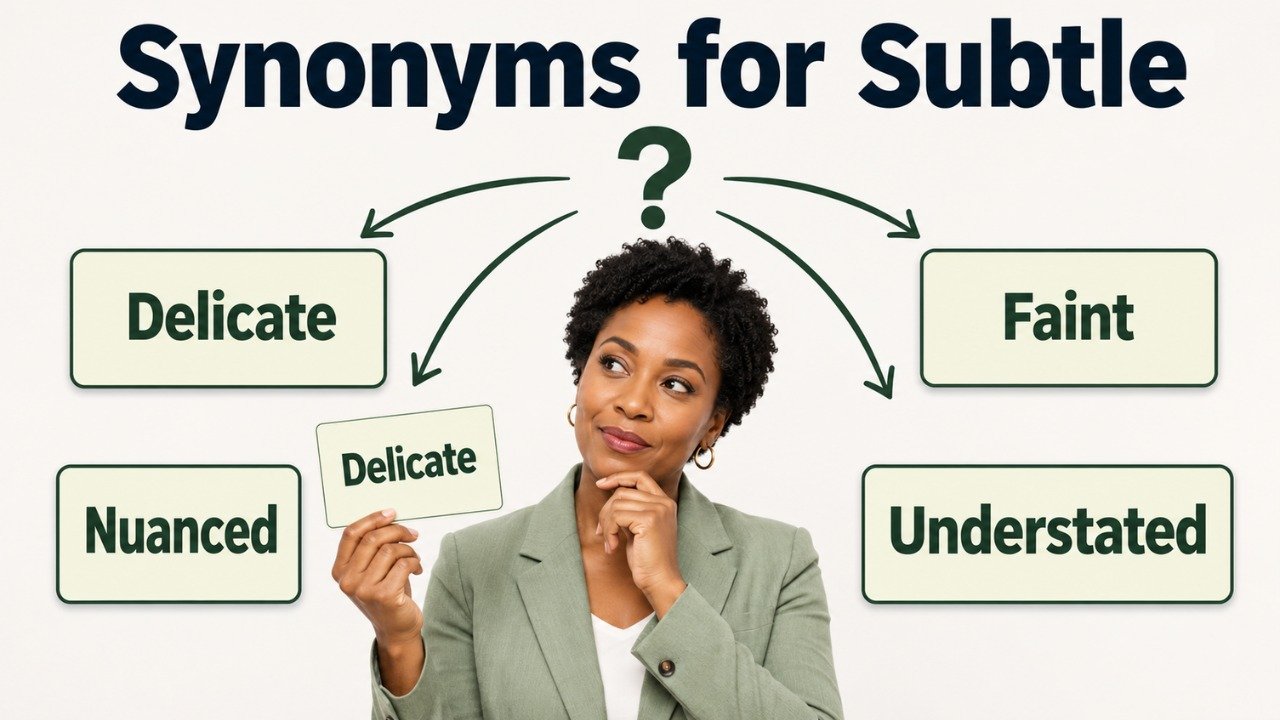
Quick Answer: Common synonyms for subtle include nuanced, delicate, understated, faint, discreet, indirect, refined, slight, implicit, and unobtrusive. Use nuanced for complex ideas or meanings, delicate for fine differences or gentle qualities, understated for restrained style, faint for barely noticeable sights or sounds, discreet for careful behavior, and implicit for ideas that are suggested rather than directly stated. The best choice depends on whether you are describing appearance, communication, intelligence, flavor, emotion, or detail.
Pronunciation and Word Details
Word: Subtle
Pronunciation: /ˈsʌtəl/
Part of Speech: Adjective
Meaning: Subtle describes something that is difficult to notice, carefully expressed, finely detailed, or intelligently indirect.
US Pronunciation:
UK Pronunciation:
What Does “Subtle” Mean?
Subtle means not immediately obvious, strong, or easy to notice. It is an adjective used to describe small differences, gentle effects, indirect messages, refined qualities, and clever ideas.
A subtle change is noticeable only when someone pays close attention. A subtle flavor is light and delicate rather than powerful. A subtle hint communicates an idea without stating it directly.
The word can also describe intelligence or skill. A subtle thinker understands complicated details and recognizes connections that other people may overlook.
In different sentences, subtle can describe colors, sounds, emotions, movements, arguments, humor, pressure, designs, scents, expressions, or differences.
Meaning, Tone, and Context of “Subtle”
Subtle usually has a neutral or positive tone. It often suggests refinement, intelligence, restraint, or careful attention to detail.
In formal and academic writing, subtle may describe complex distinctions, hidden influences, or carefully developed arguments. In everyday conversation, it may describe a faint smell, a quiet change, an indirect comment, or a restrained style.
The word can also carry a negative meaning when it describes influence, manipulation, danger, or pressure that is difficult to detect. For example, subtle pressure may affect a decision without being openly expressed.
Subtle is useful in artistic, sensory, emotional, analytical, and conversational contexts. Its meaning becomes clearer through the noun it describes.
When and How to Use “Subtle”
For Small Differences: Use subtle when two things differ in a way that requires careful observation.
Example: There is a subtle difference between the two shades of blue.
For Gentle Sensory Qualities: Use subtle for a light flavor, scent, color, or sound.
Example: The tea has a subtle floral taste.
For Indirect Communication: Use subtle when a message is suggested rather than stated openly.
Example: She gave him a subtle hint about the upcoming celebration.
For Restrained Style: Use subtle to describe something elegant that does not demand attention.
Example: The room featured subtle colors and simple decorations.
For Complex Ideas: Use subtle when an argument or meaning contains fine details.
Example: The essay presents a subtle analysis of human motivation.
For Quiet Emotional Changes: Use subtle when feelings appear through small expressions or actions.
Example: A subtle look of concern crossed his face.
For Clever Methods: Use subtle for a plan or technique that works indirectly.
Example: The negotiator used a subtle strategy to change the direction of the discussion.
Best Synonyms for Subtle
Nuanced: Containing fine differences, layers, or shades of meaning.
Example: Her nuanced explanation considered several possible interpretations.
Delicate: Fine, gentle, sensitive, or easily affected.
Example: The perfume had a delicate rose scent.
Understated: Presented with restraint and without unnecessary emphasis.
Example: His understated style looked elegant and professional.
Faint: Weak, light, or barely noticeable.
Example: A faint sound came from the hallway.
Slight: Small in degree, amount, or importance.
Example: There was a slight change in her expression.
Discreet: Careful, private, and unlikely to attract attention.
Example: The assistant made a discreet inquiry about the matter.
Implicit: Suggested or understood without being directly expressed.
Example: The agreement contained an implicit expectation of cooperation.
Indirect: Communicated or achieved without being open or straightforward.
Example: He made an indirect reference to the earlier disagreement.
Refined: Carefully developed, elegant, or improved through attention to detail.
Example: The restaurant is known for its refined atmosphere.
Unobtrusive: Not noticeable or likely to attract attention.
Example: The small speaker was unobtrusive and blended into the room.
50 Synonyms for Subtle With Short Meanings
- Delicate: Fine, gentle, or sensitive.
- Nuanced: Containing small differences in meaning.
- Understated: Expressed with quiet restraint.
- Faint: Barely visible, audible, or noticeable.
- Slight: Small in amount or degree.
- Gentle: Soft, mild, or not forceful.
- Soft: Quiet, light, or restrained.
- Muted: Reduced in strength, brightness, or intensity.
- Restrained: Controlled and not strongly expressed.
- Discreet: Careful and unlikely to attract attention.
- Indirect: Not openly or directly expressed.
- Implicit: Suggested without being clearly stated.
- Suggestive: Hinting at an idea or meaning.
- Elusive: Difficult to identify, understand, or notice.
- Hidden: Kept out of sight or awareness.
- Unobtrusive: Not attracting unnecessary attention.
- Refined: Elegant and carefully developed.
- Sophisticated: Complex, advanced, or intelligently designed.
- Intricate: Containing many fine details.
- Fine: Very small, precise, or delicate.
- Precise: Exact and carefully defined.
- Perceptive: Able to notice small or hidden details.
- Discerning: Showing careful judgment and understanding.
- Shrewd: Clever at understanding situations.
- Clever: Showing intelligence or skill.
- Artful: Cleverly or skillfully arranged.
- Ingenious: Original, intelligent, and skillful.
- Tactful: Careful not to offend or embarrass.
- Sensitive: Aware of small changes or feelings.
- Gradual: Developing slowly over time.
- Minute: Extremely small or detailed.
- Imperceptible: Too slight to be easily noticed.
- Inconspicuous: Not clearly visible or noticeable.
- Subdued: Quiet, controlled, or reduced in intensity.
- Quiet: Calm and not attention seeking.
- Mild: Gentle and not severe.
- Modest: Limited, restrained, or not showy.
- Veiled: Partly hidden or indirectly expressed.
- Concealed: Deliberately kept hidden.
- Obscure: Difficult to notice or understand.
- Ambiguous: Open to more than one interpretation.
- Cryptic: Mysterious or difficult to understand.
- Stealthy: Quiet and designed to avoid detection.
- Sly: Clever in a secretive or indirect way.
- Insidious: Gradually harmful and difficult to notice.
- Ethereal: Extremely light, delicate, or refined.
- Pale: Light and lacking strong color.
- Wispy: Thin, light, and delicate.
- Shadowy: Unclear, hidden, or difficult to identify.
- Low key: Restrained, quiet, and not attention seeking.
Read Also:
Synonyms for Impossible

Synonyms for Subtle by Context
When Subtle Means Difficult to Notice
Faint, slight, imperceptible, inconspicuous, and unobtrusive describe things that are not immediately noticeable.
Use faint for weak sounds, colors, smells, or physical signs. Use imperceptible when something is almost impossible to detect. Use inconspicuous for objects or people that do not stand out.
Example: A faint line appeared near the edge of the painting.
Example: The temperature change was almost imperceptible.
When Subtle Means Complex or Detailed
Nuanced, intricate, sophisticated, refined, and delicate describe ideas or creations with fine details.
Nuanced is especially useful for arguments, emotions, opinions, and interpretations. Intricate emphasizes complexity. Refined suggests elegance and careful development.
Example: The researcher offered a nuanced interpretation of the results.
Example: The design contained intricate patterns that were visible at close range.
When Subtle Means Indirect
Implicit, indirect, suggestive, veiled, and discreet describe communication that does not state everything openly.
Implicit refers to information that is understood without being directly expressed. Veiled often describes criticism, threats, or references that are partly hidden.
Example: Her comment contained an implicit warning.
Example: He made a veiled reference to the disagreement.
When Subtle Means Restrained
Understated, muted, subdued, modest, quiet, and restrained describe styles or expressions that avoid excessive attention.
Understated is often positive and suggests elegance. Muted commonly describes colors, sounds, and emotions. Subdued suggests reduced energy or intensity.
Example: She selected an understated dress for the formal dinner.
Example: The walls were painted in muted shades of green.
When Subtle Means Clever
Perceptive, shrewd, discerning, artful, and ingenious relate to intelligence, awareness, or clever methods.
Perceptive describes someone who recognizes details quickly. Shrewd suggests practical intelligence. Artful may describe a clever method that is carefully planned.
Example: His perceptive question revealed the weakness in the proposal.
Example: She used an artful approach to resolve the conflict.
Another Word for Subtle
Nuanced is often the best single replacement for subtle when discussing opinions, arguments, emotions, meanings, or complex differences. However, the most accurate alternative depends on the context.
Use faint for something barely noticeable, understated for restrained style, discreet for careful behavior, and implicit for an unstated message.
Original: The article gives a subtle explanation of the conflict.
Better Option: The article gives a nuanced explanation of the conflict.
Original: She wore a subtle shade of pink.
Better Option: She wore a pale shade of pink.
Original: He gave me a subtle warning.
Better Option: He gave me an implicit warning.
Original: The restaurant has a subtle atmosphere.
Better Option: The restaurant has an understated atmosphere.
When Not to Use “Subtle”
Do not use subtle when a more precise adjective would clearly explain what you mean. Subtle can become vague when the reader cannot tell whether you mean faint, complex, indirect, elegant, or clever.
Avoid using subtle repeatedly in descriptions. Replacing it with a specific synonym makes the sentence more informative.
Weak: The soup had a subtle taste.
Better: The soup had a mild herbal taste.
Weak: She made a subtle comment.
Better: She made an indirect comment about the delayed project.
Weak: The report describes a subtle change.
Better: The report describes a gradual decline in demand.
Weak: He selected a subtle design.
Better: He selected an understated design with muted colors.
Subtle may also be too weak for something obvious, intense, or dramatic. Do not call a major transformation subtle when the difference is immediately visible.
Words Commonly Confused With Subtle
Subtle vs Slight: Subtle means difficult to notice or understand, while slight mainly means small in amount or degree. A change can be slight without being difficult to notice.
Subtle vs Nuanced: Subtle can describe anything that is not obvious. Nuanced specifically describes something containing fine distinctions or several layers of meaning.
Subtle vs Discreet: Subtle describes a quality, effect, message, or method. Discreet describes careful behavior intended to protect privacy or avoid attention.
Subtle vs Implicit: Subtle is broader and can describe appearance, flavor, behavior, or meaning. Implicit refers specifically to something understood but not directly stated.
Subtle vs Delicate: Subtle means difficult to notice, while delicate often means fine, gentle, fragile, or sensitive.
Subtle vs Faint: Subtle may involve complexity or indirectness. Faint usually describes something physically weak, light, or barely detectable.
Which Synonym Should You Choose?
Choose nuanced when discussing complicated ideas, opinions, emotions, interpretations, or arguments.
Choose delicate when describing a gentle flavor, fine detail, sensitive issue, or fragile quality.
Choose understated when describing elegant clothing, decoration, writing, or behavior that avoids unnecessary attention.
Choose faint when referring to a weak sound, light color, smell, mark, or physical sensation.
Choose slight when the amount, degree, or difference is small.
Choose discreet when someone acts carefully, privately, or tactfully.
Choose implicit when a message, expectation, or meaning is understood but not directly stated.
Choose indirect when a person avoids communicating something openly.
Choose refined when describing elegant taste, careful development, or polished quality.
Choose imperceptible when a change or effect is so small that it is almost impossible to notice.
Real Life Examples of “Subtle” in Sentences
Original: The painting contains subtle differences in color.
Better Option: The painting contains delicate differences in color.
Original: She noticed a subtle change in his voice.
Better Option: She noticed a slight change in his voice.
Original: The sauce has a subtle sweetness.
Better Option: The sauce has a mild sweetness.
Original: He gave a subtle warning during the meeting.
Better Option: He gave an implicit warning during the meeting.
Original: The room has a subtle elegance.
Better Option: The room has an understated elegance.
Original: The character shows subtle signs of fear.
Better Option: The character shows faint signs of fear.
Original: The essay presents a subtle argument.
Better Option: The essay presents a nuanced argument.
Original: She used a subtle method to influence the decision.
Better Option: She used an indirect method to influence the decision.
Original: The design included subtle decorative details.
Better Option: The design included refined decorative details.
Original: His subtle humor was easy to miss.
Better Option: His understated humor was easy to miss.
Synonym Groups and Usage Differences
Visibility Group
Faint, slight, imperceptible, inconspicuous, and unobtrusive describe things that are difficult to see, hear, smell, or detect.
Faint describes weak sensory qualities. Imperceptible describes something almost impossible to notice. Unobtrusive describes something intentionally designed not to attract attention.
Example: The device was small and unobtrusive.
Refinement Group
Nuanced, delicate, refined, sophisticated, and intricate suggest detail, elegance, or complexity.
Nuanced is best for meanings and ideas. Delicate suits sensory qualities and fine differences. Sophisticated suggests advanced development or elegant taste.
Example: Her nuanced performance revealed the character’s conflicting emotions.
Indirectness Group
Implicit, indirect, suggestive, veiled, and discreet describe messages or actions that are not completely open.
Implicit focuses on unstated meaning. Veiled suggests that the message is partly hidden. Discreet emphasizes privacy and careful behavior.
Example: The speaker made a veiled criticism of the proposal.
Intelligence Group
Perceptive, discerning, shrewd, artful, and ingenious relate to thoughtful observation or clever planning.
Perceptive and discerning are usually positive. Shrewd suggests practical judgment. Artful may suggest strategic cleverness and can be positive or slightly suspicious.
Example: Her perceptive analysis identified a problem that others had missed.
Restraint Group
Understated, restrained, muted, subdued, quiet, and modest describe controlled expression.
Understated often suggests elegance. Muted is commonly used for color and sound. Subdued may describe emotions, lighting, behavior, or atmosphere.
Example: The office used muted colors to create a calm environment.
Antonyms of Subtle
The opposite of subtle depends on whether the word refers to visibility, communication, style, strength, or complexity.
Obvious: Easy to notice or understand.
Blatant: Extremely clear and impossible to ignore.
Noticeable: Easy to observe or recognize.
Pronounced: Strong, clear, or easily identified.
Strong: Powerful in effect, taste, color, or intensity.
Bold: Confident, vivid, or attention seeking.
Direct: Openly and clearly communicated.
Explicit: Fully and directly stated.
Crude: Lacking refinement or careful detail.
Simple: Easy to understand and lacking complexity.
Open: Not hidden, indirect, or secretive.
Dramatic: Striking, intense, or immediately noticeable.
Comparison Subtle vs Related Words
Subtle vs Nuanced
Subtle means difficult to notice or understand immediately. Nuanced means containing fine distinctions or several layers of meaning.
Example With Subtle: She noticed a subtle change in his expression.
Example With Nuanced: She offered a nuanced explanation of his emotional response.
Subtle vs Delicate
Subtle emphasizes limited visibility or indirect expression. Delicate emphasizes fineness, gentleness, sensitivity, or fragility.
Example With Subtle: The advertisement contained a subtle message.
Example With Delicate: The fabric had a delicate floral pattern.
Subtle vs Discreet
Subtle describes something restrained or difficult to notice. Discreet describes behavior that avoids embarrassment, attention, or loss of privacy.
Example With Subtle: He made a subtle gesture toward the door.
Example With Discreet: He made a discreet inquiry about the private matter.
Subtle vs Slight
Subtle describes something that may require careful attention. Slight means small in amount, size, or degree.
Example With Subtle: There was a subtle tension between the speakers.
Example With Slight: There was a slight delay before the presentation began.
Subtle vs Implicit
Subtle can describe many qualities, including appearance, flavor, change, and communication. Implicit specifically describes an idea that is suggested or understood without direct expression.
Example With Subtle: The story contains a subtle criticism of greed.
Example With Implicit: The story contains an implicit warning about greed.
Common Phrases and Expressions With Subtle
Subtle Difference: A small distinction that requires careful attention.
Subtle Hint: An indirect suggestion or clue.
Subtle Change: A small transformation that is not immediately obvious.
Subtle Effect: A gentle or difficult to notice result.
Subtle Flavor: A mild and delicate taste.
Subtle Humor: Humor that is clever, restrained, or not immediately obvious.
Subtle Distinction: A fine difference between similar ideas or things.
Subtle Pressure: Indirect influence placed on a person.
Subtle Beauty: Attractiveness that is refined rather than dramatic.
Subtle Approach: A careful method that avoids direct or forceful action.
Common Mistakes to Avoid
One common mistake is using subtle as a general adjective without explaining what is difficult to notice. Add specific details so the reader understands whether the subtle quality involves color, sound, meaning, emotion, or behavior.
Do not confuse subtle with slight. A slight change is small, while a subtle change may be difficult to recognize.
Avoid choosing faint when discussing complex ideas. Faint usually describes a weak sensory quality, while nuanced is better for arguments and interpretations.
Do not use discreet as a replacement for every meaning of subtle. Discreet refers to privacy, tact, or careful behavior.
Remember that the letter b in subtle is silent. The adverb form is subtly, as in “She subtly changed the subject.”
Repeated use of subtle can make descriptive writing sound vague. Use precise alternatives such as understated, implicit, delicate, muted, or imperceptible whenever they better express the intended meaning.
Conclusion
Understanding synonyms for subtle helps you describe small differences, refined qualities, indirect messages, and complex ideas more accurately. Choose nuanced for layered meanings, delicate for gentle details, understated for restrained style, faint for barely noticeable sensations, and implicit for unstated ideas. Discreet works best for careful behavior, while imperceptible describes something almost impossible to detect. Selecting the right alternative improves clarity and allows readers to understand exactly what kind of subtle quality you intend to describe.
FAQs About Synonyms for Subtle
What Is the Best Synonym for Subtle?
Nuanced is often the best synonym for subtle when describing ideas, meanings, emotions, or arguments. The best choice still depends on the sentence.
What Is a Synonym for a Subtle Difference?
A nuanced distinction, fine difference, slight variation, or delicate distinction can describe a subtle difference.
What Is Another Word for a Subtle Hint?
An indirect suggestion, discreet clue, implicit message, or veiled reference can replace subtle hint.
Is Delicate a Synonym for Subtle?
Yes. Delicate is a useful synonym when subtle describes a fine detail, gentle flavor, light scent, or sensitive quality.
What Is the Difference Between Subtle and Slight?
Subtle means difficult to notice or understand. Slight mainly means small in amount, size, or degree.
Can Subtle Describe a Person?
Yes. A subtle person may be perceptive, clever, tactful, or skilled at communicating ideas indirectly.
Is Subtle Positive or Negative?
Subtle is often positive when it suggests refinement, intelligence, or restraint. It can be negative when describing hidden pressure, manipulation, danger, or harmful influence.
