
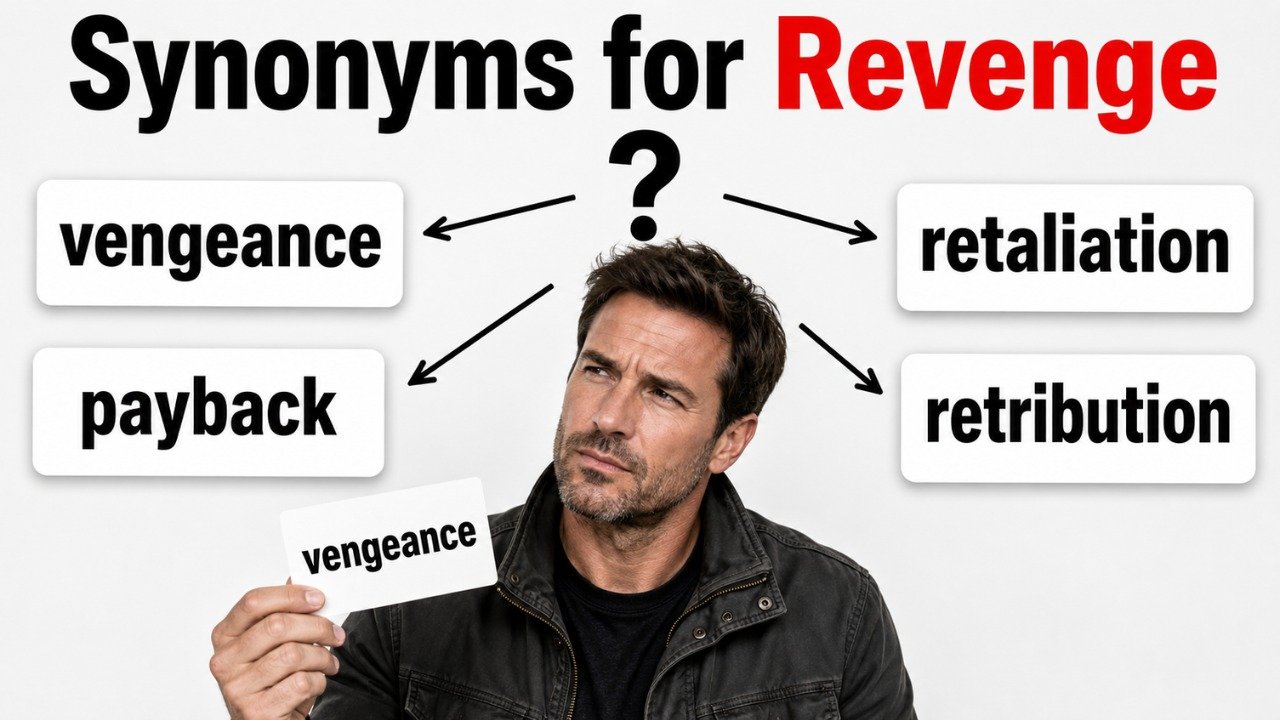
Quick Answer: The best synonyms for revenge are retaliation, vengeance, retribution, reprisal, payback, avengement, requital, punishment, reckoning, and getting even. Retaliation is the strongest neutral choice for formal writing. Vengeance is more emotional and dramatic. Retribution suggests deserved punishment, while reprisal commonly describes a harmful response to an earlier action. Payback and getting even suit casual conversation. Vendetta describes a continuing desire for revenge, while reckoning suggests that someone is finally facing the consequences of previous actions.
Pronunciation and Word Details
Word: Revenge
Pronunciation: /rɪˈvendʒ/
Part of Speech: Noun and verb
Meaning: Revenge is an action taken to hurt or punish someone in return for a previous wrong.
US Pronunciation:
UK Pronunciation:
What Does “Revenge” Mean?
Revenge means harming, punishing, embarrassing, or defeating someone because that person caused pain, loss, insult, or injury first.
As a noun, revenge describes the desire for repayment or the action taken against the person responsible for a wrong.
Example: He wanted revenge after being publicly humiliated.
As a verb, revenge can mean taking action in response to an injury or insult. However, the verb avenge is often more natural when someone acts for another person or defends another person’s honor.
Example: She promised to revenge the insult.
More Natural: She promised to avenge the insult.
Revenge appears in conversations about personal conflict, betrayal, competition, war, crime, family disputes, fiction, history, and emotional relationships. The exact meaning depends on whether the speaker is describing a private response, official retaliation, deserved consequences, or a continuing feud.
Meaning, Tone, and Context of “Revenge”
Revenge usually has a strong and emotional tone. It often suggests anger, resentment, bitterness, humiliation, or a desire to make another person suffer.
In casual conversation, revenge may refer to getting even after an insult, betrayal, joke, or unfair action. Payback and getting even are common casual alternatives.
In formal writing, retaliation, reprisal, retribution, and punitive response are usually more precise. These words help explain whether the response is personal, official, legal, military, or disciplinary.
In stories and dramatic writing, vengeance creates a powerful and serious tone. It often suggests a deep desire to punish someone for a major wrong.
Revenge is not always the same as justice. Justice is based on fairness, rules, evidence, and proportionate consequences. Revenge is usually personal and emotionally motivated. A person seeking justice wants the wrong corrected, while a person seeking revenge may mainly want the wrongdoer to suffer.
The word can sometimes be used in a light or humorous way. Someone may jokingly describe winning a game after an earlier defeat as sweet revenge. The situation and tone show whether the word is serious or playful.
When and How to Use “Revenge”
For Personal Retaliation: Use revenge when someone wants to hurt or punish another person because of a personal wrong.
Example: He planned revenge against the person who betrayed him.
For Emotional Conflict: Use revenge when anger, resentment, or humiliation motivates the response.
Example: Her decision was driven by anger and a desire for revenge.
For Formal Retaliation: Use retaliation when describing a response to an attack, threat, punishment, or harmful decision.
Example: The organization feared retaliation after reporting the misconduct.
For Deserved Consequences: Use retribution when the punishment is presented as deserved or morally justified.
Example: The dishonest official eventually faced retribution for his actions.
For Official Responses: Use reprisal when a government, group, or authority responds to an earlier harmful action.
Example: The attack was described as a reprisal for the previous raid.
For Casual Speech: Use payback or getting even when the situation is informal.
Example: Winning the final match felt like payback for last season’s defeat.
For Dramatic Writing: Use vengeance when the emotion is intense, serious, or connected with a major wrong.
Example: The character devoted his life to vengeance.
For Continuing Conflict: Use vendetta when revenge continues for a long period and involves repeated hostility.
Example: The disagreement developed into a bitter family vendetta.
Best Synonyms for Revenge
Retaliation: Harmful action taken in response to an earlier harmful action.
Example: She remained silent because she feared retaliation.
Vengeance: Strong and often violent punishment motivated by anger or injury.
Example: The warrior returned seeking vengeance for his family.
Retribution: Punishment considered deserved because of wrongdoing.
Example: The corrupt leader finally faced retribution.
Reprisal: An act of harm or punishment carried out in response to another act.
Example: The group launched a reprisal after the attack.
Payback: Informal revenge or repayment for an earlier wrong.
Example: Defeating his rival felt like perfect payback.
Avengement: The act of punishing someone for a wrong or injury.
Example: The story focuses on the hero’s avengement of his brother.
Requital: Repayment for an action, service, injury, or wrong.
Example: He viewed the punishment as requital for years of cruelty.
Punishment: A penalty given for wrongdoing or unacceptable behavior.
Example: The judge imposed punishment based on the seriousness of the offense.
Reckoning: A moment when someone must face the results of previous actions.
Example: The dishonest manager knew that a reckoning was coming.
Getting Even: Informal action intended to balance a previous insult or injury.
Example: She was more interested in getting even than solving the problem.
50 Synonyms for Revenge with Short Meanings
- Retaliation: Harmful action taken in response to another harmful action.
- Vengeance: Strong punishment motivated by anger or injury.
- Retribution: Deserved punishment for wrongdoing.
- Reprisal: An act carried out in response to an earlier attack or offense.
- Payback: Informal repayment for a wrong or injury.
- Avengement: The act of punishing someone for a previous wrong.
- Requital: Repayment for an injury, service, or action.
- Punishment: A penalty imposed because of wrongdoing.
- Vindictive Action: Behavior intended to hurt someone because of resentment.
- Retaliatory Action: An action taken in direct response to harm.
- Retaliatory Response: A harmful or defensive reaction to an earlier act.
- Retaliatory Measure: A step intended to answer or punish another action.
- Retaliatory Strike: An attack launched in response to a previous attack.
- Reprisal Attack: An attack intended as punishment for earlier harm.
- Punitive Response: A reaction designed to punish someone.
- Retributive Action: An action that delivers punishment for wrongdoing.
- Counterattack: An attack made in response to another attack.
- Counterstrike: A forceful strike made after an earlier strike.
- Counterblow: A harmful response to an earlier blow or action.
- Counterstroke: A responding action intended to weaken an opponent.
- Counteroffensive: A major response against an earlier attack.
- Answering Blow: A response that returns the harm received.
- Return Blow: A blow delivered in response to another blow.
- Backlash: A strong negative reaction to an action or decision.
- Comeback: A sharp or forceful response to an insult or challenge.
- Retort: A quick and often angry verbal response.
- Rejoinder: A direct reply to an argument, criticism, or insult.
- Countercharge: An accusation made in response to another accusation.
- Counteraccusation: An accusation directed back at the original accuser.
- Reckoning: A time when someone faces the consequences of past behavior.
- Comeuppance: Deserved punishment or failure after bad behavior.
- Just Deserts: A deserved result, especially an unpleasant one.
- Poetic Justice: A fitting result in which wrongdoing leads to punishment.
- Settling the Score: Taking action to repay a past injury or insult.
- Getting Even: Informally repaying someone for a wrong.
- Evening the Score: Balancing a previous defeat, injury, or insult.
- Score Settling: Resolving an old conflict through retaliation.
- Tit for Tat: Repaying an action with a similar action.
- An Eye for an Eye: Punishment equal to the harm that was caused.
- Measure for Measure: Returning treatment in an equal degree.
- Repayment: Returning an action, treatment, or injury.
- Paying Someone Back: Informally responding to a previous wrong.
- Returning the Favor: Giving similar treatment in return, sometimes negatively.
- Requital of Wrongs: Repayment or punishment for previous injuries.
- Vendetta: A long and bitter campaign of revenge.
- Blood Feud: A continuing conflict involving revenge between families or groups.
- Feud: A long lasting and hostile conflict.
- Grudge Settlement: An action taken to resolve resentment through retaliation.
- Retaliatory Campaign: A continuing series of actions intended as revenge.
- Retributive Justice: Punishment based on the belief that wrongdoing deserves consequences.
Read Also:
Synonyms for Appropriate

Synonyms for Revenge by Context
When Revenge Means Personal Retaliation
Retaliation, payback, getting even, settling the score, and paying someone back describe responses to personal injury, betrayal, embarrassment, or unfair treatment.
Retaliation is neutral and works in both formal and everyday writing. Payback and getting even are more conversational. Settling the score suggests that the person remembers an old wrong and wants to balance it.
Example: He viewed the victory as payback for his earlier defeat.
Example: She rejected the idea of getting even and chose to end the argument.
When Revenge Means Vengeance
Vengeance, avengement, requital, and requital of wrongs create a serious or dramatic tone. They work well in literature, historical writing, speeches, and stories involving major betrayal, violence, loss, or dishonor.
Vengeance is stronger and more emotional than retaliation. Avengement focuses on punishing someone for a particular wrong.
Example: The hero searched for vengeance after the destruction of his home.
Example: The plot follows the avengement of an innocent victim.
When Revenge Means Deserved Punishment
Retribution, punishment, reckoning, comeuppance, just deserts, poetic justice, and retributive justice describe consequences that appear deserved.
Retribution is common in formal, moral, religious, legal, and literary discussions. Comeuppance is more conversational and often expresses satisfaction when an arrogant or dishonest person fails.
Example: The villain eventually received his just deserts.
Example: Losing the position was viewed as a form of poetic justice.
When Revenge Means an Official Response
Reprisal, retaliatory action, retaliatory measure, retaliatory strike, reprisal attack, punitive response, and counteroffensive fit official, political, military, organizational, or disciplinary contexts.
These words are usually more precise than revenge because they describe the form of the response.
Example: The new restriction was introduced as a retaliatory measure.
Example: Officials warned that any reprisal attack could increase the conflict.
When Revenge Means a Verbal Response
Retort, rejoinder, comeback, countercharge, and counteraccusation describe verbal forms of retaliation.
A retort is a quick and often sharp reply. A rejoinder is a direct response in a discussion or argument. A counteraccusation answers an accusation by blaming the original accuser.
Example: She responded to the insult with a clever retort.
Example: His counteraccusation distracted attention from the original complaint.
When Revenge Becomes a Continuing Conflict
Vendetta, blood feud, feud, grudge settlement, and retaliatory campaign describe revenge that continues beyond one event.
A vendetta is a continuing effort to harm a particular person or group. A blood feud is more serious and traditionally involves repeated violence between families or groups.
Example: A minor disagreement developed into a personal vendetta.
Example: Community leaders worked to end the blood feud.
Another Word for Revenge
Retaliation is usually the best general replacement for revenge. It is clear, neutral, and suitable for formal writing. However, the best alternative depends on the emotion, situation, and type of response.
Use vengeance for intense emotional punishment, retribution for deserved consequences, reprisal for an official response, and payback for informal conversation.
Original: He wanted revenge after being unfairly dismissed.
Better Option: He wanted retaliation after being unfairly dismissed.
Original: The hero returned to seek revenge for his family.
Better Option: The hero returned to seek vengeance for his family.
Original: The punishment felt like revenge for his dishonesty.
Better Option: The punishment felt like retribution for his dishonesty.
Original: Winning the competition was her revenge for the earlier defeat.
Better Option: Winning the competition was her payback for the earlier defeat.
When Not to Use “Revenge”
Avoid revenge when the sentence requires a more neutral, specific, or formal word. Revenge can sound emotional and personal, which may be unsuitable in reports, essays, official statements, or professional communication.
Use retaliation when describing a response to harmful treatment. Use retribution when discussing deserved punishment. Use reprisal for an official response and payback for an informal situation.
Weak: The policy was introduced as revenge against the other department.
Better: The policy was introduced as a retaliatory measure against the other department.
Weak: The court gave him revenge for the crime.
Better: The court imposed punishment for the crime.
Weak: The company feared revenge from former workers.
Better: The organization feared retaliation from former workers.
Weak: The character received revenge for his dishonest behavior.
Better: The character received his comeuppance for his dishonest behavior.
Do not use revenge when you actually mean justice. Justice aims to correct wrongdoing fairly, while revenge is driven by a desire to hurt or punish.
Weak: The victims asked the court for revenge.
Better: The victims asked the court for justice.
Avoid using revenge repeatedly in the same paragraph. Choose precise alternatives based on the action, emotion, and result.
Repetitive: He wanted revenge, planned revenge, and finally achieved revenge.
Better: He desired vengeance, planned retaliation, and eventually settled the score.
Words Commonly Confused With Revenge
Revenge vs Retaliation: Revenge is usually personal and emotionally motivated. Retaliation is a response to harm and can be personal, official, defensive, or strategic.
Revenge vs Vengeance: Revenge is the general word for punishing someone after a wrong. Vengeance is stronger, more emotional, and often more dramatic.
Revenge vs Retribution: Revenge is motivated by personal anger or resentment. Retribution suggests that the punishment is deserved because of wrongdoing.
Revenge vs Justice: Revenge aims to make the wrongdoer suffer. Justice aims to correct the wrong through fair rules and proportionate consequences.
Revenge vs Punishment: Revenge is usually carried out because of personal injury. Punishment may be imposed by a parent, teacher, court, employer, or authority to enforce rules.
Revenge vs Payback: Revenge can be serious, violent, or formal. Payback is more casual and may refer to a minor defeat, insult, joke, or competition.
Revenge vs Reprisal: Revenge is a broad personal or emotional response. Reprisal commonly refers to an organized or official response to another action.
Revenge vs Vendetta: Revenge may involve one act. A vendetta is a continuing and often obsessive campaign against a person, family, or group.
Revenge vs Avenge: Revenge is usually a noun, although it can also be a verb. Avenge is a verb meaning to punish someone responsible for harming another person.
Example With Revenge: She wanted revenge for the insult.
Example With Avenge: She wanted to avenge her friend.
Which Synonym Should You Choose?
Choose retaliation in formal writing when describing a response to harm, criticism, punishment, threats, or unfair treatment.
Choose vengeance in fiction, speeches, dramatic writing, and emotional descriptions of serious personal wrongs.
Choose retribution when the punishment is presented as deserved, morally fitting, or connected with justice.
Choose reprisal when writing about an official, political, military, or organizational response.
Choose payback in casual speech when someone responds to a defeat, joke, insult, or unfair action.
Choose getting even when describing a personal and informal desire to balance a previous wrong.
Choose comeuppance when a badly behaved person experiences a deserved failure or punishment.
Choose poetic justice when the final result matches the wrongdoing in an appropriate or ironic way.
Choose vendetta when the desire for revenge continues for a long time.
Choose retort or comeback when the revenge takes the form of a sharp verbal response.
Choose counteraccusation when one person answers an accusation by blaming the original accuser.
Choose punishment in reports, essays, and factual writing when an authority imposes a penalty.
Choose justice when the goal is fairness rather than personal harm.
Real Life Examples of “Revenge” in Sentences
Original: He wanted revenge after his partner betrayed him.
Better Option: He wanted retaliation after his partner betrayed him.
Original: The hero spent years planning revenge.
Better Option: The hero spent years planning vengeance.
Original: The new restriction was revenge for the earlier complaint.
Better Option: The new restriction was a retaliatory measure for the earlier complaint.
Original: She defeated her rival and finally got revenge.
Better Option: She defeated her rival and finally got payback.
Original: The criminal eventually faced revenge for his actions.
Better Option: The criminal eventually faced retribution for his actions.
Original: His public failure felt like revenge for his arrogance.
Better Option: His public failure felt like poetic justice for his arrogance.
Original: The argument became a long campaign of revenge.
Better Option: The argument became a long personal vendetta.
Original: She answered the insult with verbal revenge.
Better Option: She answered the insult with a sharp retort.
Original: The team wanted revenge after losing the previous final.
Better Option: The team wanted to settle the score after losing the previous final.
Original: He believed revenge would repair the harm.
Better Option: He believed getting even would repair the harm.
Synonym Groups and Usage Differences
Personal Retaliation Group
Retaliation, payback, getting even, paying someone back, and settling the score describe a personal response to unfair or harmful treatment.
Retaliation is the most neutral word. Payback and getting even sound casual. Settling the score suggests that the conflict has continued for some time.
Example: Winning the debate felt like payback for the earlier embarrassment.
Emotional Vengeance Group
Vengeance, avengement, requital, vindictive action, and requital of wrongs express emotional punishment after a serious injury or betrayal.
Vengeance is the strongest and most dramatic word in this group. Vindictive action emphasizes cruelty and resentment.
Example: His desire for vengeance controlled every decision he made.
Deserved Consequences Group
Retribution, comeuppance, reckoning, just deserts, poetic justice, and retributive justice describe punishment that appears deserved.
Comeuppance is informal, while retribution and retributive justice are more formal. Poetic justice describes a fitting or ironic result.
Example: The dishonest businessman finally received his comeuppance.
Official Response Group
Reprisal, retaliatory measure, retaliatory strike, reprisal attack, punitive response, and counteroffensive describe organized reactions by groups or authorities.
These words are precise and suitable for formal reports, analytical writing, and serious discussions.
Example: The restriction was criticized as a punitive response to peaceful opposition.
Verbal Retaliation Group
Retort, rejoinder, comeback, countercharge, and counteraccusation describe spoken or written responses to criticism and blame.
A comeback may be clever or humorous. A retort is usually sharp and immediate. A countercharge is a serious accusation made in response to another accusation.
Example: Her calm rejoinder ended the argument.
Continuing Conflict Group
Vendetta, blood feud, feud, grudge settlement, and retaliatory campaign describe revenge that continues over time.
Vendetta often involves a focused campaign against a person. Feud is broader and may involve repeated arguments, competition, or hostility.
Example: Their professional disagreement became a bitter feud.
Antonyms of Revenge
The opposite of revenge depends on whether the speaker means forgiveness, peace, fairness, restraint, or reconciliation.
Forgiveness: Choosing not to remain angry or demand punishment.
Mercy: Showing compassion instead of imposing severe punishment.
Pardon: Officially or personally forgiving an offense.
Reconciliation: Restoring a peaceful relationship after conflict.
Peace: A condition without hostility or retaliation.
Restraint: Controlling the desire to respond with anger or harm.
Tolerance: Accepting differences, mistakes, or difficulties without retaliation.
Compassion: Recognizing another person’s suffering and responding with care.
Understanding: Trying to recognize the reasons behind another person’s actions.
Justice: Correcting wrongdoing through fair and balanced rules.
Resolution: Solving a conflict without continuing hostility.
Amnesty: An official decision to forgive certain offenses.
Kindness: Treating someone with care rather than hostility.
Leniency: Giving a less severe punishment than expected.
Reparation: Repairing the harm caused by an earlier wrong.
Comparison of Revenge vs Related Words
Revenge vs Retaliation
Revenge is usually personal and driven by anger. Retaliation simply describes a response to harm and may be emotional, official, strategic, or defensive.
Example With Revenge: He wanted revenge against the person who embarrassed him.
Example With Retaliation: She feared retaliation after reporting the violation.
Revenge vs Vengeance
Revenge is the common general term. Vengeance sounds stronger, more dramatic, and more emotionally intense.
Example With Revenge: She planned revenge after the betrayal.
Example With Vengeance: She devoted her life to vengeance after the betrayal.
Revenge vs Retribution
Revenge focuses on personal satisfaction. Retribution focuses on punishment that is considered deserved.
Example With Revenge: The victim’s brother wanted revenge.
Example With Retribution: The offender eventually faced retribution.
Revenge vs Reprisal
Revenge can be personal and informal. Reprisal is more formal and often describes an official or organized response.
Example With Revenge: He damaged the property as revenge.
Example With Reprisal: The group carried out a reprisal after the attack.
Revenge vs Payback
Revenge may refer to serious emotional or physical harm. Payback is informal and often describes less serious situations.
Example With Revenge: The character sought revenge for his family’s suffering.
Example With Payback: Winning the rematch felt like payback.
Revenge vs Justice
Revenge is motivated by personal pain and the desire to make someone suffer. Justice is based on fairness, evidence, rules, and proportionate consequences.
Example With Revenge: He wanted the offender to suffer as he had suffered.
Example With Justice: He wanted the offender to receive a fair legal penalty.
Revenge vs Punishment
Revenge is normally personal. Punishment may be imposed by an authority to correct behavior, enforce rules, or protect others.
Example With Revenge: She exposed the secret as revenge.
Example With Punishment: The authority imposed punishment for the violation.
Revenge vs Vendetta
Revenge may involve one response to one wrong. A vendetta continues over time and often includes repeated acts of hostility.
Example With Revenge: He took revenge for the insult.
Example With Vendetta: He continued a vendetta against his former business partner.
Common Phrases and Expressions With “Revenge”
Take Revenge: Punish someone because of an earlier wrong.
Example: He refused to take revenge against his rival.
Seek Revenge: Try to find a way to punish the person responsible.
Example: The character leaves home to seek revenge.
Get Revenge: Successfully punish or defeat someone in return.
Example: The team hoped to get revenge in the final match.
Sweet Revenge: A satisfying victory after an earlier loss or humiliation.
Example: Winning the award felt like sweet revenge.
Act of Revenge: A specific action intended to punish someone.
Example: The damage appeared to be an act of revenge.
Desire for Revenge: A strong wish to repay someone for a wrong.
Example: His desire for revenge prevented him from moving forward.
Revenge Attack: An attack carried out because of an earlier attack.
Example: Officials feared that the incident could lead to a revenge attack.
Revenge Plot: A plan or story centered on punishing a wrongdoer.
Example: The novel follows a complicated revenge plot.
Revenge Motive: A reason for an action based on resentment or retaliation.
Example: Investigators considered revenge as a possible motive.
Personal Revenge: Retaliation caused by a private injury, insult, or dispute.
Example: The decision appeared to be motivated by personal revenge.
Common Mistakes to Avoid
A common mistake is using revenge when justice is the intended meaning. Revenge is personal and emotional, while justice is fair, structured, and based on rules.
Incorrect: The victims went to court to demand revenge.
Better: The victims went to court to demand justice.
Another mistake is using revenge when retaliation would sound more neutral and professional.
Weak: The employee feared revenge after making the complaint.
Better: The employee feared retaliation after making the complaint.
Do not treat vengeance and revenge as identical in tone. Vengeance is usually stronger and more dramatic.
Too Strong: She wanted vengeance after losing a friendly game.
Better: She wanted payback after losing a friendly game.
Avoid using retribution for minor and playful situations. It suggests serious or deserved punishment.
Unnatural: Winning the card game was retribution for her earlier loss.
Better: Winning the card game was payback for her earlier loss.
Do not confuse revenge with avenge. Revenge is commonly a noun, while avenge is a verb used when punishing someone responsible for a wrong.
Awkward: He wanted to revenge his brother.
Better: He wanted to avenge his brother.
Avoid unclear wording that does not explain the wrong or response.
Vague: She did it for revenge.
Clearer: She revealed the secret in retaliation for the earlier betrayal.
Writers should also avoid repeating revenge too often. Choose a more specific word such as retaliation, retribution, reprisal, payback, vendetta, or comeuppance based on the intended meaning.
Conclusion
Understanding synonyms for revenge makes it easier to describe personal anger, formal retaliation, deserved punishment, and continuing conflict accurately. Retaliation is the strongest neutral alternative, while vengeance creates a dramatic and emotional tone. Retribution suggests deserved consequences, reprisal suits official responses, and payback works in casual situations. Choose comeuppance or poetic justice for fitting consequences and vendetta for long running hostility. The best replacement always depends on the seriousness, motive, tone, and context of the sentence.
FAQs About Synonyms for Revenge
What Is the Best Synonym for Revenge?
Retaliation is the best general synonym because it clearly describes an action taken in response to harm or unfair treatment.
Is Vengeance the Same as Revenge?
Vengeance and revenge have similar meanings, but vengeance sounds stronger, more emotional, and more dramatic.
What Is a Formal Word for Revenge?
Retaliation, retribution, reprisal, requital, and punitive response are useful formal alternatives.
What Is a Casual Synonym for Revenge?
Payback, getting even, settling the score, and paying someone back are common casual alternatives.
Is Revenge the Same as Justice?
No. Revenge is usually personal and emotionally motivated, while justice aims to correct wrongdoing fairly through balanced consequences.
What Is the Difference Between Revenge and Avenge?
Revenge is commonly a noun describing retaliation. Avenge is a verb meaning to punish someone responsible for harming another person.
What Is the Opposite of Revenge?
Forgiveness, mercy, reconciliation, restraint, compassion, peace, and justice are common opposites of revenge.
