
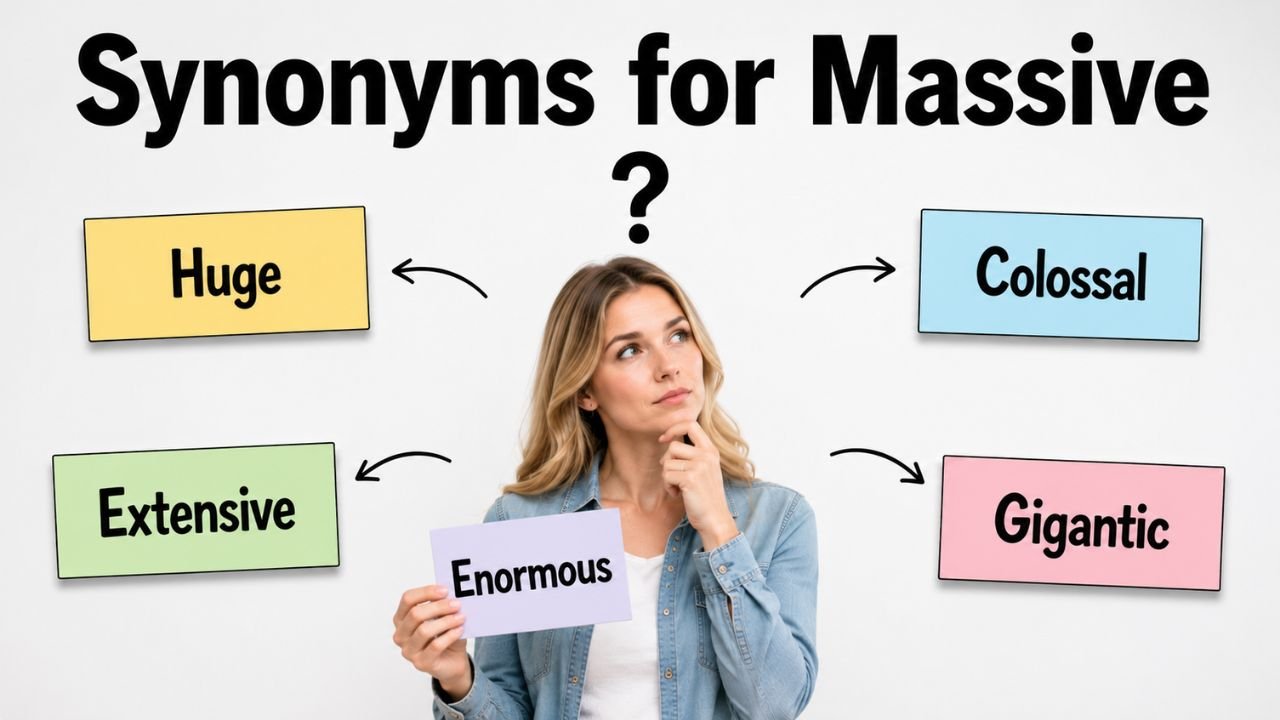
Quick Answer: The best synonyms for massive include enormous, immense, huge, gigantic, colossal, vast, monumental, tremendous, mammoth, and substantial. Use enormous or gigantic for physical size, vast for area or scope, substantial for formal writing, monumental for importance, and tremendous for impact or intensity. Mammoth and colossal add strong emphasis, while huge works naturally in everyday conversation.
Pronunciation and Word Details
Word: Massive.
Pronunciation: /ˈmæs.ɪv/
Part of Speech: Adjective.
Meaning: Extremely large, heavy, extensive, serious, or important.
US Pronunciation:
UK Pronunciation:
What Does “Massive” Mean?
Massive means extremely large, heavy, extensive, serious, or influential. It is an adjective used to describe something that is much greater than normal in size, amount, scale, power, or importance.
The word can describe physical objects, such as a massive building or a massive stone wall. It can also describe abstract ideas, including a massive improvement, a massive challenge, or a massive impact.
In everyday conversation, massive often adds strong emphasis. A person might describe a large crowd, an important opportunity, or a serious problem as massive. In formal writing, more precise alternatives such as substantial, extensive, considerable, or monumental may sometimes be more suitable.
Meaning, Tone, and Context of “Massive”
Massive usually has a strong and emphatic tone. It creates a clear impression that something is unusually large, powerful, serious, or important.
The word is common in both casual and formal English. In casual speech, it can replace huge or enormous. In reports, essays, and professional writing, it may describe a major change, extensive damage, or a considerable amount.
Massive can be neutral when describing physical size. However, its emotional tone depends on the subject. A massive success sounds positive, while a massive failure sounds negative. A massive structure sounds descriptive, while a massive burden suggests emotional or practical difficulty.
In technical or academic writing, massive may be too general when an exact measurement is available. A specific number or a more precise adjective can communicate the information more effectively.
When and How to Use “Massive”
For Physical Size: Use massive when an object is exceptionally large, solid, or heavy.
Example: A massive stone statue stood at the entrance.
For Large Quantities: Use massive to describe an unusually great amount of something.
Example: The project required a massive amount of preparation.
For Broad Scale: Use massive when an activity, event, or operation covers a large area or involves many people.
Example: The city began a massive restoration program.
For Strong Impact: Use massive when something produces a powerful or important effect.
Example: The new policy created a massive change in working practices.
For Serious Problems: Use massive to emphasize the scale or difficulty of a problem.
Example: Repairing the damaged bridge became a massive challenge.
For Rapid Growth: Use massive when an increase or expansion is exceptionally large.
Example: The business experienced massive growth during the year.
For Success or Achievement: Use massive to describe an outstanding result or accomplishment.
Example: Completing the research was a massive achievement for the team.
Best Synonyms for Massive
Enormous: Extremely large in size, amount, or degree.
Example: The construction project required an enormous investment.
Immense: Exceptionally great in size, extent, or intensity.
Example: She felt immense pride after completing the difficult task.
Huge: Very large in size, quantity, or importance.
Example: The event attracted a huge audience.
Gigantic: Extremely large in physical size or scale.
Example: A gigantic tree stood in the center of the garden.
Colossal: Unusually large, impressive, or powerful.
Example: Restoring the historic building was a colossal undertaking.
Vast: Extremely large in area, range, extent, or quantity.
Example: The library contains a vast collection of historical material.
Monumental: Exceptionally great in importance, effort, or achievement.
Example: Protecting the ancient site was a monumental responsibility.
Tremendous: Very great in amount, strength, quality, or importance.
Example: The volunteers made a tremendous contribution.
Mammoth: Extremely large and often difficult to manage.
Example: Organizing the international conference was a mammoth task.
Substantial: Large enough to be important, valuable, or noticeable.
Example: The company reported a substantial increase in demand.
50 Synonyms for Massive with Short Meanings
- Enormous: Extremely large in size or amount.
- Immense: Exceptionally great in scale or degree.
- Huge: Very large or important.
- Gigantic: Extremely large in physical size.
- Colossal: Remarkably large or powerful.
- Vast: Very great in area, range, or quantity.
- Monumental: Extremely important or impressive.
- Tremendous: Very great in strength, amount, or effect.
- Mammoth: Exceptionally large and difficult to manage.
- Gargantuan: Enormous in size, quantity, or scale.
- Giant: Much larger than normal.
- Substantial: Considerably large or important.
- Considerable: Large enough to deserve attention.
- Extensive: Covering a wide area or range.
- Expansive: Broad, wide, or extensive.
- Towering: Extremely tall or impressive.
- Bulky: Large and difficult to carry or handle.
- Hefty: Large, heavy, or considerable.
- Weighty: Heavy or highly important.
- Prodigious: Remarkably great in size or quantity.
- Stupendous: Extremely impressive in size or degree.
- Titanic: Exceptionally powerful or enormous.
- Jumbo: Larger than the usual size.
- Oversized: Bigger than the normal or expected size.
- Sizable: Fairly large or significant.
- Capacious: Able to contain a large amount.
- Voluminous: Large in quantity, volume, or extent.
- Sprawling: Extending across a wide area.
- Sweeping: Broad in range, influence, or effect.
- Widespread: Existing across a large area or population.
- Boundless: Seemingly unlimited in extent.
- Limitless: Without an apparent limit.
- Grand: Large, impressive, or important.
- Mighty: Great in power, size, or strength.
- Formidable: Impressively large, strong, or difficult.
- Overwhelming: Extremely powerful or difficult to manage.
- Major: Great in importance, size, or seriousness.
- Severe: Very serious, intense, or damaging.
- Intense: Extremely strong in degree or effect.
- Profound: Very great, deep, or influential.
- Astronomical: Extremely high in amount or value.
- Mountainous: Resembling a mountain in size or quantity.
- Hulking: Large, heavy, and often awkward.
- Outsized: Unusually large or influential.
- Mega: Extremely large or impressive in informal language.
- Large Scale: Involving a broad area, amount, or operation.
- Far Reaching: Affecting many people, places, or situations.
- Crushing: Extremely heavy, serious, or difficult to bear.
- Explosive: Increasing rapidly and powerfully.
- Extraordinary: Far greater than what is normal or expected.
Read Also:
Synonyms for Prove

Synonyms for Massive by Context
When Massive Means Physically Large
Enormous, gigantic, colossal, mammoth, hulking, towering, and oversized are useful when describing objects, buildings, animals, or structures.
Example: A colossal stone arch marked the entrance to the palace.
Gigantic emphasizes extreme physical size. Hulking often describes something large, heavy, and awkward. Towering is best for something unusually tall.
When Massive Means a Large Amount
Huge, immense, substantial, considerable, voluminous, astronomical, and mountainous work well for quantities, costs, information, or collections.
Example: The investigation produced a voluminous collection of documents.
Astronomical is especially effective for extremely high prices, costs, numbers, or distances. Mountainous can describe large piles, debts, or workloads.
When Massive Means Broad in Scale
Vast, extensive, expansive, sweeping, widespread, sprawling, and large scale describe broad operations, areas, changes, or effects.
Example: The organization introduced sweeping changes throughout its departments.
Vast works well for land, knowledge, differences, or possibilities. Extensive is more formal and often describes research, damage, experience, or coverage.
When Massive Means Important
Monumental, major, profound, weighty, formidable, and far reaching emphasize importance, influence, or consequences.
Example: The discovery had profound effects on future research.
Monumental is suitable for historic achievements or demanding tasks. Profound usually describes deep effects, changes, insights, or emotions.
When Massive Means Powerful or Intense
Tremendous, overwhelming, severe, intense, crushing, mighty, and explosive describe strong pressure, emotion, growth, damage, or force.
Example: The sudden increase placed overwhelming pressure on local services.
Severe is usually negative and works for damage, pain, weather, shortages, or criticism. Explosive is suitable for rapid growth or sudden expansion.
When Massive Is Used Informally
Huge, mega, jumbo, giant, and mammoth sound natural in casual descriptions and promotional language.
Example: Finishing the assignment early was a huge relief.
Huge is the safest everyday alternative. Mega adds excitement but may sound too informal for academic or professional writing.
Another Word for Massive
Enormous is often the best single replacement for massive because it can describe physical size, quantities, problems, changes, and effects. However, the most suitable alternative depends on the intended meaning.
Use vast for area or scope, substantial for formal amounts, monumental for importance, and severe for serious negative conditions.
Original: The company experienced massive growth.
Better Option: The company experienced tremendous growth.
Original: They faced a massive financial problem.
Better Option: They faced a severe financial problem.
Original: The museum contains a massive collection.
Better Option: The museum contains a vast collection.
Original: Completing the bridge was a massive achievement.
Better Option: Completing the bridge was a monumental achievement.
When Not to Use “Massive”
Avoid massive when the sentence requires a precise size, measurement, percentage, or amount. The word communicates magnitude but does not provide exact information.
Weak: The warehouse is massive.
Better: The warehouse covers more than twenty thousand square metres.
Massive may also sound repetitive when used several times in the same paragraph.
Weak: The massive storm caused massive damage and created a massive problem.
Better: The severe storm caused extensive damage and created a major problem.
Avoid using massive in highly formal writing when a more specific word communicates the meaning more accurately.
Weak: The report identified a massive difference between the results.
Better: The report identified a substantial difference between the results.
Massive may sound exaggerated when the subject is only moderately large.
Weak: I had a massive cup of tea.
Better: I had a large cup of tea.
Do not use massive for every positive achievement. Monumental, remarkable, outstanding, or significant may provide a clearer tone.
Weak: Her promotion was a massive moment in her career.
Better: Her promotion was a significant moment in her career.
Words Commonly Confused With Massive
Massive vs Enormous: Both mean extremely large. Massive can suggest physical weight, broad scale, or strong impact, while enormous mainly emphasizes exceptional size or amount.
Massive vs Huge: Huge is more common in casual speech. Massive often sounds stronger and can suggest solidity, seriousness, or broad influence.
Massive vs Vast: Massive can describe a large object, quantity, problem, or effect. Vast usually describes a wide area, range, extent, or amount.
Massive vs Substantial: Massive strongly emphasizes exceptional size. Substantial is more controlled and formal, meaning large enough to be important or noticeable.
Massive vs Monumental: Massive focuses on scale or magnitude. Monumental usually emphasizes historic importance, outstanding effort, or lasting significance.
Massive vs Extensive: Massive suggests great overall size or force. Extensive means covering a broad area, range, or amount.
Massive vs Severe: Massive describes size or scale. Severe describes seriousness, intensity, harshness, or damage.
Which Synonym Should You Choose?
Choose enormous when describing something extremely large in size, amount, or degree.
Choose immense when emphasizing great scale, strength, admiration, pride, or difficulty.
Choose huge in everyday conversation when you need a natural and familiar word.
Choose gigantic when describing an object, animal, building, or structure of extreme physical size.
Choose colossal when the subject is exceptionally large, powerful, or difficult to complete.
Choose vast when writing about land, knowledge, possibilities, collections, distances, or scope.
Choose substantial for formal writing about money, evidence, growth, changes, support, or quantities.
Choose extensive for research, damage, experience, preparation, coverage, or investigation.
Choose monumental for historic achievements, important decisions, or demanding responsibilities.
Choose severe for damage, weather, pain, shortages, punishment, or serious problems.
Choose tremendous when describing strong success, effort, support, pressure, or improvement.
Choose astronomical for extremely high costs, prices, figures, or distances.
Real Life Examples of “Massive” in Sentences
Original: The storm caused massive damage across the region.
Better Option: The storm caused extensive damage across the region.
Original: The company received a massive number of applications.
Better Option: The company received an enormous number of applications.
Original: The new transport system had a massive impact on the city.
Better Option: The new transport system had a profound impact on the city.
Original: Building the hospital was a massive project.
Better Option: Building the hospital was a monumental project.
Original: The country contains a massive area of forest.
Better Option: The country contains a vast area of forest.
Original: The repairs required a massive amount of money.
Better Option: The repairs required a substantial amount of money.
Original: A massive crowd gathered outside the stadium.
Better Option: A huge crowd gathered outside the stadium.
Original: The workers faced a massive challenge.
Better Option: The workers faced a formidable challenge.
Original: There was a massive increase in demand.
Better Option: There was a tremendous increase in demand.
Original: The building contains a massive entrance hall.
Better Option: The building contains a grand entrance hall.
Synonym Groups and Usage Differences
Physical Size Group
Enormous, gigantic, colossal, mammoth, hulking, towering, jumbo, and oversized describe visible physical size.
Gigantic and colossal create a dramatic image. Hulking suggests heaviness or awkwardness, while towering focuses on height.
Example: A towering monument stood above the city square.
Scale and Scope Group
Vast, extensive, expansive, sweeping, widespread, sprawling, and large scale describe broad areas, activities, or influence.
Vast is suitable for space or range. Extensive often sounds more formal, while sprawling describes something spreading irregularly across a wide area.
Example: The study involved extensive research across several regions.
Quantity Group
Immense, huge, substantial, considerable, voluminous, astronomical, and mountainous describe large amounts.
Substantial and considerable are useful in formal writing. Astronomical adds stronger emphasis and is often used for figures or costs.
Example: The renovation required a substantial investment.
Importance Group
Monumental, major, profound, weighty, formidable, and far reaching describe importance or consequences.
Monumental highlights exceptional significance. Profound suggests a deep effect, while far reaching emphasizes influence across many areas.
Example: The decision had far reaching consequences for the entire community.
Intensity Group
Tremendous, overwhelming, severe, intense, crushing, and mighty emphasize strength, pressure, seriousness, or force.
Severe is commonly negative. Overwhelming describes something difficult to resist or manage, while tremendous can be positive or negative.
Example: The emergency created overwhelming pressure on the medical staff.
Informal Emphasis Group
Huge, mega, giant, jumbo, and mammoth create strong emphasis in casual communication.
Mega is highly informal and often adds excitement. Huge is the most flexible option for ordinary conversation.
Example: Receiving the scholarship was a huge opportunity.
Antonyms of Massive
The opposite of massive depends on whether the word refers to physical size, quantity, importance, scale, or intensity.
Tiny: Extremely small in physical size.
Small: Limited in size, amount, or importance.
Little: Small in size, quantity, or degree.
Miniature: Much smaller than the normal version.
Compact: Small and efficiently arranged.
Light: Not heavy in weight.
Slight: Small in degree, amount, or importance.
Minor: Limited in importance or seriousness.
Modest: Moderate rather than exceptionally large.
Limited: Restricted in amount, range, or extent.
Narrow: Small in width, range, or scope.
Insignificant: Too small or unimportant to have a major effect.
Minimal: The smallest possible amount or degree.
Negligible: So small that it has little importance.
Trivial: Of very little importance or seriousness.
Comparison: Massive vs Related Words
Massive vs Enormous
Massive can suggest extreme size, physical weight, broad scale, or serious impact. Enormous mainly emphasizes something far larger than normal.
Example With Massive: The earthquake caused massive disruption.
Example With Enormous: The repairs required an enormous amount of money.
Massive vs Huge
Massive often sounds stronger and may suggest solidity or seriousness. Huge is more conversational and works in a wider range of everyday situations.
Example With Massive: A massive stone wall surrounded the castle.
Example With Huge: A huge crowd attended the celebration.
Massive vs Vast
Massive describes large objects, amounts, problems, changes, or effects. Vast usually refers to great area, extent, range, or quantity.
Example With Massive: The company launched a massive recruitment campaign.
Example With Vast: The desert covers a vast area.
Massive vs Substantial
Massive expresses exceptional magnitude and may sound dramatic. Substantial is more formal and measured, meaning large enough to matter.
Example With Massive: The mistake caused a massive loss.
Example With Substantial: The mistake caused a substantial financial loss.
Massive vs Monumental
Massive focuses on size, scale, or impact. Monumental focuses on exceptional importance, effort, or historical significance.
Example With Massive: The team completed a massive construction project.
Example With Monumental: Preserving the ancient structure was a monumental achievement.
Massive vs Extensive
Massive emphasizes overall magnitude. Extensive emphasizes broad coverage, range, or amount.
Example With Massive: The factory suffered massive damage.
Example With Extensive: The factory required extensive repairs.
Massive vs Severe
Massive emphasizes scale or quantity. Severe emphasizes seriousness, intensity, pain, harshness, or damage.
Example With Massive: The closure created a massive problem.
Example With Severe: The area experienced a severe water shortage.
Common Phrases and Expressions With “Massive”
Massive Amount: An exceptionally large quantity.
Massive Impact: A powerful or important effect.
Massive Increase: A very large rise in number, amount, or level.
Massive Difference: A major and easily noticeable distinction.
Massive Success: An extremely positive result or achievement.
Massive Failure: A serious and highly noticeable lack of success.
Massive Crowd: An exceptionally large gathering of people.
Massive Structure: A very large, solid, or heavy building or object.
Massive Effort: An unusually great amount of work or energy.
Massive Scale: A level involving great size, reach, or resources.
Common Mistakes to Avoid
One common mistake is using massive repeatedly when more specific synonyms are available. Repetition can make writing sound exaggerated and less polished. Replace some uses with vast, substantial, extensive, severe, or monumental according to the intended meaning.
Another mistake is using massive when an exact figure would be clearer. In reports, research, and technical writing, measurements and percentages are often more informative than general adjectives.
Writers also confuse physical size with importance. Gigantic is suitable for physical objects, while monumental is often better for important achievements or historic events.
Avoid using informal alternatives such as mega in academic essays or formal reports. Choose substantial, considerable, extensive, or significant instead.
Do not assume every synonym can replace massive in every sentence. Vast sounds natural with areas and knowledge, but it may sound unnatural with a single heavy object. Severe suits damage or pain, but it does not describe physical size.
Finally, avoid unnecessary exaggeration. Massive should communicate something genuinely exceptional rather than something only slightly larger than normal.
Conclusion
The most useful synonyms for massive include enormous, immense, huge, gigantic, colossal, vast, substantial, monumental, tremendous, and mammoth. The right choice depends on what you are describing. Use gigantic for physical size, vast for scope, substantial for formal amounts, severe for serious problems, and monumental for important achievements. Understanding these synonyms for massive helps you communicate size, quantity, intensity, and influence with greater accuracy while avoiding repetition and unnecessary exaggeration.
FAQs About Synonyms for Massive
What is the best synonym for massive?
Enormous is one of the best general synonyms because it describes exceptionally large objects, amounts, changes, and problems.
Is huge a synonym for massive?
Yes. Huge is a common synonym for massive, especially in casual conversation. Massive may sound stronger or suggest greater weight and seriousness.
What is a formal synonym for massive?
Substantial, considerable, extensive, and monumental are useful formal alternatives. The correct choice depends on whether you mean amount, scope, or importance.
What is another word for a massive amount?
Enormous, immense, substantial, considerable, astronomical, and vast can describe a massive amount.
Can massive describe something important?
Yes. Massive can describe an important effect, achievement, opportunity, or change. Monumental, major, and profound may offer more precise alternatives.
What is the difference between massive and vast?
Massive can describe size, amount, scale, or impact. Vast usually describes a wide area, extensive range, or extremely large quantity.
What is the opposite of massive?
Common opposites include tiny, small, miniature, modest, limited, minor, slight, and insignificant.
