
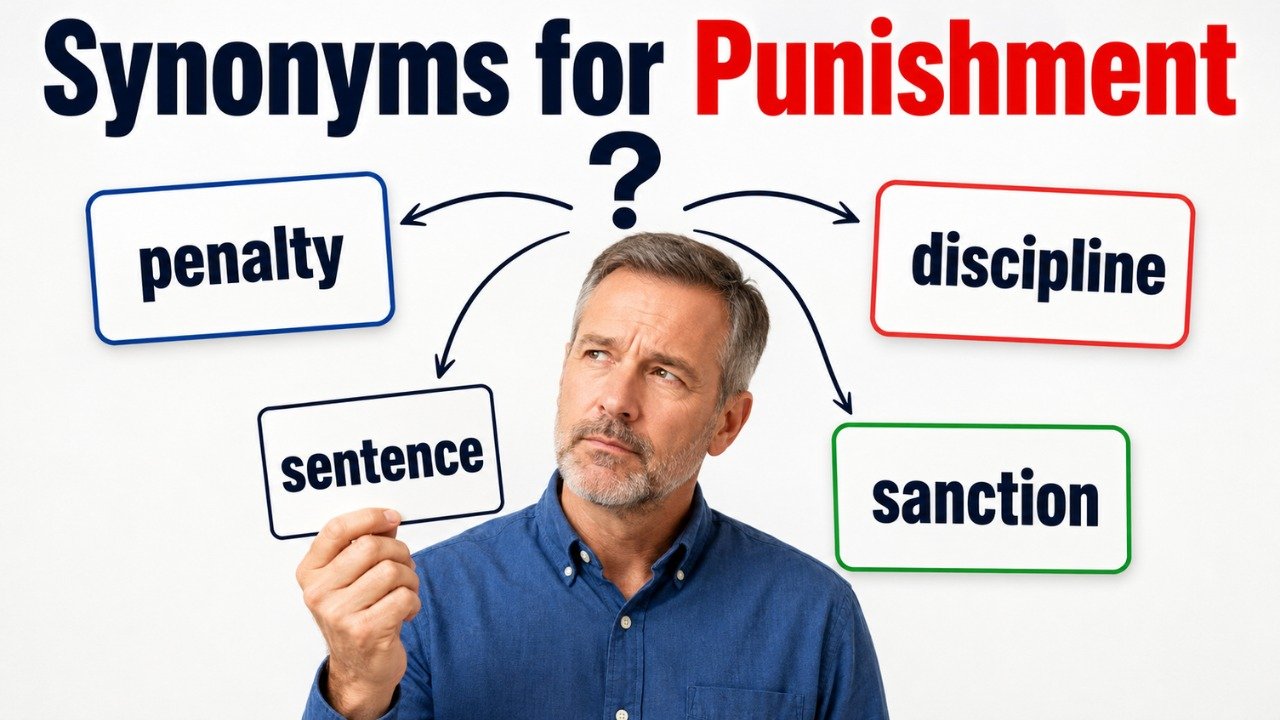
Quick Answer: Synonyms for punishment include penalty, sentence, sanction, discipline, correction, chastisement, retribution, consequence, reprimand, and fine. Use penalty for a consequence caused by breaking a rule, sentence for a court decision, sanction for an official restriction, and discipline for behavior correction. Reprimand works for formal criticism, while retribution describes punishment given in return for wrongdoing. The best choice depends on whether the context is legal, educational, professional, moral, or conversational.
Pronunciation and Word Details
Word: Punishment
Pronunciation: /ˈpʌnɪʃmənt/
Part of Speech: Noun
Meaning: A penalty or unpleasant consequence given to someone for breaking a rule, law, or accepted standard of behavior.
US Pronunciation:
UK Pronunciation:
What Does “Punishment” Mean?
Punishment means an unpleasant consequence given because someone has done something wrong or broken a rule. It is a noun formed from the verb “punish.”
Punishment may involve losing a privilege, paying a fine, receiving criticism, serving a sentence, or completing a corrective task. The exact form depends on the situation.
In legal contexts, punishment may refer to imprisonment, probation, fines, or community service. In schools and homes, it may involve detention, grounding, or the loss of privileges. In professional settings, it may include a reprimand, suspension, or dismissal.
The word can also be used figuratively to describe severe physical or emotional strain.
Example: The long journey was a punishment for his already tired body.
Meaning, Tone, and Context of “Punishment”
Punishment usually has a serious, negative, and authoritative tone. It suggests that a person must experience an unpleasant result because of misconduct, disobedience, or a legal violation.
The word is neutral enough for general use, but its emotional effect depends on the situation. It can sound formal in legal and academic writing, direct in everyday conversation, or harsh when describing severe treatment.
In education and parenting discussions, discipline or correction may sound more constructive than punishment. These words focus on improving behavior rather than causing discomfort.
In law, words such as penalty, sentence, and sanction are usually more precise. In moral or literary contexts, retribution, reckoning, and comeuppance may express the idea that a wrongdoer receives a deserved consequence.
When and How to Use “Punishment”
For Legal Consequences: Use punishment when discussing consequences imposed for breaking a law.
Example: The court considered the seriousness of the offense before deciding the punishment.
For Breaking Rules: Use it when someone faces a consequence for violating an established rule.
Example: Missing the activity was his punishment for repeatedly ignoring the instructions.
For Correcting Behavior: Use punishment when an authority gives a consequence intended to stop unwanted behavior.
Example: The teacher explained that the punishment was meant to discourage cheating.
For Moral Consequences: Use it when describing suffering that appears to result from wrongdoing.
Example: He viewed his loneliness as punishment for betraying his closest friend.
For Physical Strain: Use punishment figuratively for something extremely demanding or painful.
Example: The intense training placed considerable punishment on her knees.
For Deterrence: Use it when the consequence is intended to prevent similar actions in the future.
Example: Supporters believed that strict punishment would discourage future violations.
Best Synonyms for Punishment
Penalty: A consequence imposed for breaking a law, agreement, or rule.
Example: The player received a penalty for violating the rules.
Sentence: A punishment officially ordered by a court.
Example: The judge announced a five year prison sentence.
Sanction: An official penalty or restriction imposed by an authority.
Example: The organization introduced a financial sanction for serious violations.
Discipline: Action taken to correct behavior and encourage self control.
Example: The coach used fair discipline to improve the team’s conduct.
Correction: A measure intended to improve behavior or remove an error.
Example: The supervisor treated the warning as a form of correction.
Chastisement: Strong criticism or punishment for wrongdoing.
Example: The employee accepted the manager’s chastisement without argument.
Retribution: Punishment given because someone is believed to deserve it.
Example: The story follows a ruler seeking retribution against those who betrayed him.
Consequence: A result that follows an action, especially an undesirable one.
Example: Losing access was a consequence of repeatedly ignoring the policy.
Reprimand: A formal expression of criticism or disapproval.
Example: She received a written reprimand for failing to follow the procedure.
Fine: Money that must be paid as punishment for an offense.
Example: The driver was ordered to pay a fine.
50 Synonyms for Punishment with Short Meanings
- Penalty: A negative consequence for breaking a rule.
- Sentence: A court ordered legal punishment.
- Sanction: An official restriction or penalty.
- Discipline: Action used to correct behavior.
- Chastisement: Strong criticism or corrective punishment.
- Correction: A measure intended to improve conduct.
- Retribution: Deserved punishment for wrongdoing.
- Reprisal: Harmful action taken in response to another action.
- Forfeiture: The forced loss of money, property, or rights.
- Fine: Money paid as a legal penalty.
- Imprisonment: Confinement in prison as punishment.
- Incarceration: The state of being held in prison.
- Detention: Temporary confinement for breaking rules.
- Confinement: Restriction within a limited place.
- Probation: Supervised freedom instead of imprisonment.
- Suspension: Temporary removal from a position or activity.
- Expulsion: Permanent removal from an institution or group.
- Dismissal: Removal from employment or responsibility.
- Demotion: Reduction to a lower rank or position.
- Censure: Formal and public disapproval.
- Reprimand: An official statement of criticism.
- Rebuke: A sharp expression of disapproval.
- Scolding: Angry verbal criticism for bad behavior.
- Admonishment: A firm warning or expression of disapproval.
- Castigation: Severe criticism or punishment.
- Reproof: An expression of blame or disapproval.
- Chastening: An experience that corrects pride or behavior.
- Penance: An action performed to show regret for wrongdoing.
- Comeuppance: A deserved unpleasant consequence.
- Reckoning: A moment when someone faces the results of past actions.
- Payback: Informal repayment for harm or wrongdoing.
- Vengeance: Harm inflicted in return for an injury.
- Retaliation: Action taken in response to harm or offense.
- Consequence: A result produced by an action.
- Deprivation: The removal of something necessary or valued.
- Restriction: A limit placed on freedom or activity.
- Grounding: A household punishment that limits someone’s freedom.
- Time Out: A brief removal from an activity to correct behavior.
- Community Service: Unpaid public work ordered as a penalty.
- Hard Labor: Demanding physical work imposed as punishment.
- Corporal Punishment: Physical punishment intended to cause pain.
- Capital Punishment: A legal sentence involving death.
- Exile: Forced removal from one’s country or community.
- Banishment: Official removal from a place or group.
- Penalization: The act of imposing a penalty.
- Punitive Measure: An action intended to punish.
- Disciplinary Action: An official response to misconduct.
- Corrective Action: A step taken to improve behavior or performance.
- Legal Penalty: A consequence established by law.
- Disciplinary Measure: A method used to address unacceptable behavior.
Read Also:
Synonyms for Massive

Synonyms for Punishment by Context
When Punishment Means a Legal Penalty
The strongest choices are penalty, sentence, fine, imprisonment, probation, and sanction. These words describe official consequences imposed by a court, government, or recognized authority.
Example: The judge selected probation as a more appropriate sentence than imprisonment.
When Punishment Means Behavior Correction
Use discipline, correction, corrective action, time out, or grounding when the purpose is to improve behavior.
Example: The parent chose a loss of privileges as a form of discipline.
When Punishment Means Formal Criticism
Use reprimand, censure, rebuke, reproof, or admonishment when the consequence mainly involves criticism or disapproval.
Example: The official received a formal censure for violating the rules.
When Punishment Means Deserved Suffering
Use retribution, comeuppance, reckoning, or chastening when someone experiences a negative result that appears deserved.
Example: The dishonest character eventually faced his comeuppance.
When Punishment Means Revenge
Use reprisal, retaliation, payback, or vengeance when one person causes harm in response to an earlier offense.
Example: The attack was described as retaliation rather than lawful punishment.
When Punishment Means Loss of Privileges
Use forfeiture, deprivation, restriction, suspension, or expulsion when a person loses freedom, property, status, or access.
Example: Suspension was the stated consequence for repeated misconduct.
Another Word for Punishment
The best general replacement for punishment is penalty. It is clear, neutral, and suitable for legal rules, workplace policies, sports, agreements, and everyday situations.
However, the best alternative depends on context. Discipline is better when the goal is behavior improvement, while sentence is more precise for a court decision.
Original: The punishment for arriving late was a written warning.
Better Option: The penalty for arriving late was a written warning.
Original: The court announced the punishment the following morning.
Better Option: The court announced the sentence the following morning.
Original: The parents discussed a suitable punishment for the repeated behavior.
Better Option: The parents discussed a suitable form of discipline for the repeated behavior.
Original: The official received punishment for ignoring the policy.
Better Option: The official received a formal reprimand for ignoring the policy.
When Not to Use “Punishment”
Avoid using punishment when a more specific word would make the sentence clearer. In legal writing, identify whether the consequence is a fine, sentence, probation, or imprisonment.
In educational and parenting contexts, punishment may sound focused on suffering rather than learning. Use discipline, guidance, or correction when the aim is constructive improvement.
Do not use punishment for every unpleasant result. Some results are natural consequences rather than penalties imposed by an authority.
Weak: His punishment for staying awake was feeling tired the next morning.
Better: The natural consequence of staying awake was feeling tired the next morning.
Weak: The court gave him a serious punishment.
Better: The court imposed a lengthy prison sentence.
Weak: The manager gave her a punishment for the mistake.
Better: The manager issued a formal reprimand for the repeated mistake.
Weak: The school used punishment to improve student responsibility.
Better: The school used consistent discipline to improve student responsibility.
Words Commonly Confused With Punishment
Punishment vs Penalty: Punishment is the broad idea of receiving an unpleasant consequence. A penalty is a specific consequence imposed for breaking a rule, law, or agreement.
Punishment vs Discipline: Punishment focuses on the consequence of wrongdoing. Discipline often focuses on teaching, correcting, and preventing future misconduct.
Punishment vs Consequence: Punishment is deliberately imposed by a person or authority. A consequence may happen naturally without anyone imposing it.
Punishment vs Sentence: Punishment can be used in many settings. A sentence is a formal legal decision made by a court.
Punishment vs Retribution: Punishment may aim to correct, discourage, or protect. Retribution mainly focuses on giving someone what they are believed to deserve.
Punishment vs Revenge: Punishment is normally connected to rules, authority, or justice. Revenge is personal harm motivated by anger or a desire for payback.
Punishment vs Correction: Punishment emphasizes an unpleasant response. Correction emphasizes improvement and better future behavior.
Which Synonym Should You Choose?
Choose penalty when discussing broken rules, contracts, fees, or official requirements.
Choose sentence when referring to a punishment ordered by a court.
Choose sanction for formal restrictions imposed by an organization, institution, or governing authority.
Choose discipline when the goal is to correct behavior and teach responsibility.
Choose correction when you want to emphasize improvement rather than suffering.
Choose reprimand for formal criticism in professional, academic, or official settings.
Choose fine when the punishment requires someone to pay money.
Choose retribution in literary, moral, or emotional writing about deserved punishment.
Choose consequence when describing the result of an action without suggesting that an authority deliberately imposed it.
Choose comeuppance in informal conversation or storytelling when someone receives a deserved negative result.
Real Life Examples of “Punishment” in Sentences
Original: The punishment for breaking the rule was severe.
Better Option: The penalty for breaking the rule was severe.
Original: The judge will announce the punishment tomorrow.
Better Option: The judge will announce the sentence tomorrow.
Original: The student received punishment for disrupting the lesson.
Better Option: The student received detention for disrupting the lesson.
Original: The company introduced punishment for repeated policy violations.
Better Option: The company introduced disciplinary action for repeated policy violations.
Original: Losing his privileges was an effective punishment.
Better Option: Losing his privileges was an effective consequence.
Original: The leader demanded punishment for the betrayal.
Better Option: The leader demanded retribution for the betrayal.
Original: Her punishment included paying a large amount of money.
Better Option: Her penalty included paying a large fine.
Original: The punishment prevented him from attending the event.
Better Option: The restriction prevented him from attending the event.
Original: Public criticism became his punishment for the mistake.
Better Option: Public censure became the consequence of his mistake.
Original: The child understood why the punishment was necessary.
Better Option: The child understood why the corrective action was necessary.
Synonym Groups and Usage Differences
Legal Consequence Group
Words in this group include penalty, sentence, fine, probation, imprisonment, and incarceration. They describe consequences established or imposed through a legal system.
Example: The court imposed a financial penalty instead of imprisonment.
Discipline Group
This group includes discipline, correction, grounding, detention, and time out. These words are common when discussing behavior in homes, schools, and organized groups.
Example: Detention was used as a disciplinary measure after repeated disruptions.
Formal Criticism Group
This group includes reprimand, censure, rebuke, reproof, and admonishment. They refer mainly to spoken or written disapproval.
Example: The committee issued a formal reprimand.
Retribution Group
This group includes retribution, reckoning, comeuppance, and chastening. These words suggest that someone is facing a deserved result.
Example: The ending gives the dishonest character a satisfying comeuppance.
Restriction Group
This group includes suspension, expulsion, confinement, deprivation, and forfeiture. Each word involves losing freedom, access, property, or status.
Example: The athlete faced suspension after the violation.
Revenge Group
This group includes reprisal, retaliation, payback, and vengeance. These terms describe a harmful response motivated by a previous injury or offense.
Example: The response appeared to be retaliation rather than fair discipline.
Antonyms of Punishment
The opposite of punishment depends on whether the context involves law, discipline, criticism, or personal treatment.
Reward: Something positive given for good behavior or achievement.
Praise: An expression of approval or admiration.
Pardon: An official decision that releases someone from legal punishment.
Forgiveness: The decision to stop blaming someone for wrongdoing.
Mercy: Compassion shown by reducing or avoiding punishment.
Leniency: A less severe or more forgiving response.
Acquittal: A legal judgment that a person is not guilty.
Absolution: Formal release from blame or guilt.
Privilege: A special right or benefit rather than a restriction.
Recognition: Positive attention given for achievement or good conduct.
Comparison: Punishment vs Related Words
Punishment vs Penalty
Punishment is a broad term for any unpleasant consequence imposed because of wrongdoing. Penalty is more specific and commonly relates to rules, laws, payments, and formal systems.
Example With Punishment: The punishment was intended to discourage future misconduct.
Example With Penalty: The late payment penalty was added to the total amount.
Punishment vs Discipline
Punishment focuses on what happens after someone behaves badly. Discipline can include rules, instruction, guidance, and consequences designed to build better habits.
Example With Punishment: Losing access was his punishment for ignoring the warning.
Example With Discipline: Consistent discipline helped him develop better habits.
Punishment vs Consequence
Punishment is deliberately imposed. A consequence can be planned or natural.
Example With Punishment: The teacher assigned detention as punishment.
Example With Consequence: Exhaustion was the natural consequence of missing sleep.
Punishment vs Retribution
Punishment may aim to correct behavior, protect others, or discourage wrongdoing. Retribution focuses on giving a wrongdoer a deserved response.
Example With Punishment: The punishment included community service.
Example With Retribution: The character sought retribution for the betrayal.
Punishment vs Sentence
Punishment can describe consequences in many areas of life. Sentence is limited mainly to a formal court decision.
Example With Punishment: The punishment affected his future opportunities.
Example With Sentence: The judge reduced the sentence to two years.
Punishment vs Reprimand
Punishment can involve physical, financial, legal, or social consequences. A reprimand is specifically a formal expression of criticism.
Example With Punishment: Suspension was considered an appropriate punishment.
Example With Reprimand: She received a written reprimand from the director.
Common Phrases and Expressions With Punishment
Severe Punishment: A very harsh or serious penalty.
Harsh Punishment: A consequence considered excessively strict.
Fair Punishment: A consequence that matches the seriousness of the offense.
Appropriate Punishment: A suitable response to particular wrongdoing.
Legal Punishment: A penalty permitted and imposed by law.
Physical Punishment: A penalty involving physical pain or discomfort.
Collective Punishment: A penalty imposed on a group because of the actions of some members.
Capital Punishment: A legal sentence that results in death.
Escape Punishment: To avoid receiving a deserved consequence.
Face Punishment: To experience the official consequence of wrongdoing.
Common Mistakes to Avoid
A common mistake is repeating punishment several times in the same paragraph. Replace some uses with precise words such as penalty, sentence, discipline, reprimand, or consequence.
Do not use sentence for ordinary household or workplace rules. Sentence normally refers to a legal judgment.
Avoid using revenge and punishment as exact synonyms. Revenge is personal and emotional, while punishment is generally imposed under a rule or authority.
Do not describe every negative result as punishment. Feeling tired after staying awake is a consequence, not necessarily a punishment.
Avoid vague sentences such as “He received punishment.” Explain whether he received a fine, suspension, reprimand, detention, or another specific penalty.
Choose words according to purpose. Use discipline for teaching, correction for improvement, and retribution for deserved suffering.
Conclusion
Understanding synonyms for punishment helps you choose language that accurately matches the situation. Penalty is the strongest general alternative, while sentence, fine, and imprisonment suit legal contexts. Discipline and correction are better when the purpose is improving behavior. Use reprimand for formal criticism, consequence for a result, and retribution for deserved suffering. Selecting a precise synonym makes legal, academic, professional, and everyday writing clearer, fairer, and easier to understand.
FAQs About Synonyms for Punishment
What Is the Best Synonym for Punishment?
Penalty is the best general synonym because it works for rules, laws, agreements, and official consequences.
Is Discipline the Same as Punishment?
Not exactly. Punishment focuses on an unpleasant consequence, while discipline often focuses on teaching and correcting behavior.
What Is a Formal Word for Punishment?
Sanction, penalty, disciplinary action, and retribution are formal alternatives. The best choice depends on the context.
What Is Another Word for Legal Punishment?
Sentence is the most precise term for a punishment ordered by a court. Penalty, fine, imprisonment, and probation are also useful.
What Is a Mild Synonym for Punishment?
Correction, warning, reprimand, and admonishment can describe milder responses to misconduct.
What Is the Difference Between Punishment and Consequence?
Punishment is intentionally imposed by someone. A consequence may occur naturally as the result of an action.
Can Retribution Replace Punishment?
Retribution can replace punishment when the sentence emphasizes that someone receives a deserved consequence for wrongdoing.
