
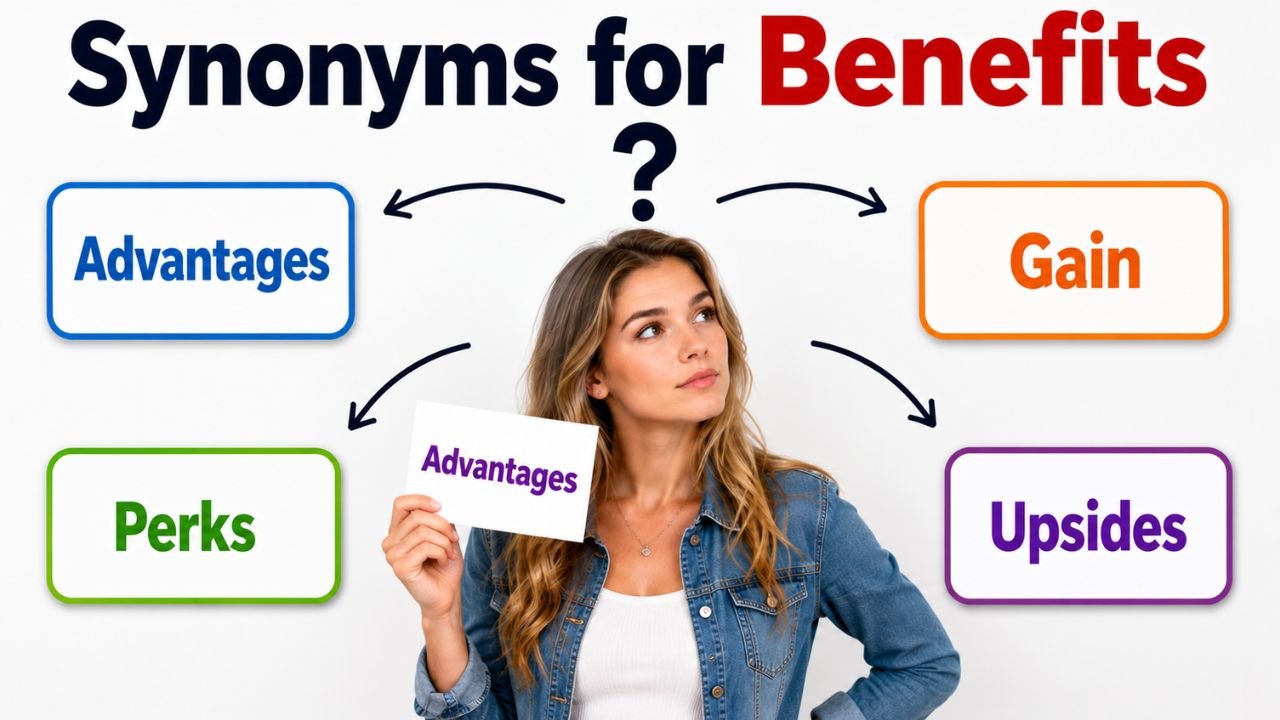
Quick Answer: Synonyms for benefits include advantages, gains, rewards, perks, positives, improvements, value, assistance, support, and returns. Advantages is the best general alternative when describing favorable qualities or useful results. Gains suits measurable progress, while rewards refers to something received for effort. Perks is appropriate for extra workplace privileges. Assistance and support work when benefits means help, while returns and profits are more suitable for financial contexts.
Pronunciation and Word Details
Word: Benefits
Pronunciation: /ˈben.ɪ.fɪts/
Part of Speech: Plural noun and third person singular verb
Meaning: Helpful results, favorable qualities, useful services, or forms of support received from something.
US Pronunciation:
UK Pronunciation:
What Does “Benefits” Mean?
Benefits means helpful results, positive effects, useful qualities, privileges, or support received from an action, decision, service, job, activity, or situation.
As a plural noun, benefits describes the favorable results or advantages provided by something.
Example: Regular exercise offers several physical and emotional benefits.
Benefits can also function as a verb. As a verb, it means helps, supports, improves, or gives an advantage to someone or something.
Example: Regular exercise benefits the body and mind.
The word appears in many contexts. Health benefits are positive effects on physical or emotional health. Employee benefits are services or compensation provided in addition to regular pay. Public benefits are forms of financial or practical support. Educational benefits are improvements gained through learning or training.
Meaning, Tone, and Context of “Benefits”
Benefits is a neutral and widely used word. It works naturally in formal writing, academic essays, workplace communication, health discussions, financial reports, educational content, and everyday conversation.
In general writing, benefits usually refers to positive results or useful qualities. A writer may discuss the benefits of exercise, reading, travel, education, technology, or careful planning.
In workplace language, benefits refers to compensation or services provided in addition to salary. These may include paid leave, insurance coverage, retirement support, travel allowances, or flexible working arrangements.
In public support contexts, benefits may describe money, services, or resources provided to eligible individuals or families.
The word is clear and professional, but it may sound vague when the writer does not explain the exact advantage. More specific alternatives such as gains, rewards, assistance, savings, or improvements can make a sentence more informative.
When and How to Use “Benefits”
For Positive Results: Use benefits when describing favorable effects created by an action, experience, habit, or decision.
Example: Daily reading provides lasting benefits for vocabulary and concentration.
For Health Improvements: Use benefits when discussing positive effects on physical, mental, or emotional health.
Example: Walking offers several benefits for heart health and emotional well being.
For Workplace Compensation: Use benefits for services, privileges, or financial support offered to employees in addition to salary.
Example: The position includes paid leave and several employee benefits.
For Financial Support: Use benefits when discussing money, services, or resources provided to eligible people.
Example: The family applied for housing benefits.
For Educational Progress: Use benefits when explaining how learning, training, or practice improves knowledge and ability.
Example: Students experience many benefits from regular writing practice.
For Social Improvement: Use benefits when describing positive effects on a group, community, or society.
Example: The community project created economic and social benefits.
As a Verb Meaning Helps: Use benefits when something improves the position, ability, or condition of someone or something.
Example: The new training program benefits both employees and managers.
Best Synonyms for Benefits
Advantages: Helpful qualities or conditions that make something better or more useful.
Example: Flexible working hours offer several advantages to employees.
Gains: Positive increases, improvements, or achievements.
Example: The students made noticeable gains in reading ability.
Rewards: Valuable results received because of effort, participation, or success.
Example: Greater confidence is one of the rewards of learning a new skill.
Perks: Extra privileges or enjoyable additions offered with a job or service.
Example: Free meals are among the most appreciated workplace perks.
Positives: Favorable qualities or aspects of a situation.
Example: One of the main positives is the flexible schedule.
Improvements: Changes that make something better than before.
Example: The new routine produced improvements in her energy and focus.
Value: The usefulness, importance, or practical worth provided by something.
Example: Readers quickly recognized the value of the guide.
Assistance: Practical, organized, or financial help.
Example: Financial assistance is available to eligible students.
Support: Help that strengthens, protects, or improves a person or situation.
Example: The program provides support to new business owners.
Returns: Financial gains or valuable results received from an investment or effort.
Example: The investment produced steady returns over several years.
50 Synonyms for Benefits with Short Meanings
- Advantages: Helpful qualities or favorable conditions.
- Gains: Positive increases or improvements.
- Rewards: Valuable results received for effort.
- Perks: Extra privileges or enjoyable additions.
- Positives: Favorable parts of a situation.
- Merits: Good qualities that make something valuable.
- Strengths: Positive qualities or useful abilities.
- Assets: Valuable qualities, resources, or advantages.
- Improvements: Changes that make something better.
- Value: Usefulness, importance, or practical worth.
- Usefulness: The quality of being helpful or practical.
- Utility: Practical value or useful function.
- Help: Support given to solve a problem.
- Assistance: Practical or financial help.
- Support: Help that strengthens or improves something.
- Aid: Help provided during need or difficulty.
- Relief: Help that reduces pain, pressure, or hardship.
- Welfare: Support for health, safety, and comfort.
- Services: Helpful activities provided to people.
- Privileges: Special rights or favorable opportunities.
- Incentives: Rewards that encourage a particular action.
- Bonuses: Extra payments or rewards.
- Allowances: Money or resources provided for a purpose.
- Compensation: Payment or value received for work.
- Provisions: Resources or services supplied for a need.
- Entitlements: Support or services someone has a right to receive.
- Coverage: Financial protection provided through a plan.
- Protections: Measures that prevent harm, loss, or difficulty.
- Opportunities: Favorable chances for progress or success.
- Returns: Gains received from effort or investment.
- Profits: Financial gains remaining after expenses.
- Earnings: Money gained through work or investment.
- Proceeds: Money received from a sale or activity.
- Savings: Money, time, or resources preserved.
- Dividends: Financial payments or valuable long term results.
- Growth: Positive development or increase.
- Advancement: Progress toward a better position or condition.
- Development: Improvement through learning or experience.
- Enhancement: An increase in quality, value, or effectiveness.
- Enrichment: Improvement in knowledge, quality, or experience.
- Outcomes: Results produced by an action or decision.
- Results: Effects created by an activity or situation.
- Payoffs: Valuable results received after effort or patience.
- Boons: Things that are especially helpful or useful.
- Blessings: Valuable or fortunate things.
- Favors: Helpful acts performed for another person.
- Conveniences: Features that save time, work, or effort.
- Upsides: Positive aspects of a situation.
- Good Points: Useful or favorable qualities.
- Positive Effects: Helpful changes produced by something.
Read Also:
Synonyms for Nuanced

Synonyms for Benefits by Context
When Benefits Means Advantages
Advantages, positives, merits, strengths, assets, upsides, and good points describe favorable qualities that make a choice, plan, situation, or method more useful.
Example: One advantage of working from home is greater flexibility.
Example: The greatest upside of the plan is its lower cost.
When Benefits Means Positive Results
Gains, improvements, outcomes, results, growth, development, enhancement, and positive effects describe favorable changes produced by an action, experience, or decision.
Example: Regular practice led to significant gains in confidence.
Example: The new teaching method produced positive results.
When Benefits Means Workplace Privileges
Perks, bonuses, privileges, incentives, allowances, compensation, provisions, and coverage describe payments, services, or advantages connected with employment.
Example: Flexible working hours are one of the most attractive workplace perks.
Example: The compensation package includes travel allowances.
When Benefits Means Financial Gain
Profits, returns, earnings, proceeds, savings, dividends, and payoffs describe money or financial value gained from work, business, investment, or careful planning.
Example: The investment generated strong returns.
Example: Buying efficient equipment created long term savings.
When Benefits Means Help or Support
Help, assistance, support, aid, relief, welfare, services, and provisions describe resources provided to meet a practical, emotional, or financial need.
Example: The family received emergency financial assistance.
Example: Local services provide support to older residents.
Another Word for Benefits
Advantages is the best general replacement for benefits. It works naturally when discussing favorable qualities, positive results, or reasons why one choice is better than another.
However, the best alternative depends on the intended meaning. Perks is better for workplace extras. Gains works for measurable progress. Assistance is more precise when discussing help. Returns is more appropriate when referring to investment results.
Original: The course provides many benefits for new writers.
Better Option: The course provides many advantages for new writers.
Original: Employees receive several benefits with the position.
Better Option: Employees receive several perks with the position.
Original: The training produced clear benefits for the students.
Better Option: The training produced clear gains for the students.
Original: The program provides benefits to families with limited income.
Better Option: The program provides assistance to families with limited income.
When Not to Use “Benefits”
Avoid using benefits when the word does not clearly explain the type of positive result being discussed. It may sound vague when readers need specific information.
Weak: The new system provides many benefits.
Better: The new system saves time, reduces errors, and improves communication.
Do not repeat benefits several times within the same paragraph. Repetition can make the writing sound dull and imprecise.
Weak: The benefits of reading include educational benefits and emotional benefits.
Better: The advantages of reading include educational gains and emotional support.
Avoid using benefits when discussing results that may be positive, negative, or neutral. Outcomes or results may be more accurate in that context.
Weak: The study examined the benefits of the treatment, including several harmful reactions.
Better: The study examined the outcomes of the treatment, including several harmful reactions.
Do not use benefits when the sentence refers only to money earned by a business.
Weak: The company reported higher benefits this year.
Better: The company reported higher profits this year.
Avoid benefits when a more exact synonym would communicate the meaning more clearly.
Weak: The employee received several benefits for completing the project.
Better: The employee received several rewards for completing the project.
Words Commonly Confused With Benefits
Benefits vs Advantages: Benefits are positive results, services, or forms of support. Advantages are qualities that place someone or something in a better position.
Benefits vs Perks: Benefits may include important workplace compensation or protection. Perks are usually optional extras that make a job more enjoyable.
Benefits vs Rewards: Benefits may occur naturally as a result of an action. Rewards are normally received because of effort, success, or achievement.
Benefits vs Profits: Benefits can be personal, social, physical, emotional, educational, or financial. Profits specifically refers to money remaining after business expenses.
Benefits vs Outcomes: Benefits are always favorable. Outcomes may be positive, negative, or neutral.
Benefits vs Assistance: Benefits may refer to any useful result or support. Assistance specifically means help provided to someone.
Benefits vs Compensation: Benefits may form part of an employment package. Compensation includes wages, payments, bonuses, and other value received for work.
Benefits vs Gains: Benefits covers a broad range of positive results. Gains usually describes measurable progress, increases, or financial improvement.
Which Synonym Should You Choose?
Choose advantages when discussing favorable qualities of a choice, plan, method, service, or situation.
Choose gains when describing measurable progress, increases, improvement, or achievement.
Choose rewards when something valuable is received because of effort, participation, or success.
Choose perks when referring to enjoyable workplace extras or added privileges.
Choose positives or upsides in casual conversation when discussing the good parts of a situation.
Choose improvements when comparing a new condition with an earlier condition.
Choose support when referring to ongoing practical, emotional, educational, or financial help.
Choose assistance when describing formal, organized, or financial help.
Choose profits when discussing money earned by a business after expenses.
Choose returns when discussing investment gains or value received over time.
Choose value when emphasizing usefulness, importance, or practical worth.
Choose outcomes when the results may be positive, negative, or neutral.
Choose merits in essays, reports, and formal comparisons when discussing valuable qualities.
Choose incentives when describing rewards intended to encourage action or better performance.
Real Life Examples of “Benefits” in Sentences
Original: Regular exercise provides many benefits for the body.
Better Option: Regular exercise provides many advantages for the body.
Original: The new routine offers several benefits for mental health.
Better Option: The new routine offers several positive effects for mental health.
Original: Employees appreciate the benefits included with the position.
Better Option: Employees appreciate the perks included with the position.
Original: The reading program created benefits for young learners.
Better Option: The reading program created gains for young learners.
Original: The investment may provide benefits in the future.
Better Option: The investment may provide returns in the future.
Original: Eligible families can apply for housing benefits.
Better Option: Eligible families can apply for housing assistance.
Original: One of the benefits of the plan is its low cost.
Better Option: One of the advantages of the plan is its low cost.
Original: The community received several benefits from the project.
Better Option: The community received several positive outcomes from the project.
Original: The flexible schedule benefits working parents.
Better Option: The flexible schedule supports working parents.
Original: Reading benefits children in several ways.
Better Option: Reading helps children in several ways.
Synonym Groups and Usage Differences
Advantage Group
Advantages, positives, merits, strengths, assets, upsides, and good points describe favorable features that improve a situation or make one choice more appealing.
Example: The greatest advantage of the plan is its simplicity.
Improvement Group
Gains, improvements, growth, advancement, development, enhancement, and enrichment describe progress or positive change over time.
Example: The student made impressive gains in writing ability.
Reward Group
Rewards, perks, bonuses, incentives, privileges, and payoffs describe something valuable received through effort, achievement, employment, or participation.
Example: Additional paid leave is a valuable workplace perk.
Support Group
Help, assistance, support, aid, relief, welfare, services, and provisions describe resources provided to meet a practical, emotional, or financial need.
Example: Emergency aid was provided to affected families.
Financial Group
Profits, returns, earnings, proceeds, savings, and dividends describe money or financial value gained through business, work, investment, or careful planning.
Example: The business invested its profits in new equipment.
Value Group
Value, usefulness, utility, assets, merits, and strengths describe the worth or practical importance of something.
Example: The guide offers considerable value to new learners.
Antonyms of Benefits
The opposite of benefits depends on whether the word refers to advantages, positive results, financial gains, privileges, or support.
Disadvantages: Conditions that make something less useful or favorable.
Drawbacks: Negative features of a choice or situation.
Harms: Physical, emotional, financial, or practical damage.
Losses: Money, value, opportunities, or resources that have been lost.
Costs: Money, effort, time, or resources required.
Penalties: Punishments or negative consequences.
Burdens: Difficult responsibilities, pressures, or demands.
Risks: Possibilities of harm, failure, or loss.
Detriments: Things that cause damage or disadvantage.
Setbacks: Problems that delay improvement or progress.
Weaknesses: Qualities that reduce effectiveness or value.
Liabilities: Disadvantages, debts, or responsibilities that create difficulty.
Comparison: Benefits vs Related Words
Benefits vs Advantages
Benefits refers to helpful results, useful services, privileges, or support received from something. Advantages refers to qualities that make one choice or position better than another.
Example With Benefits: Exercise provides several health benefits.
Example With Advantages: One advantage of exercising at home is convenience.
Benefits vs Perks
Benefits can include essential workplace compensation, services, or financial protection. Perks are usually optional extras that make a position more enjoyable.
Example With Benefits: The job provides health benefits and paid leave.
Example With Perks: Free meals are among the most popular workplace perks.
Benefits vs Rewards
Benefits may develop naturally as positive results. Rewards are normally earned or intentionally given because of effort or achievement.
Example With Benefits: Better concentration is one of the benefits of proper sleep.
Example With Rewards: Recognition was her reward for years of excellent work.
Benefits vs Profits
Benefits can be personal, social, educational, physical, or financial. Profits only refers to financial gains remaining after business expenses.
Example With Benefits: The project created benefits for local residents.
Example With Profits: The business reported higher profits this month.
Benefits vs Outcomes
Benefits are always positive. Outcomes are simply results and may be favorable, unfavorable, or neutral.
Example With Benefits: The treatment provided several health benefits.
Example With Outcomes: Researchers examined both the positive and negative outcomes of the treatment.
Benefits vs Gains
Benefits is a broad term for positive results or support. Gains usually refers to measurable improvement, progress, or financial increase.
Example With Benefits: The course offers many benefits to beginners.
Example With Gains: Students made significant gains in reading speed.
Common Phrases and Expressions With “Benefits”
Health Benefits: Positive effects on physical, mental, or emotional health.
Employee Benefits: Compensation and support provided in addition to wages.
Added Benefits: Extra advantages beyond the main purpose.
Mutual Benefits: Positive results received by everyone involved.
Long Term Benefits: Advantages that continue or appear over an extended period.
Short Term Benefits: Positive results experienced within a limited period.
Direct Benefits: Positive results that occur clearly or immediately.
Economic Benefits: Financial or commercial advantages.
Public Benefits: Money, support, or services provided to eligible people.
Benefits Package: A collection of workplace payments, services, and privileges.
Common Mistakes to Avoid
One common mistake is using benefits without explaining what the benefits actually are. Specific information makes writing clearer and more useful.
Vague: The program provides many benefits.
Clear: The program reduces costs, improves access, and provides professional training.
Another mistake is confusing benefits with profits. A project may create personal or social benefits without producing financial profit.
Incorrect: The community project produced several social profits.
Correct: The community project produced several social benefits.
Writers should remember that benefits is plural when used as a noun.
Incorrect: The benefits is easy to understand.
Correct: The benefits are easy to understand.
Benefits may also function as a verb with a singular subject.
Correct: The new schedule benefits every employee.
Avoid using perks for essential workplace protection. Health coverage is usually a benefit, while free meals or entertainment are more accurately described as perks.
Do not replace benefits with outcomes unless the sentence may include negative or neutral results. Benefits always suggests favorable results.
Avoid repeating benefits several times within a short passage. Use precise alternatives such as advantages, gains, support, improvements, rewards, or returns.
Choose profits instead of benefits when discussing money remaining after business expenses.
Choose assistance instead of benefits when the sentence refers specifically to organized or financial help.
Conclusion
Synonyms for benefits include advantages, gains, rewards, perks, improvements, assistance, support, profits, returns, and positive effects. Advantages is the strongest general replacement, while gains and improvements suit progress. Use perks for workplace extras, rewards for earned results, and assistance or support for help. Returns and profits are more accurate in financial contexts. Selecting the right synonym makes writing clearer by showing whether the benefit is an advantage, privilege, service, improvement, reward, or financial gain.
FAQs About Synonyms for Benefits
What is the best synonym for benefits?
Advantages is the best general synonym because it naturally describes favorable qualities, useful results, and positive conditions.
What is a formal synonym for benefits?
Advantages, merits, gains, positive outcomes, provisions, and compensation are suitable formal alternatives.
What is a casual synonym for benefits?
Perks, positives, upsides, and good points are natural alternatives for casual speech and informal writing.
What is another word for employee benefits?
Compensation, perks, privileges, allowances, provisions, and coverage may replace employee benefits depending on the specific meaning.
Can profits be used as a synonym for benefits?
Profits can replace benefits only when the sentence specifically refers to financial gains from business activity.
What is the difference between benefits and advantages?
Benefits are positive results, services, or support received from something. Advantages are favorable qualities that make one option or position better.
What are synonyms for health benefits?
Health advantages, positive effects, improvements, wellness gains, favorable outcomes, and supportive effects are useful alternatives.
