
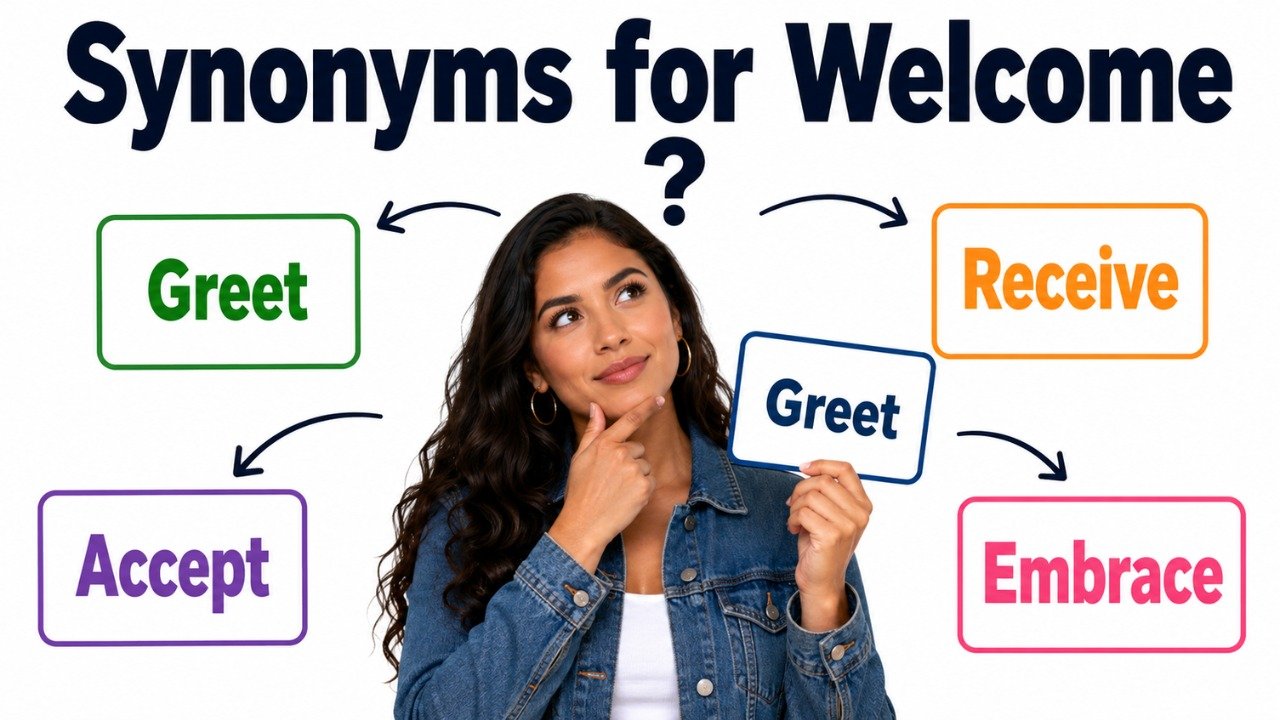
Quick Answer: The best synonyms for welcome include greet, receive, accept, invite, embrace, acknowledge, host, appreciated, invited, and well received. Use greet when meeting someone, receive when accepting a guest, invite when asking someone to join, and embrace for enthusiastic acceptance. Appreciated and valued describe something viewed positively, while well received suits ideas, announcements, performances, and proposals.
Pronunciation and Word Details
Word: Welcome.
Pronunciation: /ˈwel.kəm/
Part of Speech: Verb, adjective, noun, and interjection.
Meaning: To greet or receive someone gladly, or to describe someone or something that is accepted with pleasure.
US Pronunciation:
UK Pronunciation:
What Does “Welcome” Mean?
Welcome means to greet, receive, or accept someone or something with pleasure. It can function as a verb, adjective, noun, or interjection.
As a verb, welcome describes the act of receiving a person warmly. A family may welcome a guest, a company may welcome a new employee, and a community may welcome visitors.
Welcome can also mean accepting an idea, development, suggestion, or change positively. People may welcome good news, useful advice, additional support, or an opportunity.
As an adjective, welcome describes someone or something that is wanted, appreciated, or accepted. A visitor may be welcome in a home, while rainfall may be a welcome relief after dry weather.
As a noun, welcome refers to a greeting or warm reception. A guest may receive a friendly welcome upon arrival.
As an interjection, welcome is commonly used as a friendly response after someone expresses thanks. The intended meaning depends on the sentence and situation.
Meaning, Tone, and Context of “Welcome”
Welcome usually has a warm, positive, polite, and friendly tone. It communicates acceptance, hospitality, appreciation, or approval.
In everyday conversation, welcome is commonly used when greeting guests, visitors, customers, colleagues, friends, or family members. It creates a sense of comfort and belonging.
In professional communication, welcome may introduce new employees, participants, clients, members, or ideas. Phrases such as welcome aboard, welcome to the team, and we welcome your feedback sound encouraging and inclusive.
In formal writing, welcome can describe acceptance or approval. A report may state that a proposal received a welcome response, while an organization may welcome a new policy.
The word can also describe something that provides relief or satisfaction. A break may be welcome after a tiring day, and positive news may be a welcome development.
Because welcome has several grammatical roles, the best synonym depends on whether it means greet, receive, accept, approve, appreciate, or show hospitality.
When and How to Use “Welcome”
For Greeting a Guest: Use welcome when receiving someone warmly upon arrival.
Example: We welcomed the guests at the entrance.
For Receiving a New Member: Use welcome when someone joins a group, workplace, class, or community.
Example: The team welcomed its newest member with enthusiasm.
For Accepting an Idea: Welcome can show that a suggestion, plan, or change is viewed positively.
Example: The committee welcomed the proposal for improved safety measures.
For Showing Appreciation: Use welcome when something is considered useful, pleasant, or valuable.
Example: Your thoughtful advice is always welcome.
For Offering Hospitality: Welcome can show that someone is invited and permitted to stay or participate.
Example: You are welcome to stay for dinner.
For Expressing Relief: Use welcome for something that brings comfort after difficulty.
Example: The cooler weather was a welcome change.
For Encouraging Participation: Welcome can invite questions, feedback, ideas, or contributions.
Example: We welcome comments from every participant.
For Responding to Thanks: Welcome is part of a polite expression used after someone shows gratitude.
Example: You are welcome, and I am glad I could help.
Best Synonyms for Welcome
Greet: To meet someone with words or actions that show recognition and friendliness.
Example: The host greeted every visitor at the door.
Receive: To accept or meet someone who arrives.
Example: The manager received the new employees warmly.
Accept: To agree to receive, consider, or approve someone or something.
Example: The group accepted the suggestion without hesitation.
Invite: To ask someone to attend, join, enter, or participate.
Example: They invited their neighbors to the celebration.
Embrace: To accept an idea, person, or change enthusiastically.
Example: The community embraced the new cultural program.
Acknowledge: To recognize someone’s presence, value, effort, or contribution.
Example: The speaker acknowledged every volunteer during the event.
Host: To receive and provide hospitality for guests or visitors.
Example: The family hosted several travelers during the holiday.
Appreciated: Recognized as valuable, helpful, or pleasing.
Example: Her support was deeply appreciated.
Invited: Asked or permitted to attend, join, or participate.
Example: All registered members were invited to the discussion.
Well Received: Accepted or regarded positively by an audience or group.
Example: The new proposal was well received by the staff.
50 Synonyms for Welcome with Short Meanings
- Greet: To meet someone in a friendly manner.
- Receive: To accept or meet someone upon arrival.
- Accept: To agree to take or approve something.
- Admit: To allow someone to enter a place.
- Invite: To ask someone to attend or participate.
- Embrace: To accept someone or something enthusiastically.
- Acknowledge: To recognize someone’s presence or importance.
- Salute: To greet someone respectfully.
- Hail: To greet or praise someone enthusiastically.
- Meet: To come together with someone upon arrival.
- Host: To receive and care for guests.
- Entertain: To provide hospitality or enjoyment for guests.
- Accommodate: To provide space, comfort, or assistance.
- Usher In: To guide someone inside or introduce something new.
- Take In: To receive someone into a home or group.
- Bid Welcome: To greet someone warmly.
- Extend Greetings: To offer friendly words of recognition.
- Show Hospitality: To treat guests generously and kindly.
- Make Comfortable: To help someone feel relaxed and accepted.
- Open One’s Home To: To receive someone as a guest.
- Appreciated: Recognized as valuable or helpful.
- Valued: Considered important or worthwhile.
- Accepted: Approved or received positively.
- Invited: Asked or permitted to attend.
- Wanted: Desired or gladly received.
- Desired: Strongly wished for or needed.
- Pleasing: Producing satisfaction or enjoyment.
- Pleasant: Enjoyable, friendly, or agreeable.
- Agreeable: Acceptable and pleasing.
- Gratifying: Producing pleasure or satisfaction.
- Encouraging: Giving confidence, hope, or approval.
- Favorable: Showing approval or positive judgment.
- Positive: Showing acceptance, support, or optimism.
- Acceptable: Suitable or satisfactory enough to approve.
- Approved: Formally accepted or supported.
- Embraced: Enthusiastically accepted or supported.
- Cherished: Deeply valued and appreciated.
- Celebrated: Publicly praised or joyfully recognized.
- Well Received: Accepted with approval or enthusiasm.
- Popular: Liked or approved by many people.
- Timely: Arriving at a useful or suitable moment.
- Refreshing: Pleasantly new, different, or relieving.
- Reassuring: Providing comfort or confidence.
- Comforting: Reducing worry, sadness, or difficulty.
- Heartening: Making someone feel hopeful or encouraged.
- Delightful: Highly pleasant or enjoyable.
- Beneficial: Producing a useful or positive result.
- Greeting: Words or actions used to welcome someone.
- Reception: The manner in which someone is received.
- Hospitality: Friendly and generous treatment of guests.
Read Also:
Synonyms for Source

Synonyms for Welcome by Context
When Welcome Means Greet
Greet, salute, hail, meet, acknowledge, and bid welcome describe recognizing someone when they arrive.
Greet is the strongest general alternative. Salute suggests respect, while hail can show enthusiasm or public praise. Acknowledge is suitable when the greeting is brief or formal.
Example: The receptionist greeted each visitor with a smile.
Example: The crowd hailed the returning athletes enthusiastically.
Example: He acknowledged the guests before beginning his speech.
When Welcome Means Receive a Guest
Receive, host, entertain, accommodate, take in, and show hospitality describe caring for someone who visits or stays.
Receive focuses on meeting someone upon arrival. Host includes organizing and caring for guests. Accommodate emphasizes providing space, comfort, or practical support.
Example: The family received us warmly.
Example: They hosted relatives for several days.
Example: The hotel accommodated the unexpected guests.
When Welcome Means Invite
Invite, admit, include, allow, encourage, and open one’s home to describe giving someone permission or an opportunity to join.
Invite is best when someone is directly asked to participate. Admit focuses on allowing entry, while include emphasizes making someone part of a group or activity.
Example: The teacher invited everyone to share an idea.
Example: Only registered visitors were admitted to the hall.
Example: The organizers included local residents in the discussion.
When Welcome Means Accept Positively
Accept, embrace, approve, support, appreciate, and acknowledge describe responding positively to a person, proposal, or development.
Accept is neutral and general. Embrace suggests enthusiastic approval. Approve is more formal and may involve an official decision.
Example: The board accepted the revised plan.
Example: Employees embraced the flexible schedule.
Example: The committee approved the proposed changes.
When Welcome Means Appreciated
Appreciated, valued, cherished, wanted, desired, and treasured describe someone or something regarded as important or pleasing.
Appreciated is suitable for help, feedback, support, and effort. Valued emphasizes importance, while cherished expresses deep affection.
Example: Your honest feedback is appreciated.
Example: Every team member should feel valued.
Example: The handwritten letter became a cherished memory.
When Welcome Means Pleasant or Beneficial
Pleasant, agreeable, delightful, refreshing, comforting, beneficial, timely, and heartening describe something that creates relief, pleasure, or improvement.
Refreshing suits a positive change. Timely describes something arriving at the right moment. Heartening communicates renewed hope.
Example: The rain brought welcome relief to the dry fields.
Example: The rain brought refreshing relief to the dry fields.
Example: The encouraging news arrived at a timely moment.
When Welcome Means Well Received
Well received, popular, approved, accepted, celebrated, favorable, and positively regarded describe a successful response from an audience or group.
Well received is commonly used for ideas, speeches, performances, announcements, and products. Popular means widely liked, while favorable describes supportive judgment.
Example: The presentation was well received by the audience.
Example: The new program became popular among students.
Example: The proposal earned a favorable response.
Another Word for Welcome
Greet is usually the best single replacement when welcome is used as a verb for receiving a person. However, the best alternative depends on whether the sentence describes hospitality, acceptance, approval, appreciation, or relief.
Use receive for meeting guests, embrace for enthusiastic acceptance, appreciate for valuing something, invite for encouraging participation, and well received for positive public reaction.
Original: The host welcomed every guest personally.
Better Option: The host greeted every guest personally.
Original: The organization welcomed the new policy.
Better Option: The organization embraced the new policy.
Original: Additional suggestions are welcome.
Better Option: Additional suggestions are appreciated.
Original: The announcement received a welcome response.
Better Option: The announcement received a favorable response.
When Not to Use “Welcome”
Welcome may sound vague when the sentence requires a more precise description of greeting, hospitality, acceptance, or approval.
Avoid repeating welcome several times in the same paragraph. Choose greet, receive, invite, accept, embrace, or appreciate according to the intended meaning.
Weak: We welcomed the visitors and gave them a welcome before welcoming them inside.
Better: We greeted the visitors warmly and invited them inside.
Do not use welcome when you mean official approval.
Weak: The committee welcomed the application.
Better: The committee approved the application.
Avoid using welcome when someone merely recognized another person without showing warmth.
Weak: He welcomed the speaker with a brief nod.
Better: He acknowledged the speaker with a brief nod.
Do not use welcome when the emphasis is on accommodation rather than greeting.
Weak: The hotel welcomed twenty additional travelers overnight.
Better: The hotel accommodated twenty additional travelers overnight.
Welcome may also sound too general when describing public response.
Weak: The audience gave the performance a welcome reaction.
Better: The performance was well received by the audience.
Avoid using welcome as a synonym for every positive adjective. Something can be useful, beneficial, pleasant, timely, or reassuring without literally being welcomed.
Weak: The medicine produced a welcome effect.
Better: The medicine produced a beneficial effect.
Words Commonly Confused With Welcome
Welcome vs Greet: Welcome suggests warmth, acceptance, or hospitality. Greet simply means recognizing someone upon meeting them.
Welcome vs Receive: Welcome emphasizes a positive attitude. Receive focuses on accepting or meeting someone who arrives.
Welcome vs Invite: Welcome happens when someone arrives or joins. Invite refers to asking someone to attend or participate beforehand.
Welcome vs Accept: Welcome often includes pleasure or enthusiasm. Accept may be neutral and simply mean agreeing to receive something.
Welcome vs Embrace: Welcome shows approval or acceptance. Embrace suggests stronger and more enthusiastic support.
Welcome vs Host: Welcome is the act of receiving someone warmly. Host includes organizing, entertaining, and caring for guests.
Welcome vs Admit: Welcome suggests friendliness. Admit only means allowing someone to enter.
Welcome vs Appreciate: Welcome describes positive acceptance. Appreciate means recognizing value, effort, help, or importance.
Welcome vs Approve: Welcome may express general support. Approve often refers to formal permission or authorization.
Welcome vs Celebrate: Welcome receives someone or something positively. Celebrate publicly recognizes an event, achievement, or person with joy.
Welcome vs Reception: Welcome may be a greeting or expression of acceptance. Reception describes the way someone or something is received.
Welcome vs Hospitality: Welcome may be a single greeting. Hospitality includes the broader treatment, care, comfort, and generosity offered to guests.
Which Synonym Should You Choose?
Choose greet when describing the first words or actions used upon meeting someone.
Choose receive when focusing on accepting a guest, visitor, delivery, message, or response.
Choose invite when asking someone to attend, enter, participate, or contribute.
Choose host when someone is responsible for receiving and caring for guests.
Choose accommodate when providing space, comfort, or practical assistance.
Choose acknowledge when recognizing someone’s presence, effort, help, or contribution.
Choose accept when agreeing to receive an offer, idea, person, request, or change.
Choose embrace when showing enthusiastic acceptance of a plan, culture, development, or opportunity.
Choose approve when formal permission or authorization is involved.
Choose appreciate when communicating gratitude or recognizing value.
Choose valued when describing a person, opinion, contribution, or relationship as important.
Choose wanted when someone or something is genuinely desired.
Choose pleasant when describing an enjoyable experience, surprise, atmosphere, or change.
Choose refreshing when something provides positive relief or a new perspective.
Choose comforting when something reduces worry, sadness, or uncertainty.
Choose heartening when news or progress creates hope.
Choose timely when help, news, or change arrives at a useful moment.
Choose well received when describing positive audience reaction to a speech, idea, performance, announcement, or proposal.
Choose favorable when referring to approval in reviews, decisions, reports, or formal responses.
Choose hospitality when discussing the generous and friendly treatment of visitors.
Real Life Examples of “Welcome” in Sentences
Original: The receptionist welcomed us at the entrance.
Better Option: The receptionist greeted us at the entrance.
Original: The family welcomed several guests for dinner.
Better Option: The family hosted several guests for dinner.
Original: The school welcomed three new students.
Better Option: The school received three new students warmly.
Original: The committee welcomed the revised proposal.
Better Option: The committee accepted the revised proposal.
Original: The employees welcomed the new working arrangement.
Better Option: The employees embraced the new working arrangement.
Original: Your suggestions are always welcome.
Better Option: Your suggestions are always appreciated.
Original: The rain was a welcome change after weeks of heat.
Better Option: The rain was a refreshing change after weeks of heat.
Original: The announcement received a welcome response.
Better Option: The announcement received a favorable response.
Original: Visitors are welcome to explore the garden.
Better Option: Visitors are invited to explore the garden.
Original: The new design was welcomed by customers.
Better Option: The new design was well received by customers.
Synonym Groups and Usage Differences
Greeting Group
Greet, salute, hail, meet, acknowledge, and bid welcome describe recognizing someone upon arrival.
Greet is warm and general. Salute is respectful, while hail is enthusiastic. Acknowledge may involve only a brief word, nod, or gesture.
Example: The guide greeted the visitors before beginning the tour.
Hospitality Group
Receive, host, entertain, accommodate, take in, show hospitality, and open one’s home to describe caring for guests.
Host includes responsibility for the event or visit. Entertain emphasizes providing food, conversation, or enjoyment. Accommodate focuses on practical needs.
Example: The couple hosted their relatives throughout the weekend.
Invitation Group
Invite, admit, allow, include, encourage, and usher in relate to entry or participation.
Invite is friendly and direct. Admit is neutral and concerns permission to enter. Include focuses on participation and belonging.
Example: Every attendee was invited to join the final discussion.
Acceptance Group
Accept, approve, embrace, support, acknowledge, and receive positively describe agreement or positive consideration.
Accept is broad. Approve is often formal, while embrace communicates enthusiasm.
Example: The organization embraced the opportunity to expand its services.
Appreciation Group
Appreciated, valued, cherished, desired, wanted, and treasured describe importance or emotional value.
Valued works well in professional communication. Cherished and treasured express stronger personal affection.
Example: Her contribution was valued by the entire team.
Relief Group
Refreshing, comforting, reassuring, heartening, timely, pleasant, and beneficial describe something positively received because it improves a situation.
Comforting reduces distress. Reassuring creates confidence. Timely emphasizes that something happened at the right moment.
Example: The positive test results were reassuring for the family.
Approval Group
Well received, favorable, popular, approved, accepted, celebrated, and positive describe public or formal support.
Well received is useful for creative work, plans, and announcements. Favorable fits reviews, decisions, and official responses.
Example: The updated policy received a favorable response from employees.
Antonyms of Welcome
The opposite of welcome depends on whether the word refers to greeting, invitation, acceptance, approval, or appreciation.
Reject: To refuse to accept someone or something.
Refuse: To decline an offer, request, person, or idea.
Dismiss: To reject or treat something as unimportant.
Exclude: To prevent someone from joining or participating.
Ban: To officially prevent entry or participation.
Bar: To block someone from entering a place.
Turn Away: To refuse entry, help, or service.
Ignore: To give no attention or recognition.
Avoid: To stay away from someone or something.
Oppose: To disagree with or resist an idea.
Disapprove: To have an unfavorable opinion.
Discourage: To reduce someone’s confidence or willingness.
Unwanted: Not desired or accepted.
Uninvited: Not asked or permitted to attend.
Unpopular: Not widely liked or approved.
Unpleasant: Causing discomfort or dissatisfaction.
Comparison: Welcome vs Related Words
Welcome vs Greet
Welcome communicates warmth, acceptance, and hospitality. Greet focuses on the first act of recognizing someone.
Example With Welcome: The family welcomed the visitors into their home.
Example With Greet: The family greeted the visitors at the door.
Welcome vs Receive
Welcome suggests that someone is received gladly. Receive is neutral and focuses on the act of accepting or meeting.
Example With Welcome: The director welcomed the new employees enthusiastically.
Example With Receive: The director received the documents that morning.
Welcome vs Invite
Welcome describes acceptance during or after arrival. Invite describes asking someone to come before the event.
Example With Welcome: We welcomed the guests when they arrived.
Example With Invite: We invited the guests several weeks earlier.
Welcome vs Accept
Welcome usually carries a positive emotional tone. Accept can be neutral and may involve agreement without enthusiasm.
Example With Welcome: The residents welcomed the new community project.
Example With Accept: The residents accepted the final decision.
Welcome vs Embrace
Welcome expresses approval or openness. Embrace communicates deeper enthusiasm and active support.
Example With Welcome: The company welcomed the proposed changes.
Example With Embrace: The company embraced the proposed changes and implemented them immediately.
Welcome vs Host
Welcome refers to greeting or accepting someone. Host means arranging, managing, and providing hospitality.
Example With Welcome: She welcomed everyone at the entrance.
Example With Host: She hosted the entire event at her home.
Welcome vs Appreciate
Welcome means to receive or accept positively. Appreciate means to recognize value or express gratitude.
Example With Welcome: We welcome your suggestions.
Example With Appreciate: We appreciate your thoughtful suggestions.
Welcome vs Approve
Welcome expresses general support or pleasure. Approve means formally agree to or authorize something.
Example With Welcome: The committee welcomed the idea.
Example With Approve: The committee approved the final budget.
Welcome vs Well Received
Welcome often describes the action of accepting something. Well received describes the positive reaction something gets from others.
Example With Welcome: The employees welcomed the new schedule.
Example With Well Received: The new schedule was well received by employees.
Welcome vs Hospitality
Welcome may refer to a greeting or friendly reception. Hospitality includes food, comfort, care, generosity, and treatment throughout a visit.
Example With Welcome: The visitors received a warm welcome.
Example With Hospitality: The visitors appreciated their hosts’ generous hospitality.
Common Phrases and Expressions With “Welcome”
Warm Welcome: A friendly and enthusiastic greeting.
Friendly Welcome: A kind and pleasant reception.
Welcome Home: A greeting offered when someone returns home.
Welcome Back: A greeting for someone returning to a place or activity.
Welcome Aboard: A greeting for someone joining a team, group, or organization.
Welcome Addition: A person or thing that improves a group or situation.
Welcome Change: A positive difference from an earlier condition.
Welcome Relief: Something that reduces pain, worry, pressure, or difficulty.
Welcome Opportunity: A chance that is gladly accepted.
Welcome News: Information that creates happiness, hope, or relief.
Common Mistakes to Avoid
A common mistake is using welcome for every type of positive response. Choose a more exact word when you mean approve, appreciate, embrace, invite, or receive.
Writers may confuse welcome with invite. An invitation happens before someone arrives, while a welcome usually happens when the person arrives or joins.
Another mistake is using welcomed when the context involves formal approval. A committee may welcome an idea, but it approves an application, budget, or final policy.
Avoid repeating welcome in greetings and introductions. A sentence such as “We welcome you and hope you enjoy this welcoming welcome” sounds unnatural. Use greet, receive, hospitality, or friendly reception instead.
Do not confuse welcome with well received. People welcome an idea, while an idea is well received by people.
Choose the correct grammatical form. Welcome can be a verb, adjective, noun, or interjection, but its function must match the sentence.
Verb Example: They welcomed the new member.
Adjective Example: The support was welcome.
Noun Example: The visitors received a warm welcome.
Interjection Example: You are welcome.
Avoid using welcomed as an adjective when welcome is required.
Incorrect: You are always welcomed here.
Correct: You are always welcome here.
Welcomed is correct when it functions as a past tense verb.
Correct: The guests were welcomed at the entrance.
Finally, avoid synonyms with the wrong emotional strength. Accept may sound neutral, while embrace suggests enthusiastic support. Choose the word that accurately reflects the reaction.
Conclusion
The best synonyms for welcome depend on whether you are greeting a person, receiving a guest, accepting an idea, or describing something pleasant. Greet and receive suit arrivals, while host and accommodate emphasize hospitality. Accept and embrace describe positive reactions to ideas or changes. Appreciated and valued work for support or contributions, while refreshing, comforting, and timely describe welcome relief. Choosing precise synonyms for welcome makes communication warmer, clearer, and better suited to each situation.
FAQs About Synonyms for Welcome
What Is the Best Synonym for Welcome?
Greet is the best general synonym when welcome means meeting someone warmly. Accept, receive, invite, and embrace may be better in other contexts.
What Is Another Word for a Warm Welcome?
Friendly greeting, warm reception, generous hospitality, enthusiastic reception, and heartfelt greeting are suitable alternatives.
What Is a Formal Synonym for Welcome?
Receive, acknowledge, accept, approve, embrace, and admit are useful formal alternatives. The correct word depends on the intended meaning.
Is Greet the Same as Welcome?
The words are similar, but not identical. Greet means to recognize someone upon meeting, while welcome also communicates acceptance, pleasure, or hospitality.
What Is a Synonym for Welcome Feedback?
Appreciate, encourage, invite, accept, and value are suitable choices. For example, “We appreciate your feedback” sounds natural and professional.
What Is a Synonym for a Welcome Change?
Refreshing change, positive development, pleasant improvement, beneficial adjustment, and timely change are useful alternatives.
What Is the Opposite of Welcome?
Reject, exclude, refuse, ignore, oppose, unwanted, and uninvited can function as opposites, depending on the sentence.
