
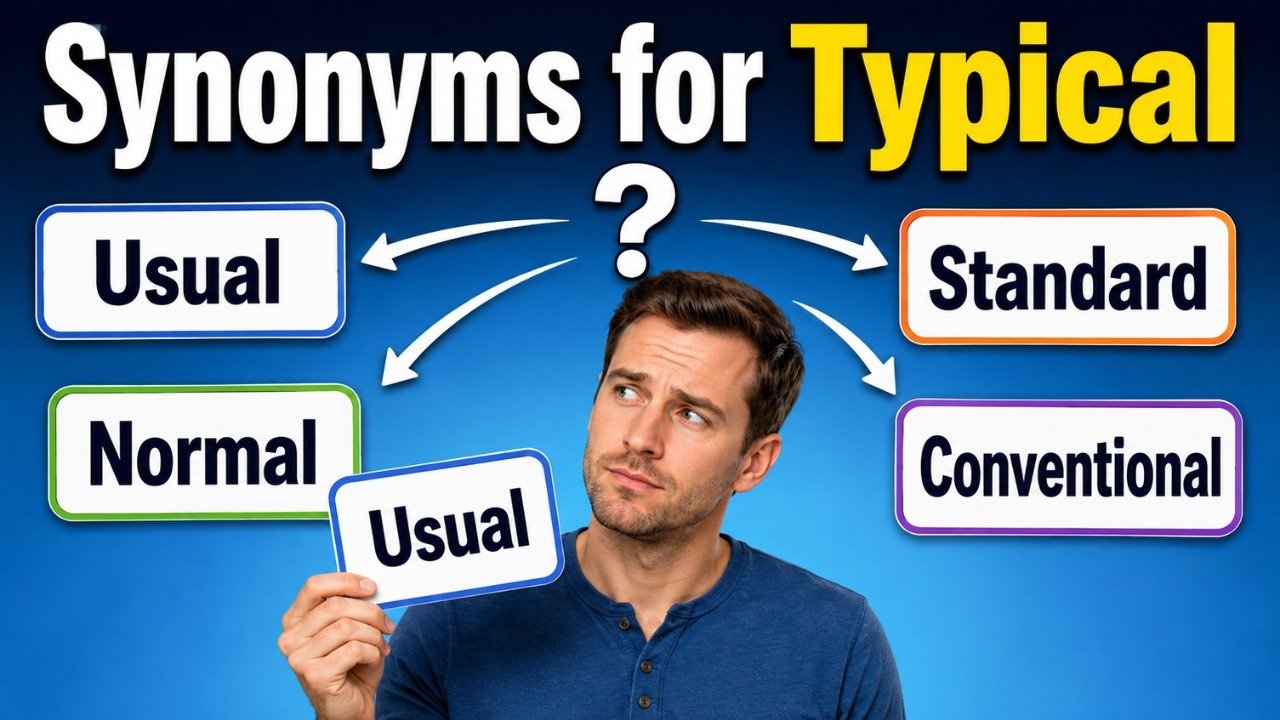
Quick Answer: The best synonyms for typical include usual, normal, common, standard, ordinary, characteristic, representative, conventional, expected, and routine. Use usual for something that happens regularly, normal for something that follows an accepted pattern, and common for something frequently seen. Representative and characteristic are better when describing qualities that clearly show a group, type, person, or place. Expected and predictable work when an action or result is not surprising.
Pronunciation and Word Details
Word: Typical.
Pronunciation: /ˈtɪpɪkəl/
Part of Speech: Adjective.
Meaning: Having the usual qualities, features, behavior, or appearance of a particular person, group, thing, or situation.
US Pronunciation:
UK Pronunciation:
What Does “Typical” Mean?
Typical means having the qualities, features, or behavior that people normally expect from a particular person, group, object, place, or situation.
The word typical is an adjective. It can describe something that is usual, common, representative, expected, or characteristic.
In the sentence “This is a typical winter morning,” typical means that the morning has conditions normally associated with winter.
In the sentence “Her response was typical of an experienced leader,” the word shows that her response displayed qualities commonly connected with experienced leadership.
Typical can also describe behavior that is predictable.
Example: It was typical of him to arrive early.
In this sentence, the behavior is familiar and expected because the person regularly arrives early.
Meaning, Tone, and Context of “Typical”
Typical usually has a neutral tone. It often describes something that follows a familiar pattern or represents the normal qualities of a group.
The word is common in everyday conversation, academic writing, reports, descriptions, comparisons, and explanations.
Neutral Use: Typical can simply mean usual or normal.
Example: A typical working day begins at eight in the morning.
Descriptive Use: It can identify the main qualities of a person, place, period, style, or object.
Example: The building has several typical features of traditional architecture.
Representative Use: Typical may describe an example that accurately represents a larger group.
Example: This painting is typical of the artist’s early work.
Predictable Use: It can refer to behavior or results that are expected.
Example: His calm reaction was typical of his personality.
Critical Use: Typical can sound slightly negative when it suggests that someone is behaving predictably in an annoying way.
Example: That is a typical excuse from someone who forgot the deadline.
The tone depends on context. In formal writing, typical is usually factual and objective. In casual conversation, it may express mild criticism, frustration, or humor.
When and How to Use “Typical”
For Something Usual
Use typical when describing an event, activity, or condition that happens regularly.
Example: A typical school day includes several lessons and a lunch break.
For a Representative Example
Use typical when something clearly represents the qualities of a larger group.
Example: This small village is typical of the region.
For Characteristic Features
Use typical to describe a feature strongly associated with a particular style, person, place, or period.
Example: Bright colors are typical of her creative work.
For Expected Behavior
Use typical when someone acts in a familiar or predictable way.
Example: It was typical of Maya to help everyone before thinking about herself.
For an Average Situation
Use typical when describing a general case rather than an unusual one.
Example: The typical customer spends twenty minutes in the store.
For Familiar Patterns
Use typical when a result follows a recognizable pattern.
Example: The symptoms followed a typical seasonal pattern.
For Mild Criticism
Use typical when pointing out predictable and possibly irritating behavior.
Example: That careless reply was typical of him.
Use this meaning carefully because the sentence may sound judgmental.
Best Synonyms for Typical
Usual
Synonym: Usual means happening or appearing in the normal way.
Example: She arrived at her usual time.
Normal
Synonym: Normal means following an accepted or expected pattern.
Example: The temperature is normal for this season.
Common
Synonym: Common means frequently found, seen, or experienced.
Example: This mistake is common among new learners.
Standard
Synonym: Standard means accepted as the usual type, level, or form.
Example: The package includes the standard equipment.
Ordinary
Synonym: Ordinary means normal and not unusual or special.
Example: It seemed like an ordinary afternoon.
Characteristic
Synonym: Characteristic means showing a quality strongly associated with someone or something.
Example: Her thoughtful response was characteristic of her personality.
Representative
Synonym: Representative means serving as a clear example of a larger group or type.
Example: The survey included a representative group of residents.
Conventional
Synonym: Conventional means following established customs, methods, or expectations.
Example: They chose a conventional design for the room.
Expected
Synonym: Expected means likely to happen because it follows a known pattern.
Example: The expected result appeared after several tests.
Routine
Synonym: Routine means regularly performed in the same familiar way.
Example: The doctor completed a routine examination.
50 Synonyms for Typical with Short Meanings
- Usual: Happening or appearing in the normal way.
- Normal: Following an accepted or expected pattern.
- Common: Frequently found, seen, or experienced.
- Ordinary: Not unusual, exceptional, or special.
- Standard: Accepted as the normal form or level.
- Conventional: Following established customs or methods.
- Customary: Commonly practiced according to habit or tradition.
- Regular: Occurring repeatedly or according to a pattern.
- Routine: Performed frequently as part of a familiar process.
- Familiar: Well known because it has been experienced before.
- Expected: Considered likely because of known circumstances.
- Predictable: Easy to anticipate because of a repeated pattern.
- Average: Representing an ordinary or middle level.
- Representative: Accurately showing the qualities of a larger group.
- Characteristic: Strongly associated with a person, thing, or type.
- Archetypal: Representing the most recognizable example of a type.
- Classic: Widely recognized as a standard example.
- Quintessential: Showing the most perfect qualities of a type.
- Textbook: Serving as a clear and exact example.
- Prototypical: Closely matching the original or most typical model.
- Emblematic: Clearly representing a quality, idea, or group.
- Illustrative: Providing a useful example of something.
- Indicative: Showing that a particular quality or condition exists.
- Symptomatic: Showing signs commonly connected with a condition.
- Commonplace: Frequently seen and therefore not unusual.
- Everyday: Connected with normal daily life.
- Prevailing: Most common or influential at a particular time.
- Prevalent: Existing commonly or widely in a group or area.
- Widespread: Existing or happening in many places.
- General: Applying to most people, things, or situations.
- Traditional: Following long established customs or practices.
- Established: Accepted and used for a long period.
- Habitual: Done regularly because of habit.
- Recurring: Happening repeatedly over time.
- Frequent: Occurring often.
- Generic: Lacking special features and representing a general type.
- Stereotypical: Following a simplified and widely expected image.
- Stock: Familiar and repeatedly used in the same form.
- Mainstream: Following ideas or practices accepted by most people.
- Normative: Connected with an accepted standard or pattern.
- Paradigmatic: Serving as a clear model or example.
- Model: Serving as an example that represents a type.
- Signature: Strongly associated with a particular person or style.
- Recognizable: Easy to identify because of familiar features.
- Standard Issue: Supplied or used as the regular version.
- Garden Variety: Ordinary and commonly found.
- Run of the Mill: Average and not especially unusual.
- Par for the Course: Normal or expected in a situation.
- True to Type: Behaving according to familiar characteristics.
- Unsurprising: Expected and not causing surprise.
Read Also:
Synonyms for Planning

Synonyms for Typical by Context
When Typical Means Usual
Use these alternatives when describing something that happens regularly or normally.
Usual: Best for regular habits, times, places, and activities.
Example: She followed her usual morning routine.
Normal: Best for accepted conditions or expected behavior.
Example: Some nervousness is normal before an interview.
Regular: Best for repeated events or established schedules.
Example: The team held its regular weekly meeting.
Routine: Best for familiar tasks and procedures.
Example: The technician performed a routine safety check.
Customary: Best for traditions, formal practices, and social behavior.
Example: It is customary to thank the host before leaving.
When Typical Means Representative
Use these synonyms when one person, object, or example reflects the qualities of a larger group.
Representative: Best for samples, surveys, examples, and populations.
Example: The selected group was representative of the wider community.
Characteristic: Best for recognizable qualities or features.
Example: Patience is characteristic of an effective teacher.
Archetypal: Best for a highly recognizable example of a type.
Example: The story presents an archetypal hero.
Prototypical: Best in technical, academic, or analytical writing.
Example: The design is a prototypical example of early modern architecture.
Quintessential: Best for the most complete or perfect example.
Example: The village offers a quintessential rural experience.
When Typical Means Common
Use these alternatives when something is frequently seen or widely experienced.
Common: Best for frequent events, objects, errors, and experiences.
Example: Headaches are a common result of dehydration.
Prevalent: Best for formal discussions about conditions or trends.
Example: The practice is prevalent throughout the region.
Widespread: Best when something exists in many places.
Example: Support for the proposal was widespread.
Commonplace: Best for something so frequent that it seems ordinary.
Example: Electronic payments have become commonplace.
Everyday: Best for normal daily experiences.
Example: The guide explains solutions to everyday problems.
When Typical Means Expected
Use these synonyms when an action, result, or reaction is easy to predict.
Expected: Best for likely results or planned developments.
Example: The expected response arrived the following morning.
Predictable: Best when a repeated pattern makes something easy to anticipate.
Example: The ending of the story was predictable.
Unsurprising: Best when a result causes little or no surprise.
Example: Her success was unsurprising after months of preparation.
True to Type: Best when a person behaves according to familiar qualities.
Example: True to type, he offered to solve the problem immediately.
Par for the Course: Best in casual language for an expected difficulty or result.
Example: Delays are par for the course during major repairs.
When Typical Means Ordinary
Use these alternatives when something is average rather than exceptional.
Ordinary: Best for normal people, days, objects, and experiences.
Example: An ordinary conversation changed her perspective.
Average: Best for measurements, performance, costs, or general levels.
Example: The average visitor stays for two hours.
Generic: Best for something without distinctive features.
Example: The first design looked too generic.
Run of the Mill: Best in casual speech for something unremarkable.
Example: It was a run of the mill mystery story.
Garden Variety: Best for an ordinary version of something.
Example: The problem was a garden variety technical error.
Another Word for Typical
The best general replacement for typical is usual. It works naturally when describing normal behavior, familiar routines, repeated events, or expected conditions.
However, the best alternative depends on the intended meaning. Use characteristic when describing a defining quality. Use representative when something stands for a wider group. Use normal when referring to an accepted condition, and use predictable when describing an expected result.
Original: This is a typical working day for her.
Better Option: This is a usual working day for her.
Original: His generosity was typical of his personality.
Better Option: His generosity was characteristic of his personality.
Original: The village is typical of the northern region.
Better Option: The village is representative of the northern region.
Original: That was a typical reaction to the announcement.
Better Option: That was an expected reaction to the announcement.
When Not to Use “Typical”
Avoid typical when a more precise word would explain the intended meaning more clearly.
When Discussing Numerical Data
Typical may be unclear in statistical or analytical writing because it does not identify whether you mean the mean, median, mode, or most common result.
Weak: The typical household has three members.
Better: The average household has three members.
When Describing a Defining Quality
Characteristic may be more precise when you mean a recognizable feature rather than an ordinary one.
Weak: Curved windows are typical of the style.
Better: Curved windows are characteristic of the style.
When Discussing a Sample
Representative is clearer when one group or example reflects a larger population.
Weak: The researchers selected a typical group of participants.
Better: The researchers selected a representative group of participants.
When Referring to Frequency
Common or frequent is more accurate when you mean something occurs often.
Weak: This is a typical spelling mistake.
Better: This is a common spelling mistake.
When the Tone Could Sound Critical
Typical may sound dismissive when describing a person’s behavior.
Weak: That was a typical response from you.
Better: That response was similar to what you have said before.
When the Meaning Is Too Vague
Typical may not explain whether something is usual, expected, average, representative, or characteristic.
Weak: The report showed typical results.
Better: The report showed the expected results.
Words Commonly Confused With Typical
Typical vs Usual: Typical describes something that represents the normal qualities of a type. Usual describes something that regularly happens or is normally used.
Example With Typical: This house is typical of the local architectural style.
Example With Usual: We met at our usual café.
Typical vs Normal: Typical means having expected or representative features. Normal means conforming to an accepted condition, level, or pattern.
Example With Typical: The animal displays typical behavior for its species.
Example With Normal: The animal’s temperature is normal.
Typical vs Average: Typical gives a general idea of what is ordinary or representative. Average often refers to a calculated or middle value.
Example With Typical: A typical visitor spends an hour at the exhibition.
Example With Average: The average visit lasts sixty minutes.
Typical vs Characteristic: Typical may mean usual or representative. Characteristic refers to a distinctive quality strongly associated with someone or something.
Example With Typical: Heavy rainfall is typical during this season.
Example With Characteristic: Careful detail is characteristic of her writing.
Typical vs Common: Typical describes something that fits an expected pattern. Common means something occurs frequently or exists in large numbers.
Example With Typical: This is a typical example of coastal architecture.
Example With Common: Stone buildings are common in the area.
Typical vs Stereotypical: Typical is usually based on real, observable patterns. Stereotypical often refers to an oversimplified assumption about a group.
Example With Typical: The meal contains ingredients typical of the region.
Example With Stereotypical: The character presents a stereotypical image of a strict teacher.
Which Synonym Should You Choose?
Choose usual when describing regular habits, activities, times, places, or routines.
Choose normal when something follows an accepted condition, level, or pattern.
Choose common when something happens frequently or appears in many places.
Choose standard when describing an accepted version, method, procedure, or level.
Choose ordinary when something is not unusual, special, or exceptional.
Choose characteristic when describing a recognizable quality of a person, style, place, or period.
Choose representative when one example accurately reflects a larger group.
Choose average when writing about measurements, costs, performance, numbers, or general levels.
Choose expected when describing a result, response, or development that is likely.
Choose predictable when a repeated pattern makes the outcome easy to anticipate.
Choose routine when describing repeated tasks, checks, appointments, or procedures.
Choose conventional when discussing accepted methods, ideas, designs, or social practices.
Choose quintessential when describing the most complete or perfect example of a type.
Choose archetypal in literary, cultural, historical, or analytical writing.
Choose prevalent in formal reports about widely existing conditions, trends, or practices.
Real Life Examples of “Typical” in Sentences
Original: A typical morning begins with a short walk.
Better Option: A usual morning begins with a short walk.
Original: This weather is typical for early spring.
Better Option: This weather is normal for early spring.
Original: The error is typical among inexperienced writers.
Better Option: The error is common among inexperienced writers.
Original: Her patience is typical of a skilled instructor.
Better Option: Her patience is characteristic of a skilled instructor.
Original: The house is typical of those built in the area.
Better Option: The house is representative of those built in the area.
Original: The company followed a typical approval process.
Better Option: The company followed a standard approval process.
Original: His reaction was typical and easy to anticipate.
Better Option: His reaction was predictable and easy to anticipate.
Original: The doctor completed a typical examination.
Better Option: The doctor completed a routine examination.
Original: It was a typical day without any major surprises.
Better Option: It was an ordinary day without any major surprises.
Original: The story contains a typical heroic character.
Better Option: The story contains an archetypal heroic character.
Synonym Groups and Usage Differences
Usualness Group
This group includes usual, normal, regular, routine, and customary. These words describe things that happen according to a familiar or accepted pattern.
Usual focuses on what normally happens. Regular emphasizes repetition. Routine describes familiar tasks or procedures. Customary relates to tradition or established practice.
Example: The office followed its usual closing procedure.
Frequency Group
This group includes common, frequent, prevalent, widespread, and commonplace. These words describe how often or widely something appears.
Common is the most flexible word. Frequent emphasizes repeated occurrence. Prevalent is more formal and describes something widely present. Widespread emphasizes a large geographical or social range.
Example: This pronunciation error is common among beginners.
Representative Group
This group includes representative, characteristic, illustrative, emblematic, and indicative. These alternatives show that something reflects the qualities of a larger group or idea.
Representative focuses on accurate reflection. Characteristic describes a defining feature. Emblematic suggests symbolic representation. Illustrative introduces a useful example.
Example: The building is representative of the region’s traditional design.
Ideal Example Group
This group includes archetypal, quintessential, prototypical, textbook, classic, and paradigmatic. These words describe especially clear examples of a type.
Archetypal is useful for familiar cultural or literary patterns. Quintessential describes the most perfect example. Textbook refers to an especially clear example. Prototypical is common in technical and academic explanations.
Example: The case is a textbook example of poor planning.
Ordinary Group
This group includes ordinary, average, generic, everyday, garden variety, and run of the mill. These words describe things that are not unusual or exceptional.
Ordinary is neutral. Average may refer to a middle level or calculated value. Generic can suggest a lack of originality. Run of the mill is informal and may sound slightly negative.
Example: The restaurant appeared ordinary from the outside.
Expectation Group
This group includes expected, predictable, unsurprising, true to type, and par for the course. These alternatives describe actions or results that follow a familiar pattern.
Expected is neutral. Predictable may suggest a lack of originality. Unsurprising focuses on the absence of surprise. True to type describes familiar personal behavior.
Example: The final result was expected after the earlier tests.
Antonyms of Typical
The opposite of typical depends on whether the word means usual, common, representative, or expected.
Atypical: Not having the usual qualities of a type.
Unusual: Different from what normally happens or appears.
Uncommon: Not frequently found or experienced.
Exceptional: Unusually good, rare, or remarkable.
Extraordinary: Far beyond what is normal or ordinary.
Rare: Not commonly found, seen, or experienced.
Irregular: Not following a regular pattern or schedule.
Abnormal: Different from an accepted or expected condition.
Unique: Unlike anything else.
Distinctive: Having qualities that make something clearly different.
Unexpected: Not anticipated or predicted.
Unpredictable: Difficult or impossible to anticipate.
Unrepresentative: Not accurately reflecting a larger group.
Remarkable: Worth noticing because it is unusual or impressive.
Unconventional: Not following accepted customs or methods.
Comparison: Typical vs Related Words
Typical vs Usual
Typical describes qualities expected from a type or group. Usual describes what regularly happens in a particular situation.
Example With Typical: This roof shape is typical of houses in the region.
Example With Usual: He took his usual route home.
Typical vs Normal
Typical focuses on expected or representative qualities. Normal focuses on an accepted state, level, or condition.
Example With Typical: This behavior is typical of young puppies.
Example With Normal: This behavior is normal for young puppies.
The first sentence identifies a familiar characteristic. The second says the behavior is acceptable and expected.
Typical vs Common
Typical means fitting an expected pattern. Common means frequently occurring or widely existing.
Example With Typical: This dish is typical of local cooking.
Example With Common: Rice is a common ingredient in local cooking.
Typical vs Average
Typical describes what is generally representative. Average often refers to a middle or calculated value.
Example With Typical: A typical reader can finish the book in one week.
Example With Average: The average reader finishes the book in seven days.
Typical vs Characteristic
Typical may describe something usual or representative. Characteristic identifies a distinctive quality strongly connected with someone or something.
Example With Typical: Warm summers are typical of the region.
Example With Characteristic: Long dry summers are characteristic of the region.
Typical vs Representative
Typical gives a general impression of what is normal. Representative emphasizes that a sample accurately reflects a larger group.
Example With Typical: The interview describes a typical customer.
Example With Representative: The study included a representative sample of customers.
Typical vs Predictable
Typical means familiar or expected. Predictable emphasizes that an outcome can be anticipated.
Example With Typical: His response was typical of his polite manner.
Example With Predictable: His response was predictable after the earlier discussion.
Typical vs Stereotypical
Typical is based on commonly observed features. Stereotypical is based on a simplified belief that may not accurately describe every member of a group.
Example With Typical: The clothing is typical of the historical period.
Example With Stereotypical: The costume presents a stereotypical image of a scientist.
Common Phrases and Expressions With “Typical”
Typical Example: An example that clearly represents a type or group.
Example: This house is a typical example of rural architecture.
Typical Day: A day that follows a person’s normal routine.
Example: A typical day includes meetings, research, and writing.
Typical Behavior: Actions normally associated with a person or group.
Example: Curiosity is typical behavior for young children.
Typical Response: A familiar or expected reaction.
Example: Silence was not her typical response to criticism.
Typical Pattern: A sequence or arrangement that commonly appears.
Example: The results followed a typical seasonal pattern.
Typical Case: A situation that represents the usual form of a problem.
Example: This is a typical case of poor communication.
Typical Feature: A quality commonly associated with something.
Example: Large windows are a typical feature of the style.
Typical Of: Having qualities strongly associated with someone or something.
Example: Her generous offer was typical of her.
Typical For: Normal or expected in a particular situation, place, or period.
Example: Cold nights are typical for this time of year.
Typical Result: An outcome that normally occurs under similar conditions.
Example: Increased confidence is a typical result of regular practice.
Common Mistakes to Avoid
Using Typical When You Mean Average
Typical does not always refer to a calculated average.
Incorrect: The typical score was calculated by adding every result.
Correct: The average score was calculated by adding every result.
Using Typical When You Mean Common
Typical describes a recognizable pattern, while common focuses on frequency.
Less Precise: This is a typical error in formal writing.
Better: This is a common error in formal writing.
Using Typical for Every Kind of Comparison
Repeated use can make writing sound vague.
Repetitive: The typical room had typical furniture and typical decorations.
Better: The standard room had ordinary furniture and decorations characteristic of the period.
Confusing Typical With Stereotypical
Typical may describe real, observable qualities. Stereotypical often refers to an oversimplified assumption.
Incorrect: Every person from the region has a typical personality.
Better: The character displays a stereotypical personality that does not represent everyone from the region.
Using Typical in a Judgmental Way
Typical can sound critical when directed at someone.
Harsh: That is typical of you.
Better: That reaction is similar to how you have responded before.
Forgetting the Correct Preposition
Use typical of when connecting a quality or action with a person, group, style, or place.
Correct: The bright patterns are typical of the designer’s work.
Use typical for when referring to a time, condition, situation, or category.
Correct: Heavy rainfall is typical for this season.
Using Typical Without Explaining the Standard
Readers may not know what group or pattern you are comparing.
Vague: The building has a typical shape.
Better: The building has a shape typical of traditional coastal homes.
Conclusion
The most useful synonyms for typical include usual, normal, common, standard, characteristic, representative, expected, routine, and ordinary. Choose usual for familiar habits, normal for accepted conditions, representative for examples of larger groups, and characteristic for defining qualities. Average is better for numerical information, while predictable describes an expected result. Understanding these synonyms for typical helps you express frequency, normality, similarity, and representation with greater clarity and accuracy.
FAQs About Synonyms for Typical
What Is the Best Synonym for Typical?
The best general synonym is usual. However, normal, common, standard, representative, or characteristic may be more accurate depending on the sentence.
Is Normal a Synonym for Typical?
Yes. Normal is a synonym when typical means following an accepted or expected pattern. Typical may also mean representative, while normal does not always carry that meaning.
What Is a Formal Synonym for Typical?
Representative, characteristic, conventional, prevalent, prototypical, and paradigmatic are useful formal alternatives. The correct choice depends on whether you are discussing examples, features, customs, or patterns.
What Is Another Word for a Typical Example?
A representative example, classic example, textbook example, archetypal example, or quintessential example can replace a typical example.
What Is the Difference Between Typical and Average?
Typical describes what is generally usual or representative. Average often refers to a calculated middle value or an ordinary level.
Can Typical Have a Negative Meaning?
Yes. Typical may sound critical when it describes predictable and annoying behavior, as in “That excuse is typical of him.” A more neutral alternative may be better in polite communication.
What Is the Opposite of Typical?
Common opposites include atypical, unusual, uncommon, exceptional, irregular, unexpected, distinctive, and unrepresentative.
