
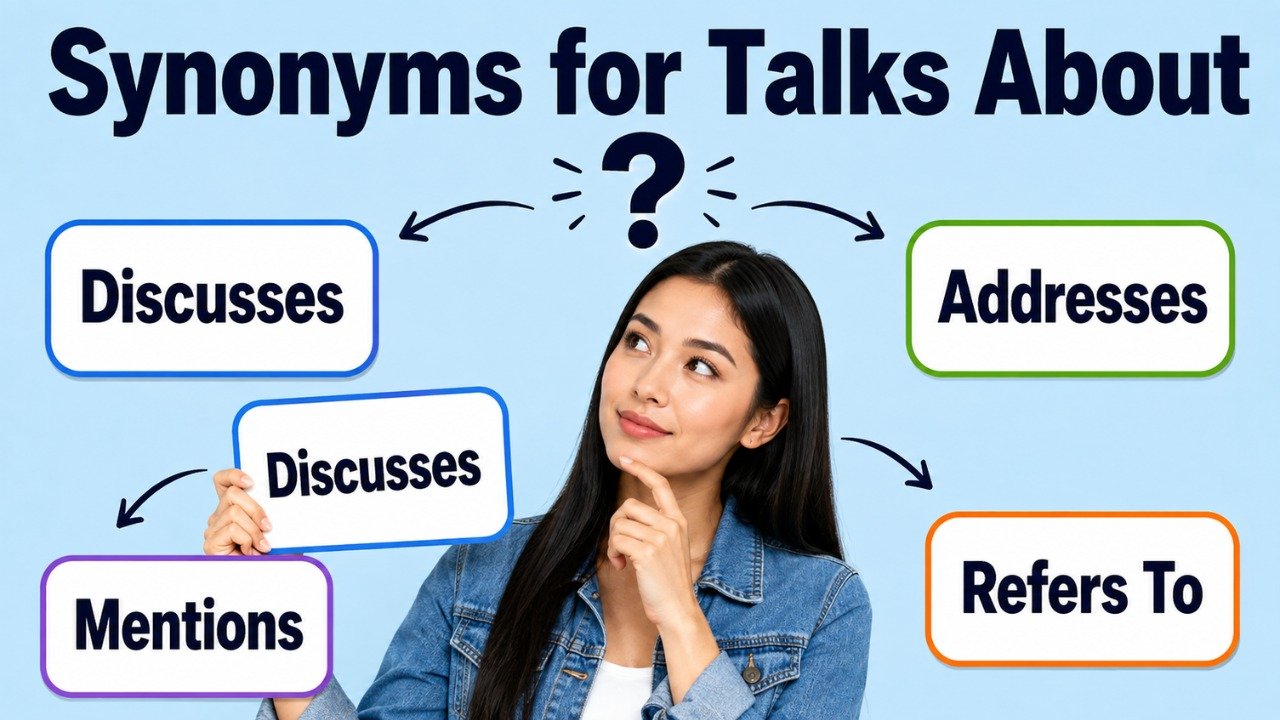
Quick Answer: The best synonyms for talks about include discusses, mentions, describes, addresses, explains, covers, examines, explores, refers to, and speaks about. Use discusses for detailed conversation or writing, mentions for a brief reference, describes for giving details, addresses for dealing directly with a subject, and explains when making something easier to understand. Examines and explores work especially well in essays, reports, and academic writing, while speaks about is natural in conversation.
Pronunciation and Word Details
Word: Talks About
Pronunciation: /tɔːks əˈbaʊt/
Part of Speech: Phrasal verb
Meaning: Refers to speaking, writing, or communicating information about a person, subject, event, or idea.
US Pronunciation:
UK Pronunciation:
What Does “Talks About” Mean?
Talks about means discusses, mentions, or communicates information concerning a particular subject.
It is a phrasal verb commonly used when someone speaks about a topic, although it can also describe what a book, article, speech, report, lesson, or other piece of communication discusses.
Conversation: She talks about her work during the meeting.
Writing: The article talks about the importance of clear communication.
Explanation: The teacher talks about how the process works.
Reference: The report talks about several challenges faced by the organization.
Although talks about is natural and easy to understand, more specific alternatives can make writing clearer. For example, discusses suggests fuller treatment of a topic, mentions suggests a brief reference, and examines suggests careful analysis.
Meaning, Tone, and Context of “Talks About”
Talks about has a neutral and conversational tone. It is common in everyday speech and informal writing because it sounds simple and natural.
In formal essays, reports, academic writing, and professional communication, a more precise verb is often better.
Casual Tone: Talks about sounds natural in ordinary conversation.
Neutral Tone: It can be used without expressing strong emotion or judgment.
Academic Context: Discusses, examines, analyzes, or explores may sound more appropriate.
Professional Context: Addresses, covers, outlines, or explains can provide greater precision.
Brief Reference: Mentions is usually better when a subject receives only a small amount of attention.
Detailed Treatment: Discusses or examines works better when a topic receives considerable attention.
The right synonym depends on what the speaker, writer, article, report, or other source actually does with the topic.
When and How to Use “Talks About”
For General Discussion
Use talks about when someone communicates generally about a topic without needing to specify how deeply it is discussed.
Example: The speaker talks about the importance of good communication.
For Detailed Discussion
Use discusses when the subject receives thoughtful or extended attention.
Example: The chapter discusses several causes of social change.
For a Brief Reference
Use mentions when someone refers to something only briefly.
Example: The report mentions a possible change in policy.
For Explanation
Use explains when someone makes a topic, process, or idea easier to understand.
Example: The guide explains how the system works.
For Description
Use describes when someone provides details about a person, object, event, or situation.
Example: The author describes the landscape in vivid detail.
For Formal Analysis
Use examines or analyzes when a subject is studied carefully.
Example: The essay examines the relationship between language and identity.
For Exploring Ideas
Use explores when a writer considers different aspects, possibilities, or meanings.
Example: The book explores the effects of memory on personal identity.
For Addressing an Issue
Use addresses when someone deals directly with an issue, question, or concern.
Example: The report addresses several important safety concerns.
Best Synonyms for Talks About
Discusses
Synonym: Discusses means gives attention to a subject through speaking or writing.
Example: The article discusses several ways to improve vocabulary.
Mentions
Synonym: Mentions means refers to something briefly without giving much detail.
Example: The speaker mentions the problem near the end of the presentation.
Describes
Synonym: Describes means gives information about the qualities, appearance, characteristics, or events connected with something.
Example: The writer describes how the town changed over time.
Addresses
Synonym: Addresses means deals directly with a particular subject, problem, or question.
Example: The report addresses concerns about rising costs.
Explains
Synonym: Explains means makes a subject or idea clearer by providing information or reasons.
Example: The teacher explains why the rule is important.
Covers
Synonym: Covers means includes or deals with a topic as part of a broader discussion.
Example: The course covers several important areas of grammar.
Examines
Synonym: Examines means studies or considers a subject carefully.
Example: The paper examines the causes of the change.
Explores
Synonym: Explores means considers a topic in depth from different perspectives.
Example: The novel explores themes of courage and responsibility.
Refers To
Synonym: Refers to means mentions or directs attention toward a person, thing, idea, or subject.
Example: The paragraph refers to an earlier argument.
Speaks About
Synonym: Speaks about means communicates orally concerning a particular subject.
Example: She speaks about her experiences with confidence.
50 Synonyms for Talks About With Short Meanings
- Discusses: Gives detailed attention to a subject.
- Mentions: Refers to something briefly.
- Describes: Gives details about something.
- Addresses: Deals directly with a topic or issue.
- Explains: Makes something easier to understand.
- Covers: Includes or deals with a subject.
- Examines: Considers something carefully.
- Explores: Investigates different aspects of a topic.
- Refers To: Directs attention to something.
- Speaks About: Talks orally about a subject.
- Discusses In Detail: Gives extensive information about a topic.
- Comments On: Gives an opinion or observation about something.
- Writes About: Communicates information about a topic in writing.
- Tells About: Gives information or a story concerning something.
- Deals With: Focuses on or handles a particular subject.
- Focuses On: Gives special attention to a topic.
- Touches On: Mentions a subject briefly.
- Elaborates On: Provides additional detail or explanation.
- Expands On: Adds more information about a subject.
- Outlines: Presents the main points of a topic.
- Summarizes: Gives the main ideas briefly.
- Reviews: Considers or discusses something systematically.
- Analyzes: Studies something carefully by examining its parts.
- Considers: Thinks about or discusses a subject thoughtfully.
- Investigates: Examines a subject to discover more information.
- Presents: Introduces or communicates information about something.
- Highlights: Draws special attention to an important point.
- Emphasizes: Gives particular importance to something.
- Notes: Briefly points out or mentions something.
- Observes: Makes a comment based on consideration or evidence.
- States: Expresses information clearly or directly.
- Reports On: Provides information about an event or subject.
- Comments Upon: Offers remarks or observations about something.
- Reflects On: Thinks or speaks thoughtfully about a subject.
- Considers In Depth: Gives detailed thought or attention to something.
- Delves Into: Examines a topic deeply.
- Looks At: Considers or examines a subject.
- Goes Into: Discusses something with additional detail.
- Brings Up: Introduces a topic into conversation.
- Raises: Introduces a subject, question, or issue for consideration.
- Introduces: Brings a subject into discussion.
- Relates: Tells or communicates information about events or experiences.
- Recounts: Tells the details of an event or experience.
- Narrates: Tells a story or sequence of events.
- Expresses: Communicates an idea, opinion, or feeling.
- Shares: Communicates information, thoughts, or experiences.
- Details: Provides specific information about something.
- Clarifies: Makes a subject easier to understand.
- Interprets: Explains the meaning or significance of something.
- Evaluates: Discusses something while judging its quality or importance.
Read Also:
Synonyms for Asset

Synonyms for Talks About by Context
When Talks About Means Discusses
Use these alternatives when a person, article, book, speech, or report gives meaningful attention to a topic.
Discusses: The report discusses the effects of the new approach.
Deals With: The chapter deals with several communication problems.
Covers: The lesson covers the basic principles of sentence structure.
Considers: The essay considers several possible explanations.
Looks At: The article looks at changing patterns in language use.
Discusses is usually the strongest general replacement because it works naturally in both formal and neutral writing.
When Talks About Means Mentions Briefly
These alternatives are better when the topic is referenced without detailed explanation.
Mentions: The introduction mentions the problem briefly.
Notes: The writer notes that conditions have improved.
Touches On: The article touches on the issue near the end.
Refers To: The report refers to several earlier findings.
Brings Up: She brings up the subject during the conversation.
Mentions and notes are useful in formal writing, while brings up is more conversational.
When Talks About Means Explains
Use these alternatives when the purpose is to make information understandable.
Explains: The guide explains how the process works.
Clarifies: The next section clarifies the meaning of the term.
Elaborates On: The author elaborates on the reasons for the decision.
Expands On: The second chapter expands on the central argument.
Details: The document details the steps required for completion.
Explains is best for general clarity, while elaborates on and expands on suggest additional depth.
When Talks About Means Examines
These choices work especially well in academic, analytical, and research based writing.
Examines: The study examines changes in consumer behavior.
Analyzes: The essay analyzes the structure of the argument.
Investigates: The report investigates possible causes of the problem.
Explores: The book explores the relationship between creativity and memory.
Evaluates: The article evaluates the strengths of several approaches.
Choose examines for careful consideration, analyzes for detailed breakdown, and evaluates when judgment is involved.
When Talks About Means Describes
Use these words when someone provides information about characteristics, events, experiences, or situations.
Describes: The author describes the village in great detail.
Recounts: She recounts what happened during the journey.
Narrates: The narrator narrates the events from a personal perspective.
Relates: He relates his experiences to the audience.
Tells About: She tells about her first experience working abroad.
Describes works well for details, while recounts and narrates are stronger for events and stories.
Another Word for Talks About
The best single replacement for talks about is often discusses. It is concise, natural, and suitable for essays, reports, articles, professional writing, and everyday communication.
However, the best alternative depends on what is actually happening. Use mentions for a brief reference, explains for clarification, describes for details, and examines for analysis.
Original: The article talks about the importance of vocabulary.
Better Option: The article discusses the importance of vocabulary.
Original: The report talks about the problem once.
Better Option: The report mentions the problem once.
Original: The guide talks about how the process works.
Better Option: The guide explains how the process works.
Original: The essay talks about the causes of the conflict.
Better Option: The essay examines the causes of the conflict.
When Not to Use “Talks About”
Talks about is perfectly natural in conversation, but it can sound vague or repetitive in formal writing.
Avoid relying on it when a more precise verb can tell readers exactly how a subject is treated.
In Formal Essays
Talks about may sound too conversational in an analytical sentence.
Weak: The essay talks about the causes of economic change.
Better: The essay examines the causes of economic change.
For Brief References
Talks about may suggest more discussion than actually occurs.
Weak: The introduction talks about the issue in one sentence.
Better: The introduction mentions the issue in one sentence.
For Detailed Explanations
Use explains when the writer makes something understandable.
Weak: The guide talks about how the machine works.
Better: The guide explains how the machine works.
For Descriptions
Choose describes when the focus is on characteristics or details.
Weak: The passage talks about the appearance of the building.
Better: The passage describes the appearance of the building.
When Repeated Too Often
Repeated use of talks about can make writing sound basic.
Weak: The first chapter talks about history. The second chapter talks about culture. The third chapter talks about language.
Better: The first chapter discusses history. The second explores culture. The third examines language.
Words Commonly Confused With Talks About
Talks About vs Discusses: Talks about is broad and conversational. Discusses usually suggests more deliberate or detailed treatment of a subject.
Talks About vs Mentions: Talks about can involve extended communication, while mentions usually means referring to something briefly.
Talks About vs Describes: Talks about simply indicates the subject of communication. Describes means providing details about what something is like.
Talks About vs Explains: Talks about does not necessarily make something clearer. Explains specifically means providing information that improves understanding.
Talks About vs Examines: Talks about is general, while examines suggests careful and often formal consideration.
Talks About vs Explores: Talks about simply identifies a topic. Explores suggests considering different aspects, ideas, possibilities, or interpretations.
Talks About vs Addresses: Talks about may simply discuss something. Addresses often implies dealing directly with an important question, problem, or concern.
Talks About vs Refers To: Talks about can involve substantial information. Refers to may involve only pointing toward or mentioning something.
Which Synonym Should You Choose?
Choose discusses when a topic receives meaningful or detailed attention.
Choose mentions when something is referred to only briefly.
Choose describes when the sentence provides characteristics, qualities, appearance, or details.
Choose explains when the purpose is to improve understanding.
Choose addresses when dealing directly with an issue, problem, concern, or question.
Choose examines when writing formal essays, reports, or analytical content.
Choose analyzes when breaking a complex subject into parts for careful study.
Choose explores when considering several aspects, meanings, ideas, or possibilities.
Choose covers when describing the range of subjects included in a lesson, book, report, or course.
Choose speaks about when referring specifically to spoken communication.
Choose brings up in casual conversation when someone introduces a topic.
Choose highlights when the writer gives special attention to an important detail.
Real Life Examples of “Talks About” in Sentences
Original: The teacher talks about effective communication in class.
Better Option: The teacher discusses effective communication in class.
Original: The article talks about one possible solution near the end.
Better Option: The article mentions one possible solution near the end.
Original: The guide talks about how the new feature works.
Better Option: The guide explains how the new feature works.
Original: The essay talks about the effects of climate on agriculture.
Better Option: The essay examines the effects of climate on agriculture.
Original: The book talks about several aspects of human creativity.
Better Option: The book explores several aspects of human creativity.
Original: The report talks about problems affecting the project.
Better Option: The report addresses problems affecting the project.
Original: The chapter talks about the appearance of the ancient building.
Better Option: The chapter describes the appearance of the ancient building.
Original: She talks about her childhood experiences in the interview.
Better Option: She recounts her childhood experiences in the interview.
Original: The course talks about grammar, vocabulary, and pronunciation.
Better Option: The course covers grammar, vocabulary, and pronunciation.
Original: The conclusion talks about the most important result.
Better Option: The conclusion highlights the most important result.
Synonym Groups and Usage Differences
Discussion Group
Discusses, covers, deals with, considers, and looks at belong to the general discussion group.
They indicate that a topic receives attention without necessarily suggesting deep analysis.
Example: The chapter discusses several approaches to learning.
Brief Reference Group
Mentions, notes, refers to, and touches on indicate limited attention.
These words are useful when something appears briefly in an article, speech, report, or conversation.
Example: The introduction briefly mentions the earlier study.
Explanation Group
Explains, clarifies, elaborates on, expands on, and details suggest that additional information is being provided.
Example: The guide explains each stage of the process.
Analysis Group
Examines, analyzes, investigates, evaluates, and explores are stronger choices for analytical writing.
They suggest careful thought, research, interpretation, or judgment.
Example: The report analyzes the reasons for the decline.
Description Group
Describes, recounts, narrates, relates, and tells about are useful when communicating details, experiences, or events.
Example: The author describes the setting with remarkable detail.
Emphasis Group
Highlights, emphasizes, notes, and draws attention to are useful when one point is especially important.
Example: The report highlights the need for clearer instructions.
Conversation Group
Speaks about, brings up, shares, and comments on are particularly natural when referring to spoken communication.
Example: She speaks about her experiences with confidence.
Antonyms of Talks About
The opposite of talks about depends on whether the meaning involves discussion, mention, explanation, or attention.
Ignores: Gives no attention to a subject.
Avoids: Deliberately stays away from a topic.
Omits: Leaves information out.
Excludes: Does not include a subject or detail.
Conceals: Keeps information from being known.
Suppresses: Prevents information from being expressed or discussed.
Overlooks: Fails to notice or consider something.
Dismisses: Treats a topic as unimportant or unworthy of consideration.
Skips: Passes over a subject without discussing it.
Withholds: Keeps information from being shared.
Comparison: Talks About vs Related Words
Talks About vs Discusses
Talks about is broad and conversational. Discusses is more precise and often sounds stronger in formal writing.
Example With Talks About: The article talks about healthy communication.
Example With Discusses: The article discusses healthy communication strategies.
Talks About vs Mentions
Talks about can suggest general or extended communication. Mentions means referring to something briefly.
Example With Talks About: The speaker talks about the problem throughout the presentation.
Example With Mentions: The speaker mentions the problem once.
Talks About vs Explains
Talks about means communicates concerning a topic. Explains means makes that topic easier to understand.
Example With Talks About: The teacher talks about the grammar rule.
Example With Explains: The teacher explains the grammar rule clearly.
Talks About vs Describes
Talks about identifies the topic of communication. Describes focuses on details or characteristics.
Example With Talks About: The passage talks about the old house.
Example With Describes: The passage describes the old house as dark and narrow.
Talks About vs Examines
Talks about is general, while examines suggests careful consideration.
Example With Talks About: The essay talks about changing family structures.
Example With Examines: The essay examines changing family structures.
Talks About vs Explores
Talks about can simply introduce or discuss a topic. Explores suggests deeper consideration of its different dimensions.
Example With Talks About: The novel talks about friendship and loss.
Example With Explores: The novel explores friendship and loss.
Talks About vs Addresses
Talks about can be descriptive or general. Addresses often suggests responding directly to an issue or concern.
Example With Talks About: The report talks about workplace stress.
Example With Addresses: The report addresses workplace stress and possible solutions.
Common Phrases and Expressions With “Talks About”
Talks About the Importance Of: Discusses why something matters.
Talks About the Need For: Discusses why something is necessary.
Talks About His Experience: Shares information about something he has personally experienced.
Talks About Her Experience: Shares information about something she has personally experienced.
Talks About the Problem: Discusses a difficulty or concern.
Talks About the Future: Discusses possibilities, expectations, or plans.
Talks About the Past: Discusses earlier events or experiences.
Talks About the Issue: Gives attention to a particular subject or concern.
Talks About the Benefits: Discusses the positive effects or advantages of something.
Talks About the Differences: Explains or discusses how two or more things differ.
Common Mistakes to Avoid
Using Talks About Too Often
Repeating talks about several times can make formal writing sound monotonous.
Instead, select a verb that reflects what the writer actually does.
Example: Use discusses for general treatment, examines for analysis, and mentions for brief references.
Replacing It With Mentions Incorrectly
Mentions is not always interchangeable with talks about.
If an entire chapter is devoted to a subject, saying it mentions the subject can underestimate the amount of attention given.
Incorrect: The chapter mentions language development for twenty pages.
Better: The chapter discusses language development in detail.
Using Discusses for Every Context
Discusses is versatile, but it does not always express the intended meaning.
If the writer makes a complex idea understandable, explains may be more precise.
Less Precise: The guide discusses how to reset the system.
Better: The guide explains how to reset the system.
Confusing Describes and Explains
Describes tells readers what something is like. Explains tells readers how or why something happens.
Description: The article describes the appearance of the device.
Explanation: The article explains how the device operates.
Choosing an Overly Formal Synonym
Words such as analyzes, evaluates, and investigates can sound unnatural when the context is simple conversation.
Unnatural: My friend analyzes his vacation during lunch.
Natural: My friend talks about his vacation during lunch.
Using Vague Verbs in Academic Writing
In essays and reports, select verbs that indicate the writer’s purpose.
Use examines for careful study, evaluates for judgment, argues for a position, explains for clarification, and describes for details.
Precise reporting verbs make sentences clearer and more informative.
Conclusion
Synonyms for talks about can make sentences clearer by showing exactly how a topic is presented. Discusses is the strongest general alternative, while mentions fits brief references, explains fits clarification, describes fits detailed information, and examines or analyzes works well in formal writing. Use explores for deeper consideration, addresses for problems or concerns, and covers for subjects included within broader material. Choosing the synonym that matches the intended meaning produces more precise, natural, and engaging writing.
FAQs About Synonyms for Talks About
What Is the Best Synonym for Talks About?
The best general synonym is discusses. It works naturally when someone gives meaningful attention to a subject in speech or writing.
What Is a Formal Synonym for Talks About?
Discusses, examines, addresses, analyzes, and explores are useful formal alternatives. The best choice depends on how the topic is treated.
What Can I Use Instead of Talks About in an Essay?
Use discusses for general treatment, examines for careful study, analyzes for detailed analysis, explores for different perspectives, and addresses for a specific issue.
Is Mentions a Synonym for Talks About?
Yes, but mentions normally suggests a brief reference. Talks about can describe a much longer discussion.
Is Discusses Better Than Talks About?
Discusses is often better in essays, reports, and formal writing because it is concise and precise. Talks about remains natural in casual communication.
What Is Another Word for Talks About in Academic Writing?
Examines, discusses, analyzes, explores, considers, and addresses are strong choices for academic writing.
What Synonym Should I Use When a Book Talks About a Topic?
Use discusses if the book gives the topic general attention, explores if it examines several dimensions, covers if the subject is part of its content, or examines if the treatment is analytical.
