
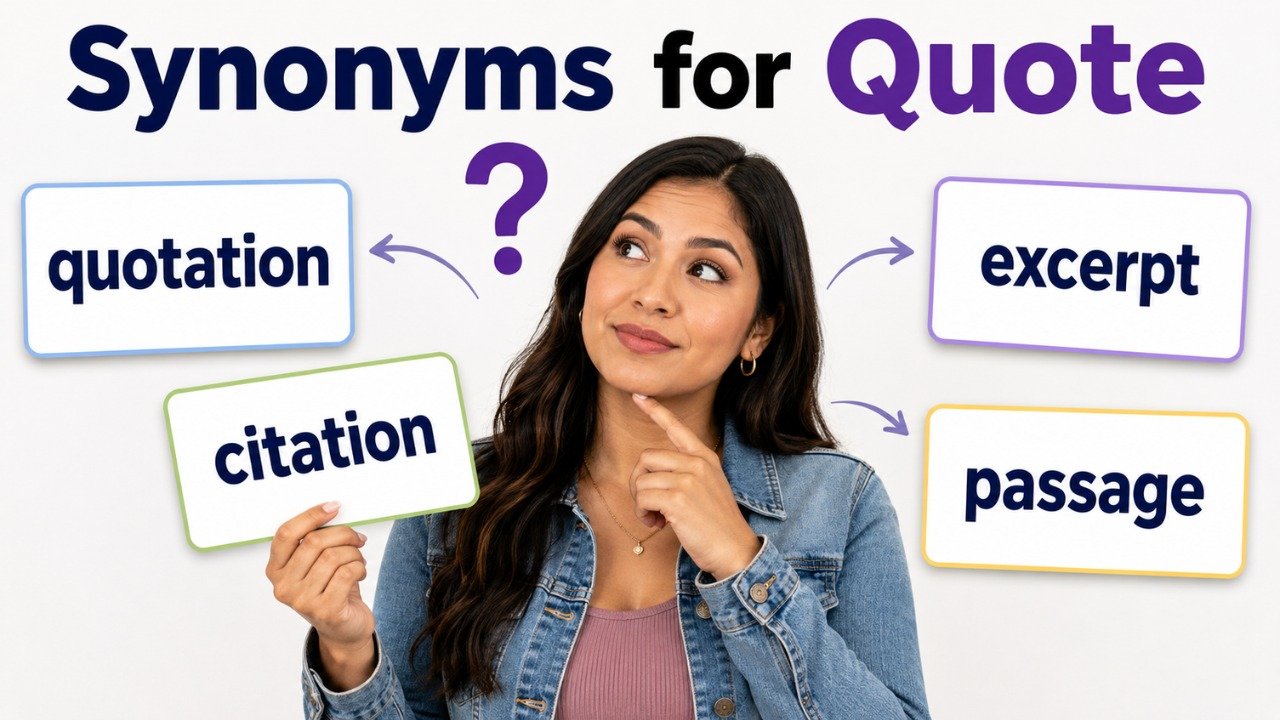
Quick Answer: The best synonyms for quote include quotation, citation, excerpt, passage, saying, line, reference, estimate, bid, and offer. Use quotation when repeating someone’s exact words, citation when identifying or referring to a source, excerpt for a selected part of a longer text, passage for a section of writing, and saying for a memorable expression. When quote refers to a price, use estimate, bid, offer, rate, or price estimate depending on the business context.
Pronunciation and Word Details
Word: Quote
Pronunciation: /kwoʊt/
Part of Speech: Noun and verb
Meaning: Words repeated from another person or text, the act of repeating those words, or a stated estimate of a price or cost.
US Pronunciation:
UK Pronunciation:
What Does “Quote” Mean?
Quote means a group of words repeated from another speaker, writer, book, speech, or piece of communication. As a noun, it commonly refers to the repeated words themselves. As a verb, it means to repeat or reproduce someone’s exact words.
The word also has an important business meaning. A quote can be an estimated price given for a product, project, repair, or service.
Repeated Words: She included a quote from the interview in her essay.
Direct Speech: He quoted the speaker accurately.
Written Source: The article quotes a short passage from the original text.
Price Estimate: The contractor provided a quote for the repair.
Formal Reference: The report quotes several experts when explaining the issue.
Because quote has several meanings, the best synonym depends on whether you are discussing words, sources, passages, speech, or prices.
Meaning, Tone, and Context of “Quote”
Quote is a neutral and widely used word. It appears naturally in conversation, essays, reports, journalism, academic writing, business communication, literature, speeches, and pricing discussions.
When referring to someone’s words, quote usually suggests that the wording is repeated exactly or very closely.
Example: The student used a quote from the speech.
In formal or academic writing, quotation is often used for the words themselves, while cite or citation relates more directly to acknowledging or identifying the source.
When only part of a longer work is reproduced, excerpt, extract, or passage may be more precise.
Quote is also common in business and service contexts.
Example: We requested a quote for the renovation.
In this sense, estimate, bid, proposal, price, or offer may be better depending on whether the amount is approximate, competitive, or formally proposed.
The tone of quote therefore changes little, but its meaning changes significantly according to context.
When and How to Use “Quote”
For Exact Words
Use quote when repeating the exact words spoken or written by another person.
Example: She included a quote from the author in her essay.
For a Formal Quotation
Use quotation when referring specifically to a set of words reproduced from another source.
Example: The quotation supports the main argument of the paragraph.
For Source Acknowledgment
Use citation when the focus is on identifying or crediting the source rather than the words themselves.
Example: Each factual claim should include an appropriate citation.
For Part of a Longer Text
Use excerpt, extract, or passage when only a section of a longer work is being reproduced.
Example: The teacher selected an excerpt from the novel.
For a Memorable Statement
Use saying, maxim, proverb, or aphorism when the quote expresses a memorable idea or piece of wisdom.
Example: The old saying still applies in many situations.
For Repeating Someone’s Words
Use cite, repeat, reproduce, recite, or reference when quote functions as a verb.
Example: The speaker cited an earlier statement during the discussion.
For an Estimated Price
Use estimate when the amount is approximate.
Example: The repair company gave us an estimate for the work.
For a Competitive Price
Use bid when a person or business proposes a price in competition with others.
Example: Three companies submitted a bid for the project.
For a Proposed Price
Use offer or proposal when a price is part of a broader agreement or suggested arrangement.
Example: The client accepted the final offer.
For a Standard Charge
Use rate when referring to a set price for a service, period, or unit.
Example: The consultant provided an hourly rate.
Best Synonyms for Quote
Quotation
Synonym: Quotation means words repeated exactly from another speaker or written source.
Example: The essay begins with a memorable quotation.
Citation
Synonym: Citation means a reference that identifies or acknowledges a source.
Example: The student added a citation after the borrowed information.
Excerpt
Synonym: Excerpt means a selected portion taken from a longer piece of writing or speech.
Example: The teacher read an excerpt from the novel.
Passage
Synonym: Passage means a section of a written work.
Example: The passage contains several powerful descriptions.
Saying
Synonym: Saying means a familiar or memorable expression.
Example: She remembered an old saying about patience.
Line
Synonym: Line means a short piece of spoken or written wording.
Example: He repeated a famous line from the poem.
Reference
Synonym: Reference means a mention or indication of another source, statement, person, or idea.
Example: The report includes a reference to the earlier research.
Estimate
Synonym: Estimate means an approximate calculation of a price, cost, amount, or value.
Example: We received an estimate for the repairs.
Bid
Synonym: Bid means a proposed price offered for work, goods, or a contract.
Example: The company submitted the lowest bid.
Offer
Synonym: Offer means a proposed amount, price, or arrangement presented for acceptance.
Example: They accepted the revised offer.
50 Synonyms for Quote With Short Meanings
- Quotation: Words reproduced from another source.
- Citation: A reference identifying or acknowledging a source.
- Excerpt: A selected part of a longer work.
- Passage: A section taken from written material.
- Extract: A portion removed from a longer text.
- Line: A short piece of written or spoken wording.
- Saying: A familiar or memorable expression.
- Phrase: A short group of words expressing an idea.
- Statement: Something expressed in spoken or written words.
- Remark: A brief spoken or written comment.
- Expression: A particular way of communicating an idea.
- Maxim: A short statement expressing a general principle.
- Aphorism: A concise statement expressing an observation or truth.
- Proverb: A traditional saying expressing practical wisdom.
- Adage: A familiar saying accepted through long use.
- Epigram: A short and memorable statement, often clever.
- Motto: A brief phrase expressing a guiding belief.
- Catchphrase: A memorable phrase repeatedly associated with an idea or person.
- Reference: A mention directing attention to a source or idea.
- Allusion: An indirect reference to something known.
- Citation Line: A short cited statement from a source.
- Quoted Passage: A section reproduced from another work.
- Quoted Words: Exact words repeated from a source.
- Extracted Passage: A selected section taken from a larger text.
- Textual Extract: A portion reproduced from written material.
- Cite: To refer to or reproduce words as evidence.
- Repeat: To say or write words again.
- Reproduce: To present words again in their original form.
- Recite: To say remembered words aloud.
- Reference: To mention or direct attention to a source.
- Mention: To refer briefly to something.
- Invoke: To refer to an authority, statement, or idea in support.
- Attribute: To identify the person or source responsible for words.
- Recount: To repeat or tell information or events.
- Report: To communicate what someone said or what happened.
- Estimate: An approximate statement of cost or value.
- Price Estimate: An approximate expected cost.
- Cost Estimate: A calculated approximation of an expense.
- Bid: A proposed price for work or a contract.
- Offer: A proposed amount presented for acceptance.
- Price: The amount requested for something.
- Rate: A stated charge for a service or unit.
- Figure: A stated numerical amount.
- Proposal: A suggested arrangement that may include price and terms.
- Tender: A formal offer to perform work for a stated price.
- Valuation: An assessment of financial worth.
- Asking Price: The amount requested by a seller.
- Fee Estimate: An approximate charge for professional services.
- Price Proposal: A proposed price presented for consideration.
- Cost Projection: An expected or calculated future cost.
Read Also:
Synonyms For The Text States
Synonyms for Quote by Context
When Quote Means Exact Words
Use quotation, quoted words, line, phrase, statement, or remark when referring to words repeated from another person or source.
Quotation: The article begins with a quotation from the speech.
Quoted Words: Her quoted words appeared at the top of the page.
Line: I remembered one line from the interview.
Phrase: The writer repeated the phrase several times.
Statement: The statement was reproduced exactly.
Quotation is usually the strongest general replacement when referring to exact borrowed wording.
When Quote Means Part of a Text
Use excerpt, passage, extract, textual extract, or quoted passage when referring to a section taken from longer material.
Excerpt: The article includes an excerpt from the original essay.
Passage: The teacher asked students to analyze the passage.
Extract: She selected a short extract from the report.
Textual Extract: The textual extract illustrates the writer’s main point.
Quoted Passage: The quoted passage provides useful evidence.
Excerpt is particularly useful when the selected material forms only a small portion of the original work.
When Quote Means a Memorable Saying
Use saying, maxim, aphorism, proverb, adage, motto, or epigram.
Saying: The familiar saying emphasizes the importance of patience.
Maxim: The maxim encourages careful decision making.
Aphorism: The aphorism expresses a complex idea in very few words.
Proverb: The proverb has been repeated for generations.
Motto: Their motto expresses the group’s central principle.
Saying is the broadest everyday option, while maxim and aphorism often sound more literary or formal.
When Quote Means to Repeat Someone’s Words
Use cite, repeat, reproduce, recite, mention, reference, invoke, or report depending on what the writer or speaker is doing.
Cite: The essay cites a statement from the interview.
Repeat: She repeated his exact words.
Reproduce: The article reproduces the original statement.
Recite: He recited several lines from memory.
Reference: The report references an earlier statement.
Cite is especially useful in academic or evidence based writing, while repeat is more general.
When Quote Means a Price Estimate
Use estimate, price estimate, cost estimate, fee estimate, cost projection, or valuation.
Estimate: We requested an estimate for the repairs.
Price Estimate: The customer received a price estimate before approving the work.
Cost Estimate: The builder prepared a cost estimate for the project.
Fee Estimate: The consultant sent a fee estimate for the service.
Cost Projection: The report includes a cost projection for the next stage.
Estimate is the strongest general replacement when the amount is approximate.
When Quote Means a Formal Price Offer
Use bid, offer, tender, proposal, price proposal, or asking price.
Bid: The company submitted a competitive bid.
Offer: The buyer made a new offer.
Tender: Several firms submitted a tender for the contract.
Proposal: The client reviewed the proposal before making a decision.
Price Proposal: The supplier prepared a detailed price proposal.
Bid and tender are usually associated with formal competitive work, while offer is broader.
Another Word for Quote
The best single replacement for quote depends on its meaning. Quotation is usually the best alternative when quote refers to someone’s exact words. Estimate is the strongest general choice when quote refers to an approximate price.
Use citation when the focus is source acknowledgment, excerpt when part of a longer text is reproduced, and bid when a formal price is submitted for competitive work.
Original: She included a quote from the author.
Better Option: She included a quotation from the author.
Original: The article uses a quote from the report.
Better Option: The article uses an excerpt from the report.
Original: We asked the builder for a quote.
Better Option: We asked the builder for an estimate.
Original: The company submitted a quote for the project.
Better Option: The company submitted a bid for the project.
When Not to Use “Quote”
Quote is useful and natural, but more specific words are sometimes clearer.
When You Mean the Source Reference
A quote is the borrowed wording itself. A citation identifies or acknowledges where information or wording came from.
Weak: Add a quote after the sentence to show the source.
Better: Add a citation after the sentence to show the source.
When Only Part of a Longer Text Is Meant
Excerpt may be clearer when the emphasis is on the selected section rather than exact quoted wording.
Weak: The teacher gave us a quote from three pages of the book.
Better: The teacher gave us an excerpt from the book.
When the Words Are a Traditional Expression
Saying or proverb may describe the expression more accurately.
Weak: My grandmother often repeated an old quote about patience.
Better: My grandmother often repeated an old saying about patience.
When the Price Is Only Approximate
Estimate makes the degree of certainty clearer.
Weak: The mechanic gave us a quote of the expected cost.
Better: The mechanic gave us an estimate of the expected cost.
When the Price Is a Competitive Proposal
Bid may be more accurate than quote.
Weak: Four contractors submitted quotes for the project.
Better: Four contractors submitted bids for the project.
When Repetition Makes Writing Monotonous
Avoid using quote repeatedly when quotation, excerpt, passage, citation, saying, or estimate would be more precise.
Weak: The first quote supports the argument, while the second quote provides another quote from the same source.
Better: The first quotation supports the argument, while the second passage provides additional evidence from the same source.
Words Commonly Confused With Quote
Quote vs Quotation: Quote commonly refers to repeated words and is widely used in everyday communication. Quotation is the more traditional noun for the words that have been reproduced.
Quote vs Citation: A quote contains borrowed words. A citation identifies or acknowledges the source.
Quote vs Excerpt: A quote may be a single sentence or short phrase repeated exactly. An excerpt is a selected portion of a longer work and may contain several sentences or paragraphs.
Quote vs Passage: Quote focuses on reproduced wording. Passage refers more generally to a section of written material.
Quote vs Reference: A quote repeats words, while a reference may simply direct attention to a source, idea, person, or earlier statement.
Quote vs Saying: Quote can come from any identifiable speaker or text. Saying usually refers to a familiar expression that may be widely repeated.
Quote vs Proverb: A quote may be any repeated statement. A proverb is a traditional expression communicating advice or common wisdom.
Quote vs Estimate: Quote can refer to a stated price, while estimate emphasizes that the amount is approximate.
Quote vs Bid: A quote provides a proposed price, while a bid often involves formally competing for work or a contract.
Quote vs Rate: A quote usually refers to a particular job, product, or situation. Rate generally refers to a standard charge per hour, item, unit, or service.
Which Synonym Should You Choose?
Choose quotation when referring to someone’s exact words in essays, articles, reports, or general writing.
Choose citation when you mean the information that identifies or credits a source.
Choose excerpt when a selected portion of a longer text is reproduced.
Choose passage when discussing a particular section of written material.
Choose saying when referring to a familiar or memorable expression.
Choose proverb when the expression communicates traditional wisdom.
Choose aphorism when you want a formal or literary word for a concise observation.
Choose line when referring to one short sentence or piece of dialogue.
Choose cite when quote is functioning as a verb in formal or academic writing.
Choose repeat when someone simply says or writes words again.
Choose reproduce when exact wording is presented again in another document or context.
Choose estimate when discussing an approximate cost.
Choose bid when a proposed price is submitted competitively.
Choose offer when a price or amount is presented for acceptance.
Choose rate when referring to a standard charge for time, services, or units.
Choose proposal when the price forms part of a larger suggested plan or agreement.
Real Life Examples of “Quote” in Sentences
Original: The essay begins with a quote from the speaker.
Better Option: The essay begins with a quotation from the speaker.
Original: The teacher gave us a quote from the middle of the novel.
Better Option: The teacher gave us an excerpt from the middle of the novel.
Original: I remember one quote from the poem.
Better Option: I remember one line from the poem.
Original: The article uses a quote from the report as evidence.
Better Option: The article uses a passage from the report as evidence.
Original: He repeated an old quote about patience.
Better Option: He repeated an old saying about patience.
Original: The writer quotes several experts.
Better Option: The writer cites several experts.
Original: She quoted his exact words in the report.
Better Option: She reproduced his exact words in the report.
Original: We asked for a quote before approving the repair.
Better Option: We asked for an estimate before approving the repair.
Original: The contractor submitted a quote for the work.
Better Option: The contractor submitted a bid for the work.
Original: The consultant gave us a quote for each hour of work.
Better Option: The consultant gave us an hourly rate for the work.
Synonym Groups and Usage Differences
Exact Words Group
Quotation, quoted words, line, phrase, statement, and remark describe words that someone has spoken or written.
Quotation is the strongest direct noun replacement for quote. Line works well for a short section of dialogue or poetry, while statement is broader.
Example: The paragraph opens with a quotation from the interview.
Text Selection Group
Excerpt, passage, extract, textual extract, and quoted passage describe material selected from a longer source.
Excerpt emphasizes that only part of the original material has been reproduced.
Example: The teacher provided an excerpt for students to analyze.
Wisdom and Saying Group
Saying, maxim, aphorism, proverb, adage, motto, and epigram describe memorable statements.
Proverb and adage often express traditional wisdom, while aphorism and epigram can sound more literary.
Example: The proverb reminds readers that patience can be valuable.
Source Reference Group
Citation, reference, allusion, mention, cite, and invoke involve directing attention to another source or idea.
Citation identifies a source directly, while allusion refers to something indirectly.
Example: The paragraph includes a citation supporting the claim.
Repetition Group
Repeat, reproduce, recite, recount, and report involve communicating words or information again.
Repeat is broad. Reproduce suggests preserving original wording, while recite often means speaking remembered words aloud.
Example: She reproduced the statement exactly as it appeared in the document.
Price Group
Estimate, price estimate, cost estimate, bid, offer, rate, proposal, tender, and price proposal relate to financial quotes.
Estimate emphasizes approximation. Bid suggests competition, and rate refers to a standard charge.
Example: The contractor provided a detailed cost estimate.
Antonyms of Quote
There is no single antonym for quote because the word has different meanings. The opposite depends on whether quote refers to borrowed words, reference, repetition, or pricing.
Paraphrase: Expresses the same idea using different wording instead of exact words.
Summarize: Gives only the main points rather than reproducing exact wording.
Omit: Leaves words or information out.
Ignore: Gives no attention to a statement or source.
Suppress: Prevents information or words from being shared.
Conceal: Keeps information from being known.
Invent: Creates wording rather than reproducing an existing statement.
Misquote: Repeats someone’s words inaccurately.
Withdraw: Removes an offer or proposed price.
Refuse: Declines to provide a price, statement, or proposal.
Comparison: Quote vs Related Words
Quote vs Quotation
Quote is commonly used as both a noun and verb. Quotation is primarily a noun and refers to words reproduced from another source.
Example With Quote: She used a quote from the interview.
Example With Quotation: She used a quotation from the interview.
Quote vs Citation
A quote contains someone’s actual words. A citation identifies the source from which information or wording came.
Example With Quote: The paragraph includes a quote from the researcher.
Example With Citation: The paragraph includes a citation identifying the source.
Quote vs Excerpt
A quote often consists of specific repeated words. An excerpt is a selected section from a longer piece of content.
Example With Quote: She included a short quote from the speech.
Example With Excerpt: She included a full paragraph as an excerpt from the speech.
Quote vs Passage
Quote emphasizes borrowed wording, while passage describes a section of written material.
Example With Quote: The essay contains a quote from the book.
Example With Passage: The class analyzed a passage from the book.
Quote vs Saying
A quote is usually connected to particular spoken or written words. A saying is a familiar expression that may be widely repeated.
Example With Quote: He shared a quote from the interview.
Example With Saying: He repeated an old saying about patience.
Quote vs Proverb
A quote can express any idea. A proverb traditionally communicates practical wisdom or advice.
Example With Quote: The speech begins with a quote about success.
Example With Proverb: The lesson begins with a proverb about patience.
Quote vs Estimate
A price quote states how much something may cost. Estimate emphasizes that the amount is approximate and may change.
Example With Quote: The supplier provided a quote for the equipment.
Example With Estimate: The mechanic provided an estimate for the repairs.
Quote vs Bid
A quote communicates a proposed price. A bid is often submitted formally when competing for a project or contract.
Example With Quote: We requested a quote from the supplier.
Example With Bid: The contractor submitted a bid for the project.
Quote vs Rate
A quote usually applies to a particular request. A rate is a standard charge based on time, quantity, distance, or another unit.
Example With Quote: The designer provided a quote for the complete project.
Example With Rate: The designer charges a fixed hourly rate.
Common Phrases and Expressions With “Quote”
Direct Quote: The exact words spoken or written by someone.
Famous Quote: A widely recognized or memorable statement.
Inspirational Quote: A statement intended to encourage or motivate.
Opening Quote: A quotation placed near the beginning of a text or speech.
Quote From a Source: Words reproduced from a particular text, speaker, or document.
Quote Someone Directly: Repeat a person’s exact wording.
Request a Quote: Ask for a proposed or estimated price.
Get a Quote: Receive a stated price or cost estimate.
Price Quote: A stated or proposed price for goods or services.
Written Quote: A price, statement, or quotation provided in written form.
Common Mistakes to Avoid
Confusing Quote With Citation
A quote is not the same as a citation.
The quote contains the actual borrowed words. The citation tells readers where those words or ideas came from.
Incorrect: I added a quote at the end of the sentence to identify the source.
Better: I added a citation at the end of the sentence to identify the source.
Using Quote When Excerpt Is More Accurate
A long section selected from a book, report, speech, or article is often better described as an excerpt.
Less Precise: The teacher gave us a three paragraph quote.
Better: The teacher gave us a three paragraph excerpt.
Confusing Quote and Paraphrase
A quote usually preserves exact wording. A paraphrase expresses an idea using different words.
Quote: She wrote, “The decision changed everything.”
Paraphrase: She explained that the decision had a major effect.
Do not present paraphrased wording as though it were an exact quotation.
Using Saying for Every Quote
A saying is usually a familiar or repeatedly used expression. It is not the best word for every statement taken from a named speaker or text.
Less Precise: The article includes a saying from the researcher.
Better: The article includes a quotation from the researcher.
Confusing Estimate and Fixed Price
Estimate normally suggests an approximate amount.
If the price is guaranteed or formally agreed, price, fixed price, offer, or proposal may be more appropriate depending on the situation.
Using Bid in the Wrong Context
Bid is most useful when someone formally proposes a price, particularly when competing for work.
Unnatural: The restaurant gave us a bid for dinner.
Natural: The contractor submitted a bid for the construction project.
Repeating Quote Too Often
Using quote repeatedly can make writing sound monotonous.
Choose quotation, passage, excerpt, saying, citation, estimate, bid, or rate when one of those words expresses the intended meaning more precisely.
Ignoring the Meaning of Quote
Always determine whether quote refers to words or a price before choosing a synonym.
Quotation and excerpt work for language, while estimate, bid, offer, and rate belong to financial contexts.
Conclusion
Synonyms for quote depend strongly on context because quote can describe repeated words, a selected passage, a memorable saying, source reference, or proposed price. Use quotation for exact wording, citation for source acknowledgment, excerpt or passage for sections of longer material, and saying for familiar expressions. When discussing money, estimate works for approximate costs, bid for competitive proposals, offer for proposed amounts, and rate for standard charges. Choosing the right alternative makes sentences clearer, more natural, and more precise.
FAQs About Synonyms for Quote
What Is the Best Synonym for Quote?
Quotation is the best general synonym when quote refers to someone’s exact words. Estimate is usually the best replacement when quote refers to an approximate price.
What Is Another Word for Quote in an Essay?
Quotation, excerpt, passage, citation, line, and statement can be useful. Choose quotation for exact words, excerpt for a selected section, and citation when referring to the source information.
Is Citation a Synonym for Quote?
Citation is a related word but not an exact synonym. A quote contains borrowed wording, while a citation identifies or acknowledges the source.
What Is Another Word for a Famous Quote?
Saying, maxim, aphorism, proverb, adage, epigram, and memorable line may work depending on the type of statement.
What Is a Synonym for Quote as a Verb?
Cite, repeat, reproduce, recite, reference, mention, and invoke can work depending on context. Cite is especially useful in formal and academic writing.
What Is Another Word for a Price Quote?
Estimate, price estimate, cost estimate, bid, offer, proposal, and rate are useful alternatives. Estimate is best for approximate costs, while bid suits competitive proposals.
What Is the Difference Between a Quote and an Excerpt?
A quote focuses on exact borrowed words. An excerpt is a selected portion of a longer text, speech, or other work and may contain multiple sentences or paragraphs.
