
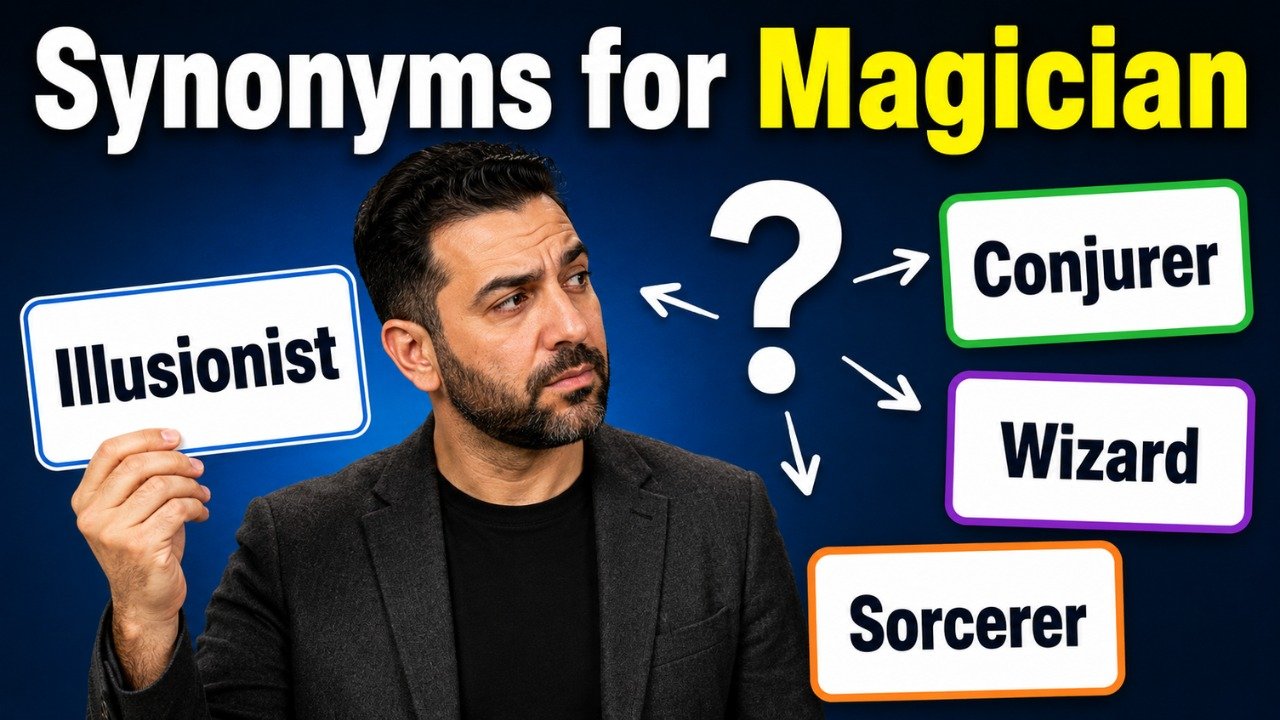
Quick Answer: The best synonyms for magician include illusionist, conjurer, prestidigitator, mentalist, wizard, sorcerer, mage, enchanter, spellcaster, and thaumaturge. Use illusionist for a professional who creates visual tricks, conjurer for someone performing traditional magic, and mentalist for a performer who appears to read thoughts. Wizard, sorcerer, mage, and spellcaster are better for fantasy stories. Prestidigitator is a formal word for a performer skilled in quick hand movements, while thaumaturge describes a person believed to perform supernatural wonders.
Pronunciation and Word Details
Word: Magician.
Pronunciation: /məˈdʒɪʃən/.
Part of Speech: Noun.
Meaning: A person who performs magic tricks or is believed to possess supernatural powers.
US Pronunciation:
UK Pronunciation:
What Does “Magician” Mean?
A magician is a person who performs impressive tricks or is believed to use supernatural powers.
The word magician is a noun. In everyday entertainment, it usually describes a performer who creates illusions through skill, preparation, distraction, special equipment, or quick hand movements.
In fantasy, mythology, and fiction, a magician may be a person who casts spells, controls magical forces, or possesses unusual supernatural abilities.
The word can also be used figuratively for someone who performs a difficult task with remarkable skill.
Entertainment Context: The magician made a coin disappear from his hand.
Fantasy Context: The magician used an ancient spell to protect the kingdom.
Figurative Context: The designer is a magician with small spaces.
The intended meaning usually becomes clear from the surrounding sentence.
Meaning, Tone, and Context of “Magician”
Magician is generally a neutral and widely understood word. Its tone changes according to the situation in which it appears.
Professional Tone: In entertainment, magician is a standard professional title for a person who performs magic tricks before an audience.
Conversational Tone: The word is common in casual speech when discussing parties, shows, tricks, or performers.
Creative Tone: In fantasy writing, magician has an imaginative and mysterious tone.
Literary Tone: Words such as mage, sorcerer, enchanter, and thaumaturge may sound more literary or dramatic than magician.
Figurative Tone: Magician can praise a person who produces impressive results through exceptional skill.
The word appears in conversations, event descriptions, biographies, fantasy novels, children’s stories, reviews, and figurative compliments.
When and How to Use “Magician”
For Stage Entertainment
Use magician for a professional performer who entertains an audience through illusions and carefully prepared tricks.
Example: The magician invited a volunteer onto the stage.
For Sleight of Hand
Use magician when describing someone who performs card tricks, coin tricks, or other effects involving precise hand movements.
Example: The magician moved the cards so smoothly that no one noticed the secret action.
For Visual Illusions
Use magician for someone who creates effects that appear impossible to the audience.
Example: The magician made the empty box appear to contain dozens of flowers.
For Mental Performances
Magician can describe someone who creates the appearance of reading thoughts, predicting choices, or influencing decisions.
Example: The magician correctly predicted the number selected by the guest.
Mentalist may be more precise when the entire performance focuses on apparent mind reading.
For Fantasy Characters
Use magician for a fictional person who casts spells, uses magical objects, or controls supernatural forces.
Example: The magician guarded the enchanted forest with a powerful spell.
For Remarkable Skill
Use magician figuratively for someone who handles a difficult activity with exceptional ability.
Example: She is a magician with fabric and can transform simple cloth into an elegant dress.
Best Synonyms for Magician
Illusionist
Synonym: A performer who creates effects that deceive the eyes or mind.
Example: The illusionist appeared to walk through a solid wall.
Conjurer
Synonym: A person who performs magic tricks or appears to summon something mysteriously.
Example: The conjurer produced a white dove from an empty cloth.
Prestidigitator
Synonym: A formal word for a performer skilled in rapid hand movements and sleight of hand.
Example: The prestidigitator amazed the audience with a complicated coin routine.
Mentalist
Synonym: A performer who creates the impression of reading minds or predicting thoughts.
Example: The mentalist correctly revealed the word chosen by an audience member.
Wizard
Synonym: A fictional or legendary person believed to possess magical powers.
Example: The wizard opened the hidden doorway with a spell.
Sorcerer
Synonym: A person in fantasy or legend who uses powerful magic.
Example: The sorcerer raised his staff and summoned a storm.
Mage
Synonym: A literary or fantasy term for a learned practitioner of magic.
Example: The young mage studied ancient books of spells.
Enchanter
Synonym: A person who uses magic to place spells on people, places, or objects.
Example: The enchanter placed a protective charm around the village.
Spellcaster
Synonym: A person or fictional character who casts magical spells.
Example: The spellcaster created a circle of light around the castle.
Thaumaturge
Synonym: A person believed to perform wonders, miracles, or supernatural acts.
Example: The villagers regarded the mysterious thaumaturge with both hope and fear.
50 Synonyms for Magician with Short Meanings
- Illusionist: A performer who creates convincing visual illusions.
- Conjurer: A person who performs traditional magic tricks.
- Prestidigitator: A performer skilled in quick and precise hand movements.
- Mentalist: A performer who appears to read or influence thoughts.
- Wizard: A fictional person with magical knowledge and power.
- Sorcerer: A person who uses powerful supernatural magic.
- Mage: A learned practitioner of magic in fantasy or legend.
- Enchanter: A person who casts charms or magical spells.
- Spellcaster: Someone who performs or uses spells.
- Thaumaturge: A person believed to perform supernatural wonders.
- Magus: A wise or powerful practitioner of magic.
- Warlock: A male practitioner of magic in fantasy or folklore.
- Witch: A person believed to practise witchcraft or cast spells.
- Sorceress: A woman who possesses or practises supernatural magic.
- Enchantress: A woman believed to use charms or magical powers.
- Necromancer: A fictional magical practitioner associated with the dead.
- Arcanist: A person who studies or uses secret magical knowledge.
- Theurgist: A practitioner who attempts to invoke supernatural powers.
- Occultist: A person who studies hidden or supernatural practices.
- Mystic: A person associated with spiritual mysteries or hidden wisdom.
- Shaman: A spiritual practitioner believed to communicate with unseen forces.
- Diviner: A person who attempts to discover hidden or future information.
- Seer: A person believed to see future or hidden events.
- Oracle: A person believed to provide inspired predictions or wisdom.
- Alchemist: A historical practitioner seeking mysterious material transformations.
- Summoner: A fantasy practitioner who calls supernatural beings or forces.
- Evoker: A fictional magic user who brings forth magical energy.
- Elementalist: A fantasy magician who controls natural elements.
- Druid: A spiritual or fantasy figure associated with nature based magic.
- Charmer: A person who uses charm, fascination, or apparent magic.
- Spellbinder: A person who holds others’ attention as if by magic.
- Mesmerist: A performer who creates fascination or apparent mental control.
- Hypnotist: A person who guides someone into a hypnotic state.
- Escapologist: A performer who escapes from restraints or confined spaces.
- Escape Artist: A performer skilled in dramatic escapes.
- Sleight of Hand Artist: A performer skilled in secret hand movements.
- Magic Performer: A person who presents magic as entertainment.
- Stage Magician: A magician who performs for a theatre audience.
- Close Up Magician: A performer who presents tricks near the audience.
- Street Magician: A performer who presents magic in public spaces.
- Card Magician: A performer who specializes in card effects.
- Coin Magician: A performer who specializes in coin tricks.
- Comedy Magician: A performer who combines magic with humour.
- Conjuring Artist: A skilled performer of traditional magical effects.
- Illusion Artist: A performer who designs and presents visual deceptions.
- Master of Illusion: A highly skilled creator of magical appearances.
- Mind Reader: A performer who appears to know another person’s thoughts.
- Miracle Worker: A person who produces results that seem impossible.
- Wonder Worker: A person believed to perform extraordinary acts.
- Magic Expert: A person with advanced knowledge of magical performance.
Read Also:
Synonyms for Methods

Synonyms for Magician by Context
When Magician Means a Stage Performer
The best choices are illusionist, stage magician, magic performer, conjurer, and illusion artist.
Illusionist emphasizes large, visual, or carefully constructed effects. Conjurer often suggests traditional magic involving cards, coins, handkerchiefs, or objects.
Example: The illusionist made the entire vehicle disappear from view.
Example: The conjurer entertained the guests with cards and coins.
When Magician Means a Sleight of Hand Performer
Use prestidigitator, sleight of hand artist, card magician, coin magician, or close up magician.
These words focus on manual control, precision, timing, and secret movements.
Example: The prestidigitator passed the coin between his fingers without being detected.
Example: A close up magician performed directly beside our table.
When Magician Means a Mental Performer
Use mentalist, mind reader, mesmerist, or hypnotist.
Mentalist is the most accurate term for a performer who creates the appearance of thought reading, prediction, memory control, or psychological influence.
Example: The mentalist revealed a name that had never been spoken aloud.
Example: The mind reader appeared to identify every hidden object.
When Magician Means a Fantasy Magic User
Use wizard, sorcerer, mage, enchanter, spellcaster, magus, or arcanist.
Wizard often suggests wisdom and study. Sorcerer usually sounds more powerful or dangerous. Mage is concise and literary, while spellcaster focuses directly on the act of casting spells.
Example: The wizard studied the symbols carved into the stone.
Example: The sorcerer released a wave of dark energy.
When Magician Means a Spiritual or Mystical Figure
Use mystic, shaman, diviner, seer, oracle, theurgist, or occultist.
These alternatives are not interchangeable in every culture or setting. Each carries a specific spiritual, historical, or fictional meaning.
Example: The seer warned the travellers about an approaching danger.
Example: The diviner interpreted the signs before the journey began.
When Magician Describes a Highly Skilled Person
Use miracle worker, wonder worker, expert, master, virtuoso, or genius, depending on the sentence.
These replacements avoid suggesting literal magic when the intended meaning is exceptional ability.
Example: The mechanic is a miracle worker with damaged engines.
Example: She is a true expert at restoring antique furniture.
Another Word for Magician
Illusionist is usually the best single replacement for magician when referring to a professional entertainer.
However, the best alternative depends on what the person actually does. Conjurer suits traditional tricks, mentalist suits apparent mind reading, and wizard suits a fictional character with supernatural powers.
Original: The magician created several impressive visual effects.
Better Option: The illusionist created several impressive visual effects.
Original: The magician performed card tricks beside the guests.
Better Option: The close up magician performed card tricks beside the guests.
Original: The magician predicted which object the volunteer would choose.
Better Option: The mentalist predicted which object the volunteer would choose.
Original: The magician protected the tower with an ancient spell.
Better Option: The wizard protected the tower with an ancient spell.
When Not to Use “Magician”
Do not use magician when a more precise professional, literary, or descriptive word would make the sentence clearer.
When the Performer Has a Specific Specialty
Magician may sound too broad when the person specializes in mentalism, escapes, cards, or large illusions.
Weak: The magician escaped from the locked container.
Better: The escapologist escaped from the locked container.
When Writing About Fantasy Roles
Magician can sound general when the fictional character has a clearly defined magical role.
Weak: The magician summoned spirits from the ancient ruins.
Better: The necromancer summoned spirits from the ancient ruins.
When Describing Ordinary Expertise
Magician can sound exaggerated in formal reports, technical documents, or professional evaluations.
Weak: The accountant is a magician with financial records.
Better: The accountant is highly skilled at organizing financial records.
When Referring to Spiritual Traditions
Do not replace specific spiritual or cultural roles with magician merely because they involve rituals, visions, or beliefs.
Weak: The community’s magician led the traditional ceremony.
Better: The community’s spiritual leader led the traditional ceremony.
When the Meaning Is Unclear
A sentence may confuse readers when it does not reveal whether magician means an entertainer or a fantasy figure.
Weak: The magician arrived at the palace.
Better: The court wizard arrived at the palace.
Words Commonly Confused With Magician
Magician vs Illusionist: Magician is a broad term for someone who performs magic. Illusionist often emphasizes elaborate visual effects and staged deception.
Magician vs Conjurer: Magician can describe almost any magic performer. Conjurer usually suggests traditional tricks involving objects, hidden movements, or apparent appearances and disappearances.
Magician vs Mentalist: A magician may perform many types of tricks. A mentalist specializes in effects involving thoughts, predictions, memory, or apparent psychological influence.
Magician vs Wizard: Magician can describe a real entertainer or a fictional magic user. Wizard is mainly associated with fantasy, folklore, or figurative expertise.
Magician vs Sorcerer: Magician is neutral and broad. Sorcerer usually refers to a fictional person who possesses powerful or mysterious supernatural abilities.
Magician vs Mage: Magician works in ordinary conversation. Mage has a more literary, historical, or fantasy based tone.
Magician vs Hypnotist: A magician creates illusions and tricks. A hypnotist guides a participant into a focused mental state and may use suggestion during a performance.
Magician vs Juggler: A magician creates apparent impossibilities through illusion. A juggler openly demonstrates coordination by keeping objects moving through the air.
Which Synonym Should You Choose?
Choose illusionist when describing a professional performer who creates large or highly visual effects.
Choose conjurer when writing about traditional tricks involving objects, cards, coins, or secret movements.
Choose prestidigitator when you need a formal word for a performer skilled in rapid hand movements.
Choose mentalist when the performance involves apparent mind reading, prediction, memory, or psychological influence.
Choose escapologist when the performer specializes in escaping from ropes, locks, chains, or enclosed spaces.
Choose wizard when writing about a wise or learned magic user in fantasy.
Choose sorcerer when the character possesses powerful, dramatic, or dangerous supernatural abilities.
Choose mage when you need a short literary term for a practitioner of magic.
Choose enchanter when the person casts charms or places magical effects on people and objects.
Choose spellcaster when the main action involves creating or using spells.
Choose miracle worker when describing a person who achieves a result that seems almost impossible.
Choose expert, master, or specialist instead of magician in formal writing about exceptional practical ability.
Real Life Examples of “Magician” in Sentences
Original: The magician performed several tricks during the celebration.
Better Option: The conjurer performed several tricks during the celebration.
Original: The magician made a large object disappear from the stage.
Better Option: The illusionist made a large object disappear from the stage.
Original: The magician correctly predicted the volunteer’s answer.
Better Option: The mentalist correctly predicted the volunteer’s answer.
Original: The magician escaped from the locked box within seconds.
Better Option: The escapologist escaped from the locked box within seconds.
Original: The magician performed with cards only a few inches from the audience.
Better Option: The close up magician performed with cards only a few inches from the audience.
Original: The magician cast a protective spell over the village.
Better Option: The enchanter cast a protective spell over the village.
Original: The magician studied the ancient language of spells.
Better Option: The mage studied the ancient language of spells.
Original: The magician called a supernatural creature into the room.
Better Option: The summoner called a supernatural creature into the room.
Original: The magician could supposedly see events before they happened.
Better Option: The seer could supposedly see events before they happened.
Original: Our decorator is a magician with narrow rooms.
Better Option: Our decorator is an expert at transforming narrow rooms.
Synonym Groups and Usage Differences
Performance Group
This group includes illusionist, conjurer, magic performer, stage magician, and illusion artist.
These terms describe entertainers who create seemingly impossible effects for an audience. Illusionist often suggests visual spectacle, while conjurer suggests traditional tricks and skilled handling.
Example: The illusionist ended the show with a dramatic disappearance.
Sleight of Hand Group
This group includes prestidigitator, sleight of hand artist, card magician, coin magician, and close up magician.
These words emphasize precise hand movements, timing, control, and secret techniques.
Example: The sleight of hand artist changed one card into another without any visible movement.
Mental Performance Group
This group includes mentalist, mind reader, mesmerist, and hypnotist.
These performers focus on thought, suggestion, memory, prediction, or apparent mental influence.
Example: The mentalist revealed the drawing hidden inside the envelope.
Escape Performance Group
This group includes escapologist and escape artist.
These terms refer to performers who escape from restraints, containers, locks, or dangerous situations.
Example: The escape artist freed herself before the timer reached zero.
Fantasy Magic Group
This group includes wizard, sorcerer, mage, enchanter, spellcaster, magus, and arcanist.
These words describe fictional or legendary users of magic. Their meanings differ according to the imagined world, the character’s training, and the source of the character’s power.
Example: The arcanist spent years studying forbidden magical symbols.
Supernatural and Mystical Group
This group includes thaumaturge, theurgist, occultist, mystic, diviner, seer, and oracle.
These terms relate to wonders, spiritual mysteries, hidden knowledge, prediction, or supernatural belief.
Example: The oracle offered a mysterious warning about the coming winter.
Figurative Skill Group
This group includes miracle worker, wonder worker, master, genius, expert, and virtuoso.
These words describe someone whose skill produces unusually impressive results.
Example: The surgeon was regarded as a miracle worker by many grateful families.
Antonyms of Magician
Magician has no single exact antonym because it can describe a performer, a fantasy magic user, or a remarkably skilled person. The most suitable opposite depends on the intended meaning.
Spectator: A person who watches a performance instead of presenting it.
Audience Member: Someone who observes the magician’s act.
Skeptic: A person who doubts supernatural claims or unexplained powers.
Realist: A person who focuses on practical facts rather than magical explanations.
Nonbeliever: Someone who does not accept claims of magic or supernatural power.
Layperson: A person without specialist knowledge of magical performance.
Novice: A beginner with little skill or experience.
Amateur: A person who lacks professional training or experience.
Bungler: Someone who performs a task clumsily or unsuccessfully.
Ordinary Person: Someone without unusual powers or exceptional abilities.
Comparison: Magician vs Related Words
Magician vs Illusionist
Magician is the broader term. Illusionist specifically highlights the creation of convincing visual or sensory effects.
Example With Magician: The magician entertained the guests with cards, coins, and ropes.
Example With Illusionist: The illusionist appeared to make an entire building vanish.
Magician vs Conjurer
Magician can refer to any magic performer. Conjurer often suggests traditional tricks, mysterious appearances, and skilled object manipulation.
Example With Magician: The magician presented a varied evening show.
Example With Conjurer: The conjurer produced a live bird from an empty container.
Magician vs Mentalist
A magician may use physical props, visual deception, and sleight of hand. A mentalist creates the impression of unusual mental abilities.
Example With Magician: The magician made the chosen card appear inside a box.
Example With Mentalist: The mentalist identified the word the volunteer was thinking about.
Magician vs Wizard
Magician can describe a real performer or a fictional character. Wizard usually describes a fictional, legendary, or figuratively brilliant person.
Example With Magician: The magician performed at the theatre.
Example With Wizard: The wizard carried a staff covered with glowing symbols.
Magician vs Sorcerer
Magician is broad and often neutral. Sorcerer sounds more dramatic and usually describes a powerful supernatural figure in fantasy.
Example With Magician: The magician entertained the children with simple tricks.
Example With Sorcerer: The sorcerer attempted to control the storm.
Magician vs Prestidigitator
Magician is common and easy to understand. Prestidigitator is formal and specifically emphasizes manual skill and rapid hand movements.
Example With Magician: The magician performed a coin trick.
Example With Prestidigitator: The prestidigitator secretly transferred the coin from one hand to the other.
Magician vs Escapologist
A magician may perform many kinds of effects. An escapologist specializes in escaping from restraints or confined locations.
Example With Magician: The magician presented a series of illusions.
Example With Escapologist: The escapologist escaped from the locked container.
Common Phrases and Expressions With Magician
Stage Magician: A performer who presents magic before a seated audience.
Close Up Magician: A performer who presents effects near spectators.
Street Magician: A performer who presents magic in a public setting.
Professional Magician: A trained performer who presents magic as paid work.
Master Magician: A highly experienced and accomplished magic performer.
Card Magician: A performer who specializes in card effects.
Comedy Magician: A performer who combines humorous dialogue with magic.
Talented Magician: A magician with impressive performance skills.
Magician’s Assistant: A person who helps present and manage a magic performance.
Magician’s Secret: A hidden method that makes a magical effect possible.
Common Mistakes to Avoid
Using Every Synonym Interchangeably
Illusionist, mentalist, wizard, and hypnotist do not describe exactly the same kind of person. Select the word that matches the person’s activity.
Incorrect: The mentalist escaped from a locked water tank.
Better: The escapologist escaped from a locked water tank.
Confusing Real Performers With Fantasy Characters
A stage magician uses performance methods, while a wizard or sorcerer is usually imagined to possess supernatural power.
Incorrect: The wizard performed card tricks at the family celebration.
Better: The magician performed card tricks at the family celebration.
Overusing Magician in One Paragraph
Repeating magician too often can make writing sound mechanical.
Repetitive: The magician entered the stage. The magician showed the cards. The magician then called for a volunteer.
Improved: The magician entered the stage and displayed the cards. The performer then called for a volunteer.
Choosing an Overly Formal Synonym
Prestidigitator and thaumaturge may sound unnatural in ordinary conversation.
Unnatural: We hired a prestidigitator for the small birthday gathering.
Natural: We hired a magician for the small birthday gathering.
Using Wizard in Formal Professional Writing
Wizard may sound playful or exaggerated when describing genuine workplace ability.
Weak: She is a spreadsheet wizard who manages company reports.
Better: She is highly skilled at organizing and analysing company reports.
Ignoring Cultural and Historical Meanings
Terms such as shaman, witch, oracle, and druid have cultural, spiritual, historical, or religious associations. They should not be treated as casual replacements for entertainer.
Using a Vague Figurative Comparison
When magician is used figuratively, explain the person’s skill clearly.
Vague: He is a magician.
Clear: He is a magician with difficult repairs and can restore almost any damaged object.
Conclusion
The best synonyms for magician depend on whether you are describing entertainment, fantasy, mental performance, or remarkable skill. Illusionist and conjurer work well for professional performers, while mentalist suits apparent mind reading. Wizard, sorcerer, mage, enchanter, and spellcaster are stronger choices for fantasy writing. Prestidigitator emphasizes skillful hand movements, and escapologist describes a specialist in dramatic escapes. Choosing a precise alternative makes your sentence clearer, more natural, and better suited to its intended tone.
FAQs About Synonyms for Magician
What Is the Best Synonym for Magician?
Illusionist is the best general synonym for a professional magician. Conjurer is suitable for traditional tricks, while wizard is better for a fictional magic user.
Is Illusionist the Same as Magician?
An illusionist is a type of magician who focuses on creating convincing visual effects. Magician is a broader term that may include card performers, mentalists, and other specialists.
What Is a Formal Word for Magician?
Prestidigitator is a formal word for a magician skilled in sleight of hand. Thaumaturge is a rare formal term for someone believed to perform supernatural wonders.
What Is Another Word for a Fantasy Magician?
Wizard, sorcerer, mage, enchanter, spellcaster, and magus are useful alternatives for a fantasy magician. The best choice depends on the character’s powers and role.
What Do You Call a Magician Who Reads Minds?
A performer who appears to read minds is usually called a mentalist. Mind reader is a more informal and descriptive alternative.
What Do You Call a Magician Who Escapes From Locks?
A magician who specializes in escaping from locks, ropes, chains, or containers is called an escapologist or escape artist.
Can Magician Describe a Highly Skilled Person?
Yes. Magician can be used figuratively for someone who achieves impressive results. In formal writing, expert, master, specialist, or virtuoso may sound more precise.
