
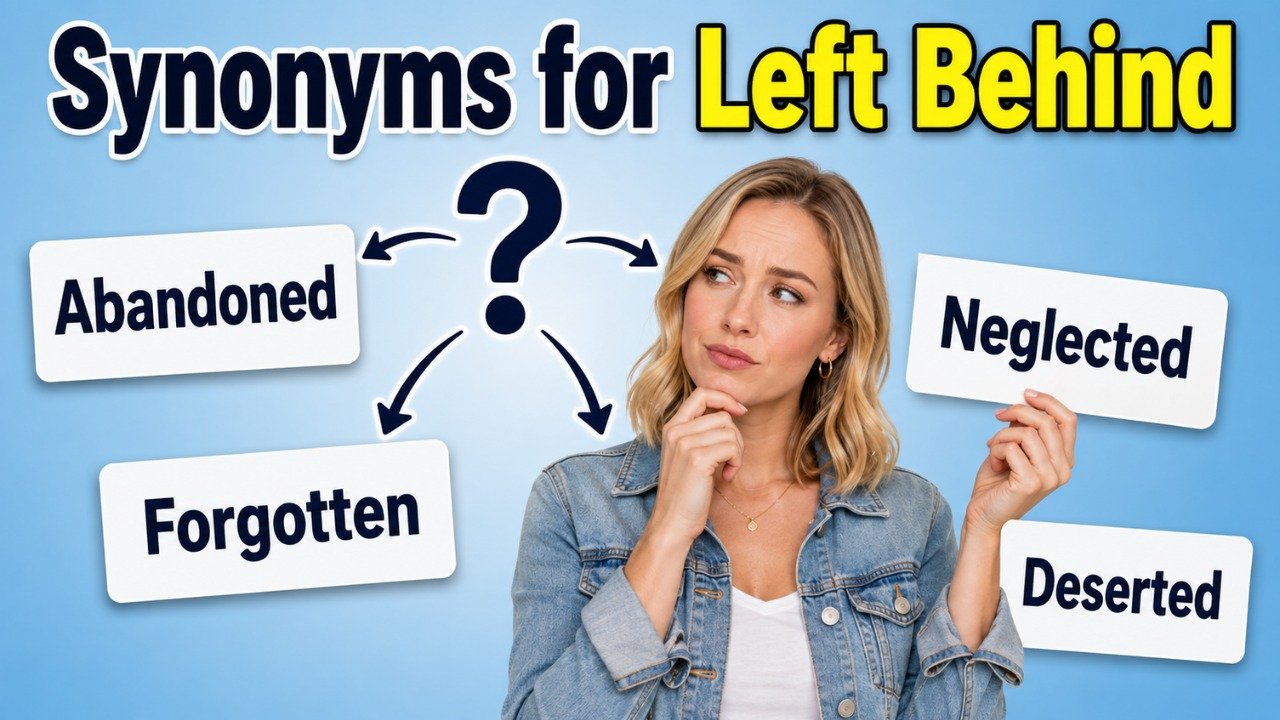
Quick Answer: Common synonyms for left behind include abandoned, forgotten, neglected, stranded, omitted, excluded, remaining, trailing, outpaced, and surpassed. Use abandoned when a person, place, or object has been deserted. Choose forgotten for something no longer remembered, omitted for missing information, remaining for something still present, and outpaced or surpassed when someone has failed to keep up with others. The best synonym depends on whether left behind refers to abandonment, exclusion, forgotten belongings, remaining items, or slower progress.
Pronunciation and Word Details
Word: Left behind.
Pronunciation: /ˌleft bɪˈhaɪnd/
Part of Speech: Adjective phrase, adverb phrase, or the past form of the phrasal verb leave behind.
Meaning: Abandoned, forgotten, omitted, remaining after others have gone, or unable to keep pace with someone or something.
US Pronunciation:
UK Pronunciation:
What Does “Left Behind” Mean?
Left behind means abandoned, forgotten, omitted, remaining in a place, or unable to keep pace with others.
The phrase comes from the verb leave behind. Its exact meaning changes according to the sentence.
When describing a person, left behind may mean that others departed without them.
Example: The passenger was left behind when the bus departed.
When describing an object, it often means forgotten or accidentally not taken.
Example: She left her notebook behind in the classroom.
When describing information, left behind can mean omitted, excluded, or overlooked.
Example: Several important details were left behind during the summary.
When describing progress, the phrase means that someone or something has failed to keep up.
Example: Businesses that ignore new methods may be left behind.
The phrase can also refer to something that remains after a person has died, moved away, or completed an activity.
Example: The letters left behind revealed much about his life.
Left behind may therefore express physical separation, emotional abandonment, accidental forgetfulness, exclusion, remaining evidence, or slower development.
Meaning, Tone, and Context of “Left Behind”
Left behind is a common and generally neutral phrase, but its emotional tone depends strongly on context.
Everyday Context: The phrase is often used when someone forgets an object or fails to take it along.
Example: I realized that I had left my keys behind.
Emotional Context: Left behind can sound sad, lonely, or painful when it refers to abandonment, separation, or loss.
Example: The child felt left behind when the other children ran ahead.
Formal Context: In reports or academic writing, more precise alternatives such as omitted, excluded, overlooked, surpassed, or remaining may be better.
Example: Several variables were omitted from the final analysis.
Competitive Context: The phrase can describe a person, business, group, or system that is progressing more slowly than others.
Example: Without proper training, some workers may be left behind.
Historical Context: Left behind may describe objects, documents, buildings, customs, or evidence remaining from an earlier period.
Example: The tools left behind provide evidence of how the community lived.
Social Context: It can refer to people who do not receive equal opportunities, resources, attention, or support.
Example: The program was created to help students who felt left behind.
Conversational Tone: In ordinary speech, left behind sounds natural and clear.
Professional Tone: In business, legal, technical, or academic writing, a more exact word often improves clarity.
When and How to Use “Left Behind”
For Abandonment
Use left behind when a person, animal, place, or object has been deserted or abandoned.
Example: The family found an abandoned dog that had been left behind.
For Forgotten Belongings
Use the phrase when someone accidentally fails to take an item.
Example: He left his glasses behind at the restaurant.
For Exclusion
Use left behind when someone is not included in an activity, decision, opportunity, or group.
Example: She worried that she would be left behind during the planning process.
For Slower Progress
Use the phrase when someone cannot keep up with changes, competition, education, technology, or development.
Example: Students without regular practice may be left behind.
For Remaining Objects
Use left behind for items, evidence, or materials that remain after people have departed.
Example: The objects left behind helped investigators understand what happened.
For Emotional Separation
The phrase can describe feelings of loneliness, rejection, or isolation.
Example: He felt left behind after his closest friends moved away.
For Historical Remains
Use left behind to describe buildings, documents, customs, or artifacts from the past.
Example: The ruins were left behind by an ancient settlement.
For Missing Information
Use the phrase informally when details have been excluded from an account, summary, report, or discussion.
Example: Important background information was left behind in the shortened version.
For Unfinished Work
Left behind may refer to duties or projects that remain incomplete.
Example: The departing manager left several unfinished tasks behind.
Best Synonyms for Left Behind
Abandoned: Deserted without care, protection, or support.
Example: The abandoned building had remained empty for many years.
Forgotten: Not remembered or accidentally not taken.
Example: A forgotten bag was discovered beneath the seat.
Neglected: Not given the care, attention, or support that was needed.
Example: The neglected garden became covered with weeds.
Stranded: Left in a place without a practical way to leave.
Example: The cancelled train left hundreds of passengers stranded.
Omitted: Not included in writing, speech, data, or a process.
Example: Her address was accidentally omitted from the form.
Excluded: Prevented from joining or not included in a group or activity.
Example: Several residents felt excluded from the discussion.
Remaining: Still present after other people or things have gone.
Example: The remaining supplies were stored for future use.
Trailing: Following behind another person, group, or competitor.
Example: The team was trailing by ten points at the break.
Outpaced: Progressed more slowly than another person, group, or system.
Example: Older equipment was outpaced by newer machinery.
Surpassed: Exceeded by someone or something in achievement, quality, speed, or progress.
Example: The earlier record was surpassed within a year.
50 Synonyms for Left Behind with Short Meanings
- Abandoned: Deserted without care or support.
- Deserted: Left empty or without companionship.
- Forsaken: Completely abandoned or rejected.
- Neglected: Not given necessary care or attention.
- Forgotten: No longer remembered or accidentally not taken.
- Stranded: Left somewhere without a way to continue or return.
- Marooned: Isolated in a place with no easy escape.
- Discarded: Thrown away or treated as unwanted.
- Relinquished: Given up or surrendered.
- Cast Aside: Rejected or no longer considered useful.
- Cast Off: Abandoned, rejected, or released.
- Overlooked: Missed or not given proper attention.
- Omitted: Not included in something.
- Excluded: Deliberately or accidentally kept out.
- Ignored: Given no attention or consideration.
- Bypassed: Passed over in favor of something else.
- Passed Over: Not selected, recognized, or included.
- Left Out: Not included in a group, activity, or statement.
- Missed: Not noticed, included, reached, or taken.
- Unmentioned: Not referred to in speech or writing.
- Unrecorded: Not written down or officially documented.
- Unnoticed: Not observed or recognized.
- Unconsidered: Not examined or taken into account.
- Unaccounted For: Missing or not properly explained.
- Remaining: Still present after others have gone.
- Leftover: Remaining after the main part has been used or removed.
- Residual: Remaining after most of something has disappeared.
- Lingering: Continuing to remain for longer than expected.
- Surviving: Continuing to exist after others have disappeared.
- Unused: Not used or consumed.
- Unclaimed: Not collected or requested by its owner.
- Unattended: Left without supervision or care.
- Uncollected: Not picked up or gathered.
- Unfinished: Not brought to completion.
- Undelivered: Not taken to the intended person or place.
- Misplaced: Put somewhere and temporarily forgotten.
- Trailing: Following at a distance or lower position.
- Lagging: Progressing more slowly than others.
- Outpaced: Unable to progress as quickly as another.
- Surpassed: Exceeded in quality, achievement, or performance.
- Overtaken: Passed by someone or something moving faster.
- Outstripped: Exceeded by a large amount.
- Eclipsed: Made less successful, important, or noticeable.
- Exceeded: Passed beyond a previous amount or level.
- Beaten: Defeated or passed in a competition.
- Outdone: Surpassed in effort, quality, or achievement.
- Fallen Behind: Failed to maintain the expected pace or position.
- Left in the Past: Made outdated by later progress or change.
- Left Alone: Separated from others without companionship.
- Isolated: Separated from people, places, or support.
Read Also:
Synonyms for Defy

Synonyms for Left Behind by Context
When Left Behind Means Abandoned
Abandoned, deserted, forsaken, neglected, discarded, cast aside, and cast off describe people, animals, places, objects, or ideas that are no longer supported or wanted.
Example: The deserted house had been empty for decades.
Example: The injured animal appeared to have been abandoned.
Example: The old proposal was cast aside after the budget changed.
Abandoned is the most direct general replacement. Forsaken sounds stronger and more emotional, while neglected suggests a lack of proper care over time.
When Left Behind Means Forgotten
Forgotten, misplaced, missed, unclaimed, uncollected, and unaccounted for are useful when someone fails to take, remember, locate, or collect an item.
Example: A forgotten umbrella remained beside the door.
Example: The misplaced document was found in a storage box.
Example: Several unclaimed bags were taken to the information desk.
Forgotten is best when an object was accidentally not taken. Misplaced is better when the location is temporarily unknown.
When Left Behind Means Excluded
Excluded, omitted, overlooked, ignored, bypassed, passed over, left out, and unconsidered describe people, details, or ideas that are not included.
Example: Several important facts were omitted from the report.
Example: Younger members felt excluded from the decision.
Example: Her application was overlooked during the first review.
Use excluded for people or groups, omitted for information, and overlooked for something missed unintentionally.
When Left Behind Means Remaining
Remaining, leftover, residual, lingering, surviving, unused, unfinished, and unattended refer to things that continue to exist after something else has ended or departed.
Example: The remaining food was placed in sealed containers.
Example: Residual moisture may remain on the surface.
Example: Several unfinished tasks required immediate attention.
Remaining is the broadest and most neutral alternative. Residual is more technical, while leftover is more conversational.
When Left Behind Means Unable to Keep Up
Trailing, lagging, outpaced, surpassed, overtaken, outstripped, eclipsed, beaten, and outdone describe slower progress or weaker performance.
Example: Smaller businesses were outpaced by rapidly growing competitors.
Example: The runner was trailing during the final section of the race.
Example: The original record was surpassed by a younger athlete.
Lagging works well for progress, development, or performance. Outpaced emphasizes speed, while surpassed emphasizes achievement or quality.
When Left Behind Means Stranded
Stranded, marooned, isolated, and left alone describe someone who remains in a place without transportation, help, or companionship.
Example: The storm left several travelers stranded.
Example: The sailors were marooned on a remote island.
Example: He felt isolated after moving away from his family.
Stranded is the most natural choice for transport problems. Marooned suggests severe physical isolation, while isolated can describe either physical or emotional separation.
Another Word for Left Behind
The best general replacement for left behind is abandoned when the phrase refers to desertion. However, no single alternative works in every context.
Use forgotten for an object that was not taken, omitted for missing information, remaining for something still present, excluded for someone not included, and outpaced for someone unable to keep up.
Original: The dog was left behind when the owners moved.
Better Option: The dog was abandoned when the owners moved.
Original: Several important facts were left behind in the summary.
Better Option: Several important facts were omitted from the summary.
Original: Only a few supplies were left behind.
Better Option: Only a few supplies remained.
Original: The older system was left behind by recent developments.
Better Option: The older system was outpaced by recent developments.
When Not to Use “Left Behind”
Left behind is useful in everyday language, but it can sound vague when readers need to know exactly what happened.
When the Meaning Is Abandonment
Use abandoned or deserted when a person, animal, place, or object has clearly been deserted.
Weak: The animals were left behind by their owners.
Better: The animals were abandoned by their owners.
When Information Is Missing
Use omitted, excluded, or overlooked when discussing reports, data, applications, or written details.
Weak: Several figures were left behind in the final report.
Better: Several figures were omitted from the final report.
When Describing Competition
Use trailing, outpaced, surpassed, or overtaken to show the precise type of disadvantage.
Weak: The team was left behind during the second half.
Better: The team was overtaken during the second half.
When Describing Remaining Materials
Use remaining, leftover, residual, or unused when referring to items still present.
Weak: The materials left behind will be stored.
Better: The remaining materials will be stored.
When the Phrase Sounds Too Emotional
Left behind can suggest rejection or loneliness. Avoid it when a neutral factual term is more appropriate.
Weak: The older file was left behind during the transfer.
Better: The older file was not transferred.
When the Agent Is Unclear
The phrase may hide who performed the action.
Weak: Important evidence was left behind.
Better: The inspection team overlooked important evidence.
When It Becomes Repetitive
Repeated use can make writing sound vague or monotonous.
Weak: The workers left tools behind, left documents behind, and left unfinished work behind.
Better: The workers forgot their tools, abandoned several documents, and failed to complete their assigned work.
Words Commonly Confused With Left Behind
Left Behind vs Abandoned: Left behind may be accidental or temporary. Abandoned usually suggests deliberate or permanent desertion.
Left Behind vs Forgotten: Forgotten refers to something not remembered or accidentally not taken. Left behind can also refer to exclusion, slower progress, or remaining objects.
Left Behind vs Stranded: Stranded specifically means unable to leave or continue a journey. Left behind may occur without someone being trapped.
Left Behind vs Neglected: Neglected means not receiving proper care or attention. Someone or something may be neglected without being physically left behind.
Left Behind vs Omitted: Omitted refers to information, words, names, or details that are not included. Left behind is broader and more conversational.
Left Behind vs Excluded: Excluded usually means kept out of a group, activity, or opportunity. Left behind may also describe accidental separation.
Left Behind vs Remaining: Remaining describes something that continues to be present. Left behind may suggest that others departed or that the object was forgotten.
Left Behind vs Lagging: Lagging means progressing more slowly than expected. Left behind can describe the result of continued lagging.
Left Behind vs Surpassed: Surpassed means exceeded in achievement, quality, or performance. Left behind describes the person or thing that is no longer keeping pace.
Left Behind vs Overlooked: Overlooked means missed or not given proper attention. Left behind may involve physical separation as well as lack of attention.
Which Synonym Should You Choose?
Choose abandoned when a person, animal, object, or place has been deserted.
Choose deserted when a place is empty because people have departed.
Choose forsaken when you want to express strong emotional rejection or complete abandonment.
Choose forgotten when someone accidentally fails to take or remember an object.
Choose misplaced when an item has been put somewhere and cannot currently be found.
Choose stranded when someone cannot continue a journey or leave a location.
Choose omitted when information, data, words, or details are missing from writing or speech.
Choose excluded when a person or group is not allowed to participate.
Choose overlooked when something is missed unintentionally during a review or decision.
Choose remaining when something is still present after other things have gone.
Choose leftover for food, materials, money, or supplies remaining after use.
Choose residual in scientific, technical, or formal descriptions of something that remains.
Choose trailing when describing a lower position during a race, game, or competition.
Choose lagging when progress, performance, or development is slower than expected.
Choose outpaced when another person, group, or system progresses more quickly.
Choose surpassed when a previous level, record, quality, or achievement has been exceeded.
Choose overtaken when someone or something has moved ahead of another.
Choose isolated when someone is physically or emotionally separated from others.
Real Life Examples of “Left Behind” in Sentences
Original: She discovered that her phone had been left behind at the office.
Better Option: She discovered that her phone had been forgotten at the office.
Original: The dog was left behind when the family moved away.
Better Option: The dog was abandoned when the family moved away.
Original: Several students felt left behind during the advanced lesson.
Better Option: Several students struggled to keep pace during the advanced lesson.
Original: Important details were left behind in the final summary.
Better Option: Important details were omitted from the final summary.
Original: The passengers were left behind when the final bus departed.
Better Option: The passengers were stranded when the final bus departed.
Original: A few boxes were left behind in the empty apartment.
Better Option: A few boxes remained in the empty apartment.
Original: Traditional businesses may be left behind by rapid change.
Better Option: Traditional businesses may be outpaced by rapid change.
Original: She felt left behind when her friends received promotions.
Better Option: She felt overlooked when her friends received promotions.
Original: The runner was left behind during the final lap.
Better Option: The runner was overtaken during the final lap.
Original: Several communities were left behind during the recovery effort.
Better Option: Several communities were neglected during the recovery effort.
Synonym Groups and Usage Differences
Abandonment Group
Abandoned, deserted, forsaken, discarded, cast aside, and cast off describe people, places, objects, or ideas that are no longer supported, wanted, or cared for.
Abandoned is neutral and direct. Deserted often describes empty places. Forsaken is more emotional and dramatic.
Example: The deserted station had not been used for many years.
Forgetfulness Group
Forgotten, misplaced, missed, unclaimed, uncollected, and unaccounted for describe objects that are not remembered, taken, found, or collected.
Forgotten suggests a failure of memory. Misplaced suggests that the item has been put in the wrong location.
Example: A misplaced envelope was discovered beneath the files.
Exclusion Group
Excluded, omitted, overlooked, ignored, bypassed, passed over, and left out describe people, details, or possibilities that are not included.
Excluded may be deliberate, while overlooked is often accidental.
Example: Her name was accidentally omitted from the list.
Remaining Group
Remaining, leftover, residual, lingering, surviving, unused, and unfinished describe things that continue to exist after an activity, event, or period has ended.
Remaining is neutral. Leftover is conversational. Residual is formal or technical.
Example: The remaining funds will support future repairs.
Progress Group
Trailing, lagging, outpaced, surpassed, overtaken, outstripped, eclipsed, beaten, and outdone describe people or things that are no longer leading or keeping pace.
Trailing refers to position. Lagging refers to slow progress. Outpaced emphasizes speed. Surpassed emphasizes achievement or level.
Example: The outdated process was outpaced by a more efficient method.
Isolation Group
Stranded, marooned, isolated, left alone, and forsaken describe separation from people, transportation, help, or support.
Stranded often involves travel. Isolated can be physical, social, or emotional.
Example: Severe weather left the travelers stranded overnight.
Neglect Group
Neglected, ignored, overlooked, unattended, and unconsidered describe a lack of care, attention, or examination.
Neglected usually suggests an ongoing failure to provide proper care.
Example: The neglected equipment eventually stopped working.
Antonyms of Left Behind
The opposite of left behind depends on whether the phrase refers to abandonment, exclusion, remaining items, or slower progress.
Accompanied: Joined or supported by another person.
Included: Made part of a group, activity, or statement.
Remembered: Kept in the mind or recalled.
Collected: Picked up or gathered.
Retrieved: Recovered or brought back.
Taken Along: Brought with someone during a journey.
Supported: Given help, care, or encouragement.
Protected: Kept safe from harm or danger.
Attended: Watched, supervised, or cared for.
Completed: Fully finished.
Mentioned: Referred to in speech or writing.
Recorded: Written down or officially documented.
Considered: Examined or taken into account.
Leading: Occupying the first or strongest position.
Advancing: Moving forward or making progress.
Ahead: Further forward in position, progress, or development.
Outpacing: Progressing faster than others.
Surpassing: Exceeding a previous level or competitor.
Connected: Joined to other people, places, or systems.
Remembered and Included: Recognized and made part of something.
Comparison: Left Behind vs Related Words
Left Behind vs Abandoned
Left behind may happen accidentally, temporarily, or deliberately. Abandoned usually suggests that someone or something has been deliberately deserted without expected return or support.
Example With Left Behind: Her coat was left behind after the meeting.
Example With Abandoned: The building was abandoned after it became unsafe.
Left Behind vs Forgotten
Left behind describes the location or condition of something that was not taken. Forgotten emphasizes the failure to remember it.
Example With Left Behind: His wallet was left behind on the table.
Example With Forgotten: He had forgotten his wallet on the table.
Left Behind vs Stranded
Left behind means not taken along or unable to keep up. Stranded specifically means being unable to continue a journey or leave a location.
Example With Left Behind: Two passengers were left behind when the bus departed early.
Example With Stranded: Two passengers were stranded without transportation.
Left Behind vs Omitted
Left behind is broad and conversational. Omitted specifically describes information, details, words, or names that are not included.
Example With Left Behind: Several facts were left behind during editing.
Example With Omitted: Several facts were omitted during editing.
Left Behind vs Excluded
Left behind may suggest accidental separation. Excluded means deliberately or effectively prevented from participating or being included.
Example With Left Behind: She felt left behind during the group discussion.
Example With Excluded: She was excluded from the group discussion.
Left Behind vs Remaining
Left behind may suggest that others departed or forgot something. Remaining simply means continuing to be present.
Example With Left Behind: Several chairs were left behind after the event.
Example With Remaining: The remaining chairs were moved into storage.
Left Behind vs Lagging
Left behind describes a condition or result. Lagging describes slower progress or performance over time.
Example With Left Behind: The department was left behind by recent changes.
Example With Lagging: The department was lagging in the use of recent methods.
Left Behind vs Outpaced
Left behind is general, while outpaced specifically means progressing more slowly than someone or something else.
Example With Left Behind: The older system was left behind.
Example With Outpaced: The older system was outpaced by faster technology.
Left Behind vs Surpassed
Left behind focuses on the person or thing that is no longer ahead. Surpassed focuses on the competitor or standard that has been exceeded.
Example With Left Behind: The former champion was left behind during the final round.
Example With Surpassed: The former champion was surpassed by a younger competitor.
Left Behind vs Neglected
Left behind may refer to physical separation or slower progress. Neglected describes a lack of necessary care, attention, or support.
Example With Left Behind: Rural areas were left behind during development.
Example With Neglected: Rural areas were neglected during development.
Common Phrases and Expressions With “Left Behind”
Leave No One Behind: Ensure that every person receives support, inclusion, or opportunity.
Feel Left Behind: Feel excluded, forgotten, or unable to keep up.
Get Left Behind: Fail to progress as quickly as others.
Be Left Behind: Remain after others have departed or advanced.
Things Left Behind: Objects or belongings remaining after someone leaves.
People Left Behind: Individuals who remain, are excluded, or lack support.
Evidence Left Behind: Clues or materials remaining after an event.
Memories Left Behind: Experiences or impressions that remain after someone departs.
Legacy Left Behind: Lasting influence, achievements, or effects after a person is gone.
Leave the Past Behind: Stop allowing previous events to control present actions.
Common Mistakes to Avoid
Using Left Behind Without Clear Context
The phrase has several meanings, so the reader may not know whether it refers to abandonment, forgetfulness, exclusion, or slower progress.
Unclear: Several people were left behind.
Clearer: Several passengers were stranded when the train departed.
Using Left Behind for Missing Information
Omitted or excluded is usually more precise in formal writing.
Weak: The final report left several statistics behind.
Better: The final report omitted several statistics.
Confusing Left Behind With Left Over
Left behind often suggests that someone departed without taking something. Left over means remaining after use or consumption.
Incorrect: We had several left behind sandwiches after lunch.
Correct: We had several leftover sandwiches after lunch.
Confusing Left Behind With Fallen Behind
Left behind can mean abandoned or forgotten. Fallen behind specifically refers to failing to maintain progress, payments, work, or position.
Unclear: He was left behind with his assignments.
Clearer: He had fallen behind with his assignments.
Using Abandoned for a Minor Accident
Abandoned may sound too strong when someone simply forgot an object.
Too Strong: She abandoned her umbrella at the restaurant.
Natural: She left her umbrella behind at the restaurant.
Using Stranded Without a Travel or Escape Problem
Stranded implies that someone cannot leave or continue.
Unnatural: The forgotten book was stranded on the desk.
Natural: The forgotten book was left on the desk.
Repeating the Phrase Too Often
Repeated use can weaken a paragraph.
Repetitive: Some students were left behind, some ideas were left behind, and some materials were left behind.
Improved: Some students struggled to keep pace, several ideas were overlooked, and unused materials remained.
Confusing Behind With Beyond
Behind refers to a position at the back or a slower stage. Beyond means farther than a point or outside a limit.
Incorrect: The slower team fell beyond the leaders.
Correct: The slower team fell behind the leaders.
Using a Vague Passive Construction
A passive sentence may hide responsibility.
Vague: Several communities were left behind.
Specific: The development plan failed to support several communities.
Choosing the Wrong Progress Synonym
Trailing is best for position, lagging for slow progress, outpaced for speed, and surpassed for achievement.
Weak: The old record was stranded by the new result.
Better: The old record was surpassed by the new result.
Conclusion
The best synonyms for left behind depend on the intended meaning. Use abandoned for desertion, forgotten for belongings not taken, omitted for missing information, excluded for people not included, and remaining for items still present. Choose stranded when someone cannot continue a journey, lagging for slow progress, and outpaced or surpassed when another person or system moves ahead. Selecting a precise alternative makes writing clearer, reduces repetition, and helps readers understand whether the phrase refers to loss, exclusion, remaining objects, or slower development.
FAQs About Synonyms for Left Behind
What Is the Best Synonym for Left Behind?
Abandoned is the best general synonym when left behind means deserted. Forgotten, omitted, remaining, or outpaced may be better in other contexts.
What Is Another Word for Feeling Left Behind?
Excluded, overlooked, forgotten, isolated, neglected, and passed over can describe the feeling of being left behind.
What Is a Formal Synonym for Left Behind?
Omitted, excluded, neglected, remaining, surpassed, and outpaced are useful formal alternatives. The correct choice depends on the sentence.
What Is Another Word for Items Left Behind?
Forgotten belongings, remaining items, unclaimed property, leftover materials, and abandoned possessions are useful alternatives.
What Is a Synonym for Being Left Behind in Progress?
Lagging, trailing, outpaced, overtaken, surpassed, and fallen behind describe slower progress or performance.
Does Left Behind Always Mean Abandoned?
No. It can also mean forgotten, omitted, remaining, excluded, stranded, or unable to keep pace.
What Is the Opposite of Left Behind?
Possible opposites include included, accompanied, remembered, collected, supported, leading, advancing, and ahead.
