
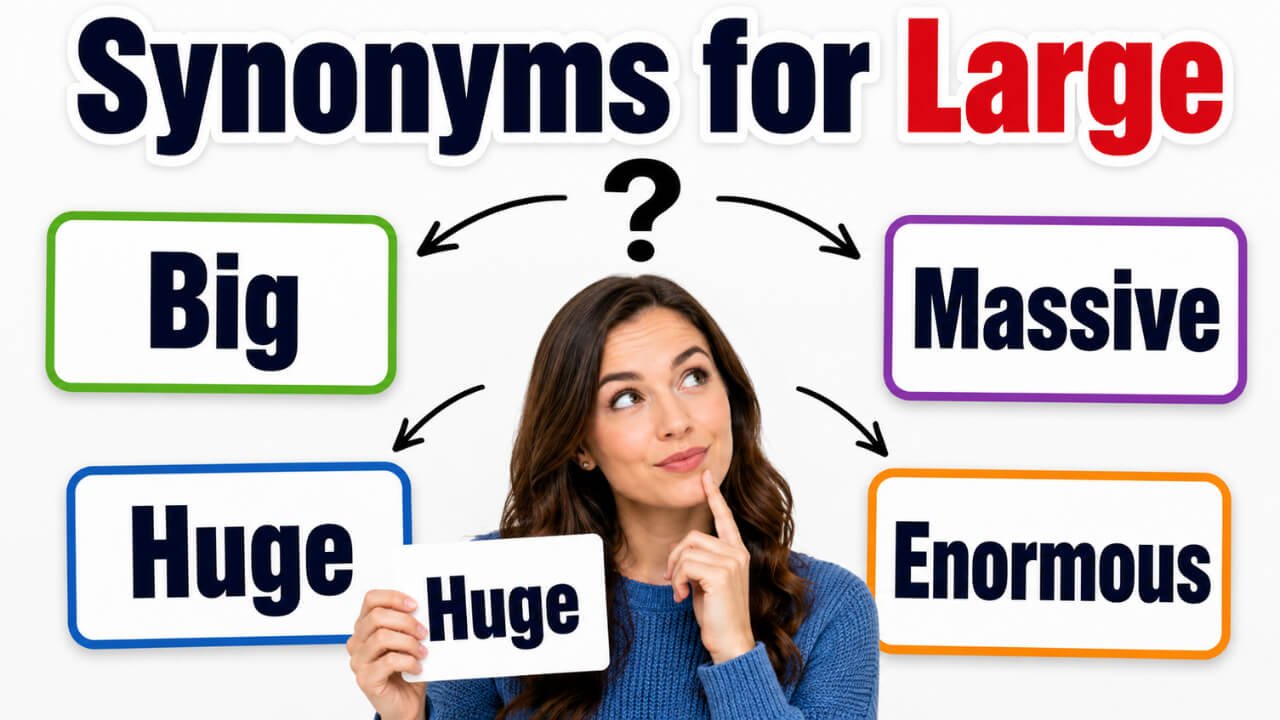
Quick Answer: The best synonyms for large include big, huge, enormous, massive, vast, immense, sizable, substantial, considerable, and spacious. Use big in casual speech, large in neutral writing, substantial in formal or professional contexts, vast for wide areas or amounts, massive for great size or weight, and spacious when describing rooms, homes, or open areas.
Pronunciation and Word Details
Word: Large.
Pronunciation: /lɑːrdʒ/.
Part of Speech: Adjective.
Meaning: Greater than average in size, amount, number, extent, or importance.
US Pronunciation:
UK Pronunciation:
What Does “Large” Mean?
Direct Answer: Large means bigger than normal, greater than average, or wide in size, amount, number, or extent.
Large is mainly used as an adjective. It can describe physical size, such as a large house, a large box, or a large animal. It can also describe quantity, scale, importance, or degree, such as a large amount, a large problem, a large audience, or a large difference.
The word is neutral and common in both speech and writing. It works well when you want a clear, simple, and accurate description without sounding too emotional or exaggerated.
Meaning, Tone, and Context of “Large”
Large has a neutral tone. It is not too formal, not too casual, and not strongly emotional. That makes it useful in everyday conversation, school writing, business writing, reports, product descriptions, and general explanations.
In casual speech, many people use big instead of large. In formal writing, words like substantial, considerable, extensive, and significant may sound more precise. In descriptive writing, words like huge, massive, vast, and immense can create stronger imagery.
Large is commonly used for size, area, quantity, number, volume, impact, and importance.
When and How to Use “Large”
For Physical Size: Use large when something is bigger than average in shape, height, width, or overall size.
Example: They bought a large table for the dining room.
For Amount: Use large when describing a high quantity or volume.
Example: The project required a large amount of time.
For Number: Use large when talking about many people, items, or results.
Example: A large group attended the grammar workshop.
For Area: Use large when describing wide spaces, land, buildings, or rooms.
Example: The library has a large reading hall.
For Importance: Use large when something has a major role, effect, or influence.
Example: Good vocabulary plays a large part in clear communication.
For General Description: Use large when you need a simple word that fits many contexts.
Example: The report showed a large increase in vocabulary test scores.
Best Synonyms for Large
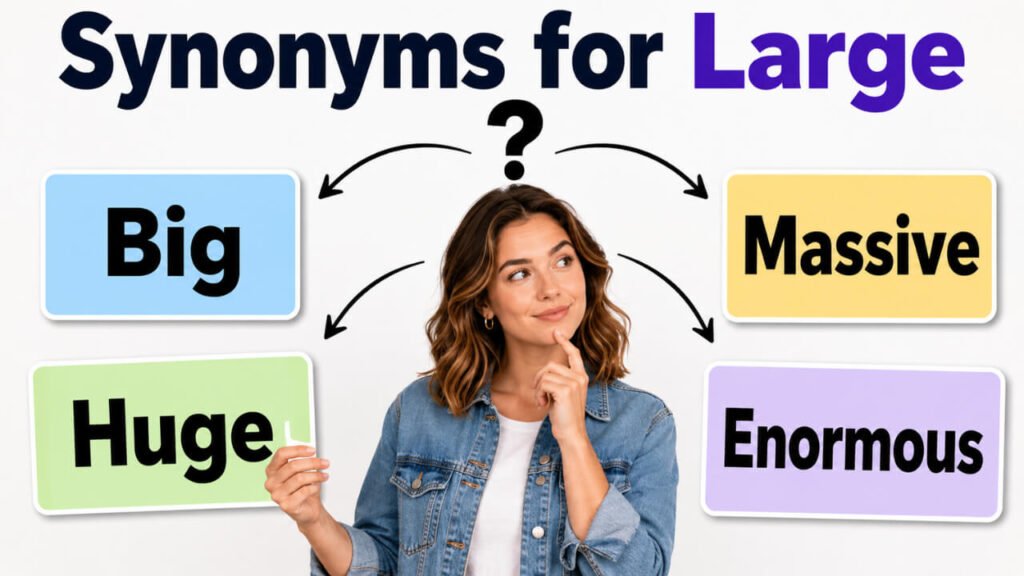
Big: Common and casual word for something large in size or amount.
Example: They moved into a big apartment near the school.
Huge: Very large and often impressive.
Example: The dictionary had a huge list of word meanings.
Enormous: Extremely large in size, number, or degree.
Example: The team faced an enormous challenge.
Massive: Very large, heavy, strong, or serious.
Example: The building had a massive entrance.
Vast: Very large in area, amount, or extent.
Example: She has a vast knowledge of grammar rules.
Immense: Extremely large or great in size, value, or importance.
Example: The teacher showed immense patience with every student.
Sizable: Fairly large or noticeably big.
Example: They collected a sizable list of useful synonyms.
Substantial: Large in amount, value, or importance, especially in formal writing.
Example: The new method made a substantial difference.
Considerable: Large enough to be important or worth noticing.
Example: The article received considerable attention from readers.
Spacious: Large with plenty of room inside.
Example: The classroom was spacious and comfortable.
50 Synonyms for Large with Short Meanings
- Big: Greater than average in size.
- Huge: Very large in size or amount.
- Enormous: Extremely large or great.
- Massive: Very large, heavy, or powerful.
- Vast: Very wide in area or extent.
- Immense: Extremely large or impressive.
- Gigantic: Extremely big in size.
- Giant: Much bigger than normal.
- Colossal: Extremely large and impressive.
- Mammoth: Very large and powerful in size.
- Sizable: Fairly large or noticeable.
- Substantial: Large in amount, value, or importance.
- Considerable: Large enough to matter.
- Great: Large in size, degree, or importance.
- Extensive: Covering a large area or range.
- Expansive: Wide, open, or covering much space.
- Broad: Wide from side to side.
- Wide: Having great distance across.
- Spacious: Having plenty of room.
- Roomy: Large enough to feel comfortable.
- Capacious: Able to hold a large amount.
- Oversized: Larger than the usual size.
- Outsized: Much larger than normal.
- Bulky: Large and difficult to carry or move.
- Hefty: Large, heavy, or strong.
- Heavy: Large in weight or amount.
- Grand: Large, impressive, or important.
- Monumental: Very large, important, or impressive.
- Tremendous: Very large in size, amount, or degree.
- Towering: Very tall or high.
- Tall: Greater than average in height.
- High: Extending far upward.
- Long: Great in length.
- Deep: Extending far down or inward.
- Full: Containing a large amount.
- Abundant: More than enough in quantity.
- Plentiful: Available in large amounts.
- Copious: Large in quantity or supply.
- Ample: More than enough in size or amount.
- Generous: Larger than expected or needed.
- Lavish: Large, rich, or abundant.
- Major: Large in importance or effect.
- Important: Large in value or meaning.
- Significant: Large enough to be noticed or important.
- Notable: Large or important enough to deserve attention.
- Marked: Clearly noticeable in size or degree.
- Prominent: Large, important, or easily noticed.
- Sweeping: Covering a large range or area.
- Widespread: Existing over a large area.
- Far reaching: Having a large effect or influence.
Read Also:
Synonyms for Overall
Synonyms for Large by Context
When Large Means Big in Size
Use these synonyms when describing physical objects, buildings, people, animals, or visible size.
Useful Synonyms: Big, huge, enormous, gigantic, massive, oversized, bulky.
Example: They placed a massive cabinet against the wall.
Example: The child carried a big school bag.
When Large Means Great in Amount
Use these words when describing quantity, supply, number, or volume.
Useful Synonyms: Substantial, considerable, abundant, plentiful, copious, ample, generous.
Example: The lesson includes a substantial number of examples.
Example: The guide gives ample practice for new learners.
When Large Means Wide or Spacious
Use these synonyms for rooms, land, fields, buildings, halls, and open spaces.
Useful Synonyms: Spacious, roomy, vast, expansive, broad, wide, capacious.
Example: The office has a spacious meeting room.
Example: The country has vast open plains.
When Large Means Important or Serious
Use these synonyms when the meaning is about importance, effect, influence, or value.
Useful Synonyms: Major, significant, substantial, considerable, important, notable, prominent.
Example: Vocabulary has a significant role in strong writing.
Example: The mistake caused a major delay in the project.
When Large Means Extensive in Range
Use these synonyms when describing coverage, reach, influence, research, or information.
Useful Synonyms: Extensive, sweeping, widespread, far reaching, broad, vast.
Example: The book provides extensive grammar guidance.
Example: The decision had far reaching effects.
Another Word for Large
Direct Answer: Another word for large is big, but the best replacement depends on the context.
Use big for everyday speech, huge for stronger emphasis, spacious for rooms, vast for areas or knowledge, and substantial for formal writing about amount or importance.
Original: They live in a large house.
Better Option: They live in a spacious house.
Original: The company made a large profit.
Better Option: The company made a substantial profit.
Original: A large crowd entered the hall.
Better Option: A huge crowd entered the hall.
Original: He has a large amount of experience.
Better Option: He has extensive experience.
When Not to Use “Large”
Do not use large when a more specific word gives a clearer meaning. Large can sound plain, repetitive, or less exact if the sentence needs detail about height, width, amount, weight, importance, or space.
Use tall for height, wide for width, heavy for weight, spacious for rooms, substantial for amount, and significant for importance.
Weak: She has a large knowledge of grammar.
Better: She has extensive knowledge of grammar.
Weak: The room is large and large windows make it bright.
Better: The room is spacious, and wide windows make it bright.
Weak: The box was large and hard to lift.
Better: The box was bulky and hard to lift.
Weak: There was a large change in the results.
Better: There was a significant change in the results.
Words Commonly Confused With Large
Large vs Big: Large is more neutral and slightly more formal, while big is more common in casual speech.
Large vs Huge: Large means bigger than average, while huge means very large and stronger in tone.
Large vs Enormous: Large is general, while enormous means extremely large.
Large vs Massive: Large describes size, while massive often suggests great weight, strength, or seriousness.
Large vs Vast: Large can describe many things, while vast is best for wide areas, large amounts, or great extent.
Large vs Spacious: Large means big, while spacious means large with plenty of comfortable room.
Large vs Substantial: Large describes size or amount, while substantial often describes serious value, importance, or quantity.
Large vs Extensive: Large is general, while extensive describes wide range, broad coverage, or detailed scope.
Which Synonym Should You Choose?
Choose big for casual speech and simple everyday sentences.
Choose large for neutral writing when you want a clear and flexible word.
Choose huge when you want stronger emphasis without sounding too formal.
Choose enormous when something is extremely large in size, number, or degree.
Choose massive when size, weight, strength, or seriousness matters.
Choose vast when writing about land, space, knowledge, range, or extent.
Choose spacious when describing rooms, homes, halls, or places with plenty of room.
Choose substantial when writing about money, value, amount, evidence, or importance.
Choose considerable when something is large enough to be noticed or taken seriously.
Choose extensive when writing about research, experience, coverage, details, or range.
Real Life Examples of “Large” in Sentences
Original: The school has a large library.
Better Option: The school has a spacious library.
Original: They received a large number of applications.
Better Option: They received a substantial number of applications.
Original: A large dog stood near the gate.
Better Option: A huge dog stood near the gate.
Original: She made a large improvement in her writing.
Better Option: She made a significant improvement in her writing.
Original: The article covers a large range of grammar topics.
Better Option: The article covers an extensive range of grammar topics.
Original: The village has a large open field.
Better Option: The village has a vast open field.
Original: He carried a large suitcase upstairs.
Better Option: He carried a bulky suitcase upstairs.
Original: The meeting had a large effect on the decision.
Better Option: The meeting had a major effect on the decision.
Original: There was a large supply of fresh fruit.
Better Option: There was an abundant supply of fresh fruit.
Original: The room felt large and comfortable.
Better Option: The room felt roomy and comfortable.
Synonym Groups and Usage Differences
Size Group
Words in this group describe physical size. Use them for objects, animals, buildings, and visible things.
Synonyms: Big, huge, enormous, gigantic, massive.
Example: The museum has a gigantic statue near the entrance.
Amount Group
Words in this group describe quantity, supply, money, number, or volume.
Synonyms: Substantial, considerable, abundant, plentiful, copious.
Example: The report includes considerable evidence.
Space Group
Words in this group describe open areas, rooms, buildings, or places with enough room.
Synonyms: Spacious, roomy, vast, expansive, wide.
Example: The new classroom is spacious and bright.
Importance Group
Words in this group describe value, effect, influence, or seriousness.
Synonyms: Major, significant, important, notable, prominent.
Example: Clear word choice has a significant effect on meaning.
Range Group
Words in this group describe scope, coverage, reach, or extent.
Synonyms: Extensive, broad, widespread, sweeping, far reaching.
Example: The course gives extensive practice in vocabulary.
Antonyms of Large
Small: Not big in size.
Tiny: Extremely small.
Little: Small in size, amount, or importance.
Miniature: Much smaller than normal.
Narrow: Not wide.
Short: Not long or not tall.
Low: Not high.
Limited: Small in amount, range, or extent.
Minor: Not large in importance or effect.
Slight: Small in degree or amount.
Compact: Small but efficiently arranged.
Cramped: Too small or crowded.
Comparison: Large vs Related Words
Large vs Big
Difference: Large is more neutral and polished, while big sounds more casual and conversational.
Example With Large: The hotel has a large conference room.
Example With Big: They bought a big sofa for the living room.
Large vs Huge
Difference: Large means bigger than average, while huge adds stronger emphasis.
Example With Large: A large crowd gathered outside.
Example With Huge: A huge crowd filled the entire hall.
Large vs Enormous
Difference: Large is general, while enormous means extremely large.
Example With Large: The building has a large entrance.
Example With Enormous: The palace has an enormous entrance.
Large vs Massive
Difference: Large focuses on size, while massive can suggest size, weight, power, or seriousness.
Example With Large: They moved a large table into the room.
Example With Massive: They moved a massive stone table into the room.
Large vs Vast
Difference: Large can describe many things, while vast works best for areas, spaces, knowledge, or extent.
Example With Large: She has a large collection of books.
Example With Vast: She has a vast knowledge of literature.
Large vs Spacious
Difference: Large means big, while spacious means big with comfortable open space.
Example With Large: The apartment is large.
Example With Spacious: The apartment is spacious and easy to move around in.
Large vs Substantial
Difference: Large describes size or amount, while substantial sounds more formal and often means important or valuable.
Example With Large: They saved a large amount of money.
Example With Substantial: They saved a substantial amount of money.
Common Phrases and Expressions With Large
Large Amount: A high quantity.
Large Number: Many people, things, or examples.
Large Size: Bigger than average size.
Large Scale: Wide in scope or range.
Large Part: An important share or role.
Large Group: Many people together.
Large Area: A wide space or region.
Large Family: A family with many members.
Large Crowd: Many people gathered in one place.
At Large: Free, not captured, or generally considered.
Common Mistakes to Avoid
One common mistake is using large too often when a more exact synonym would sound better. Repeating the same word can make writing feel dull.
Another mistake is using large for every type of size. A person can be tall, a river can be wide, a suitcase can be bulky, and a room can be spacious.
Avoid using strong synonyms like colossal, gigantic, or enormous in formal writing unless the size is truly extreme. These words can sound exaggerated when the meaning only requires large, substantial, or considerable.
Also avoid confusing large with important in every context. Sometimes significant, major, or notable is more accurate.
Conclusion
Synonyms for large help you describe size, amount, space, importance, and range with more accuracy. Use big for casual speech, huge or enormous for emphasis, spacious for rooms, vast for wide areas, substantial for formal amounts, and significant for important effects. The best synonym depends on what you are describing. Strong word choice makes your writing clearer, more natural, and more useful for readers.
FAQs About Synonyms for Large
What is the best synonym for large?
Answer: The best general synonym for large is big. For formal writing, substantial, considerable, or extensive may be better.
What is a formal synonym for large?
Answer: Formal synonyms for large include substantial, considerable, significant, extensive, and major.
What is a stronger word than large?
Answer: Stronger words than large include huge, enormous, massive, gigantic, immense, and colossal.
What is another word for a large room?
Answer: Another word for a large room is spacious. You can also use roomy if the tone is more casual.
What is another word for a large amount?
Answer: Another word for a large amount is substantial. Other good choices include considerable, abundant, copious, and ample.
Is large more formal than big?
Answer: Yes, large is slightly more formal and neutral than big. Big is common in everyday conversation.
What is the opposite of large?
Answer: The opposite of large is small. Other antonyms include tiny, little, minor, limited, and compact.
