
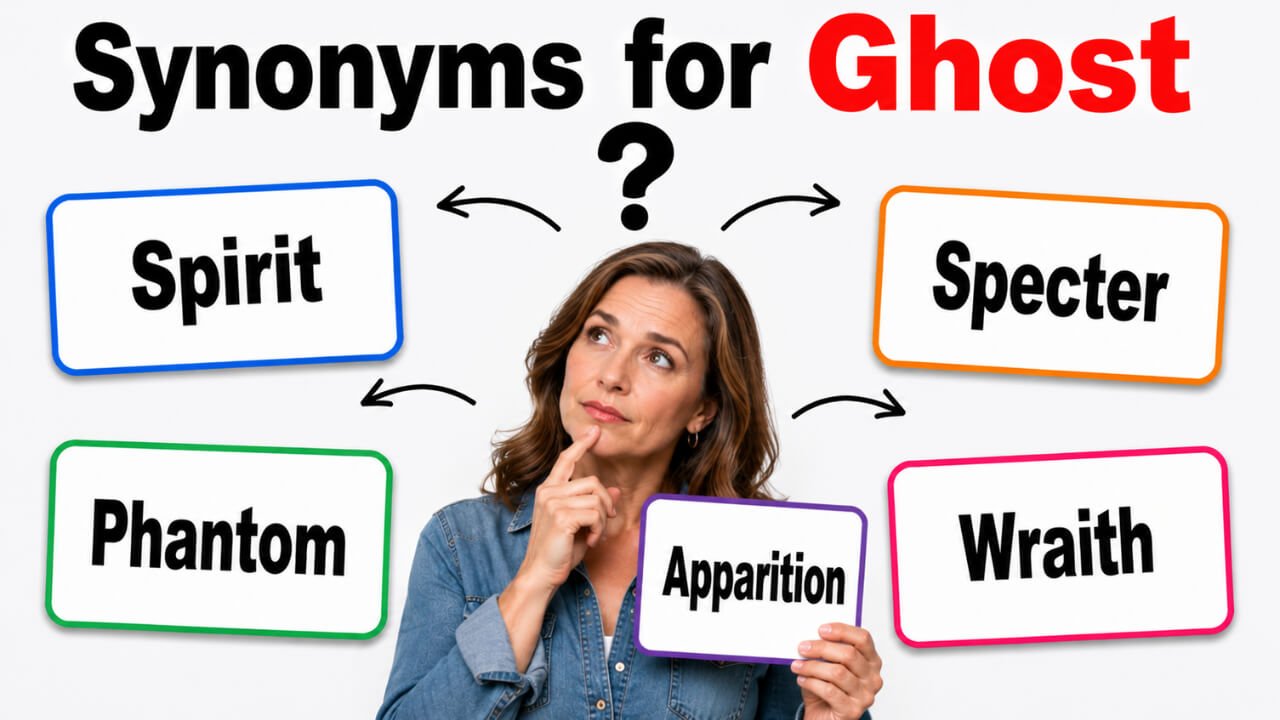
Quick Answer: The best synonyms for ghost are spirit, apparition, phantom, specter, wraith, shade, revenant, soul, presence, and poltergeist. Use spirit as the broadest neutral alternative, apparition for something that suddenly appears, phantom for an unreal or mysterious figure, and specter for a frightening presence. Wraith and shade suit literary writing, while revenant describes someone believed to have returned from the dead. When ghost is a verb meaning to disappear without explanation, use vanish, withdraw, ignore, or go silent.
Pronunciation and Word Details
Word: Ghost
Pronunciation: /ɡoʊst/
Part of Speech: Noun and verb
Meaning: A ghost is the spirit or appearance of a dead person, while the verb can mean disappearing or ending communication without explanation.
US Pronunciation:
UK Pronunciation:
What Does “Ghost” Mean?
“Ghost” usually means the spirit or visible form of a dead person believed to appear to the living.
As a noun, it can describe a supernatural being, a mysterious figure, a faint image, or a reminder of something that existed in the past.
Supernatural Meaning: The old story describes a ghost wandering through the house.
Faint Image Meaning: A ghost of the original picture remained on the screen.
Lingering Memory Meaning: The ghost of an earlier conflict still affected their decisions.
As a verb, “ghost” can mean leaving a place quietly, disappearing suddenly, or stopping communication with someone without giving an explanation.
Disappearance Meaning: The suspect ghosted out of the building before anyone noticed.
Communication Meaning: He ghosted the group after agreeing to help.
The intended meaning depends on whether the word refers to a spirit, an unclear image, a lasting memory, physical disappearance, or unexplained silence.
Meaning, Tone, and Context of “Ghost”
“Ghost” can sound supernatural, mysterious, emotional, literary, casual, or unsettling depending on the context.
When it refers to a dead person’s spirit, the word is neutral and widely understood. It appears in stories, folklore, conversations, descriptions, and discussions about supernatural beliefs.
Example: Local stories claim that a ghost appears near the bridge.
Words such as apparition, specter, wraith, and shade create a more literary or dramatic tone.
Example: A pale wraith moved through the mist.
When “ghost” describes a faint trace or memory, it often has a figurative and emotional tone.
Example: A ghost of regret remained in his expression.
As a verb meaning to stop responding, “ghost” is informal and conversational. More formal alternatives include withdraw from communication, end contact, or cease responding.
Informal Example: She ghosted him after their final conversation.
Formal Example: She ended communication without providing an explanation.
The word can also describe something that is empty, abandoned, hidden, or barely visible.
Example: The once crowded settlement had become a ghost town.
When and How to Use “Ghost”
For a Supernatural Spirit
Use “ghost” when discussing the believed spirit of a dead person.
Explanation: Spirit is the broadest alternative, while apparition and specter create a more dramatic effect.
Example: The children claimed that they had seen a ghost near the stairs.
For a Mysterious Appearance
Use “ghost” for a figure that appears suddenly, seems unreal, or cannot be clearly identified.
Explanation: Apparition, phantom, and vision work well in this meaning.
Example: A ghost appeared briefly at the end of the hallway.
For a Frightening Presence
Use “ghost” when a supernatural figure creates fear or unease.
Explanation: Specter, wraith, and spook can add a darker tone.
Example: The ghost frightened everyone who entered the room.
For a Lingering Memory
Use “ghost” figuratively when an earlier event continues to affect the present.
Explanation: Echo, trace, shadow, and memory may express the idea more clearly.
Example: The ghost of the disagreement remained between them.
For a Faint Image
Use “ghost” when an image, shape, or mark is barely visible.
Explanation: Afterimage, outline, imprint, and faint image are useful alternatives.
Example: A ghost of the old lettering remained on the wall.
For Sudden Disappearance
Use “ghost” as a verb when someone leaves or disappears without attracting attention.
Explanation: Vanish, slip away, withdraw, or disappear may be clearer.
Example: The stranger ghosted into the crowd.
For Ending Communication
Use “ghost” informally when someone suddenly stops replying or breaks contact without explanation.
Explanation: Go silent, stop replying, ignore, and break contact describe this behavior more directly.
Example: He ghosted his friends after moving to another city.
For Hidden or Empty Places
Use “ghost” before another noun when something is deserted, inactive, or no longer functioning normally.
Explanation: Abandoned, deserted, empty, or inactive may work as clearer alternatives.
Example: The abandoned mining area became a ghost settlement.
Best Synonyms for Ghost
Spirit
Synonym: The nonphysical part of a person believed to continue after death.
Example: The story says that a spirit protects the house.
Apparition
Synonym: A mysterious or supernatural figure that appears unexpectedly.
Example: A pale apparition appeared beside the window.
Phantom
Synonym: A ghostly figure or something that seems real but does not physically exist.
Example: The traveler saw a phantom in the fog.
Specter
Synonym: A frightening ghost or a threatening presence.
Example: A dark specter seemed to follow them.
Wraith
Synonym: A thin, shadowy ghost, especially in literary descriptions.
Example: A silent wraith moved through the ruined building.
Shade
Synonym: The spirit of a dead person, especially in poetic or literary writing.
Example: The shade of the former king appeared in the dream.
Revenant
Synonym: A dead person believed to have returned among the living.
Example: The legend describes a revenant seeking justice.
Soul
Synonym: The spiritual part of a person believed to exist beyond physical life.
Example: They believed the soul had found peace.
Presence
Synonym: An unseen or unexplained feeling that someone or something is nearby.
Example: She sensed a strange presence behind her.
Poltergeist
Synonym: A spirit believed to cause noises, movement, or physical disturbances.
Example: The family blamed the unexplained sounds on a poltergeist.
50 Synonyms for Ghost with Short Meanings
- Spirit: The nonphysical part of a dead person.
- Apparition: A supernatural figure that appears suddenly.
- Phantom: An unreal, mysterious, or ghostly figure.
- Specter: A frightening ghost or threatening presence.
- Wraith: A thin and shadowy ghostly form.
- Shade: A spirit of the dead in literary language.
- Revenant: A dead person believed to have returned.
- Soul: The spiritual part of a person.
- Presence: An unseen being or unexplained feeling nearby.
- Poltergeist: A spirit believed to cause physical disturbances.
- Spook: An informal word for a ghost or frightening figure.
- Vision: A supernatural or imagined appearance.
- Manifestation: A visible appearance of a spirit or force.
- Entity: A being whose exact nature is unknown.
- Phantasm: An imagined or ghostly figure.
- Eidolon: A spirit, idealized image, or ghostly likeness.
- Banshee: A female spirit associated with warning cries.
- Restless Spirit: A soul believed to remain among the living.
- Departed Soul: The spirit of someone who has died.
- Disembodied Spirit: A spirit existing without a physical body.
- Ghostly Figure: A person shaped supernatural appearance.
- Spectral Figure: A figure resembling a ghost.
- Unseen Presence: Something felt nearby but not visible.
- Shadow: A dark shape or lingering influence.
- Silhouette: A dark outline of a person or object.
- Afterimage: A faint image remaining after the original disappears.
- Echo: A remaining effect or reminder of the past.
- Trace: A small sign that something once existed.
- Remnant: A remaining part of something largely gone.
- Vestige: A faint surviving sign of the past.
- Imprint: A lasting mark, image, or influence.
- Memory: A mental reminder of a person or event.
- Residue: Something left behind after the rest has disappeared.
- Outline: The visible outer shape of something.
- Reflection: An image appearing in a surface.
- Disappear: To cease being visible or present.
- Vanish: To disappear suddenly or completely.
- Fade: To gradually become weaker or less visible.
- Withdraw: To move away or end involvement.
- Leave: To go away from a person or place.
- Abandon: To leave someone or something behind.
- Desert: To leave a person or responsibility without support.
- Evade: To avoid someone or escape attention.
- Avoid: To deliberately stay away from someone.
- Ignore: To give no attention or response.
- Go Silent: To suddenly stop communicating.
- Stop Replying: To discontinue responses without explanation.
- Break Contact: To end communication with someone.
- Slip Away: To leave quietly or without being noticed.
- Cut Off Communication: To completely stop exchanging messages or information.
Read Also:
Synonyms for Correct

Synonyms for Ghost by Context
When Ghost Means a Spirit
Spirit, soul, departed soul, disembodied spirit, shade, and revenant refer to a person believed to exist after death.
Spirit: The clearest and broadest alternative.
Example: They believed a friendly spirit watched over the family.
Soul: Focuses on the spiritual essence of a person.
Example: The ceremony honored the soul of the departed leader.
Shade: Adds a poetic or classical tone.
Example: The shade wandered silently beside the river.
Revenant: Describes someone believed to have returned from death.
Example: The villagers feared that the revenant had come back for revenge.
When Ghost Means an Apparition
Apparition, phantom, vision, manifestation, phantasm, and spectral figure describe something that appears supernatural or unreal.
Apparition: Best for an unexpected supernatural appearance.
Example: The apparition disappeared when the light entered the room.
Phantom: Suggests something mysterious, unreal, or difficult to explain.
Example: A phantom seemed to cross the empty road.
Vision: May describe a spiritual, imagined, or dreamlike appearance.
Example: She saw a vision of a woman dressed in white.
Manifestation: Describes the visible form of a supernatural force or presence.
Example: The moving shadow was believed to be a manifestation of the spirit.
When Ghost Means a Frightening Being
Specter, wraith, spook, poltergeist, and banshee have stronger associations with fear.
Specter: Suggests a frightening or threatening ghost.
Example: A dark specter stood at the foot of the stairs.
Wraith: Creates a shadowy and literary image.
Example: The wraith vanished into the night.
Spook: An informal term for a frightening ghost.
Example: The children invented a story about a spook in the attic.
Poltergeist: Describes a spirit associated with unexplained movement or noise.
Example: They believed a poltergeist was moving the furniture.
When Ghost Means a Lingering Influence
Echo, shadow, trace, memory, imprint, remnant, and vestige describe something from the past that continues to affect the present.
Echo: A repeated feeling, pattern, or effect from an earlier time.
Example: The new conflict was an echo of an older disagreement.
Shadow: A dark or troubling influence that remains.
Example: The shadow of failure affected his confidence.
Trace: A small remaining sign.
Example: No trace of anger remained in her voice.
Imprint: A lasting effect on a person, place, or situation.
Example: The experience left a deep imprint on his character.
When Ghost Means a Faint Image
Afterimage, outline, silhouette, reflection, residue, and faint image describe something barely visible.
Afterimage: An image that remains briefly after the original is gone.
Example: An afterimage of the bright light remained in her vision.
Outline: The outer shape of something without full detail.
Example: The outline of a person appeared through the curtain.
Silhouette: A dark shape visible against a lighter background.
Example: A silhouette stood at the top of the hill.
Residue: A mark or substance remaining after something has disappeared.
Example: A pale residue showed where the sign had once hung.
When Ghost Means to Disappear
Disappear, vanish, fade, withdraw, slip away, and leave describe someone becoming absent.
Disappear: The most neutral and direct alternative.
Example: The stranger disappeared before anyone could speak to him.
Vanish: Suggests sudden and complete disappearance.
Example: The animal vanished into the forest.
Fade: Suggests gradual disappearance.
Example: The distant figure faded into the fog.
Slip Away: Suggests leaving quietly and unnoticed.
Example: She slipped away before the meeting ended.
When Ghost Means to Stop Responding
Ignore, go silent, stop replying, break contact, avoid, and cut off communication describe ending contact without explanation.
Ignore: Means refusing to acknowledge messages or attempts at contact.
Example: He ignored every message she sent.
Go Silent: Describes a sudden end to communication.
Example: The client went silent after requesting the final proposal.
Stop Replying: A clear and direct description of the behavior.
Example: She stopped replying after their disagreement.
Break Contact: Means ending communication more deliberately.
Example: He broke contact with the group after leaving the project.
Another Word for Ghost
“Spirit” is the best general replacement when ghost refers to the believed nonphysical form of a dead person. Apparition works better for something suddenly seen, while phantom emphasizes mystery or unreality. When ghost is a verb, disappear is the clearest general alternative. Stop replying or go silent is more precise when the word describes unexplained communication withdrawal.
Original: They believed a ghost lived in the old house.
Better Option: They believed a spirit lived in the old house.
Original: A ghost appeared beside the window.
Better Option: An apparition appeared beside the window.
Original: The figure ghosted into the fog.
Better Option: The figure vanished into the fog.
Original: He ghosted his colleagues after leaving the job.
Better Option: He stopped replying to his colleagues after leaving the job.
When Not to Use “Ghost”
When You Need a Neutral Description
“Ghost” may sound supernatural when you only mean an unclear shape or image.
Weak: A ghost appeared on the damaged photograph.
Better: A faint image appeared on the damaged photograph.
When Discussing Religious Beliefs Carefully
Spirit, soul, or departed soul may be more respectful when describing beliefs about life after death.
Weak: They prayed for the ghost of their relative.
Better: They prayed for the soul of their relative.
When Describing Technical Image Problems
Afterimage, duplicate image, faint outline, or visual residue may be clearer in technical writing.
Weak: A ghost remained on the display.
Better: An afterimage remained on the display.
When Writing Formally About Communication
The verb “ghost” is informal and may sound unsuitable in reports, policies, or professional messages.
Weak: The applicant ghosted the recruitment team.
Better: The applicant stopped responding to the recruitment team.
When the Disappearance Was Explained
Do not describe someone as ghosting if the person clearly ended the relationship or explained the decision.
Weak: She ghosted the group after announcing that she was leaving.
Better: She withdrew from the group after announcing her decision.
When the Word Creates Unnecessary Drama
Use a simpler word if the supernatural image distracts from the intended meaning.
Weak: The ghost of the old design remained in the document.
Better: A trace of the old design remained in the document.
Words Commonly Confused With Ghost
Ghost vs Spirit: Ghost usually refers to the believed appearance of a dead person. Spirit is broader and can refer to a soul, supernatural being, mood, or inner character.
Ghost vs Apparition: Ghost names the being itself. Apparition focuses on the act or experience of something supernatural appearing.
Ghost vs Phantom: Ghost usually suggests a dead person’s spirit. Phantom may describe a ghost, an illusion, an imagined threat, or something that seems present but is not real.
Ghost vs Specter: Ghost is neutral and general. Specter often has a darker, more threatening, or frightening tone.
Ghost vs Wraith: Ghost is common in everyday language. Wraith is more literary and usually describes a thin, shadowy supernatural figure.
Ghost vs Poltergeist: Ghost is a general term. Poltergeist specifically refers to a spirit believed to create noise or move physical objects.
Ghost vs Soul: Ghost suggests a spirit appearing among the living. Soul refers more broadly to the spiritual essence of a person.
Ghost vs Afterimage: Ghost can describe a supernatural being or faint image. Afterimage specifically describes an image that remains after the original object or light is gone.
Ghost vs Ignore: Ghosting involves ending communication without explanation. Ignoring may happen once or repeatedly and does not always mean ending contact completely.
Which Synonym Should You Choose?
Choose spirit for a broad and neutral reference to a supernatural being.
Choose apparition when describing something that suddenly appears.
Choose phantom when the figure seems unreal, mysterious, or imagined.
Choose specter for a frightening presence or symbolic threat.
Choose wraith for literary, poetic, or dark descriptions.
Choose shade for classical or poetic writing about the dead.
Choose revenant when describing someone believed to have returned from death.
Choose soul when focusing on the spiritual essence of a person.
Choose presence when something is sensed but not clearly seen.
Choose poltergeist when unexplained movement or noise is involved.
Choose echo when referring to a repeated effect from the past.
Choose trace when only a small sign remains.
Choose afterimage for a faint visual image that continues after the original disappears.
Choose vanish for sudden disappearance.
Choose fade for gradual disappearance.
Choose withdraw when someone deliberately steps away from contact or participation.
Choose go silent when communication suddenly stops.
Choose stop replying for a direct and clear description of unanswered communication.
Choose break contact when someone intentionally ends communication.
Real Life Examples of “Ghost” in Sentences
Original: The children believed a ghost lived in the attic.
Better Option: The children believed a spirit lived in the attic.
Original: A ghost appeared at the end of the hallway.
Better Option: An apparition appeared at the end of the hallway.
Original: The traveler saw a ghost moving through the mist.
Better Option: The traveler saw a phantom moving through the mist.
Original: The ghost frightened everyone in the building.
Better Option: The specter frightened everyone in the building.
Original: The ghost of the old disagreement remained.
Better Option: The shadow of the old disagreement remained.
Original: A ghost of the original image was still visible.
Better Option: An afterimage of the original picture was still visible.
Original: The person ghosted into the crowd.
Better Option: The person vanished into the crowd.
Original: She ghosted the party before dinner ended.
Better Option: She slipped away from the party before dinner ended.
Original: He ghosted his former teammates.
Better Option: He stopped replying to his former teammates.
Original: The customer ghosted the business after requesting information.
Better Option: The customer went silent after requesting information.
Synonym Groups and Usage Differences
Supernatural Spirit Group
Spirit, soul, shade, revenant, departed soul, and disembodied spirit describe beings connected with death or the afterlife.
Spirit is the broadest word. Soul focuses on a person’s spiritual essence, while revenant suggests a dead person returning.
Example: The villagers believed the restless spirit returned each winter.
Appearance Group
Apparition, phantom, vision, manifestation, phantasm, and spectral figure focus on something supernatural or unreal becoming visible.
Apparition emphasizes sudden appearance. Phantom adds mystery, while vision may suggest a spiritual or imagined experience.
Example: A pale apparition appeared briefly beside the gate.
Fear Group
Specter, wraith, spook, poltergeist, and banshee create a darker or more frightening tone.
Specter suggests threat, wraith sounds literary, and poltergeist refers to a spirit associated with physical disturbances.
Example: A shadowy wraith followed the travelers through the ruins.
Lingering Influence Group
Echo, shadow, trace, memory, imprint, remnant, and vestige describe something from the past that remains present.
Echo suggests repetition, shadow suggests a troubling influence, and vestige describes a very small surviving sign.
Example: The decision carried an echo of earlier mistakes.
Faint Image Group
Afterimage, silhouette, outline, reflection, residue, and ghostly figure describe shapes or images that are unclear or incomplete.
Afterimage is useful for visual effects, while silhouette describes a dark shape against a lighter background.
Example: A faint silhouette was visible behind the curtain.
Disappearance Group
Disappear, vanish, fade, withdraw, slip away, leave, and evade describe becoming absent.
Vanish suggests sudden disappearance. Fade suggests gradual change, while slip away implies leaving quietly.
Example: The distant figure faded into the evening mist.
Communication Group
Ignore, go silent, stop replying, avoid, break contact, and cut off communication describe ending or reducing contact.
Go silent is conversational, while cut off communication is clearer and more formal.
Example: The supplier stopped replying after the payment question was raised.
Antonyms of Ghost
The opposite of ghost depends on whether the word refers to visibility, presence, communication, or abandonment.
Living Person: Someone who is alive rather than a spirit of the dead.
Physical Being: A person or creature with a material body.
Reality: Something that truly exists rather than an illusion.
Presence: The state of being available or physically nearby.
Appearance: The act of becoming visible.
Arrival: The act of reaching a person or place.
Remain: To continue staying in a place.
Stay: To avoid leaving or disappearing.
Respond: To answer a message or request.
Reply: To communicate an answer.
Engage: To take part in communication or activity.
Acknowledge: To show that a message or person has been noticed.
Contact: To begin or continue communication.
Support: To remain available and helpful.
Commit: To continue participating in a relationship or responsibility.
Comparison: Ghost vs Related Words
Ghost vs Spirit
Ghost usually describes the spirit of a dead person believed to appear physically. Spirit is broader and may refer to any nonphysical being or the inner nature of a person.
Example With Ghost: A ghost appeared beside the old staircase.
Example With Spirit: They believed a protective spirit watched over the village.
Ghost vs Apparition
Ghost refers to the supernatural being. Apparition emphasizes the mysterious sight or appearance.
Example With Ghost: The story describes a ghost living in the house.
Example With Apparition: An apparition appeared and vanished within seconds.
Ghost vs Phantom
Ghost is commonly associated with a dead person. Phantom can describe a ghost, illusion, imagined sensation, or unreal threat.
Example With Ghost: The ghost was believed to be the former owner.
Example With Phantom: A phantom figure crossed the empty road.
Ghost vs Specter
Ghost is a neutral general term. Specter often suggests fear, danger, or a threatening idea.
Example With Ghost: They told stories about a ghost near the lake.
Example With Specter: The specter of failure troubled the entire team.
Ghost vs Wraith
Ghost is suitable for everyday speech. Wraith is more poetic and describes a thin, shadowy figure.
Example With Ghost: She thought she saw a ghost.
Example With Wraith: A pale wraith drifted through the moonlight.
Ghost vs Soul
Ghost usually suggests an appearing spirit. Soul describes the spiritual essence or deepest character of a person.
Example With Ghost: The legend says that a ghost returns every year.
Example With Soul: They prayed that the departed soul would find peace.
Ghost vs Vanish
Ghost can mean disappearing without explanation, especially from communication. Vanish simply means to disappear suddenly.
Example With Ghost: He ghosted the group after accepting the task.
Example With Vanish: He vanished from the room before the announcement.
Ghost vs Ignore
Ghosting usually involves a continuing and unexplained end to communication. Ignoring can describe one unanswered message or a temporary refusal to respond.
Example With Ghost: She ghosted him after several weeks of conversation.
Example With Ignore: She ignored one message because she was busy.
Common Phrases and Expressions With Ghost
Ghost Story: A story about spirits, supernatural beings, or unexplained events.
Ghost Town: A place that has been largely or completely abandoned.
Ghost Image: A faint duplicate or remaining visual image.
Ghost Writer: A person who writes content officially credited to someone else.
Ghost of a Chance: A very small possibility of success.
Give Up the Ghost: To die, stop functioning, or finally fail.
Pale as a Ghost: Extremely pale, often because of fear, illness, or shock.
Look Like a Ghost: To appear unusually pale, weak, or frightened.
Ghost From the Past: A person, memory, or problem returning from an earlier time.
Ghost Someone: To suddenly stop communicating without explanation.
Common Mistakes to Avoid
Treating Every Supernatural Being as a Ghost
Not every supernatural creature is a ghost. Goblins, fairies, demons, and monsters have different meanings.
Incorrect: The story’s dragon is a ghost.
Correct: The story’s dragon is a mythical creature.
Confusing Ghost With Spirit
Spirit is a broader word. A ghost is usually connected with a dead person appearing among the living.
Unclear: The forest was protected by the ghost of nature.
Better: The forest was protected by a nature spirit.
Using Poltergeist as a General Synonym
A poltergeist is specifically associated with unexplained movement, sounds, or physical disturbances.
Weak: A quiet poltergeist appeared in the doorway.
Better: A quiet apparition appeared in the doorway.
Using Ghosting for Any Delayed Reply
A late response does not necessarily mean someone has ended communication.
Weak: She ghosted me for two hours.
Better: She did not reply for two hours.
Using Informal Language in Formal Reports
Avoid the verb “ghost” in formal documents when a clearer description is available.
Informal: The participant ghosted the research team.
Formal: The participant stopped responding to the research team.
Confusing a Trace With a Full Image
A trace, outline, or afterimage is faint. It should not describe something clearly visible in full detail.
Weak: A detailed ghost of the photograph was clearly visible.
Better: A faint afterimage of the photograph remained visible.
Repeating Ghost Too Often
Repeated use can make descriptive writing sound simple or predictable. Use spirit, apparition, phantom, specter, presence, or shadow when those words better match the tone.
Choosing an Overly Dramatic Synonym
Wraith, specter, and revenant create strong literary images. Spirit or presence may sound more natural in neutral writing.
Dramatic: A terrifying revenant seemed to be present in the quiet room.
Neutral: They sensed an unexplained presence in the quiet room.
Conclusion
The most useful synonyms for ghost depend on whether the word describes a supernatural spirit, mysterious appearance, faint image, lingering memory, sudden disappearance, or unexplained silence. Spirit is the broadest choice, while apparition, phantom, specter, and wraith create stronger imagery. Echo, trace, and afterimage suit figurative or visual meanings. When ghost functions as a verb, disappear, withdraw, go silent, and stop replying offer clearer alternatives. Choosing by context makes each sentence more accurate and natural.
FAQs About Synonyms for Ghost
What Is the Best Synonym for Ghost?
Spirit is the best general synonym for ghost. Apparition, phantom, specter, and wraith are stronger choices for mysterious, frightening, or literary contexts.
What Is a Formal Word for Ghost?
Apparition, spectral figure, manifestation, and disembodied spirit are useful formal alternatives. The right word depends on the intended meaning and tone.
What Is a Scary Synonym for Ghost?
Specter, wraith, poltergeist, spook, and revenant create a frightening effect. Specter is especially useful for a threatening supernatural presence.
What Is a Literary Synonym for Ghost?
Wraith, shade, specter, phantasm, and eidolon are literary alternatives. Wraith usually describes a thin and shadowy ghostly figure.
What Is Another Word for Ghosting Someone?
Ignoring, going silent, stopping replies, breaking contact, and cutting off communication can describe ghosting. Stop replying is the clearest direct alternative.
Is Phantom the Same as Ghost?
They are similar but not identical. A ghost is usually the spirit of a dead person, while a phantom can also be an illusion, imagined figure, or unreal sensation.
What Is the Difference Between a Ghost and a Poltergeist?
Ghost is a general term for a dead person’s spirit. A poltergeist is specifically believed to create physical disturbances such as noises or moving objects
