
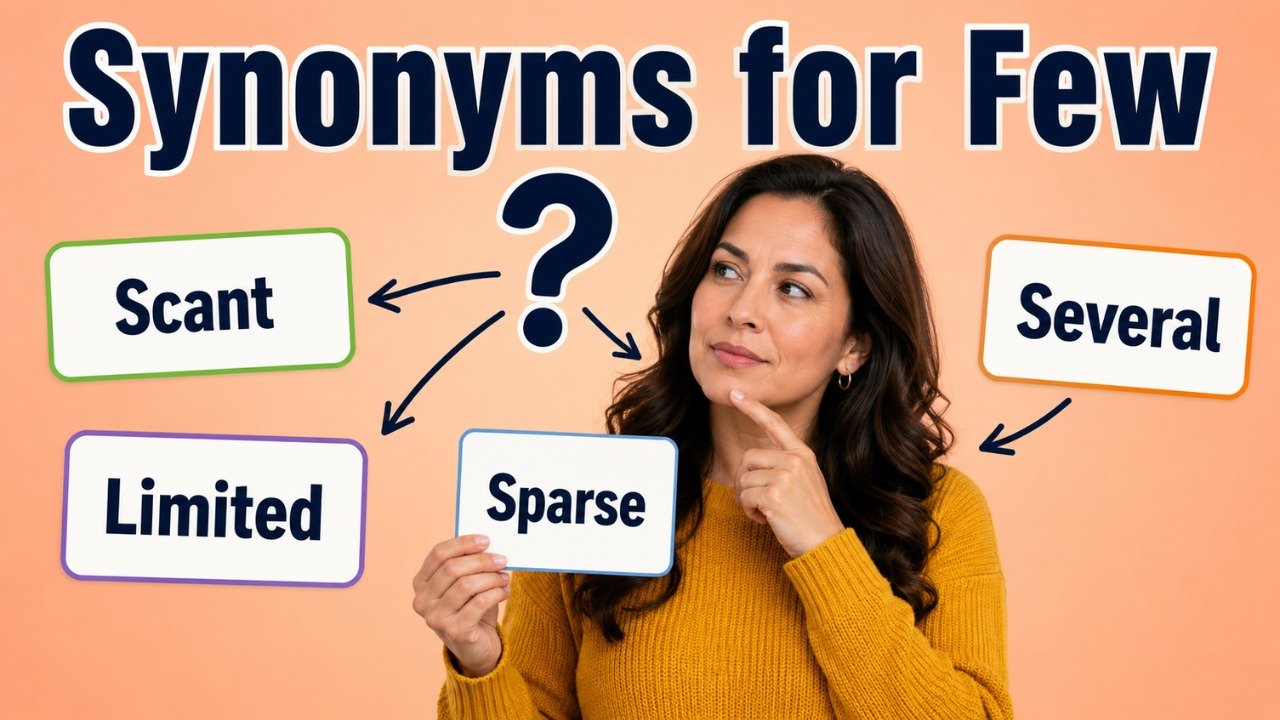
Quick Answer: The best synonyms for few include several, some, a handful, limited, scarce, sparse, rare, occasional, minimal, and insufficient. The right choice depends on context. Use several or some for a small but noticeable number, a handful for a very small group, limited for restricted quantity, scarce for something difficult to find, sparse for things spread thinly, rare for uncommon occurrences, and minimal for the smallest practical amount. These synonyms for few help describe small numbers, restricted quantities, uncommon events, and limited availability more precisely.
Pronunciation and Word Details
Word: Few.
Pronunciation: /fjuː/.
Part of Speech: Determiner, adjective, pronoun, and noun depending on use.
Meaning: A small number of people or things, usually fewer than expected or needed.
US Pronunciation:
UK Pronunciation:
What Does “Few” Mean?
Few means a small number of people, things, events, or opportunities.
The word can function as a determiner, adjective, pronoun, or noun depending on the sentence.
When few appears before a plural noun, it indicates that the number is small.
Example: Few students completed the assignment early.
Here, few means only a small number of students.
Few can also appear without a noun when the missing noun is already understood.
Example: Many applied, but few were selected.
In this sentence, few refers to a small number of applicants.
The phrase a few has a slightly different meaning. Few often emphasizes shortage or insufficiency, while a few usually means some and can sound more positive.
Example: Few people understood the instructions.
This suggests that not enough people understood.
Example: A few people understood the instructions.
This simply means that some people understood.
Few is therefore useful when discussing quantity, availability, frequency, opportunities, choices, people, objects, and events.
Meaning, Tone, and Context of “Few”
Few is a common and neutral word, but its tone can change depending on whether a appears before it.
Few often carries a slightly negative meaning because it suggests that the number is smaller than expected, needed, or desirable.
Example: Few opportunities were available.
This sentence suggests that opportunities were limited.
A few is more neutral or positive because it indicates the presence of a small number rather than emphasizing a shortage.
Example: A few opportunities were available.
This suggests that some opportunities existed.
Few is common in everyday conversation, essays, reports, academic writing, business communication, statistics, descriptions, and formal writing.
In formal contexts, words such as limited, minimal, scarce, or insufficient may communicate the intended meaning more precisely.
In casual speech, several, some, a couple, or a handful may sound more natural depending on the quantity being described.
When and How to Use “Few”
For a Small Number of People
Use few when only a small number of people are involved.
Example: Few employees attended the optional meeting.
For Limited Choices
Few works well when choices or possibilities are restricted.
Example: We had few alternatives available.
For Limited Opportunities
Use few when opportunities are uncommon or restricted.
Example: Few opportunities existed for further expansion.
For Rare Events
Few can show that something does not happen often.
Example: Few incidents occurred during the entire year.
For a Small Number of Objects
Use few with countable plural nouns.
Example: Only a few books remained on the shelf.
For Insufficient Quantity
Few can emphasize that the number is not enough.
Example: Few resources were available to complete the task.
For Positive Small Quantities
Use a few when you want to emphasize that some people or things are present.
Example: A few volunteers offered to help.
Best Synonyms for Few
Several: A small but noticeable number greater than two.
Example: Several students stayed after class.
Some: An unspecified number or amount.
Example: Some participants arrived early.
Handful: A very small number of people or things.
Example: Only a handful of applicants met the requirements.
Limited: Restricted in number, amount, or availability.
Example: Limited seats remain for the workshop.
Scarce: Available only in small quantities and difficult to obtain.
Example: Fresh water was scarce in the region.
Sparse: Small in number and spread over a wide area.
Example: Sparse vegetation covered the hillside.
Rare: Uncommon or infrequently occurring.
Example: Such opportunities are rare.
Occasional: Happening only from time to time.
Example: The town receives occasional visitors during winter.
Minimal: Very small in amount, degree, or number.
Example: The change had minimal impact on the results.
Insufficient: Not enough for a particular need or purpose.
Example: Insufficient staff were available for the project.
50 Synonyms for Few with Short Meanings
- Several: A small but noticeable number.
- Some: An unspecified small number.
- Handful: A very small number.
- Limited: Restricted in number or quantity.
- Scarce: Available only in small numbers.
- Sparse: Thinly distributed or small in number.
- Rare: Uncommon or infrequent.
- Occasional: Happening only sometimes.
- Minimal: Very small in number or degree.
- Insufficient: Not enough for a need.
- Scant: Barely sufficient in quantity.
- Scanty: Small or inadequate in amount.
- Meager: Smaller than expected or needed.
- Slight: Small in amount or degree.
- Small: Limited in number or size.
- Low: Small in number, level, or quantity.
- Restricted: Kept within narrow limits.
- Finite: Limited rather than unlimited.
- Modest: Relatively small in amount.
- Negligible: So small as to be almost unimportant.
- Paltry: Disappointingly small or inadequate.
- Inadequate: Not sufficient for the purpose.
- Deficient: Lacking enough of something.
- Short: Below the required quantity.
- Lacking: Not having enough.
- Uncommon: Not frequently found or experienced.
- Infrequent: Not happening often.
- Sporadic: Occurring irregularly and occasionally.
- Isolated: Occurring only in separate individual cases.
- Limited Number: A restricted total.
- Small Number: A low quantity of countable things.
- Small Group: A limited collection of people or things.
- Small Selection: A restricted range of choices.
- Small Quantity: A limited amount.
- Tiny Number: An extremely small count.
- Mere Handful: Only a very small number.
- Couple: Two or approximately two in informal use.
- A Couple: A very small number, often around two.
- A Few: Some, but not many.
- Not Many: A small number rather than a large one.
- Hardly Any: Almost none.
- Barely Any: Almost no amount or number.
- Only Some: A restricted portion of a group.
- Select Few: A small chosen group.
- Minority: The smaller part of a group.
- Smattering: A small scattered amount or number.
- Sprinkling: A small scattered number.
- Trace: A very small amount or sign.
- Modicum: A small or limited amount.
- Paucity: A shortage or insufficient quantity.
Read Also:
Synonyms for Onboarding

Synonyms for Few by Context
When Few Means a Small Number
Several, some, a few, handful, couple, small number, tiny number, and not many work when referring to countable people or things.
Example: Several guests arrived before dinner.
Example: A handful of employees remained in the office.
Several generally suggests more than two but still not many. Handful emphasizes a very small number.
When Few Means Limited
Limited, restricted, finite, modest, small, and low are useful when the number or availability is controlled or naturally restricted.
Example: Limited spaces are available for the course.
Example: The organization operates with a modest number of employees.
Limited is especially useful in formal and professional writing.
When Few Means Scarce
Scarce, scant, scanty, meager, deficient, lacking, and insufficient emphasize shortage.
Example: Resources became scarce during the emergency.
Example: The evidence was insufficient to support the conclusion.
Scarce suggests difficulty finding something, while insufficient directly means that there is not enough.
When Few Means Rare
Rare, uncommon, infrequent, occasional, sporadic, and isolated work when few refers to events that do not happen often.
Example: Serious errors are rare.
Example: The region experiences occasional storms.
Rare emphasizes unusual occurrence, while occasional means something happens from time to time.
When Few Means Almost None
Hardly any, barely any, negligible, trace, and tiny number express an extremely small quantity.
Example: Hardly any seats remained.
Example: Only a negligible number of complaints were received.
These alternatives are stronger than few because they suggest a number close to zero.
When Few Means a Small Selected Group
Select few, minority, small group, handful, and limited number can describe a restricted group of people.
Example: Only a select few were invited to the final interview.
Example: A minority of participants disagreed with the proposal.
Another Word for Few
Another word for few is limited when the sentence emphasizes restricted number or availability.
However, the best alternative depends on meaning. Several works for a small but noticeable number, scarce suits shortage, rare fits uncommon events, and handful emphasizes a very small group.
Original: Few seats remained in the auditorium.
Better Option: Limited seats remained in the auditorium.
Original: Few people attended the meeting.
Better Option: A handful of people attended the meeting.
Original: Few errors appeared in the final report.
Better Option: Only a small number of errors appeared in the final report.
Original: Few opportunities like this become available.
Better Option: Opportunities like this are rare.
When Not to Use “Few”
Avoid few when the exact quantity matters.
Weak: Few people completed the survey.
Better: Seven people completed the survey.
An exact number is more useful when precise data is available.
Avoid few when the number is actually moderate rather than very small.
Weak: Few employees attended the conference.
Better: Several employees attended the conference.
Use several when the group is small but not unusually small.
Few can also sound negative when you mean to emphasize that some options are available.
Weak: Few solutions remain.
Better: A few solutions remain.
The addition of a changes the tone from shortage to availability.
Avoid using few with uncountable nouns.
Incorrect: Few water remained.
Better: Little water remained.
Few is normally used with countable plural nouns, while little is used with uncountable nouns.
In formal reports, vague words such as few may be weaker than precise figures or percentages.
Weak: Few respondents disagreed.
Better: A small minority of respondents disagreed.
Words Commonly Confused With Few
Few vs A Few: Few emphasizes that the number is small and possibly insufficient. A few means some and usually sounds more positive.
Example: Few students passed the test means not many passed.
Example: A few students passed the test means some students passed.
Few vs Little: Few is used with countable plural nouns, while little is used with uncountable nouns.
Example: Few books were available.
Example: Little information was available.
Few vs Several: Few suggests a very small number, often smaller than expected. Several usually means more than two but still not many.
Few vs Some: Few emphasizes smallness, while some simply indicates an unspecified number without necessarily suggesting shortage.
Few vs Scarce: Few directly describes a small number. Scarce means something is difficult to find or available in insufficient quantity.
Few vs Rare: Few describes quantity. Rare usually describes frequency or how unusual something is.
Few vs Limited: Few focuses on a small count, while limited emphasizes restriction or boundaries.
Few vs Minority: Few means a small number, while minority refers specifically to the smaller part of a larger group.
Which Synonym Should You Choose?
Choose several when you mean more than two but still not many.
Choose some when the exact number is unknown or unimportant.
Choose a handful when describing a very small group in natural conversation.
Choose limited in formal writing, reports, business communication, or descriptions of restricted availability.
Choose scarce when something is difficult to find because very little is available.
Choose sparse when objects, people, vegetation, or information are spread thinly.
Choose rare when discussing uncommon events, opportunities, conditions, or occurrences.
Choose occasional when something happens from time to time.
Choose minimal when emphasizing the smallest practical amount or degree.
Choose insufficient when the available number does not meet a requirement.
Choose minority when comparing a smaller group with a larger group.
Choose hardly any when the quantity is almost zero.
Choose a few when you want a more positive alternative that means some rather than not enough.
Real Life Examples of “Few” in Sentences
Original: Few students volunteered for the event.
Better Option: A handful of students volunteered for the event.
Original: Few seats remained on the train.
Better Option: Limited seats remained on the train.
Original: Few opportunities are available in this field.
Better Option: Opportunities are scarce in this field.
Original: Few people visit the area during winter.
Better Option: Only a small number of people visit the area during winter.
Original: Few errors appeared in the final document.
Better Option: Minimal errors appeared in the final document.
Original: Few storms occur during this season.
Better Option: Storms are rare during this season.
Original: Few employees objected to the change.
Better Option: A minority of employees objected to the change.
Original: Few resources were available to the team.
Better Option: Resources were limited for the team.
Original: Few houses were visible across the valley.
Better Option: Sparse houses were visible across the valley.
Original: Few complaints were received after the update.
Better Option: Only a handful of complaints were received after the update.
Synonym Groups and Usage Differences
Small Number Group
Several, some, a few, handful, couple, small number, and tiny number describe small quantities of countable things.
Several is neutral and flexible. Handful emphasizes that the number is very small. Couple usually suggests two or approximately two in casual speech.
Example: A handful of visitors arrived before noon.
Shortage Group
Scarce, scant, meager, insufficient, inadequate, deficient, and lacking emphasize that there is not enough.
These words are stronger than few because they directly communicate a shortage.
Example: The village had scarce supplies after the storm.
Restricted Quantity Group
Limited, restricted, finite, modest, and low emphasize boundaries or reduced availability.
Limited is especially useful for seats, resources, time, choices, and opportunities.
Example: The venue has limited seating.
Rarity Group
Rare, uncommon, occasional, infrequent, sporadic, and isolated describe things that happen or appear only occasionally.
Rare is strongest when something is unusual.
Example: Such mistakes are rare among experienced workers.
Almost None Group
Hardly any, barely any, negligible, trace, and mere handful indicate an extremely small number or amount.
Example: Hardly any tickets remained by evening.
Small Group Group
Minority, select few, handful, small group, and limited number describe a restricted collection of people.
Example: A select few advanced to the final round.
Antonyms of Few
The opposite of few depends on whether you are describing quantity, availability, or frequency.
Many: A large number of people or things.
Numerous: Existing in large numbers.
Several: More than a very small number in some contexts.
Abundant: Available in large quantities.
Plentiful: Existing or available in generous amounts.
Countless: Too numerous to count easily.
Multiple: Consisting of many elements or instances.
Frequent: Happening often.
Common: Occurring regularly or widely.
Ample: More than enough for a particular purpose.
Sufficient: Enough to meet a need.
Plenty: A large or adequate amount.
Comparison: Few vs Related Words
Few vs A Few
Few emphasizes shortage, while a few emphasizes presence.
Example With Few: Few students understood the difficult question.
Example With A Few: A few students understood the difficult question.
The first sounds more negative. The second simply states that some students understood.
Few vs Several
Few generally suggests a very small number. Several indicates a small number greater than two without necessarily implying shortage.
Example With Few: Few employees volunteered.
Example With Several: Several employees volunteered.
Few vs Some
Few emphasizes that the quantity is small. Some gives no strong indication of whether the number is large or small.
Example With Few: Few visitors stayed after sunset.
Example With Some: Some visitors stayed after sunset.
Few vs Little
Few is used with countable nouns. Little is used with uncountable nouns.
Example With Few: Few chairs remained.
Example With Little: Little space remained.
Few vs Scarce
Few describes number directly. Scarce emphasizes limited availability.
Example With Few: Few apartments were available.
Example With Scarce: Affordable apartments were scarce.
Few vs Rare
Few refers to quantity, while rare refers mainly to frequency or uncommonness.
Example With Few: Few cases were reported.
Example With Rare: Such cases are rare.
Few vs Limited
Few states that the number is small. Limited suggests that the amount or number is restricted.
Example With Few: Few tickets remained.
Example With Limited: Limited tickets remained.
Few vs Minority
Few is a general description of a small number. Minority specifically refers to the smaller portion of a group.
Example With Few: Few voters opposed the proposal.
Example With Minority: A minority of voters opposed the proposal.
Common Phrases and Expressions With “Few”
A Few: Some, but not many.
Very Few: An extremely small number.
Quite a Few: A surprisingly large number despite the word few.
Only a Few: No more than a small number.
Just a Few: A small number and nothing more.
Few and Far Between: Rare and difficult to find.
One of the Few: One person or thing belonging to a small group.
The Chosen Few: A small specially selected group.
Select Few: A restricted group chosen for a purpose.
Few in Number: Existing only in a small quantity.
Common Mistakes to Avoid
One common mistake is treating few and a few as identical.
Few often carries a negative meaning because it suggests that the quantity is smaller than desired.
Example: Few people came to help.
This suggests disappointment.
A few sounds more positive.
Example: A few people came to help.
This emphasizes that some help was available.
Another common mistake is using few with uncountable nouns.
Incorrect: Few money was available.
Correct: Little money was available.
Use few with countable plural nouns such as people, books, choices, and opportunities.
Use little with uncountable nouns such as money, water, time, and information.
Avoid replacing few with rare when you are discussing quantity rather than frequency.
Unnatural: Rare students attended the class.
Better: Few students attended the class.
Rare students would suggest that the students themselves are unusual rather than small in number.
Do not use scarce as a direct replacement in every sentence.
Unnatural: Scarce students attended the lecture.
Better: Few students attended the lecture.
Scarce usually describes availability rather than simply counting a group.
Avoid vague use of few when exact numbers are available in data, reports, research, or formal analysis.
Vague: Few respondents selected the final option.
Better: Eight respondents selected the final option.
Conclusion
The best synonyms for few depend on whether you mean a small number, restricted availability, shortage, or rarity. Use several or some for neutral small quantities, a handful for very small groups, limited for restricted choices or resources, scarce for shortages, rare for uncommon events, and minimal for very small amounts. Understanding these differences helps you choose synonyms for few that sound natural, precise, and appropriate in conversation, essays, reports, descriptions, and professional writing.
FAQs About Synonyms for Few
What Is the Best Synonym for Few?
Several, some, a handful, and limited are useful general alternatives. The best choice depends on whether you are emphasizing a small number, shortage, or restricted availability.
What Is Another Word for Very Few?
A handful, hardly any, barely any, tiny number, and mere handful can describe an extremely small number.
Is Several a Synonym for Few?
Yes, in some contexts. Several means a small number greater than two, while few often suggests an even smaller or insufficient number.
What Is the Difference Between Few and A Few?
Few often means not many and may suggest shortage. A few means some and usually has a more positive or neutral meaning.
What Is a Formal Synonym for Few?
Limited, minimal, insufficient, scarce, minority, and negligible are useful formal alternatives depending on context.
Can Scarce Replace Few?
Sometimes. Scarce works when something is difficult to obtain because the available quantity is small. It does not naturally replace few in every sentence.
What Are Good Synonyms for Few in Writing?
Several, some, limited, scarce, sparse, rare, minimal, insufficient, handful, and minority are strong choices for different writing contexts.
