
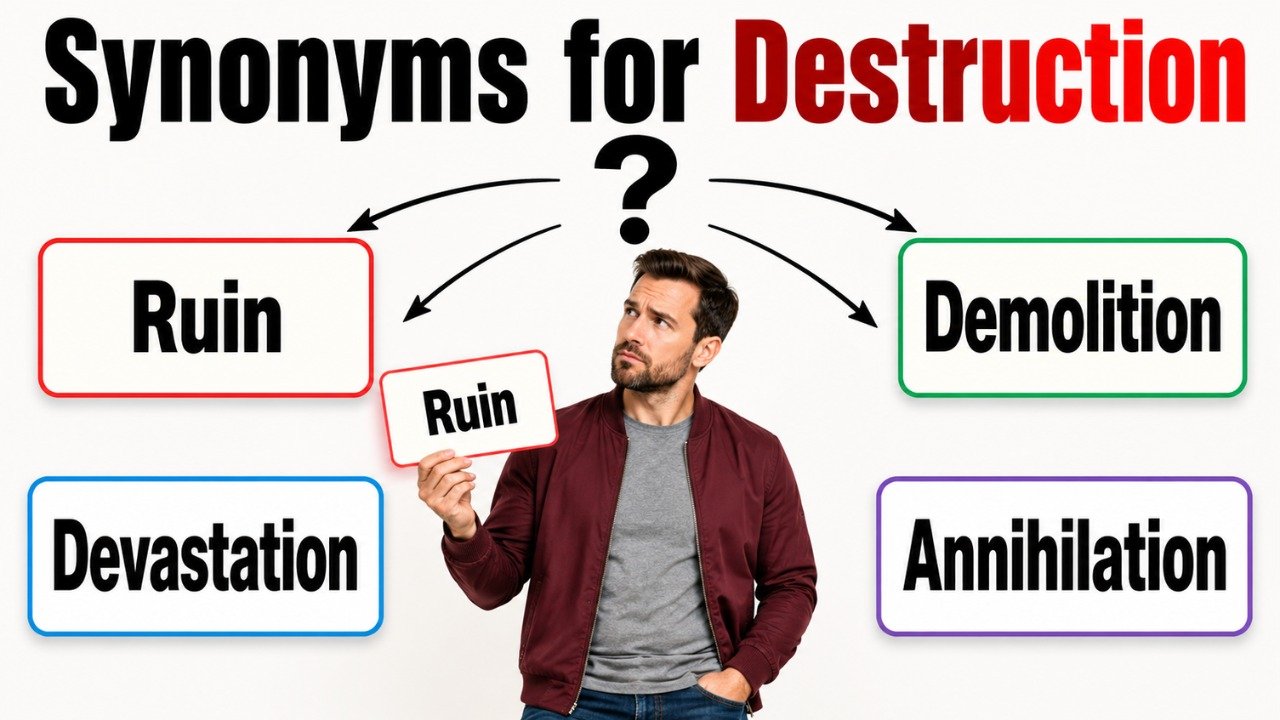
Quick Answer: The best synonyms for destruction include devastation, ruin, demolition, annihilation, obliteration, damage, wreckage, collapse, havoc, and downfall. In the keyword synonyms for destruction, choose demolition for buildings, devastation for severe damage or emotional loss, ruin for lasting harm, annihilation for complete removal, damage for general harm, and collapse for the failure of a structure, system, or plan.
Pronunciation and Word Details
Word: Destruction.
Pronunciation: /dɪˈstrʌk.ʃən/.
Part of Speech: Noun.
Meaning: Destruction means the act or result of damaging, ruining, breaking, or completely ending something.
US Pronunciation:
UK Pronunciation:
What Does “Destruction” Mean?
Destruction means serious damage, ruin, or complete loss. It is a noun used when something is badly harmed, broken, removed, or made useless.
The word destruction can describe physical damage, emotional harm, social collapse, environmental loss, war damage, building removal, or the failure of a system. For example, the destruction of a house means the house is badly damaged or gone. The destruction of trust means trust has been ruined. The meaning depends on what is being destroyed.
Meaning, Tone, and Context of “Destruction”
Destruction has a strong, serious, and often negative tone. It is more intense than damage and more final than harm. It usually suggests that something important has been broken, ruined, or lost in a major way.
The word is common in news writing, essays, history, science, environmental writing, legal discussions, disaster reports, and emotional descriptions. In casual speech, people may use destruction for dramatic effect, but in formal writing it should be used carefully. If the harm is small, damage may sound more accurate than destruction.
When and How to Use “Destruction”
For Physical Damage: Use destruction when an object, place, or structure is badly damaged or ruined.
Example: The storm caused the destruction of several homes.
For Complete Loss: Use destruction when something no longer exists in its original form.
Example: The fire led to the destruction of important records.
For Emotional Harm: Use destruction when trust, hope, peace, or confidence is deeply ruined.
Example: The betrayal caused the destruction of their friendship.
For Environmental Damage: Use destruction when nature, forests, habitats, or ecosystems are severely harmed.
Example: The destruction of the forest affected many animals.
For Social or Political Collapse: Use destruction when a system, plan, rule, or institution fails badly.
Example: Poor decisions led to the destruction of public trust.
Best Synonyms for Destruction
Devastation: Severe damage, ruin, or emotional suffering.
Example: The flood left devastation across the town.
Ruin: The state of being badly damaged or destroyed.
Example: Years of neglect brought the building to ruin.
Demolition: The planned tearing down of a building or structure.
Example: The old bridge was ready for demolition.
Annihilation: Complete destruction so that almost nothing remains.
Example: The attack threatened the annihilation of the village.
Obliteration: Total removal or destruction of something.
Example: The explosion caused the obliteration of the wall.
Damage: Harm that makes something weaker, broken, or less useful.
Example: The storm caused serious damage to the roof.
Wreckage: The broken remains after destruction.
Example: Rescue workers searched through the wreckage.
Collapse: A sudden fall, failure, or breakdown.
Example: The collapse of the tower shocked everyone.
Havoc: Widespread damage, confusion, or disorder.
Example: Heavy rain created havoc on the roads.
Downfall: The loss of power, success, or stability.
Example: Greed became the company’s downfall.
50 Synonyms for Destruction with Short Meanings
- Devastation: Severe damage or deep ruin.
- Ruin: Complete or serious damage.
- Demolition: Planned tearing down of a structure.
- Annihilation: Total destruction or complete defeat.
- Obliteration: Complete removal or wiping out.
- Wreckage: Broken remains after damage.
- Damage: Harm that weakens or breaks something.
- Havoc: Widespread damage and disorder.
- Collapse: Sudden fall or failure.
- Downfall: Loss of power, success, or stability.
- Extinction: Complete disappearance of a species or group.
- Eradication: Complete removal of something harmful.
- Extermination: Complete killing or removal.
- Decimation: Severe destruction or great reduction.
- Ravaging: Violent or severe damaging.
- Razing: Complete tearing down to the ground.
- Dismantling: Taking something apart piece by piece.
- Disintegration: Breaking into small parts or pieces.
- Breakdown: Failure or collapse of a system.
- Fragmentation: Breaking into separate pieces.
- Shattering: Breaking suddenly into pieces.
- Smashing: Breaking with force.
- Crushing: Damaging by heavy pressure or force.
- Wrecking: Ruining or badly damaging something.
- Spoilage: Damage that makes something useless.
- Loss: The state of no longer having something.
- Harm: Physical, emotional, or practical damage.
- Desolation: Empty ruin, sadness, or severe destruction.
- Ruination: The process or result of being ruined.
- Disaster: A sudden event causing great damage.
- Catastrophe: A terrible event with serious damage.
- Calamity: A great misfortune or disaster.
- Chaos: Complete disorder after damage or failure.
- Carnage: Bloody destruction or great loss of life.
- Despoliation: Damage caused by stripping or taking resources.
- Vandalism: Intentional damage to property.
- Sabotage: Deliberate damage to stop success.
- Impairment: Damage that reduces ability or quality.
- Degradation: Gradual decline or damage in condition.
- Deterioration: Slow worsening or decay.
- Erosion: Gradual wearing away or loss.
- Dissolution: Breaking apart or ending of something.
- Decomposition: Breaking down into simpler parts.
- Incineration: Destruction by burning.
- Burning: Damage or destruction by fire.
- Defacement: Damage that spoils appearance.
- Deforestation: Destruction or removal of forests.
- Clearance: Removal of buildings, trees, or objects.
- Elimination: Complete removal of something.
- Wiping Out: Complete destruction or removal.
Read Also:
Synonyms for Responsibility

Synonyms for Destruction by Context
When Destruction Means Damage
Use damage, harm, impairment, degradation, deterioration, and erosion when destruction means injury, weakening, or loss of quality.
Damage: The heavy rain caused damage to the road.
Harm: Careless words can cause emotional harm.
Impairment: The injury led to impairment of movement.
Degradation: Pollution causes degradation of soil and water.
When Destruction Means Demolition
Use demolition, razing, dismantling, clearance, and wrecking when destruction means tearing down a structure or taking something apart.
Demolition: The unsafe building was marked for demolition.
Razing: The old factory faced razing after years of neglect.
Dismantling: Workers began the careful dismantling of the stage.
Wrecking: The crew handled the wrecking of the damaged wall.
When Destruction Means Complete Loss
Use annihilation, obliteration, eradication, extinction, elimination, and wiping out when destruction means total removal or complete ending.
Annihilation: The fire threatened the annihilation of the old records.
Obliteration: The blast caused the obliteration of the entrance.
Eradication: The campaign focused on the eradication of the disease.
Extinction: Habitat loss can lead to extinction.
When Destruction Means Ruin
Use ruin, ruination, devastation, desolation, and downfall when destruction means severe damage, lasting loss, or broken success.
Ruin: The scandal brought his career to ruin.
Ruination: Poor planning caused the ruination of the project.
Devastation: The earthquake left devastation behind.
Downfall: Pride became his downfall.
When Destruction Means Disaster or Havoc
Use disaster, catastrophe, calamity, havoc, chaos, and carnage when destruction is linked to a terrible event, mass disorder, or severe suffering.
Disaster: The flood became a disaster for the village.
Catastrophe: The accident was a catastrophe for the company.
Havoc: Strong winds caused havoc in the city.
Chaos: The sudden collapse created chaos in the hall.
Another Word for Destruction
Another word for destruction is devastation, especially when the damage is severe, widespread, or emotionally painful. However, the best replacement depends on context. Use demolition for buildings, damage for general harm, ruin for lasting loss, and annihilation for complete destruction.
Original: The storm caused destruction across the coast.
Better Option: The storm caused devastation across the coast.
Original: The destruction of the old school began in May.
Better Option: The demolition of the old school began in May.
Original: The careless decision caused the destruction of trust.
Better Option: The careless decision caused the ruin of trust.
Original: The fire caused destruction to the documents.
Better Option: The fire caused damage to the documents.
When Not to Use “Destruction”
Do not use destruction when the damage is small, temporary, or easy to repair. The word can sound too strong if you only mean a scratch, mistake, delay, change, or simple loss.
Weak: The pencil mark caused destruction on the page.
Better: The pencil mark caused damage on the page.
Weak: The meeting had destruction because it started late.
Better: The meeting had confusion because it started late.
Weak: The phone had destruction after falling once.
Better: The phone had minor damage after falling once.
Weak: The editor made destruction to the paragraph.
Better: The editor made changes to the paragraph.
Weak: The file had destruction from the update.
Better: The file was corrupted by the update.
Use destruction for serious harm, ruin, collapse, or complete loss. Use damage, change, error, confusion, or loss when the situation is less severe.
Words Commonly Confused With Destruction
Destruction vs Damage: Destruction means serious ruin or complete loss. Damage can be small, partial, or repairable.
Destruction vs Demolition: Destruction can happen by accident or force. Demolition is usually planned tearing down of a building or structure.
Destruction vs Devastation: Destruction focuses on the act or result of ruining something. Devastation adds a stronger sense of emotional pain or widespread suffering.
Destruction vs Ruin: Destruction suggests something has been damaged or ended. Ruin often suggests a lasting state of failure, loss, or decay.
Destruction vs Collapse: Destruction is broad. Collapse means a sudden fall or failure of a building, system, plan, or organization.
Destruction vs Annihilation: Destruction can be partial or complete. Annihilation means total destruction with almost nothing left.
Destruction vs Loss: Loss means no longer having something. Destruction means something has been damaged, ruined, or ended.
Which Synonym Should You Choose?
Choose devastation when writing about severe damage, disaster, grief, or emotional loss.
Choose demolition when writing about planned removal of buildings, bridges, walls, or structures.
Choose damage when writing about harm that may be repairable or less complete.
Choose ruin when writing about lasting harm to a place, relationship, plan, or reputation.
Choose annihilation when writing about total destruction or complete defeat.
Choose obliteration when something is completely removed, erased, or wiped away.
Choose collapse when a structure, system, business, plan, or argument fails suddenly.
Choose havoc when destruction creates confusion, disorder, or widespread trouble.
Choose downfall when writing about the failure of a person, leader, company, or idea.
Choose extinction when writing about the complete disappearance of a species or group.
Real Life Examples of “Destruction” in Sentences
Original: The storm caused destruction throughout the town.
Better Option: The storm caused devastation throughout the town.
Original: The workers started the destruction of the old building.
Better Option: The workers started the demolition of the old building.
Original: The fire caused destruction to the kitchen.
Better Option: The fire caused serious damage to the kitchen.
Original: The argument led to the destruction of their friendship.
Better Option: The argument led to the ruin of their friendship.
Original: The explosion caused the destruction of the bridge entrance.
Better Option: The explosion caused the obliteration of the bridge entrance.
Original: The company faced destruction after years of poor choices.
Better Option: The company faced collapse after years of poor choices.
Original: The disease caused the destruction of many crops.
Better Option: The disease caused the devastation of many crops.
Original: The new road caused the destruction of the habitat.
Better Option: The new road caused the loss of the habitat.
Original: The careless policy caused destruction in the system.
Better Option: The careless policy caused havoc in the system.
Original: The scandal caused the destruction of his career.
Better Option: The scandal caused the downfall of his career.
Synonym Groups and Usage Differences
Damage Group
Damage, harm, impairment, deterioration, degradation, and erosion describe harm that weakens something. These words are useful when destruction is not complete.
Example: Years of pollution caused the degradation of the river.
Demolition Group
Demolition, razing, dismantling, clearance, and wrecking describe taking down buildings, structures, or physical objects.
Example: The demolition of the old hotel took several weeks.
Total Loss Group
Annihilation, obliteration, eradication, elimination, extinction, and wiping out describe complete removal or complete ending.
Example: The fire caused the obliteration of several historic records.
Ruin Group
Ruin, ruination, devastation, desolation, and downfall describe lasting damage, serious failure, or deep loss.
Example: Bad leadership led to the downfall of the organization.
Disaster Group
Disaster, catastrophe, calamity, havoc, chaos, and carnage describe events or results filled with severe damage, disorder, or suffering.
Example: The sudden flood created havoc in the market.
Antonyms of Destruction
Creation: The act of making something new.
Construction: The act of building something.
Building: The process of creating or developing.
Repair: Fixing something damaged.
Restoration: Bringing something back to a better condition.
Preservation: Protecting something from damage or loss.
Protection: Keeping something safe from harm.
Maintenance: Keeping something in good working condition.
Recovery: Returning to a better state after damage.
Improvement: Making something better or stronger.
Growth: Increase, development, or progress.
Renewal: Making something fresh, strong, or active again.
Comparison: Destruction vs Related Words
Destruction vs Damage
Destruction is stronger than damage. Damage can be partial, minor, or repairable, while destruction often means severe ruin or complete loss.
Example With Destruction: The earthquake caused the destruction of several homes.
Example With Damage: The earthquake caused damage to several windows.
Destruction vs Demolition
Destruction can happen naturally, accidentally, or intentionally. Demolition usually means planned tearing down of a structure.
Example With Destruction: The fire caused the destruction of the warehouse.
Example With Demolition: The city approved the demolition of the warehouse.
Destruction vs Devastation
Destruction focuses on ruin or damage. Devastation suggests severe damage plus emotional pain, shock, or widespread suffering.
Example With Destruction: The storm caused the destruction of several roads.
Example With Devastation: The storm left devastation across the region.
Destruction vs Ruin
Destruction is the process or result of damaging something badly. Ruin often describes the final damaged state or long lasting failure.
Example With Destruction: The flood caused the destruction of the crops.
Example With Ruin: The crops were left in ruin after the flood.
Destruction vs Collapse
Destruction is a broad word for ruin or serious damage. Collapse means a sudden fall, breakdown, or failure.
Example With Destruction: The fire caused the destruction of the roof.
Example With Collapse: The roof collapsed during the fire.
Common Phrases and Expressions With Destruction
Mass Destruction: Damage on a very large scale.
Complete Destruction: Total ruin with nothing useful left.
Total Destruction: Full and final damage or loss.
Widespread Destruction: Damage spread over a large area.
Cause Destruction: Make serious damage happen.
Lead to Destruction: Result in ruin or serious harm.
Path of Destruction: The area damaged by a moving force or event.
Environmental Destruction: Severe harm to nature or ecosystems.
Destruction of Property: Serious damage to buildings, land, or belongings.
Self Destruction: Behavior that harms one’s own life, success, or well being.
Common Mistakes to Avoid
One common mistake is using destruction for small damage. If something is only scratched, cracked, or slightly harmed, use damage instead.
Another mistake is using destruction when demolition is more exact. If a building is intentionally torn down by workers, demolition is usually the better word.
Writers also confuse destruction with devastation. Devastation often includes emotional pain or widespread suffering, while destruction focuses more on ruin or damage. Avoid repeating destruction too often in one paragraph. Use ruin, damage, collapse, demolition, havoc, or devastation when they match the context better.
Be careful with very strong synonyms like annihilation, obliteration, and extermination. These words suggest extreme or complete destruction, so they should not be used for mild situations.
Conclusion
Understanding synonyms for destruction helps you describe damage, ruin, collapse, and total loss more clearly. Use damage for general harm, demolition for buildings, devastation for severe impact, ruin for lasting failure, collapse for sudden breakdown, and annihilation or obliteration for complete destruction. The keyword synonyms for destruction is useful because one word cannot fit every context. Choosing the right synonym makes your writing more accurate, natural, and powerful without sounding too dramatic or vague.
FAQs About Synonyms for Destruction
What is the best synonym for destruction?
The best synonym for destruction is devastation when you mean severe damage or ruin. For buildings, demolition is often the better word.
What is a simple synonym for destruction?
A simple synonym for destruction is damage. It is easier and more general, especially when the harm is not complete.
What is a strong synonym for destruction?
A strong synonym for destruction is annihilation. It means complete destruction or total defeat.
What is the difference between destruction and demolition?
Destruction can happen by accident, nature, force, or choice. Demolition usually means the planned tearing down of a building or structure.
Is ruin a synonym for destruction?
Yes, ruin is a synonym for destruction. It often means serious damage, failure, or a state where something has lost its value or usefulness.
What is the opposite of destruction?
The opposite of destruction can be creation, construction, repair, restoration, preservation, or protection, depending on the sentence.
How do you use destruction in a sentence?
You can say, “The storm caused the destruction of many homes.” This means the storm badly damaged or ruined many homes.
