
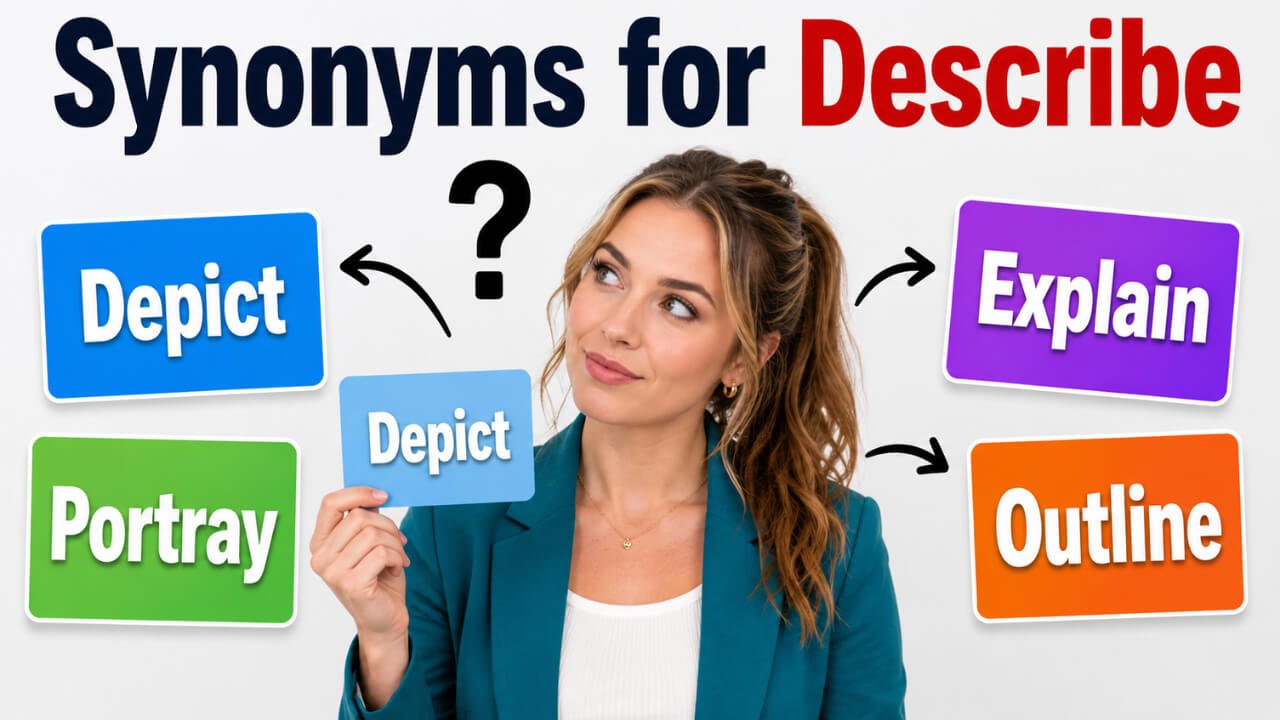
Quick Answer: The best synonyms for describe are explain, depict, portray, define, characterize, outline, detail, illustrate, narrate, and represent. Use explain when making something clear, depict or portray when showing a scene, person, or feeling in words, define when giving meaning, outline when giving the main points, and detail when giving full information.
Pronunciation and Word Details
Word: Describe
Pronunciation: /dɪˈskraɪb/
Part of Speech: Verb
Meaning: To say, write, or show what someone or something is like by giving details.
US Pronunciation:
UK Pronunciation:
What Does “Describe” Mean?
Direct Answer: Describe means to give details about a person, place, thing, idea, feeling, event, or situation so someone can understand what it is like.
Part of Speech: Describe is a verb.
Main Use: It is used when someone explains appearance, qualities, features, actions, emotions, conditions, or experiences.
Sentence Context: Describe can be used in everyday speech, essays, stories, reports, reviews, instructions, and academic writing. You can describe a person, describe a place, describe a problem, describe a feeling, describe a process, or describe the relationship between two ideas.
Example: Please describe what happened during the meeting.
Meaning, Tone, and Context of “Describe”
Tone: Describe is neutral, clear, and widely used.
Formality: It works in both formal and casual writing.
Academic Context: In essays and research, describe means to explain features, patterns, results, or observations.
Creative Context: In stories and poems, describe means to paint a picture with words.
Professional Context: In reports, describe means to present facts, details, steps, or conditions clearly.
Conversational Context: In everyday speech, describe is used when asking someone to explain what something looked like, felt like, sounded like, or seemed like.
When and How to Use “Describe”
For Appearance: Use describe when explaining how someone or something looks.
Example: She described the house as small, bright, and peaceful.
For Feelings: Use describe when expressing emotions or inner experiences.
Example: He described the moment as joyful and unforgettable.
For Events: Use describe when telling what happened.
Example: The witness described the accident clearly.
For Details: Use describe when giving specific information.
Example: The report describes the main causes of the problem.
For Creative Writing: Use describe when creating a mental image for the reader.
Example: The author described the garden with rich sensory details.
For Academic Writing: Use describe when presenting features, patterns, or observations without giving too much personal opinion.
Example: The student described the results of the experiment.
Best Synonyms for Describe
Explain: To make something clear or easy to understand.
Example: The teacher explained the rule with simple examples.
Depict: To show or describe something in words, art, or detail.
Example: The story depicts life in a small village.
Portray: To describe or show a person, character, place, or feeling in a particular way.
Example: The writer portrayed the hero as brave but imperfect.
Define: To state the exact meaning of a word, idea, or concept.
Example: The dictionary defines the term clearly.
Characterize: To describe the qualities or features of someone or something.
Example: Critics characterize the speech as honest and powerful.
Outline: To describe the main points without every detail.
Example: The manager outlined the plan for the project.
Detail: To describe something fully with specific information.
Example: The article details the steps of the process.
Illustrate: To explain or describe something by using examples, images, or details.
Example: The chart illustrates the change in sales.
Narrate: To describe events by telling a story.
Example: She narrated her travel experience beautifully.
Represent: To describe, show, or stand for something.
Example: The painting represents hope and renewal.
50 Synonyms for Describe with Short Meanings
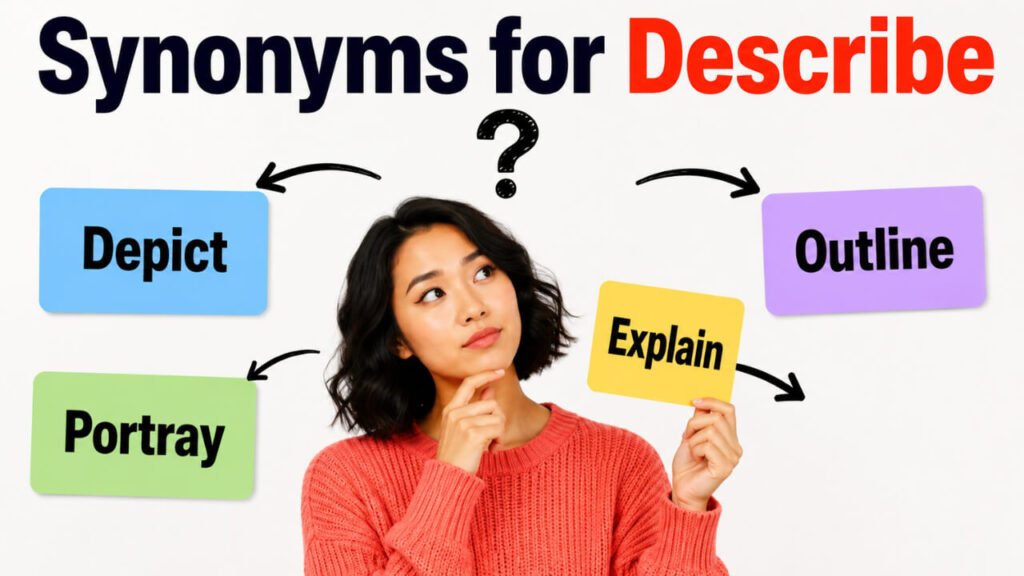
- Explain: To make something clear.
- Depict: To show something through words or images.
- Portray: To present someone or something in a certain way.
- Define: To give the exact meaning.
- Characterize: To describe qualities or features.
- Outline: To give the main points.
- Detail: To give complete information.
- Illustrate: To explain with examples or images.
- Narrate: To tell events as a story.
- Represent: To show or stand for something.
- State: To say something clearly.
- Express: To put thoughts or feelings into words.
- Convey: To communicate an idea, feeling, or meaning.
- Present: To show or explain information.
- Report: To give facts or information about something.
- Relate: To tell or describe an experience.
- Recount: To tell the details of an event.
- Tell: To say or explain something.
- Summarize: To describe briefly using main points.
- Clarify: To make something easier to understand.
- Expound: To explain something in detail.
- Elaborate: To add more detail to an explanation.
- Interpret: To explain the meaning of something.
- Specify: To state details clearly.
- Identify: To name or recognize something.
- Name: To say what something is called.
- Label: To describe someone or something with a word or phrase.
- List: To describe by naming items one by one.
- Catalog: To list and describe items systematically.
- Record: To write or store details.
- Document: To record information clearly.
- Profile: To describe the main details of a person or subject.
- Sketch: To give a brief description.
- Render: To show or describe in a particular form.
- Picture: To create an image of something in words.
- Paint: To describe vividly with words.
- Capture: To express the main feeling or quality.
- Discuss: To describe and examine a subject.
- Mention: To refer to something briefly.
- Set out: To present information clearly.
- Lay out: To explain details in an organized way.
- Give an account of: To describe an event or experience.
- Put into words: To express something through language.
- Spell out: To explain something clearly and fully.
- Delineate: To describe or outline precisely.
- Map out: To describe a plan or structure.
- Trace: To describe development, history, or progress.
- Review: To describe and examine something.
- Elucidate: To explain something clearly.
- Call: To describe someone or something with a particular name or quality.
Read Also:
Synonyms for Relationship
Synonyms for Describe by Context
When Describe Means Explain Clearly
Explain: To make a subject easy to understand.
Example: The guide explains how the system works.
Clarify: To remove confusion by giving clearer information.
Example: She clarified the meaning of the sentence.
Elucidate: To explain something in a clear and careful way.
Example: The speaker elucidated the main argument.
Spell out: To explain fully and directly.
Example: The teacher spelled out the instructions.
When Describe Means Show in Words
Depict: To show a person, place, or situation through words or images.
Example: The poem depicts a quiet winter morning.
Portray: To show someone or something in a particular light.
Example: The article portrays the leader as calm and thoughtful.
Paint: To describe vividly and creatively.
Example: The author paints a warm picture of village life.
Picture: To create a mental image.
Example: She pictured the city as bright and crowded.
When Describe Means Give Meaning
Define: To state the exact meaning.
Example: The lesson defines each grammar term.
Identify: To recognize and name something.
Example: The report identifies the key problem.
Specify: To mention exact details.
Example: Please specify the size and color.
Label: To describe with a word or phrase.
Example: Critics labeled the decision as risky.
When Describe Means Give Main Points
Outline: To present the main ideas.
Example: The teacher outlined the chapter.
Summarize: To describe briefly.
Example: He summarized the report in one paragraph.
Sketch: To give a quick description.
Example: She sketched the basic plan for the event.
Set out: To explain in an organized way.
Example: The document sets out the rules clearly.
When Describe Means Tell What Happened
Narrate: To describe events as a story.
Example: He narrated the journey from start to finish.
Recount: To tell details of an event.
Example: She recounted the conversation carefully.
Relate: To tell an experience or story.
Example: He related the incident to his friend.
Report: To give facts about an event.
Example: The witness reported what she saw.
Another Word for Describe
Direct Answer: Another word for describe is explain, because it is the most useful general replacement when you want to make something clear. The best alternative depends on context. Use depict for visual description, define for meaning, outline for main points, and portray for people, characters, scenes, or feelings.
Original: Please describe the problem clearly.
Better Option: Please explain the problem clearly.
Original: The writer described the old castle.
Better Option: The writer depicted the old castle.
Original: The speaker described the main plan.
Better Option: The speaker outlined the main plan.
Original: The sentence describes him as honest.
Better Option: The sentence characterizes him as honest.
When Not to Use “Describe”
Repetition Problem: Do not repeat describe too many times in the same paragraph. Use stronger synonyms when the meaning is more specific.
Weak: The writer describes the town and describes the people in detail.
Better: The writer depicts the town and portrays the people in detail.
Too General: Describe can sound vague when you need a more exact verb.
Weak: The report describes the numbers.
Better: The report analyzes the numbers.
Wrong Synonym Choice: Do not use define when you mean give details about appearance or feeling.
Weak: She defined the sunset as orange and peaceful.
Better: She described the sunset as orange and peaceful.
Too Casual: In formal writing, choose precise words such as outline, specify, define, characterize, or document when they fit better.
Weak: The paper describes every detail about the method.
Better: The paper details the method.
Words Commonly Confused With Describe
Describe vs Explain: Describe tells what something is like, while explain tells how or why something happens.
Describe vs Define: Describe gives details, while define gives the exact meaning of a word or concept.
Describe vs Depict: Describe can be general, while depict often creates a visual picture through words or images.
Describe vs Portray: Describe gives details, while portray shows someone or something in a particular way.
Describe vs Illustrate: Describe uses words to give details, while illustrate often explains through examples, images, or evidence.
Describe vs Summarize: Describe can include many details, while summarize gives only the main points.
Describe vs Narrate: Describe explains what something is like, while narrate tells events in story form.
Describe vs Characterize: Describe gives general details, while characterize focuses on qualities, traits, or nature.
Which Synonym Should You Choose?
Choose explain when you want to make a subject clear in simple language.
Choose depict when describing a scene, place, image, or situation vividly.
Choose portray when describing a person, character, mood, or situation in a particular way.
Choose define when giving the exact meaning of a word, phrase, or concept.
Choose outline when giving the main points without full detail.
Choose detail when giving complete and specific information.
Choose illustrate when using examples, images, or evidence to make an idea clear.
Choose narrate when telling events in order as a story.
Choose characterize when focusing on the qualities or nature of someone or something.
Choose specify when naming exact details, amounts, features, or conditions.
Real Life Examples of “Describe” in Sentences
Original: Can you describe the new apartment?
Better Option: Can you depict the new apartment?
Original: The teacher described the grammar rule.
Better Option: The teacher explained the grammar rule.
Original: The report describes the safety problem.
Better Option: The report details the safety problem.
Original: She described the man as kind and patient.
Better Option: She characterized the man as kind and patient.
Original: The story describes a lonely traveler.
Better Option: The story portrays a lonely traveler.
Original: The guide describes the steps clearly.
Better Option: The guide outlines the steps clearly.
Original: He described the event to his family.
Better Option: He recounted the event to his family.
Original: The diagram describes the process.
Better Option: The diagram illustrates the process.
Original: Please describe your main goal.
Better Option: Please specify your main goal.
Original: The article describes the history of the town.
Better Option: The article traces the history of the town.
Synonym Groups and Usage Differences
Explanation Group
Use: Explain, clarify, elucidate, and spell out are best when the goal is to make something easier to understand.
Example: The speaker clarified the reason for the change.
Visual Description Group
Use: Depict, portray, picture, paint, and render are best for scenes, people, images, and creative writing.
Example: The novel paints a beautiful picture of country life.
Meaning Group
Use: Define, identify, specify, and label are best when explaining meaning, naming something, or giving exact details.
Example: The glossary defines each important term.
Storytelling Group
Use: Narrate, recount, relate, and tell are best for events, memories, journeys, and experiences.
Example: She recounted the story with emotion.
Brief Description Group
Use: Outline, summarize, sketch, and mention are best when you need a short version rather than full detail.
Example: The manager outlined the weekly goals.
Formal Detail Group
Use: Detail, document, record, delineate, and set out are best for reports, instructions, research, and official writing.
Example: The policy sets out the rules for attendance.
Antonyms of Describe
Hide: To keep details from being seen or known.
Conceal: To keep information secret or covered.
Omit: To leave out important information.
Ignore: To give no attention to something.
Confuse: To make something harder to understand.
Misrepresent: To describe something falsely or unfairly.
Distort: To change details in a misleading way.
Withhold: To refuse to give information.
Obscure: To make meaning unclear.
Silence: To prevent information from being expressed.
Comparison: Describe vs Related Words
Describe vs Explain
Difference: Describe tells what something is like, while explain tells how something works or why something happens.
Example With Describe: She described the room as bright and spacious.
Example With Explain: She explained why the room was designed that way.
Describe vs Define
Difference: Describe gives details, while define gives meaning.
Example With Describe: The student described the animal in detail.
Example With Define: The student defined the word mammal.
Describe vs Depict
Difference: Describe is broad, while depict often creates a picture in the reader’s mind.
Example With Describe: The article describes the city.
Example With Depict: The article depicts the city as busy and colorful.
Describe vs Portray
Difference: Describe gives details, while portray shows someone or something from a certain viewpoint.
Example With Describe: The book describes the leader’s actions.
Example With Portray: The book portrays the leader as wise and brave.
Describe vs Summarize
Difference: Describe can include details, while summarize gives only the main points.
Example With Describe: She described the entire scene carefully.
Example With Summarize: She summarized the scene in two sentences.
Describe vs Characterize
Difference: Describe can discuss many details, while characterize focuses on qualities, traits, or nature.
Example With Describe: He described the speech in detail.
Example With Characterize: He characterized the speech as honest and direct.
Common Phrases and Expressions With Describe
Describe in Detail: To explain something with full information.
Describe Clearly: To explain something in a way that is easy to understand.
Describe Briefly: To explain something in a short way.
Describe Accurately: To give correct details.
Describe Fully: To include all important details.
Describe Someone As: To say someone has a certain quality.
Describe Something As: To say something has a certain nature or feature.
Hard to Describe: Difficult to explain in words.
Best Described As: Most accurately called or explained as.
Describe the Difference: To explain how two things are not the same.
Common Mistakes to Avoid
Using Describe Instead of Explain: Use describe for details and explain for reasons, causes, or processes.
Using Describe Instead of Define: Use define when giving the exact meaning of a word or concept.
Repeating Describe Too Often: Replace it with depict, portray, outline, detail, explain, or characterize when the context allows.
Choosing a Synonym That Changes Meaning: Depict, define, summarize, and narrate do not always mean the same thing as describe.
Using Too Many Vague Details: A good description should include clear, useful, and relevant information.
Forgetting the Object: Describe usually needs an object, such as describe the place, describe the feeling, or describe the problem.
Overusing Creative Synonyms in Formal Writing: Words like paint and picture may sound too artistic in reports, essays, or technical writing.
Conclusion
Synonyms for describe help you choose clearer and more accurate words for different writing situations. Use explain when making something clear, depict when creating a visual image, portray when showing a person or mood, define when giving meaning, and outline when giving main points. For detailed writing, detail, specify, and delineate are strong choices. For storytelling, narrate, recount, and relate work well. The best synonym depends on purpose, tone, and context.
FAQs About Synonyms for Describe
What is the best synonym for describe?
Answer: The best synonym for describe is explain when the goal is to make something clear. For visual writing, depict or portray may be better.
What is another word for describe in writing?
Answer: Another word for describe in writing is depict, portray, explain, outline, detail, or illustrate, depending on the sentence.
What is a formal synonym for describe?
Answer: Formal synonyms for describe include delineate, specify, document, detail, characterize, and elucidate.
What is a synonym for describe a person?
Answer: Good synonyms for describe a person include portray, characterize, profile, depict, and represent.
What is a synonym for describe briefly?
Answer: Good synonyms for describe briefly include summarize, outline, sketch, mention, and state.
Is explain the same as describe?
Answer: Not always. Describe tells what something is like, while explain tells how something works or why something happens.
What is the opposite of describe?
Answer: Opposites of describe include hide, conceal, omit, withhold, obscure, and misrepresent.
