
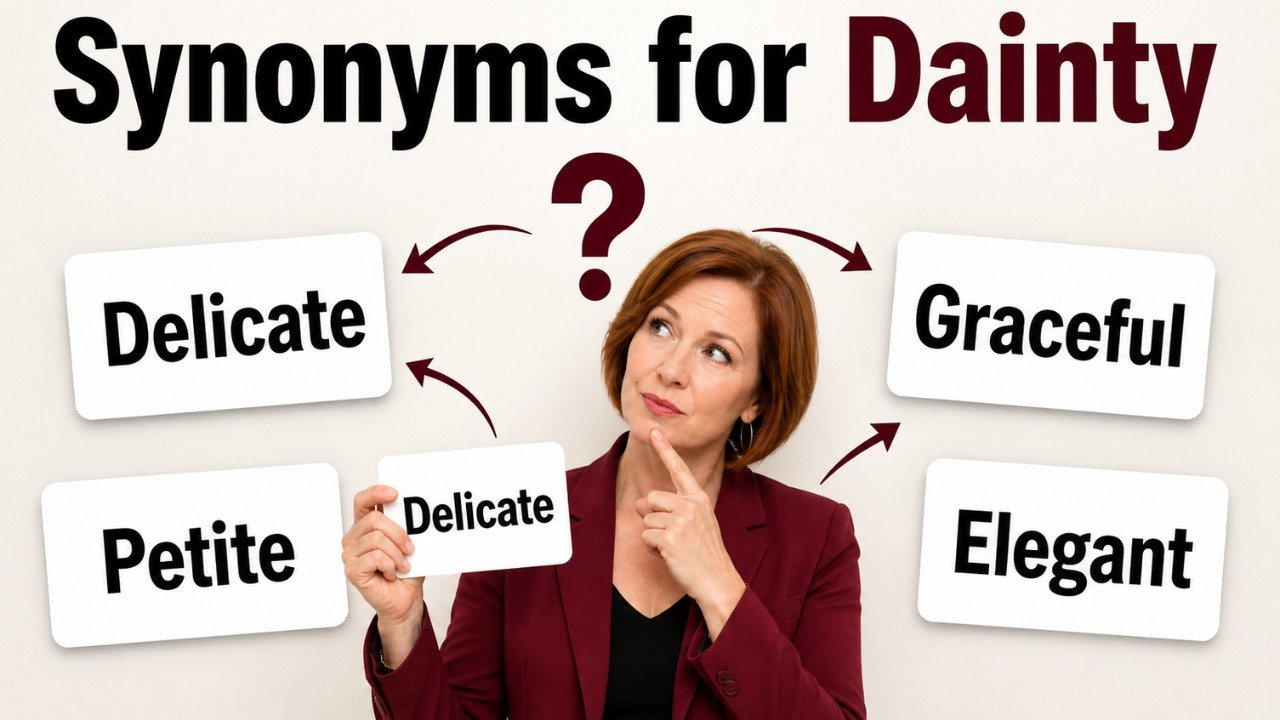
Quick Answer: The best synonyms for dainty include delicate, elegant, graceful, refined, petite, exquisite, pretty, slender, tasteful, and intricate. Use delicate for something easily damaged or finely made, elegant for refined beauty, graceful for movement, petite for a small person or object, exquisite for exceptional detail, slender for shape, and tasteful for restrained decoration. The best choice depends on whether dainty describes size, appearance, movement, clothing, jewelry, behavior, or food.
Pronunciation and Word Details
Word: Dainty
Pronunciation: /ˈdeɪn.ti/
Part of Speech: Adjective
Meaning: Small, delicate, attractive, refined, or carefully made in a pleasing way.
US Pronunciation:
UK Pronunciation:
What Does “Dainty” Mean?
Dainty means delicately small, pretty, elegant, or carefully made. It is mainly used as an adjective to describe objects, physical features, movements, patterns, clothing, decorations, and small portions of food.
When dainty describes appearance, it suggests beauty created through small size, fine detail, or graceful proportions.
Example: She wore a dainty silver necklace.
When it describes physical features, it often refers to something small and delicately shaped.
Example: The figurine had dainty hands and finely painted features.
Dainty can also describe movement that appears light, gentle, and controlled.
Example: The dancer crossed the stage with dainty steps.
In food descriptions, dainty usually refers to small, attractive portions that are carefully presented.
Example: The table was arranged with dainty cakes and fruit pastries.
The word can sometimes describe a person who is overly particular, fussy, or unwilling to handle anything unpleasant. This meaning is less common and can sound critical.
Meaning, Tone, and Context of “Dainty”
Dainty usually has a positive, gentle, and refined tone. It communicates small scale, careful detail, elegance, and visual charm.
The word is common in descriptions of jewelry, clothing, flowers, furniture, decorative patterns, handwriting, gestures, and carefully prepared food.
Positive Tone: The bracelet has a dainty floral design.
Dainty is more expressive than small because it suggests attractiveness and delicacy rather than size alone.
Neutral Size Description: The box is small.
More Descriptive Version: The box is dainty and beautifully decorated.
The word may sound traditional, literary, or slightly formal in some contexts. In everyday conversation, people often replace it with delicate, petite, pretty, elegant, or tiny.
Dainty should be used carefully when describing a person. It can sound complimentary when referring to graceful features or a small frame, but it may feel limiting if it implies that someone is weak or fragile.
When and How to Use “Dainty”
For Delicate Appearance
Use dainty when something looks fine, light, small, and attractive.
Example: The cup had a dainty painted border.
For Small Jewelry
Use dainty for thin necklaces, narrow bracelets, small earrings, or finely detailed rings.
Example: She chose a dainty pendant for the ceremony.
For Petite Features
Use dainty for small and delicately shaped hands, feet, facial features, or proportions.
Example: The portrait showed her dainty features clearly.
For Graceful Movement
Use dainty when a person or animal moves in small, light, and controlled steps.
Example: The bird walked across the branch with dainty movements.
For Fine Decoration
Use dainty for small patterns, floral details, embroidery, carving, or ornamentation.
Example: Dainty flowers were stitched around the edge of the cloth.
For Refined Clothing
Use dainty when clothing or accessories have subtle details and a light, elegant appearance.
Example: The dress featured dainty lace sleeves.
For Small Food Portions
Use dainty for food served in small, attractive, and carefully arranged portions.
Example: The guests were offered dainty sandwiches and pastries.
For Gentle Behavior
Use dainty for actions that appear careful, restrained, or graceful.
Example: She lifted the cup with a dainty gesture.
For Intricate Craftsmanship
Use dainty when an object is carefully made with very small details.
Example: The artist created a dainty model of the historic house.
For Understated Style
Use dainty when a design is attractive without being heavy, bold, or excessive.
Example: The room included dainty decorative accents.
Best Synonyms for Dainty
Delicate: Fine, light, attractive, or easily damaged.
Example: The vase had a delicate painted pattern.
Elegant: Graceful, stylish, and refined in appearance.
Example: She selected an elegant bracelet for the event.
Graceful: Pleasing because of smooth movement or balanced form.
Example: The deer moved with graceful steps.
Refined: Polished, tasteful, and showing careful attention to quality.
Example: The room had a refined decorative style.
Petite: Attractively small in size or physical build.
Example: The petite table fitted neatly beside the chair.
Exquisite: Extremely beautiful and carefully made.
Example: The box displayed exquisite carved details.
Pretty: Attractive in a gentle, charming, or pleasing way.
Example: A pretty floral pattern covered the fabric.
Slender: Gracefully thin or narrow.
Example: The lamp stood on a slender metal base.
Tasteful: Attractive, appropriate, and not excessive.
Example: The invitation featured tasteful decorative lettering.
Intricate: Containing many small and carefully arranged details.
Example: The pendant had an intricate leaf pattern.
50 Synonyms for Dainty with Short Meanings
- Delicate: Finely made, light, or easily damaged.
- Elegant: Graceful and refined in appearance.
- Graceful: Smooth, balanced, and pleasing in form or movement.
- Refined: Polished, tasteful, and carefully developed.
- Petite: Attractively small in size or build.
- Tiny: Extremely small.
- Small: Limited in physical size.
- Diminutive: Unusually or attractively small.
- Miniature: Made as a very small version of something.
- Slight: Small, thin, or delicate in build.
- Fine: Thin, precise, or carefully made.
- Exquisite: Exceptionally beautiful and detailed.
- Pretty: Gently attractive and pleasing.
- Charming: Pleasant and appealing in a delightful way.
- Lovely: Beautiful, attractive, or enjoyable.
- Neat: Small, orderly, and carefully arranged.
- Tasteful: Attractive without being excessive.
- Polished: Refined and carefully finished.
- Sophisticated: Stylish, developed, and elegant.
- Fragile: Easily broken or damaged.
- Frail: Physically weak, thin, or delicate.
- Slender: Gracefully thin or narrow.
- Slim: Thin in an attractive or neat way.
- Lightweight: Light in weight and easy to handle.
- Airy: Light, open, and delicate in appearance.
- Subtle: Attractive without being obvious or bold.
- Soft: Gentle in appearance, texture, sound, or effect.
- Gentle: Mild, calm, and not forceful.
- Understated: Stylish without attracting excessive attention.
- Ornamental: Designed mainly for decoration.
- Decorative: Intended to make something more attractive.
- Intricate: Made with many small and complex details.
- Precise: Exact and carefully controlled.
- Meticulous: Created with great attention to detail.
- Tidy: Neat, orderly, and well arranged.
- Trim: Neat, compact, and attractively shaped.
- Compact: Small and efficiently arranged.
- Modest: Simple, restrained, and not showy.
- Demure: Quiet, modest, and gently reserved.
- Genteel: Polite, refined, and traditionally elegant.
- Chic: Fashionable and stylish.
- Stylish: Attractive and fashionable in design.
- Appealing: Pleasant and attractive.
- Attractive: Pleasing in appearance or character.
- Sweet: Gently charming, pleasant, or attractive.
- Cute: Attractively small or charming.
- Prim: Neat, formal, and carefully proper.
- Fancy: Decorated with attractive or detailed features.
- Bite Sized: Small enough to eat in one or two bites.
- Finely Made: Produced with delicate skill and careful detail.
Read Also:
Synonyms for Low
Synonyms for Dainty by Context
When Dainty Means Delicate
Delicate, fine, fragile, airy, soft, and finely made are suitable when something looks light, thin, or carefully constructed.
Example With Dainty: The artist painted a dainty border around the page.
Example With Delicate: The artist painted a delicate border around the page.
Example With Fine: The artist added fine decorative lines around the page.
Delicate is the closest general replacement. Fine emphasizes thinness or precision, while fragile suggests that the object may break easily.
When Dainty Means Small
Petite, tiny, small, diminutive, miniature, slight, compact, and trim describe limited size.
Example With Dainty: A dainty table stood beside the window.
Example With Petite: A petite table stood beside the window.
Example With Compact: A compact table stood beside the window.
Petite suggests attractive smallness. Miniature describes a reduced version of something larger. Compact suggests efficient use of limited space.
When Dainty Means Elegant
Elegant, graceful, refined, polished, sophisticated, tasteful, chic, and stylish describe refined beauty.
Example With Dainty: She wore a dainty evening dress.
Example With Elegant: She wore an elegant evening dress.
Example With Refined: Her evening dress had a refined appearance.
Elegant is best for formal beauty. Refined emphasizes good taste, while chic and stylish emphasize fashion.
When Dainty Means Pretty
Pretty, charming, lovely, appealing, attractive, sweet, and cute work when something has gentle visual appeal.
Example With Dainty: The cottage had a dainty front garden.
Example With Charming: The cottage had a charming front garden.
Example With Pretty: The cottage had a pretty front garden.
Pretty is direct and familiar. Charming adds warmth and personality. Cute is more casual and often emphasizes small size.
When Dainty Means Graceful
Graceful, gentle, light, controlled, refined, and elegant can describe movement or behavior.
Example With Dainty: She crossed the room with dainty steps.
Example With Graceful: She crossed the room with graceful steps.
Example With Light: She crossed the room with light steps.
Graceful is the strongest replacement for smooth and attractive movement. Light emphasizes softness and minimal pressure.
When Dainty Means Detailed
Intricate, precise, meticulous, ornamental, decorative, fine, and exquisite describe detailed craftsmanship.
Example With Dainty: The cabinet displayed dainty carvings.
Example With Intricate: The cabinet displayed intricate carvings.
Example With Exquisite: The cabinet displayed exquisite carvings.
Intricate focuses on complexity. Precise emphasizes accuracy. Exquisite communicates exceptional beauty and quality.
When Dainty Describes Food
Bite sized, small, delicate, refined, neat, attractive, and carefully presented are useful alternatives for food.
Example With Dainty: The café served dainty fruit tarts.
Example With Bite Sized: The café served bite sized fruit tarts.
Example With Delicate: The café served delicate fruit tarts.
Bite sized focuses on portion size. Delicate may describe texture, flavor, presentation, or appearance.
When Dainty Means Understated
Subtle, modest, tasteful, restrained, neat, and understated describe decoration that is attractive but not bold.
Example With Dainty: The room had dainty floral details.
Example With Subtle: The room had subtle floral details.
Example With Tasteful: The room had tasteful floral details.
Subtle emphasizes low visual intensity. Tasteful suggests good judgment. Understated communicates restrained elegance.
Another Word for Dainty
Delicate is usually the best general replacement for dainty because it can describe appearance, design, craftsmanship, features, and movement. However, petite is better for small size, elegant for refined beauty, graceful for movement, and intricate for detailed decoration.
Original: She wore a dainty necklace.
Better Option: She wore a delicate necklace.
Original: A dainty table stood near the doorway.
Better Option: A petite table stood near the doorway.
Original: The dancer made a dainty movement.
Better Option: The dancer made a graceful movement.
Original: The fabric featured a dainty pattern.
Better Option: The fabric featured an intricate pattern.
When Not to Use “Dainty”
Do not use dainty when you only mean small. The word adds ideas of delicacy, attractiveness, refinement, or careful detail.
Weak: He parked his dainty truck outside.
Better: He parked his small truck outside.
Avoid dainty when describing something strong, heavy, rough, or practical.
Weak: The workers used a dainty steel beam.
Better: The workers used a sturdy steel beam.
Do not use dainty when fragile would communicate an actual risk of damage more clearly.
Weak: The glass equipment is dainty and must be handled carefully.
Better: The glass equipment is fragile and must be handled carefully.
Avoid using dainty for a person when it could sound dismissive or imply weakness.
Weak: The dainty employee could not lift the box.
Better: The employee had a slight build but lifted the box carefully.
Do not use dainty when the intended meaning is highly decorative or elaborate rather than small and delicate.
Weak: The hall had dainty gold columns and enormous statues.
Better: The hall had elaborate gold columns and enormous statues.
Avoid repeating dainty throughout a description. Use precise alternatives to create variety.
Weak: She wore a dainty dress, dainty earrings, and dainty shoes.
Better: She wore an elegant dress, delicate earrings, and refined shoes.
Words Commonly Confused With Dainty
Dainty vs Delicate: Dainty emphasizes small, pretty, or refined appearance. Delicate may also mean easily damaged, sensitive, or requiring careful treatment.
Example With Dainty: She wore a dainty bracelet.
Example With Delicate: The delicate bracelet could bend easily.
Dainty vs Petite: Dainty describes delicate attractiveness. Petite mainly refers to small physical size or build.
Example With Dainty: The chair had dainty carved legs.
Example With Petite: The petite chair fitted neatly into the corner.
Dainty vs Elegant: Dainty suggests small scale and fine detail. Elegant describes graceful, refined beauty at any size.
Example With Dainty: She selected a dainty pendant.
Example With Elegant: She selected an elegant evening coat.
Dainty vs Fragile: Dainty describes appearance. Fragile means easily broken, damaged, or harmed.
Example With Dainty: The vase had dainty flowers painted on it.
Example With Fragile: The vase was fragile and required careful handling.
Dainty vs Graceful: Dainty may describe small, careful movement. Graceful emphasizes smooth, controlled, and attractive movement.
Example With Dainty: The kitten took dainty steps.
Example With Graceful: The dancer made a graceful turn.
Dainty vs Intricate: Dainty suggests small and delicate detail. Intricate emphasizes complexity and many connected details.
Example With Dainty: The fabric had a dainty border.
Example With Intricate: The fabric had an intricate woven pattern.
Dainty vs Cute: Dainty has a refined and delicate tone. Cute is more casual and can describe anything charming or appealing.
Example With Dainty: She chose a dainty floral pin.
Example With Cute: She chose a cute animal shaped pin.
Which Synonym Should You Choose?
Choose delicate when describing fine objects, thin materials, detailed decorations, or items that require careful handling.
Choose elegant for formal clothing, refined interiors, graceful designs, or polished appearances.
Choose graceful when describing smooth movement, balanced posture, or attractive physical action.
Choose refined for sophisticated style, careful manners, or highly developed taste.
Choose petite when discussing attractively small furniture, clothing sizes, objects, or physical build.
Choose tiny when size is the main idea and refinement is not important.
Choose miniature for a small model or reduced version of a larger object.
Choose exquisite when something is exceptionally beautiful, detailed, or skillfully made.
Choose pretty for familiar, gentle, and approachable descriptions of appearance.
Choose charming when something has warmth, personality, or delightful appeal.
Choose slender when describing a thin, narrow, and graceful shape.
Choose tasteful for decorations, clothing, or design choices that are attractive without being excessive.
Choose subtle when decorative details are soft and not immediately noticeable.
Choose intricate when a pattern, carving, or object contains many small details.
Choose fragile when the object can break or become damaged easily.
Choose bite sized when describing small food portions.
Choose chic or stylish when the main meaning involves fashion.
Choose modest or understated when the design is restrained and simple.
Real Life Examples of “Dainty” in Sentences
Original: She wore a dainty chain around her neck.
Better Option: She wore a delicate chain around her neck.
Original: The table had dainty carved legs.
Better Option: The table had finely carved legs.
Original: A dainty flower grew beside the path.
Better Option: A tiny, delicate flower grew beside the path.
Original: The dancer took dainty steps across the stage.
Better Option: The dancer took graceful steps across the stage.
Original: The invitation featured dainty lettering.
Better Option: The invitation featured elegant lettering.
Original: The shop displayed dainty ceramic cups.
Better Option: The shop displayed petite ceramic cups.
Original: The fabric had a dainty leaf pattern.
Better Option: The fabric had an intricate leaf pattern.
Original: They served dainty sandwiches at the gathering.
Better Option: They served bite sized sandwiches at the gathering.
Original: Her room included dainty decorative details.
Better Option: Her room included tasteful decorative details.
Original: The figurine had dainty facial features.
Better Option: The figurine had refined facial features.
Synonym Groups and Usage Differences
Delicacy Group
Delicate, fine, soft, airy, fragile, and finely made relate to lightness, thinness, and careful construction.
Delicate is the broadest option. Fine emphasizes precision. Airy suggests visual lightness. Fragile warns that something can be damaged easily.
Example: The sculpture combined fine metalwork with delicate floral details.
Size Group
Petite, tiny, small, diminutive, miniature, slight, compact, and trim describe limited size.
Petite often sounds attractive and positive. Tiny simply identifies very small size. Diminutive is more formal. Miniature describes a small copy or model.
Example: A miniature clock stood on the petite shelf.
Elegance Group
Elegant, refined, polished, sophisticated, graceful, tasteful, chic, and stylish describe beauty with good taste.
Elegant is suitable for formal descriptions. Refined emphasizes restraint and quality. Chic and stylish are strongly connected to fashion.
Example: The polished design looked elegant without being excessive.
Beauty Group
Pretty, charming, lovely, appealing, attractive, sweet, and cute describe visual or emotional appeal.
Pretty is gentle and familiar. Charming adds personality. Lovely expresses strong approval. Cute is casual and often connected with smallness.
Example: The charming cottage had a pretty painted doorway.
Detail Group
Intricate, precise, meticulous, ornamental, decorative, fine, and exquisite describe detailed work.
Intricate focuses on complexity. Precise emphasizes accuracy. Meticulous describes careful effort. Exquisite suggests outstanding beauty.
Example: The artist used meticulous brushwork to create an exquisite border.
Restraint Group
Subtle, understated, modest, neat, tidy, tasteful, and demure describe a restrained appearance.
Subtle means not obvious. Understated communicates quiet elegance. Modest suggests simplicity. Demure is most often used for reserved behavior or clothing.
Example: Her understated outfit included subtle decorative stitching.
Movement Group
Graceful, gentle, light, soft, controlled, and elegant describe smooth or delicate action.
Graceful is the most natural replacement for attractive movement. Gentle suggests limited force. Light emphasizes softness and ease.
Example: The bird landed with a light and graceful movement.
Food Group
Bite sized, small, delicate, neat, refined, and carefully presented describe dainty food.
Bite sized focuses on portion size. Delicate may refer to flavor or texture. Refined and carefully presented emphasize appearance.
Example: The guests enjoyed bite sized desserts with delicate flavors.
Antonyms of Dainty
The opposite of dainty depends on whether the word refers to size, strength, appearance, movement, or decoration.
Large: Greater than average in size.
Huge: Extremely large.
Massive: Very large, heavy, or solid.
Bulky: Large and difficult to move or arrange.
Heavy: Having substantial weight or visual density.
Thick: Wide between opposite surfaces.
Broad: Wide in shape or extent.
Sturdy: Strong and not easily damaged.
Robust: Strong, healthy, and solidly made.
Durable: Able to resist wear or damage.
Rough: Uneven, harsh, or lacking refinement.
Coarse: Thick, rough, or not finely made.
Clumsy: Awkward in movement or design.
Ungraceful: Lacking smoothness or elegance.
Plain: Without decoration or special detail.
Bold: Visually strong and noticeable.
Showy: Designed to attract a great deal of attention.
Elaborate: Containing many decorative or complex features.
Crude: Made without skill, care, or refinement.
Unrefined: Lacking polish, elegance, or sophistication.
Comparison: Dainty vs Related Words
Dainty vs Delicate
Dainty suggests something small, pretty, and refined. Delicate has a wider meaning and can describe appearance, sensitivity, weakness, or risk of damage.
Example With Dainty: She wore a dainty floral necklace.
Example With Delicate: The delicate necklace required careful storage.
Dainty vs Petite
Dainty includes attractiveness and fine detail. Petite mainly communicates small size or build.
Example With Dainty: The room contained a dainty painted cabinet.
Example With Petite: The room contained a petite cabinet.
Dainty vs Elegant
Dainty usually describes small and delicate beauty. Elegant describes refined beauty regardless of size.
Example With Dainty: She carried a dainty purse.
Example With Elegant: She wore an elegant floor length dress.
Dainty vs Graceful
Dainty may describe small, careful movements. Graceful emphasizes smoothness, balance, and control.
Example With Dainty: The bird made dainty movements along the branch.
Example With Graceful: The bird made a graceful turn in the air.
Dainty vs Exquisite
Dainty emphasizes delicacy and small scale. Exquisite emphasizes exceptional beauty, skill, or detail.
Example With Dainty: The box had a dainty flower design.
Example With Exquisite: The box displayed exquisite hand painted detail.
Dainty vs Pretty
Dainty is more specific and refined. Pretty is broader and simply means attractive in a gentle way.
Example With Dainty: She chose a dainty lace collar.
Example With Pretty: She chose a pretty blue collar.
Dainty vs Fragile
Dainty describes how something looks. Fragile describes how easily it can be broken or harmed.
Example With Dainty: The lamp had a dainty glass shade.
Example With Fragile: The fragile glass shade cracked during transport.
Dainty vs Intricate
Dainty communicates delicate size and appearance. Intricate describes complex construction or detailed patterns.
Example With Dainty: The card had a dainty border.
Example With Intricate: The card had an intricate geometric border.
Dainty vs Subtle
Dainty suggests small and refined beauty. Subtle means gentle, restrained, or not immediately obvious.
Example With Dainty: The fabric featured dainty flowers.
Example With Subtle: The fabric featured a subtle color change.
Dainty vs Cute
Dainty sounds refined and traditional. Cute sounds casual, friendly, and playfully attractive.
Example With Dainty: She wore a dainty pearl pin.
Example With Cute: She wore a cute fruit shaped pin.
Common Phrases and Expressions With Dainty
Dainty Jewelry: Small, delicate, and refined necklaces, bracelets, rings, or earrings.
Dainty Features: Small and delicately shaped facial or physical features.
Dainty Hands: Small, slender, and finely shaped hands.
Dainty Feet: Small and delicately shaped feet.
Dainty Steps: Light, small, and graceful movements.
Dainty Floral Pattern: A design made with small and delicate flowers.
Dainty Lace: Fine lace with light and detailed construction.
Dainty Dessert: A small and attractively presented sweet dish.
Dainty Bite: A small and carefully taken portion of food.
Dainty Appearance: A delicate, neat, and refined overall look.
Dainty Decoration: A small ornamental feature with fine detail.
Dainty Manner: Gentle, restrained, and carefully controlled behavior.
Common Mistakes to Avoid
Using Dainty as a Basic Size Word: Dainty does not simply mean small. It also suggests delicacy, beauty, or refinement.
Weak: The warehouse contains a dainty storage area.
Better: The warehouse contains a small storage area.
Confusing Dainty With Fragile: A dainty object may look delicate without being easy to break.
Weak: The metal bracelet is dainty, so it will certainly break.
Better: The metal bracelet looks dainty, but its construction is durable.
Using Dainty for Heavy Objects: The word normally conflicts with heavy, rough, large, or industrial objects.
Weak: A dainty stone wall surrounded the property.
Better: A sturdy stone wall surrounded the property.
Choosing Petite for Detailed Patterns: Petite mainly describes size, while intricate or delicate is usually better for patterns.
Weak: The fabric had a petite pattern.
Better: The fabric had an intricate pattern.
Describing All Attractive Things as Dainty: Large, bold, or dramatic designs may be elegant or beautiful without being dainty.
Weak: The palace had a dainty entrance with towering columns.
Better: The palace had a grand entrance with towering columns.
Repeating Dainty Too Often: Repetition makes descriptive writing sound limited.
Weak: The dainty room had dainty curtains and dainty decorations.
Better: The refined room had delicate curtains and tasteful decorations.
Using Dainty in a Dismissive Way: Avoid suggesting that a person is incapable, weak, or less serious because of their size or appearance.
Weak: She looked too dainty to lead the project.
Better: Her appearance had no connection to her ability to lead the project.
Confusing Delicate Flavor With Small Portion: Delicate describes a mild flavor, while bite sized describes portion size.
Weak: The cake had a bite sized vanilla flavor.
Better: The cake had a delicate vanilla flavor.
Conclusion
Synonyms for dainty include delicate, elegant, graceful, refined, petite, exquisite, pretty, slender, tasteful, and intricate. Choose delicate for fine appearance, petite for small size, graceful for movement, exquisite for exceptional detail, and tasteful for restrained decoration. Fragile is best when something can break easily, while bite sized suits small food portions. Selecting a precise alternative helps readers understand whether dainty refers to beauty, size, craftsmanship, movement, style, or presentation.
FAQs About Synonyms for Dainty
What Is the Best Synonym for Dainty?
Delicate is the best general synonym for dainty. Petite works better for size, elegant for style, graceful for movement, and intricate for detailed patterns.
What Does Dainty Mean in Simple Words?
Dainty means small, delicate, attractive, refined, or carefully made in a pleasing way.
Is Petite a Synonym for Dainty?
Yes. Petite is a useful synonym when dainty describes small size or build. It does not always communicate fine detail or delicacy.
Is Dainty the Same as Fragile?
No. Dainty describes appearance, size, or refinement. Fragile means something can be broken, damaged, or harmed easily.
What Is Another Word for Dainty Jewelry?
Delicate, fine, elegant, petite, subtle, understated, and refined are useful alternatives for describing dainty jewelry.
What Is a Synonym for Dainty Movement?
Graceful, light, gentle, elegant, controlled, and delicate can describe dainty movement.
What Is the Opposite of Dainty?
Common opposites include large, bulky, heavy, sturdy, rough, coarse, bold, clumsy, crude, and unrefined
