
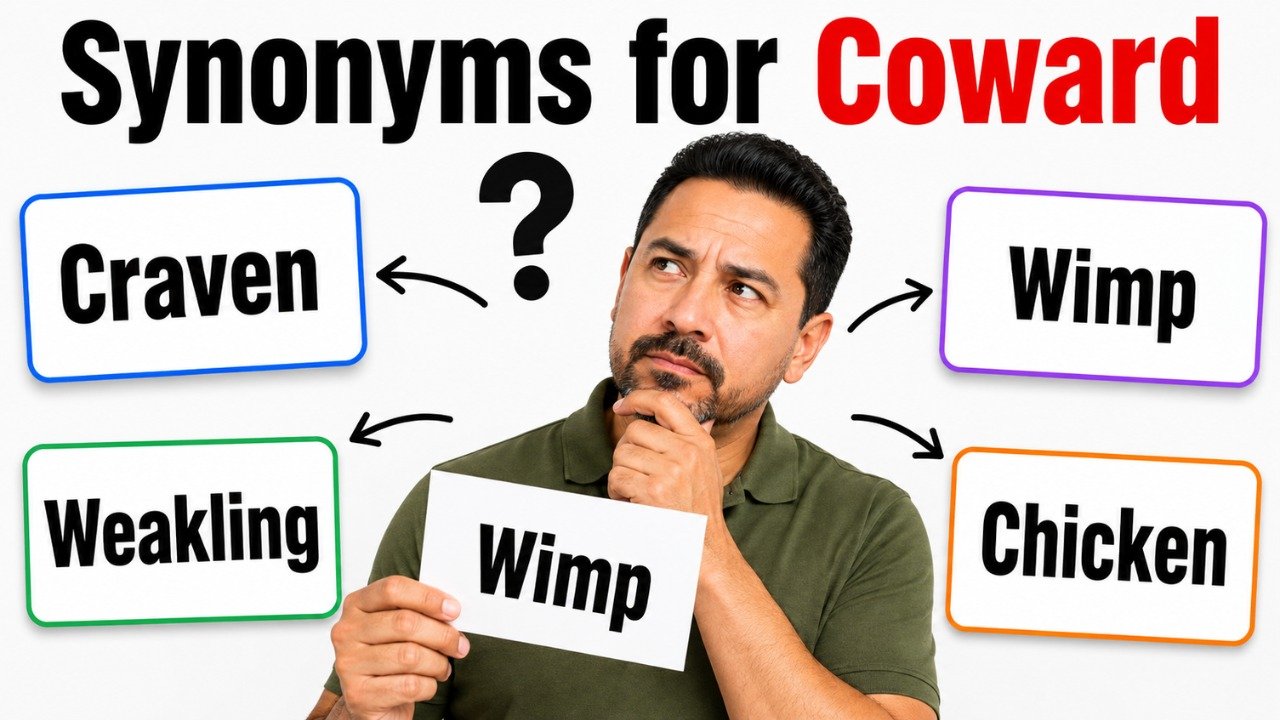
Quick Answer: Synonyms for coward include weakling, chicken, faintheart, scaredy cat, craven person, quitter, deserter, poltroon, milksop, and timid person. The best choice depends on context. Weakling can describe someone seen as lacking courage, chicken is informal, faintheart has a literary tone, quitter emphasizes giving up because of fear or difficulty, deserter suits someone who abandons a duty, while poltroon is a formal or old fashioned term for an extremely cowardly person.
Pronunciation and Word Details
Word: Coward
Pronunciation: /ˈkaʊərd/
Part of Speech: Noun
Meaning: A person who lacks courage and is unwilling to face danger, difficulty, or fear.
US Pronunciation:
UK Pronunciation:
What Does “Coward” Mean?
Coward means a person who lacks courage when facing danger, difficulty, opposition, or fear. It is a noun and is generally used as a negative description of someone’s behavior.
The word can describe someone who avoids a difficult situation because they are afraid, refuses to defend a position, abandons responsibility under pressure, or fails to act when courage is expected.
Coward is usually stronger than simply saying someone is afraid. Fear is a normal emotion, while calling someone a coward judges how that person responds to fear.
Danger Context: He was called a coward for refusing to help when others were in danger.
Conflict Context: She accused him of being a coward because he avoided the confrontation.
Responsibility Context: Leaving everyone else to deal with the problem made him appear cowardly.
Figurative Context: Some people use coward for someone who avoids difficult conversations or decisions.
Meaning, Tone, and Context of “Coward”
Coward has a strongly negative and judgmental tone. It is commonly used as an insult or criticism, so it should be chosen carefully.
In everyday conversation, informal alternatives such as chicken or scaredy cat may sound less formal but can still be insulting.
In literary or formal writing, faintheart, poltroon, craven person, or pusillanimous person may appear when the writer wants a stronger or more traditional expression.
In descriptions of behavior, words such as timid person, fearful person, reluctant person, or hesitant person can sometimes be more neutral than coward.
The best synonym depends on whether you want to criticize a lack of bravery, describe fear neutrally, emphasize abandonment of duty, or show unwillingness to take risks.
When and How to Use “Coward”
For Lack of Courage: Use coward when someone repeatedly avoids danger or difficulty because of fear.
Example: The story portrays him as a coward who refuses to defend his friends.
For Avoiding Responsibility: Coward may describe someone who escapes a difficult duty instead of facing it.
Example: He was accused of being a coward after abandoning the team during the crisis.
For Conflict: The word can describe someone unwilling to confront a difficult situation.
Example: Calling someone a coward during an argument can make the conflict more intense.
For Literary Description: Coward can help define a character whose fear influences important decisions.
Example: The novel begins with a coward who gradually learns to become brave.
For Informal Criticism: Casual synonyms such as chicken may replace coward in lighter conversation.
Example: His friends jokingly called him a chicken because he refused to ride the roller coaster.
For Neutral Description: If criticism is unnecessary, use fearful, hesitant, timid, or apprehensive instead.
Example: She was hesitant about entering the unfamiliar building alone.
Best Synonyms for Coward
Weakling: A person regarded as lacking courage, strength, or determination.
Example: The character was unfairly dismissed as a weakling because he avoided the fight.
Chicken: An informal word for someone who is afraid to do something.
Example: His friends called him a chicken when he refused the challenge.
Faintheart: A person who lacks courage or confidence.
Example: The adventure was not suitable for a faintheart.
Scaredy Cat: An informal and often playful term for someone who is easily frightened.
Example: She jokingly called her brother a scaredy cat after he ran from the spider.
Craven Person: Someone who behaves with extreme fear or lack of courage.
Example: The story presents him as a craven person who abandons his companions.
Quitter: Someone who gives up instead of continuing through difficulty.
Example: He did not want anyone to think he was a quitter.
Deserter: Someone who abandons a duty, group, cause, or responsibility.
Example: The commander viewed anyone who fled the post as a deserter.
Poltroon: An old fashioned or literary word for an extremely cowardly person.
Example: The villain mocked him as a poltroon.
Milksop: An old fashioned term for a weak or timid person.
Example: The arrogant character dismissed his rival as a milksop.
Timid Person: Someone who lacks confidence or is easily frightened.
Example: A timid person may avoid situations that require bold action.
50 Synonyms for Coward with Short Meanings
- Weakling: A person seen as lacking courage or strength.
- Chicken: An informal term for someone who is afraid.
- Faintheart: A person who lacks bravery or confidence.
- Scaredy Cat: A playful informal term for someone easily frightened.
- Poltroon: A person considered extremely cowardly.
- Milksop: A timid or weak person.
- Quitter: Someone who gives up when things become difficult.
- Deserter: Someone who abandons a duty or group.
- Craven Person: Someone showing extreme fear or cowardice.
- Timid Person: Someone who lacks confidence or courage.
- Fearful Person: Someone strongly affected by fear.
- Fainthearted Person: Someone who lacks courage or determination.
- Yellow Belly: An informal and insulting term for a coward.
- Yellowbellied Person: Someone regarded as lacking courage.
- Scared Person: Someone who is frightened.
- Frightened Person: Someone experiencing strong fear.
- Nervous Person: Someone easily worried or unsettled.
- Timorous Person: Someone who is habitually fearful or timid.
- Pusillanimous Person: A person lacking courage or determination.
- Spineless Person: Someone regarded as lacking courage or firmness.
- Gutless Person: An informal term for someone lacking bravery.
- Fearful Soul: A person characterized by fearfulness.
- Shrinking Violet: A shy or timid person who avoids attention.
- Mouse: An informal comparison for a very timid person.
- Wimp: An informal term for a weak or timid person.
- Wuss: A highly informal term for someone considered weak or afraid.
- Softie: Someone considered too gentle or lacking toughness in a given situation.
- Quailer: A person who shrinks back because of fear.
- Flincher: Someone who pulls back from danger or difficulty.
- Backer Out: Someone who withdraws from an agreed action because of fear or uncertainty.
- Runner: Someone who escapes instead of facing a threatening situation.
- Fleer: Someone who flees from danger.
- Runaway: Someone who escapes from a difficult or dangerous situation.
- Skulker: Someone who hides or avoids duty.
- Shirker: Someone who avoids responsibility or difficult tasks.
- Avoider: Someone who repeatedly stays away from difficult situations.
- Retreater: Someone who withdraws from danger or opposition.
- Defector: Someone who abandons a group, cause, or allegiance.
- Abandoner: Someone who leaves others or a responsibility behind.
- Recreant: An old fashioned term for a cowardly or disloyal person.
- Dastard: A literary or old fashioned term for a cowardly person.
- Caitiff: An archaic term for a cowardly or contemptible person.
- Sneak: Someone who acts secretly and may avoid direct confrontation.
- Croucher: Someone who shrinks or lowers themselves in fear.
- Trembler: Someone who visibly shakes or reacts strongly from fear.
- Alarmist: A person easily frightened who may exaggerate danger.
- Fence Sitter: Someone unwilling to take a clear position when courage may be required.
- Hesitant Person: Someone reluctant to act because of uncertainty or fear.
- Apprehensive Person: Someone anxious about what may happen.
- Reluctant Person: Someone unwilling or hesitant to face an action or situation.
Read Also:
Synonyms for Indubitably
Synonyms for Coward by Context
When Coward Means Someone Who Lacks Courage
Weakling, faintheart, craven person, poltroon, milksop, and timorous person emphasize a general lack of bravery.
Example: The character begins as a faintheart but eventually confronts his greatest fear.
Example: His enemies unfairly described him as a weakling.
When Coward Means Someone Who Is Easily Frightened
Chicken, scaredy cat, fearful person, frightened person, nervous person, and apprehensive person focus more directly on fear.
Example: His friends jokingly called him a chicken when he refused to enter the dark room.
Example: An apprehensive person may need more time before taking an unfamiliar risk.
When Coward Means Someone Who Avoids Responsibility
Shirker, skulker, quitter, abandoner, and avoider work when the criticism involves avoiding a difficult duty.
Example: No one wanted to be seen as a shirker during the emergency.
Example: The manager criticized him as a quitter because he left when the project became difficult.
When Coward Means Someone Who Runs Away
Deserter, runaway, fleer, runner, retreater, and defector can fit situations involving escape, withdrawal, or abandonment.
Example: The story describes the soldier as a deserter after he abandoned his position.
Example: The frightened runner disappeared before anyone could question him.
When Coward Has a Literary or Old Fashioned Meaning
Poltroon, dastard, recreant, caitiff, milksop, and faintheart are useful in historical, literary, or dramatic writing.
Example: The villain called his opponent a poltroon before the duel.
Example: The old story describes the betrayer as a recreant.
Another Word for Coward
The best single replacement for coward is often faintheart when you want to describe someone who lacks courage without using the original word. In everyday language, chicken is more casual, while timid person gives a softer and more neutral description.
Original: Everyone thought he was a coward for refusing the challenge.
Better Option: Everyone thought he was a faintheart for refusing the challenge.
Original: Stop being a coward and come with us.
Better Option: Stop being a chicken and come with us.
Original: The character was portrayed as a coward who avoided danger.
Better Option: The character was portrayed as a timid person who avoided danger.
Original: He acted like a coward when he abandoned his responsibility.
Better Option: He acted like a shirker when he abandoned his responsibility.
When Not to Use “Coward”
Coward should not be used when someone is simply cautious, anxious, uncertain, or reasonably afraid. Fear does not automatically mean cowardice.
The word can also sound unnecessarily insulting in professional, academic, or sensitive communication. More neutral terms such as hesitant, apprehensive, reluctant, cautious, or fearful may communicate the intended meaning without attacking the person’s character.
Weak: She was a coward because she wanted more information before making the decision.
Better: She was cautious because she wanted more information before making the decision.
Weak: He is a coward about public speaking.
Better: He feels nervous about public speaking.
Weak: The employee was a coward for questioning the risky plan.
Better: The employee was apprehensive about the risky plan.
Avoid using coward when the issue is poor confidence rather than a genuine refusal to face fear or responsibility.
Words Commonly Confused With Coward
Coward vs Timid: A coward is judged for failing to act courageously, while timid simply describes someone who lacks confidence or is easily frightened.
Coward vs Afraid: Afraid describes an emotional state. Coward describes a person whose behavior is considered lacking in courage.
Coward vs Weakling: Weakling can refer to a perceived lack of physical or emotional strength, while coward specifically relates to courage.
Coward vs Quitter: A quitter gives up before completing something. A coward may avoid something specifically because of fear.
Coward vs Deserter: A deserter abandons a duty, position, or group. Coward is broader and does not necessarily involve abandoning a formal responsibility.
Coward vs Shy: Shy describes discomfort or nervousness around people and attention. It does not mean someone lacks courage.
Which Synonym Should You Choose?
Choose faintheart when describing someone who lacks courage in literary or descriptive writing.
Choose chicken for informal conversation when the tone is casual or teasing.
Choose timid person when you want a more neutral and less insulting description.
Choose weakling when the context involves perceived weakness as well as a lack of courage.
Choose quitter when the person gives up because a situation becomes difficult.
Choose deserter when someone abandons an official duty, position, group, or responsibility.
Choose shirker when someone avoids work, responsibility, or an unpleasant obligation.
Choose poltroon when writing in a literary, historical, or deliberately old fashioned style.
Choose craven person when emphasizing extreme fearfulness or shameful lack of courage.
Choose apprehensive person in professional or polite writing when the person is worried rather than genuinely cowardly.
Real Life Examples of “Coward” in Sentences
Original: They called him a coward because he refused to enter the abandoned building.
Better Option: They called him a chicken because he refused to enter the abandoned building.
Original: The story presents the prince as a coward at the beginning.
Better Option: The story presents the prince as a faintheart at the beginning.
Original: He felt like a coward after abandoning the project.
Better Option: He felt like a quitter after abandoning the project.
Original: The commander considered him a coward for leaving his post.
Better Option: The commander considered him a deserter for leaving his post.
Original: She was treated like a coward because she hesitated.
Better Option: She was treated like a timid person because she hesitated.
Original: He acted like a coward whenever responsibility became difficult.
Better Option: He acted like a shirker whenever responsibility became difficult.
Original: The villain repeatedly called his rival a coward.
Better Option: The villain repeatedly called his rival a poltroon.
Original: No one wanted to appear cowardly during the emergency.
Better Option: No one wanted to appear fainthearted during the emergency.
Original: Calling him a coward did not help him overcome his fear.
Better Option: Calling him fearful did not help him overcome his anxiety.
Original: The character was a coward who always ran from danger.
Better Option: The character was a craven person who always ran from danger.
Synonym Groups and Usage Differences
Courage Group
Faintheart, weakling, poltroon, craven person, and timorous person describe someone considered lacking in courage.
Example: The hero initially appears to be a faintheart but becomes courageous by the end.
Fear Group
Chicken, scaredy cat, fearful person, frightened person, and apprehensive person emphasize being afraid.
Example: He jokingly called himself a chicken before stepping onto the high bridge.
Avoidance Group
Shirker, skulker, avoider, quitter, and backer out describe someone who avoids difficult actions or responsibilities.
Example: No one wanted a shirker on a team that required shared responsibility.
Abandonment Group
Deserter, defector, runaway, abandoner, and fleer emphasize leaving a place, group, responsibility, or danger.
Example: The leader considered him a deserter after he abandoned his assigned position.
Literary Group
Poltroon, dastard, recreant, caitiff, and milksop have literary, historical, or old fashioned tones.
Example: The playwright describes the dishonest nobleman as a dastard.
Antonyms of Coward
The opposite of coward usually refers to courage, bravery, confidence, or willingness to face danger and difficulty.
Hero: A person admired for courage or outstanding actions.
Brave Person: Someone willing to face danger or difficulty.
Courageous Person: Someone who acts despite fear.
Valiant Person: Someone showing great bravery and determination.
Fearless Person: Someone who appears to have little or no fear.
Daredevil: Someone willing to take unusually dangerous risks.
Champion: A person who strongly supports or defends a cause or individual.
Defender: Someone who protects another person, place, or principle.
Fighter: Someone who actively resists difficulty or opposition.
Stalwart: A loyal, dependable, and courageous person.
Comparison: Coward vs Related Words
Coward vs Timid Person
Coward is a stronger negative judgment, while timid person describes someone who lacks confidence or feels easily frightened without necessarily criticizing their character.
Example With Coward: They accused him of being a coward because he abandoned everyone during the crisis.
Example With Timid Person: He is a timid person who feels uncomfortable speaking in large groups.
Coward vs Chicken
Coward is more direct and can sound seriously insulting. Chicken is informal and is often used in teasing or casual speech.
Example With Coward: The villain called his opponent a coward for refusing to fight.
Example With Chicken: His friends called him a chicken when he refused the dare.
Coward vs Weakling
Coward specifically concerns a lack of courage, while weakling can suggest physical, emotional, or personal weakness.
Example With Coward: He was called a coward for running away from the confrontation.
Example With Weakling: The bully wrongly assumed the smaller student was a weakling.
Coward vs Quitter
Coward emphasizes fear, while quitter emphasizes giving up before a task or challenge is completed.
Example With Coward: He was branded a coward after refusing to face the danger.
Example With Quitter: She refused to be a quitter and continued working despite the setbacks.
Coward vs Deserter
Coward is a broad judgment about courage. Deserter specifically describes someone who abandons a duty, position, or group.
Example With Coward: They called him a coward for avoiding the confrontation.
Example With Deserter: The officer was treated as a deserter after abandoning his assigned post.
Coward vs Faintheart
Coward is common and strongly negative, while faintheart is more literary and can sound less aggressive.
Example With Coward: The character feared being remembered as a coward.
Example With Faintheart: The difficult expedition was no place for a faintheart.
Common Phrases and Expressions With “Coward”
Call Someone a Coward: Accuse a person of lacking courage.
Act Like a Coward: Behave in a way considered fearful or lacking bravery.
Die a Coward: A dramatic phrase describing someone remaining fearful until death.
Coward at Heart: Someone believed to be deeply fearful despite appearances.
Only a Coward: A critical phrase suggesting a courageous person would behave differently.
Coward in a Crisis: Someone who becomes fearful when serious difficulty appears.
Coward Under Pressure: Someone who loses courage in a stressful situation.
Coward in the Face of Danger: Someone unwilling to confront a threatening situation.
Coward by Nature: A phrase suggesting someone is naturally fearful.
Never Be a Coward: An expression encouraging someone to show courage.
Common Mistakes to Avoid
A common mistake is using coward as a synonym for anyone who feels fear. Fear itself does not make someone a coward. The word usually involves a judgment about how someone responds when courage is expected.
Another mistake is using overly harsh synonyms in neutral writing. Words such as gutless, yellow belly, and wuss are strongly informal and insulting, so they should not be used in professional communication.
Do not confuse timid with cowardly. A timid person may simply lack confidence and can still act courageously when necessary.
Avoid using deserter unless the person actually abandons a duty, group, position, or responsibility.
Also avoid repeating coward throughout a paragraph when a more specific word would communicate the situation better.
Unclear: He was a coward because he felt nervous.
Better: He felt nervous before facing the unfamiliar situation.
Wrong Choice: She was a deserter because she disliked confrontation.
Better: She was hesitant because she disliked confrontation.
Repetitive: The coward made a cowardly decision because he was a coward.
Better: The fearful character made a craven decision and refused to face the danger.
Conclusion
Synonyms for coward range from strong negative terms to softer descriptions of fear or hesitation. Use faintheart for literary contexts, chicken for casual speech, timid person for a gentler description, quitter for someone who gives up, deserter for someone who abandons duty, and shirker for someone who avoids responsibility. More forceful choices such as poltroon and craven person emphasize serious lack of courage. Choosing the right word helps communicate whether you mean fear, weakness, avoidance, abandonment, or unwillingness to face danger.
FAQs About Synonyms for Coward
What Is the Best Synonym for Coward?
Answer: Faintheart is a close synonym, while chicken is common in informal speech and timid person offers a softer alternative.
What Is Another Word for a Cowardly Person?
Answer: Weakling, faintheart, poltroon, chicken, craven person, and timid person can all describe someone perceived as lacking courage.
What Is a Formal Synonym for Coward?
Answer: Poltroon, faintheart, craven person, and pusillanimous person are more formal or literary alternatives.
What Is an Informal Synonym for Coward?
Answer: Chicken, scaredy cat, wimp, and wuss are informal alternatives, although some can sound insulting.
Is Timid the Same as Cowardly?
Answer: No. Timid means shy, hesitant, or easily frightened, while cowardly usually criticizes someone for failing to show courage.
Is Deserter a Synonym for Coward?
Answer: It can be a related term when someone abandons a duty or position because of fear, but deserter specifically refers to abandonment rather than general lack of courage.
What Is the Opposite of Coward?
Answer: Common opposites include hero, brave person, courageous person, valiant person, fearless person, defender, and stalwart.
