
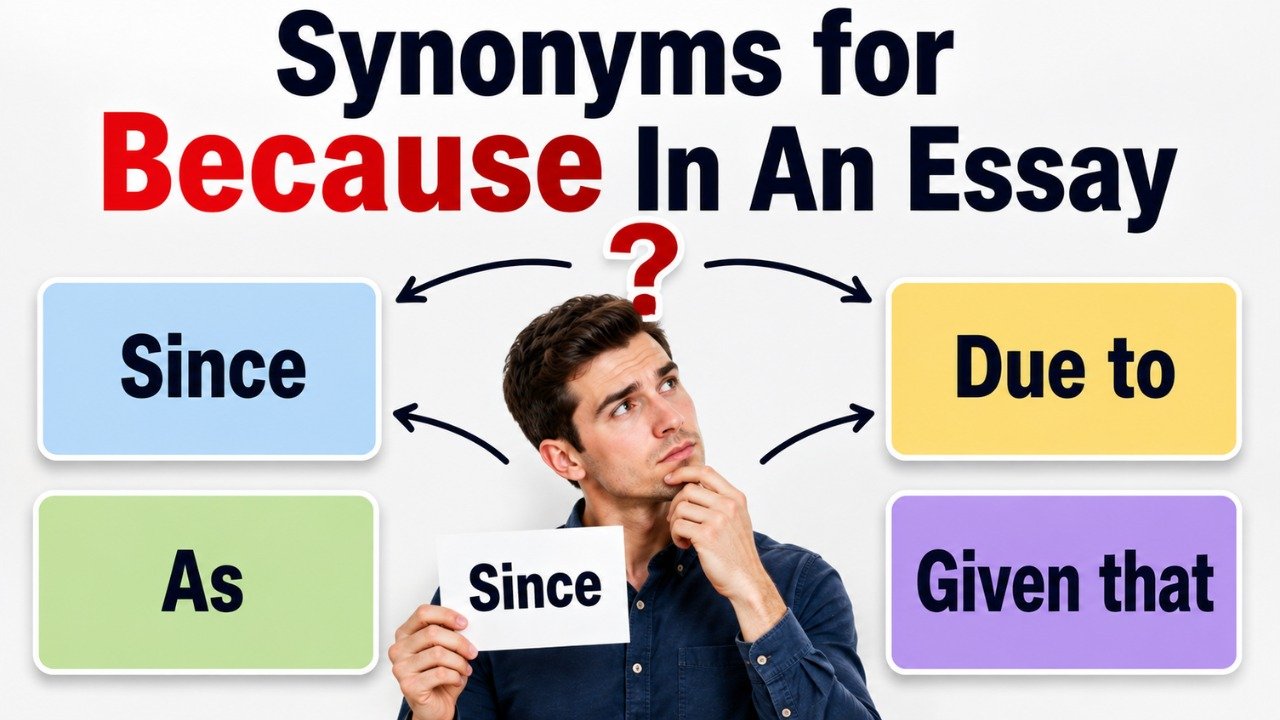
Quick Answer: The best synonyms for because in an essay include since, as, given that, considering that, due to, owing to, because of, in light of, on the grounds that, and for. Use since or as for a concise explanation, given that for formal reasoning, due to or owing to before a noun phrase, in light of when evidence affects a conclusion, and on the grounds that when presenting a formal justification. The best choice depends on sentence structure, clarity, tone, and the type of argument being made.
Pronunciation and Word Details
Word: Because.
Pronunciation: /bɪˈkɒz/ or /bɪˈkəz/.
Part of Speech: Subordinating conjunction.
Meaning: Used to introduce the reason or cause of an action, event, belief, or conclusion.
US Pronunciation:
UK Pronunciation:
What Does “Because” Mean?
Because introduces the reason why something happens, exists, or is believed to be true.
It is a subordinating conjunction that connects a reason clause to a main clause. In an essay, because helps writers explain causes, support claims, justify decisions, and connect evidence with conclusions.
Cause Context: The crops failed because rainfall was limited.
Evidence Context: The argument is convincing because it includes reliable evidence.
Explanation Context: The policy was revised because the original approach was ineffective.
Justification Context: The method was selected because it produced more consistent results.
Because is useful in academic writing, but repeating it too often can make an essay sound basic or monotonous. Alternatives such as since, given that, due to, and in light of can improve variety when they fit the grammar and meaning.
Meaning, Tone, and Context of “Because”
Because has a neutral and direct tone. It is appropriate in casual conversation, formal essays, reports, explanations, and academic arguments.
Neutral Tone: Because clearly connects an action or conclusion with its reason.
Academic Tone: The word is acceptable in essays when the relationship between cause and result is clear.
Conversational Tone: Because is common in everyday speech and informal explanations.
Explanatory Use: It answers the question of why something happened.
Argumentative Use: It connects a claim to supporting reasoning or evidence.
Analytical Use: It explains why a pattern, result, or relationship exists.
Because is not automatically informal or weak. It becomes repetitive only when used too frequently or when a more exact expression would better describe the relationship.
For example, in light of emphasizes evidence, whereas on the grounds that emphasizes justification. Due to usually introduces a noun phrase rather than a full clause.
When and How to Use “Because”
For Explaining a Cause
Use because to state why an event occurred.
Example: The river flooded because heavy rain continued throughout the night.
For Supporting an Argument
Use because to connect a claim with a reason.
Example: Public transportation should receive more funding because it reduces traffic congestion.
For Interpreting Evidence
Use because to explain what evidence suggests.
Example: The results are significant because the same pattern appeared in every trial.
For Justifying a Decision
Use because to explain why a choice was reasonable.
Example: The researchers selected this method because it provided accurate measurements.
For Explaining Human Behavior
Use because to connect an action with a motivation or condition.
Example: Many consumers changed their habits because prices increased.
For Showing a Direct Relationship
Use because when one factor clearly causes or explains another.
Example: The metal expanded because its temperature rose.
For Introducing Background Reasoning
Use because when readers need an explanation before accepting a conclusion.
Example: The proposal deserves consideration because it addresses the main causes of the problem.
Best Synonyms for Because in an Essay
Since
Synonym: Introduces a reason in a concise and natural way.
Example: Since the evidence was incomplete, the conclusion remained uncertain.
As
Synonym: Introduces a reason that is already known or easy to understand.
Example: As demand continued to rise, production increased.
Given That
Synonym: Introduces a fact that supports an argument, decision, or conclusion.
Example: Given that the sample was small, the findings should be interpreted carefully.
Considering That
Synonym: Introduces a fact that should be taken into account.
Example: Considering that resources were limited, the project achieved impressive results.
Due To
Synonym: Means caused by and is usually followed by a noun phrase.
Example: The event was postponed due to severe weather.
Owing To
Synonym: A formal alternative meaning because of.
Example: Several roads were closed owing to flooding.
Because Of
Synonym: Introduces a noun or noun phrase that explains a cause.
Example: Attendance declined because of transportation problems.
In Light Of
Synonym: Introduces evidence, circumstances, or information that affects a judgment.
Example: In light of the new evidence, the earlier conclusion requires revision.
On the Grounds That
Synonym: Introduces a formal reason or justification.
Example: The proposal was rejected on the grounds that it lacked financial support.
For
Synonym: Introduces an explanation, usually in formal or literary writing.
Example: The decision was understandable, for the available options were limited.
50 Synonyms for Because in an Essay With Short Meanings
- Since: Introduces a clear reason or explanation.
- As: Shows why something happens or is true.
- For: Provides a formal explanation or reason.
- Given That: Introduces a fact supporting a conclusion.
- Considering That: Presents a circumstance that should be considered.
- Seeing That: Introduces an obvious or known reason.
- Now That: Gives a reason created by a changed situation.
- Inasmuch As: Means because or to the extent that.
- Insofar As: Introduces a reason within a limited condition.
- Being That: Introduces a reason in informal writing.
- Seeing As: Gives a reason in conversational language.
- In View of the Fact That: Introduces a fact affecting a decision.
- Due to the Fact That: Introduces a reason in a wordy formal structure.
- Owing to the Fact That: Gives a formal explanation of cause.
- On the Grounds That: Introduces a formal justification.
- On Account of the Fact That: Explains a cause through a complete clause.
- By Reason of the Fact That: Gives a highly formal cause.
- Because Of: Introduces a noun phrase expressing cause.
- Due To: Means caused by a particular condition.
- Owing To: Introduces a formal cause or reason.
- As a Result Of: Shows that something happened from a cause.
- On Account Of: Means because of a particular situation.
- By Reason Of: Gives a formal cause or justification.
- In View Of: Introduces circumstances affecting a judgment.
- In Light Of: Introduces evidence or information relevant to a conclusion.
- Thanks To: Introduces a positive or beneficial cause.
- Through: Shows the means or cause of an outcome.
- From: Indicates the source or origin of a result.
- Resulting From: Describes an outcome produced by a cause.
- Arising From: Introduces the source of a problem or situation.
- Stemming From: Shows the original cause of an issue or result.
- Caused By: Directly identifies the source of an event.
- Attributable To: Identifies the factor responsible for a result.
- Based On: Introduces information supporting a decision or conclusion.
- Given: Introduces a known fact or existing condition.
- Considering: Introduces a factor that influences judgment.
- In Response To: Shows that an action occurred because of another event.
- As a Consequence Of: Introduces a result caused by something.
- In Consequence Of: Gives a formal statement of cause.
- By Virtue Of: Means because of a quality, condition, or position.
- As a Result: Introduces the outcome of an earlier cause.
- Consequently: Shows that one event follows from another.
- Therefore: Introduces a logical result or conclusion.
- Thus: Shows the result of previously stated reasoning.
- Hence: Introduces a conclusion caused by an earlier fact.
- For This Reason: Clearly links a result to a stated cause.
- Accordingly: Introduces an action or conclusion based on previous information.
- That Is Why: Explains the result of a previously stated cause.
- Which Explains Why: Connects evidence or circumstances with an outcome.
- As a Consequence: Introduces a result produced by an earlier cause.
Read Also:
Synonyms for Planning

Synonyms for Because in an Essay by Context
When Because Introduces a Complete Clause
Use these alternatives before a subject and verb.
Since: Concise and suitable for most essays.
As: Useful when the reason is already known or less important than the result.
Given That: Formal and useful for analytical reasoning.
Considering That: Emphasizes a circumstance that affects judgment.
Seeing That: Appropriate when the reason is obvious, although it is less formal.
Example: Since the original data was incomplete, further research was necessary.
Example: Given that participation was voluntary, the results may not represent the entire population.
Example: Considering that the policy was recently introduced, its long term effects remain unclear.
When Because Is Followed by a Noun Phrase
Because itself normally introduces a clause. Use these alternatives before a noun, pronoun, or noun phrase.
Because Of: The closest and most direct phrase.
Due To: Common in formal and academic writing.
Owing To: More formal than because of.
As a Result Of: Emphasizes the resulting effect.
On Account Of: Correct but less common in academic writing.
Example: The match was delayed because of heavy rain.
Example: Production declined due to equipment failure.
Example: Several services were suspended owing to budget reductions.
When Explaining Evidence or Reasoning
Use these alternatives when facts or evidence support a conclusion.
In Light Of: Best when new evidence affects a judgment.
Given: Useful before a known condition or fact.
Based On: Shows that a conclusion comes from evidence.
In View Of: Introduces relevant circumstances.
Attributable To: Identifies the factor responsible for a result.
Example: In light of these findings, the theory should be reconsidered.
Example: Based on the available evidence, the claim appears reasonable.
Example: The improvement was largely attributable to better training.
When Presenting Formal Justification
Use these phrases when explaining why a decision, rule, or argument is accepted.
On the Grounds That: Best for formal decisions and arguments.
By Reason Of: Highly formal and often used in official writing.
By Virtue Of: Refers to a position, quality, right, or condition.
For: Introduces a formal explanation after a complete statement.
Example: The application was denied on the grounds that required information was missing.
Example: The committee supported the proposal, for it addressed the most urgent issue.
Example: The participant qualified by virtue of prior experience.
When Rewriting the Sentence Around the Result
Some alternatives do not directly replace because. They introduce the result and require a new sentence or clause.
Therefore: Introduces a logical conclusion.
Consequently: Shows a direct result.
Thus: Presents a concise academic conclusion.
Hence: Connects reasoning with an outcome.
For This Reason: Makes the cause and result relationship explicit.
Accordingly: Introduces an appropriate response or decision.
Original: The evidence was unreliable because the sample was too small.
Rewritten: The sample was too small. Therefore, the evidence was unreliable.
Original: The road was flooded because rainfall had increased.
Rewritten: Rainfall had increased. Consequently, the road was flooded.
When the Cause Is Positive
Use thanks to when the cause produces a desirable result.
Thanks To: Highlights a beneficial cause.
Through: Can show the means by which success was achieved.
By Virtue Of: Can describe an advantage created by a quality or position.
Example: Thanks to improved planning, the project finished early.
Example: The organization expanded through careful investment.
Avoid thanks to when describing a harmful cause unless the expression is intentionally ironic.
Another Word for Because in an Essay
The best general replacement for because is since. It is concise, natural, and suitable for most explanatory sentences.
However, since can also refer to time. Use given that when you want a more formal alternative without possible time related ambiguity. Use due to when the cause is a noun phrase rather than a complete clause.
Original: The experiment was repeated because the first results were unclear.
Better Option: The experiment was repeated since the first results were unclear.
Original: The conclusion is uncertain because the sample was limited.
Better Option: Given that the sample was limited, the conclusion is uncertain.
Original: Attendance decreased because transportation was unavailable.
Better Option: Attendance decreased due to transportation problems.
Original: The recommendation changed because new evidence became available.
Better Option: In light of the new evidence, the recommendation changed.
When Not to Use “Because”
Because should not be removed merely to make an essay sound formal. It is often the clearest choice. However, another expression may be better in certain situations.
When It Creates Repetition
Repeated because clauses can make a paragraph sound mechanical.
Weak: The policy failed because it was expensive. It was also unpopular because it was difficult to understand.
Better: The policy failed because it was expensive. It was also unpopular due to its complexity.
When a More Precise Relationship Is Needed
Because only shows a general reason. A more exact phrase may identify evidence, justification, or consequence.
Weak: The conclusion changed because of new evidence.
Better: In light of the new evidence, the conclusion changed.
When It Creates a Sentence Fragment
A because clause cannot usually stand alone as a complete academic sentence.
Weak: Because the information was incomplete.
Better: The decision was delayed because the information was incomplete.
When the Cause Is a Noun Phrase
Because should normally be followed by a complete clause containing a subject and verb.
Weak: The event was cancelled because heavy rain.
Better: The event was cancelled because of heavy rain.
When Due To Would Be More Concise
Due to is useful before a noun phrase, especially in formal writing.
Weak: The service stopped because the system experienced a failure.
Better: The service stopped due to a system failure.
When a Result Transition Is Needed
Do not place because where therefore or consequently is grammatically required.
Weak: The evidence was incomplete. Because, the claim could not be confirmed.
Better: The evidence was incomplete. Therefore, the claim could not be confirmed.
When the Alternative Is More Ambiguous
As and since can create confusion in some sentences because they may express time.
Unclear: Since the study began, the results were questioned.
This sentence could mean that the results were questioned from the time the study began.
Clearer: Because the study began without sufficient preparation, the results were questioned.
Words Commonly Confused With Because
Because vs Because Of: Because introduces a complete clause, while because of introduces a noun phrase.
Because Example: The event ended early because the weather became dangerous.
Because Of Example: The event ended early because of dangerous weather.
Because vs Due To: Because introduces a subject and verb. Due to usually introduces a noun phrase and means caused by.
Because Example: Sales declined because demand weakened.
Due To Example: Sales declined due to weaker demand.
Because vs Since: Both can introduce a reason, but since can also refer to time.
Because Example: The plan changed because costs increased.
Since Example: Since costs increased, the plan changed.
Because vs As: Both can introduce a cause, but as may also describe time or manner.
Because Example: The building closed because repairs were necessary.
As Example: As repairs were necessary, the building closed.
Because vs Therefore: Because introduces a cause, while therefore introduces a result or conclusion.
Because Example: The roads were closed because snow had accumulated.
Therefore Example: Snow had accumulated. Therefore, the roads were closed.
Because vs For: Both may introduce explanations, but for is more formal and usually connects two independent clauses.
Because Example: The theory was rejected because the evidence was weak.
For Example: The theory was rejected, for the evidence was weak.
Which Synonym Should You Choose?
Choose since when you need a concise alternative and the sentence cannot be misunderstood as referring to time.
Choose as when the reason is already understood or less important than the main result.
Choose given that when presenting a known fact that supports an analytical conclusion.
Choose considering that when a circumstance must be taken into account before forming a judgment.
Choose because of before a noun phrase in clear, neutral writing.
Choose due to before a noun phrase in formal essays, reports, and explanations.
Choose owing to when you need a more formal alternative to because of.
Choose in light of when evidence or new information affects a conclusion.
Choose on the grounds that when explaining a formal justification, rejection, approval, or decision.
Choose attributable to when identifying the factor responsible for a result.
Choose as a result of when emphasizing the effect created by a cause.
Choose thanks to only when the cause is positive or beneficial.
Choose therefore, consequently, thus, or hence when rewriting the sentence to focus on the result rather than the cause.
Choose for this reason when you want the connection between a cause and its result to be especially clear.
Real Life Examples of “Because” in Essay Sentences
Original: The project failed because funding was limited.
Better Option: The project failed due to limited funding.
Original: The theory remains influential because it explains several important patterns.
Better Option: The theory remains influential since it explains several important patterns.
Original: The findings should be treated carefully because the sample was small.
Better Option: Given that the sample was small, the findings should be treated carefully.
Original: The policy was revised because new evidence became available.
Better Option: In light of the new evidence, the policy was revised.
Original: The application was rejected because it did not meet the stated criteria.
Better Option: The application was rejected on the grounds that it did not meet the stated criteria.
Original: The streets flooded because of heavy rainfall.
Better Option: The streets flooded as a result of heavy rainfall.
Original: The company expanded because demand increased.
Better Option: As demand increased, the company expanded.
Original: The conclusion cannot be accepted because the evidence is inconsistent.
Better Option: The evidence is inconsistent. Therefore, the conclusion cannot be accepted.
Original: Student performance improved because teachers received better training.
Better Option: Student performance improved owing to better teacher training.
Original: The treatment was effective because it addressed the underlying cause.
Better Option: The treatment was effective, for it addressed the underlying cause.
Synonym Groups and Usage Differences
Clause Introducing Group
This group includes since, as, given that, considering that, seeing that, and inasmuch as. These expressions are followed by a clause containing a subject and verb.
Example: Given that the data was collected recently, the findings remain relevant.
Noun Phrase Group
This group includes because of, due to, owing to, as a result of, on account of, and by reason of. These expressions are usually followed by a noun or noun phrase.
Example: The flight was delayed due to poor visibility.
Evidence and Judgment Group
This group includes in light of, in view of, based on, given, and considering. These expressions show that evidence or circumstances affect a judgment.
Example: In view of the available evidence, further investigation is justified.
Formal Justification Group
This group includes on the grounds that, by reason of, by virtue of, and for. These expressions suit formal reasoning, decisions, and official explanations.
Example: The request was approved on the grounds that it met every requirement.
Result Transition Group
This group includes therefore, consequently, thus, hence, accordingly, and for this reason. These words introduce a result and require the sentence to be restructured.
Example: The evidence was insufficient. Consequently, the claim remained unproven.
Source and Origin Group
This group includes stemming from, arising from, resulting from, caused by, and attributable to. These expressions identify the origin of a condition or outcome.
Example: The disagreement stemmed from unclear communication.
Positive Cause Group
This group includes thanks to, through, and by virtue of. These alternatives often describe a beneficial cause, means, or advantage.
Example: Thanks to early preparation, the team completed the task successfully.
Antonyms of Because
Because does not have one exact antonym because it introduces a cause. However, several contrast words show that something happened despite a condition rather than as a result of it.
Although: Introduces a fact that contrasts with the result.
Even Though: Emphasizes an unexpected contrast.
Despite: Shows that something happened regardless of a condition.
In Spite Of: Means despite a particular difficulty or fact.
Regardless Of: Shows that a condition did not affect the result.
Notwithstanding: A formal word meaning despite.
Nevertheless: Introduces a result that contrasts with what was expected.
However: Introduces an opposing or contrasting idea.
Independent Of: Shows that one factor did not depend on another.
Unrelated To: Shows that no meaningful connection exists.
Comparison: Because vs Related Words
Because vs Since
Because gives a direct reason. Since can also introduce a reason, but it may refer to time.
Example With Because: The study was repeated because the first trial failed.
Example With Since: Since the first trial failed, the study was repeated.
Use because when time related ambiguity is possible.
Because vs As
Because emphasizes the reason. As often places greater emphasis on the result.
Example With Because: The event was delayed because the speaker arrived late.
Example With As: As the speaker arrived late, the event was delayed.
Because is usually clearer when the cause is important.
Because vs Because Of
Because is followed by a clause. Because of is followed by a noun phrase.
Example With Because: The team left because the weather became dangerous.
Example With Because Of: The team left because of the dangerous weather.
Because vs Due To
Because introduces a reason clause. Due to usually introduces a noun phrase and often sounds more formal.
Example With Because: The machine stopped because a component failed.
Example With Due To: The machine stopped due to component failure.
Because vs Therefore
Because introduces the cause. Therefore introduces the result.
Example With Because: The roads were unsafe because ice had formed.
Example With Therefore: Ice had formed. Therefore, the roads were unsafe.
Because vs In Light Of
Because gives a general cause. In light of emphasizes evidence or information influencing a judgment.
Example With Because: The recommendation changed because new facts emerged.
Example With In Light Of: In light of the new facts, the recommendation changed.
Common Phrases and Expressions With “Because”
Because Of: Introduces a noun phrase that identifies a cause.
Simply Because: Emphasizes that one reason alone explains something.
Only Because: Shows that one specific reason caused an action.
Mainly Because: Identifies the most important reason.
Partly Because: Shows that something has several causes.
Largely Because: Indicates that one cause explains most of the result.
Precisely Because: Strongly emphasizes the exact reason.
Just Because: Introduces a reason, sometimes with a casual or dismissive tone.
Because This Shows: Connects evidence with an interpretation.
Because This Suggests: Connects evidence with a possible conclusion.
Common Mistakes to Avoid
Starting Too Many Sentences With Because
Beginning a sentence with because is grammatically correct when the sentence contains a complete main clause. However, repeated openings can make an essay monotonous.
Vary the structure with given that, in light of, due to, or a result transition.
Writing an Incomplete Because Clause
A because clause alone is usually a sentence fragment.
Incorrect: Because the evidence was unreliable.
Correct: The conclusion was rejected because the evidence was unreliable.
Confusing Because and Because Of
Use because before a complete clause.
Correct: The event was cancelled because the weather was dangerous.
Use because of before a noun phrase.
Correct: The event was cancelled because of dangerous weather.
Using Due To Before a Complete Clause
Due to is generally followed by a noun phrase.
Weak: The event was cancelled due to the weather became dangerous.
Better: The event was cancelled because the weather became dangerous.
Better: The event was cancelled due to dangerous weather.
Replacing Because With Therefore Without Restructuring
Therefore introduces a result, not a cause.
Incorrect: The experiment failed therefore the equipment was damaged.
Correct: The experiment failed because the equipment was damaged.
Correct: The equipment was damaged. Therefore, the experiment failed.
Overusing Wordy Alternatives
Phrases such as due to the fact that and owing to the fact that are grammatically possible but often unnecessarily long.
Wordy: The meeting ended early due to the fact that attendance was low.
Better: The meeting ended early because attendance was low.
Better: The meeting ended early due to low attendance.
Using Thanks To for a Negative Cause
Thanks to normally suggests a positive outcome.
Unnatural: The road was closed thanks to a serious accident.
Better: The road was closed because of a serious accident.
Using As When the Meaning Is Unclear
As may express cause, time, or manner. Use because when readers could misunderstand the relationship.
Assuming Because Is Too Informal
Because is acceptable in academic essays. Clarity is more important than replacing every common word with a longer expression.
Conclusion
The best synonyms for because in an essay depend on grammar, tone, and the relationship being explained. Since, as, and given that introduce complete reason clauses, while because of, due to, and owing to work before noun phrases. In light of is useful for evidence, and on the grounds that suits formal justification. Therefore, consequently, and thus introduce results rather than causes. Choosing the right alternative improves sentence variety while keeping the essay clear, accurate, and logically connected.
FAQs About Synonyms for Because in an Essay
What Is the Best Synonym for Because in an Essay?
Since is the most common concise alternative. Given that is often better when a formal and unambiguous expression is needed.
Is It Acceptable to Use Because in an Essay?
Yes. Because is grammatically correct and appropriate in formal essays when it clearly introduces a reason.
What Is a Formal Alternative to Because?
Given that, in light of, owing to, and on the grounds that are useful formal alternatives.
Can Due To Replace Because?
Due to can replace because of before a noun phrase. It cannot always replace because before a complete clause.
What Can I Use Instead of Because at the Start of a Sentence?
You can use since, as, given that, considering that, or in light of, depending on the sentence structure.
Are Therefore and Because Synonyms?
They express the same cause and result relationship from different directions. Because introduces the cause, while therefore introduces the result.
How Can I Avoid Repeating Because in an Essay?
Use precise alternatives such as since, given that, due to, in light of, and as a result of. You can also restructure some sentences with therefore, consequently, or thus.
