
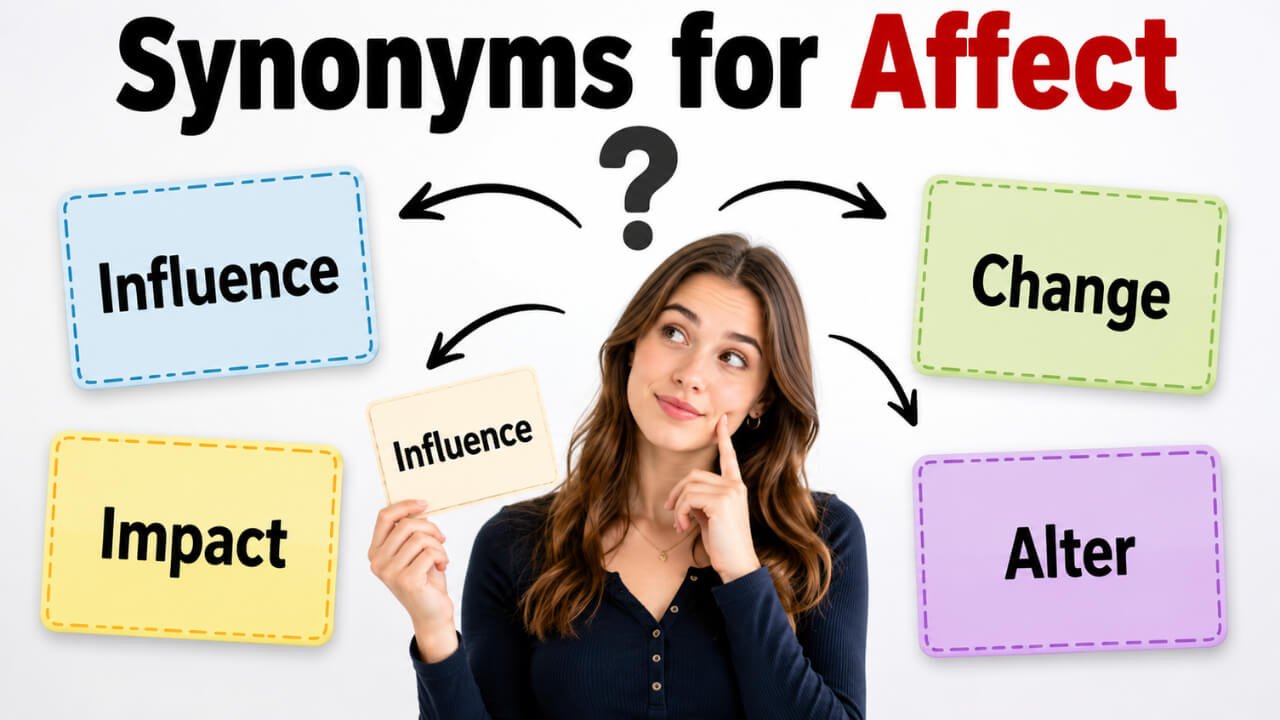
Quick Answer: The best synonyms for affect include influence, impact, alter, change, shape, modify, sway, move, disturb, and afflict. Use influence when something has an indirect effect on a decision or result. Choose alter or modify when something causes a noticeable change. Move and touch work best for emotional reactions. Afflict is suitable when an illness or difficulty causes suffering. Affect can also mean to pretend or adopt a particular manner, in which case feign, assume, or put on may be better alternatives.
Pronunciation and Word Details
Word: Affect.
Pronunciation: /əˈfekt/.
Part of Speech: Verb.
Meaning: To influence, change, emotionally move, harm, or deliberately display a particular manner.
US Pronunciation:
UK Pronunciation:
What Does “Affect” Mean?
Affect means to influence someone or something, usually by causing a change in condition, behavior, feelings, or results. It is most commonly used as a verb.
The word often describes how one thing produces a result in another. Weather can affect travel, stress can affect health, and a decision can affect an entire community.
Affect can also describe an emotional response. A powerful story may deeply affect its readers. In medical contexts, it can mean to attack or harm a part of the body.
A less common meaning is to deliberately adopt or pretend to have a particular style, feeling, voice, or manner.
Influence: The new policy may affect working conditions.
Cause Change: Cold temperatures can affect battery performance.
Create Emotion: Her speech affected everyone in the room.
Cause Harm: The condition mainly affects the lungs.
Pretend or Adopt: He affected a confident manner during the interview.
Meaning, Tone, and Context of “Affect”
Affect is generally a neutral and widely accepted word. It appears in everyday speech, formal writing, academic discussions, medical explanations, reports, essays, and professional communication.
In formal writing, affect is often used to explain a relationship between a cause and a result. Writers may discuss how technology affects communication, how pollution affects health, or how education affects economic opportunity.
In emotional contexts, affect may carry a strong or sensitive tone. Saying that an experience deeply affected someone suggests that it created a meaningful emotional response.
In medical or technical contexts, affect describes how a condition, substance, or process acts upon a system, organ, or function.
When affect means to pretend or adopt a behavior, it can have a slightly critical tone because it may suggest that the behavior is unnatural or insincere.
Neutral Tone: The delay affected the schedule.
Formal Tone: Several factors may affect the accuracy of the results.
Emotional Tone: The farewell deeply affected her.
Medical Tone: The disease affects the nervous system.
Critical Tone: He affected an air of superiority.
When and How to Use “Affect”
For Influence: Use affect when one person, event, condition, or decision has an influence on another.
Example: Rising costs may affect consumer choices.
For Change: Use affect when something causes a condition, result, process, or situation to become different.
Example: Lack of sleep can affect your ability to concentrate.
For Emotional Impact: Use affect when something creates a noticeable emotional reaction.
Example: The documentary affected many viewers deeply.
For Health Conditions: Use affect when an illness, injury, or physical problem acts upon a body part or function.
Example: The infection can affect the throat and lungs.
For Performance: Use affect when a factor improves or reduces how well someone or something works.
Example: Poor lighting can affect reading performance.
For Decisions: Use affect when information, emotions, or circumstances influence a choice.
Example: Personal experience may affect how people judge the situation.
For Pretended Behavior: Use affect when someone deliberately adopts a manner, expression, voice, or attitude.
Example: She affected a calm voice despite feeling nervous.
Best Synonyms for Affect
Influence
Synonym: Influence means to change or guide someone’s thoughts, actions, choices, or results.
Example: Family traditions influence the way people celebrate important events.
Impact
Synonym: Impact means to have a strong or noticeable effect on someone or something.
Example: The new rules will impact several departments.
Alter
Synonym: Alter means to make something different without necessarily changing it completely.
Example: The editor altered the final paragraph for clarity.
Change
Synonym: Change means to make or become different.
Example: Regular practice can change the way you approach difficult tasks.
Shape
Synonym: Shape means to influence the development, character, or direction of something.
Example: Childhood experiences can shape adult behavior.
Modify
Synonym: Modify means to make a limited or specific change.
Example: The team modified its plan after reviewing the results.
Sway
Synonym: Sway means to influence a person’s opinion, choice, or decision.
Example: The evidence may sway undecided voters.
Move
Synonym: Move means to create a strong emotional reaction.
Example: Her sincere words moved the audience.
Disturb
Synonym: Disturb means to negatively affect someone’s peace, emotions, concentration, or condition.
Example: The loud noise disturbed his sleep.
Afflict
Synonym: Afflict means to cause pain, illness, difficulty, or suffering.
Example: The illness can afflict people of any age.
50 Synonyms for Affect with Short Meanings
- Influence: To change or guide thoughts, behavior, or results.
- Impact: To produce a strong or noticeable effect.
- Alter: To make something different.
- Change: To cause a person, thing, or condition to become different.
- Shape: To influence the development or character of something.
- Modify: To make a limited or specific change.
- Sway: To influence an opinion, choice, or decision.
- Determine: To control or establish a particular result.
- Guide: To influence the direction or development of something.
- Govern: To control how something operates or develops.
- Control: To direct or limit an action, process, or result.
- Direct: To guide something toward a particular course.
- Mold: To shape someone’s character, ideas, or behavior.
- Transform: To cause a major or complete change.
- Condition: To influence behavior through experience or circumstances.
- Regulate: To control the operation, speed, or amount of something.
- Adjust: To change something slightly for a particular purpose.
- Disturb: To negatively affect peace, order, or concentration.
- Disrupt: To interrupt the normal progress of something.
- Interfere With: To prevent something from working normally.
- Move: To create a strong emotional response.
- Touch: To produce a gentle or meaningful emotional reaction.
- Impress: To create a strong effect on someone’s mind or feelings.
- Upset: To cause emotional discomfort or unhappiness.
- Trouble: To cause worry, discomfort, or difficulty.
- Distress: To cause serious worry, sadness, or suffering.
- Sadden: To make someone feel unhappy.
- Inspire: To positively influence someone to think or act.
- Motivate: To give someone a reason or desire to act.
- Stimulate: To encourage activity, interest, thought, or growth.
- Provoke: To cause a reaction, feeling, or response.
- Evoke: To bring a memory, image, or emotion to mind.
- Arouse: To create or awaken a feeling or reaction.
- Stir: To awaken strong thoughts or emotions.
- Afflict: To cause pain, illness, or suffering.
- Harm: To cause physical, emotional, or practical damage.
- Damage: To reduce the condition, quality, or usefulness of something.
- Impair: To weaken the quality or normal function of something.
- Weaken: To make something less strong or effective.
- Compromise: To reduce the safety, quality, or effectiveness of something.
- Infect: To enter the body and cause disease.
- Attack: To act harmfully against a body part, system, or condition.
- Strike: To suddenly affect someone with illness or difficulty.
- Burden: To place emotional, physical, or practical pressure on someone.
- Assume: To adopt a particular appearance, manner, or position.
- Adopt: To begin using a particular style, attitude, or behavior.
- Feign: To pretend to feel or possess something.
- Pretend: To behave as though something is true when it is not.
- Simulate: To imitate an appearance, feeling, or condition.
- Put On: To deliberately display a manner, voice, or emotion.
Read Also:
Synonyms for Saying
Synonyms for Affect by Context
When Affect Means to Influence
Influence is the most direct replacement when affect describes how something guides a decision, opinion, behavior, or result.
Useful alternatives include influence, sway, shape, guide, determine, govern, control, and direct.
Example With Affect: Personal values can affect career decisions.
Example With Influence: Personal values can influence career decisions.
Example With Shape: Personal values can shape career decisions.
Example With Guide: Personal values can guide career decisions.
When Affect Means to Cause Change
Use change, alter, modify, adjust, transform, or regulate when affect refers to making something different.
Change is broad and direct. Alter suggests a noticeable difference. Modify usually refers to a limited change, while transform indicates a major change.
Example With Affect: The new information affected their original plan.
Example With Alter: The new information altered their original plan.
Example With Modify: The new information caused them to modify their original plan.
Example With Transform: The discovery transformed their understanding of the issue.
When Affect Means to Create Emotion
Use move, touch, impress, upset, distress, sadden, stir, evoke, or arouse when discussing feelings.
Move and touch usually describe meaningful emotional reactions. Upset and distress describe negative emotions. Evoke often refers to bringing a memory or feeling to mind.
Example With Affect: The final scene deeply affected the audience.
Example With Moved: The final scene deeply moved the audience.
Example With Touched: The final scene touched the audience.
Example With Stirred: The final scene stirred powerful emotions in the audience.
When Affect Means to Cause Harm
Use harm, damage, impair, weaken, compromise, disturb, disrupt, or afflict when something has a negative result.
Impair is useful when a function becomes weaker. Compromise often refers to safety, quality, or effectiveness. Afflict is commonly used for illness, suffering, or long term difficulty.
Example With Affect: The injury affected his ability to walk.
Example With Impaired: The injury impaired his ability to walk.
Example With Weakened: The injury weakened his ability to walk.
Example With Compromised: The injury compromised his mobility.
When Affect Means to Pretend
Use feign, pretend, assume, adopt, simulate, or put on when affect describes deliberately displaying a manner or feeling.
Feign and pretend suggest that the behavior is not genuine. Assume and adopt may simply mean taking on a particular appearance or style.
Example With Affect: He affected an expression of surprise.
Example With Feigned: He feigned surprise.
Example With Put On: He put on a surprised expression.
Example With Assumed: He assumed an expression of surprise.
Another Word for Affect
Influence is usually the best single replacement for affect when the word means to produce a change in behavior, judgment, development, or results. However, the best alternative depends on the sentence.
Use alter for a direct change, move for an emotional response, impair for reduced ability, and feign for pretended behavior.
Original: Weather conditions can affect travel plans.
Better Option: Weather conditions can influence travel plans.
Original: The experience affected her opinion.
Better Option: The experience changed her opinion.
Original: His story deeply affected the listeners.
Better Option: His story deeply moved the listeners.
Original: The injury affected his balance.
Better Option: The injury impaired his balance.
When Not to Use “Affect”
Avoid using affect when a more specific word would explain the type or strength of the result more clearly.
Affect can sound vague when the reader needs to know whether something improved, damaged, delayed, changed, or influenced a result. Choose a precise verb that shows what actually happened.
Do not use affect as a noun when you mean a result. In most general sentences, effect is the correct noun.
Avoid repeatedly using affect in nearby sentences. Replace it with influence, alter, shape, damage, move, or another context appropriate alternative.
Weak: The weather affected the event.
Better: The heavy rain delayed the event.
Weak: The decision affected employee performance.
Better: The decision reduced employee performance.
Weak: The speech affected the audience.
Better: The speech inspired the audience.
Weak: The error affected the final report.
Better: The error compromised the accuracy of the final report.
Words Commonly Confused With Affect
Affect vs Effect: Affect is usually a verb meaning to influence or change. Effect is usually a noun meaning a result or consequence.
Example With Affect: The new schedule may affect attendance.
Example With Effect: The new schedule may have a positive effect on attendance.
Affect vs Influence: Affect is broad and can describe any type of change. Influence often describes indirect guidance over behavior, opinions, or decisions.
Example With Affect: The delay affected the entire project.
Example With Influence: Her advice influenced my decision.
Affect vs Impact: Affect is neutral and widely suitable in formal writing. Impact often suggests a strong or noticeable result.
Example With Affect: The policy may affect small businesses.
Example With Impact: The policy may strongly impact small businesses.
Affect vs Alter: Affect means to have an influence, while alter means to make something different.
Example With Affect: Stress can affect your judgment.
Example With Alter: The editor altered the wording.
Affect vs Afflict: Affect means to influence or change. Afflict means to cause illness, pain, or suffering.
Example With Affect: The condition can affect concentration.
Example With Afflict: The condition can afflict people for many years.
Affect vs Infect: Affect describes an influence or change. Infect means to enter a body or system and spread disease or harmful material.
Example With Affect: The illness may affect the lungs.
Example With Infect: The virus can infect lung cells.
Which Synonym Should You Choose?
Choose influence when discussing decisions, opinions, behavior, or development.
Choose impact when the result is strong, important, or easily noticed.
Choose alter when something becomes different in a clear but not necessarily complete way.
Choose modify when someone makes a controlled or limited change.
Choose shape when experiences or conditions gradually influence development.
Choose sway when one person or argument changes an opinion or decision.
Choose move or touch when something creates an emotional reaction.
Choose upset or distress when the emotional result is negative.
Choose impair when an ability, function, or quality becomes weaker.
Choose damage when something suffers physical, practical, or reputational harm.
Choose afflict when an illness, problem, or hardship causes suffering.
Choose disrupt when the normal progress of an activity or process is interrupted.
Choose feign or pretend when someone deliberately displays an emotion or behavior that is not genuine.
Choose evoke when something brings a memory, image, or emotion to mind.
Real Life Examples of “Affect” in Sentences
Original: Lack of sleep can affect your concentration.
Better Option: Lack of sleep can impair your concentration.
Original: Her teacher affected the way she viewed education.
Better Option: Her teacher shaped the way she viewed education.
Original: The rising price affected customer demand.
Better Option: The rising price influenced customer demand.
Original: The sad ending affected everyone in the room.
Better Option: The sad ending moved everyone in the room.
Original: The storm affected several outdoor events.
Better Option: The storm disrupted several outdoor events.
Original: The medication may affect your energy level.
Better Option: The medication may alter your energy level.
Original: His advice affected my final decision.
Better Option: His advice swayed my final decision.
Original: The injury affected her ability to work.
Better Option: The injury impaired her ability to work.
Original: The criticism affected his confidence.
Better Option: The criticism weakened his confidence.
Original: She affected a cheerful voice during the difficult conversation.
Better Option: She put on a cheerful voice during the difficult conversation.
Synonym Groups and Usage Differences
Influence Group
Influence, sway, shape, guide, determine, govern, and control describe how something directs behavior, development, choices, or results.
Influence is broad and neutral. Sway is commonly connected to opinions and decisions. Shape suggests gradual development.
Example: Early experiences can shape a person’s attitude toward learning.
Change Group
Alter, change, modify, adjust, transform, and regulate describe different levels of change.
Modify and adjust suggest small or controlled changes. Alter is broader, while transform describes a major difference.
Example: The designer modified the layout to improve readability.
Emotional Response Group
Move, touch, impress, upset, distress, sadden, evoke, arouse, and stir describe emotional reactions.
Move and touch often suggest sympathy or deep feeling. Evoke brings a feeling or memory to mind. Distress indicates serious emotional discomfort.
Example: The familiar song evoked memories of childhood.
Harm Group
Harm, damage, impair, weaken, compromise, attack, strike, and afflict describe negative effects.
Damage is broad. Impair usually refers to reduced function. Compromise suggests that quality or safety has become less reliable.
Example: Constant interruptions can impair concentration.
Motivation Group
Inspire, motivate, stimulate, and provoke describe the creation of thought, action, interest, or response.
Inspire is usually positive. Motivate encourages action. Provoke can describe either a positive or negative reaction.
Example: Her success inspired others to continue working toward their goals.
Pretended Behavior Group
Assume, adopt, feign, pretend, simulate, and put on describe taking on an appearance, manner, or emotion.
Feign clearly suggests insincerity. Assume and adopt can describe intentional behavior without always implying dishonesty.
Example: He feigned confidence to hide his nervousness.
Antonyms of Affect
The opposite of affect depends on whether the word means to influence, change, emotionally move, harm, or pretend.
Ignore: To give no attention or consideration to something.
Leave Alone: To avoid changing, influencing, or disturbing something.
Preserve: To keep something in its existing condition.
Maintain: To keep something at the same level or state.
Protect: To prevent harm, damage, or negative influence.
Safeguard: To keep someone or something safe from danger.
Stabilize: To make something steady or less likely to change.
Strengthen: To make something more effective or powerful.
Repair: To correct or restore something that has been damaged.
Heal: To restore health or emotional well being.
Remain Unmoved: To experience no emotional reaction.
Be Genuine: To display a sincere feeling or manner rather than pretending.
Comparison: Affect vs Related Words
Affect vs Influence
Affect is a broad word describing any change or result. Influence often describes indirect control over opinions, decisions, behavior, or development.
Example With Affect: The construction work affected local traffic.
Example With Influence: Friends can influence a person’s choices.
Affect vs Impact
Affect can describe either a small or large result. Impact usually emphasizes a stronger or more noticeable result.
Example With Affect: The change may affect several employees.
Example With Impact: The closure will significantly impact the local economy.
Affect vs Alter
Affect means to influence something. Alter means to make it different.
Example With Affect: Temperature can affect the material.
Example With Alter: Heat can alter the shape of the material.
Affect vs Shape
Affect can describe any type of influence. Shape usually describes gradual influence on character, development, attitudes, or future direction.
Example With Affect: The experience affected his confidence.
Example With Shape: The experience shaped his approach to leadership.
Affect vs Move
Affect can refer to emotional or practical influence. Move specifically describes a strong emotional reaction.
Example With Affect: The story affected the readers.
Example With Move: The story moved the readers to tears.
Affect vs Impair
Affect does not show whether the result is positive or negative. Impair specifically means to reduce ability, quality, or normal function.
Example With Affect: The medication may affect coordination.
Example With Impair: The medication may impair coordination.
Affect vs Afflict
Affect means to influence or change. Afflict means to cause ongoing pain, illness, suffering, or difficulty.
Example With Affect: The disease may affect the joints.
Example With Afflict: The disease can afflict older adults.
Common Phrases and Expressions With “Affect”
Directly Affect: To produce an immediate influence or change.
Seriously Affect: To cause an important or harmful result.
Negatively Affect: To cause an undesirable change or consequence.
Positively Affect: To create a helpful or beneficial result.
Deeply Affect: To create a powerful emotional response.
Emotionally Affect: To influence someone’s feelings.
Affect Performance: To change how well someone or something works.
Affect the Outcome: To influence the final result.
Affect Daily Life: To change normal routines, comfort, or activities.
Affect a Decision: To influence the choice someone makes.
Common Mistakes to Avoid
One common mistake is confusing affect with effect. Affect is usually an action word, while effect usually names the result of that action.
Incorrect: The weather had a negative affect on attendance.
Correct: The weather had a negative effect on attendance.
Another mistake is using effect as a verb when affect is needed.
Incorrect: The noise may effect your concentration.
Correct: The noise may affect your concentration.
Avoid using affect when the sentence needs a more precise verb. Words such as delay, damage, improve, reduce, inspire, or upset tell the reader exactly what happened.
Do not assume that impact is always a stronger or better replacement. It can sound repetitive or unnecessarily forceful when influence, alter, or affect would be clearer.
Remember that affect can have a different pronunciation and meaning when used as a noun in specialized discussions of visible emotion. In most everyday writing, however, affect is used as a verb.
Avoid confusing affect and afflict. A problem may affect many people, but an illness or hardship may afflict them.
Conclusion
Understanding synonyms for affect helps you describe influence, change, emotion, harm, and behavior more precisely. Influence works well for decisions and development, while alter and modify describe change. Move and touch are suitable for emotional reactions. Impair, damage, and afflict express harmful results, while feign and pretend describe insincere behavior. Because affect has several meanings, the best synonym always depends on what causes the result, how strong the result is, and whether the effect is emotional, physical, practical, or deliberate.
FAQs About Synonyms for Affect
What Is the Best Synonym for Affect?
Influence is the best general synonym when affect means to change a decision, behavior, condition, or result. A more precise alternative may be better in a specific sentence.
Is Impact a Synonym for Affect?
Yes, impact can replace affect when something produces a strong or noticeable result. Affect is often more neutral, while impact may suggest greater force or importance.
What Is a Formal Synonym for Affect?
Influence, alter, modify, determine, impair, and compromise are useful formal alternatives. The correct choice depends on the intended meaning.
What Is an Emotional Synonym for Affect?
Move, touch, upset, distress, stir, and evoke are suitable when affect refers to an emotional reaction.
What Is the Difference Between Affect and Effect?
Affect is usually a verb meaning to influence or change. Effect is usually a noun referring to the result of an action or change.
Can Affect Mean Pretend?
Yes. Affect can mean to deliberately adopt a voice, attitude, expression, or manner. Feign, pretend, assume, and put on are useful alternatives in this context.
Which Synonym Should Be Used for a Negative Affect?
Use harm, damage, impair, weaken, disrupt, distress, or afflict when the result is negative. Choose the word that most clearly explains the type of harm.
