
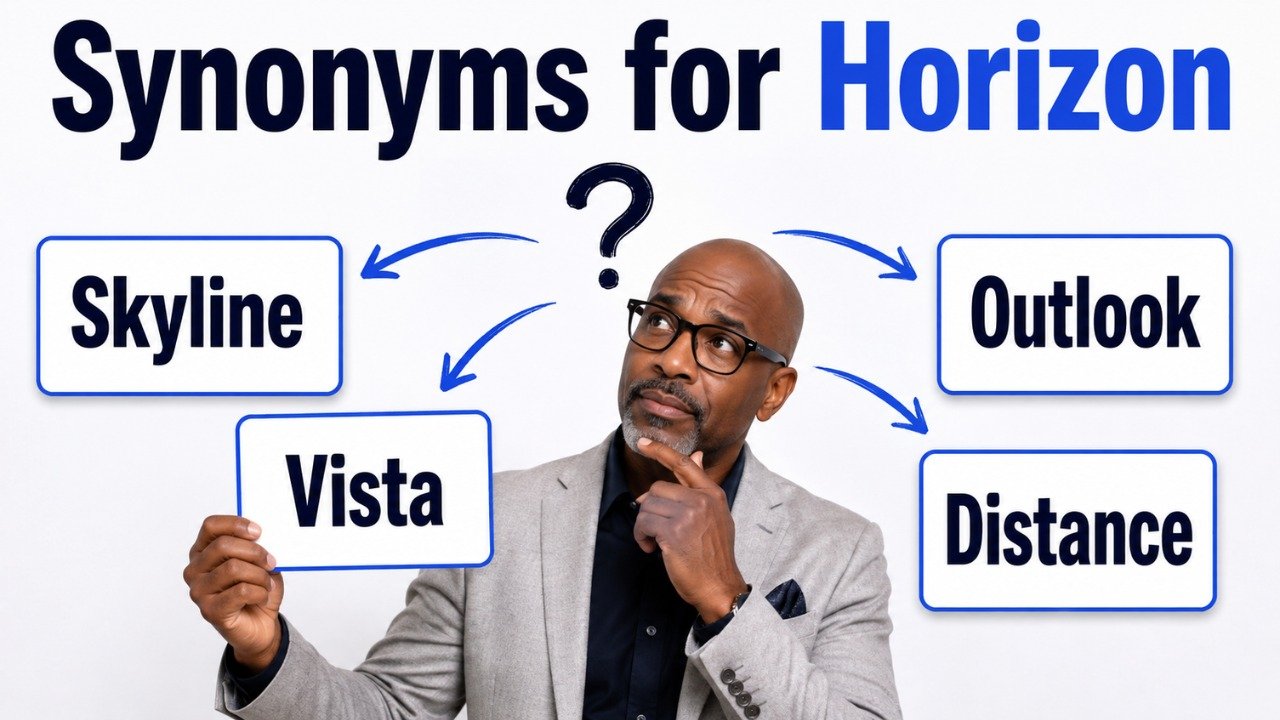
Quick Answer: Synonyms for horizon include skyline, boundary, limit, outlook, prospect, vista, range, scope, perspective, and field of view. The best choice depends on context. Skyline works well for the visible line where land or buildings meet the sky, boundary and limit suit figurative edges, outlook and prospect describe future possibilities, vista emphasizes a broad view, scope refers to the extent of knowledge or activity, and perspective works when horizon means a person’s range of understanding.
Pronunciation and Word Details
Word: Horizon
Pronunciation: /həˈraɪzən/
Part of Speech: Noun
Meaning: The apparent line where the earth or sea seems to meet the sky, or figuratively the limit of knowledge, experience, possibility, or expectation.
US Pronunciation:
UK Pronunciation:
What Does “Horizon” Mean?
Horizon means the apparent line in the distance where the land or sea seems to meet the sky. It is a noun and is commonly used in descriptions of landscapes, travel, weather, nature, photography, and visual distance.
The word also has an important figurative meaning. It can refer to the limits of a person’s knowledge, experience, imagination, opportunities, or expectations.
For example, broadening your horizons means gaining new experiences or learning about unfamiliar ideas. Something appearing on the horizon can also mean that an event or development is likely to happen soon.
Physical View: The sun disappeared below the horizon.
Distance: A ship appeared on the horizon.
Knowledge: Travel can broaden a person’s horizons.
Future Possibility: Several new opportunities are on the horizon.
Meaning, Tone, and Context of “Horizon”
Horizon is a neutral and versatile word. It can sound descriptive, visual, thoughtful, academic, or figurative depending on the sentence.
In landscape and nature writing, horizon usually refers to the distant visual boundary between earth and sky. Skyline, line of sight, and distant edge may work in related contexts.
In figurative writing, horizon can describe the limits of knowledge, awareness, opportunity, or imagination. Scope, range, perspective, and outlook are useful alternatives in these situations.
The word can also describe future developments. Phrases such as on the horizon often refer to something expected or approaching.
Visual Context: Horizon describes the distant line where the sky appears to meet the earth or water.
Knowledge Context: Horizon can mean the limits of what someone knows or understands.
Opportunity Context: Horizon can represent future possibilities or developments.
Perspective Context: Horizon can describe the range of someone’s awareness or experience.
When and How to Use “Horizon”
For Distant Views: Use horizon when describing the visible line where land or water seems to meet the sky.
Example: The mountains formed a dark shape along the horizon.
For Landscapes: Horizon works naturally when writing about wide outdoor scenes.
Example: The open plains stretched toward the horizon.
For Future Possibilities: Use horizon figuratively when discussing events or opportunities that may appear soon.
Example: New career opportunities are beginning to appear on the horizon.
For Knowledge: Use horizon when talking about the limits or expansion of understanding.
Example: Reading widely can broaden your intellectual horizon.
For Perspective: Horizon can describe a person’s range of experience or awareness.
Example: Living abroad expanded her cultural horizons.
For Limits: Horizon may represent the furthest point someone can see, imagine, or understand.
Example: The discovery pushed the horizon of scientific knowledge further.
Best Synonyms for Horizon
Skyline: The visible outline of land, buildings, or other features against the sky.
Example: The city skyline was visible from several miles away.
Boundary: A line or limit marking the edge of an area or concept.
Example: The discovery moved beyond the traditional boundary of the field.
Limit: The furthest point or extent something can reach.
Example: Researchers continued testing the limits of current knowledge.
Outlook: A view of future possibilities or a person’s attitude toward them.
Example: The economic outlook remained positive.
Prospect: A possibility or expectation concerning the future.
Example: The prospect of new opportunities encouraged the team.
Vista: A wide and pleasing view, especially across a landscape.
Example: The hill offered a sweeping vista of the valley.
Range: The extent or area over which something reaches or applies.
Example: The course expanded the range of topics students could explore.
Scope: The extent of knowledge, activity, influence, or possibility.
Example: The project has a much broader scope than originally planned.
Perspective: A particular way of seeing or understanding something.
Example: Traveling gave her a wider perspective on different cultures.
Field of View: The area that can be seen from a particular position.
Example: The tower provided a broad field of view across the coastline.
50 Synonyms for Horizon with Short Meanings
- Skyline: The outline of land or buildings against the sky.
- Boundary: A line marking an edge or limit.
- Limit: The furthest possible point or extent.
- Outlook: A view of future possibilities.
- Prospect: An expected or possible future situation.
- Vista: A wide view across a landscape.
- Range: The extent over which something reaches.
- Scope: The breadth or extent of something.
- Perspective: A way of viewing or understanding something.
- Field of View: The visible area from a particular position.
- Sky Line: The apparent line where sky meets distant land.
- Distant Edge: The farthest visible boundary of a scene.
- Visible Boundary: The outer line that can be seen.
- Far Edge: A distant limit or border.
- Distance: A remote point or area within sight.
- Expanse: A wide and open area.
- View: What can be seen from a particular place.
- Panorama: A broad and extensive view.
- Scene: A visible area or landscape.
- Landscape: The visible features of an area of land.
- Seascape: A broad view of the sea.
- Skyline Edge: The visible outer line against the sky.
- Visual Limit: The furthest point visible to the eye.
- Line of Sight: The direction or extent of direct vision.
- Sightline: A clear line or direction of vision.
- Outer Limit: The greatest possible extent.
- Edge: The outer boundary of something.
- Border: A dividing or limiting line.
- Margin: The outer edge or limit of an area.
- Frontier: The outer limit of knowledge, activity, or exploration.
- Threshold: The point at which something begins or changes.
- Extent: The amount or range covered by something.
- Reach: The furthest distance or influence possible.
- Breadth: The width or broad extent of something.
- Compass: The full range or scope of something.
- Purview: The range of knowledge, responsibility, or concern.
- Awareness: The range of what someone knows or recognizes.
- Understanding: The extent of someone’s knowledge or comprehension.
- Worldview: A broad way of understanding life or the world.
- Vision: The ability to imagine or consider future possibilities.
- Possibility: Something that may happen or become available.
- Opportunity: A favorable possibility for future action.
- Future: The time and possibilities that lie ahead.
- Expectation: A belief about what may happen.
- Forecast: A statement or view about future developments.
- Potential: The possibility of future growth or achievement.
- Opening: A new opportunity or possibility.
- Frontage: The visible or outward facing extent of an area.
- Vantage: A position from which something is viewed.
- Viewpoint: A position or perspective from which something is seen.
Read Also:
Synonyms for Texture

Synonyms for Horizon by Context
When Horizon Means the Visible Line in the Distance
Skyline, distant edge, visible boundary, far edge, sky line, and visual limit are useful when describing the line where the sky seems to meet land or water.
Example: The last light faded behind the distant edge of the sea.
Example: A row of mountains shaped the skyline.
When Horizon Means a Wide View
Vista, panorama, view, landscape, seascape, and expanse work when the focus is on a broad visual scene rather than a single boundary line.
Example: The balcony offered a panoramic view of the valley.
Example: From the cliff, visitors could enjoy a wide seascape.
When Horizon Means a Limit
Boundary, limit, outer limit, edge, border, margin, and frontier can replace horizon when describing the furthest extent of knowledge, ability, or activity.
Example: The research pushed beyond the traditional boundaries of the field.
Example: Scientists continue exploring the frontiers of medicine.
When Horizon Means Knowledge or Experience
Scope, range, perspective, purview, awareness, understanding, and worldview are useful when horizon refers to what a person knows or experiences.
Example: Studying another language can broaden your perspective.
Example: The course expanded the scope of her understanding.
When Horizon Means Future Possibilities
Outlook, prospect, possibility, opportunity, future, expectation, and potential work when horizon refers to what may happen next.
Example: The prospect of expansion remains strong.
Example: Several new opportunities are beginning to emerge.
Another Word for Horizon
The best single replacement for horizon depends strongly on context. Skyline is often the best alternative for a visible distant line, while outlook works better for future expectations and scope suits figurative limits of knowledge or activity.
Original: The sun slowly disappeared beneath the horizon.
Better Option: The sun slowly disappeared beyond the skyline.
Original: Several changes are visible on the horizon.
Better Option: Several changes are visible in the future outlook.
Original: Traveling broadened his horizons.
Better Option: Traveling broadened his perspective.
Original: The research expanded the horizon of scientific understanding.
Better Option: The research expanded the scope of scientific understanding.
When Not to Use “Horizon”
Horizon may be too figurative when a sentence requires a precise description of a physical boundary, future forecast, or field of knowledge.
If you are discussing city buildings against the sky, skyline is usually more specific. When describing future expectations, outlook or prospect may communicate the meaning more directly.
Horizon can also sound vague when the reader cannot tell whether it refers to distance, knowledge, possibility, or the future.
Weak: The company has a good horizon.
Better: The company has a promising outlook.
Weak: The tall buildings changed the horizon.
Better: The tall buildings changed the skyline.
Weak: This subject is outside my horizon.
Better: This subject is outside my area of expertise.
Use horizon when its visual or figurative meaning adds value rather than simply replacing a more precise word.
Words Commonly Confused With Horizon
Horizon vs Skyline: Horizon is the apparent line where land or water meets the sky. Skyline usually refers to the outline of buildings, mountains, or other objects against the sky.
Horizon vs Vista: Horizon is a distant boundary line, while vista is a broad and often attractive view.
Horizon vs Outlook: Horizon may represent future possibilities, while outlook directly describes expectations or attitudes about the future.
Horizon vs Scope: Horizon can figuratively mean the limits of understanding or experience, while scope refers to the extent of a subject, activity, or project.
Horizon vs Perspective: Horizon can describe the limits of awareness, while perspective refers to a particular way of seeing or understanding something.
Horizon vs Frontier: Horizon suggests a visible or figurative limit, while frontier often represents an outer boundary of exploration, knowledge, or development.
Which Synonym Should You Choose?
Choose skyline when describing buildings, mountains, or land outlined against the sky.
Choose vista when emphasizing a wide and impressive landscape view.
Choose panorama when describing an extensive scene visible from one position.
Choose boundary when referring to a clear physical or figurative limit.
Choose frontier when discussing the outer limits of knowledge, science, exploration, or innovation.
Choose scope in essays and reports when describing the extent of a subject or activity.
Choose perspective when horizon refers to a person’s way of understanding the world.
Choose outlook when discussing future conditions, expectations, or possibilities.
Choose prospect when emphasizing a particular future possibility.
Choose range when describing the breadth of knowledge, experience, vision, or activity.
Real Life Examples of “Horizon” in Sentences
Original: The sun appeared above the horizon.
Better Option: The sun appeared above the distant skyline.
Original: Dark clouds gathered on the horizon.
Better Option: Dark clouds gathered along the distant edge of the sky.
Original: Travel helped broaden her horizons.
Better Option: Travel helped broaden her perspective.
Original: New opportunities are appearing on the horizon.
Better Option: New opportunities are becoming visible in the outlook ahead.
Original: The mountains stretched across the horizon.
Better Option: The mountains stretched across the skyline.
Original: The discovery expanded the horizon of modern research.
Better Option: The discovery expanded the scope of modern research.
Original: A ship slowly appeared on the horizon.
Better Option: A ship slowly appeared in the distance.
Original: His intellectual horizon widened after years of study.
Better Option: His intellectual perspective widened after years of study.
Original: Major changes are on the horizon.
Better Option: Major changes are expected in the near future.
Original: Nothing interrupted the flat desert horizon.
Better Option: Nothing interrupted the distant edge of the desert landscape.
Synonym Groups and Usage Differences
Visual Boundary Group
Skyline, distant edge, visible boundary, far edge, and visual limit describe the distant line visible to an observer.
Example: The mountains formed a dark skyline at sunset.
Broad View Group
Vista, panorama, landscape, seascape, expanse, and view describe a large visible area.
Example: The hilltop revealed a broad panorama of the countryside.
Limits Group
Boundary, limit, edge, margin, frontier, extent, and reach focus on the furthest point something can extend.
Example: The experiment pushed the limits of existing technology.
Knowledge Group
Scope, range, perspective, purview, awareness, understanding, and worldview describe the breadth of knowledge or experience.
Example: Reading history expanded her understanding of different cultures.
Future Group
Outlook, prospect, possibility, opportunity, future, expectation, and potential describe developments that may lie ahead.
Example: The economic outlook appears more stable than before.
Antonyms of Horizon
The opposite of horizon depends on whether the word refers to openness, limits, perspective, or future possibility.
Center: The middle rather than the distant edge.
Interior: The inside area rather than an outer boundary.
Foreground: The part of a view closest to the observer.
Nearness: Close distance rather than something far away.
Restriction: A condition that reduces range or possibility.
Narrowness: Limited breadth of thought, experience, or vision.
Constraint: Something that limits action or possibility.
Certainty: A definite outcome rather than an open future possibility.
Immediate View: What is directly visible nearby rather than in the distance.
Closed Perspective: A restricted way of thinking rather than a broad horizon.
Comparison: Horizon vs Related Words
Horizon vs Skyline
Horizon is the apparent distant line where earth or water meets the sky. Skyline is the visible outline of buildings, mountains, or other objects against the sky.
Example With Horizon: The sun sank below the horizon.
Example With Skyline: The towers created a distinctive city skyline.
Horizon vs Vista
Horizon describes a distant boundary, while vista describes a broad and often attractive view.
Example With Horizon: A distant ship appeared on the horizon.
Example With Vista: The balcony offered a beautiful vista of the mountains.
Horizon vs Outlook
Horizon can figuratively refer to future events, while outlook focuses more directly on expected future conditions.
Example With Horizon: Several major developments are on the horizon.
Example With Outlook: The financial outlook appears encouraging.
Horizon vs Scope
Horizon may describe the limit of knowledge or experience, while scope describes how broad a subject, activity, or responsibility is.
Example With Horizon: Studying abroad broadened his horizons.
Example With Scope: The research project has a broad scope.
Horizon vs Perspective
Horizon can refer to the limits of someone’s awareness, while perspective describes the way someone sees or interprets a situation.
Example With Horizon: New experiences expanded her intellectual horizons.
Example With Perspective: The experience changed her perspective on success.
Horizon vs Frontier
Horizon is often a distant visual or figurative limit. Frontier suggests the furthest boundary of exploration, discovery, or development.
Example With Horizon: New technologies are appearing on the horizon.
Example With Frontier: Researchers are working at the frontier of medical science.
Common Phrases and Expressions With “Horizon”
On the Horizon: Likely to happen or appear soon.
Example: Several important changes are on the horizon.
Beyond the Horizon: Outside the visible range or beyond current knowledge.
Example: The explorers wondered what lay beyond the horizon.
Broaden Your Horizons: Gain new experiences, ideas, or knowledge.
Example: Learning another language can broaden your horizons.
Expand Your Horizons: Increase the range of your experiences or understanding.
Example: Traveling can expand your horizons.
Over the Horizon: Beyond the visible distance or expected in the future.
Example: A new opportunity may be waiting over the horizon.
Distant Horizon: The farthest visible boundary.
Example: The mountain peaks appeared along the distant horizon.
Eastern Horizon: The visible boundary toward the east.
Example: The first light appeared on the eastern horizon.
Western Horizon: The distant boundary toward the west.
Example: The sun glowed above the western horizon.
New Horizons: New opportunities, experiences, or areas of discovery.
Example: The program opened new horizons for young researchers.
Intellectual Horizons: The limits or range of a person’s knowledge and ideas.
Example: Wide reading can expand your intellectual horizons.
Common Mistakes to Avoid
A common mistake is treating horizon and skyline as exact synonyms in every sentence. Skyline usually describes the visible outline of buildings or natural features, while horizon refers to the apparent line where earth or water meets the sky.
Another mistake is using horizon when outlook would be clearer for future predictions.
Avoid replacing horizon with vista when the sentence specifically refers to a boundary line. Vista describes the whole view rather than its distant edge.
Do not use scope and perspective interchangeably. Scope describes extent, while perspective describes a viewpoint or way of understanding.
Horizon can also become vague in figurative writing if the surrounding sentence does not show whether you mean knowledge, future possibility, or personal experience.
Unclear: The project improved our horizon.
Better: The project broadened our perspective.
Wrong Choice: The city horizon contained dozens of tall towers.
Better: The city skyline contained dozens of tall towers.
Vague: The horizon of the company looks good.
Better: The company’s future outlook looks promising.
Repetitive: Travel broadened his horizons and expanded his horizons in many ways.
Better: Travel broadened his horizons and gave him a wider perspective on other cultures.
Conclusion
Synonyms for horizon vary according to whether the word describes a distant view, a limit, personal knowledge, or future possibilities. Use skyline for a visible outline, vista or panorama for a broad view, boundary and limit for edges, scope and range for extent, perspective for understanding, and outlook or prospect for the future. Choosing the most precise alternative helps readers immediately understand whether you are describing a physical landscape, an intellectual limit, or something expected to happen ahead.
FAQs About Synonyms for Horizon
What Is the Best Synonym for Horizon?
Answer: Skyline is one of the best alternatives when horizon refers to a distant visible line, while outlook, scope, or perspective may be better in figurative contexts.
What Is Another Word for Horizon in Nature?
Answer: Skyline, distant edge, visible boundary, vista, and far edge can work depending on whether you mean the boundary itself or the wider landscape.
What Is a Synonym for Broadening Your Horizons?
Answer: Expanding your perspective, widening your knowledge, gaining experience, and broadening your understanding can express a similar idea.
Is Skyline the Same as Horizon?
Answer: Not exactly. Horizon is the apparent line where earth or water meets the sky, while skyline is the outline of buildings, mountains, or other features against the sky.
What Is a Figurative Synonym for Horizon?
Answer: Scope, range, perspective, outlook, frontier, and purview are useful figurative alternatives depending on context.
What Is Another Word for Something on the Horizon?
Answer: Prospect, possibility, future development, expectation, and upcoming opportunity can describe something likely to happen soon.
Can Frontier Be a Synonym for Horizon?
Answer: Yes, in figurative contexts. Frontier works especially well when horizon refers to the outer limits of exploration, knowledge, science, or development.
