
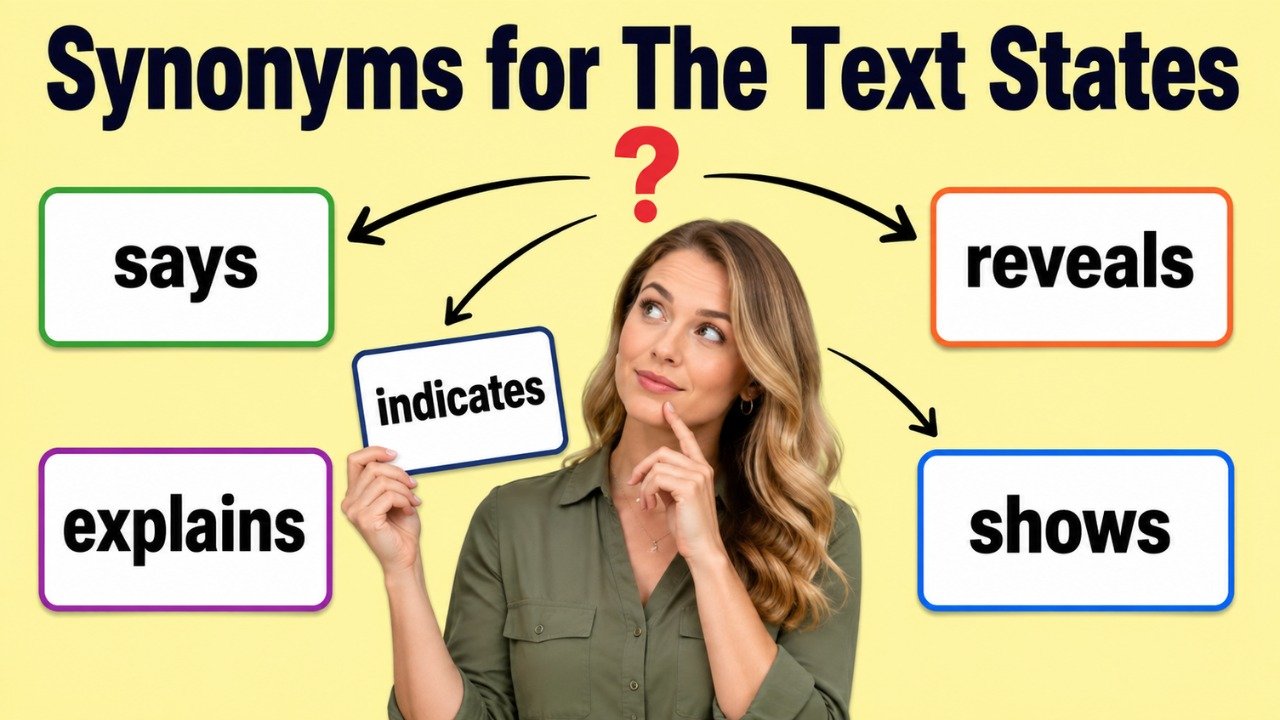
Quick Answer: The best synonyms for the text states include the text says, the passage states, the passage explains, the author states, the text explains, the text indicates, the text notes, the text reveals, the passage mentions, and the author explains. Among these synonyms for the text states, use the text explains when clarifying an idea, the text indicates when evidence suggests something, the text reveals when information becomes clear, the text notes for a brief observation, and the author argues when discussing a claim or position in academic writing.
Pronunciation and Word Details
Word: The text states.
Pronunciation: /ðə tekst steɪts/.
Part of Speech: Phrase.
Meaning: A phrase used to introduce information, ideas, claims, or evidence presented in a written passage.
US Pronunciation:
UK Pronunciation:
What Does “The Text States” Mean?
The text states means that a written passage directly presents or communicates a particular idea, fact, claim, or piece of information.
The phrase is commonly used in essays, reading responses, literary analysis, academic assignments, and discussions about written material.
The word states functions as a verb meaning expresses something clearly or formally. In the phrase the text states, the text is treated as the source of the information.
Example: The text states that regular practice improves performance.
Writers often use this phrase before explaining evidence from a passage. However, repeating it too frequently can make writing sound mechanical. Alternatives such as the text explains, the passage indicates, or the author notes can make analysis clearer and more varied.
Meaning, Tone, and Context of “The Text States”
The text states has a neutral to formal tone. It is especially common in school assignments, essays, reading comprehension responses, research discussions, and analytical writing.
In academic writing, the phrase is useful when introducing information that appears directly in a source.
In literary analysis, writers may choose more specific verbs depending on what the passage is doing. For example, explains works for clarification, suggests works for an implied idea, argues works for a position, and reveals works for newly presented information.
In casual conversation, the phrase may sound slightly formal. The text says is usually more natural in everyday speech.
The best replacement depends on whether the source is stating a fact, explaining an idea, presenting evidence, making an argument, describing something, or implying a meaning.
When and How to Use “The Text States”
For Direct Information: Use the text states when the information appears clearly and directly in a passage.
Example: The text states that the event occurred in the spring.
For Evidence: Use the phrase when introducing information that supports your interpretation.
Example: The text states that the character avoided speaking to his family.
For Reading Responses: It works well when answering questions based on a passage.
Example: The text states that water is necessary for plant growth.
For Academic Writing: The phrase can introduce a fact, explanation, or claim from a written source.
Example: The text states that economic conditions affected migration.
For Literary Analysis: Use it when referring to something directly written, but choose a more specific verb when analyzing purpose or meaning.
Example: The text states that the character left home, but later passages suggest that fear influenced the decision.
For Reports: The text states can introduce information contained in a document or written report.
Example: The text states that the procedure should be repeated twice.
Best Synonyms for the Text States
The Text Says
Synonym: The text says means that the written material communicates certain information.
Example: The text says that the bridge was completed after several years.
The Passage States
Synonym: The passage states means that a particular section of writing directly presents information.
Example: The passage states that the family moved because of financial difficulties.
The Text Explains
Synonym: The text explains means that the passage makes an idea or process easier to understand.
Example: The text explains why the experiment produced different results.
The Author States
Synonym: The author states means that the writer directly expresses a fact, opinion, or claim.
Example: The author states that education plays an important role in social development.
The Text Indicates
Synonym: The text indicates means that information in the passage points toward a particular conclusion.
Example: The text indicates that the character already knew the truth.
The Text Notes
Synonym: The text notes means that the passage briefly mentions or observes something important.
Example: The text notes that temperatures were unusually low.
The Text Reveals
Synonym: The text reveals means that the passage makes information known or clear.
Example: The text reveals that the two characters had met before.
The Passage Mentions
Synonym: The passage mentions means that a detail is referred to briefly.
Example: The passage mentions several reasons for the population decline.
The Author Explains
Synonym: The author explains means that the writer provides reasons, details, or clarification.
Example: The author explains how the process affects the environment.
The Text Suggests
Synonym: The text suggests means that the passage implies an idea without necessarily stating it directly.
Example: The text suggests that the character regrets the decision.
50 Synonyms for the Text States with Short Meanings
- The Text Says: The passage communicates information.
- The Passage States: A section directly presents information.
- The Text Explains: The passage clarifies an idea.
- The Author States: The writer directly expresses something.
- The Text Indicates: The passage points toward a conclusion.
- The Text Notes: The passage briefly observes something.
- The Text Reveals: The passage makes information clear.
- The Passage Mentions: A detail is briefly referred to.
- The Author Explains: The writer clarifies an idea or reason.
- The Text Suggests: The passage implies a possible meaning.
- The Passage Explains: A section provides clarification.
- The Author Notes: The writer briefly highlights a detail.
- The Author Mentions: The writer refers to something briefly.
- The Text Describes: The passage gives details about something.
- The Passage Describes: A section provides descriptive information.
- The Author Describes: The writer presents characteristics or details.
- The Text Reports: The passage provides factual information.
- The Passage Reports: A section presents reported facts.
- The Author Reports: The writer presents information or findings.
- The Text Shows: The passage provides evidence of something.
- The Passage Shows: A section demonstrates an idea.
- The Author Shows: The writer demonstrates something through evidence.
- The Text Demonstrates: The passage clearly provides supporting evidence.
- The Passage Demonstrates: A section proves or illustrates something.
- The Author Demonstrates: The writer supports an idea with evidence.
- The Text Presents: The passage introduces information or an idea.
- The Passage Presents: A section introduces a point or fact.
- The Author Presents: The writer puts forward information.
- The Text Observes: The passage makes a thoughtful observation.
- The Author Observes: The writer comments on a detail or pattern.
- The Text Emphasizes: The passage gives special importance to something.
- The Author Emphasizes: The writer strongly highlights an idea.
- The Text Highlights: The passage draws attention to a point.
- The Author Highlights: The writer calls attention to something important.
- The Text Clarifies: The passage makes an idea clearer.
- The Author Clarifies: The writer removes confusion about a point.
- The Text Identifies: The passage names or recognizes something.
- The Author Identifies: The writer points out a particular detail.
- The Text Claims: The passage presents an assertion.
- The Author Claims: The writer makes a statement that may require support.
- The Text Argues: The passage presents a position supported by reasoning.
- The Author Argues: The writer supports a particular viewpoint.
- The Text Maintains: The passage continues to support a position.
- The Author Maintains: The writer firmly holds a particular view.
- The Text Asserts: The passage expresses an idea confidently.
- The Author Asserts: The writer strongly states a claim.
- The Text Implies: The passage communicates meaning indirectly.
- The Passage Implies: A section suggests something without stating it directly.
- The Text Confirms: The passage verifies previously discussed information.
- The Author Concludes: The writer reaches a final judgment or result.
Read Also:
Synonyms for Window
Synonyms for the Text States by Context
When the Text Directly Gives Information
Use these alternatives when the information is explicitly written rather than implied.
Useful options include the text says, the passage states, the author states, the text reports, and the text presents.
Example: The passage states that the town was founded near the river.
Example: The author reports that the population increased steadily.
When the Text Explains an Idea
Use these expressions when the passage provides reasons, details, or clarification.
Useful options include the text explains, the passage explains, the author explains, and the text clarifies.
Example: The text explains why the plants need additional sunlight.
Example: The author clarifies the difference between the two methods.
When the Text Provides Evidence
Use stronger analytical verbs when the writing supports an interpretation or conclusion.
Useful options include the text shows, demonstrates, confirms, indicates, and reveals.
Example: The text demonstrates that the policy produced several unexpected effects.
Example: The passage indicates that the character feels uncertain.
When the Text Briefly Refers to Something
Use mentions or notes when the information is present but is not discussed deeply.
Example: The passage mentions a second possible explanation.
Example: The author notes that the results may change over time.
When the Text Makes an Argument
Use argues, claims, maintains, or asserts when the source presents a position rather than a simple fact.
Example: The author argues that stronger protections are necessary.
Example: The text maintains that cooperation produces better outcomes.
When the Text Implies an Idea
Use suggests or implies when the meaning is not directly stated.
Example: The text suggests that the character does not trust his friend.
Example: The passage implies that another conflict may occur.
Another Word for the Text States
The text says is the simplest general replacement for the text states, while the text explains is often stronger in essays and analytical writing.
The best alternative depends on what the passage actually does. Use indicates for evidence, suggests for implied meaning, argues for a claim, notes for a brief observation, and reveals when important information becomes known.
Original: The text states that exercise can improve concentration.
Better Option: The text explains that exercise can improve concentration.
Original: The text states that the character feels uncomfortable.
Better Option: The text suggests that the character feels uncomfortable.
Original: The text states several problems with the proposal.
Better Option: The text identifies several problems with the proposal.
Original: The text states that the evidence supports the conclusion.
Better Option: The text demonstrates that the evidence supports the conclusion.
When Not to Use “The Text States”
The text states is grammatically correct, but it can become repetitive or vague when used too frequently.
When the Meaning Is Implied
Do not use states if the passage does not directly say the idea.
Weak: The text states that the character is afraid, although fear is never directly mentioned.
Better: The text suggests that the character is afraid.
When the Author Is Making an Argument
A more precise reporting verb can show the purpose of the sentence.
Weak: The text states that the law should be changed.
Better: The author argues that the law should be changed.
When the Passage Gives an Explanation
Explains is clearer than states when reasons or processes are being discussed.
Weak: The text states how the process works.
Better: The text explains how the process works.
When Introducing Evidence
Shows, demonstrates, or indicates can make analytical writing stronger.
Weak: The text states that the character has changed.
Better: The text demonstrates that the character has changed.
When the Phrase Becomes Repetitive
Using the same phrase in every paragraph makes writing sound mechanical.
Weak: The text states that the storm began. The text states that people left. The text states that roads were closed.
Better: The passage reports that the storm began, explains that residents left, and notes that several roads were closed.
Words Commonly Confused With the Text States
The Text States vs The Text Says: Both introduce directly presented information. The text states sounds more formal, while the text says is simpler and more conversational.
The Text States vs The Text Explains: States introduces information. Explains indicates that the passage provides reasons, details, or clarification.
The Text States vs The Text Suggests: States should be used for direct information. Suggests is better when meaning is implied or open to interpretation.
The Text States vs The Text Indicates: States introduces something explicit. Indicates often means that evidence points toward a conclusion.
The Text States vs The Text Reveals: States simply presents information. Reveals emphasizes that previously unknown or important information becomes clear.
The Text States vs The Author Argues: States can introduce facts or claims. Argues specifically means that the writer supports a position with reasoning or evidence.
The Text States vs The Author Claims: States is neutral. Claims may suggest that the statement is an assertion that still needs evidence or evaluation.
Which Synonym Should You Choose?
Choose the text says when you want a simple and natural alternative.
Choose the passage states when referring to one particular section of a reading.
Choose the text explains when the passage clarifies a reason, process, or idea.
Choose the author states when you want to emphasize the writer rather than the document.
Choose the text indicates when evidence points toward a conclusion.
Choose the text suggests when the meaning is implied rather than directly stated.
Choose the text reveals when important or previously unclear information becomes known.
Choose the text notes when introducing a brief observation or secondary detail.
Choose the text demonstrates when the passage provides strong evidence.
Choose the author argues when discussing a position, opinion, or central claim.
Choose the author claims when discussing an assertion that may require evaluation.
Choose the text emphasizes when the passage gives special importance to an idea.
For essays and academic writing, explains, indicates, demonstrates, suggests, argues, notes, and reveals usually provide more precise analysis than repeatedly using states.
For reading responses, the passage states, the text says, the author explains, and the text indicates are clear and useful.
For literary analysis, suggests, reveals, emphasizes, demonstrates, and implies often communicate interpretation more effectively.
Real Life Examples of “The Text States” in Sentences
Original: The text states that the village experienced a long drought.
Better Option: The passage reports that the village experienced a long drought.
Original: The text states why the experiment failed.
Better Option: The text explains why the experiment failed.
Original: The text states that the character feels isolated.
Better Option: The text suggests that the character feels isolated.
Original: The text states that several factors caused the problem.
Better Option: The author identifies several factors that caused the problem.
Original: The text states that the plan was unsuccessful.
Better Option: The evidence in the text demonstrates that the plan was unsuccessful.
Original: The text states that the issue deserves more attention.
Better Option: The author argues that the issue deserves more attention.
Original: The text states a small difference between the two groups.
Better Option: The text notes a small difference between the two groups.
Original: The text states that the character knew the secret.
Better Option: The text reveals that the character knew the secret.
Original: The text states that the results support the theory.
Better Option: The text confirms that the results support the theory.
Original: The text states the importance of cooperation.
Better Option: The text emphasizes the importance of cooperation.
Synonym Groups and Usage Differences
Direct Statement Group
The text says, the passage states, the author states, and the text reports are useful when information is explicitly presented.
These alternatives are generally neutral and suitable for reading responses and academic writing.
Example: The passage states that the journey lasted three months.
Explanation Group
The text explains, the author explains, the passage explains, and the text clarifies indicate that the source provides additional understanding.
Example: The author explains why the policy was introduced.
Evidence Group
The text shows, demonstrates, indicates, and confirms work well when a passage supports a conclusion.
Example: The text demonstrates that the two events are closely connected.
Interpretation Group
The text suggests and the text implies are useful when the meaning is indirect.
Example: The text implies that the decision was made reluctantly.
Argument Group
The author argues, claims, asserts, and maintains describe positions or viewpoints.
Example: The author argues that early intervention is necessary.
Emphasis Group
The text emphasizes and the text highlights show that the source gives special attention to an important point.
Example: The text highlights the importance of careful preparation.
Description Group
The text describes and the author describes are useful when the source provides characteristics, appearances, events, or details.
Example: The author describes the landscape as quiet and isolated.
Antonyms of the Text States
Because the text states is a phrase rather than a single word, its opposites depend on the intended meaning.
The Text Omits: The passage leaves information out.
The Text Conceals: The passage keeps information hidden.
The Text Denies: The passage says that something is not true.
The Text Contradicts: The passage presents information that conflicts with another statement.
The Text Disputes: The passage challenges a claim or idea.
The Author Rejects: The writer refuses to accept a position.
The Text Questions: The passage expresses doubt about an idea.
The Text Withholds: The passage does not provide certain information.
The Text Refutes: The passage provides evidence against a claim.
The Author Disagrees: The writer expresses a different position.
Comparison: The Text States vs Related Words
The Text States vs The Text Says
The text states sounds more formal and academic. The text says is simpler and more conversational.
Example With The Text States: The text states that the program began in May.
Example With The Text Says: The text says that the program began in May.
The Text States vs The Text Explains
The text states introduces information directly. The text explains means the source provides reasons or clarification.
Example With The Text States: The text states that rainfall declined.
Example With The Text Explains: The text explains why rainfall declined.
The Text States vs The Text Suggests
The text states refers to explicit information. The text suggests introduces an interpretation or implication.
Example With The Text States: The text states that the character left the city.
Example With The Text Suggests: The text suggests that the character left because of fear.
The Text States vs The Text Indicates
The text states reports something directly. The text indicates usually means evidence points toward a conclusion.
Example With The Text States: The text states that attendance fell.
Example With The Text Indicates: The text indicates that financial pressure contributed to lower attendance.
The Text States vs The Author Argues
The text states can introduce a fact or claim. The author argues specifically identifies a position supported by reasoning.
Example With The Text States: The text states that the policy has several disadvantages.
Example With The Author Argues: The author argues that the policy should be replaced.
The Text States vs The Text Reveals
States neutrally presents information. Reveals emphasizes discovery or newly understood information.
Example With The Text States: The text states that the two people were related.
Example With The Text Reveals: The text reveals that the two people were related.
Common Phrases and Expressions With the Text States
The Text States That: Introduces information directly presented in a passage.
Example: The text states that the project began several years earlier.
As the Text States: Refers back to information already presented.
Example: As the text states, several factors influenced the decision.
The Text Clearly States: Emphasizes that information is explicit.
Example: The text clearly states that participation is optional.
The Text Specifically States: Introduces a precise detail.
Example: The text specifically states that the rule applies to all participants.
The Text Also States: Adds another piece of information.
Example: The text also states that additional research is required.
The Text Further States: Introduces another formal point.
Example: The text further states that the results should be reviewed.
The Text States That According To: Introduces information attributed within a passage.
Example: The text states that, according to the survey, most participants preferred the first option.
The Text States the Importance of: Introduces an idea presented as significant.
Example: The text states the importance of careful planning.
The Text States a Reason: Introduces a directly presented cause or explanation.
Example: The text states a reason for the sudden decline.
The Text States a Fact: Refers to directly presented factual information.
Example: The text states a fact about the region’s population.
Common Mistakes to Avoid
Repeating The Text States Too Often: Using the same reporting phrase in every paragraph can make an essay sound repetitive. Vary your wording according to what the source actually does.
Using States for Implied Meaning: If the passage does not directly express the idea, choose suggests, implies, or indicates instead.
Using Says in Very Formal Analysis Too Often: The text says is correct, but more precise verbs such as explains, demonstrates, reveals, or argues can make formal writing stronger.
Using Claims for Every Statement: Claims can imply that a statement requires proof or may be questioned. Do not use it automatically for simple facts.
Confusing Explains With States: Use explains when the source gives reasons or clarification, not merely when it provides a fact.
Ignoring the Author: Sometimes the author states or the author argues is clearer than treating the text itself as the speaker.
Using Reveals for Ordinary Facts: Reveals works best when information becomes newly known or significant. Use states, notes, or mentions for ordinary details.
Choosing Strong Verbs Without Evidence: Do not write demonstrates or proves unless the passage genuinely provides enough support for that description.
Using Vague Reporting Verbs: Choose a verb that tells readers exactly what the source is doing, such as describing, arguing, explaining, comparing, or emphasizing.
Conclusion
Synonyms for the text states include the text says, the passage states, the text explains, the author notes, the text indicates, the text reveals, and the author argues. The best choice depends on the source’s purpose. Use explains for clarification, indicates for evidence, suggests for implied meaning, reveals for new information, and argues for a supported position. Choosing specific reporting verbs makes essays, reading responses, and analytical writing more natural, varied, and precise.
FAQs About Synonyms for the Text States
What Is Another Way to Say the Text States?
You can say the text says, the passage states, the text explains, the author notes, or the text indicates. The best choice depends on what the source is doing.
What Is a Better Phrase Than the Text States in an Essay?
The text explains, the author argues, the passage indicates, and the text demonstrates are often stronger because they describe the purpose of the information more precisely.
Can I Say the Text Says in Academic Writing?
Yes. The text says is grammatically correct, but more specific verbs such as explains, indicates, argues, or demonstrates may sound more analytical.
What Can I Use Instead of States in an Essay?
Useful alternatives include explains, notes, indicates, reveals, suggests, argues, claims, demonstrates, describes, reports, and emphasizes.
Is the Text Suggests the Same as the Text States?
No. The text states means information is directly presented. The text suggests means the idea is implied or supported indirectly.
Should I Write the Text States or the Author States?
Both are correct. Use the author states when emphasizing the writer and the text states when focusing on information found in the written passage.
What Is the Best Synonym for the Text States in Literary Analysis?
The text suggests, reveals, demonstrates, emphasizes, and implies are especially useful in literary analysis because they describe how a passage communicates meaning.
