
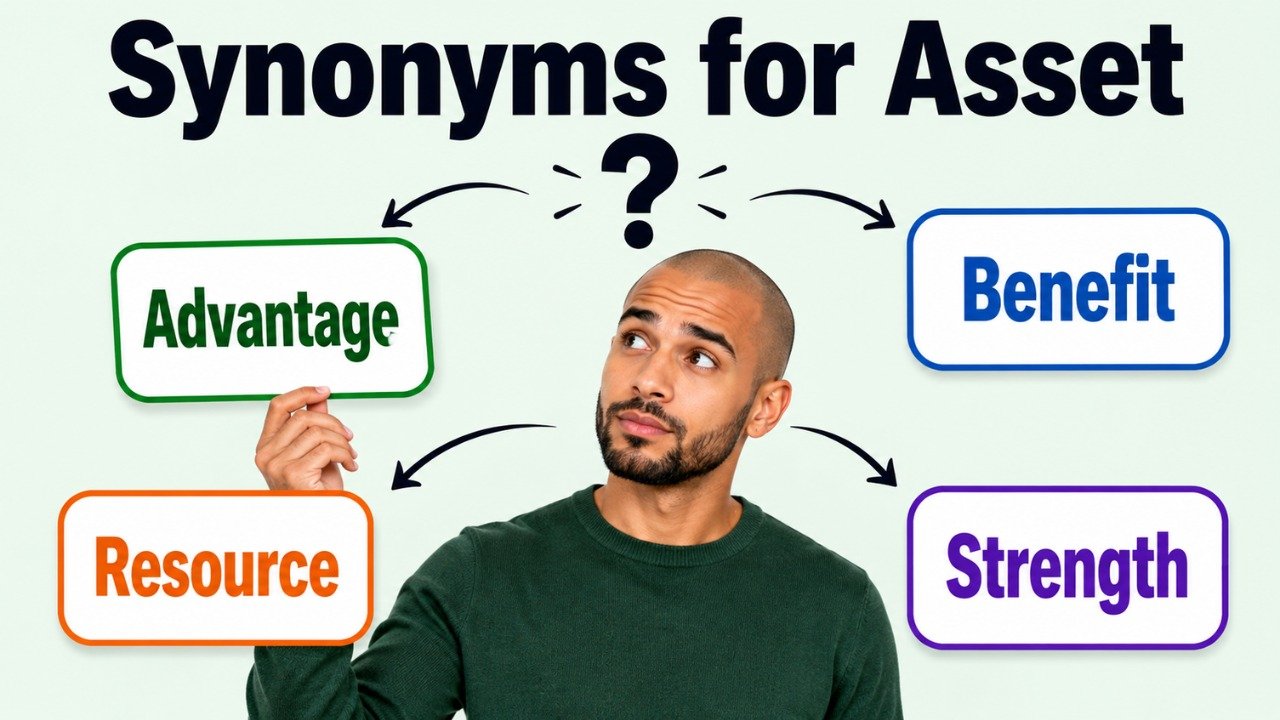
Quick Answer: The best synonyms for asset include resource, property, possession, capital, investment, advantage, benefit, strength, value, and holding. The best choice depends on context. Use resource for something useful, property or possession for something owned, capital or investment for financial value, advantage or strength for a helpful quality, and valuable member when asset describes a useful person. These synonyms for asset make business, financial, academic, professional, and everyday writing clearer and more precise.
Pronunciation and Word Details
Word: Asset.
Pronunciation: /ˈæs.et/.
Part of Speech: Noun.
Meaning: Something valuable or useful that a person, organization, or group owns, controls, or benefits from.
US Pronunciation:
UK Pronunciation:
What Does “Asset” Mean?
Asset means something valuable, useful, or beneficial.
The word is a noun and has several common meanings.
In finance and accounting, an asset is something owned or controlled that has economic value.
Example: The building is one of the company’s most valuable assets.
Here, asset refers to property that has financial worth.
Asset can also describe a useful resource.
Example: Good communication is an important asset in leadership.
In this sentence, asset means a beneficial quality.
The word can also describe a person who contributes significant value to a group or organization.
Example: Her experience makes her an asset to the team.
Asset is therefore commonly used for money, property, equipment, investments, resources, skills, abilities, and valuable people.
Meaning, Tone, and Context of “Asset”
Asset is generally neutral to positive in tone.
In financial and accounting contexts, the word is technical and formal.
Example: The company recorded its property as a long term asset.
In business communication, asset often refers to something that contributes value or improves performance.
Example: Strong customer knowledge is a valuable asset.
When describing a person, asset is complimentary.
Example: His technical knowledge makes him an asset to the department.
In everyday conversation, asset may refer more broadly to an advantage, useful feature, or strength.
Example: Patience can be a real asset when dealing with difficult situations.
The word appears frequently in finance, accounting, business, management, economics, property discussions, employment, education, and personal development.
When and How to Use “Asset”
For Property
Use asset when referring to something owned that has financial or practical value.
Example: The warehouse is a major asset for the business.
For Financial Value
Asset is common in accounting and finance when discussing investments, cash, securities, and valuable property.
Example: Cash is listed as a current asset.
For Business Resources
Use asset for resources that support operations or future growth.
Example: The company’s skilled workforce is an important asset.
For Personal Strengths
Asset can describe a useful ability, quality, or characteristic.
Example: Her confidence is an asset during presentations.
For Valuable People
Use asset when a person makes an important contribution to a team or organization.
Example: His knowledge of the industry makes him an asset to the company.
For Competitive Advantages
Asset can refer to something that helps a person or organization perform better than others.
Example: A strong reputation can be a major asset in a competitive market.
For Useful Resources
Use asset when something provides practical support or value.
Example: The research database is an asset for students.
Best Synonyms for Asset
Resource: Something useful that can help achieve a goal.
Example: The training guide is a valuable resource for new employees.
Property: Something legally owned by a person or organization.
Example: The land is valuable property.
Possession: Something owned or controlled by someone.
Example: The painting was one of her most treasured possessions.
Capital: Money or valuable resources used to create further economic value.
Example: The business needs additional capital to expand.
Investment: Something acquired with the expectation of future value or return.
Example: The new equipment is an important investment.
Advantage: A condition or quality that provides a benefit.
Example: Her experience gives the team a clear advantage.
Benefit: Something that provides help or value.
Example: Flexible scheduling is a major benefit for employees.
Strength: A useful ability, quality, or favorable feature.
Example: Clear communication is one of his greatest strengths.
Value: The usefulness, importance, or financial worth of something.
Example: The property has increased in value.
Holding: An asset or investment owned by a person or organization.
Example: The land is one of the family’s largest holdings.
50 Synonyms for Asset with Short Meanings
- Resource: Something useful for achieving a purpose.
- Property: Something legally owned.
- Possession: Something belonging to a person or organization.
- Holding: Property or an investment that is owned.
- Capital: Wealth or resources used for economic purposes.
- Investment: Something acquired for future value or return.
- Security: A financial instrument with economic value.
- Wealth: Valuable possessions and financial resources.
- Estate: Property and assets owned by a person.
- Equity: Financial value representing ownership.
- Funds: Money available for a particular purpose.
- Cash: Money available for immediate use.
- Reserves: Resources or funds kept for future use.
- Valuables: Items that have significant financial or personal worth.
- Belongings: Things owned by someone.
- Goods: Items that have practical or commercial value.
- Equipment: Useful tools or machinery owned for a purpose.
- Inventory: Goods and materials held by a business.
- Stock: Goods, shares, or resources held for use or sale.
- Collateral: Valuable property offered as security for a financial obligation.
- Receivable: Money owed to a business and treated as an asset.
- Financial Resource: Money or property with economic value.
- Economic Resource: Something capable of creating financial benefit.
- Tangible Property: A physical item with measurable value.
- Personal Property: Movable property owned by an individual.
- Advantage: Something that creates a favorable position.
- Benefit: Something that provides value or improvement.
- Strength: A useful quality or ability.
- Value: Worth, usefulness, or importance.
- Merit: A positive quality or advantage.
- Plus: An informal term for an advantage.
- Boon: Something highly useful or beneficial.
- Gain: Something valuable obtained or achieved.
- Aid: Something that provides assistance.
- Support: Help or resources that improve performance.
- Help: Something that makes a task or situation easier.
- Contributor: A person who adds value to a group or project.
- Talent: Natural or developed ability that provides value.
- Expert: A highly skilled or knowledgeable person.
- Specialist: A person with focused knowledge or skill.
- Key Person: Someone especially important to an organization or activity.
- Valuable Member: A person who contributes significant value to a group.
- Strong Point: A particularly useful quality or advantage.
- Positive: A favorable quality or feature.
- Virtue: A beneficial or admirable quality.
- Quality: A characteristic that may provide value.
- Capability: The ability to perform or achieve something.
- Leverage: An advantage that can be used to improve results.
- Useful Resource: Something that provides practical value.
- Valuable Resource: Something especially useful or beneficial.
Read Also:
Synonyms for Engineer

Synonyms for Asset by Context
When Asset Means Property
Property, possession, holding, estate, belongings, goods, valuables, and personal property are useful alternatives when asset refers to something owned.
Example: The family owns several valuable properties.
Example: The necklace was one of her most valuable possessions.
Property is especially useful for land, buildings, and legally owned items.
Possession is broader and can refer to almost anything someone owns.
When Asset Means a Financial Resource
Capital, investment, security, equity, funds, cash, reserves, and financial resource work well in financial contexts.
Example: The business raised additional capital for expansion.
Example: The shares became one of his most successful investments.
Capital commonly refers to resources used for business or investment.
Investment emphasizes money or property expected to produce future benefits.
When Asset Means Something Valuable
Resource, value, benefit, boon, gain, merit, and useful resource can describe something that provides practical or strategic value.
Example: Reliable information is a valuable resource.
Example: Her international experience was a major benefit.
Resource is one of the broadest and most natural alternatives.
When Asset Means an Advantage
Advantage, strength, plus, merit, leverage, virtue, and strong point work when asset means a favorable quality or condition.
Example: Her ability to remain calm is a major strength.
Example: Their central location gives the business an advantage.
Advantage emphasizes a favorable position, while strength emphasizes a useful quality.
When Asset Means a Valuable Person
Contributor, talent, expert, specialist, key person, and valuable member can replace asset when describing someone who contributes strongly to a group.
Example: She is a valuable member of the research team.
Example: His experience makes him a key person on the project.
These alternatives can sound more specific and personal than simply calling someone an asset.
When Asset Means a Useful Ability
Strength, talent, capability, quality, virtue, and merit work when describing skills or personal characteristics.
Example: Patience is one of her greatest strengths.
Example: His analytical capability helps the team solve difficult problems.
Another Word for Asset
Another word for asset is resource when referring to something useful or valuable.
However, the best replacement depends on context. Use property for something owned, capital for financial resources, advantage for a favorable condition, and strength for a useful personal quality.
Original: The library is an important asset for the community.
Better Option: The library is an important resource for the community.
Original: The building is the company’s largest asset.
Better Option: The building is the company’s largest property holding.
Original: Her experience is a valuable asset.
Better Option: Her experience is a valuable strength.
Original: His knowledge makes him an asset to the team.
Better Option: His knowledge makes him a valuable member of the team.
When Not to Use “Asset”
Avoid asset when a more specific financial term provides clearer information.
Weak: The company purchased a new asset.
Better: The company purchased new manufacturing equipment.
Equipment tells the reader exactly what was purchased.
Avoid using asset when describing people if the wording sounds impersonal.
Weak: Sarah is an asset.
Better: Sarah is a valuable member of the team.
The second version explains the person’s value more naturally.
Do not use asset when you simply mean money.
Weak: We need more assets to pay the bill.
Better: We need more cash to pay the bill.
Asset may include property or investments that cannot immediately be used as cash.
Avoid asset when strength or advantage is more precise.
Weak: His patience is his best asset.
Better: His patience is his greatest strength.
Both are correct, but strength sounds more natural when describing personality.
In accounting, do not treat every valuable thing as an asset without considering whether it meets the relevant financial definition.
In general writing, choose the word that communicates the exact type of value rather than repeatedly using asset.
Words Commonly Confused With Asset
Asset vs Property: Asset is broader than property. Property is something owned, while an asset can also include financial rights, useful resources, or valuable qualities.
Asset vs Resource: A resource is something useful for achieving a purpose. An asset usually emphasizes value, ownership, or advantage.
Asset vs Capital: Capital usually refers to money or resources used to produce further economic value. Asset is a broader term covering many types of valuable resources.
Asset vs Investment: An investment is something acquired with the expectation of future benefit or return. An asset may be held for many reasons and does not always represent an investment decision.
Asset vs Equity: Asset refers to something of value. Equity usually refers to ownership value after relevant obligations are considered.
Asset vs Wealth: Wealth describes the overall accumulation of valuable resources. An asset is an individual valuable item or resource within that wealth.
Asset vs Advantage: Advantage refers to a favorable position or benefit. Asset can describe an advantage but also has financial and ownership meanings.
Asset vs Strength: Strength usually describes a positive ability or quality. Asset is broader and may refer to property, money, people, or advantages.
Which Synonym Should You Choose?
Choose resource when discussing something useful for completing work, learning, research, or achieving a goal.
Choose property when referring to land, buildings, or legally owned possessions.
Choose possession for something belonging to an individual.
Choose holding when discussing property or investments owned by a person or organization.
Choose capital in business and economic writing when money or resources are being used to create value.
Choose investment when the asset was acquired with the expectation of future returns or benefits.
Choose security when discussing financial instruments.
Choose advantage when the asset provides a favorable position.
Choose strength when discussing a useful personal or organizational quality.
Choose benefit when emphasizing a positive result.
Choose valuable member when describing a person who contributes significantly to a team.
Choose capability when the asset is a useful ability.
Choose leverage when something can be used strategically to improve outcomes.
Real Life Examples of “Asset” in Sentences
Original: The new building is a valuable asset for the company.
Better Option: The new building is a valuable property holding for the company.
Original: Her communication skills are a major asset.
Better Option: Her communication skills are a major strength.
Original: The database is an asset for researchers.
Better Option: The database is a useful resource for researchers.
Original: His experience makes him an asset to the department.
Better Option: His experience makes him a valuable member of the department.
Original: The organization has several financial assets.
Better Option: The organization has several valuable investments and holdings.
Original: Their reputation is an important asset.
Better Option: Their reputation is an important advantage.
Original: Cash is one of the company’s most liquid assets.
Better Option: Cash is one of the company’s most accessible financial resources.
Original: The new employee quickly became an asset to the team.
Better Option: The new employee quickly became a key contributor to the team.
Original: Strong leadership is an asset during difficult periods.
Better Option: Strong leadership is a major benefit during difficult periods.
Original: Her knowledge of local markets is a valuable asset.
Better Option: Her knowledge of local markets gives the company valuable leverage.
Synonym Groups and Usage Differences
Property Group
Property, possession, holding, estate, belongings, valuables, goods, and personal property describe things that are owned.
Property is broad and often legal or financial.
Possession focuses on ownership or control.
Holding is especially common for investments and property portfolios.
Example: The land is one of the company’s largest property holdings.
Financial Group
Capital, investment, security, equity, funds, cash, reserves, receivable, and financial resource belong to financial contexts.
Capital emphasizes resources available for productive use.
Investment emphasizes future returns.
Cash emphasizes immediate availability.
Example: The company invested additional capital in new equipment.
Resource Group
Resource, equipment, inventory, economic resource, useful resource, and valuable resource describe things that contribute practical or economic value.
Example: Skilled workers are among the organization’s most valuable resources.
Advantage Group
Advantage, benefit, merit, plus, boon, gain, leverage, and strong point describe something that improves a position or outcome.
Advantage is neutral and broad.
Boon suggests something particularly helpful.
Leverage emphasizes strategic usefulness.
Example: The location gives the business a major competitive advantage.
Personal Strength Group
Strength, talent, virtue, quality, capability, and value describe useful personal characteristics or abilities.
Example: Clear communication is one of her strongest qualities.
Valuable Person Group
Contributor, expert, specialist, key person, and valuable member describe people whose skills or knowledge benefit a group.
Example: His technical experience makes him a key contributor.
Antonyms of Asset
The opposite of asset depends on whether asset means property, benefit, strength, or financial value.
Liability: Something that creates an obligation, cost, or disadvantage.
Debt: Money that must be repaid.
Burden: Something that creates difficulty or responsibility.
Disadvantage: A condition that makes success more difficult.
Weakness: A quality that reduces effectiveness.
Drawback: A negative feature or limitation.
Cost: Something requiring money or resources.
Expense: Money spent or owed.
Deficit: An amount by which resources fall short.
Obstacle: Something that prevents or slows progress.
Hindrance: Something that makes an activity more difficult.
Detriment: Something that causes harm or disadvantage.
Comparison: Asset vs Related Words
Asset vs Resource
Asset emphasizes value or ownership, while resource emphasizes usefulness.
Example With Asset: The property is a major asset for the company.
Example With Resource: The training manual is a useful resource for employees.
Asset vs Property
Asset includes many types of valuable resources. Property usually refers to something owned.
Example With Asset: Cash is a financial asset.
Example With Property: The family owns property outside the city.
Asset vs Capital
Asset is a broad category of valuable resources. Capital usually refers to money or resources available for economic activity.
Example With Asset: The company owns several valuable assets.
Example With Capital: The company needs additional capital to expand.
Asset vs Investment
An asset is something with value, while an investment is something acquired with the expectation of future return or benefit.
Example With Asset: The warehouse is an important asset.
Example With Investment: The new machinery is a long term investment.
Asset vs Advantage
Asset can mean something valuable in many ways. Advantage specifically means something that creates a favorable position.
Example With Asset: Her experience is a valuable asset.
Example With Advantage: Her experience gives her an advantage over less experienced applicants.
Asset vs Strength
Asset is broader, while strength focuses on positive qualities, abilities, or capabilities.
Example With Asset: His patience is a valuable asset.
Example With Strength: His patience is one of his greatest strengths.
Asset vs Liability
An asset provides value or benefit, while a liability creates an obligation, cost, or disadvantage.
Example With Asset: The building provides long term value.
Example With Liability: The unpaid debt is a financial liability.
Asset vs Wealth
An asset is an individual valuable resource. Wealth describes the total amount of valuable resources owned.
Example With Asset: The land is a valuable asset.
Example With Wealth: The family accumulated considerable wealth over several generations.
Common Phrases and Expressions With “Asset”
Valuable Asset: Something that provides significant value or usefulness.
Financial Asset: Something with measurable financial value.
Current Asset: An asset expected to be converted into cash or used within a relatively short period.
Fixed Asset: Property or equipment held for long term use.
Business Asset: Something owned or controlled by a business that has value.
Major Asset: Something especially important or valuable.
Key Asset: A resource that plays an important role in success.
Company Asset: Property or resources belonging to an organization.
Personal Asset: Something valuable owned by an individual.
Asset to the Team: A person whose abilities or work significantly benefit a group.
Common Mistakes to Avoid
One common mistake is treating asset and cash as identical.
Cash is one type of asset, but assets can also include property, investments, equipment, inventory, and financial rights.
Incorrect: All company assets are available to spend immediately.
Better: Some company assets, such as cash, are immediately available, while others may need to be sold or converted.
Another mistake is using asset and liability as though they mean the same thing.
An asset provides value, while a liability usually represents an obligation or burden.
Incorrect: The unpaid loan is one of the company’s assets.
Better: The unpaid loan is one of the company’s liabilities.
Avoid calling every useful person an asset when more specific wording would sound warmer or clearer.
Less Personal: Maria is an asset.
Better: Maria is a highly valued member of the team.
Do not confuse asset with advantage in every sentence.
Unnatural: The lower price is our strongest financial asset in the negotiation.
Better: The lower price is our strongest advantage in the negotiation.
Avoid repeating asset when the type of value can be named directly.
Repetitive: The building is an asset, the equipment is an asset, and the cash is an asset.
Better: The organization owns valuable property, equipment, and financial resources.
In formal business writing, use precise financial terms when they are available.
Conclusion
The best synonyms for asset depend on whether you mean property, financial value, a useful resource, an advantage, or a valuable person. Use resource for practical usefulness, property or possession for ownership, capital and investment for financial contexts, advantage or benefit for favorable conditions, and strength for useful qualities. When describing people, contributor or valuable member often sounds more specific. Understanding these differences helps you choose synonyms for asset that are accurate, natural, and appropriate for business, finance, essays, reports, and everyday communication.
FAQs About Synonyms for Asset
What Is the Best Synonym for Asset?
Resource is one of the best general alternatives. Property, possession, capital, advantage, and strength are better in more specific contexts.
What Is Another Word for a Valuable Asset?
Valuable resource, key resource, advantage, strength, benefit, and important holding can all work depending on what the asset is.
What Is a Synonym for Asset in Business?
Resource, capital, investment, property, holding, equipment, inventory, and financial resource are useful business alternatives.
What Is Another Word for Asset When Describing a Person?
Contributor, valuable member, expert, specialist, talent, or key person can describe someone who brings significant value to a team.
Is Resource a Synonym for Asset?
Yes. Resource is a strong synonym when asset means something useful or valuable for achieving a goal.
What Is the Opposite of Asset?
Liability is the most direct opposite in financial and business contexts. Disadvantage, burden, weakness, and drawback can work in broader contexts.
What Are Good Synonyms for Asset in Writing?
Resource, property, possession, capital, investment, advantage, benefit, strength, value, and holding are strong choices for different kinds of writing.
