
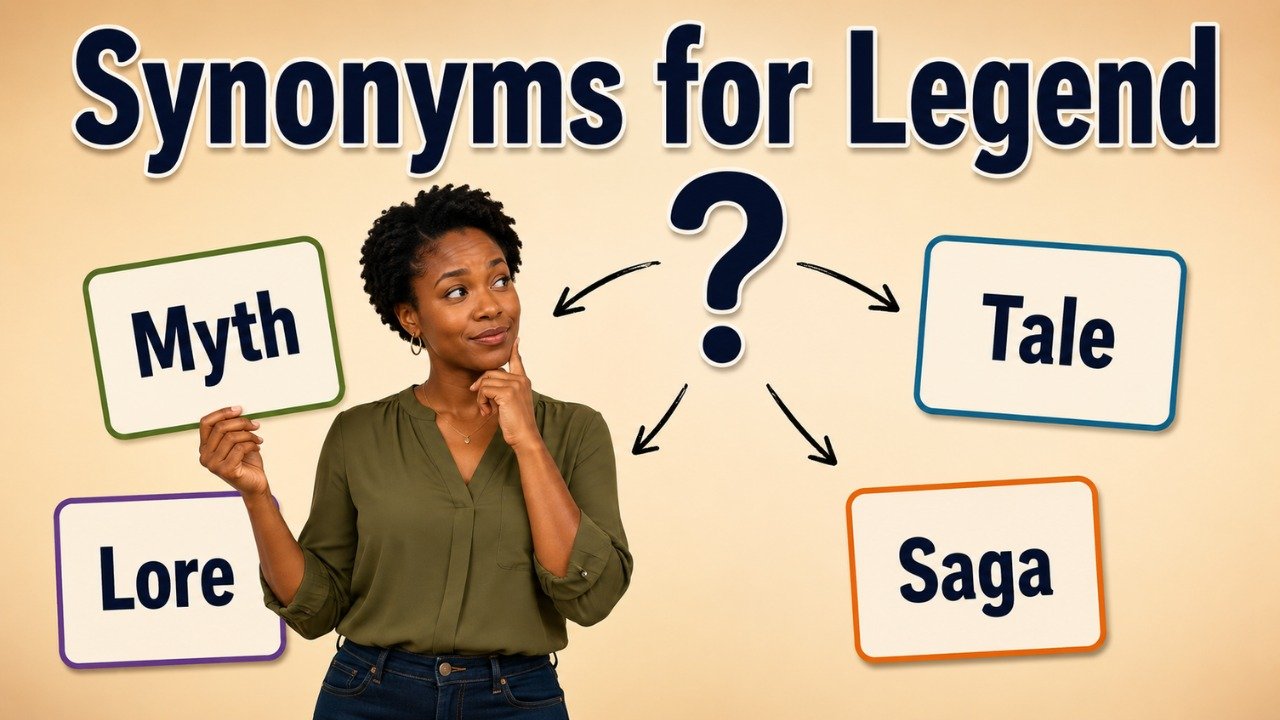
Quick Answer: The best synonyms for legend include icon, hero, luminary, great, myth, folklore, tale, saga, lore, and key. The right choice depends on meaning. Use icon, luminary, or great for an admired or famous person. Use myth, tale, folklore, or saga for a traditional story. Use key when legend refers to the explanation of symbols on a map, chart, or diagram. These synonyms for legend help make descriptions more precise in conversation, essays, reports, storytelling, and technical writing.
Pronunciation and Word Details
Word: Legend.
Pronunciation: /ˈledʒ.ənd/.
Part of Speech: Noun.
Meaning: A famous or admired person, a traditional story, or an explanation of symbols used in a map, chart, or diagram.
US Pronunciation:
UK Pronunciation:
What Does “Legend” Mean?
Legend means a person who is extremely famous or admired, a traditional story passed through generations, or a guide explaining symbols and colors.
The word is primarily used as a noun, but its exact meaning depends heavily on context.
When legend describes a person, it usually expresses strong admiration.
Example: The celebrated musician became a legend in his field.
Here, legend means an exceptionally respected or influential person.
Legend can also describe a traditional story that may combine historical events with imaginative details.
Example: The villagers told an old legend about a hidden treasure.
In this use, legend refers to a story preserved through tradition.
In maps, charts, graphs, and diagrams, a legend explains what symbols, patterns, or markings represent.
Example: Check the legend to understand the symbols on the map.
The word can therefore refer to fame, storytelling, cultural tradition, or explanatory information.
Meaning, Tone, and Context of “Legend”
Legend has several tones because it has several meanings.
When describing a famous person, legend is usually positive, admiring, and emphatic. It suggests that someone has achieved exceptional recognition, influence, or respect.
Example: She is a legend of the sport.
In casual conversation, people sometimes use legend more loosely to praise someone who has done something impressive or helpful.
Example: You are a legend for helping us finish the project.
When referring to traditional stories, legend has a literary, historical, cultural, or imaginative tone.
Example: The legend has been told for generations.
In academic discussions, legend may describe a traditional narrative associated with a historical person, place, or event.
When used for maps and diagrams, legend has a neutral and technical meaning.
Example: The legend identifies each color used in the chart.
Because the meanings are different, choosing the right synonym requires understanding exactly how legend is being used.
When and How to Use “Legend”
For a Famous or Admired Person
Use legend when someone is exceptionally respected because of achievements, influence, talent, or lasting importance.
Example: The athlete became a legend after decades of remarkable achievements.
For Strong Praise
Legend can express enthusiastic admiration in casual conversation.
Example: Our neighbor is a legend for helping everyone during the storm.
For a Traditional Story
Use legend for a story passed through generations, especially one connected with historical people, places, beliefs, or extraordinary events.
Example: According to legend, a great ruler once lived in the ancient fortress.
For Cultural Tradition
Legend can describe stories that form part of a community’s cultural memory.
Example: The local legend explains why the mountain received its unusual name.
For Maps
Use legend for the section that explains symbols, colors, patterns, or markings.
Example: The map legend shows which lines represent rivers and roads.
For Charts and Diagrams
Legend can explain visual categories in charts, graphs, and diagrams.
Example: Read the legend before comparing the categories in the chart.
For Historical Reputation
Legend may describe someone whose reputation has grown beyond ordinary fame.
Example: His achievements turned him into a legend among later generations.
Best Synonyms for Legend
Icon: A highly admired person who represents excellence, influence, or a particular field.
Example: The celebrated performer became a cultural icon.
Hero: A person admired for courage, achievement, character, or exceptional actions.
Example: The rescue worker became a local hero.
Luminary: A distinguished and influential person in a particular profession or field.
Example: The conference attracted several scientific luminaries.
Great: A person recognized for exceptional ability or historical importance.
Example: She is remembered as one of the literary greats.
Myth: A traditional story involving beliefs, extraordinary events, or symbolic meaning.
Example: The ancient myth explains the origin of the mountain.
Folklore: Traditional stories, customs, beliefs, and tales shared within a culture.
Example: The mysterious creature appears throughout regional folklore.
Tale: A story, especially one involving imaginative or traditional events.
Example: The old tale has been passed down for centuries.
Saga: A long story involving remarkable people, families, adventures, or historical events.
Example: The book retells the ancient saga of warriors and kings.
Lore: Traditional knowledge, stories, and beliefs associated with a community or subject.
Example: The forest is surrounded by centuries of local lore.
Key: A guide explaining symbols, colors, or markings on a map, chart, or diagram.
Example: The key explains what each symbol on the map represents.
50 Synonyms for Legend with Short Meanings
- Icon: A highly admired or representative person.
- Hero: A person respected for achievements or courage.
- Star: A highly successful or celebrated person.
- Great: A person of exceptional importance or ability.
- Luminary: A distinguished and influential person.
- Master: Someone with exceptional skill in a field.
- Giant: A person of enormous influence or achievement.
- Celebrity: A widely recognized and famous person.
- Notable: A person worthy of attention or recognition.
- Immortal: A famous person whose reputation continues after death.
- Phenomenon: Someone remarkable because of extraordinary ability or success.
- Virtuoso: A person with exceptional artistic or technical skill.
- Titan: A person of exceptional power, importance, or influence.
- Champion: A highly successful or admired person.
- Pioneer: Someone who leads the development of a new field or idea.
- Trailblazer: A person who creates a new path for others.
- Maestro: A masterful and highly accomplished artist or performer.
- Authority: A respected expert in a particular subject.
- Myth: A traditional or symbolic story.
- Folklore: Traditional stories and beliefs of a culture.
- Tale: A story involving real or imagined events.
- Story: An account of events or experiences.
- Fable: A traditional story often carrying a lesson.
- Saga: A long story of significant events or adventures.
- Lore: Traditional knowledge, stories, and beliefs.
- Tradition: A belief or story passed through generations.
- Narrative: A structured account or story.
- Epic: A long story about heroic or significant events.
- Chronicle: An extended account of events over time.
- Romance: A traditional or imaginative adventure story.
- Yarn: An entertaining or imaginative story.
- Folk Tale: A traditional story shared among generations.
- Traditional Tale: A story preserved through cultural tradition.
- Popular Story: A widely known story or account.
- Mythic Tale: A traditional story containing extraordinary elements.
- Key: An explanation of symbols or markings.
- Map Key: A guide explaining symbols used on a map.
- Guide: Information that helps interpret something.
- Symbol Guide: An explanation of visual symbols.
- Explanatory Key: Information defining symbols or categories.
- Caption: Text explaining an image, figure, or illustration.
- Label: Text identifying or explaining something.
- Inscription: Words written or engraved on an object.
- Epigraph: A short inscription or written statement.
- Motto: A brief phrase expressing an idea or principle.
- Wording: The particular words used in a written statement.
- Text: Written words appearing with an image or object.
- Notation: Symbols or written marks used to communicate information.
- Explanation: Information that makes meaning clear.
- Annotation: An explanatory note attached to visual or written information.
Read Also:
Synonyms for Left Behind

Synonyms for Legend by Context
When Legend Means a Famous Person
When legend describes someone who has achieved extraordinary success or recognition, useful synonyms include icon, hero, great, luminary, titan, giant, maestro, and star.
Example: She became an icon of modern dance.
Example: He is considered one of the greats of the profession.
Icon emphasizes cultural recognition. Luminary sounds more formal and works especially well for respected professionals. Great emphasizes lasting achievement.
When Legend Means an Exceptional Expert
For someone known for exceptional talent or expertise, use master, virtuoso, maestro, authority, or giant.
Example: The pianist was regarded as a virtuoso.
Example: She became an authority on ancient architecture.
Virtuoso works particularly well for artistic or technical ability, while authority emphasizes knowledge and expertise.
When Legend Means a Traditional Story
Useful alternatives include tale, folk tale, traditional tale, story, saga, folklore, lore, myth, and narrative.
Example: The children listened to an old folk tale about the mountain.
Example: The ancient saga describes generations of rulers.
Tale is broad and natural. Folk tale emphasizes cultural tradition. Saga suggests a longer and more dramatic story.
When Legend Means Myth or Folklore
Use myth, folklore, lore, tradition, or mythic tale when discussing culturally transmitted beliefs and stories.
Example: According to local folklore, mysterious lights once appeared above the lake.
Example: The creature belongs to ancient regional lore.
Myth can suggest a traditional symbolic story, while folklore includes a wider collection of stories, customs, and beliefs.
When Legend Means a Map Explanation
Use key, map key, symbol guide, explanatory key, or guide.
Example: Check the map key to identify the hiking routes.
Example: The symbol guide explains every marking on the diagram.
Key is usually the simplest direct replacement in this technical meaning.
When Legend Means Written Explanatory Text
Use caption, label, inscription, annotation, or text when legend refers to words connected with an image, object, illustration, or symbol.
Example: The caption underneath the illustration provides additional information.
Example: An inscription appeared along the edge of the monument.
Another Word for Legend
Another word for legend is icon when referring to an exceptionally admired person. However, the best replacement depends on context.
Use myth or tale for traditional stories. Use key for maps and charts. Use caption or inscription for explanatory or identifying text.
Original: She became a legend in the fashion industry.
Better Option: She became an icon in the fashion industry.
Original: An ancient legend describes a mysterious creature.
Better Option: An ancient tale describes a mysterious creature.
Original: Look at the legend to understand the map.
Better Option: Look at the key to understand the map.
Original: The legend beneath the illustration explains the symbols.
Better Option: The caption beneath the illustration explains the symbols.
When Not to Use “Legend”
Legend is expressive, but it is not always the most precise word.
Avoid using legend when the reader needs a more specific description of why someone is respected.
Weak: She is a legend in medical research.
Better: She is a leading authority in medical research.
Authority explains that the person’s reputation comes from expertise rather than general fame.
Avoid legend when discussing a traditional story if the exact type of story matters.
Weak: The book contains an old legend.
Better: The book contains a traditional folk tale.
Folk tale provides clearer cultural context.
In technical writing, key may be simpler than legend when describing map symbols.
Weak: Consult the legend before reading the map.
Better: Consult the map key before reading the map.
Avoid repeatedly calling different successful people legends because excessive use can weaken the praise.
Weak: Every successful performer in the article was called a legend.
Better: Use icon, luminary, master, pioneer, or great according to the person’s specific achievements.
Words Commonly Confused With Legend
Legend vs Myth: A legend is usually connected with a person, place, event, or cultural tradition that may have some historical basis. A myth often deals with symbolic beliefs, supernatural beings, origins, or explanations of natural and cultural phenomena.
Legend vs Folklore: A legend is one type of traditional story. Folklore is broader and includes stories, customs, beliefs, sayings, traditions, and practices.
Legend vs Folk Tale: A legend is often associated with a particular historical person, place, or event. A folk tale is a traditional story shared within a community and does not necessarily claim a historical connection.
Legend vs Icon: Legend emphasizes extraordinary reputation and lasting admiration. Icon often emphasizes cultural importance, recognizability, or symbolic influence.
Legend vs Hero: A hero is admired for courage, character, achievement, or important actions. A legend is admired because a person’s reputation has become exceptionally strong or enduring.
Legend vs Celebrity: A celebrity is someone who is widely known. A legend suggests greater achievement, admiration, or lasting influence.
Legend vs Luminary: Luminary is a formal term for an influential and respected person in a profession or field. Legend is more emotional and emphatic.
Legend vs Key: Both can describe explanatory information on maps or charts. Key is often simpler and immediately understandable in technical contexts.
Which Synonym Should You Choose?
Choose icon when describing a person who represents excellence, influence, or cultural importance.
Choose hero when admiration comes from courage, character, or important actions.
Choose luminary in formal or professional writing about an influential expert.
Choose great when discussing a historically important person with exceptional accomplishments.
Choose master when emphasizing high levels of skill and experience.
Choose virtuoso when describing outstanding artistic or technical skill.
Choose pioneer when someone introduced an important new practice, idea, or field.
Choose myth when referring to a traditional story with symbolic, supernatural, or cultural meaning.
Choose folklore when discussing the wider collection of traditional stories and beliefs associated with a culture.
Choose tale for a simple and flexible alternative meaning story.
Choose saga when describing a long, dramatic story involving important events or generations.
Choose lore when referring to accumulated traditional knowledge, beliefs, and stories.
Choose key in reports, maps, charts, diagrams, and technical material where symbols require explanation.
Choose caption when written text explains a picture, illustration, or visual element.
Choose inscription when words are written, carved, or engraved onto an object.
Real Life Examples of “Legend” in Sentences
Original: The musician became a legend during his long career.
Better Option: The musician became an icon during his long career.
Original: She is a legend in the scientific community.
Better Option: She is a luminary in the scientific community.
Original: The coach became a legend after decades of success.
Better Option: The coach became one of the greats after decades of success.
Original: The village has a legend about a hidden cave.
Better Option: The village has a folk tale about a hidden cave.
Original: The ancient legend tells of a powerful warrior.
Better Option: The ancient saga tells of a powerful warrior.
Original: According to legend, the treasure remains beneath the ruins.
Better Option: According to folklore, the treasure remains beneath the ruins.
Original: The creature appears frequently in local legend.
Better Option: The creature appears frequently in local lore.
Original: Use the legend to understand the map symbols.
Better Option: Use the key to understand the map symbols.
Original: The chart legend explains the colored sections.
Better Option: The chart key explains the colored sections.
Original: The legend below the illustration identifies each object.
Better Option: The caption below the illustration identifies each object.
Synonym Groups and Usage Differences
Fame and Admiration Group
Icon, hero, star, great, luminary, celebrity, and immortal belong to the fame and admiration group.
These words describe people who receive recognition, but they differ in strength and reason.
Icon suggests symbolic cultural importance. Hero suggests admiration for actions or character. Luminary suggests professional distinction. Celebrity mainly emphasizes public recognition.
Example: The respected author became a literary icon.
Exceptional Skill Group
Master, virtuoso, maestro, authority, phenomenon, titan, and giant emphasize exceptional ability, knowledge, or influence.
Master is broad. Virtuoso commonly describes impressive artistic or technical skill. Authority emphasizes expertise. Titan and giant emphasize major influence.
Example: She was considered a master of portrait painting.
Traditional Story Group
Myth, tale, folk tale, traditional tale, saga, narrative, epic, and story describe different forms of storytelling.
Myth often carries symbolic or cultural meaning. Tale is broad. Saga suggests an extended dramatic story. Epic suggests large scale heroic events.
Example: The epic recounts the journey of a legendary warrior.
Cultural Tradition Group
Folklore, lore, tradition, myth, and popular story emphasize stories and beliefs passed between generations.
Folklore is the broadest term because it can include beliefs, customs, stories, and practices.
Lore emphasizes accumulated traditional knowledge.
Example: Stories about the mysterious forest remain part of local lore.
Map and Diagram Group
Key, map key, symbol guide, explanatory key, and guide explain visual symbols or categories.
Key is usually the most concise option.
Example: The map key identifies roads, rivers, and boundaries.
Explanatory Text Group
Caption, label, inscription, epigraph, text, notation, and annotation refer to words or symbols that provide information.
Caption normally accompanies an image. Label identifies something. Inscription is written or engraved on an object. Annotation provides extra explanation.
Example: An annotation beside the diagram explains the unusual symbol.
Antonyms of Legend
There is no single antonym for legend because the word has several meanings. The opposite depends on context.
Unknown: A person who is not widely recognized.
Ordinary Person: Someone without exceptional fame or reputation.
Novice: A person who lacks extensive experience or mastery.
Beginner: Someone at the early stage of learning a skill.
Nobody: An informal term for someone with little public recognition.
Fact: Something established as true rather than a traditional or imaginative account.
Reality: What actually exists or happened rather than a legendary account.
Truth: An accurate account rather than an invented or exaggerated story.
History: A documented account of past events rather than a traditional legend.
Unexplained Symbol: A symbol that lacks a key or explanatory guide.
Comparison: Legend vs Related Words
Legend vs Icon
Legend describes someone whose achievements and reputation have become exceptionally admired or enduring. Icon emphasizes recognition and symbolic cultural importance.
Example With Legend: The veteran athlete became a legend of the sport.
Example With Icon: The designer became a cultural icon.
Legend vs Hero
Legend emphasizes lasting reputation. Hero emphasizes courage, admirable behavior, or significant actions.
Example With Legend: The performer remains a legend decades after retirement.
Example With Hero: The firefighter became a local hero after the rescue.
Legend vs Luminary
Legend is expressive and can be used in both casual and formal settings. Luminary is more formal and emphasizes professional distinction.
Example With Legend: She became a legend in the music world.
Example With Luminary: She became a luminary in the field of classical music.
Legend vs Myth
A legend is traditionally associated with a person, event, or place and may have some historical basis. A myth often explains beliefs, origins, supernatural events, or symbolic ideas.
Example With Legend: The town has a legend about a lost traveler.
Example With Myth: The ancient myth explains how the seasons began.
Legend vs Folklore
Legend refers to an individual traditional story. Folklore refers to the wider body of cultural stories, customs, beliefs, and traditions.
Example With Legend: The guide shared a legend about the old castle.
Example With Folklore: The story forms part of the region’s folklore.
Legend vs Tale
Legend often suggests a traditional story associated with history or cultural memory. Tale is a broader word for almost any narrated story.
Example With Legend: The legend has survived for hundreds of years.
Example With Tale: She told the children a fascinating tale.
Legend vs Saga
Legend can be relatively short or focused on one important figure or event. Saga normally suggests a long and detailed story involving many events.
Example With Legend: The legend describes a mysterious king.
Example With Saga: The saga follows several generations of the royal family.
Legend vs Key
Both words can explain symbols on a map or chart. Key is usually clearer and more direct in everyday technical writing.
Example With Legend: The legend explains the colored lines on the map.
Example With Key: The key explains the colored lines on the map.
Common Phrases and Expressions With “Legend”
Living Legend: A person who is still alive and already regarded as exceptionally important or accomplished.
Local Legend: A famous person or traditional story strongly associated with a particular place.
Urban Legend: A widely circulated modern story that is often presented as true despite uncertain evidence.
According to Legend: A phrase introducing a traditional or widely repeated story.
Legend Has It: An expression used before describing a traditional story or belief.
Become a Legend: To gain extraordinary fame, admiration, or lasting recognition.
True Legend: A person regarded as genuinely exceptional or highly admirable.
Sports Legend: An athlete or sporting figure remembered for exceptional achievements.
Musical Legend: A musician or performer with extraordinary influence or enduring fame.
Ancient Legend: A traditional story originating in the distant past.
Common Mistakes to Avoid
One common mistake is assuming that every synonym for legend works in every context.
Icon cannot normally replace legend when legend means a traditional story.
Incorrect: The village elders told an ancient icon.
Better: The village elders told an ancient legend.
Another mistake is replacing legend with myth without considering the difference.
A legend may be connected to a supposedly historical person, event, or place. Myth often has symbolic, supernatural, or cultural functions.
Avoid calling every successful person a legend. The word usually suggests exceptional or lasting significance.
Weak: Every employee who completed the project was a legend.
Better: Several employees made outstanding contributions to the project.
Do not confuse celebrity with legend. Someone can be famous without having the achievement or enduring influence suggested by legend.
In map and chart writing, remember that key is often more immediately understandable than legend.
Less Direct: Study the legend before interpreting the symbols.
More Direct: Study the key before interpreting the symbols.
Avoid using folklore as though it refers to only one story. Folklore describes a broader collection of cultural traditions, while a legend may be one individual story within that tradition.
Choose synonyms according to the specific meaning rather than simply replacing the word to avoid repetition.
Conclusion
The best synonyms for legend depend on whether the word describes an admired person, a traditional story, or explanatory information. Use icon, luminary, great, master, or hero for influential people. Choose myth, tale, folklore, lore, or saga for traditional narratives. Use key or map key for symbols on maps and charts, while caption and inscription suit explanatory text. Understanding these different meanings makes it easier to choose synonyms for legend that sound natural, accurate, and appropriate for each sentence.
FAQs About Synonyms for Legend
What Is the Best Synonym for Legend?
The best general synonym is icon when legend refers to an admired person. For a traditional story, tale or myth may work better. For maps, use key.
What Is Another Word for a Famous Legend?
Icon, luminary, great, titan, giant, hero, star, and master can describe an exceptionally famous or respected person.
Is Icon a Synonym for Legend?
Yes. Icon is a strong synonym when legend describes someone who is highly admired, influential, and culturally important.
Is Myth the Same as Legend?
Not exactly. Both describe traditional stories, but legends are often connected with historical people, places, or events, while myths commonly involve symbolic or supernatural themes.
What Is a Formal Synonym for Legend?
Luminary is a useful formal synonym for a highly respected person. Authority also works when the person’s reputation comes from knowledge or expertise.
What Is Another Word for Legend on a Map?
Key and map key are the clearest alternatives. Symbol guide or explanatory key can also be appropriate.
What Are Good Synonyms for Legend in Writing?
Icon, luminary, great, hero, myth, tale, folklore, saga, lore, and key are strong choices. The best option depends on the intended meaning and sentence context.
