
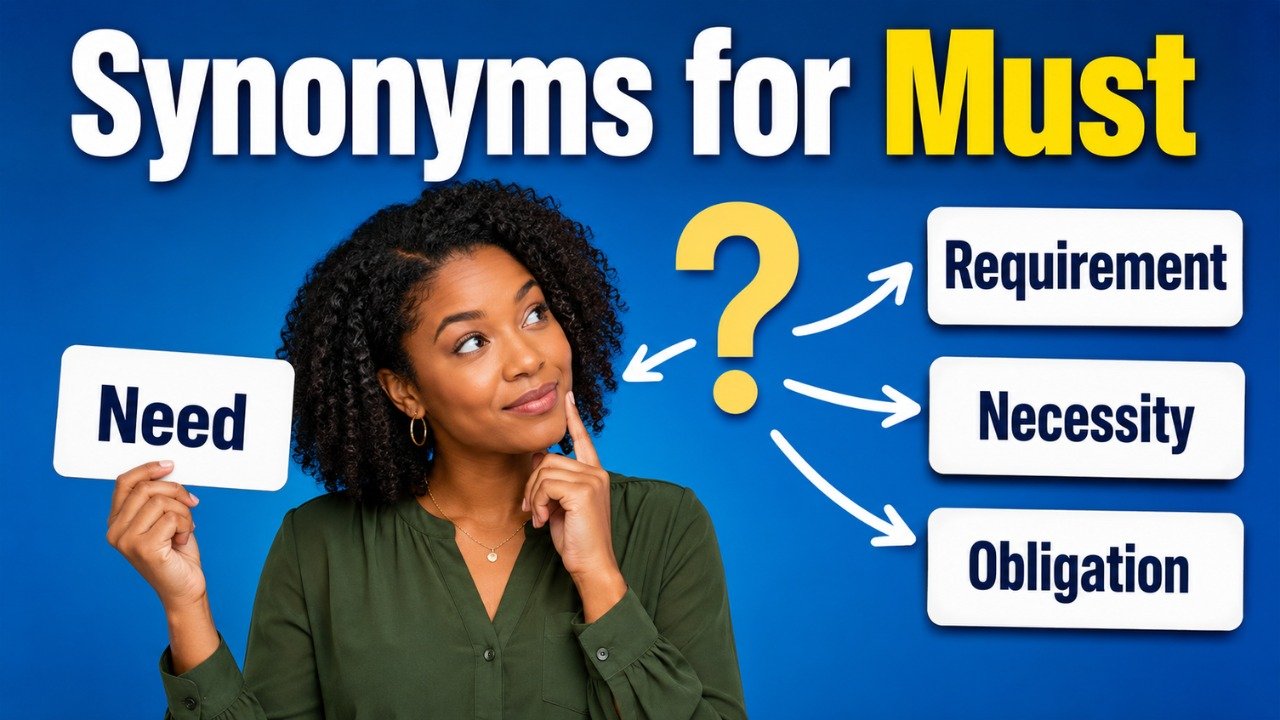
Quick Answer: The best synonyms for must include have to, need to, be required to, be obliged to, should, ought to, be expected to, be compelled to, be certain to, and essential. Use have to in everyday conversation, be required to in formal rules, and be obliged to for a strong personal or professional duty. Should and ought to express advice rather than strict obligation. Be certain to works when must expresses a logical conclusion, while essential replaces the noun form when something is extremely important.
Pronunciation and Word Details
Word: Must.
Pronunciation: /mʌst/.
Part of Speech: Modal verb and noun.
Meaning: Must expresses a strong obligation, an unavoidable necessity, a firm recommendation, or a confident conclusion.
US Pronunciation:
UK Pronunciation:
What Does “Must” Mean?
Must means that something is necessary, required, strongly advised, or believed to be certainly true. It is most commonly used as a modal verb before the base form of another verb.
In obligation sentences, must shows that a person has a duty or no reasonable choice.
Example: Employees must follow the safety instructions.
In necessity sentences, it shows that an action is essential for achieving a result.
Example: You must add water before starting the machine.
Must can also express a strong recommendation.
Example: You must visit the old library during your trip.
When used for logical certainty, must shows that the speaker strongly believes a conclusion is true.
Example: The lights are off, so everyone must be asleep.
Must may also function as a noun in informal language. In this sense, it means an essential item, activity, or requirement.
Example: Comfortable shoes are a must for a long walk.
Meaning, Tone, and Context of “Must”
Must usually has a strong, direct, and serious tone. It communicates more force than should, ought to, or might want to.
In rules, instructions, contracts, and official notices, must expresses a firm requirement. It tells the reader that following the instruction is not optional.
Example: All applications must include a valid signature.
In everyday conversation, must can sound commanding when directed at another person. Speakers often use have to or need to when they want to sound less forceful.
Direct: You must finish this tonight.
Softer: You need to finish this tonight.
Must can also sound enthusiastic rather than strict when recommending something.
Example: You must try this recipe.
In academic or analytical writing, must may introduce a logical conclusion based on evidence.
Example: The repeated results must indicate a consistent pattern.
As a noun, a must has a positive and conversational tone. It describes something considered necessary or highly valuable.
Example: A clear schedule is a must for this project.
When and How to Use “Must”
For Strong Obligation
Use must when a rule, authority, duty, or serious situation requires someone to act.
Example: Visitors must remain behind the marked line.
For Essential Necessity
Use must when an action is necessary for success, safety, or completion.
Example: The surface must be completely dry before painting.
For Firm Instructions
Use must when giving clear directions that should not be ignored.
Example: You must submit the form before the deadline.
For Strong Advice
Use must when recommending something with enthusiasm or urgency.
Example: You must read the final chapter.
For Personal Determination
Use must when expressing a strong decision or inner responsibility.
Example: I must improve my time management.
For Logical Certainty
Use must when evidence leads to a confident conclusion.
Example: She has been travelling all day, so she must be tired.
For Prohibition
Use must not when an action is strictly forbidden.
Example: Passengers must not open the door while the vehicle is moving.
For an Essential Item
Use a must when describing something necessary, valuable, or strongly recommended.
Example: A reliable dictionary is a must for vocabulary learners.
Best Synonyms for Must
Have To: To be required or forced by circumstances to do something.
Example: We have to leave before the road closes.
Need To: To require an action because it is important or necessary.
Example: You need to check the figures again.
Be Required To: To be officially expected to follow a rule or condition.
Example: Applicants are required to provide identification.
Be Obliged To: To have a moral, social, or formal responsibility.
Example: The company was obliged to correct the mistake.
Should: To express advice, expectation, or a weaker duty.
Example: You should save a copy of the document.
Ought To: To express what is advisable, responsible, or morally right.
Example: We ought to consider the long term effects.
Be Expected To: To describe an action that people normally or officially anticipate.
Example: Team members are expected to arrive on time.
Be Compelled To: To be strongly forced by circumstances, authority, or emotion.
Example: She felt compelled to report the problem.
Be Certain To: To indicate that something will probably or definitely happen.
Example: The announcement is certain to attract attention.
Essential: Completely necessary or extremely important.
Example: Clear communication is essential for effective teamwork.
50 Synonyms for Must With Short Meanings
- Have To: To be required by circumstances or rules.
- Need To: To require an action for a particular purpose.
- Be Required To: To have an official obligation.
- Be Obliged To: To have a formal, moral, or social duty.
- Be Obligated To: To be bound by a responsibility or agreement.
- Be Compelled To: To be strongly forced to act.
- Be Forced To: To have no practical choice.
- Be Bound To: To be certain or obligated to do something.
- Be Duty Bound To: To have a strong moral or professional responsibility.
- Be Mandated To: To be officially ordered by a rule or authority.
- Be Instructed To: To be told clearly what action to take.
- Be Directed To: To receive an official instruction.
- Be Ordered To: To be commanded by someone with authority.
- Be Commanded To: To be given a firm and authoritative order.
- Be Expected To: To be required according to accepted standards.
- Be Supposed To: To be expected or intended to act in a certain way.
- Be Meant To: To be intended or designed to do something.
- Be Under an Obligation To: To have a binding duty or responsibility.
- Be Under Orders To: To have instructions from an authority.
- Have No Choice but To: To be unable to avoid an action.
- It Is Necessary To: To be needed for a result or purpose.
- It Is Essential To: To be completely necessary.
- It Is Imperative To: To be extremely important and urgent.
- It Is Mandatory To: To be required by an official rule.
- It Is Compulsory To: To be required and not optional.
- It Is Vital To: To be extremely important for success or safety.
- It Is Crucial To: To be decisive or highly important.
- Be Indispensable: To be so necessary that it cannot be replaced.
- Cannot Do Without: To need something completely.
- Cannot Avoid: To be unable to escape an action or result.
- Should: To express advice, expectation, or moderate obligation.
- Ought To: To express responsible or advisable action.
- Had Better: To give strong advice with a possible consequence.
- Would Be Wise To: To recommend a sensible action.
- Would Be Advisable To: To suggest a useful or appropriate action.
- Be Urged To: To receive strong encouragement to act.
- Be Encouraged To: To receive supportive advice to take action.
- Be Advised To: To receive a professional or careful recommendation.
- Be Called Upon To: To be asked or expected to perform a duty.
- Be Tasked With: To be given responsibility for an activity.
- Be Responsible For: To have a duty to complete or manage something.
- Be Certain To: To be highly likely or sure to happen.
- Be Sure To: To be expected to happen with confidence.
- Certainly: Without doubt or uncertainty.
- Surely: Used to express confidence in a conclusion.
- Necessarily: As an unavoidable or logical result.
- Undoubtedly: Without reasonable doubt.
- Essential: Completely necessary or extremely important.
- Necessity: Something that is required or unavoidable.
- Requirement: A condition or action that must be fulfilled.
Read Also:
Synonyms for Typical
Synonyms for Must by Context
When Must Means Strong Obligation
Have to, be required to, be obliged to, be obligated to, and be duty bound to express responsibility or obligation.
Have to is the most natural alternative in everyday speech.
Example With Must: I must attend the meeting.
Example With Have To: I have to attend the meeting.
Be required to is more suitable for official rules and formal instructions.
Example: All participants are required to register in advance.
Be obliged to often describes a legal, moral, or professional responsibility.
Example: Managers are obliged to protect confidential information.
When Must Means Necessity
Need to, it is necessary to, it is essential to, it is vital to, and it is crucial to show that an action is important for a particular result.
Need to sounds natural in both conversation and general writing.
Example: You need to charge the device before using it.
It is essential to gives the statement greater importance.
Example: It is essential to verify the information before publication.
It is vital to is especially useful when safety, health, survival, or major success is involved.
Example: It is vital to keep emergency exits clear.
When Must Means an Official Requirement
Be required to, be mandated to, it is mandatory to, and it is compulsory to work well in policies, regulations, procedures, and formal notices.
Example With Must: Students must wear protective equipment.
Example With Required To: Students are required to wear protective equipment.
Mandatory describes something demanded by a rule.
Example: Attendance at the training session is mandatory.
Compulsory is common when participation is required and not optional.
Example: Basic safety training is compulsory for new workers.
When Must Means Strong Advice
Should, ought to, had better, would be wise to, and be advised to express different strengths of advice.
Should gives clear but polite advice.
Example: You should compare the two options carefully.
Ought to often suggests moral responsibility or sensible behaviour.
Example: We ought to treat every applicant fairly.
Had better gives stronger advice and may imply a negative consequence.
Example: You had better save your work before restarting the computer.
When Must Means Logical Certainty
Be certain to, be sure to, certainly, surely, and undoubtedly express confidence based on evidence or reasoning.
Example With Must: The floor is wet, so someone must have cleaned it.
Example With Surely: Surely, someone has cleaned the floor.
Be certain to often describes a highly predictable future result.
Example: A clear explanation is certain to improve understanding.
Undoubtedly emphasizes that the speaker has very little doubt.
Example: Her experience will undoubtedly benefit the team.
When Must Means an Essential Thing
Essential, necessity, requirement, indispensable item, and priority can replace the noun form of must.
Example With Must: A secure password is a must.
Example With Essential: A secure password is essential.
Requirement is suitable when something must satisfy a condition.
Example: Previous experience is a basic requirement for the position.
Necessity describes something needed for normal life, work, or success.
Example: Reliable transport is a necessity in remote areas.
Another Word for Must
The best general replacement for must is have to because it expresses strong necessity naturally in everyday language. However, the best alternative depends on whether the sentence communicates a rule, personal need, recommendation, duty, or logical conclusion.
Use be required to for formal regulations, need to for practical necessity, should for advice, and be certain to for confident predictions.
Original: You must complete the application before Friday.
Better Option: You are required to complete the application before Friday.
Original: I must buy more paper.
Better Option: I need to buy more paper.
Original: You must speak with your manager.
Better Option: You should speak with your manager.
Original: This change must improve the final result.
Better Option: This change is certain to improve the final result.
When Not to Use “Must”
Avoid must when the situation involves a suggestion rather than a genuine obligation. It may sound unnecessarily controlling when should, could, or might want to would communicate the idea more politely.
Weak: You must choose the blue design.
Better: You could choose the blue design.
Do not use must when an official rule needs precise legal or procedural wording. Be required to or it is mandatory to may be clearer.
Weak: Applicants must send two documents.
Better: Applicants are required to send two documents.
Avoid must when describing a past obligation. Must does not normally have a regular past tense form for this meaning. Use had to.
Weak: Yesterday, I must leave early.
Better: Yesterday, I had to leave early.
Do not use must repeatedly in the same paragraph. Repetition can make the writing sound harsh and monotonous.
Weak: You must open the file. You must read the instructions. You must complete every section.
Better: Open the file and read the instructions. You are then required to complete every section.
Avoid must when your conclusion is uncertain. Words such as may, might, or could are more accurate when the evidence is limited.
Weak: The delay must be caused by the weather.
Better: The delay may be caused by the weather.
Words Commonly Confused With Must
Must vs Have To: Both express strong necessity. Must often reflects the speaker’s authority, judgment, or strong feeling, while have to commonly describes an external rule or circumstance.
Must vs Should: Must expresses a firm requirement. Should expresses advice, expectation, or a weaker responsibility.
Must vs Need To: Must is usually more forceful. Need to focuses on practical necessity and often sounds more conversational.
Must vs Ought To: Must communicates obligation. Ought to usually communicates responsible, advisable, or morally appropriate action.
Must vs Required To: Must is direct and compact. Required to is more formal and often appears in policies, instructions, and official documents.
Must vs Mandatory: Must is a modal verb used before another verb. Mandatory is an adjective describing something officially required.
Must vs Compulsory: Must introduces a required action. Compulsory describes an activity, rule, or condition that is not optional.
Must Not vs Do Not Have To: Must not means an action is forbidden. Do not have to means an action is optional or unnecessary.
Which Synonym Should You Choose?
Choose have to for strong obligation in everyday conversation.
Choose need to when describing a practical action necessary for completing a task.
Choose be required to for formal rules, official instructions, applications, reports, and workplace procedures.
Choose be obliged to when describing a legal, professional, social, or moral duty.
Choose be mandated to when a law, authority, or formal policy demands an action.
Choose should for polite advice, recommendations, and general guidance.
Choose ought to when discussing moral responsibility or sensible behaviour.
Choose had better when giving urgent advice that involves a possible negative result.
Choose it is essential to when emphasizing an action that is necessary for success.
Choose it is vital to when safety or a serious result depends on the action.
Choose be certain to when must expresses a confident prediction.
Choose undoubtedly when emphasizing a conclusion in formal or analytical writing.
Choose essential when replacing the noun phrase a must.
Choose requirement when describing a formal condition that must be satisfied.
Real Life Examples of “Must” in Sentences
Original: You must bring your identification to the appointment.
Better Option: You are required to bring your identification to the appointment.
Original: We must leave before the traffic becomes heavy.
Better Option: We have to leave before the traffic becomes heavy.
Original: I must reply to this message tonight.
Better Option: I need to reply to this message tonight.
Original: You must check the final paragraph again.
Better Option: You should check the final paragraph again.
Original: Every employee must follow the security procedure.
Better Option: Every employee is obliged to follow the security procedure.
Original: You must back up the files before updating the system.
Better Option: It is essential to back up the files before updating the system.
Original: The package must be at the reception desk.
Better Option: The package is surely at the reception desk.
Original: This approach must produce better results.
Better Option: This approach is certain to produce better results.
Original: A comfortable chair is a must for a home office.
Better Option: A comfortable chair is essential for a home office.
Original: Visitors must not enter the restricted area.
Better Option: Visitors are not permitted to enter the restricted area.
Synonym Groups and Usage Differences
Obligation Group
Have to, be required to, be obliged to, be obligated to, and be duty bound to express responsibility.
Have to is conversational, while be required to is more formal. Be duty bound to emphasizes moral or professional responsibility.
Example: Medical staff are duty bound to protect private information.
Necessity Group
Need to, it is necessary to, it is essential to, it is crucial to, and it is vital to express importance or necessity.
Need to is neutral and practical. Essential, crucial, and vital add stronger emphasis.
Example: It is crucial to review the evidence carefully.
Authority Group
Be mandated to, be ordered to, be directed to, and be instructed to indicate that an authority has given a command.
Mandated is suitable for laws and official policies. Ordered and commanded sound stronger and more forceful.
Example: The department was directed to prepare a complete report.
Advice Group
Should, ought to, had better, would be wise to, and be advised to express recommendations.
Should is the most flexible choice. Had better is stronger and often suggests consequences.
Example: You would be wise to keep a written record of the agreement.
Certainty Group
Be certain to, be sure to, certainly, surely, and undoubtedly show confidence in a conclusion or prediction.
Certainly and undoubtedly fit formal statements. Surely is more conversational and may express surprise.
Example: The updated design will undoubtedly improve readability.
Essential Item Group
Essential, necessity, requirement, priority, and indispensable item can replace the noun form of must.
Essential highlights importance, while requirement emphasizes a condition that must be met.
Example: Careful planning is an essential for large projects.
Antonyms of Must
The opposite of must changes according to its meaning. For obligation, the opposite may be may, can, or be free to. For necessity, the opposite may be optional, unnecessary, or avoidable. For prohibition, the opposite may be permitted or allowed.
May: To have permission or possibility.
Can: To be allowed or able to do something.
Optional: Available by choice rather than required.
Unnecessary: Not needed for a purpose.
Avoidable: Capable of being prevented or escaped.
Voluntary: Done by personal choice.
Permitted: Officially allowed.
Allowed: Given permission.
Free To: Able to choose an action without obligation.
Not Required To: Having no official duty to perform an action.
Need Not: Used to say that an action is unnecessary.
Uncertain: Not known or believed with confidence.
Doubtful: Unlikely or not confidently accepted as true.
Comparison of Must and Related Words
Must vs Have To
Must often expresses the speaker’s personal authority, urgency, or firm judgment. Have to commonly refers to an external rule, circumstance, or practical necessity.
Example With Must: I must remember to contact her.
Example With Have To: I have to wear a uniform at work.
Must vs Should
Must expresses a strong obligation that is not optional. Should expresses advice or a desirable action.
Example With Must: Drivers must stop at the red light.
Example With Should: You should rest after the journey.
Must vs Need To
Must sounds stronger and more commanding. Need to focuses on what is practically necessary.
Example With Must: You must follow this safety rule.
Example With Need To: I need to purchase a larger folder.
Must vs Ought To
Must expresses firm necessity. Ought to expresses responsible, proper, or morally advisable behaviour.
Example With Must: You must provide accurate information.
Example With Ought To: People ought to respect different opinions.
Must vs Required To
Must is direct and concise. Required to sounds more formal and clearly connects an obligation to a rule, policy, or authority.
Example With Must: Members must renew their registration.
Example With Required To: Members are required to renew their registration.
Must vs Mandatory
Must is followed by the base form of a verb. Mandatory is an adjective that describes something officially required.
Example With Must: Participants must attend the introduction.
Example With Mandatory: Attendance at the introduction is mandatory.
Must vs Certain To
Must can express a logical conclusion about a present or past situation. Certain to usually expresses a highly confident prediction.
Example With Must: He must be working because his office light is on.
Example With Certain To: His experience is certain to strengthen the project.
Common Phrases and Expressions With “Must”
Must Be: Used to express obligation or a confident conclusion.
Example: The information must be accurate.
Must Have: Used to express a past conclusion or required possession.
Example: She must have received the letter.
Must Do: An important action that should be completed.
Example: Updating the records is a must do task.
Must See: Something highly recommended or worth viewing.
Example: The historic hall is a must see for visitors.
Must Read: A book, article, or document considered essential.
Example: This guide is a must read for beginners.
Must Know: Information that is essential to understand.
Example: These are must know rules for new employees.
Must Try: Something strongly recommended for experience or enjoyment.
Example: The vegetable soup is a must try.
Must Remember: Something important that should not be forgotten.
Example: You must remember to lock the cabinet.
Must Not: Used to express strict prohibition.
Example: Confidential files must not leave the office.
If You Must: Used when reluctantly accepting another person’s choice.
Example: You may leave early if you must.
A Must: An essential or highly recommended thing.
Example: Regular practice is a must for steady improvement.
Common Mistakes to Avoid
Do not place to directly after must. Must is followed by the base form of a verb.
Incorrect: You must to complete the form.
Correct: You must complete the form.
Do not add s to must when the subject is he, she, or it.
Incorrect: She musts attend the meeting.
Correct: She must attend the meeting.
Do not create a regular past form such as musted. Use had to for a past obligation.
Incorrect: We musted leave early yesterday.
Correct: We had to leave early yesterday.
Do not confuse must not with do not have to. Must not means forbidden, while do not have to means unnecessary or optional.
Forbidden: You must not enter this room.
Optional: You do not have to attend the session.
Avoid using should when the action is a strict requirement.
Weak: Employees should wear safety equipment at all times.
Better: Employees must wear safety equipment at all times.
Avoid using must for uncertain guesses.
Unclear: The missing file must be in the archive.
Better: The missing file may be in the archive.
Do not repeat must in every instruction. Combine actions or use a more appropriate synonym to create smoother writing.
Repetitive: You must sign the form. You must attach a photograph. You must send it before Friday.
Improved: Sign the form and attach a photograph. The completed application is required before Friday.
Conclusion
Understanding synonyms for must helps you express different levels of obligation, necessity, advice, and certainty. Use have to for everyday duties, need to for practical necessity, and be required to for official rules. Should and ought to are better for recommendations, while be certain to and undoubtedly suit confident conclusions. When must functions as a noun, essential, necessity, and requirement are useful alternatives. Choosing the right word makes instructions clearer, improves tone, and prevents advice from sounding unnecessarily forceful.
FAQs About Synonyms for Must
What Is the Best Synonym for Must?
Have to is the best general synonym for must in everyday speech. Be required to is better for formal rules, while need to works well for practical necessities.
Is Should a Synonym for Must?
Should can be a synonym in advice contexts, but it is weaker. Must expresses a firm obligation, while should suggests that an action is recommended or desirable.
What Is a Formal Synonym for Must?
Be required to is one of the clearest formal alternatives. Be obliged to, be mandated to, and it is mandatory to are also suitable for official writing.
What Is a Polite Alternative to Must?
Need to and should usually sound more polite. Could you and it would be helpful to are even softer when making requests rather than stating obligations.
What Is the Difference Between Must and Have To?
Both express necessity. Must often reflects personal authority or strong judgment, while have to frequently describes an external rule, condition, or circumstance.
Can Must Express Certainty?
Yes. Must can express a confident conclusion based on evidence. In the sentence “The door is locked, so they must have left,” the speaker believes leaving is the most logical explanation.
What Is the Opposite of Must?
The opposite depends on context. Optional, unnecessary, may, need not, and not required to oppose obligation or necessity. Permitted and allowed may oppose must not.
