
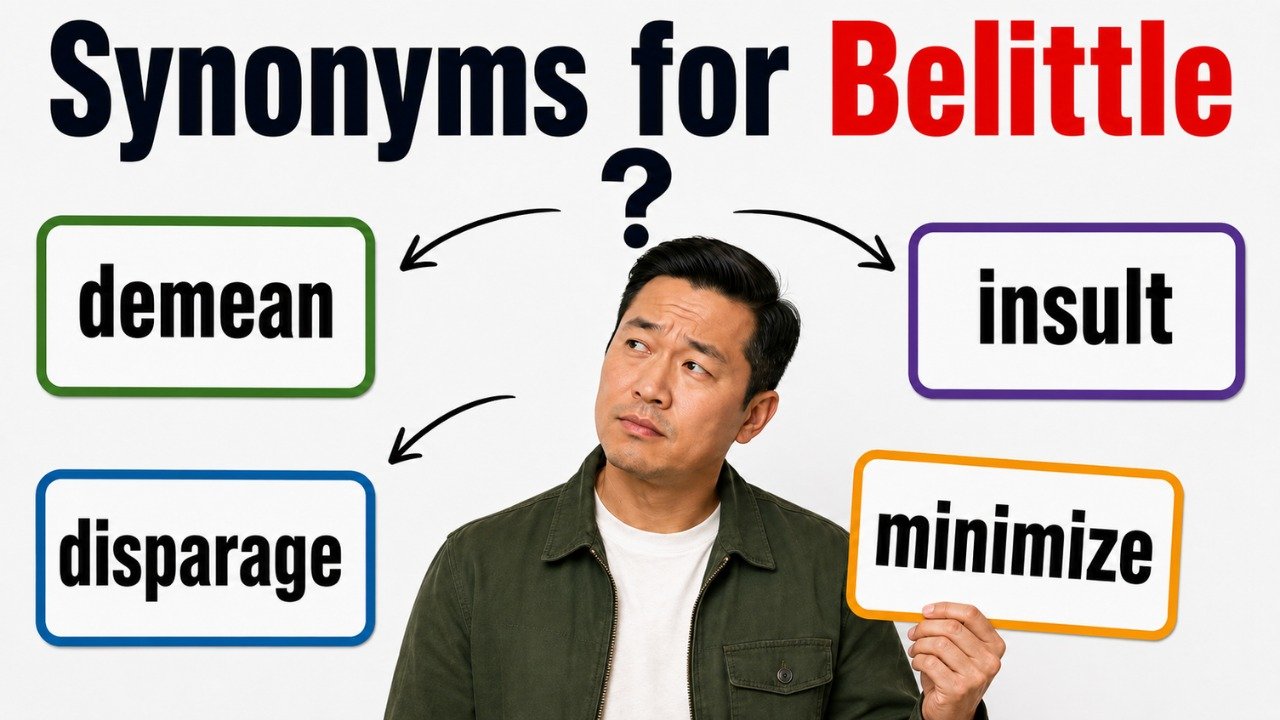
Quick Answer: The best synonyms for belittle include demean, disparage, denigrate, diminish, devalue, insult, mock, ridicule, trivialize, and minimize. Use demean when someone harms another person’s dignity. Choose disparage or denigrate in formal writing about unfair criticism. Mock and ridicule fit insulting humor or public embarrassment. Trivialize and minimize are best when someone treats a problem, achievement, or feeling as less important than it really is.
Pronunciation and Word Details
Word: Belittle.
Pronunciation: /bɪˈlɪt.əl/
Part of Speech: Verb.
Meaning: To make a person, achievement, feeling, or issue seem less important, valuable, or impressive.
US Pronunciation:
UK Pronunciation:
What Does “Belittle” Mean?
Belittle means to make someone or something seem unimportant, inferior, foolish, or less valuable than it really is. It is a verb commonly used when a person criticizes, insults, dismisses, or underestimates another person.
The word often describes language or behavior that damages someone’s confidence or dignity.
Example: The supervisor belittled the employee’s contribution during the meeting.
Belittle can also refer to reducing the importance of an achievement, concern, experience, or problem.
Example: Do not belittle the effort required to complete the project.
The word usually carries a negative meaning. It suggests that the speaker is being unfair, disrespectful, dismissive, or insulting.
Belittle may be used with a person as the object.
Example: He often belittles people who disagree with him.
It may also be used with an idea, feeling, achievement, concern, or difficulty.
Example: She did not want anyone to belittle her concerns.
The past tense and past participle are belittled. The present participle is belittling.
Example: His belittling remarks made the conversation uncomfortable.
Meaning, Tone, and Context of “Belittle”
Belittle has a negative, critical, and emotionally strong tone. It is used when words or actions reduce someone’s confidence, status, value, or importance.
Emotional Context: Belittle often describes behavior that makes another person feel embarrassed, weak, foolish, or unworthy.
Professional Context: The word may describe a manager, coworker, teacher, or leader who unfairly criticizes another person’s abilities or contribution.
Personal Context: It is commonly used when discussing disrespectful behavior in friendships, families, or relationships.
Formal Context: In essays, reports, and serious discussions, belittle can describe language that devalues a group, idea, achievement, or concern.
Conversational Context: In everyday speech, put down, make fun of, or talk down to may sound more natural.
Psychological Context: Belittling language may affect confidence, motivation, and a person’s sense of worth.
Argumentative Context: Someone may belittle an opposing opinion instead of responding to it fairly.
Social Context: Belittle may refer to treating a person as less intelligent, capable, important, or respectable.
The word is stronger than criticize. Criticism may be fair and constructive, while belittling is usually disrespectful and intended to reduce value or confidence.
When and How to Use “Belittle”
For Personal Insults
Use belittle when someone uses words or behavior to make another person feel inferior.
Example: He belittled his younger brother for making a small mistake.
For Dismissing Achievements
Use belittle when someone treats an accomplishment as ordinary, unimportant, or undeserved.
Example: Her coworkers tried to belittle her success.
For Minimizing Feelings
Use belittle when someone treats another person’s feelings as foolish or unimportant.
Example: A supportive friend will listen rather than belittle your emotions.
For Unfair Criticism
Use belittle when criticism attacks a person’s worth instead of offering helpful advice.
Example: The coach corrected the players without belittling them.
For Talking Down to Someone
Use belittle when a person speaks in a superior or disrespectful manner.
Example: She disliked the way the speaker belittled the audience.
For Reducing the Importance of a Problem
Use belittle when a serious concern is treated as minor or meaningless.
Example: We should not belittle the difficulties faced by new employees.
For Academic Discussion
Use belittle when discussing language that devalues people, cultures, ideas, or experiences.
Example: The essay explains how stereotypes can belittle entire communities.
For Describing Repeated Behavior
Use belittle when insulting or dismissive behavior happens regularly.
Example: Constantly belittling others can damage trust within a team.
Best Synonyms for Belittle
Demean
Synonym: To lower someone’s dignity, status, or self respect.
Example: The comments were intended to demean the new employee.
Disparage
Synonym: To speak about someone or something in a disrespectful or critical way.
Example: The article unfairly disparaged the artist’s work.
Denigrate
Synonym: To attack the reputation or value of someone or something.
Example: He tried to denigrate the achievements of his opponent.
Diminish
Synonym: To make something appear less important, impressive, or valuable.
Example: One mistake should not diminish her overall success.
Devalue
Synonym: To reduce the perceived worth or importance of something.
Example: Such comments devalue the work completed by the team.
Insult
Synonym: To speak or behave in a way that offends or disrespects someone.
Example: There was no need to insult him during the discussion.
Mock
Synonym: To make fun of someone in an unkind or disrespectful way.
Example: The students were told not to mock anyone’s accent.
Ridicule
Synonym: To make someone appear foolish through cruel humor or criticism.
Example: The speaker ridiculed those who questioned his proposal.
Trivialize
Synonym: To make a serious matter seem unimportant or simple.
Example: The statement trivialized the challenges faced by the workers.
Minimize
Synonym: To present something as smaller, less serious, or less important than it is.
Example: The report should not minimize the risks involved.
50 Synonyms for Belittle with Short Meanings
- Demean: To reduce someone’s dignity or self respect.
- Disparage: To speak of someone or something disrespectfully.
- Denigrate: To damage the reputation or value of something.
- Diminish: To make something appear less important or impressive.
- Devalue: To reduce the perceived worth of someone or something.
- Insult: To offend someone through disrespectful words or behavior.
- Mock: To make fun of someone unkindly.
- Ridicule: To make someone appear foolish through cruel humor.
- Trivialize: To treat a serious matter as unimportant.
- Minimize: To make something seem smaller or less serious.
- Deprecate: To express disapproval of someone or something.
- Deride: To treat someone with contemptuous mockery.
- Scorn: To show strong disrespect or contempt.
- Disdain: To treat someone as unworthy of respect.
- Humiliate: To make someone feel deeply embarrassed or ashamed.
- Embarrass: To cause someone to feel uncomfortable or ashamed.
- Discredit: To damage trust in someone’s ability or reputation.
- Undermine: To weaken someone’s confidence, authority, or position.
- Discount: To treat something as less important or believable.
- Dismiss: To reject something as unworthy of attention.
- Degrade: To lower someone’s dignity, quality, or status.
- Defame: To damage someone’s reputation through harmful claims.
- Slander: To harm someone’s reputation through false spoken statements.
- Malign: To speak harmful or unfairly critical words about someone.
- Vilify: To describe someone as extremely bad or unworthy.
- Smear: To damage a person’s reputation through unfair accusations.
- Taunt: To provoke or insult someone with mocking remarks.
- Tease: To make fun of someone, sometimes in an unkind way.
- Jeer: To shout rude or mocking comments.
- Sneer At: To show disrespect through words or facial expression.
- Scoff At: To speak about something with mocking disbelief.
- Laugh At: To make someone feel foolish through laughter.
- Put Down: To criticize or insult someone in a hurtful way.
- Talk Down To: To speak as though another person is less intelligent.
- Run Down: To criticize someone or something repeatedly.
- Make Light Of: To treat a serious matter as unimportant.
- Play Down: To make something seem less significant.
- Write Off: To dismiss someone or something as useless or unimportant.
- Look Down On: To consider someone inferior or less worthy.
- Patronize: To treat someone with false kindness and superiority.
- Condescend To: To behave as though another person is less important.
- Underestimate: To judge someone’s ability or value as lower than it is.
- Underrate: To value someone or something too poorly.
- Depreciate: To reduce the estimated value or importance of something.
- Marginalize: To treat a person or group as unimportant.
- Invalidate: To reject another person’s feelings or experience as unjustified.
- Disrespect: To show a lack of respect for someone.
- Criticize: To point out faults, sometimes unfairly or harshly.
- Reproach: To express disappointment or criticism toward someone.
- Contemn: To regard or treat someone with contempt.
Read Also:
Synonyms for because in an essay
Synonyms for Belittle by Context
When Belittle Means to Insult a Person
Demean, insult, humiliate, degrade, disrespect, put down, and talk down to are useful alternatives.
Demean: Best when words or actions damage someone’s dignity.
Example: The manager should never demean employees in front of customers.
Insult: Best for a direct offensive remark or action.
Example: He insulted her by questioning her intelligence.
Humiliate: Suitable when someone is made to feel deeply ashamed in front of others.
Example: The public criticism humiliated the young performer.
Put Down: A common conversational phrase for insulting criticism.
Example: Good friends do not put each other down.
When Belittle Means to Criticize Unfairly
Disparage, denigrate, deride, malign, vilify, run down, and discredit are strong alternatives.
Disparage: Suitable for formal writing about disrespectful criticism.
Example: The reviewer disparaged the entire project without explaining its weaknesses.
Denigrate: Best when someone attacks another person’s value, ability, or reputation.
Example: She refused to denigrate her competitors.
Deride: Appropriate when criticism includes contempt or mockery.
Example: Critics derided the proposal before reading it fully.
Discredit: Best when someone attempts to damage trust in a person or claim.
Example: They tried to discredit the witness.
When Belittle Means to Make Fun of Someone
Mock, ridicule, tease, taunt, jeer, laugh at, sneer at, and scoff at fit this meaning.
Mock: A common word for unkind imitation or humor.
Example: It is wrong to mock someone for speaking slowly.
Ridicule: Stronger than mock and often suggests public embarrassment.
Example: The audience ridiculed the speaker’s mistake.
Taunt: Best when insulting words are intended to provoke a reaction.
Example: The opposing players taunted him after the loss.
Sneer At: Suitable when contempt is shown through tone or facial expression.
Example: He sneered at her suggestion.
When Belittle Means to Reduce Importance
Diminish, devalue, trivialize, minimize, discount, dismiss, play down, and make light of are useful choices.
Diminish: Best when an achievement, quality, or contribution is made to seem smaller.
Example: His criticism did not diminish the value of her work.
Trivialize: Best when a serious experience or problem is treated as minor.
Example: The joke trivialized a serious safety concern.
Minimize: Suitable when someone reduces the apparent size or seriousness of something.
Example: The company should not minimize the effect of the delay.
Play Down: A conversational alternative for making something seem less important.
Example: He played down the difficulty of the task.
When Belittle Means to Treat Someone as Inferior
Patronize, condescend to, look down on, disdain, scorn, marginalize, and underestimate fit this context.
Patronize: Best when someone uses a falsely kind but superior tone.
Example: Please explain the process clearly without patronizing the audience.
Condescend To: Suitable when a person behaves as though someone else is beneath them.
Example: She never condescended to less experienced workers.
Look Down On: A natural expression for considering another person inferior.
Example: He tends to look down on people with different opinions.
Marginalize: Best when a person or group is pushed aside or treated as unimportant.
Example: Poor communication can marginalize quieter team members.
Another Word for Belittle
Demean is one of the best single replacements for belittle when the sentence concerns a person’s dignity or self respect. However, the best alternative depends on the intended meaning.
Use disparage for unfair criticism, ridicule for cruel humor, trivialize for serious issues, and diminish for achievements or value.
Original: The supervisor belittled the employee during the meeting.
Better Option: The supervisor demeaned the employee during the meeting.
Original: The article belittled her professional achievements.
Better Option: The article disparaged her professional achievements.
Original: They belittled his concerns about workplace safety.
Better Option: They trivialized his concerns about workplace safety.
Original: The other students belittled him for his mistake.
Better Option: The other students ridiculed him for his mistake.
When Not to Use “Belittle”
Do not use belittle when the behavior is simply constructive criticism, disagreement, correction, or honest evaluation. Belittle suggests disrespect and an attempt to reduce someone’s worth or importance.
When Criticism Is Helpful
Use criticize, correct, advise, or evaluate when the purpose is improvement rather than humiliation.
Weak: The editor belittled several unclear sentences.
Better: The editor corrected several unclear sentences.
When Someone Politely Disagrees
Belittle is too strong when a person simply expresses a different opinion.
Weak: She belittled my proposal by suggesting another approach.
Better: She questioned my proposal and suggested another approach.
When Something Is Physically Reduced
Belittle does not mean to make an object smaller in size.
Weak: The worker belittled the wooden board.
Better: The worker shortened the wooden board.
When You Mean Underestimate
Use underestimate when someone incorrectly judges ability, cost, time, or difficulty.
Weak: We belittled the time required to complete the work.
Better: We underestimated the time required to complete the work.
When the Tone Is Playful
Belittle may sound too serious if friends are teasing each other harmlessly.
Weak: They belittled each other about their favorite meals.
Better: They teased each other about their favorite meals.
When You Mean Dismiss a Claim
Use dismiss, reject, or discount when the main idea is refusing to accept an argument.
Weak: The committee belittled the proposal because it lacked evidence.
Better: The committee dismissed the proposal because it lacked evidence.
Words Commonly Confused With Belittle
Belittle vs Criticize: Belittle means to reduce someone’s confidence or importance through disrespect. Criticize means to identify faults and may be fair or constructive.
Belittle vs Demean: Belittle makes someone or something seem unimportant. Demean specifically lowers a person’s dignity or self respect.
Belittle vs Insult: Belittle often involves repeated dismissive behavior. Insult may refer to one offensive comment or action.
Belittle vs Mock: Belittle reduces someone’s value or confidence. Mock specifically involves making fun of someone.
Belittle vs Ridicule: Belittle may be subtle or indirect. Ridicule usually involves obvious and often public mockery.
Belittle vs Trivialize: Belittle commonly targets people or achievements. Trivialize usually targets serious feelings, experiences, or issues.
Belittle vs Minimize: Belittle is usually emotionally disrespectful. Minimize means to present something as less serious and may not always involve an insult.
Belittle vs Underestimate: Belittle is often intentional and disrespectful. Underestimate may be an honest error in judgment.
Belittle vs Patronize: Belittle openly or indirectly reduces someone’s worth. Patronize involves speaking with false kindness while showing superiority.
Which Synonym Should You Choose?
Choose demean when someone’s dignity or self respect is being damaged.
Choose disparage in formal writing about unfair or disrespectful criticism.
Choose denigrate when someone attacks another person’s reputation, value, or achievements.
Choose diminish when an achievement, contribution, or quality is made to seem less impressive.
Choose devalue when someone reduces the perceived worth of work, ideas, or people.
Choose insult for a direct offensive remark or action.
Choose mock when someone makes fun of another person through imitation or humor.
Choose ridicule when the mockery is cruel, obvious, or public.
Choose trivialize when a serious problem, feeling, or experience is treated as unimportant.
Choose minimize when someone reduces the apparent seriousness of an issue.
Choose patronize when someone speaks in a falsely helpful but superior manner.
Choose talk down to in casual conversation about disrespectful communication.
Choose dismiss when an idea or concern is rejected without proper consideration.
Choose underestimate when someone judges ability, difficulty, or value too low.
Choose marginalize when a person or group is excluded or treated as unimportant.
Real Life Examples of “Belittle” in Sentences
Original: The teacher never belittled students who gave incorrect answers.
Better Option: The teacher never humiliated students who gave incorrect answers.
Original: He belittled her contribution to the project.
Better Option: He diminished her contribution to the project.
Original: Do not belittle people because they have less experience.
Better Option: Do not look down on people because they have less experience.
Original: The speaker belittled everyone who questioned his opinion.
Better Option: The speaker ridiculed everyone who questioned his opinion.
Original: She felt that her manager constantly belittled her.
Better Option: She felt that her manager constantly demeaned her.
Original: They belittled the seriousness of the customer’s complaint.
Better Option: They trivialized the seriousness of the customer’s complaint.
Original: His remarks belittled years of careful research.
Better Option: His remarks devalued years of careful research.
Original: The older students belittled him because of his accent.
Better Option: The older students mocked him because of his accent.
Original: The report belittled the risks associated with the plan.
Better Option: The report minimized the risks associated with the plan.
Original: She belittled his idea without offering a better solution.
Better Option: She dismissed his idea without offering a better solution.
Synonym Groups and Usage Differences
Dignity Group
Demean, degrade, humiliate, insult, and disrespect describe behavior that damages a person’s dignity or self respect.
Demean and degrade suggest lowering someone’s status or worth. Humiliate emphasizes shame or embarrassment.
Example: Publicly correcting him was necessary, but humiliating him was not.
Unfair Criticism Group
Disparage, denigrate, malign, vilify, discredit, and run down describe harmful or unfair criticism.
Disparage is formal and broad. Denigrate attacks value or reputation. Vilify presents someone as extremely bad.
Example: The candidate criticized the policy without denigrating its supporters.
Mockery Group
Mock, ridicule, deride, taunt, jeer, tease, laugh at, and sneer at describe unkind humor or contempt.
Mock and tease may sometimes be mild. Ridicule, deride, and jeer are usually more hurtful.
Example: The audience began to jeer when the performer made a mistake.
Minimizing Group
Diminish, minimize, trivialize, devalue, discount, play down, and make light of describe reducing importance or seriousness.
Trivialize is strongest when a serious experience is treated carelessly. Diminish often applies to achievements or value.
Example: One poor result should not diminish the progress already made.
Superiority Group
Patronize, condescend to, look down on, scorn, and disdain suggest that someone considers another person inferior.
Patronize may sound politely insulting. Scorn and disdain express stronger contempt.
Example: The expert answered basic questions without patronizing the audience.
Dismissal Group
Dismiss, discount, write off, invalidate, underestimate, and underrate describe rejecting or undervaluing people, ideas, or concerns.
Invalidate is commonly used for feelings or experiences. Write off means to decide that someone or something has little value or hope.
Example: Do not dismiss a useful idea simply because it comes from a beginner.
Antonyms of Belittle
The opposite of belittle is to respect, support, praise, value, or encourage someone or something.
Praise: To express approval or admiration.
Compliment: To say something positive about a person or achievement.
Admire: To regard someone with respect or approval.
Respect: To recognize someone’s value, ability, or rights.
Honor: To show deep respect or recognition.
Value: To consider someone or something important or worthwhile.
Appreciate: To recognize the worth or importance of something.
Encourage: To give someone confidence or support.
Support: To help someone emotionally or practically.
Uplift: To improve someone’s mood, confidence, or sense of worth.
Celebrate: To recognize an achievement with pleasure or approval.
Commend: To formally praise someone’s actions or qualities.
Esteem: To hold someone in high regard.
Validate: To recognize another person’s feelings or experience as real and important.
Magnify: To make something appear more important or impressive.
Comparison: Belittle vs Related Words
Belittle vs Demean
Belittle means to make someone or something seem unimportant. Demean focuses more directly on reducing personal dignity.
Example With Belittle: He belittled her contribution to the discussion.
Example With Demean: His insulting tone demeaned everyone in the room.
Belittle vs Disparage
Belittle may target a person, concern, or achievement. Disparage usually means speaking critically or disrespectfully about someone or something.
Example With Belittle: She belittled his effort by calling the task easy.
Example With Disparage: The reviewer disparaged the author’s writing style.
Belittle vs Mock
Belittle reduces confidence or importance. Mock involves making fun of someone or copying them in an insulting way.
Example With Belittle: The supervisor belittled his ability.
Example With Mock: The students mocked the way he pronounced the word.
Belittle vs Ridicule
Belittle can be subtle and may involve dismissive comments. Ridicule is usually more obvious and is intended to make someone look foolish.
Example With Belittle: She belittled his suggestion during the meeting.
Example With Ridicule: She ridiculed his suggestion in front of the entire team.
Belittle vs Trivialize
Belittle often concerns a person or achievement. Trivialize concerns a serious issue, experience, or feeling.
Example With Belittle: He belittled her professional success.
Example With Trivialize: He trivialized her concerns about workplace safety.
Belittle vs Minimize
Belittle usually contains disrespect or contempt. Minimize means to make something appear less serious and can sometimes be neutral.
Example With Belittle: The comments belittled the workers’ contribution.
Example With Minimize: The summary minimized the financial risks.
Belittle vs Underestimate
Belittle is often intentional and emotionally harmful. Underestimate means to judge ability, value, cost, or difficulty too low.
Example With Belittle: They belittled her because she was inexperienced.
Example With Underestimate: They underestimated how quickly she could learn.
Belittle vs Patronize
Belittle reduces someone’s worth through dismissive behavior. Patronize involves speaking with false kindness while assuming superiority.
Example With Belittle: He belittled the new employee’s knowledge.
Example With Patronize: He patronized the new employee by explaining every simple detail slowly.
Common Phrases and Expressions With Belittle
Belittle Someone: To make a person feel unimportant or inferior.
Belittle an Achievement: To make an accomplishment appear less impressive.
Belittle a Contribution: To reduce the perceived value of someone’s effort.
Belittle a Concern: To treat a worry as foolish or unimportant.
Belittle an Opinion: To dismiss a person’s view disrespectfully.
Belittle Someone’s Feelings: To treat emotions as unreasonable or meaningless.
Belittle Someone’s Intelligence: To suggest that a person lacks understanding or ability.
Belittle Someone in Public: To embarrass or demean a person in front of others.
Constantly Belittle: To repeatedly make someone feel inferior.
Try to Belittle: To attempt to reduce another person’s confidence or value.
Common Mistakes to Avoid
Confusing Belittle With Criticize
Criticism can be fair, useful, and respectful. Belittling is dismissive and usually intended to make someone feel inferior.
Incorrect: The teacher belittled the essay by suggesting clearer examples.
Correct: The teacher criticized the essay constructively by suggesting clearer examples.
Using Belittle for Physical Size
Belittle does not mean to physically reduce the size of something.
Incorrect: The tailor belittled the dress.
Correct: The tailor shortened the dress.
Using Belittle Instead of Underestimate
Use underestimate for incorrect judgments about time, cost, ability, or difficulty.
Incorrect: We belittled the cost of repairing the building.
Correct: We underestimated the cost of repairing the building.
Choosing Mock for Every Context
Mock works when someone makes fun of another person. It does not always fit when the issue involves dismissal or reduced importance.
Unclear: The report mocked the seriousness of the problem.
Clear: The report minimized the seriousness of the problem.
Ignoring the Strength of the Word
Belittle is emotionally strong. Avoid using it for polite disagreement or ordinary correction.
Too Strong: She belittled my plan by asking for more details.
Better: She questioned my plan by asking for more details.
Repeating Belittle Too Often
Repeated use may make writing sound heavy or monotonous.
Repetitive: He belittled her work, belittled her ideas, and belittled her experience.
Improved: He disparaged her work, dismissed her ideas, and devalued her experience.
Using an Unnatural Object
Belittle is most natural with people, feelings, concerns, achievements, abilities, contributions, and ideas.
Unnatural: He belittled the weather.
Natural: He minimized the effect of the bad weather.
Confusing Belittling With Belittled
Belittling describes the insulting action or remark. Belittled describes the person or thing receiving that treatment.
Belittling Example: She made several belittling comments.
Belittled Example: He felt belittled by her comments.
Conclusion
The best synonyms for belittle depend on the kind of disrespect being described. Demean and degrade relate to dignity, while disparage and denigrate fit unfair criticism. Mock and ridicule describe cruel humor, and trivialize or minimize work best for serious concerns or experiences. Patronize and talk down to describe superior behavior. Choosing the right synonyms for belittle helps make writing clearer while showing whether the sentence concerns insults, dismissal, mockery, reduced importance, or damage to someone’s confidence.
FAQs About Synonyms for Belittle
What Is the Best Synonym for Belittle?
Demean is one of the best general synonyms for belittle. Disparage, diminish, ridicule, and trivialize may be more accurate in specific contexts.
What Is a Formal Synonym for Belittle?
Disparage, denigrate, deprecate, diminish, and demean are suitable formal alternatives.
What Is a Simple Word for Belittle?
Insult, mock, dismiss, or put down are simple alternatives. The correct choice depends on the meaning of the sentence.
Is Belittle the Same as Insult?
Not exactly. An insult may be one offensive remark, while belittling often involves making someone feel inferior or unimportant.
What Is the Difference Between Belittle and Demean?
Belittle means to make someone seem unimportant or less capable. Demean focuses more specifically on damaging a person’s dignity.
Can Trivialize Replace Belittle?
Trivialize can replace belittle when a serious concern, feeling, or experience is treated as unimportant. It is less suitable when a person is directly insulted.
What Is the Opposite of Belittle?
Praise, respect, value, encourage, appreciate, support, and uplift are common opposites of belittle.
