
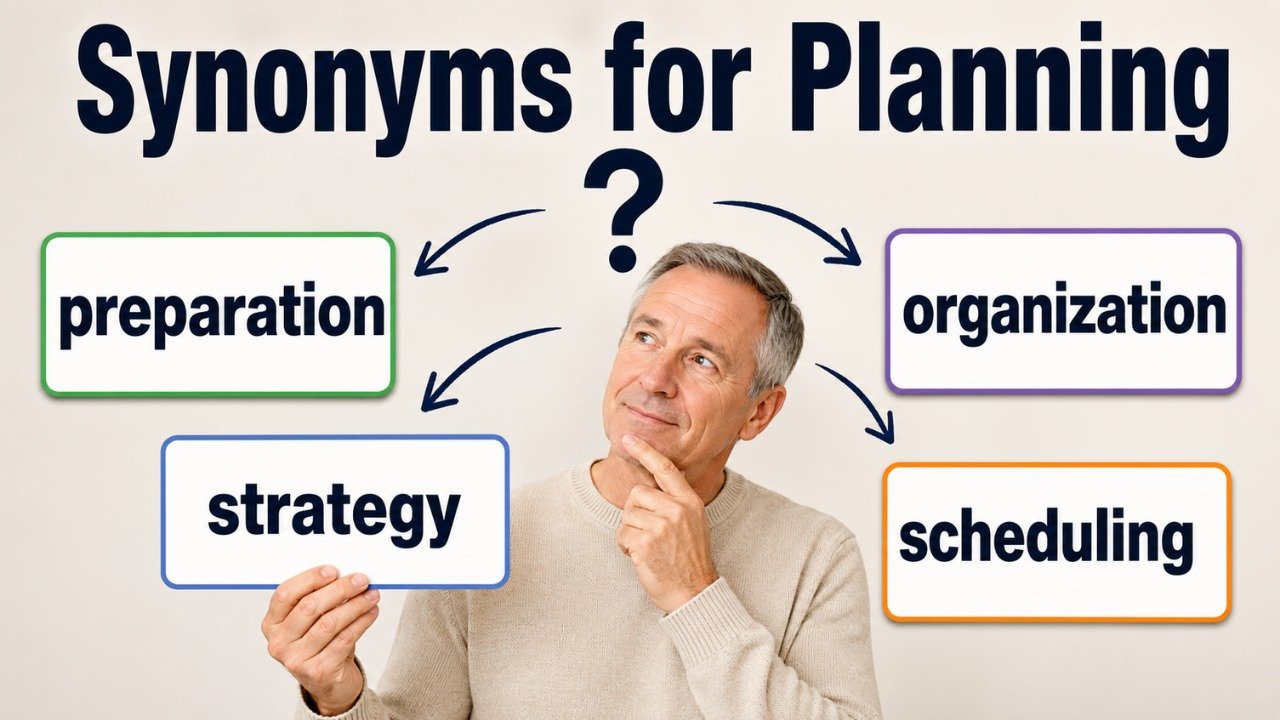
Quick Answer: Useful synonyms for planning include preparation, strategy, scheduling, organization, arrangement, design, coordination, forecasting, road mapping, and strategizing. Preparation is the best general alternative when someone is getting ready in advance. Strategy is better for long term goals and important decisions. Scheduling fits time and calendar management, while coordination works best when people, tasks, or resources must work together. Design and formulation are suitable for formal, academic, technical, or project related contexts.
Pronunciation and Word Details
Word: Planning.
Pronunciation: /ˈplæn.ɪŋ/
Part of Speech: Noun, gerund, and present participle of plan.
Meaning: The process of deciding in advance what to do, how to do it, and when to do it.
US Pronunciation:
UK Pronunciation:
What Does “Planning” Mean?
Planning means deciding in advance how a task, event, project, or goal will be completed. It usually involves identifying objectives, choosing actions, organizing resources, and setting a timeline.
As a noun, planning describes the complete process of preparing for something.
Example: Careful planning helped the team complete the project successfully.
Planning can also be the present participle of the verb plan.
Example: We are planning a family celebration for next month.
The word works in personal, professional, academic, financial, technical, and creative contexts. Someone may plan a trip, a lesson, a business project, a budget, a meeting, or a daily routine.
Planning can involve simple decisions, such as deciding what to cook, or complex decisions, such as organizing a major construction project.
Meaning, Tone, and Context of “Planning”
Planning usually has a neutral and practical tone. It suggests preparation, organization, thought, and purposeful decision making.
In professional writing, planning often refers to a structured process involving goals, responsibilities, timelines, budgets, and resources.
Professional Context: The department began planning its annual training program.
In academic writing, the word can describe the development of research, lessons, assignments, or educational programs.
Academic Context: Effective lesson planning supports clear classroom instruction.
In casual conversation, planning commonly means making arrangements for a future activity.
Casual Context: We are planning dinner at my house this weekend.
In management and business contexts, planning often sounds formal and strategic.
Formal Context: Strategic planning allows an organization to prepare for future opportunities.
The word is generally positive because it suggests responsibility and preparation. However, excessive planning can sometimes imply hesitation or a lack of action.
Critical Context: They spent so much time planning that they never started the work.
When and How to Use “Planning”
For Preparing in Advance
Use planning when someone is deciding what needs to happen before an activity begins.
Example: Planning the journey early helped us avoid unnecessary problems.
For Organizing a Project
Planning is appropriate when tasks, responsibilities, resources, and deadlines need to be arranged.
Example: Project planning began several weeks before the work was approved.
For Managing Time
Use planning when creating a schedule or deciding when tasks should be completed.
Example: Weekly planning helps her balance work and personal responsibilities.
For Reaching a Goal
Planning can describe the process of identifying a goal and deciding how to achieve it.
Example: Financial planning helped the family save for a new home.
For Coordinating People
Use planning when several people, teams, or departments must work together.
Example: The event required careful planning between staff members and volunteers.
For Making Strategic Decisions
Planning is useful when discussing long term direction, priorities, or major decisions.
Example: The company improved its strategic planning before entering a new market.
For Designing Something
The word can describe the early design or development of a product, system, lesson, building, or program.
Example: The engineers are planning a more efficient transport system.
For Handling Possible Problems
Planning may include preparing for risks, delays, emergencies, or unexpected changes.
Example: Contingency planning allowed the team to respond quickly to the delay.
Best Synonyms for Planning
Preparation
Synonym: Preparation means getting ready for a future activity, event, or responsibility.
Example: Thorough preparation made the presentation much easier to deliver.
Strategy
Synonym: Strategy is a carefully developed method for reaching a major or long term goal.
Example: The team created a strategy for increasing customer satisfaction.
Scheduling
Synonym: Scheduling means arranging tasks or events according to specific times and dates.
Example: Scheduling the interviews early prevented unnecessary delays.
Organization
Synonym: Organization means arranging tasks, information, people, or resources in an orderly way.
Example: Good organization helped the committee complete its work efficiently.
Arrangement
Synonym: Arrangement refers to plans or preparations made for an event or activity.
Example: The travel arrangements were completed before the holiday began.
Design
Synonym: Design means creating a detailed structure or method for something.
Example: The design of the training program took several weeks.
Coordination
Synonym: Coordination means organizing different people, tasks, or resources so they work together effectively.
Example: Successful coordination between the departments prevented confusion.
Forecasting
Synonym: Forecasting means using available information to predict future conditions or needs.
Example: Sales forecasting helped the business prepare its annual budget.
Road mapping
Synonym: Road mapping means creating a clear sequence of goals, stages, and actions for future development.
Example: Product road mapping gave the development team a clear direction.
Strategizing
Synonym: Strategizing means thinking carefully about the best method for achieving an objective.
Example: The managers spent the afternoon strategizing for the upcoming negotiation.
50 Synonyms for Planning With Short Meanings
- Preparation: The process of getting ready in advance.
- Strategy: A method designed to achieve an important goal.
- Scheduling: Arranging tasks or events by time and date.
- Organization: Putting activities and resources into an orderly structure.
- Arrangement: A plan made for a future activity or event.
- Design: A detailed structure or method created for a purpose.
- Formulation: The careful development of a plan, idea, or policy.
- Coordination: Organizing people and activities to work together.
- Mapping: Showing the stages or direction of a process.
- Outlining: Identifying the main points or steps of a plan.
- Structuring: Arranging different parts into an organized system.
- Forecasting: Predicting future conditions, needs, or results.
- Budgeting: Planning how money will be earned, saved, or spent.
- Programming: Arranging activities or instructions in a planned sequence.
- Roadmapping: Creating a sequence of future goals and actions.
- Strategizing: Developing methods for reaching an objective.
- Prearrangement: An arrangement completed before an event occurs.
- Forethought: Careful thought about what may happen in the future.
- Anticipation: Thinking about and preparing for a future situation.
- Calculation: Careful consideration of possible actions and results.
- Deliberation: Detailed thought before making a decision.
- Consideration: Careful attention given to choices or possibilities.
- Projection: An estimate of what may happen in the future.
- Prioritization: Deciding which tasks or goals are most important.
- Sequencing: Arranging actions in the order they should happen.
- Logistics: Organizing the practical details of an operation or event.
- Management: Controlling and organizing work, people, or resources.
- Administration: Managing the practical details of a project or system.
- Orchestration: Carefully coordinating many connected activities.
- Conception: The development of an initial idea or purpose.
- Visualization: Mentally imagining a future result or process.
- Drafting: Creating an early version of a plan or document.
- Plotting: Developing a sequence of actions, events, or ideas.
- Blueprinting: Producing a detailed model for future action.
- Goal Setting: Choosing clear results that should be achieved.
- Agenda Setting: Deciding which subjects or tasks require attention.
- Resource Allocation: Deciding how available resources should be used.
- Scenario Building: Imagining possible future situations and responses.
- Contingency Preparation: Getting ready for possible problems or changes.
- Project Design: Creating the structure, goals, and stages of a project.
- Action Design: Developing a practical sequence of actions.
- Operational Preparation: Organizing the practical steps required for work.
- Tactical Preparation: Preparing specific actions for a short term objective.
- Workflow Design: Arranging how tasks should move through a process.
- Timetabling: Assigning activities to particular times.
- Calendaring: Placing tasks or events on a calendar.
- Framework Building: Creating the main structure for future work.
- Course Setting: Choosing the direction that an activity should follow.
- Masterminding: Developing and directing a detailed plan.
- Plan Development: Creating and improving a plan before action begins.
Read Also:
Synonyms for Tone
Synonyms for Planning by Context
When Planning Means Preparing in Advance
Preparation, forethought, anticipation, and prearrangement are useful when the focus is getting ready before something happens.
Preparation: Best for general readiness.
Example: Preparation for the examination began several weeks early.
Forethought: Best when emphasizing careful thinking about future consequences.
Example: With a little forethought, the problem could have been avoided.
Anticipation: Best when preparing for an expected situation.
Example: The store increased its supplies in anticipation of greater demand.
Prearrangement: Best when details have already been agreed upon.
Example: Entry was allowed only by prearrangement.
When Planning Means Creating a Strategy
Strategy, strategizing, road mapping, goal setting, and scenario building are suitable for long term goals and major decisions.
Strategy: A complete method for reaching an objective.
Example: The organization developed a strategy for improving its services.
Strategizing: The active process of considering possible methods.
Example: The team is strategizing before the final meeting.
Road mapping: A staged plan showing future progress.
Example: Road mapping helped the developers identify their next priorities.
Goal Setting: The process of choosing clear objectives.
Example: Goal setting gives employees a measurable direction.
Scenario Building: Preparing for several possible future situations.
Example: Scenario building helped the managers understand potential risks.
When Planning Means Organizing Time
Scheduling, timetabling, calendaring, prioritization, and sequencing are useful when the focus is time and order.
Scheduling: Best for assigning exact times and dates.
Example: Scheduling the appointments took most of the morning.
Timetabling: Common when arranging classes, transport, or regular activities.
Example: Timetabling the courses required careful coordination.
Calendaring: Useful for adding planned activities to a calendar.
Example: Calendaring important deadlines prevented missed assignments.
Prioritization: Best for deciding what should be completed first.
Example: Prioritization allowed the team to focus on urgent tasks.
Sequencing: Best for arranging actions in the correct order.
Example: Proper sequencing made the installation process easier.
When Planning Means Designing a Project
Design, formulation, outlining, structuring, drafting, and blueprinting work well when creating a project, system, policy, or document.
Design: Best for creating an intentional structure.
Example: The design of the program reflects the needs of new employees.
Formulation: Best for policies, ideas, methods, or official proposals.
Example: The formulation of the policy required expert advice.
Outlining: Best for identifying major points before adding detail.
Example: Outlining the report made the writing process faster.
Structuring: Best for arranging connected parts logically.
Example: Structuring the course into weekly units improved clarity.
Blueprinting: Best for a detailed model that guides future work.
Example: The team began blueprinting the new operating system.
When Planning Means Coordinating Resources
Coordination, logistics, resource allocation, orchestration, management, and administration are useful when people, materials, money, and responsibilities must be organized.
Coordination: Best for connecting different teams or activities.
Example: Coordination between the two offices improved communication.
Logistics: Best for transport, equipment, supplies, and practical arrangements.
Example: The logistics of the conference were handled by a separate committee.
Resource Allocation: Best for deciding how money, time, staff, or equipment should be used.
Example: Resource allocation was based on the urgency of each project.
Orchestration: Best for managing many complicated activities.
Example: The successful launch required the orchestration of several teams.
Another Word for Planning
Preparation is often the best single replacement for planning because both words describe getting ready before an activity begins. However, the most accurate alternative depends on the context.
Use strategy for long term objectives, scheduling for time management, coordination for teamwork, and design for creating a structured system or project.
Original: Careful planning was necessary before the event.
Better Option: Careful preparation was necessary before the event.
Original: The company is planning how to enter the new market.
Better Option: The company is developing a strategy for entering the new market.
Original: Planning the weekly meetings took several hours.
Better Option: Scheduling the weekly meetings took several hours.
Original: Planning between the departments prevented delays.
Better Option: Coordination between the departments prevented delays.
When Not to Use “Planning”
Planning is a broad word. It may sound vague when a more specific word can explain the exact activity.
When Exact Timing Is the Focus
Use scheduling instead of planning when discussing dates, times, or appointments.
Weak: Planning the interviews was difficult because everyone was busy.
Better: Scheduling the interviews was difficult because everyone was busy.
When Long Term Direction Is the Focus
Use strategy when discussing major goals and competitive decisions.
Weak: The company needs better planning to increase its market share.
Better: The company needs a stronger strategy to increase its market share.
When Practical Readiness Is the Focus
Use preparation when someone is getting ready for a task, examination, or event.
Weak: Her planning for the examination was thorough.
Better: Her preparation for the examination was thorough.
When Teamwork Is the Focus
Use coordination when several people or departments must work together.
Weak: Better planning between the teams improved the launch.
Better: Better coordination between the teams improved the launch.
When Prediction Is the Focus
Use forecasting when making estimates about future sales, costs, demand, or conditions.
Weak: Financial planning showed that expenses might rise.
Better: Financial forecasting showed that expenses might rise.
When “Planning” Becomes Repetitive
Repeating planning several times in the same paragraph can make the writing sound dull.
Weak: Planning began early because the planning team believed detailed planning was necessary.
Better: Preparation began early because the project team believed a detailed strategy was necessary.
Words Commonly Confused With Planning
Planning vs Preparation: Planning involves deciding what will happen and how it will happen. Preparation involves completing the actions needed to become ready.
Example: Planning the presentation involved selecting the main topics, while preparation involved creating the slides and practising the speech.
Planning vs Strategy: Planning can include timelines, resources, tasks, and responsibilities. Strategy focuses on the overall method used to reach an important goal.
Example: The strategy explains where the organization wants to go, while the plan explains how it will get there.
Planning vs Scheduling: Planning is the broader process of deciding actions and objectives. Scheduling assigns activities to specific times and dates.
Example: Planning determined which tasks were necessary, while scheduling determined when each task would be completed.
Planning vs Organization: Planning decides future actions. Organization arranges the people, information, and resources needed to perform those actions.
Example: Planning established the project stages, while organization ensured that every person understood their role.
Planning vs Forecasting: Planning decides what should be done. Forecasting predicts what may happen based on available information.
Example: Forecasting predicted higher demand, and planning determined how the business would respond.
Planning vs Design: Planning covers actions, timing, resources, and goals. Design focuses on creating the structure, appearance, or operation of something.
Example: The design explained how the system would function, while the plan explained how it would be developed.
Which Synonym Should You Choose?
Choose preparation when discussing readiness for an examination, meeting, event, journey, or responsibility.
Choose strategy when writing about long term goals, competition, growth, leadership, or major decisions.
Choose scheduling when assigning tasks, appointments, lessons, interviews, or events to specific times.
Choose organization when arranging information, responsibilities, people, or materials.
Choose coordination when different people, teams, or departments must work together.
Choose forecasting when estimating future sales, costs, demand, weather, or business conditions.
Choose design when creating the structure of a system, product, course, building, or program.
Choose formulation when discussing formal policies, proposals, methods, or academic ideas.
Choose logistics when describing transport, supplies, equipment, venues, or practical arrangements.
Choose roadmapping when explaining the stages through which a product, project, or organization will develop.
Choose prioritization when deciding which responsibilities should receive attention first.
Choose outlining when creating the main structure of an essay, presentation, report, or project.
Real Life Examples of “Planning” in Sentences
Original: We are planning our family holiday for December.
Better Option: We are making arrangements for our family holiday in December.
Original: The manager is planning a new sales approach.
Better Option: The manager is developing a new sales strategy.
Original: Planning the appointments took most of the afternoon.
Better Option: Scheduling the appointments took most of the afternoon.
Original: The event succeeded because of careful planning.
Better Option: The event succeeded because of careful preparation.
Original: The departments improved their planning before the product launch.
Better Option: The departments improved their coordination before the product launch.
Original: The teacher spent Friday planning next week’s lessons.
Better Option: The teacher spent Friday designing next week’s lessons.
Original: Financial planning helped the couple control their expenses.
Better Option: Careful budgeting helped the couple control their expenses.
Original: The committee is planning how to use the available funds.
Better Option: The committee is considering how to allocate the available funds.
Original: The engineers are planning the stages of construction.
Better Option: The engineers are mapping the stages of construction.
Original: The company is planning for several possible outcomes.
Better Option: The company is building scenarios for several possible outcomes.
Synonym Groups and Usage Differences
Preparation Group
Preparation, forethought, anticipation, and prearrangement relate to getting ready before an event or activity.
Preparation is the broadest term. Forethought emphasizes careful thinking, while prearrangement means the details were settled earlier.
Example: Proper preparation reduced the risk of mistakes.
Strategy Group
Strategy, strategizing, road mapping, goal setting, and course setting describe deciding how an important objective will be reached.
Strategy focuses on the overall method. Road mapping focuses on stages, while goal setting identifies the desired results.
Example: The new strategy provides a clear direction for future growth.
Time Management Group
Scheduling, timetabling, calendaring, prioritization, and sequencing relate to when and in what order activities should occur.
Scheduling assigns times, prioritization identifies importance, and sequencing establishes the correct order.
Example: Careful scheduling prevented two meetings from occurring at the same time.
Design Group
Design, formulation, outlining, structuring, drafting, and blueprinting describe creating the form or structure of something.
Outlining provides the basic points. Drafting creates an early version, while blueprinting produces a detailed model.
Example: Outlining the proposal helped the writer arrange the main ideas.
Coordination Group
Coordination, logistics, orchestration, management, administration, and resource allocation relate to controlling people, tasks, and materials.
Logistics focuses on practical requirements. Orchestration suggests managing many connected activities, while resource allocation decides how available resources will be distributed.
Example: Effective coordination allowed every team to complete its work on time.
Prediction Group
Forecasting, projection, anticipation, scenario building, and calculation relate to considering future possibilities.
Forecasting uses information to estimate future conditions. Scenario building explores several possible outcomes.
Example: Demand forecasting helped the business order the correct amount of stock.
Antonyms of Planning
The opposite of planning depends on whether the word refers to preparation, organization, strategy, or deliberate action.
Spontaneity: Acting naturally without making arrangements in advance.
Improvisation: Creating or deciding something at the moment it is needed.
Disorganization: A lack of order, structure, or coordination.
Neglect: Failure to give proper attention to preparation or responsibility.
Inaction: Failure to take steps toward a goal.
Randomness: The absence of a deliberate order or method.
Carelessness: A lack of attention to details or possible consequences.
Reaction: Responding only after something has already happened.
Unpreparedness: The state of not being ready for an activity or situation.
Uncertainty: A lack of clear knowledge about what should happen.
Confusion: A state in which actions, responsibilities, or objectives are unclear.
Disorder: A lack of organized structure or arrangement.
Comparison: Planning vs Related Words
Planning vs Preparation
Planning involves deciding objectives, actions, responsibilities, and timelines. Preparation involves doing the practical work required to become ready.
Example With Planning: Planning the conference involved choosing the date, speakers, and program.
Example With Preparation: Preparation for the conference involved arranging chairs and testing the equipment.
Planning vs Strategy
Planning explains the steps needed to achieve something. Strategy explains the broader method and direction.
Example With Planning: The project planning included weekly tasks and deadlines.
Example With Strategy: The strategy focused on reaching younger customers.
Planning vs Scheduling
Planning decides what needs to happen. Scheduling decides exactly when it will happen.
Example With Planning: Planning identified the main stages of the project.
Example With Scheduling: Scheduling assigned a completion date to each stage.
Planning vs Forecasting
Planning determines future actions. Forecasting estimates future conditions or results.
Example With Planning: The business is planning to hire more employees.
Example With Forecasting: The business is forecasting an increase in customer demand.
Planning vs Organization
Planning looks forward and decides what should be done. Organization arranges what is needed to carry out the plan.
Example With Planning: Planning established the goals of the campaign.
Example With Organization: Organization ensured that each team received the correct materials.
Planning vs Coordination
Planning creates the intended course of action. Coordination keeps people and activities working together.
Example With Planning: Planning began three months before the event.
Example With Coordination: Coordination between staff members continued throughout the event.
Planning vs Design
Planning covers the entire process of reaching a result. Design creates the structure or form of the final system, product, or program.
Example With Planning: Planning covered the budget, schedule, and responsibilities.
Example With Design: Design determined how the new website would be organized.
Common Phrases and Expressions With Planning
Strategic Planning: The process of deciding long term goals and methods.
Project Planning: The organization of tasks, resources, responsibilities, and deadlines for a project.
Advance Planning: Preparation completed well before an activity begins.
Careful Planning: Detailed preparation intended to prevent mistakes.
Long Term Planning: Decision making focused on future goals over an extended period.
Financial Planning: Managing income, expenses, savings, and future financial needs.
Event Planning: Organizing the venue, schedule, guests, equipment, and activities for an event.
Contingency Planning: Preparing alternative actions for unexpected problems.
Workforce Planning: Estimating and organizing future staffing requirements.
Lesson Planning: Preparing learning objectives, activities, materials, and assessments.
Common Mistakes to Avoid
Using Planning When a More Specific Word Is Needed
Planning can be too general. Use scheduling for time, budgeting for money, forecasting for predictions, and coordination for teamwork.
Unclear: The company improved its planning.
Clearer: The company improved its financial forecasting and resource allocation.
Repeating Planning Too Often
Frequent repetition can make a paragraph sound unnatural.
Repetitive: The planning team began planning the event after the first planning meeting.
Improved: The organizing team began preparing the event after the first strategy meeting.
Confusing Planning With Preparation
Planning involves deciding what to do. Preparation involves completing the practical work needed to become ready.
Incorrect Meaning: We finished planning by setting up the chairs.
Better Meaning: We finished preparing by setting up the chairs.
Confusing Planning With Scheduling
A schedule is only one part of a complete plan.
Limited: Our planning contains the dates of every meeting.
Better: Our schedule contains the dates of every meeting.
Choosing an Unnatural Synonym
Not every alternative works in every sentence. Strategy cannot always replace planning, especially when discussing simple arrangements.
Unnatural: We developed a strategy for meeting our friends at the cafe.
Natural: We made arrangements to meet our friends at the cafe.
Using Vague Planning Statements
Explain what is being planned and what result is expected.
Vague: More planning is needed.
Specific: More budget preparation and staff coordination are needed before the project can begin.
Forgetting the Correct Preposition
Use planning for before a noun when discussing preparation. Use planning to before a verb when discussing an intended action.
Planning For: We are planning for the annual conference.
Planning To: We are planning to attend the annual conference.
Conclusion
Synonyms for planning include preparation, strategy, scheduling, organization, coordination, design, forecasting, and road mapping. The best alternative depends on the exact purpose. Use preparation for general readiness, strategy for long term goals, scheduling for dates and times, and coordination for connected teams or tasks. Forecasting suits future estimates, while design and formulation work well in formal project development. Choosing a precise synonym makes your sentence clearer and helps readers understand which part of the planning process you mean.
FAQs About Synonyms for Planning
What Is the Best Synonym for Planning?
Preparation is the best general synonym for planning. Strategy, scheduling, organization, and coordination may be more accurate in specific contexts.
What Is a Formal Word for Planning?
Formulation, strategic preparation, project design, and coordination are suitable formal alternatives. The best choice depends on what is being organized.
Is Strategy the Same as Planning?
No. Strategy describes the overall method used to achieve a goal. Planning includes the detailed tasks, resources, responsibilities, and timelines needed to follow that strategy.
What Is Another Word for Planning an Event?
Event preparation, organization, arrangement, coordination, and logistics are useful alternatives for planning an event.
What Is Another Word for Future Planning?
Forethought, forecasting, projection, anticipation, road mapping, and long term preparation can describe planning for the future.
What Is Another Word for Careful Planning?
Detailed preparation, deliberate organization, strategic thinking, forethought, and thorough coordination can replace careful planning.
Can Scheduling Replace Planning?
Scheduling can replace planning when the sentence focuses on dates, times, or appointments. It is not a complete replacement when goals, resources, and strategy are also involved.
