
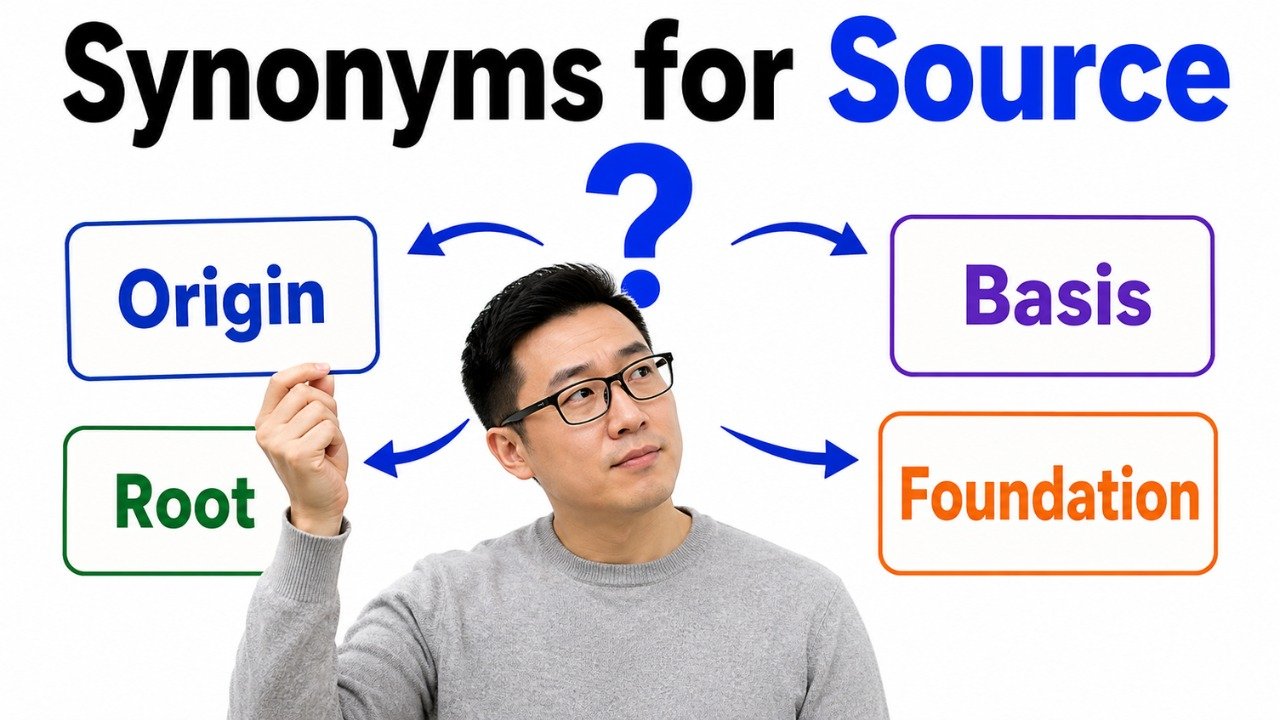
Quick Answer: Common synonyms for source include origin, beginning, root, cause, provider, supplier, reference, authority, fountainhead, and wellspring. Use origin for the place where something begins, cause for what produces a result, provider or supplier for a person or organization that supplies something, and reference or authority for information used in research. Fountainhead and wellspring are more expressive choices for the original source of ideas, creativity, or influence.
Pronunciation and Word Details
Word: Source.
Pronunciation: /sɔːrs/
Part of Speech: Noun and verb.
Meaning: The person, place, thing, or cause from which something begins, develops, comes, or is obtained.
US Pronunciation:
UK Pronunciation:
What Does “Source” Mean?
Source means the original place, person, thing, or cause from which something comes. It is most commonly used as a noun, but it can also function as a verb.
As a noun, source can refer to the beginning of a river, the cause of a problem, a provider of goods, or a person, document, or record that supplies information.
Example: The mountain spring is the source of the river.
In this sentence, source means the place where the river begins.
Example: The researcher checked several sources before completing the report.
Here, sources means documents, records, publications, or people that provided information.
As a verb, source means to obtain a product, material, worker, or piece of information from a particular place.
Example: The company sources its materials from local producers.
The exact meaning of source depends on whether the sentence discusses origin, information, supply, cause, inspiration, or production.
Meaning, Tone, and Context of “Source”
Source usually has a neutral, clear, and informative tone. It is common in everyday speech, academic writing, journalism, business communication, science, history, research, technology, and professional reports.
In academic writing, source usually means a document, record, publication, interview, or other form of evidence used to support information.
Example: The student included a reliable source for each major claim.
In business, source may refer to a supplier, producer, provider, or place from which materials and products are obtained.
Example: The factory needs a dependable source of raw materials.
In science and geography, source can identify the origin of energy, water, light, sound, heat, or natural movement.
Example: The sun is a major source of energy.
In personal or emotional contexts, source may identify the cause of a feeling, problem, conflict, or inspiration.
Example: Music became a source of comfort during a difficult period.
Source is generally suitable for formal and casual contexts. However, more precise synonyms can make a sentence clearer by showing whether the intended meaning is origin, cause, supplier, reference, or inspiration.
When and How to Use “Source”
For an Origin
Use source when identifying the place or point where something begins.
Example: The explorers searched for the source of the river.
For Information
Use source for a person, document, record, or publication that provides facts.
Example: The writer verified the claim through an independent source.
For a Cause
Use source when identifying what creates a problem, feeling, event, or result.
Example: Investigators discovered the source of the unusual noise.
For a Provider
Use source for a person, business, or place that supplies goods or services.
Example: The farm is a dependable source of fresh vegetables.
For Research
Use source when referring to evidence used in an essay, report, or study.
Example: Each source should be relevant to the research question.
For Inspiration
Use source for something that encourages creativity, motivation, or new ideas.
Example: Nature was a constant source of inspiration for the painter.
For Energy or Supply
Use source when something provides power, water, food, income, or another necessary supply.
Example: Solar panels provide a clean source of energy.
For Obtaining Something
Use source as a verb when finding or acquiring materials, products, workers, or information.
Example: The restaurant sources its ingredients from nearby farms.
Best Synonyms for Source
Origin: The place, point, or situation where something begins.
Example: Scientists continue to study the origin of the unusual signal.
Beginning: The first stage or earliest point of something.
Example: The agreement marked the beginning of a new partnership.
Root: The basic cause or earliest foundation of something.
Example: Poor communication was the root of the disagreement.
Cause: The person, event, or condition that produces a result.
Example: The inspection revealed the cause of the equipment failure.
Provider: A person or organization that supplies something.
Example: The clinic is a trusted provider of health services.
Supplier: A person or business that supplies products or materials.
Example: The manufacturer contacted a new supplier of metal parts.
Reference: A source of information used for guidance or research.
Example: This handbook is a useful reference for new employees.
Authority: A trusted person or work with expert knowledge.
Example: She is considered an authority on regional history.
Fountainhead: The original or most important source of an idea or movement.
Example: The university became a fountainhead of scientific innovation.
Wellspring: A rich and continuing source of ideas, feelings, or qualities.
Example: Her childhood memories were a wellspring of creative ideas.
50 Synonyms for Source with Short Meanings
- Origin: The point where something begins.
- Beginning: The first stage of something.
- Root: The basic cause or foundation.
- Cause: Something that produces a result.
- Basis: The main support for an idea or action.
- Foundation: The underlying support of something.
- Starting Point: The place or stage where something begins.
- Point of Origin: The exact location where something starts.
- Birthplace: The place where a person, idea, or movement began.
- Fountainhead: The original source of an idea or activity.
- Wellspring: A rich and continuing source.
- Spring: A natural place where water emerges.
- Provenance: The history and original ownership of something.
- Derivation: The origin or development of a word or idea.
- Ancestry: The family or historical origin of something.
- Parent: The person or thing from which another develops.
- Creator: A person who makes or begins something.
- Originator: The person who first develops an idea.
- Author: The creator of written content.
- Producer: A person or organization that creates goods.
- Generator: Something that produces energy, ideas, or results.
- Provider: A person or organization that supplies something.
- Supplier: A business or person that provides materials.
- Distributor: A person or business that delivers goods.
- Outlet: A place through which goods or information are supplied.
- Channel: A route through which something is delivered.
- Reservoir: A stored supply that can be used when needed.
- Repository: A place where information or materials are stored.
- Resource: Something useful that provides support or information.
- Supply: An available amount of something needed.
- Reference: Information used for guidance or research.
- Authority: A trusted expert or reliable work.
- Citation: A formal mention of a work used as evidence.
- Record: Stored information about events or facts.
- Document: A written or digital source of information.
- Text: Written material used for study or evidence.
- Publication: A printed or digital work made available to readers.
- Archive: A collection of historical records or documents.
- Database: An organized collection of information.
- Informant: A person who provides useful information.
- Witness: A person who has direct knowledge of an event.
- Contact: A person who can provide information or assistance.
- Evidence: Information that supports a conclusion.
- Clue: Information that helps reveal an answer.
- Inspiration: Something that encourages ideas or creativity.
- Influence: Something that affects thoughts, actions, or development.
- Reason: An explanation for why something happens.
- Impetus: A force or event that begins an action.
- Feeder: A person, system, or route that supplies something.
- Input: Information, energy, or material entered into a system.
Read Also:
Synonyms for Energetic
Synonyms for Source by Context
When Source Means Origin
Origin, beginning, root, starting point, point of origin, birthplace, provenance, and derivation describe where something begins.
Origin is the most flexible choice for places, customs, ideas, words, and events.
Example: Researchers examined the origin of the ancient tradition.
Beginning refers to the first stage of an activity or period.
Example: The discovery marked the beginning of a new scientific investigation.
Root often describes the deepest cause or foundation of something.
Example: Fear was at the root of his hesitation.
When Source Means Information
Reference, authority, record, document, text, publication, archive, database, informant, and witness describe places or people from which information is obtained.
Reference is useful for books, guides, websites, and documents used for guidance.
Example: The manual is a helpful reference for new staff members.
Authority describes a trusted expert or respected work.
Example: The historian is a respected authority on ancient trade.
Informant and witness refer to people who provide information.
Example: A witness confirmed the time of the incident.
When Source Means a Provider
Provider, supplier, producer, distributor, outlet, channel, feeder, and contact describe people, businesses, or systems that supply something.
Provider is broad and can describe services, products, care, or information.
Example: The organization is a major provider of educational services.
Supplier is most common for materials, products, equipment, and business goods.
Example: The builder selected a reliable supplier of stone.
Distributor focuses on delivering products to stores or customers.
Example: The distributor sends fresh produce throughout the region.
When Source Means a Cause
Cause, reason, root, basis, foundation, influence, and impetus identify why something happens or develops.
Cause directly identifies what produces an effect.
Example: The engineers found the cause of the power failure.
Reason explains why an action, decision, or event occurred.
Example: Cost was the main reason for the delay.
Impetus describes something that encourages an activity to begin.
Example: Public concern provided the impetus for reform.
When Source Means a Supply
Supply, reservoir, repository, resource, generator, channel, and input describe something that provides a useful amount of material, power, or information.
Reservoir describes a stored supply.
Example: The lake serves as a reservoir of drinking water.
Generator describes something that produces energy, ideas, or activity.
Example: The machine acts as a generator of electrical power.
Resource describes anything useful that supports a task or need.
Example: The library is a valuable resource for students.
When Source Means Inspiration
Inspiration, influence, wellspring, fountainhead, originator, and creator describe where creative ideas or motivation come from.
Wellspring suggests a rich and continuing supply of ideas or emotion.
Example: Personal experience became a wellspring of material for her writing.
Influence describes something that shapes another person’s style or thinking.
Example: Classical music was an important influence on his work.
Fountainhead describes the original source of a movement, idea, or tradition.
Example: The school became a fountainhead of new teaching methods.
Another Word for Source
Origin is often the best single replacement for source when discussing where something begins. However, the best alternative depends on the sentence.
Use reference for information, supplier for goods, cause for a problem, and inspiration for creativity.
Original: The source of the river is located in the mountains.
Better Option: The origin of the river is located in the mountains.
Original: This book is a useful source for historical information.
Better Option: This book is a useful reference for historical information.
Original: The company needs a new source of raw materials.
Better Option: The company needs a new supplier of raw materials.
Original: Investigators identified the source of the problem.
Better Option: Investigators identified the cause of the problem.
When Not to Use “Source”
Avoid source when a more specific word would communicate the meaning more clearly.
Weak: The store is our source for office equipment.
Better: The store is our supplier of office equipment.
Do not use source when discussing the direct cause of an event if cause is clearer.
Weak: The source of the fire was damaged wiring.
Better: The cause of the fire was damaged wiring.
Avoid calling every piece of information a source. A source is where information comes from, while evidence is information that supports a claim.
Weak: The fingerprint was an important source in the investigation.
Better: The fingerprint was important evidence in the investigation.
Do not confuse source with resource. A source provides something, while a resource is something useful for completing a task.
Weak: The training guide is a valuable source for improving your skills.
Better: The training guide is a valuable resource for improving your skills.
Avoid using source repeatedly in academic paragraphs.
Weak: The first source supports the second source, while the third source questions both sources.
Better: The first study supports the second report, while the third publication questions both conclusions.
Words Commonly Confused With Source
Source vs Origin: Source can mean the beginning, provider, cause, or supplier of something. Origin specifically refers to where something begins or comes from.
Source vs Cause: Source is broad, while cause directly identifies what produces an event or result.
Source vs Reference: A source provides information. A reference is something consulted for facts, guidance, or support.
Source vs Resource: A source is where something comes from. A resource is something useful for achieving a goal.
Source vs Citation: A source is the original work or person providing information. A citation is the formal acknowledgment of that source.
Source vs Evidence: A source provides information, while evidence supports or proves a claim.
Source vs Supplier: Source can refer to any origin or provider. Supplier specifically refers to a person or business that supplies goods or materials.
Source vs Authority: A source may provide information without being an expert. An authority is trusted because of knowledge, experience, or recognized expertise.
Which Synonym Should You Choose?
Choose origin when identifying where a tradition, idea, object, river, or event began.
Choose beginning when referring to the first stage of an activity, relationship, or period.
Choose root when discussing the deepest cause of a problem, belief, or behavior.
Choose cause when identifying what directly produced an event or result.
Choose reference when discussing a book, guide, document, or work used for information.
Choose authority when referring to a trusted expert or respected publication.
Choose supplier when discussing products, equipment, materials, or business goods.
Choose provider when discussing services, care, information, or general supplies.
Choose producer when referring to someone who creates goods, energy, or content.
Choose witness when a person directly observed an event.
Choose informant when someone gives information to investigators or researchers.
Choose evidence when information supports a conclusion or claim.
Choose inspiration when something encourages creativity or motivation.
Choose wellspring for a rich and continuing source of ideas or emotions.
Choose provenance when discussing the documented origin and ownership history of an object.
Choose database when information is stored in an organized digital system.
Real Life Examples of “Source” in Sentences
Original: The mountain is the source of several small rivers.
Better Option: The mountain is the origin of several small rivers.
Original: The report identifies stress as the main source of the problem.
Better Option: The report identifies stress as the main cause of the problem.
Original: The library is a useful source of legal information.
Better Option: The library is a useful resource for legal information.
Original: The company found a new source for packaging materials.
Better Option: The company found a new supplier of packaging materials.
Original: The teacher asked students to evaluate each source.
Better Option: The teacher asked students to evaluate each reference.
Original: Her grandfather was a source of inspiration.
Better Option: Her grandfather was a powerful influence on her work.
Original: The journalist protected the identity of the source.
Better Option: The journalist protected the identity of the informant.
Original: The document is the main source for this historical claim.
Better Option: The document is the main authority for this historical claim.
Original: The researchers examined the source of the unusual pattern.
Better Option: The researchers examined the origin of the unusual pattern.
Original: The lake is the town’s main source of water.
Better Option: The lake is the town’s main water supply.
Synonym Groups and Usage Differences
Origin Group
Origin, beginning, root, starting point, birthplace, provenance, and derivation describe where something begins.
Origin is the broadest word. Birthplace often describes where a person, movement, or idea began. Provenance focuses on documented history and ownership.
Example: The museum investigated the provenance of the painting.
Information Group
Reference, authority, record, document, publication, archive, database, informant, and witness relate to information.
Reference is useful for research and guidance. Authority suggests expertise. Witness and informant refer to people rather than written material.
Example: The official record confirmed the date of the event.
Supply Group
Provider, supplier, producer, distributor, outlet, reservoir, supply, and feeder describe how goods, services, or materials become available.
Supplier provides goods, while distributor delivers them. Provider is broader and can include services.
Example: The hospital selected a new provider of laboratory services.
Cause Group
Cause, root, reason, basis, influence, and impetus explain why something happens.
Cause produces a result. Reason explains an action or decision. Impetus encourages something to begin.
Example: The announcement provided the impetus for immediate action.
Creation Group
Creator, originator, author, producer, and generator identify who or what creates something.
Author is specific to written works. Originator introduces an idea or method. Generator produces energy, activity, or results.
Example: She was the originator of the community program.
Inspiration Group
Inspiration, influence, wellspring, and fountainhead describe sources of creativity, motivation, and thought.
Inspiration encourages creation. Influence shapes style or behavior. Wellspring suggests an abundant continuing supply.
Example: The natural landscape became a wellspring of artistic ideas.
Antonyms of Source
The opposite of source depends on whether the word means beginning, provider, cause, or point of supply.
Destination: The place where something is going.
Endpoint: The final point of a process or journey.
Conclusion: The final part or result of something.
Result: Something produced by an action or cause.
Effect: A change produced by another event.
Outcome: The final result of a process.
Consequence: A result that follows an action.
Recipient: A person who receives something.
Consumer: A person who uses supplied goods or services.
User: A person who receives or operates something.
Sink: A point where energy, data, or material is received.
Termination: The point where something ends.
Finish: The final stage of an activity.
End: The point where something stops.
Product: Something created from materials or effort.
Comparison: Source vs Related Words
Source vs Origin
Source has several meanings, including provider, cause, and reference. Origin mainly refers to the beginning or earliest point.
Example With Source: The journalist refused to identify her source.
Example With Origin: Scientists investigated the origin of the signal.
Source vs Cause
Source may identify where something comes from. Cause specifically identifies what produces a result.
Example With Source: The team searched for the source of the sound.
Example With Cause: Loose wiring was the cause of the sound.
Source vs Reference
Source is the original provider of information. Reference is material used for guidance or support.
Example With Source: The interview was the main source of information.
Example With Reference: Keep the guide nearby as a reference.
Source vs Resource
Source describes where something comes from. Resource describes something useful or valuable.
Example With Source: The well is the village’s main source of water.
Example With Resource: The training manual is a useful resource.
Source vs Citation
Source is the work, person, or record containing information. Citation is the written acknowledgment of that source.
Example With Source: The report was used as a source.
Example With Citation: The writer added a citation after the quotation.
Source vs Evidence
Source provides information. Evidence helps prove or support a conclusion.
Example With Source: The witness was an important source of information.
Example With Evidence: The photograph provided evidence of the damage.
Source vs Supplier
Source is a general term for any origin or provider. Supplier specifically provides goods or materials.
Example With Source: The region is a source of high quality stone.
Example With Supplier: The builder contacted a local stone supplier.
Common Phrases and Expressions With “Source”
Source of Information: A person, record, or work that provides facts.
Primary Source: Original evidence created during the period being studied.
Secondary Source: Material that analyzes or explains original evidence.
Reliable Source: A trustworthy provider of accurate information.
Original Source: The first person, document, or place from which information came.
Source Material: Original information used to create another work.
Source of Income: A job, investment, or activity that provides money.
Source of Energy: Something that produces usable power.
Source of Inspiration: Something that encourages creativity or motivation.
Source of Conflict: The main cause of disagreement or tension.
Common Mistakes to Avoid
One common mistake is confusing source with citation. A source contains the information, while a citation identifies and acknowledges that source.
Another mistake is using source and resource as exact synonyms. A source is where something originates. A resource is something useful for completing a task or meeting a need.
Avoid using source when cause would be more direct. In a sentence about an accident, illness, failure, or problem, cause is often clearer.
Writers sometimes describe evidence as a source. Evidence supports a conclusion, while a source provides the information from which evidence may be obtained.
Do not call a supplier a source when the business relationship needs to be clear. Supplier or provider is usually more precise.
Avoid repeating source throughout academic writing. Replace repeated uses with document, publication, record, study, reference, witness, or authority when appropriate.
Always check whether the sentence refers to origin, information, cause, supply, inspiration, or creation before choosing a synonym.
Conclusion
Understanding synonyms for source makes it easier to describe origins, causes, information, providers, and supplies accurately. Use origin for where something begins, cause for what produces a result, reference for research information, and supplier for goods or materials. Choose authority for a trusted expert, inspiration for creative influence, and wellspring for a continuing supply of ideas. The best synonym depends on what the source provides and how it functions in the sentence, so precise context should guide your word choice.
FAQs About Synonyms for Source
What is the best synonym for source?
Origin is the best general synonym when source means where something begins. Reference, provider, supplier, or cause may be better in other contexts.
What is another word for a source of information?
Reference, authority, record, document, publication, informant, and witness are useful alternatives.
Is source the same as origin?
Source and origin are similar when discussing beginnings. However, source can also mean a provider, cause, supplier, or reference.
What is a formal synonym for source?
Origin, provenance, authority, reference, derivation, provider, and fountainhead are suitable formal alternatives.
What is another word for a reliable source?
Trusted authority, dependable reference, credible witness, verified record, and reputable publication are useful alternatives.
What is the difference between a source and a resource?
A source is where something comes from. A resource is something useful for achieving a purpose or completing a task.
What is the opposite of source?
Common opposites include destination, endpoint, result, effect, recipient, consumer, and outcome.
