
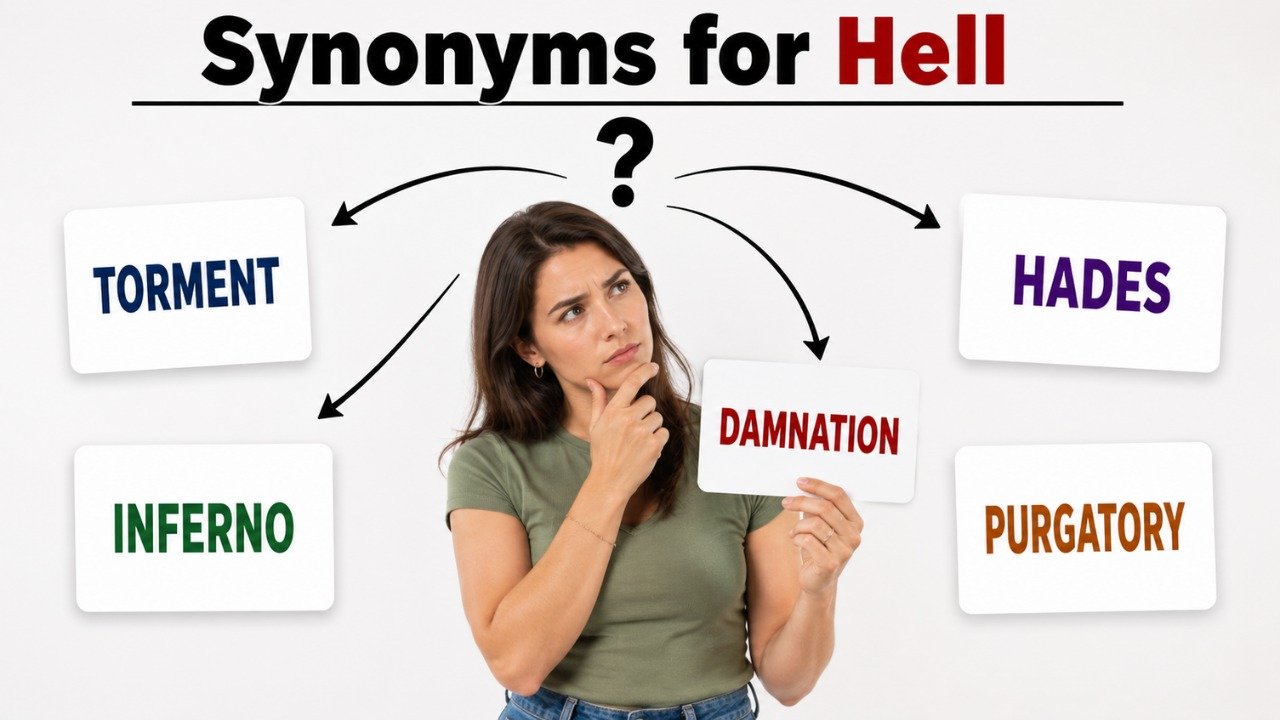
Quick Answer: Synonyms for hell include underworld, inferno, perdition, Hades, netherworld, abyss, torment, misery, nightmare, and chaos. Underworld is useful in mythology and discussions of the afterlife. Inferno describes a place filled with intense fire. Torment and misery express severe suffering, while nightmare describes an unbearable experience. Chaos works best for a confused or disorderly situation. The most suitable alternative depends on whether hell refers to a religious realm, emotional pain, physical danger, an unpleasant place, or a forceful expression.
Pronunciation and Word Details
Word: Hell.
Pronunciation: /hel/.
Part of Speech: Noun and interjection.
Meaning: A place or condition associated with punishment, extreme suffering, misery, or complete disorder.
US Pronunciation:
UK Pronunciation:
What Does “Hell” Mean?
Hell means a place or condition of severe punishment, suffering, misery, or disorder.
As a noun, hell can refer to a place of punishment in certain religious beliefs. It can also describe an extremely unpleasant experience, a dangerous location, emotional suffering, or a chaotic situation.
In informal conversation, the word may appear in forceful questions or expressions. In these cases, it adds anger, surprise, frustration, or emphasis rather than referring to a literal place.
Religious Context: Hell may describe a realm of punishment after death.
Emotional Context: It can represent intense pain, fear, or misery.
Situational Context: It can describe an unbearable experience or environment.
Informal Context: It may strengthen a question, command, or emotional reaction.
Meaning, Tone, and Context of “Hell”
Hell usually has a strong, negative, and emotional tone. It may sound serious in religious writing, dramatic in storytelling, or informal and forceful in everyday conversation.
In religious discussions, the term may carry spiritual and moral meaning. Because beliefs differ, writers should use it carefully and avoid treating one interpretation as universal.
In figurative language, hell describes extreme difficulty or suffering. A person might describe a painful illness, dangerous journey, or stressful workplace as hell.
In casual speech, the word can express anger, disbelief, or emphasis. However, it may sound rude or inappropriate in polite, professional, academic, or sensitive communication.
Formal Use: Suitable when discussing religious concepts, literature, mythology, or historical beliefs.
Figurative Use: Suitable for describing intense suffering, danger, or hardship.
Conversational Use: Common in emotional expressions, although it may sound impolite.
Literary Use: Often used symbolically to represent punishment, despair, evil, or inner conflict.
When and How to Use “Hell”
For Religious Concepts: Use hell when discussing a place of punishment within a particular belief system.
Example: The poem presents hell as a realm of moral punishment.
For Severe Suffering: Use hell figuratively to describe an extremely painful experience.
Example: The injured climber said the journey back was hell.
For an Unpleasant Place: Use hell when a location feels dangerous, unbearable, or miserable.
Example: The crowded shelter became hell during the heatwave.
For Complete Disorder: Use hell to describe a situation filled with noise, confusion, or uncontrolled activity.
Example: When the alarm sounded, the station turned into hell.
For Emotional Emphasis: Use hell informally to strengthen frustration, surprise, or anger.
Example: What the hell happened here?
For Literary Symbolism: Use hell as a symbol of guilt, despair, punishment, or internal suffering.
Example: The character creates a private hell through fear and regret.
Best Synonyms for Hell
Underworld: A realm believed to contain the dead.
Example: The hero entered the underworld to search for his lost companion.
Inferno: A place or scene filled with intense fire.
Example: Within minutes, the burning building became an inferno.
Perdition: A state of spiritual ruin or eternal punishment.
Example: The old tale warned that betrayal would lead to perdition.
Hades: The world of the dead in ancient Greek mythology.
Example: The myth describes a journey into Hades.
Netherworld: An imagined world below the earth where spirits or the dead exist.
Example: The novel follows a warrior through a shadowy netherworld.
Abyss: A deep, frightening, or seemingly endless place.
Example: The character believed he was falling into a dark abyss.
Torment: Severe physical or emotional suffering.
Example: Uncertainty became a source of constant torment.
Misery: A condition of great unhappiness or suffering.
Example: The harsh winter brought hunger and misery.
Nightmare: A terrible, frightening, or extremely difficult experience.
Example: Losing every important document was a complete nightmare.
Chaos: A state of complete confusion and disorder.
Example: The sudden evacuation created chaos throughout the building.
50 Synonyms for Hell with Short Meanings
- Underworld: A legendary or spiritual realm of the dead.
- Inferno: A place or scene of intense fire.
- Perdition: Eternal punishment or spiritual destruction.
- Hades: The underworld in ancient Greek mythology.
- Netherworld: An imagined world beneath the living world.
- Abyss: A deep and frightening emptiness.
- Pit: A deep place associated with punishment or danger.
- Tartarus: A place of punishment in ancient Greek mythology.
- Gehenna: A term associated with punishment and destruction.
- Damnation: Condemnation to spiritual punishment.
- Eternal Punishment: Endless suffering after death.
- Realm of Punishment: A world where wrongdoing is punished.
- Place of Torment: A location associated with severe suffering.
- Fiery Abyss: A deep place imagined as filled with fire.
- Lower World: A realm believed to exist beneath the earth.
- World Below: An imagined region beneath the world of the living.
- Realm of the Dead: A spiritual world inhabited by the deceased.
- Land of the Dead: A legendary destination for departed souls.
- Shadow World: A dark and mysterious spiritual realm.
- Dark Realm: A gloomy world associated with suffering or evil.
- Torment: Extreme physical or emotional suffering.
- Agony: Severe pain or distress.
- Anguish: Deep emotional or physical suffering.
- Suffering: The experience of pain or hardship.
- Misery: Extreme unhappiness or discomfort.
- Despair: Complete loss of hope.
- Distress: Serious pain, anxiety, or difficulty.
- Torture: Intense physical or emotional pain.
- Ordeal: A deeply difficult or painful experience.
- Nightmare: A frightening or unbearable situation.
- Horror: An experience that causes intense fear or disgust.
- Living Nightmare: A real experience that feels terrifying.
- Nightmare Existence: A life filled with fear or suffering.
- Place of Misery: A location where conditions are unbearable.
- Chaos: Complete confusion and disorder.
- Mayhem: Violent or uncontrolled disorder.
- Bedlam: A scene of noise and confusion.
- Pandemonium: Wild and uncontrolled confusion.
- Havoc: Widespread damage or disorder.
- Disorder: A lack of control or organization.
- Turmoil: A state of intense confusion or disturbance.
- Disaster: A situation causing severe harm or difficulty.
- Catastrophe: A sudden event involving great destruction.
- Ruin: A condition of destruction or collapse.
- Wasteland: A damaged, empty, or hopeless place.
- Dungeon: A dark prison associated with suffering.
- Snake Pit: A place filled with hostility or danger.
- War Zone: A place marked by danger, conflict, and destruction.
- Death Trap: A dangerously unsafe place or situation.
- Nightmare Realm: An imagined world filled with fear and suffering.
Read Also:
Synonyms for Immense

Synonyms for Hell by Context
When Hell Means a Religious Realm
Underworld, perdition, Hades, netherworld, Tartarus, Gehenna, damnation, and realm of punishment relate to spiritual beliefs, mythology, death, or punishment.
Example: The legend describes the underworld as a silent kingdom beneath the earth.
Example: The ancient hero was condemned to Tartarus.
Example: The sermon focused on salvation rather than damnation.
These terms are not always interchangeable. Hades and Tartarus belong to Greek mythology, while other terms come from different religious or cultural traditions.
When Hell Means Extreme Suffering
Torment, agony, anguish, misery, distress, torture, ordeal, despair, and suffering describe painful physical or emotional experiences.
Example: Waiting for news caused the family unbearable anguish.
Example: The long recovery was a painful ordeal.
Example: Isolation pushed the prisoner into despair.
Torment suggests continuing suffering, while agony usually describes especially severe pain. Misery can include discomfort, unhappiness, and poor living conditions.
When Hell Means a Terrible Experience
Nightmare, horror, living nightmare, nightmare existence, disaster, and catastrophe describe experiences that feel frightening, exhausting, or unbearable.
Example: The delayed journey became a logistical nightmare.
Example: The flood was a catastrophe for the entire region.
Example: Being trapped underground was a living nightmare.
Nightmare is suitable for many everyday situations. Catastrophe is stronger and usually involves serious destruction or loss.
When Hell Means Complete Disorder
Chaos, mayhem, bedlam, pandemonium, havoc, disorder, and turmoil describe confusion, noise, conflict, or a loss of control.
Example: The unexpected announcement created pandemonium in the hall.
Example: The damaged traffic lights caused chaos downtown.
Example: Months of political turmoil weakened the region.
Chaos is the most flexible choice. Mayhem suggests wild disorder, while bedlam often emphasizes noise and confusion.
When Hell Means a Dangerous Place
War zone, death trap, snake pit, dungeon, wasteland, and place of misery describe hostile, damaged, unsafe, or unbearable environments.
Example: Without working exits, the building was a death trap.
Example: Years of conflict had turned the district into a wasteland.
Example: The dishonest workplace felt like a snake pit.
These alternatives should match the actual situation. War zone and death trap can sound exaggerated when the danger is minor.
Another Word for Hell
Underworld is often the best single replacement when hell refers to a spiritual or mythological realm. However, the right alternative depends on the intended meaning.
Use inferno for intense fire, nightmare for a terrible experience, torment for severe suffering, and chaos for uncontrolled disorder.
Original: The hero believed the doorway led to hell.
Better Option: The hero believed the doorway led to the underworld.
Original: The burning warehouse looked like hell.
Better Option: The burning warehouse looked like an inferno.
Original: The entire journey was hell.
Better Option: The entire journey was a nightmare.
Original: The office became hell after the system failed.
Better Option: The office descended into chaos after the system failed.
When Not to Use “Hell”
Do not use hell when a more precise word would explain the situation better. The word can sound exaggerated, vague, offensive, or overly emotional in formal communication.
Avoid using it casually when discussing religious beliefs with people whose views may differ. Also avoid it in polite emails, professional reports, academic analysis, and communication intended for young audiences unless the subject genuinely requires the term.
Weak: The data collection process was hell.
Better: The data collection process was difficult and time consuming.
Weak: The meeting became hell.
Better: The meeting became tense and disorderly.
Weak: The kitchen was hell after dinner.
Better: The kitchen was chaotic after dinner.
Weak: The patient went through hell.
Better: The patient experienced severe pain and emotional distress.
Weak: The fire looked like hell.
Better: The fire turned the building into an inferno.
Words Commonly Confused With Hell
Hell vs Hades: Hell commonly refers to punishment or suffering, while Hades specifically refers to the underworld of ancient Greek mythology.
Hell vs Inferno: Hell may describe punishment, misery, or chaos. Inferno mainly describes a large and dangerously intense fire.
Hell vs Underworld: Hell often carries the idea of punishment. Underworld more broadly describes a realm of the dead and does not always imply punishment.
Hell vs Damnation: Hell is described as a place or condition. Damnation is the state of being condemned to spiritual punishment.
Hell vs Purgatory: Hell is usually associated with punishment, while purgatory refers in some beliefs to a temporary state of purification.
Hell vs Nightmare: Hell may be literal, religious, or figurative. Nightmare usually describes a frightening dream or an extremely unpleasant real experience.
Hell vs Chaos: Hell can suggest suffering and disorder together. Chaos specifically means complete confusion or lack of organization.
Which Synonym Should You Choose?
Choose underworld when discussing mythology, spiritual realms, or the world of the dead.
Choose inferno when describing a large fire, burning location, or scene of extreme heat.
Choose perdition when writing formally or literarily about spiritual destruction or punishment.
Choose Hades when referring specifically to ancient Greek mythology.
Choose torment when emphasizing continuing physical or emotional suffering.
Choose agony when describing severe pain.
Choose misery when describing deep unhappiness, discomfort, or poor conditions.
Choose nightmare when describing a terrible personal experience in conversation or general writing.
Choose chaos when the main idea is confusion or disorder.
Choose pandemonium when a scene is extremely noisy, crowded, and uncontrolled.
Choose ordeal when describing a long and difficult experience that someone survived.
Choose disaster or catastrophe in reports when an event causes serious harm, destruction, or loss.
Choose death trap when a place is physically dangerous because of unsafe conditions.
Choose turmoil when discussing prolonged social, political, emotional, or organizational disturbance.
Real Life Examples of “Hell” in Sentences
Original: The journey through the flooded roads was hell.
Better Option: The journey through the flooded roads was an ordeal.
Original: The burning factory looked like hell.
Better Option: The burning factory had become an inferno.
Original: The airport was hell during the cancellations.
Better Option: The airport was chaotic during the cancellations.
Original: She went through hell during her recovery.
Better Option: She endured months of agony during her recovery.
Original: The noisy classroom was hell for the new teacher.
Better Option: The noisy classroom was complete bedlam for the new teacher.
Original: Their holiday became hell after the storm arrived.
Better Option: Their holiday became a nightmare after the storm arrived.
Original: The abandoned prison looked like hell.
Better Option: The abandoned prison looked like a dark dungeon.
Original: The dishonest office was hell for responsible employees.
Better Option: The dishonest office was a snake pit for responsible employees.
Original: The city became hell after the fighting began.
Better Option: The city became a war zone after the fighting began.
Original: Uncertainty made every day feel like hell.
Better Option: Uncertainty made every day feel like constant torment.
Synonym Groups and Usage Differences
Religious Realm Group
Underworld, Hades, Tartarus, Gehenna, netherworld, and realm of the dead refer to spiritual or mythological places connected with death.
Some are specific to particular cultures and should not be treated as exact equivalents.
Example: The story follows a musician who travels into the underworld.
Punishment Group
Perdition, damnation, eternal punishment, realm of punishment, and place of torment focus on judgment or consequences for wrongdoing.
These terms are common in religious, literary, and moral discussions.
Example: The character feared damnation because of his past actions.
Suffering Group
Torment, agony, anguish, misery, distress, torture, and despair describe emotional or physical pain.
Agony is especially intense, while misery can describe a longer condition of unhappiness or discomfort.
Example: Years of uncertainty caused emotional anguish.
Terrible Experience Group
Nightmare, ordeal, horror, living nightmare, disaster, and catastrophe describe events that are frightening, exhausting, or destructive.
Nightmare and ordeal work well for personal experiences. Catastrophe is more suitable for events involving serious damage.
Example: Rebuilding after the storm became a difficult ordeal.
Disorder Group
Chaos, mayhem, bedlam, pandemonium, havoc, disorder, and turmoil describe situations without control or organization.
Bedlam emphasizes noise, while havoc emphasizes damage and disruption.
Example: The last minute change caused chaos throughout the office.
Dangerous Place Group
Death trap, war zone, snake pit, wasteland, and dungeon describe unsafe, hostile, ruined, or oppressive places.
These alternatives are vivid and should be used only when their strong meanings fit the situation.
Example: The damaged building was a death trap.
Antonyms of Hell
The opposite of hell depends on whether the word means punishment, suffering, misery, danger, or disorder.
Heaven: A spiritual realm associated with peace and reward.
Paradise: A perfect place of happiness and beauty.
Bliss: A state of complete happiness.
Peace: Freedom from conflict, disturbance, or suffering.
Comfort: A condition of physical or emotional ease.
Relief: The easing or ending of pain and distress.
Salvation: Rescue from spiritual danger or punishment.
Sanctuary: A safe and protected place.
Harmony: A peaceful and balanced condition.
Order: A controlled and organized state.
Safety: Freedom from danger or harm.
Joy: A strong feeling of happiness.
Comparison of Hell and Related Words
Hell vs Underworld
Hell commonly suggests punishment, pain, or evil. Underworld generally means a mythical or spiritual realm of the dead.
Example With Hell: The speaker warned of punishment in hell.
Example With Underworld: The hero entered the underworld to find the lost king.
Hell vs Inferno
Hell has religious and figurative meanings. Inferno specifically describes a large, intense, and destructive fire.
Example With Hell: The prison became a living hell for its occupants.
Example With Inferno: The explosion turned the warehouse into an inferno.
Hell vs Hades
Hell may be used in several religious and figurative contexts. Hades belongs specifically to ancient Greek mythology and can refer to both the underworld and its ruler.
Example With Hell: The novel presents hell as a place of punishment.
Example With Hades: The myth tells of a musician entering Hades.
Hell vs Nightmare
Hell can refer to a spiritual place, severe suffering, or chaos. Nightmare usually describes a frightening dream or terrible experience.
Example With Hell: The workers described the unsafe mine as hell.
Example With Nightmare: Losing her passport abroad was a nightmare.
Hell vs Torment
Hell can name a place, condition, or experience. Torment refers directly to severe and continuing suffering.
Example With Hell: The trapped passengers felt they were in hell.
Example With Torment: The constant pain caused unbearable torment.
Hell vs Chaos
Hell may include pain, danger, noise, and disorder. Chaos focuses specifically on complete confusion or lack of control.
Example With Hell: The battlefield looked like hell.
Example With Chaos: The false alarm caused chaos in the building.
Common Phrases and Expressions With Hell
Go Through Hell: Experience extreme suffering or difficulty.
Hell on Earth: A place or situation of unbearable suffering.
All Hell Broke Loose: A situation suddenly became wild or chaotic.
To Hell and Back: Through an extremely difficult experience.
Raise Hell: Create noise, trouble, or strong protest.
Give Someone Hell: Treat someone harshly or criticize them strongly.
What the Hell: An informal expression of surprise, anger, or confusion.
Like Hell: An informal phrase expressing strong disagreement or intensity.
A Hell of a Time: A very difficult or unusually exciting experience, depending on context.
A Cold Day in Hell: Something believed to be extremely unlikely.
Common Mistakes to Avoid
A common mistake is using hell for every unpleasant experience. This weakens its impact and can make writing sound exaggerated. Choose difficulty, inconvenience, frustration, ordeal, or nightmare when they describe the situation more accurately.
Do not assume that Hades, Tartarus, Gehenna, and purgatory all mean the same thing. Each belongs to a particular religious, cultural, or mythological context.
Avoid using hell repeatedly within the same paragraph. Replace it with precise alternatives such as torment, chaos, inferno, or misery.
Be careful with tone. The word may sound offensive or aggressive in formal emails, professional reports, polite conversation, or sensitive discussions.
Capitalize Hell when treating it as the formal name of a specific religious place, according to the chosen writing style. Use lowercase when it has a general or figurative meaning.
Avoid unnatural combinations. Say an inferno for a great fire, chaos for disorder, and agony for intense pain rather than forcing one synonym into every context.
Conclusion
Synonyms for hell vary according to meaning, tone, and context. Underworld, Hades, and netherworld suit mythology or discussions of the dead. Inferno describes intense fire, while torment, agony, and misery express severe suffering. Nightmare and ordeal work well for difficult experiences. Chaos, bedlam, and pandemonium describe disorder. Choosing a precise alternative makes writing clearer, more respectful, and more expressive. Before replacing hell, decide whether the sentence concerns religion, pain, danger, fire, confusion, or emotional emphasis.
FAQs About Synonyms for Hell
What Is the Best Synonym for Hell?
Underworld is a strong general alternative for a spiritual realm. Nightmare, torment, inferno, or chaos may be better in figurative contexts.
Is Inferno Another Word for Hell?
Inferno can replace hell when the focus is intense fire or heat. It does not always carry the same religious meaning.
Is Hades the Same as Hell?
No. Hades specifically refers to the underworld in ancient Greek mythology, while hell has broader religious and figurative meanings.
What Is a Polite Alternative to Hell?
Difficulty, terrible experience, misery, chaos, or nightmare can sound more appropriate, depending on the sentence.
What Word Describes Hell as Suffering?
Torment is one of the strongest choices. Agony, anguish, misery, and despair also describe severe suffering.
What Word Describes Hell as a Chaotic Place?
Chaos is the most direct option. Bedlam, pandemonium, mayhem, and turmoil can provide more specific shades of meaning.
Can Hell Be Used in Formal Writing?
Yes, when discussing religion, mythology, literature, or the word itself. In professional writing, a more precise and neutral alternative is often better.
